
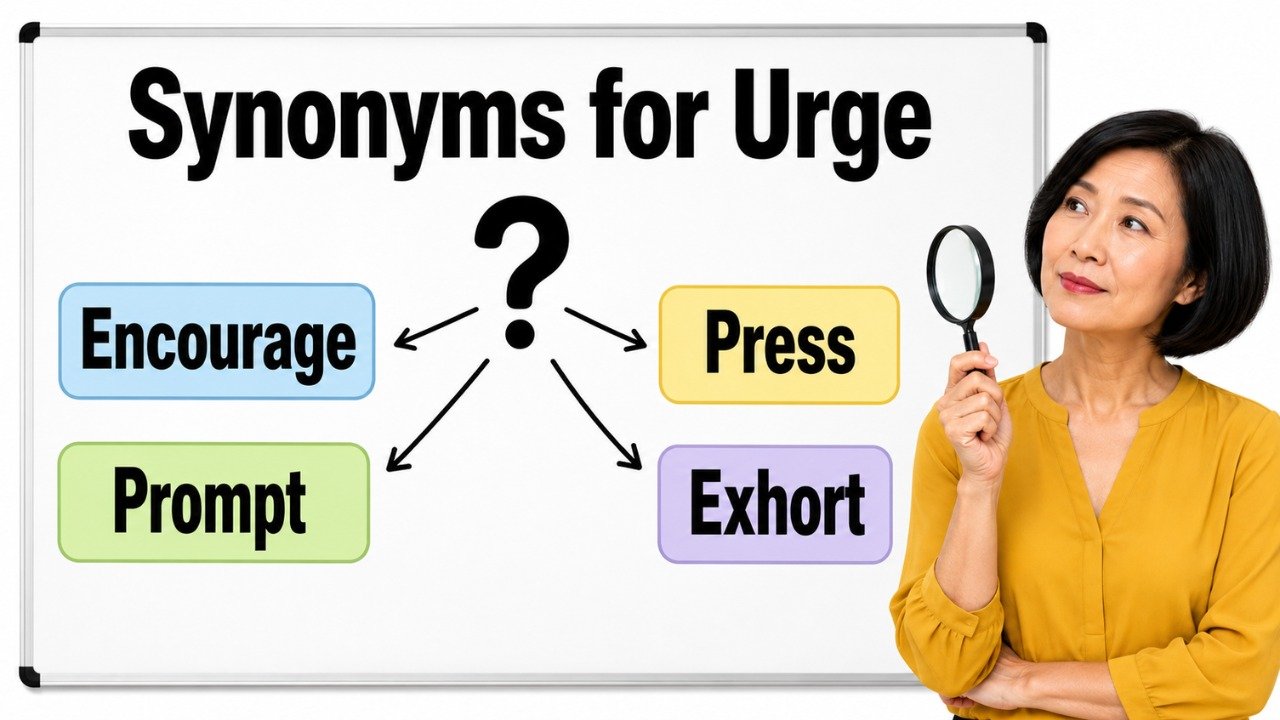
Quick Answer: The best synonyms for urge include encourage, persuade, prompt, press, advise, recommend, push, appeal, impulse, and desire. The best choice depends on meaning and context. Use encourage for positive support, persuade when trying to change someone’s mind, press when applying strong pressure, advise for guidance, recommend for formal suggestions, appeal when making an earnest request, and impulse or desire when urge refers to a strong inner feeling.
Pronunciation and Word Details
Word: Urge
Pronunciation: /ɜːrdʒ/
Part of Speech: Verb and noun
Meaning: As a verb, urge means to strongly encourage someone to do something. As a noun, it means a strong desire or impulse to act.
US Pronunciation:
UK Pronunciation:
What Does “Urge” Mean?
Urge means to strongly encourage, persuade, or press someone to take a particular action. It can also mean a powerful inner desire that makes someone want to do something.
As a verb, urge usually involves encouragement, persuasion, advice, or pressure.
Example: The teacher urged the students to review their work carefully.
Here, urged means strongly encouraged.
As a noun, urge describes a strong feeling or impulse.
Example: She felt an urge to laugh.
In this sentence, urge means a sudden or powerful desire.
The exact meaning depends on the sentence. Someone may urge another person to act, while a person may also experience an urge to speak, eat, travel, laugh, buy something, or make a change.
Meaning, Tone, and Context of “Urge”
Urge is generally neutral but can become strong or emotional depending on the situation.
As a verb, it often communicates seriousness. If someone urges another person to act, the speaker usually believes the action is important.
Formal Context: Experts urged officials to consider additional safety measures.
Professional Context: The manager urged the team to complete the review carefully.
Personal Context: She urged her friend to give the opportunity another chance.
As a noun, urge often describes an instinctive, emotional, or sudden desire.
Example: He resisted the urge to interrupt.
Urge can appear in formal writing, academic discussion, advice, everyday conversation, reports, persuasive writing, and descriptions of emotions or behavior.
Words such as advise and recommend are usually milder. Press and push are stronger. Encourage sounds more supportive, while persuade emphasizes changing another person’s decision.
When and How to Use “Urge”
For Strong Encouragement: Use urge when someone strongly encourages another person to act.
Example: Doctors urge people to seek help when symptoms become severe.
For Serious Advice: Urge can show that advice is important and should not be ignored.
Example: I urge you to read the instructions carefully.
For Persuasion: Use urge when someone tries strongly to influence another person’s choice.
Example: She urged him to reconsider the offer.
For Requests: Urge can make a request sound serious and pressing.
Example: Residents urged local leaders to address the problem quickly.
For Emotional Desire: As a noun, urge describes a strong inner desire.
Example: He felt an urge to call his family.
For Sudden Impulses: Urge can describe an immediate feeling that encourages action.
Example: She resisted the urge to check the message again.
For Recommendations: In formal contexts, urge can express a powerful recommendation.
Example: The report urges further investigation.
Best Synonyms for Urge
Encourage
Synonym: Encourage means to give someone confidence, support, or motivation to act.
Example: Her parents encouraged her to continue studying.
Persuade
Synonym: Persuade means to convince someone to think or act in a particular way.
Example: They persuaded him to reconsider his decision.
Prompt
Synonym: Prompt means to cause or encourage someone to take action.
Example: The warning prompted residents to leave the area.
Press
Synonym: Press means to strongly and repeatedly encourage someone to act.
Example: They pressed the committee to make a decision.
Advise
Synonym: Advise means to give guidance about what someone should do.
Example: The doctor advised him to rest for several days.
Recommend
Synonym: Recommend means to suggest that something is suitable or advisable.
Example: The report recommends further research.
Push
Synonym: Push means to strongly encourage or pressure someone toward action.
Example: His coach pushed him to improve his performance.
Appeal
Synonym: Appeal means to make a serious or emotional request.
Example: The organization appealed to residents to conserve water.
Impulse
Synonym: Impulse means a sudden strong desire to do something.
Example: She resisted the impulse to respond immediately.
Desire
Synonym: Desire means a strong wish or feeling of wanting something.
Example: He had a strong desire to travel abroad.
50 Synonyms for Urge with Short Meanings
- Encourage: Give support or confidence to act.
- Persuade: Convince someone to take action.
- Prompt: Cause or encourage an action.
- Press: Strongly encourage someone to act.
- Advise: Give guidance about what should be done.
- Recommend: Suggest something as a good choice.
- Push: Strongly motivate or pressure someone.
- Appeal: Make an earnest request.
- Implore: Ask someone very seriously or emotionally.
- Entreat: Request something earnestly.
- Exhort: Strongly encourage through serious advice.
- Beseech: Ask urgently and emotionally.
- Plead: Make an emotional request.
- Counsel: Give thoughtful advice or guidance.
- Suggest: Present an idea for consideration.
- Request: Ask someone to do something.
- Invite: Encourage someone to participate or respond.
- Motivate: Give someone a reason to act.
- Inspire: Encourage action through enthusiasm or influence.
- Stimulate: Encourage activity, thought, or response.
- Spur: Encourage someone to act more quickly or energetically.
- Prod: Encourage someone through repeated prompting.
- Nudge: Gently encourage someone toward action.
- Drive: Strongly motivate someone to act.
- Compel: Make someone feel strongly forced to act.
- Incite: Encourage a strong action or reaction.
- Move: Cause someone emotionally to take action.
- Influence: Affect someone’s choices or behavior.
- Convince: Cause someone to accept an idea or decision.
- Coax: Gently persuade someone to act.
- Beg: Ask urgently or emotionally.
- Solicit: Formally ask for support, help, or action.
- Petition: Make a formal request.
- Embolden: Give someone courage to act.
- Galvanize: Stimulate someone into strong action.
- Rally: Bring people together and motivate them to act.
- Impel: Drive or motivate someone strongly.
- Instigate: Cause or encourage an action to begin.
- Advocate: Publicly support or recommend an action or idea.
- Promote: Encourage the development or acceptance of something.
- Impulse: A sudden strong desire to act.
- Desire: A strong feeling of wanting something.
- Craving: A powerful desire for something.
- Longing: A strong emotional desire.
- Inclination: A natural tendency or preference.
- Compulsion: A powerful feeling that something must be done.
- Need: A strong feeling that something is necessary.
- Drive: A powerful inner motivation.
- Appetite: A strong desire for a particular experience or activity.
- Yearning: A deep and persistent desire.
Read Also:
Synonyms for Particular
Synonyms for Urge by Context
When Urge Means Encourage
When urge means to give someone strong encouragement, encourage, motivate, inspire, and spur are useful alternatives.
Encourage: Best when the tone is positive and supportive.
Example: Teachers encouraged students to ask more questions.
Motivate: Useful when the goal is to increase effort or enthusiasm.
Example: The speech motivated the group to continue.
Inspire: Best when encouragement comes from admiration, ideas, or emotion.
Example: Her success inspired others to pursue similar goals.
Spur: Useful when something causes quicker or stronger action.
Example: The disappointing result spurred the team to work harder.
When Urge Means Persuade
Persuade, convince, coax, and influence work when urge means trying to change someone’s decision or behavior.
Persuade: Best when someone is actively trying to gain agreement.
Example: She persuaded her brother to attend the event.
Convince: Emphasizes changing someone’s belief or decision.
Example: The evidence convinced him to reconsider.
Coax: Suggests gentle and patient persuasion.
Example: She coaxed the child into trying the new food.
Influence: Describes a broader effect on another person’s choices.
Example: His advice influenced her decision.
When Urge Means Strongly Press
Press, push, prod, impel, and compel express stronger levels of encouragement or pressure.
Press: Useful when someone repeatedly demands action.
Example: Residents pressed officials for a faster response.
Push: Often suggests persistent encouragement or pressure.
Example: The coach pushed the athletes to improve.
Prod: Suggests repeated reminders or encouragement.
Example: Her colleague prodded her to finish the application.
Impel: Formal and strong, meaning to drive someone toward action.
Example: Concern for others impelled him to help.
When Urge Means Make an Earnest Request
Appeal, implore, plead, beseech, and entreat work when the speaker makes an emotional or serious request.
Appeal: Suitable for formal or public requests.
Example: Officials appealed to residents to remain cautious.
Implore: Expresses strong emotion and urgency.
Example: She implored him to reconsider.
Plead: Natural when a request is emotional.
Example: They pleaded with him to stay.
Entreat: Formal and literary, expressing an earnest request.
Example: She entreated them to listen carefully.
When Urge Means a Strong Desire
As a noun, urge can be replaced by impulse, desire, craving, longing, yearning, inclination, or compulsion.
Impulse: Best for a sudden desire.
Example: He resisted the impulse to laugh.
Desire: Broad and neutral.
Example: She had a strong desire to succeed.
Craving: Describes an intense desire, often for something specific.
Example: He developed a craving for something sweet.
Longing: Suggests an emotional desire that lasts.
Example: She felt a longing to return home.
Compulsion: Describes a powerful feeling that may be difficult to resist.
Example: He felt a compulsion to check everything twice.
Another Word for Urge
Encourage is often the best general alternative when urge is used as a verb because it expresses support for taking action without sounding overly forceful. However, persuade, press, advise, prompt, or appeal may be more accurate depending on the level of pressure and the speaker’s intention.
When urge is a noun, impulse is often the strongest alternative for a sudden feeling, while desire works better for a broader or longer lasting wish.
Original: I urge you to consider all the available options.
Better Option: I encourage you to consider all the available options.
Original: They urged the committee to respond immediately.
Better Option: They pressed the committee to respond immediately.
Original: She felt an urge to laugh.
Better Option: She felt an impulse to laugh.
Original: He had an urge to travel somewhere new.
Better Option: He had a desire to travel somewhere new.
When Not to Use “Urge”
Urge may sound too strong when you only want to make a mild suggestion.
Weak: I urge you to try the soup if you feel like it.
Better: I suggest trying the soup if you feel like it.
Avoid urge when the situation requires a softer and more polite form of guidance.
Weak: I urge you to choose whichever option you prefer.
Better: I recommend choosing whichever option you prefer.
Urge can also sound overly formal in casual situations.
Weak: I urge you to come over for coffee.
Better: I encourage you to come over for coffee.
Do not use persuade when no change of opinion is involved.
Weak: The teacher persuaded students to keep working when they already wanted to continue.
Better: The teacher encouraged students to keep working.
Avoid compulsion when the feeling is simply a normal desire.
Weak: She felt a compulsion to buy a new notebook.
Better: She felt an urge to buy a new notebook.
Repeated use of urge can also make writing sound forceful.
Weak: The report urges action and urges leaders to respond while urging communities to cooperate.
Better: The report recommends action, encourages leaders to respond, and asks communities to cooperate.
Words Commonly Confused With Urge
Urge vs Encourage: Urge is stronger and often suggests importance or urgency. Encourage usually sounds more supportive and positive.
Urge vs Persuade: Urge means strongly encouraging someone to act. Persuade means successfully or actively convincing someone to change a decision or belief.
Urge vs Advise: Advise involves giving guidance. Urge adds stronger pressure or emphasis to that guidance.
Urge vs Recommend: Recommend suggests a good course of action. Urge implies that the action is especially important.
Urge vs Push: Push can sound more forceful or demanding than urge.
Urge vs Prompt: Prompt often refers to something that causes an action or reaction, while urge often involves deliberate encouragement.
Urge vs Impulse: Urge can be either a verb or noun. Impulse is primarily a noun describing a sudden desire or reaction.
Urge vs Desire: Desire is a broad feeling of wanting something. An urge is often stronger, more immediate, or connected to action.
Which Synonym Should You Choose?
Choose encourage when the tone should be supportive, positive, and motivating.
Choose persuade when the goal is to convince someone to change a decision, opinion, or behavior.
Choose press when strong or repeated pressure is involved.
Choose advise when giving professional, practical, or personal guidance.
Choose recommend when making a formal or neutral suggestion.
Choose appeal when making an earnest or serious public request.
Choose prompt when an event, statement, or situation causes someone to act.
Choose spur when something motivates energetic or immediate action.
Choose coax when gentle persuasion is more appropriate than pressure.
Choose implore or plead when the request is highly emotional or urgent.
Choose impulse when urge is a noun describing a sudden desire.
Choose desire when describing a broader wish.
Choose craving when the feeling is intense and focused on something specific.
Choose compulsion when the feeling seems extremely difficult to resist.
For reports and essays, advise, recommend, encourage, press, prompt, and advocate often work well depending on meaning.
For emails and professional communication, encourage and recommend usually sound polite and clear.
For casual conversation, push, encourage, want, desire, or feel like may sound more natural.
Real Life Examples of “Urge” in Sentences
Original: I urge everyone to read the instructions carefully.
Better Option: I encourage everyone to read the instructions carefully.
Original: Doctors urge patients to report unusual symptoms.
Better Option: Doctors advise patients to report unusual symptoms.
Original: Residents urged officials to repair the road.
Better Option: Residents pressed officials to repair the road.
Original: She urged her friend to apply for the position.
Better Option: She encouraged her friend to apply for the position.
Original: He urged the group to reconsider its decision.
Better Option: He persuaded the group to reconsider its decision.
Original: The report urges further investigation.
Better Option: The report recommends further investigation.
Original: She felt an urge to check the door again.
Better Option: She felt an impulse to check the door again.
Original: He had an urge to explore a new place.
Better Option: He had a desire to explore a new place.
Original: The coach urged the team to keep trying.
Better Option: The coach motivated the team to keep trying.
Original: They urged the public to remain calm.
Better Option: They appealed to the public to remain calm.
Synonym Groups and Usage Differences
Encouragement Group
Encourage, inspire, motivate, spur, and embolden describe positive forms of influence.
Encourage is broad and supportive. Inspire often involves emotion or admiration. Motivate emphasizes reasons for action. Spur suggests increased energy or effort.
Example: Her advice encouraged him to continue his studies.
Persuasion Group
Persuade, convince, influence, coax, and appeal involve changing or guiding another person’s decision.
Persuade and convince are direct. Coax is gentler. Influence may happen indirectly.
Example: She persuaded him to reconsider the proposal.
Pressure Group
Press, push, prod, impel, and compel communicate stronger pressure.
Press and push can describe repeated demands. Prod is usually less intense. Impel suggests strong motivation, while compel can imply that someone feels they have little choice.
Example: Community leaders pressed officials to respond.
Advice Group
Advise, recommend, counsel, suggest, and advocate are useful when urge involves guidance.
Advise is direct guidance. Recommend proposes a suitable choice. Counsel often suggests thoughtful or professional advice. Suggest is softer. Advocate expresses active support.
Example: The doctor advised her to get more rest.
Earnest Request Group
Appeal, plead, implore, entreat, and beseech express serious requests.
Appeal is suitable in neutral and formal situations. Plead and implore carry more emotion. Entreat and beseech have a more literary or formal tone.
Example: The family appealed for additional information.
Inner Desire Group
Impulse, desire, craving, longing, inclination, compulsion, and yearning describe the noun meaning of urge.
Impulse is sudden. Desire is broad. Craving is intense. Longing and yearning are emotional. Inclination is milder. Compulsion is difficult to resist.
Example: She resisted the impulse to reply immediately.
Antonyms of Urge
The antonyms of urge depend on whether it is being used as a verb meaning encourage or as a noun meaning strong desire.
Antonym: Discourage means to reduce someone’s confidence or desire to act.
Antonym: Deter means to prevent or discourage someone from taking action.
Antonym: Dissuade means to persuade someone not to do something.
Antonym: Restrain means to prevent or control an action.
Antonym: Prevent means to stop something from happening.
Antonym: Hinder means to make an action more difficult.
Antonym: Suppress means to control or prevent an impulse or feeling.
Antonym: Resist means to refuse to act on a desire or pressure.
Antonym: Restraint means control over an impulse or desire.
Antonym: Reluctance means unwillingness or hesitation to act.
Comparison: Urge vs Related Words
Urge vs Encourage
Urge is generally stronger than encourage. Encourage focuses on giving confidence or support, while urge often communicates that action is important or necessary.
Example With Urge: I urge you to seek advice before making the decision.
Example With Encourage: I encourage you to explore all your options.
Urge vs Persuade
Urge focuses on strong encouragement. Persuade focuses on changing someone’s mind or convincing them to act.
Example With Urge: She urged him to attend the meeting.
Example With Persuade: She persuaded him to attend the meeting.
The second example suggests that her effort successfully changed his decision.
Urge vs Advise
Advise is calmer and usually focuses on giving useful guidance. Urge communicates greater importance.
Example With Urge: Doctors urge patients with severe symptoms to seek help.
Example With Advise: Doctors advise patients to rest after the procedure.
Urge vs Recommend
Recommend is usually more neutral and less forceful.
Example With Urge: We urge immediate action.
Example With Recommend: We recommend further review.
Urge vs Press
Press often communicates stronger, persistent pressure.
Example With Urge: Residents urged officials to investigate.
Example With Press: Residents pressed officials to investigate immediately.
Urge vs Prompt
Prompt often describes the cause of an action rather than a person directly persuading another.
Example With Urge: She urged him to respond.
Example With Prompt: The warning prompted him to respond.
Urge vs Impulse
As a noun, urge and impulse can both describe a strong desire. Impulse usually emphasizes suddenness.
Example With Urge: She felt an urge to speak.
Example With Impulse: She acted on a sudden impulse to speak.
Urge vs Craving
Urge is broad and can involve many types of actions. Craving usually refers to a particularly intense desire for something.
Example With Urge: He had an urge to leave early.
Example With Craving: He had a craving for something sweet.
Common Phrases and Expressions With Urge
Urge Someone To Act: Strongly encourage a person to take action.
Urge Caution: Strongly advise people to behave carefully.
Urge Restraint: Encourage someone to remain controlled and avoid extreme action.
Urge Action: Strongly recommend that something be done.
Urge Someone To Reconsider: Strongly encourage a person to think about a decision again.
Strong Urge: A powerful desire to do something.
Sudden Urge: An unexpected desire that appears quickly.
Resist the Urge: Avoid acting on a strong desire.
Feel the Urge: Experience a strong desire to act.
Suppress the Urge: Control or prevent yourself from acting on an impulse.
Common Mistakes to Avoid
One common mistake is treating every synonym for urge as interchangeable. The correct word depends heavily on how strong the encouragement or desire is.
Encourage sounds positive and supportive, while press and push involve stronger pressure.
Mistake: She pressed her child to enjoy the new hobby.
Better: She encouraged her child to enjoy the new hobby.
Another mistake is using persuade when the sentence does not involve changing someone’s mind.
Mistake: The coach persuaded the players to remain motivated.
Better: The coach encouraged the players to remain motivated.
Writers may also confuse urge and impulse. Urge can describe either encouragement or desire, while impulse usually refers to an internal feeling.
Mistake: The teacher gave the students an impulse to study harder.
Better: The teacher encouraged the students to study harder.
Avoid using craving for every type of urge. Craving is stronger and more specific.
Mistake: She had a craving to organize her desk.
Better: She had an urge to organize her desk.
Be careful with compel. It can imply force or a lack of choice.
Mistake: Her friend compelled her to try a new restaurant when the suggestion was friendly.
Better: Her friend encouraged her to try a new restaurant.
Repetition is another common weakness.
Repetitive: The speaker urged people to act, urged leaders to respond, and urged communities to cooperate.
Improved: The speaker encouraged people to act, pressed leaders to respond, and appealed to communities for cooperation.
Avoid vague usage when the reader cannot understand what action is being encouraged.
Vague: They urged the situation.
Clear: They urged the committee to investigate the situation.
Conclusion
Synonyms for urge vary according to whether the word describes encouragement, persuasion, pressure, advice, an earnest request, or an inner desire. Encourage is a strong general alternative, while persuade focuses on changing a decision, press suggests stronger pressure, advise and recommend suit guidance, and appeal works for serious requests. When urge is a noun, impulse is best for a sudden feeling, while desire, craving, longing, and compulsion express different levels of wanting. Choosing by context makes writing clearer and more precise.
FAQs About Synonyms for Urge
What Is the Best Synonym for Urge?
Encourage is often the best general synonym when urge means strongly supporting someone’s action. Persuade, press, advise, and prompt may be more accurate in specific contexts.
What Is Another Word for Urge as a Noun?
Impulse is one of the strongest alternatives when urge means a sudden desire. Desire, craving, longing, yearning, and compulsion are other useful choices.
Is Encourage the Same as Urge?
They are similar, but urge is usually stronger. Encourage emphasizes support, while urge often suggests that the action is particularly important.
What Is a Formal Synonym for Urge?
Exhort, implore, advocate, recommend, and advise can work in formal contexts. The best choice depends on whether the meaning involves persuasion, guidance, or an earnest request.
What Is a Stronger Word Than Urge?
Press, compel, implore, and plead can sound stronger than urge. Press suggests persistent pressure, while implore and plead add emotional urgency.
What Is the Difference Between Urge and Persuade?
Urge means strongly encouraging someone to act. Persuade means convincing someone to change a belief, decision, or behavior.
What Is the Opposite of Urge?
Discourage, deter, dissuade, restrain, and prevent are common opposites when urge means encourage. Restraint and resistance can express the opposite idea when urge refers to an inner impulse.
