
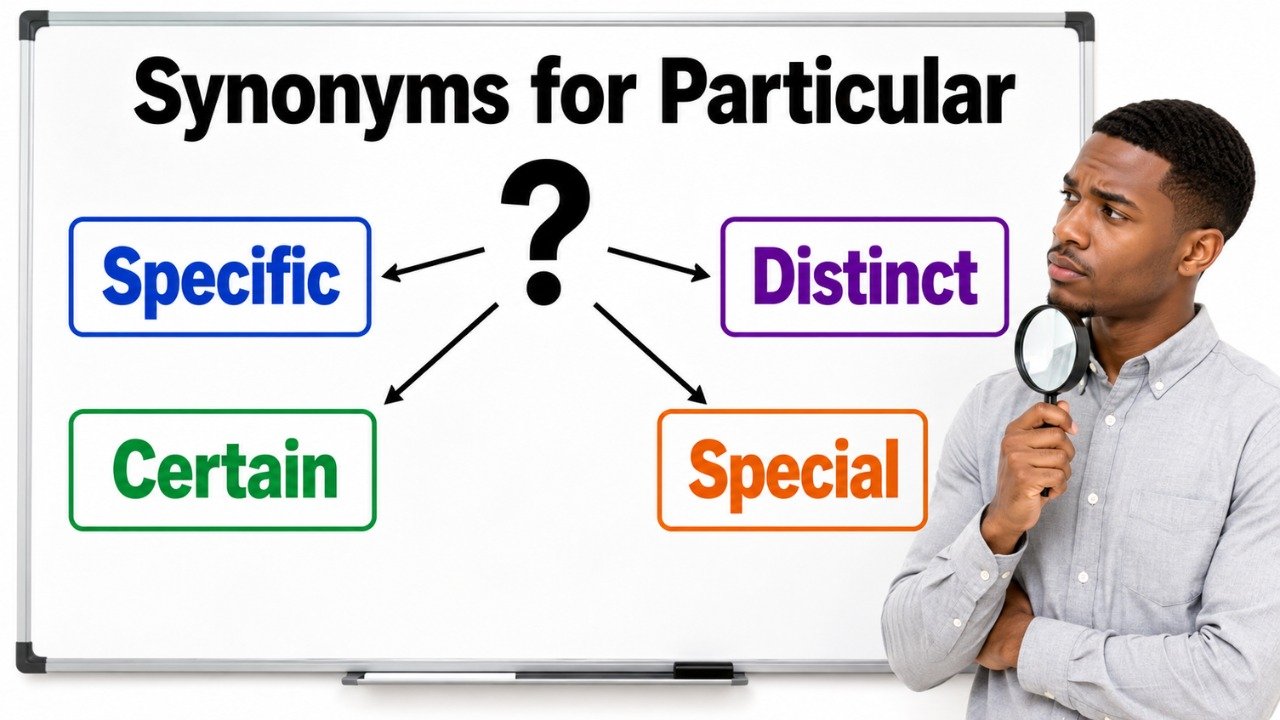
Quick Answer: The best synonyms for particular include specific, certain, distinct, individual, special, precise, exact, unique, selective, and specific. When particular means clearly identified, specific or certain works best. For accuracy and detail, precise or exact is stronger. When describing something unusual or important, special or unique fits better. When particular describes someone who is careful about choices, selective or choosy may be more natural. The best synonym depends on the meaning and sentence context.
Pronunciation and Word Details
Word: Particular.
Pronunciation: /pəˈtɪk.jə.lər/
Part of Speech: Adjective and noun.
Meaning: Particular describes a specific person, thing, detail, or quality, and can also describe someone who is careful or selective about choices.
US Pronunciation:
UK Pronunciation:
What Does “Particular” Mean?
Particular most often means specific, clearly identified, individual, or especially important.
As an adjective, it can point to one person, object, place, time, detail, or situation rather than a general group.
Example: She was looking for a particular book.
Here, particular means one specific book.
The word can also describe something distinctive or unusual.
Example: The room had a particular charm.
In this sentence, particular suggests a special or distinctive quality.
Particular can also describe someone who is careful, selective, or difficult to satisfy.
Example: He is very particular about the quality of his food.
Here, particular means selective and attentive to details.
As a noun, particular can refer to an individual detail or fact, although this use is more formal.
Example: The agreement included several important particulars.
The exact meaning of particular therefore depends on whether it refers to specificity, uniqueness, detail, importance, or selectiveness.
Meaning, Tone, and Context of “Particular”
Particular is generally a neutral and flexible word. It appears naturally in formal writing, everyday conversation, academic discussion, professional communication, and descriptive language.
Neutral Context: Particular often identifies one specific thing without adding emotion.
Example: Is there a particular reason for the change?
Formal Context: In reports, essays, and professional writing, particular can introduce a specific example, detail, condition, or concern.
Example: Particular attention should be given to accuracy.
Conversational Context: In everyday speech, particular can describe preferences or choices.
Example: I do not have any particular preference.
Descriptive Context: Particular may highlight an unusual or distinctive feature.
Example: The garden has a particular beauty in the early morning.
Selective Context: When describing a person, particular can suggest careful standards or strong preferences.
Example: She is particular about how her workspace is organized.
The word is useful because it can be precise without sounding overly technical. However, more specific synonyms may communicate the intended meaning more clearly.
When and How to Use “Particular”
For Specific Identification: Use particular when pointing to one clearly intended person, object, place, time, or situation.
Example: I had one particular restaurant in mind.
For Specific Details: Use particular when discussing one detail within a larger subject.
Example: The report focused on one particular problem.
For Special Importance: Use particular when something deserves extra attention.
Example: This issue is of particular importance to the project.
For Personal Preferences: Use particular when someone has clear standards or preferences.
Example: He is particular about the type of coffee he drinks.
For Distinctive Qualities: Use particular when something has a recognizable or unusual character.
Example: The painting has a particular style that makes it memorable.
For Emphasis: Particular can strengthen a statement by drawing attention to one element.
Example: The teacher placed particular emphasis on clear writing.
For Formal Detail: Particular is useful in professional or academic writing when narrowing a broad subject.
Example: The research examined a particular aspect of language development.
Best Synonyms for Particular
Specific: Clearly identified or precisely defined.
Example: She asked for a specific document from the folder.
Certain: One specific person or thing that is known or understood.
Example: Certain conditions must be met before approval.
Distinct: Clearly different or recognizable.
Example: The region has a distinct cultural identity.
Individual: Relating to one person or thing separately.
Example: Each individual case requires careful review.
Special: Different from ordinary things because of importance or value.
Example: The occasion held special meaning for the family.
Precise: Exact and carefully defined.
Example: The instructions gave precise measurements.
Exact: Completely accurate or specifically identified.
Example: We need the exact location before leaving.
Unique: Unlike anything else or having a distinctive quality.
Example: The building has a unique architectural style.
Selective: Careful about choosing among available options.
Example: She is selective about the projects she accepts.
Distinctive: Having a quality that makes something easy to recognize.
Example: The artist developed a distinctive visual style.
50 Synonyms for Particular with Short Meanings
- Specific: Clearly identified or defined.
- Certain: Referring to one known or understood person or thing.
- Distinct: Clearly separate or recognizably different.
- Individual: Relating to one person or thing separately.
- Special: Having unusual importance or value.
- Precise: Clearly and exactly defined.
- Exact: Completely accurate or specifically identified.
- Unique: Unlike others in a noticeable way.
- Selective: Careful about making choices.
- Distinctive: Having recognizable or unusual qualities.
- Specified: Clearly stated or identified.
- Definite: Clearly established or certain.
- Identifiable: Able to be clearly recognized.
- Designated: Officially chosen or named.
- Named: Specifically mentioned or identified.
- Chosen: Selected from available options.
- Selected: Deliberately picked from a group.
- Separate: Existing individually rather than together.
- Single: Referring to one person or thing.
- Singular: Remarkably distinctive or individually notable.
- Exclusive: Limited to a particular person, group, or purpose.
- Personal: Relating specifically to one individual.
- Detailed: Including specific information or features.
- Explicit: Clearly and directly expressed.
- Defined: Clearly explained or established.
- Concrete: Specific and clearly understood rather than general.
- Focused: Concentrated on one subject or purpose.
- Targeted: Directed toward a specific person, group, or goal.
- Specialized: Designed for a specific subject or purpose.
- Characteristic: Typical of a specific person, thing, or group.
- Peculiar: Distinctive or unusual in character.
- Exceptional: Unusual because of high quality or importance.
- Remarkable: Worth noticing because of an unusual quality.
- Notable: Important or deserving attention.
- Unusual: Different from what is common or expected.
- Individualized: Adapted to one specific person or situation.
- Personalized: Made suitable for a particular individual.
- Discriminating: Showing careful judgment when choosing.
- Choosy: Careful and difficult to satisfy when selecting.
- Fussy: Very concerned about small preferences or details.
- Fastidious: Very careful about standards and details.
- Meticulous: Extremely careful and attentive to details.
- Exacting: Having very high standards or requirements.
- Demanding: Requiring a high standard or careful attention.
- Careful: Giving close attention to details or choices.
- Discerning: Showing good judgment and careful selection.
- Precise in choice: Careful about selecting exactly what is wanted.
- Well defined: Clearly established and easy to identify.
- Clearly specified: Directly stated or identified.
- One specific: Referring to a single identified person or thing.
Read Also:
Synonyms for Local
Synonyms for Particular by Context
When Particular Means Specific
Specific, certain, definite, specified, named, designated, and identifiable work best when particular points to one clearly intended person, thing, place, or situation.
Example: She was searching for a specific file.
Example: The rule applies only under certain conditions.
Specific is often the strongest general replacement because it communicates clear identification without changing the tone.
When Particular Means Exact or Precise
Exact, precise, explicit, defined, concrete, and well defined fit when the focus is accuracy or clear detail.
Example: The engineer needed precise measurements before beginning the work.
Example: Please provide the exact date of the meeting.
Precise is especially useful for measurements, instructions, descriptions, and technical details.
When Particular Means Special
Special, unique, exceptional, remarkable, notable, distinctive, and singular work when particular emphasizes importance, individuality, or unusual character.
Example: The place holds special meaning for her family.
Example: The building has a distinctive design.
Special emphasizes importance, while unique and distinctive emphasize difference.
When Particular Means Individual
Individual, single, separate, personal, chosen, and selected work when referring to one member of a larger group.
Example: Each individual student received feedback.
Example: The selected applicant will receive further instructions.
When Particular Means Selective
Selective, discerning, choosy, fastidious, exacting, demanding, and fussy can describe someone who has strong preferences or high standards.
Example: She is selective about the books she recommends.
Example: He is very discerning when choosing ingredients.
Selective is neutral, while choosy and fussy are more conversational and may sound slightly critical.
Another Word for Particular
Specific is usually the best single replacement for particular when the word identifies one person, object, detail, situation, or idea. However, the best alternative changes with context.
Use special when particular means important. Use precise or exact when accuracy matters. Use selective when describing careful preferences.
Original: I am looking for a particular document.
Better Option: I am looking for a specific document.
Original: She showed particular interest in the final chapter.
Better Option: She showed special interest in the final chapter.
Original: The machine requires a particular measurement.
Better Option: The machine requires a precise measurement.
Original: He is particular about the clothes he buys.
Better Option: He is selective about the clothes he buys.
When Not to Use “Particular”
Particular is useful, but it can sound vague when a more precise word would communicate the intended meaning more clearly.
Weak: We need a particular amount of water.
Better: We need an exact amount of water.
Exact is stronger because the sentence refers to a measurable quantity.
Weak: She has a particular style that everyone recognizes.
Better: She has a distinctive style that everyone recognizes.
Distinctive emphasizes recognizable qualities more clearly.
Weak: He is particular when choosing employees.
Better: He is selective when choosing employees.
Selective directly communicates careful choice.
Weak: The report discussed a particular issue in detail.
Better: The report discussed a specific issue in detail.
Specific is more direct when referring to one clearly identified topic.
Particular can also become repetitive in formal writing. If the word appears several times in one paragraph, replace some uses with specific, individual, special, precise, or distinctive when those words accurately match the meaning.
Avoid using choosy or fussy in formal writing when you mean particular in the sense of careful standards. Selective or discerning is usually more professional.
Words Commonly Confused With Particular
Particular vs Specific: Particular and specific often overlap. Specific emphasizes clear identification or detail, while particular may also express special importance or careful preference.
Particular vs Certain: Certain can point to an identified but unnamed person or thing. Particular often emphasizes one specific choice or example.
Particular vs Precise: Particular identifies something specific. Precise emphasizes accuracy and exactness.
Particular vs Exact: Exact means completely accurate or identical to what is required. Particular simply points to one specific thing and does not always suggest mathematical or factual accuracy.
Particular vs Special: Special suggests unusual importance, value, affection, or distinction. Particular can simply mean specific without suggesting importance.
Particular vs Unique: Unique means one of a kind or distinctly different. Particular does not necessarily mean something is unique.
Particular vs Selective: Particular can describe someone with strong preferences. Selective specifically describes careful choice among different options.
Particular vs Peculiar: Particular usually means specific or selective. Peculiar means strange, unusual, or distinctive and can carry a noticeably different tone.
Which Synonym Should You Choose?
Choose specific when identifying one person, object, detail, reason, place, or situation.
Choose certain when referring to some identifiable people, things, or conditions without naming them directly.
Choose precise when discussing measurements, instructions, calculations, descriptions, or technical requirements.
Choose exact when complete accuracy is essential.
Choose individual when discussing one member of a larger group.
Choose special when emphasizing importance, affection, value, or unusual significance.
Choose unique when something is genuinely unlike other examples.
Choose distinctive when a quality makes something easy to recognize.
Choose selective when describing someone who chooses carefully.
Choose discerning when careful judgment and good taste are important.
Choose choosy in casual conversation when someone is difficult to satisfy.
Choose fastidious when describing extremely careful attention to standards, cleanliness, or detail.
For essays and reports, specific, precise, individual, distinctive, and selective usually sound natural and professional.
For emails, specific is often the clearest option because it is direct and easy to understand.
For casual conversation, particular, certain, special, or choosy may all work depending on the intended tone.
Real Life Examples of “Particular” in Sentences
Original: She wanted a particular type of chair for the room.
Better Option: She wanted a specific type of chair for the room.
Original: Is there any particular reason for your decision?
Better Option: Is there any specific reason for your decision?
Original: He showed particular interest in the research project.
Better Option: He showed special interest in the research project.
Original: The instructions require a particular measurement.
Better Option: The instructions require a precise measurement.
Original: She is particular about the quality of her work.
Better Option: She is exacting about the quality of her work.
Original: One particular student asked several thoughtful questions.
Better Option: One individual student asked several thoughtful questions.
Original: The building has a particular appearance.
Better Option: The building has a distinctive appearance.
Original: He is particular about which projects he accepts.
Better Option: He is selective about which projects he accepts.
Original: The report focuses on a particular part of the problem.
Better Option: The report focuses on a specific part of the problem.
Original: We need to identify the particular location where the error occurred.
Better Option: We need to identify the exact location where the error occurred.
Synonym Groups and Usage Differences
Specificity Group
Specific, certain, definite, specified, designated, named, and identifiable all point toward one clearly intended person, thing, detail, or condition.
Specific is the most flexible word in this group.
Example: The manager asked for specific information about the delay.
Accuracy Group
Precise, exact, explicit, defined, concrete, and detailed emphasize clarity and accuracy.
These words work well in technical writing, instructions, reports, and research.
Example: The technician recorded the exact measurements.
Individuality Group
Individual, single, separate, personal, and individualized focus on one person or thing rather than a larger group.
Example: Each individual response was reviewed separately.
Special Importance Group
Special, exceptional, notable, remarkable, singular, and unique emphasize importance or unusual qualities.
Example: The discovery had special importance for the research team.
Distinctiveness Group
Distinct, distinctive, characteristic, peculiar, and unusual describe recognizable differences or qualities.
Example: The region has a distinctive architectural style.
Selectiveness Group
Selective, discerning, choosy, fastidious, exacting, demanding, and fussy describe careful preferences or high standards.
Example: The editor is highly selective about the articles accepted for publication.
Antonyms of Particular
The opposite of particular depends on whether the word means specific, individual, special, precise, or selective.
General: Broad rather than specific.
Vague: Not clearly identified or explained.
Indefinite: Not precisely established or stated.
Unspecified: Not clearly named or defined.
Universal: Applying to everyone or everything rather than one particular case.
Common: Ordinary or widely shared rather than special.
Ordinary: Not unusual or distinctive.
Typical: Representing the usual type rather than a specific exception.
Generalized: Broadly stated rather than focused on one case.
Imprecise: Lacking exactness or accuracy.
Approximate: Close but not exact.
Indiscriminate: Showing little or no careful selection.
Undiscerning: Not showing careful judgment when choosing.
Flexible: Willing to accept a range of choices rather than insisting on one specific option.
Comparison: Particular vs Related Words
Particular vs Specific
Particular can mean one clearly identified thing, but it can also mean special or selective. Specific mainly emphasizes clear identification or detail.
Example With Particular: She wanted a particular chair for her office.
Example With Specific: She wanted a specific chair with adjustable height.
Particular vs Certain
Certain often refers to people or things that are known but not directly named. Particular usually draws attention to one specific example.
Example With Particular: One particular question caused confusion.
Example With Certain: Certain questions require additional explanation.
Particular vs Precise
Particular identifies something, while precise emphasizes accuracy.
Example With Particular: We discussed a particular section of the report.
Example With Precise: We recorded the precise dimensions of the room.
Particular vs Exact
Exact communicates complete accuracy or perfect identification. Particular simply narrows attention to one thing.
Example With Particular: I remember a particular conversation from that day.
Example With Exact: I remember the exact time the conversation began.
Particular vs Special
Particular can mean specific without suggesting emotional value. Special usually indicates unusual importance, affection, or significance.
Example With Particular: She chose a particular seat near the window.
Example With Special: The photograph has special meaning for her family.
Particular vs Unique
Particular identifies one specific item. Unique means something is unlike all others or highly distinctive.
Example With Particular: He requested a particular design.
Example With Unique: The artist created a unique design.
Particular vs Selective
Particular can describe someone with strong preferences. Selective more directly means careful about choosing.
Example With Particular: She is particular about the restaurants she visits.
Example With Selective: She is selective about the restaurants she recommends.
Common Phrases and Expressions With Particular
In Particular: Especially or specifically.
Example: I enjoyed the entire trip, but the final day in particular was memorable.
No Particular Reason: Without one specific reason.
Example: There was no particular reason for changing the schedule.
A Particular Person: One specific individual.
Example: The message was intended for a particular person.
A Particular Time: One specific moment or period.
Example: The service is available only at a particular time.
A Particular Place: One clearly identified location.
Example: They were searching for a particular place near the river.
Of Particular Importance: Especially important or significant.
Example: Accuracy is of particular importance in this report.
Pay Particular Attention: Give special or careful consideration.
Example: Please pay particular attention to the final instructions.
Nothing in Particular: Nothing specific.
Example: I was not looking for anything in particular.
Particular About Something: Having careful preferences or standards.
Example: She is particular about how her desk is arranged.
This Particular Case: The specific situation currently being discussed.
Example: This particular case requires a different approach.
Common Mistakes to Avoid
A common mistake is assuming that every synonym for particular can replace it in every sentence. The word has several meanings, so context matters.
Repetition: Avoid using particular repeatedly when specific, individual, exact, distinctive, or special would add clarity.
Wrong Synonym Choice: Do not use unique merely because particular identifies one thing. Unique suggests that something is unlike all others.
Confusing Specific and Precise: Specific identifies the thing being discussed. Precise emphasizes accuracy. Choose according to the intended meaning.
Overusing Special: Particular does not always mean special. A particular document may simply be one specific document, not an important one.
Unnatural Formality: Fastidious and exacting are stronger than particular. Do not use them unless the person truly has very demanding standards.
Using Fussy in Formal Writing: Fussy can sound critical and conversational. Selective, discerning, or exacting is usually more suitable in professional contexts.
Vague Usage: A sentence such as “There was a particular problem” may leave readers wondering what the problem was. Name or explain the issue when the detail matters.
Ignoring Word Function: Particular is mainly an adjective in everyday use. Make sure the replacement fits grammatically in the same position.
Conclusion
Synonyms for particular include specific, certain, distinct, individual, special, precise, exact, unique, selective, and distinctive. Specific is usually the best choice when identifying one person, thing, or detail. Precise and exact work better when accuracy matters, while special and unique emphasize importance or difference. Selective and discerning are useful when particular describes careful preferences. Because particular has several meanings, choosing the right synonym depends on whether you want to express specificity, accuracy, individuality, distinction, importance, or careful selection.
FAQs About Synonyms for Particular
What is the best synonym for particular?
Specific is usually the best general synonym for particular when referring to one clearly identified person, thing, detail, or situation.
What is another word for particular in formal writing?
Specific, precise, distinct, individual, definite, and designated are useful formal alternatives. The best choice depends on the intended meaning.
Can specific replace particular?
Yes, specific can replace particular in many sentences where the meaning is clearly identified or clearly defined. It may not work when particular means selective or special.
What is a synonym for particular when describing a person?
Selective, discerning, choosy, fastidious, exacting, and fussy can describe a person who has strong preferences or high standards.
What is the difference between particular and precise?
Particular usually identifies one specific thing, while precise emphasizes accuracy, exact detail, or careful definition.
Does particular mean special?
Particular can mean special in some contexts, especially when emphasizing importance or attention. However, it often simply means specific.
What is the opposite of particular?
General is the most common opposite when particular means specific. Other antonyms include vague, indefinite, unspecified, ordinary, imprecise, and indiscriminate depending on context.
