
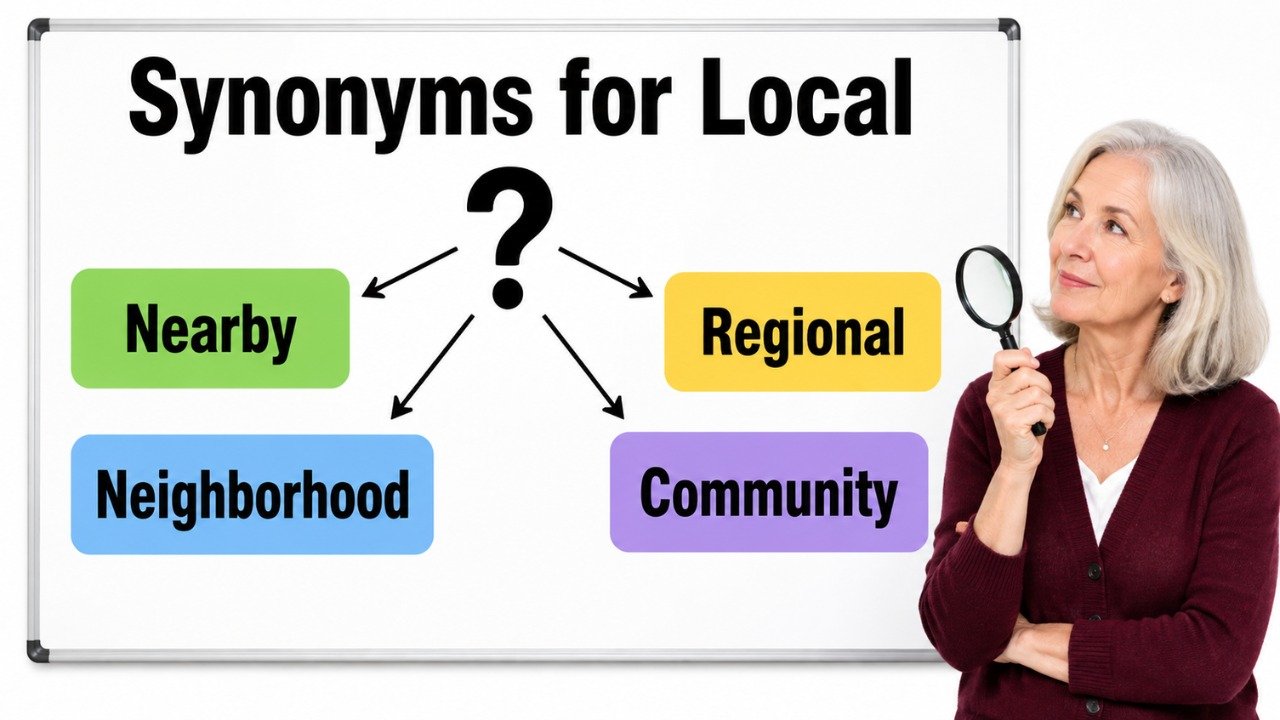
Quick Answer: Useful synonyms for local include nearby, regional, neighborhood, community, municipal, native, domestic, provincial, resident, and indigenous. The best choice depends on context. Use nearby for physical distance, regional for a wider geographic area, neighborhood for a small community, municipal for city government, native for a person or thing originating in a place, domestic for something within a country, and resident when referring to someone who lives in a particular area.
Pronunciation and Word Details
Word: Local.
Pronunciation: /ˈloʊkəl/
Part of Speech: Adjective and noun.
Meaning: Relating to a particular place or area, especially one that is nearby or limited in geographic scope.
US Pronunciation:
UK Pronunciation:
What Does “Local” Mean?
Local means connected with a particular place, community, town, city, region, or nearby area.
As an adjective, local describes something that belongs to, comes from, serves, or happens within a specific area.
Example: The local library offers free reading programs.
As a noun, local can refer to a person who lives in a particular area.
Example: A local showed us the shortest route through town.
The meaning of local changes slightly according to context. It may describe distance, government, businesses, residents, food, news, customs, transportation, services, or geographic identity.
In everyday speech, local often means nearby.
In formal or administrative writing, regional, municipal, district, provincial, or community may be more precise.
Meaning, Tone, and Context of “Local”
Local is a neutral and widely used word. It works naturally in casual conversation, professional writing, journalism, education, government, travel, geography, and everyday descriptions.
The word usually creates a sense of closeness or connection to a particular place.
Casual Context: Local often means nearby or close to where someone lives.
Example: We bought the vegetables from a local market.
Community Context: Local can refer to people, organizations, customs, events, or services associated with a community.
Example: Local residents attended the meeting.
Government Context: Local can describe authorities, councils, departments, or services operating within a city or district.
Example: Local authorities approved the new plan.
Geographic Context: Local may refer to an area smaller than a national or international region.
Example: Local weather conditions changed quickly.
Cultural Context: Local may describe traditions, food, language, or customs associated with a particular place.
Example: Visitors enjoyed the local cuisine.
Because local is broad, more exact synonyms can make writing clearer.
When and How to Use “Local”
For Nearby Places: Use local when something is close to a particular location.
Example: She visited a local clinic for advice.
For Communities: Use local when discussing people, services, activities, or organizations within a specific community.
Example: Local residents organized a neighborhood cleanup.
For Government: Use local for government bodies or services operating at town, city, or district level.
Example: Local officials reviewed the proposal.
For Products: Use local when something is produced, grown, or made in the surrounding area.
Example: The restaurant uses local vegetables.
For Culture: Use local when referring to traditions, customs, food, language, or practices connected with a specific place.
Example: The guide explained several local customs.
For News and Events: Use local when information concerns a limited geographic area.
Example: The report focused on local events.
For Residents: Use local as a noun for someone who lives in the area.
Example: We asked a local for directions.
Best Synonyms for Local
Nearby: Close in physical distance.
Example: They found a nearby shop that was still open.
Regional: Connected with a particular geographic region.
Example: The program supports regional development.
Neighborhood: Connected with a small residential or community area.
Example: The neighborhood center offers classes for families.
Community: Connected with people living in the same area.
Example: Community leaders discussed the new project.
Municipal: Connected with a town or city government.
Example: Municipal officials approved improvements to the road.
Native: Originating naturally in a particular place or belonging there by birth.
Example: The plant is native to the surrounding region.
Domestic: Existing or occurring within a particular country rather than internationally.
Example: Domestic travel increased during the holiday period.
Provincial: Connected with a province or regional administrative area.
Example: Provincial authorities announced new regulations.
Resident: Living in or belonging to a particular place.
Example: Resident families were invited to the meeting.
Indigenous: Originating naturally or historically in a particular region.
Example: The area contains several indigenous plant species.
50 Synonyms for Local with Short Meanings
- Nearby: Located close to a particular place.
- Regional: Connected with a specific geographic region.
- Neighborhood: Connected with a small local community.
- Community: Related to people living in the same area.
- Municipal: Related to a town or city government.
- Native: Originating in or naturally belonging to a place.
- Domestic: Existing within a particular country.
- Provincial: Relating to a province or regional area.
- Resident: Living in a particular place.
- Indigenous: Naturally or historically originating in a region.
- Area: Connected with a particular geographic location.
- District: Relating to a defined part of a city or region.
- Town: Connected with a particular town.
- City: Connected with a particular city.
- Village: Associated with a particular village.
- County: Relating to a county or similar administrative area.
- Territorial: Connected with a defined geographic territory.
- Sectional: Limited to or associated with one area or section.
- Zonal: Connected with a specific geographic zone.
- Vicinal: Relating to a neighboring or nearby area.
- Adjacent: Situated next to or near something.
- Neighboring: Located close to or beside another place.
- Close: Situated at a short distance.
- Close by: Located nearby.
- Surrounding: Existing around a particular place.
- Immediate: Very close to a particular place or area.
- Proximate: Located near or close to something.
- Homegrown: Produced or developed within the local area.
- Locally produced: Made or grown within the surrounding area.
- Locally sourced: Obtained from nearby producers or suppliers.
- Home: Connected with one’s own place or area.
- Home area: Connected with the place where someone lives.
- Hometown: Connected with a person’s town of origin or residence.
- Resident based: Centered on people living in the area.
- Community based: Organized around a particular community.
- Area based: Operating within a specific geographic area.
- Place based: Connected closely with a particular location.
- District based: Limited to a specific district.
- Citywide: Extending throughout a particular city.
- Townwide: Extending throughout a particular town.
- Intraregional: Existing or occurring within one region.
- Inland: Situated within the interior of a region or country.
- Native born: Born in the particular place being discussed.
- Resident born: Born among the resident population of an area.
- Grassroots: Originating within an ordinary local community.
- Communal: Relating to a shared community.
- Civic: Connected with a city or its citizens.
- Metropolitan: Connected with a city and its surrounding urban area.
- Suburban: Connected with an area outside a city center.
- Rural: Connected with the countryside or a nonurban area.
Read Also:
Synonyms for Adore

Synonyms for Local by Context
When Local Means Nearby
When local refers to physical distance, useful synonyms include nearby, close, neighboring, adjacent, proximate, surrounding, and close by.
Example: There is a nearby pharmacy on the next street.
Example: Residents use services from neighboring communities.
Nearby is usually the simplest alternative when physical closeness is the main idea.
When Local Means Regional
When local describes something belonging to a geographic region, regional, provincial, territorial, district, or area based may be more accurate.
Example: Regional authorities discussed transportation improvements.
Example: The district office handles applications from surrounding towns.
Regional usually covers a larger area than local.
When Local Means Community Based
When the focus is on people living together in an area, community, neighborhood, community based, communal, civic, and grassroots are useful alternatives.
Example: Community leaders organized a public meeting.
Example: Grassroots groups helped residents voice their concerns.
When Local Means Connected With Government
When local refers to city or town government, municipal, civic, district, county, or provincial may be stronger choices.
Example: Municipal officials approved the building project.
Example: County authorities reviewed the road safety plan.
The correct word depends on the level of government involved.
When Local Means Native to a Place
When local refers to something originating naturally or historically in an area, native and indigenous may be more precise.
Example: The garden contains several native plants.
Example: Researchers documented indigenous species in the region.
Native is broad, while indigenous often emphasizes original or long established origin.
When Local Means Produced Nearby
For food, goods, materials, or products produced in the same area, homegrown, locally produced, locally sourced, and regional can work well.
Example: The shop sells homegrown vegetables.
Example: The kitchen uses locally sourced ingredients.
When Local Refers to Residents
When local is used as a noun for a person living in an area, resident, inhabitant, native, townsperson, or community member may be clearer depending on context.
Example: A resident explained the history of the building.
Example: Several community members attended the event.
Another Word for Local
A strong general replacement for local is regional, especially when the sentence refers to an area larger than a neighborhood but smaller than an entire country.
However, no single synonym fits every use. Nearby is better for distance, municipal for city government, native for origin, resident for people, and community for neighborhood life.
Original: The local office handles applications from nearby towns.
Better Option: The regional office handles applications from nearby towns.
Original: We visited a local restaurant after the meeting.
Better Option: We visited a nearby restaurant after the meeting.
Original: Local officials discussed the new road.
Better Option: Municipal officials discussed the new road.
Original: Local plants grow well in this climate.
Better Option: Native plants grow well in this climate.
When Not to Use “Local”
Local can become vague when the reader needs to know the exact geographic level or relationship.
If something covers several cities or a broad area, regional may be clearer.
Weak: The local program serves five counties.
Better: The regional program serves five counties.
When describing city government specifically, municipal may sound more precise.
Weak: Local officials approved the city budget.
Better: Municipal officials approved the city budget.
When referring only to physical distance, nearby is often clearer.
Weak: We found a local hotel next to the station.
Better: We found a nearby hotel next to the station.
When describing a plant or animal originating naturally in an area, native may be more accurate.
Weak: This is a local plant species.
Better: This is a native plant species.
Avoid using local when readers cannot tell what area you mean.
Weak: Local rules are different.
Better: City rules are different.
Precise geographic language makes writing easier to understand.
Words Commonly Confused With Local
Local vs Regional: Local usually describes a smaller or nearby area, while regional normally covers a broader geographic zone.
Local vs Nearby: Local can mean connected with an area even if something is not physically close. Nearby specifically refers to short physical distance.
Local vs Native: Local describes connection with a place. Native usually means originating, growing, or being born in that place.
Local vs Municipal: Local is broad, while municipal specifically refers to a town or city government.
Local vs Domestic: Local concerns a limited geographic area, while domestic generally refers to an entire country.
Local vs Indigenous: Local simply indicates geographic connection. Indigenous more specifically refers to something originating naturally or historically in a region.
Local vs Resident: Local may describe a person or thing connected with an area. Resident specifically refers to someone who lives there.
Local vs Community: Local emphasizes geographic connection, while community emphasizes the people or social group within that place.
Which Synonym Should You Choose?
Choose nearby when describing physical closeness, such as a nearby store, school, clinic, or restaurant.
Choose regional in formal writing when discussing a wider geographic area, economic zone, service network, or administrative region.
Choose neighborhood for a small residential area or immediate community.
Choose community when the focus is on residents, social activities, public involvement, or shared interests.
Choose municipal for city government, public authorities, administrative decisions, or city services.
Choose native when describing something that originates naturally in a place.
Choose domestic when comparing activity within a country with international activity.
Choose provincial when referring specifically to a province or similar administrative region.
Choose resident when describing someone who lives in a particular area.
Choose indigenous when discussing species, peoples, traditions, or things with original historical roots in a region.
In reports and essays, choose the synonym that identifies the exact geographic scale. In casual conversation, nearby and local are often the most natural choices.
Real Life Examples of “Local” in Sentences
Original: We bought bread from a local bakery.
Better Option: We bought bread from a nearby bakery.
Original: The local government approved the plan.
Better Option: The municipal government approved the plan.
Original: The local economy depends heavily on agriculture.
Better Option: The regional economy depends heavily on agriculture.
Original: Several local residents attended the meeting.
Better Option: Several community residents attended the meeting.
Original: Local plants require less maintenance in this environment.
Better Option: Native plants require less maintenance in this environment.
Original: The local office manages services across four towns.
Better Option: The regional office manages services across four towns.
Original: The local group organized a cleanup event.
Better Option: The community group organized a cleanup event.
Original: Visitors enjoyed local food during their stay.
Better Option: Visitors enjoyed regional food during their stay.
Original: We asked a local where to find the station.
Better Option: We asked a resident where to find the station.
Original: The business purchases local vegetables.
Better Option: The business purchases locally sourced vegetables.
Synonym Groups and Usage Differences
Nearby Location Group
Nearby, neighboring, adjacent, close, close by, proximate, and surrounding belong to this group.
These words emphasize physical distance rather than cultural or administrative connection.
Example: A nearby clinic provides medical services to the neighborhood.
Regional Area Group
Regional, provincial, territorial, district, county, zonal, and area based describe wider geographic divisions.
They work well in reports, government writing, geography, economics, and planning.
Example: Regional development has created more employment opportunities.
Community Group
Community, neighborhood, communal, civic, grassroots, and community based focus on people and activities within an area.
Example: Community organizations supported the new project.
Government Group
Municipal, civic, county, provincial, district, and territorial can replace local when the exact government level is known.
Example: Municipal authorities approved the new public park.
Origin Group
Native, indigenous, homegrown, locally produced, and locally sourced relate to origin or production within a place.
Example: Farmers sell homegrown produce at the weekend market.
Resident Group
Resident, native, community member, townsperson, and inhabitant describe people connected with a place.
Example: A resident recommended several places to visit.
Antonyms of Local
The opposite of local depends on whether the word refers to distance, geographic scale, origin, or area of activity.
Distant: Located far away.
Remote: Situated far from a particular place or center.
National: Relating to an entire country.
International: Involving more than one country.
Global: Relating to the whole world.
Foreign: Coming from another country or place.
External: Existing outside a particular area or organization.
Nonresident: Not living in the area being discussed.
Imported: Brought in from another region or country.
Overseas: Located in or connected with another country across the sea.
Comparison: Local vs Related Words
Local vs Nearby
Local refers broadly to something connected with a particular area. Nearby refers specifically to distance.
Example With Local: We support local businesses whenever possible.
Example With Nearby: We found a nearby grocery store.
A business can be local because it belongs to the community, even if it is not the closest business to someone.
Local vs Regional
Local usually covers a smaller area, while regional usually includes several towns, districts, or communities.
Example With Local: Local residents attended the town meeting.
Example With Regional: Regional planners discussed transportation across several cities.
Local vs Native
Local describes geographic association, while native emphasizes origin.
Example With Local: The restaurant serves local food.
Example With Native: The garden contains native flowers.
A product may be local because it was produced nearby, while a species is native because it originated naturally in the area.
Local vs Municipal
Local is a broad everyday term. Municipal specifically refers to a city or town government.
Example With Local: Local officials discussed the issue.
Example With Municipal: Municipal officials approved the road repairs.
Local vs Domestic
Local describes a limited area, while domestic normally covers activity inside an entire country.
Example With Local: The company works with local suppliers.
Example With Domestic: The company serves the domestic market.
Local vs Community
Local emphasizes place, while community emphasizes people and shared social connections.
Example With Local: Local services are available throughout the district.
Example With Community: Community groups organized the event.
Local vs Indigenous
Local means connected with a place. Indigenous usually describes something originating naturally or historically there.
Example With Local: Visitors learned about local customs.
Example With Indigenous: Researchers studied indigenous plant species.
Common Phrases and Expressions With Local
Local Area: The place or region immediately surrounding someone.
Local Community: People living in a particular neighborhood, town, or district.
Local Residents: People who live in the area being discussed.
Local Government: Government operating at town, city, district, or similar level.
Local Business: A business operating primarily within a particular community or area.
Local Economy: Economic activity within a specific geographic area.
Local News: News concerning events within a particular town, city, or region.
Local Culture: Customs, traditions, food, language, and practices associated with a place.
Local Services: Services provided within a particular community or district.
Local Produce: Food or agricultural products grown or produced within the surrounding area.
Common Mistakes to Avoid
Using Local Too Broadly: Local becomes unclear when readers do not know what geographic area it describes.
Weak: The local office controls the entire eastern region.
Better: The regional office controls the entire eastern region.
Confusing Local With Nearby: Nearby always emphasizes distance, while local can mean belonging to a community.
Weak: The local mountain is fifty miles away.
Better: The regional mountain range is fifty miles away.
Using Municipal for Everything Local: Municipal specifically relates to cities or towns and should not replace local in every sentence.
Weak: We bought municipal vegetables.
Better: We bought local vegetables.
Confusing Native With Local: Native emphasizes origin, not simply current location.
Weak: The local species originated on another continent.
Better: The species is locally established but not native.
Wrong Geographic Scale: Choose words according to the size of the area.
Weak: A local transportation system connects six provinces.
Better: A regional transportation system connects six provinces.
Repetition: Repeating local several times can make writing dull.
Weak: The local council met with local residents about local development.
Better: The municipal council met with community residents about regional development.
Unnatural Formality: Formal geographic terms may sound awkward in casual situations.
Weak: We ate lunch at a proximate café.
Better: We ate lunch at a nearby café.
The most useful synonym is the one that accurately shows whether you mean distance, geography, government, residents, origin, or community.
Conclusion
The best synonyms for local depend on the exact meaning of the sentence. Nearby works best for physical closeness, regional for a broader area, community and neighborhood for people and places, municipal for city government, native for geographic origin, and resident for someone who lives in an area. Other useful synonyms for local include provincial, domestic, indigenous, and civic. Choosing the right alternative makes descriptions more precise by showing whether the focus is distance, administration, culture, origin, or geographic scale.
FAQs About Synonyms for Local
What is the best synonym for local?
Nearby is a strong synonym when local means physically close. Regional, community, municipal, native, and resident may be better in other contexts.
What is another word for local area?
Nearby area, surrounding area, neighborhood, district, community, and region are useful alternatives depending on the size of the place.
What is a formal synonym for local?
Regional, municipal, provincial, territorial, and community based can work in formal writing. The best choice depends on the geographic level being described.
What is another word for local people?
Residents, community members, inhabitants, townspeople, and natives may work. Resident is usually the most neutral option for someone who currently lives in an area.
Are local and regional the same?
No. Local usually describes a smaller or nearby area, while regional generally covers a broader geographic area that may contain several communities.
What is the opposite of local?
Common opposites include distant, national, international, global, foreign, remote, and imported. The correct antonym depends on context.
What is another word for local products?
Homegrown, locally produced, locally sourced, regional, and native may work depending on whether the focus is production, sourcing, or geographic origin.
