
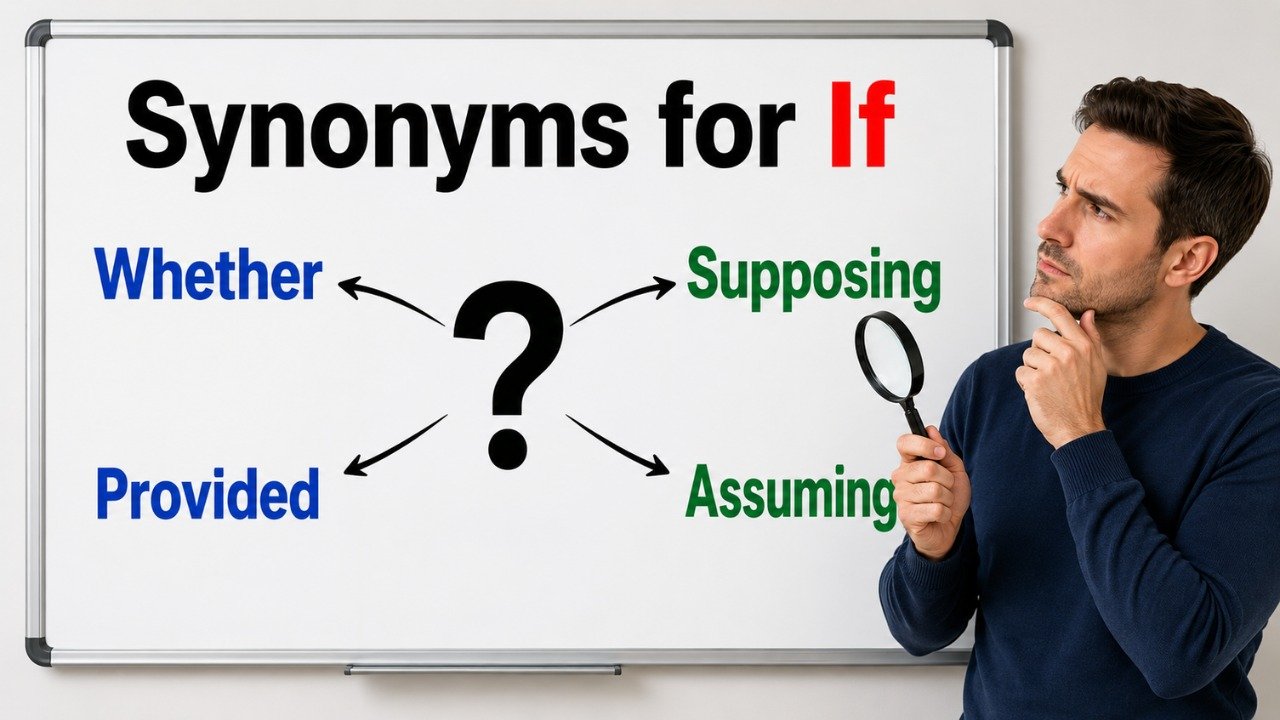
Quick Answer: Common synonyms for if include provided that, assuming that, on condition that, in case, whether, supposing that, whenever, given that, so long as, and unless in certain negative constructions. The best choice depends on context. Use provided that or on condition that in formal writing, assuming that for hypothetical situations, in case for precautions, whether when expressing uncertainty between possibilities, and so long as when emphasizing a condition. These synonyms for if help make conditional sentences more precise and varied.
Pronunciation and Word Details
Word: If.
Pronunciation: /ɪf/
Part of Speech: Conjunction and noun in limited uses.
Meaning: Used to introduce a condition, possibility, uncertainty, or hypothetical situation.
US Pronunciation:
UK Pronunciation:
What Does “If” Mean?
If is a conjunction used to introduce a condition, possibility, uncertainty, or imagined situation.
It commonly connects one event with another event that depends on it.
Example: If it rains, we will stay inside.
In this sentence, staying inside depends on the condition of rain.
If can also introduce hypothetical situations.
Example: If I had more time, I would learn another language.
It may also appear when someone is uncertain about something.
Example: I do not know if she is available.
In some contexts, whether is more precise than if when two possibilities are being considered.
As a noun, if can refer to a condition or uncertainty, especially in the expression “ifs and buts.”
Meaning, Tone, and Context of “If”
If is a neutral and extremely common word in English. It appears naturally in casual conversation, formal writing, academic language, instructions, agreements, reports, essays, questions, and everyday communication.
It is neither especially formal nor informal.
In conditional sentences, if introduces the condition that must happen before another result becomes possible.
Example: If you finish early, you can leave.
In hypothetical language, if introduces an imagined situation.
Example: If I lived near the sea, I would swim every morning.
In polite requests, if can soften the tone.
Example: If you have a moment, could you check this sentence?
In uncertain statements, if may mean whether.
Example: I wonder if he remembers the meeting.
Because if performs several grammatical functions, not every alternative can replace it in every sentence.
When and How to Use “If”
For Conditions: Use if when one action or result depends on another situation.
Example: If the weather improves, we will go outside.
For Possibilities: Use if when something may or may not happen.
Example: If she arrives early, ask her to wait.
For Hypothetical Situations: Use if when imagining an unreal or uncertain situation.
Example: If I were taller, I might play basketball.
For Future Results: Use if to connect a possible future condition with its likely result.
Example: If you study regularly, you will improve.
For Uncertainty: Use if when you are unsure whether something is true.
Example: I am not sure if the door is locked.
For Polite Requests: Use if to make a request or suggestion sound less direct.
Example: If possible, please send the document before noon.
For Warnings: Use if to introduce a condition that could lead to an undesirable result.
Example: If you ignore the instructions, the process may fail.
For Choices: If may introduce uncertainty between alternatives, although whether is often more precise.
Example: She asked if we wanted tea or coffee.
Best Synonyms for If
Provided That: Introduces a specific condition that must be satisfied.
Example: You may leave early provided that your work is finished.
Assuming That: Introduces something treated as true for the purpose of discussion.
Example: Assuming that the weather remains clear, we can travel tomorrow.
On Condition That: Expresses a strict requirement before something can happen.
Example: You may borrow the book on condition that you return it tomorrow.
In Case: Introduces preparation for a possible event.
Example: Take an umbrella in case it rains.
Whether: Introduces uncertainty or alternatives.
Example: I do not know whether she will attend.
Supposing That: Introduces an imagined or hypothetical condition.
Example: Supposing that the plan fails, what will we do next?
Given That: Introduces a condition or fact accepted as true.
Example: Given that everyone agrees, we can proceed.
So Long As: Means that something is acceptable while a condition remains true.
Example: You can stay so long as you remain quiet.
Whenever: Means every time a particular condition occurs.
Example: Whenever you need help, call me.
In the Event That: Introduces a possible future condition in formal language.
Example: In the event that the meeting is canceled, everyone will be informed.
50 Synonyms for If with Short Meanings
- Provided That: Only when a stated condition is met.
- Providing That: On the condition that something happens.
- Assuming That: Treating something as true for discussion.
- Supposing That: Imagining that a certain condition exists.
- Suppose That: Consider a hypothetical situation.
- On Condition That: Only after a requirement is satisfied.
- So Long As: Provided a condition continues to be true.
- As Long As: Provided that a stated condition is met.
- In Case: As preparation for a possible event.
- Whether: Used when there is uncertainty between possibilities.
- Given That: Taking a stated fact or condition as true.
- In the Event That: If a particular event occurs.
- In the Case That: In the situation where something happens.
- On the Assumption That: Based on the belief that something is true.
- With the Condition That: Subject to a stated requirement.
- Subject to the Condition That: Depending on a specific requirement.
- Only If: Only when a particular condition is satisfied.
- Even If: Despite the possibility that something happens.
- If Ever: If something happens at any time.
- If Necessary: When a particular need arises.
- If Needed: When something becomes necessary.
- If Possible: When circumstances allow something.
- If Required: When a requirement makes something necessary.
- If Applicable: When something is relevant to the situation.
- If Appropriate: When something suits the circumstances.
- If True: When a statement or condition is correct.
- If So: If the previously mentioned situation is true.
- If Not: If the opposite condition applies.
- Should: A formal conditional alternative in certain sentences.
- Should It Happen That: If a particular event occurs.
- Were: A formal hypothetical alternative in certain constructions.
- Were It the Case That: If a hypothetical situation were true.
- Had: A formal conditional alternative for past situations.
- Had It Been the Case That: If a past condition had existed.
- Whenever: Every time a condition occurs.
- When: In some predictable conditional situations.
- Once: As soon as a condition has been fulfilled.
- Where: In situations where a condition applies.
- Wherever: In any situation or place where a condition applies.
- Depending on Whether: According to which condition proves true.
- Depending on If: Depending on whether something occurs.
- According As: Depending on how circumstances develop.
- Contingent on: Dependent upon a condition.
- Conditional on: Dependent on a stated requirement.
- Subject to: Dependent upon a rule or condition.
- Insofar As: To the extent that a condition applies.
- Provided: On the condition that something happens.
- Granted That: Accepting that a condition or fact is true.
- Presuming That: Assuming something is true in advance.
- Barring: Unless a particular event or problem occurs.
Read Also:
Synonyms for Charming

Synonyms for If by Context
When If Introduces a Condition
When if introduces a requirement that must be satisfied before something else happens, provided that, providing that, on condition that, as long as, and so long as are strong alternatives.
Example: If you complete the form, your request can be processed.
Alternative: Provided that you complete the form, your request can be processed.
When If Introduces a Hypothetical Situation
For imagined possibilities, assuming that, supposing that, suppose that, presuming that, and were can work well.
Example: If we had unlimited time, what would we change?
Alternative: Supposing that we had unlimited time, what would we change?
When If Expresses Uncertainty
When if means that someone does not know which possibility is true, whether is often the strongest replacement.
Example: I do not know if he will attend.
Alternative: I do not know whether he will attend.
When If Introduces a Precaution
In case is useful when someone takes action because something might happen.
Example: Take a jacket if the temperature drops.
Alternative: Take a jacket in case the temperature drops.
The meanings are close, but the second sentence emphasizes preparation for a possible event.
When If Introduces a Formal Condition
Formal writing often uses provided that, on condition that, subject to, conditional on, or in the event that.
Example: If payment is received, the order will be processed.
Alternative: Provided that payment is received, the order will be processed.
When If Means Every Time
When a condition repeatedly produces the same result, whenever may be more natural.
Example: If I visit that neighborhood, I stop at the bakery.
Alternative: Whenever I visit that neighborhood, I stop at the bakery.
Another Word for If
Provided that is one of the strongest alternatives for if when a sentence expresses a clear condition. However, the best replacement depends on meaning.
Use whether for uncertainty, assuming that for hypothetical situations, in case for precautions, and as long as for continuing conditions.
Original: If you finish your work, you can leave.
Better Option: Provided that you finish your work, you can leave.
Original: I wonder if she knows the answer.
Better Option: I wonder whether she knows the answer.
Original: If the plan succeeds, what happens next?
Better Option: Assuming that the plan succeeds, what happens next?
Original: Bring some water if you become thirsty later.
Better Option: Bring some water in case you become thirsty later.
When Not to Use “If”
If is natural in most conditional sentences, but sometimes another word makes the meaning clearer.
When presenting two alternatives, whether is usually more precise.
Weak: We need to decide if we should stay or leave.
Better: We need to decide whether we should stay or leave.
Avoid using if when the situation is certain to happen rather than conditional.
Weak: If the sun sets tonight, the temperature will drop.
Better: When the sun sets tonight, the temperature will drop.
Do not use if and in case as though they always mean the same thing.
Weak: Take an umbrella if it rains later.
This sentence may suggest taking the umbrella only after rain begins.
Better: Take an umbrella in case it rains later.
In formal writing, repeated uses of if can sometimes be replaced by provided that, assuming that, or in the event that.
Weak: If the payment arrives, and if the details are correct, the request will be approved.
Better: Provided that the payment arrives and the details are correct, the request will be approved.
Words Commonly Confused With If
If vs Whether: If introduces conditions and can also express uncertainty. Whether is more precise when discussing alternatives or uncertainty between possibilities.
If vs When: If describes something uncertain or conditional. When usually refers to something expected or certain to happen.
If vs Unless: If introduces a condition. Unless introduces a negative condition and usually means if not.
If vs In Case: If connects a condition with its result. In case usually describes preparation for a possible event.
If vs Provided That: If is neutral and general. Provided that sounds more formal and emphasizes that a requirement must be satisfied.
If vs Assuming That: If simply introduces a condition. Assuming that asks the reader to accept a condition temporarily for discussion or reasoning.
If vs Even If: If describes an ordinary condition. Even if emphasizes that the result will remain unchanged despite the condition.
If vs Only If: If gives a condition that may lead to a result. Only if makes the condition necessary for the result.
Which Synonym Should You Choose?
Choose provided that when emphasizing a specific requirement in formal or professional writing.
Choose providing that for the same meaning in slightly more conversational contexts.
Choose whether when discussing uncertainty, alternatives, or choices.
Choose assuming that when exploring a possibility in analysis, discussion, or reasoning.
Choose supposing that when introducing an imagined situation.
Choose in case when describing preparation for something that might happen.
Choose as long as when one situation is acceptable while a condition remains true.
Choose so long as for a slightly more formal version of as long as.
Choose in the event that for formal notices, procedures, instructions, and carefully worded conditions.
Choose whenever when the condition happens repeatedly.
Choose should in formal conditional constructions such as “Should you need assistance.”
For essays and reports, provided that, assuming that, whether, and given that can make relationships between ideas more precise.
For everyday conversation, if, as long as, in case, and whether usually sound the most natural.
Real Life Examples of “If” in Sentences
Original: If you need help, let me know.
Better Option: Should you need help, let me know.
Original: If she agrees, we can continue.
Better Option: Provided that she agrees, we can continue.
Original: I cannot tell if the information is correct.
Better Option: I cannot tell whether the information is correct.
Original: If the weather stays clear, we will have lunch outside.
Better Option: Assuming that the weather stays clear, we will have lunch outside.
Original: If you remain quiet, you may stay here.
Better Option: As long as you remain quiet, you may stay here.
Original: If the train is delayed, call me.
Better Option: In the event that the train is delayed, call me.
Original: If I visit my hometown, I see my old friends.
Better Option: Whenever I visit my hometown, I see my old friends.
Original: If the experiment works, the team will repeat it.
Better Option: Assuming that the experiment works, the team will repeat it.
Original: If you are worried about rain, carry an umbrella.
Better Option: Carry an umbrella in case it rains.
Original: If the application is complete, it will be reviewed.
Better Option: Provided that the application is complete, it will be reviewed.
Synonym Groups and Usage Differences
Condition Group
Provided that, providing that, on condition that, as long as, and so long as introduce requirements.
These alternatives are useful when one event clearly depends on another.
Example: You may participate provided that you follow the rules.
Hypothetical Group
Assuming that, supposing that, suppose that, presuming that, and were introduce imagined situations.
They are especially useful in discussion, analysis, and hypothetical reasoning.
Example: Assuming that demand increases, production will need to rise.
Uncertainty Group
Whether and depending on whether express uncertainty between possibilities.
They are especially useful when there are two possible outcomes.
Example: We have not decided whether we will travel.
Precaution Group
In case is the most natural alternative when action is taken before a possible event occurs.
Example: Keep a flashlight nearby in case the power goes out.
Formal Condition Group
In the event that, subject to, conditional on, and contingent on are useful in formal writing.
They often appear in policies, agreements, procedures, and reports.
Example: Access is contingent on successful verification.
Repeated Condition Group
Whenever and when can describe repeated or predictable conditions.
Example: Whenever he travels, he keeps a written schedule.
Antonyms of If
If does not have a simple direct antonym because it is a conjunction rather than a descriptive word. However, several expressions can convey opposite ideas depending on context.
Certainly: Indicates that something is definite rather than conditional.
Definitely: Shows that there is no important uncertainty.
Regardless: Means without being affected by a condition.
Regardless of Whether: Indicates that the result does not depend on which condition is true.
Unconditionally: Without requiring any condition.
Inevitably: In a way that is certain to happen.
Surely: With strong certainty.
Necessarily: As a required or unavoidable result.
Always: On every occasion rather than only under a condition.
No Matter Whether: Indicates that either possibility leads to the same result.
Comparison: If vs Related Words
If vs Whether
If is commonly used for conditions, while whether is better for choices and uncertainty between alternatives.
Example With If: If it rains, we will stay home.
Example With Whether: I do not know whether it will rain.
If vs When
If refers to an uncertain event. When usually refers to something expected or certain.
Example With If: If she arrives today, we will meet her.
Example With When: When she arrives today, we will meet her.
If vs Unless
Unless means if not and introduces a negative condition.
Example With If: If you do not call, I will leave.
Example With Unless: Unless you call, I will leave.
If vs In Case
If connects a condition directly with a result. In case describes preparation for something that may happen.
Example With If: Call me if the train is delayed.
Example With In Case: Take some food in case the train is delayed.
If vs Provided That
If is general and neutral. Provided that makes the condition sound more specific and necessary.
Example With If: You can enter if you have permission.
Example With Provided That: You can enter provided that you have permission.
If vs Assuming That
If introduces a possibility. Assuming that treats a possibility as temporarily true for reasoning or planning.
Example With If: If sales increase, we will hire more staff.
Example With Assuming That: Assuming that sales increase, we will need more staff.
If vs Even If
If makes the result dependent on the condition. Even if often shows that the result will remain the same despite the condition.
Example With If: If it rains, we will cancel the picnic.
Example With Even If: Even if it rains, we will continue the picnic.
If vs Only If
If presents a condition that may be sufficient. Only if means the condition is necessary.
Example With If: If you ask, she may help.
Example With Only If: She will help only if you ask.
Common Phrases and Expressions With If
If Possible: When circumstances allow.
If Necessary: When something becomes required.
If Needed: When there is a need for something.
If So: If the previously mentioned statement is true.
If Not: If the opposite situation applies.
If Anything: Used to introduce a point that is more accurate than what was previously suggested.
If Ever: If something happens at any time.
If Only: Used to express a wish, regret, or strong desire.
Even If: Despite the possibility that something is true or happens.
Only If: On the strict condition that something happens.
Common Mistakes to Avoid
A common mistake is assuming every synonym for if can replace it directly. If has several grammatical functions, and each alternative works only in certain contexts.
One frequent error is using if instead of whether when discussing two alternatives.
Incorrect: I do not know if I should accept or refuse.
Better: I do not know whether I should accept or refuse.
Another mistake is confusing if with when. Use if for uncertainty and when for an event expected to occur.
Incorrect: If the meeting starts at nine, everyone will enter the room.
If the meeting is definitely scheduled for nine, when is clearer.
Better: When the meeting starts at nine, everyone will enter the room.
Writers also confuse if with in case.
If describes what happens after a condition occurs, while in case describes preparation before something may happen.
Avoid using formal phrases such as in the event that in casual sentences when simple if sounds clearer.
Unnatural: In the event that you feel hungry, eat an apple.
Better: If you feel hungry, eat an apple.
Another mistake is overusing if in a paragraph. In formal writing, alternatives such as provided that, assuming that, whether, and subject to can sometimes improve variety and precision.
Be careful with only if. Moving only can change the logical meaning of a sentence.
Finally, do not replace if mechanically. Always identify whether the sentence expresses a condition, hypothesis, uncertainty, precaution, repeated event, or strict requirement before choosing an alternative.
Conclusion
The best synonyms for if depend on the type of condition being expressed. Provided that and on condition that work well for requirements, assuming that and supposing that suit hypothetical situations, whether expresses uncertainty, and in case introduces precautions. As long as and so long as emphasize continuing conditions, while in the event that suits formal writing. Understanding these differences makes conditional sentences clearer, more accurate, and more natural while helping you choose synonyms for if that genuinely fit the intended meaning.
FAQs About Synonyms for If
What is the best synonym for if?
Provided that is one of the best alternatives when if introduces a clear condition. Whether, assuming that, and in case are better in other contexts.
What is another word for if in formal writing?
Provided that, on condition that, assuming that, subject to, and in the event that are useful formal alternatives.
Can whether replace if?
Yes, especially when expressing uncertainty or presenting alternatives. It cannot replace if in every conditional sentence.
What is the difference between if and whether?
If commonly introduces a condition. Whether usually introduces uncertainty or a choice between possibilities.
Can when be used instead of if?
Sometimes. Use when when the event is expected or certain to occur, and if when the event remains uncertain.
Is in case a synonym for if?
It is a close alternative in some situations, but the meanings differ. In case usually refers to preparation for something that might happen.
What can I use instead of if in an essay?
Depending on context, you can use provided that, assuming that, whether, given that, on condition that, or in the event that.
