
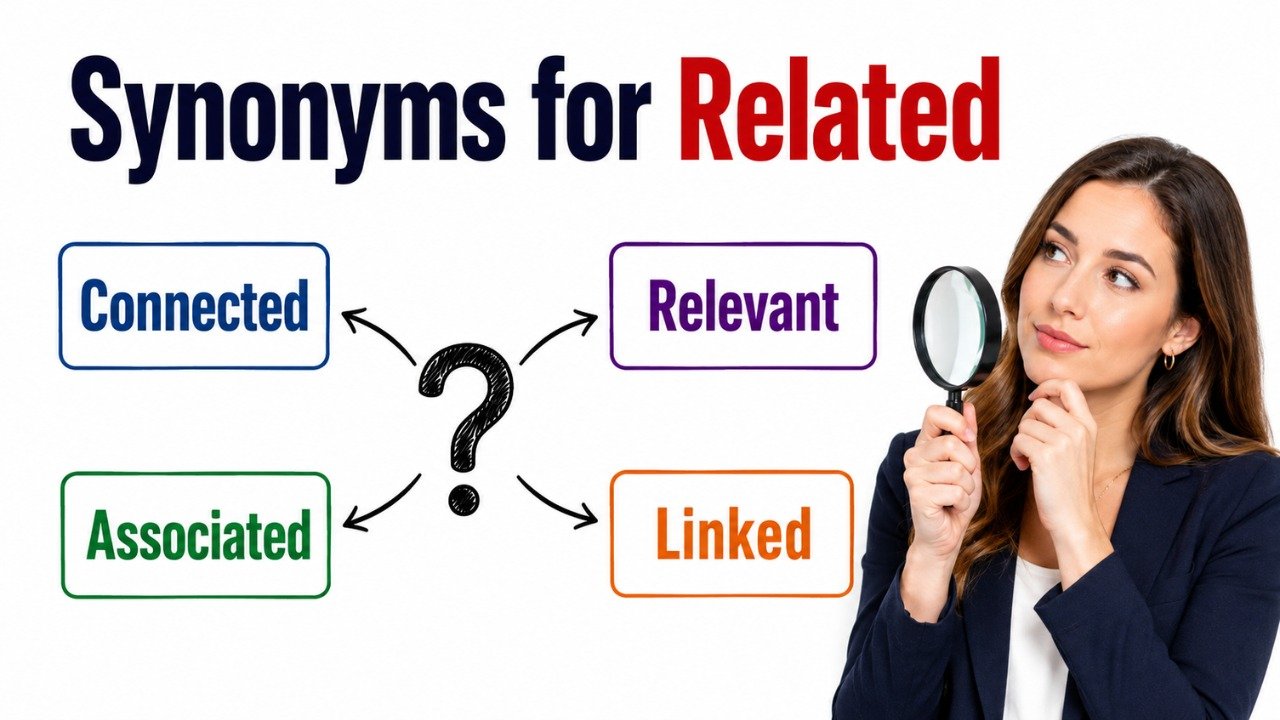
Quick Answer: Common synonyms for related include connected, associated, linked, relevant, affiliated, corresponding, interrelated, akin, allied, and connected with. The best choice depends on context. Connected is the clearest general alternative when two things have a relationship. Associated works well in formal and academic writing. Relevant is best when something directly applies to a topic. Affiliated suits organizations and professional relationships. Akin describes similarity, while interrelated emphasizes several things affecting or depending on one another.
Pronunciation and Word Details
Word: Related.
Pronunciation: /rɪˈleɪtɪd/
Part of Speech: Adjective.
Meaning: Connected to another person, thing, subject, event, or idea in some meaningful way.
US Pronunciation:
UK Pronunciation:
What Does “Related” Mean?
Related means connected to, associated with, or having a meaningful relationship with something or someone.
As an adjective, related can describe connections between ideas, subjects, events, objects, people, causes, or areas of study. It can also describe people who belong to the same family.
Example: The two problems are closely related.
In this sentence, related means that the problems have a meaningful connection.
Related can also show relevance to a particular subject.
Example: Please include only information related to the project.
Here, related means connected with or relevant to the project.
When used for family relationships, related means connected through birth, marriage, or family ties.
Example: The two families are related.
The word is therefore broad and flexible. Its precise synonym depends on whether the connection involves ideas, relevance, similarity, family, organizations, causes, or mutual influence.
Meaning, Tone, and Context of “Related”
Related is generally a neutral and widely used word. It appears naturally in conversation, academic writing, professional communication, reports, essays, instructions, and technical explanations.
Neutral Tone: Related usually has no strong emotional meaning. It simply describes a connection.
Formal Use: Related is common in reports, research, essays, policies, and professional writing.
Conversational Use: It also sounds completely natural in everyday speech.
Academic Context: Related often connects concepts, variables, subjects, theories, or findings.
Professional Context: It can describe tasks, documents, responsibilities, issues, or departments.
Family Context: Related can describe people who have a family connection.
Technical Context: The word may describe systems, processes, data, causes, symptoms, or functions that have a connection.
Relevance Context: Related can mean applicable or relevant to a particular topic.
Because related has several uses, replacing it with a synonym requires attention to the exact type of connection being described.
When and How to Use “Related”
For General Connection: Use related when two things have some meaningful connection.
Example: The two topics are closely related.
For Relevance: Use related when information, ideas, or details apply to a particular subject.
Example: Please send documents related to your application.
For Family Connections: Use related when people belong to the same family.
Example: The two men are related through their mothers.
For Academic Concepts: Use related when theories, subjects, or findings have a conceptual connection.
Example: The researchers examined several related concepts.
For Causes and Effects: Related can describe circumstances that appear connected.
Example: The decline was related to several economic factors.
For Professional Matters: Use related for tasks, issues, responsibilities, or records connected with a job or project.
Example: All related expenses must be recorded accurately.
For Similar Ideas: Related can describe things that belong to the same general area even when they are not identical.
Example: The course covers language, communication, and related subjects.
Best Synonyms for Related
Connected: Joined by a meaningful relationship.
Example: The two events appear to be connected.
Associated: Connected in thought, meaning, cause, or circumstance.
Example: Several risks are associated with the process.
Linked: Connected directly or indirectly.
Example: Researchers found that the two factors were linked.
Relevant: Directly connected with the subject being discussed.
Example: Only relevant information should be included in the report.
Affiliated: Officially or professionally connected with a group or organization.
Example: The center is affiliated with several educational institutions.
Corresponding: Matching or connected in a particular way.
Example: Each category has a corresponding set of requirements.
Interrelated: Connected so that each part affects or depends on others.
Example: Economic and social conditions are often interrelated.
Akin: Similar in character, nature, or meaning.
Example: Her approach is akin to an earlier method.
Allied: Connected through common interests, purposes, or characteristics.
Example: The department works with allied fields of study.
Pertinent: Directly relevant to the matter being considered.
Example: Please include only the facts pertinent to the case.
50 Synonyms for Related with Short Meanings
- Connected: Joined by a meaningful relationship.
- Associated: Connected through meaning, cause, or circumstance.
- Linked: Joined directly or indirectly.
- Relevant: Directly applicable to a subject.
- Affiliated: Officially connected with a group or organization.
- Corresponding: Matching or connected in a particular way.
- Interrelated: Mutually connected or dependent.
- Akin: Similar in nature or character.
- Allied: Connected through common interests or qualities.
- Pertinent: Directly relevant to a particular matter.
- Applicable: Relevant or suitable in a particular situation.
- Connected With: Having a clear relationship with something.
- Associated With: Having a recognized connection with something.
- Linked With: Joined to something through a relationship.
- Tied: Closely connected to something else.
- Tied To: Dependent on or connected with something.
- Joined: Brought together through some connection.
- Coupled: Connected or considered together.
- Combined: Joined together as part of a larger whole.
- Integrated: Connected as part of a unified system.
- Interconnected: Connected with several other things.
- Interdependent: Depending on one another.
- Connected Together: Joined through a shared relationship.
- Correspondent: Similar or matching in function or position.
- Comparable: Similar enough to be compared.
- Similar: Having qualities in common.
- Like: Similar in character or nature.
- Kindred: Similar in nature or connected through family.
- Cognate: Related through origin, meaning, or linguistic history.
- Analogous: Similar because of a comparable relationship or function.
- Parallel: Similar in structure, development, or effect.
- Concerning: About or connected with a subject.
- Regarding: Relating to a particular matter.
- Pertaining: Having a connection with a particular subject.
- Germane: Directly relevant to the issue being discussed.
- Material: Relevant and important to a particular matter.
- Appropriate: Suitable and relevant in context.
- Connected By: Joined through a particular factor or relationship.
- Dependent: Relying on another factor or condition.
- Relational: Involving relationships between things.
- Familial: Connected with family relationships.
- Kin: Connected through family or ancestry.
- Blood Related: Connected through biological family ties.
- Concomitant: Naturally accompanying or associated with something.
- Attendant: Accompanying or connected with another condition.
- Collateral: Connected indirectly or secondarily.
- Adjacent: Closely connected in position or subject matter.
- Compatible: Able to exist or work together appropriately.
- Convergent: Developing toward similar ideas or results.
- Sympathetic: Similar in feeling, character, or outlook.
Read Also:
Synonyms for Hit

Synonyms for Related by Context
When Related Means Connected
Connected, linked, associated, tied, joined, coupled, and interconnected work when related describes a direct or indirect connection.
Example: The two incidents appear to be connected.
Example: Several financial problems were linked to poor planning.
Connected is the broadest alternative, while linked often suggests a more specific relationship.
When Related Means Relevant
Relevant, pertinent, applicable, germane, material, concerning, regarding, and pertaining are useful when related means connected with the topic being discussed.
Example: Please provide only relevant information.
Example: The report contains several facts pertinent to the investigation.
Relevant is common and neutral. Pertinent and germane sound more formal.
When Related Means Similar
Akin, similar, comparable, analogous, corresponding, parallel, and kindred work when related means similar rather than directly connected.
Example: The two methods are similar in purpose.
Example: This theory is analogous to an earlier model.
Akin often suggests similarity in nature, while analogous emphasizes a comparable relationship or function.
When Related Means Mutually Connected
Interrelated, interconnected, interdependent, integrated, and dependent suit situations where several factors influence one another.
Example: Health, education, and income are often interrelated.
Example: The different parts of the system are interdependent.
Interrelated emphasizes connection, while interdependent emphasizes mutual dependence.
When Related Means Connected With an Organization
Affiliated, associated, allied, joined, and connected work when describing institutional or professional relationships.
Example: The research center is affiliated with several universities.
Example: The organization works closely with allied institutions.
Affiliated is particularly useful for official organizational connections.
When Related Means Family Connection
Familial, kin, kindred, blood related, and connected by family can describe relationships between family members.
Example: The two women are related through their grandparents.
Example: The families are connected by marriage.
Familial generally describes something connected with family life, while kin refers directly to relatives.
Another Word for Related
Connected is usually the best single replacement for related because it works naturally in a wide range of contexts. However, the best alternative depends on whether you mean connected, relevant, similar, affiliated, or linked through family.
Original: The two issues are closely related.
Better Option: The two issues are closely connected.
Original: Please include information related to the assignment.
Better Option: Please include information relevant to the assignment.
Original: The organization is related to several professional groups.
Better Option: The organization is affiliated with several professional groups.
Original: These ideas are related in several important ways.
Better Option: These ideas are interrelated in several important ways.
When Not to Use “Related”
Related is useful but broad. In precise writing, a more specific synonym can often communicate the relationship more clearly.
Do not use related when relevant is the exact meaning.
Weak: Include only details related to the question.
Better: Include only details relevant to the question.
Relevant clearly tells readers that the information must directly apply to the question.
Avoid related when an official organizational relationship is being described.
Weak: The institute is related to three professional associations.
Better: The institute is affiliated with three professional associations.
Affiliated more clearly expresses a recognized organizational connection.
Do not use related when the main idea is similarity.
Weak: The two designs are related in appearance.
Better: The two designs are similar in appearance.
Avoid related when the relationship involves mutual influence.
Weak: These economic factors are related.
Better: These economic factors are interrelated.
Interrelated more clearly suggests that several factors affect one another.
Do not use related repeatedly in the same paragraph when connected, relevant, linked, corresponding, or associated would provide greater precision.
Words Commonly Confused With Related
Related vs Connected: Both describe a relationship. Connected is often broader and more direct, while related can also mean relevant, similar, or connected through family.
Related vs Relevant: Related means having some connection. Relevant means directly applicable or important to the particular subject being discussed.
Related vs Associated: Associated often describes a recognized connection between ideas, conditions, people, or events. Related is broader and can describe many kinds of relationships.
Related vs Linked: Linked often suggests that a particular connection can be identified. Related can describe a looser or more general relationship.
Related vs Similar: Related means connected in some way, while similar means sharing qualities or characteristics. Two things can be related without being similar.
Related vs Affiliated: Related is broad. Affiliated usually refers to an official or recognized connection between organizations, institutions, or individuals.
Related vs Interrelated: Related means connected. Interrelated means connected with one another in a way that may involve mutual influence.
Related vs Pertinent: Related means connected generally, while pertinent means directly relevant to a specific matter.
Which Synonym Should You Choose?
Choose connected for a general relationship between people, ideas, events, or objects.
Choose associated when writing formally about a recognized relationship between factors, conditions, concepts, or outcomes.
Choose linked when the connection is direct, identifiable, or supported by evidence.
Choose relevant for reports, essays, emails, questions, and discussions when something directly applies to the topic.
Choose pertinent in formal writing when information is specifically important to the matter under consideration.
Choose affiliated when discussing an official connection between organizations, institutions, or professional groups.
Choose corresponding when two items match each other in position, function, category, or meaning.
Choose interrelated when several ideas, problems, or factors influence one another.
Choose akin when two things are similar in character or nature.
Choose analogous when explaining a structural or functional similarity.
Choose kindred when describing similar ideas, feelings, or family connections.
Choose familial when the context specifically involves family relationships.
Real Life Examples of “Related” in Sentences
Original: The two problems are closely related.
Better Option: The two problems are closely connected.
Original: The report includes several issues related to workplace safety.
Better Option: The report includes several issues concerning workplace safety.
Original: Please send all documents related to the application.
Better Option: Please send all documents relevant to the application.
Original: The two conditions may be related.
Better Option: The two conditions may be associated.
Original: The researchers examined several related variables.
Better Option: The researchers examined several interconnected variables.
Original: The organization is related to a larger professional network.
Better Option: The organization is affiliated with a larger professional network.
Original: These ideas are related in meaning.
Better Option: These ideas are akin in meaning.
Original: The problems are related to changes in demand.
Better Option: The problems are linked to changes in demand.
Original: Several related subjects are covered in the course.
Better Option: Several allied subjects are covered in the course.
Original: The family discovered that the two men were related.
Better Option: The family discovered that the two men were kin.
Synonym Groups and Usage Differences
Connection Group
Connected, linked, associated, tied, joined, and coupled describe relationships between people, ideas, events, objects, or conditions.
Connected is the broadest choice. Linked often suggests a specific relationship, while associated may sound more formal.
Example: The two findings appear to be closely linked.
Relevance Group
Relevant, pertinent, applicable, germane, material, concerning, and pertaining describe information connected with a particular subject.
Relevant is the most common choice, while pertinent and germane are more formal.
Example: Only information pertinent to the matter should be included.
Similarity Group
Akin, similar, analogous, comparable, corresponding, parallel, and kindred describe things that share characteristics.
These words should be used when similarity matters more than direct connection.
Example: The second approach is analogous to the first.
Mutual Connection Group
Interrelated, interconnected, interdependent, integrated, and dependent describe relationships involving several connected parts.
Interdependent is especially useful when each element relies on another.
Example: The social and economic factors are highly interrelated.
Organizational Group
Affiliated, allied, associated, connected, and joined describe relationships between organizations, departments, institutions, or groups.
Affiliated usually indicates the clearest official connection.
Example: The department is affiliated with a larger research institute.
Family Group
Familial, kin, kindred, blood related, and connected by family describe relationships created through ancestry, birth, or marriage.
Example: The two families are connected by marriage.
Antonyms of Related
The opposite of related depends on whether related means connected, relevant, similar, or associated.
Unrelated: Having no meaningful connection.
Disconnected: Not joined or associated.
Unconnected: Having no relationship with something else.
Irrelevant: Not applicable to the subject being discussed.
Unassociated: Not connected through a recognized relationship.
Independent: Existing or functioning without depending on another thing.
Separate: Existing apart from something else.
Distinct: Clearly different or separate.
Dissimilar: Not alike in qualities or characteristics.
Different: Not the same or similar.
Unlinked: Not connected by an identifiable relationship.
Isolated: Separate from other things or influences.
Remote: Only slightly connected or distant in relevance.
Extraneous: Unnecessary and unrelated to the main subject.
Impertinent: Not relevant to the matter being discussed.
Comparison: Related vs Related Words
Related vs Connected
Related and connected can often replace each other. Connected usually emphasizes the existence of a relationship, while related can also indicate similarity, relevance, or family ties.
Example With Related: The two topics are closely related.
Example With Connected: The two topics are closely connected.
Related vs Relevant
Related means connected in some way. Relevant is narrower and means directly applicable to the subject or situation.
Example With Related: She collected several documents related to the project.
Example With Relevant: She selected the documents most relevant to the project.
Related vs Associated
Associated emphasizes a recognized connection, especially between conditions, ideas, risks, or events.
Example With Related: The problem is related to poor maintenance.
Example With Associated: The problem is associated with poor maintenance.
Related vs Linked
Linked often suggests a clearer or more identifiable connection than related.
Example With Related: The two developments may be related.
Example With Linked: The two developments may be linked.
Related vs Similar
Related describes connection, while similar describes likeness. Things may have a relationship without looking or functioning alike.
Example With Related: The two subjects are related through their shared history.
Example With Similar: The two subjects use similar research methods.
Related vs Affiliated
Related can describe almost any connection. Affiliated specifically suits official, organizational, academic, or professional relationships.
Example With Related: The center is related to several educational groups.
Example With Affiliated: The center is affiliated with several educational groups.
Related vs Interrelated
Related indicates that things have a connection. Interrelated suggests several things are connected with one another and may influence each other.
Example With Related: The problems are related.
Example With Interrelated: The problems are interrelated and cannot easily be considered separately.
Common Phrases and Expressions With Related
Closely Related: Having a strong or direct connection.
Directly Related: Connected in an immediate or clear way.
Related To: Connected with a person, thing, subject, or event.
Related Issue: A problem connected with another matter.
Related Topic: A subject connected with the main discussion.
Related Information: Information connected with a particular subject.
Related Field: An area of study or work connected with another field.
Related Matter: An issue associated with the subject being considered.
Related Question: A question connected with another topic or discussion.
Related Problem: A difficulty connected with another issue or cause.
Common Mistakes to Avoid
Confusing Related With Relevant: Something can be related to a topic without being important to the immediate discussion. Use relevant when the information directly applies to the subject.
Using Related Too Repeatedly: Repeating related several times in one paragraph can make writing vague. Consider connected, linked, associated, relevant, corresponding, or interrelated where appropriate.
Choosing Similar When Connection Is Intended: Similar describes likeness, not necessarily a relationship. Two objects may look similar while having no connection.
Using Affiliated for Informal Connections: Affiliated usually suggests an official or recognized relationship. Connected or associated may be better for informal relationships.
Using Interrelated for Only Two Simple Connections: Interrelated is most useful when several parts are mutually connected or influence one another. Connected may be clearer for a simple relationship.
Using Related Without Explaining the Connection: A sentence such as “The events were related” can be vague. Explain how they are related when the connection matters.
Choosing a Synonym With the Wrong Tone: Germane and pertinent suit formal writing, while connected and linked work naturally in both formal and conversational English.
Ignoring Family Meaning: When related refers to family members, words such as connected, relevant, or applicable cannot replace it naturally. Kin or family connection may be more accurate.
Conclusion
Synonyms for related include connected, associated, linked, relevant, affiliated, corresponding, interrelated, akin, allied, and pertinent. Connected is the best general replacement, while relevant works when something directly applies to a topic. Associated and linked suit formal descriptions of relationships, affiliated is useful for organizations, and interrelated emphasizes mutual connections. Akin and analogous are stronger choices when similarity matters. Choosing the best synonym depends on whether you mean connection, relevance, similarity, family relationship, or organizational association.
FAQs About Synonyms for Related
What is the best synonym for related?
Connected is usually the best general synonym for related because it works for many types of relationships between ideas, events, people, and objects.
What is a formal synonym for related?
Associated, pertinent, germane, affiliated, corresponding, and interrelated are useful formal alternatives. The best choice depends on the type of connection.
Are related and relevant the same?
Not exactly. Related means connected in some way, while relevant means directly applicable or important to the subject being discussed.
What is another word for closely related?
Closely connected, strongly associated, linked, interconnected, akin, and interrelated can replace closely related depending on context.
What synonym for related works in academic writing?
Associated, linked, relevant, corresponding, interrelated, pertinent, and analogous are useful choices in academic writing.
Can similar be a synonym for related?
Yes, but only when related means having qualities or characteristics in common. Similar does not necessarily indicate an actual connection.
What is the opposite of related?
Common opposites include unrelated, disconnected, unconnected, irrelevant, separate, distinct, independent, and dissimilar.
