
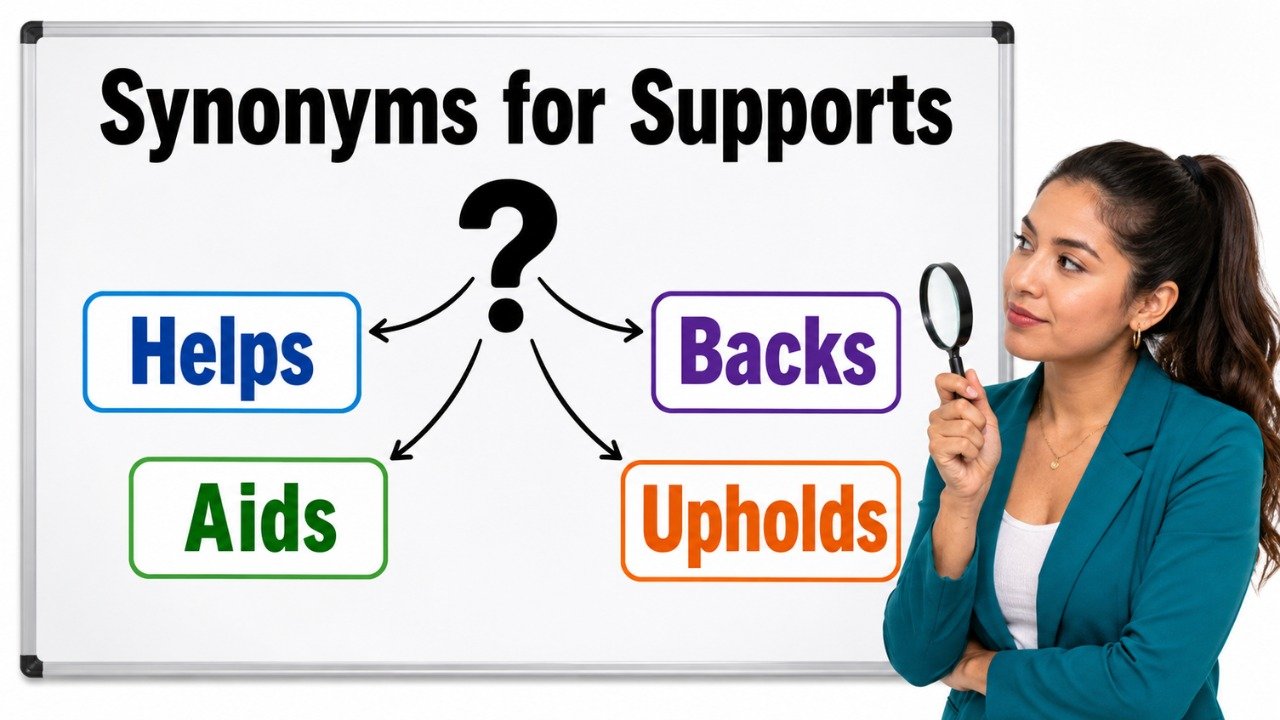
Quick Answer: The best synonyms for supports include helps, assists, backs, sustains, upholds, endorses, reinforces, maintains, advocates for, and substantiates. Use helps or assists when describing practical aid, backs or endorses for approval, upholds for principles or decisions, sustains for continued strength, reinforces for making something stronger, and substantiates when evidence confirms a claim.
Pronunciation and Word Details
Word: Supports
Pronunciation: /səˈpɔːrts/
Part of Speech: Verb and plural noun
Meaning: Helps, strengthens, approves, maintains, holds up, or provides evidence for someone or something.
US Pronunciation:
UK Pronunciation:
What Does “Supports” Mean?
Supports means helps, strengthens, maintains, approves, or provides a foundation for someone or something.
As a verb, supports is the third person singular form of support.
Example: She supports the team during difficult projects.
It can describe giving practical help.
Example: The program supports new learners.
It can express agreement or approval.
Example: He supports the proposed change.
It can mean physically holding something in place.
Example: The column supports the roof.
Supports can also mean providing evidence that makes a statement, theory, or conclusion more believable.
Example: The evidence supports the conclusion.
As a plural noun, supports can refer to objects, structures, systems, or people that provide strength, stability, or assistance.
Example: Additional supports were installed beneath the platform.
The intended meaning therefore depends strongly on context.
Meaning, Tone, and Context of “Supports”
Supports is a neutral and flexible word that appears naturally in everyday conversation, professional communication, academic writing, technical descriptions, reports, essays, and formal discussions.
When supports refers to helping a person, organization, or activity, its tone is usually positive.
Example: The mentor supports students throughout the course.
When it refers to agreement, it indicates approval or willingness to stand behind an idea.
Example: The committee supports the recommendation.
In academic and analytical writing, supports often describes evidence that strengthens an argument or conclusion.
Example: The data supports the proposed explanation.
In physical or technical contexts, supports means holding weight or maintaining stability.
Example: The frame supports the upper structure.
In emotional contexts, supports can suggest encouragement, care, or reassurance.
Example: Her family supports her during stressful periods.
The word itself is generally neutral, but alternatives such as endorses, advocates for, sustains, reinforces, and substantiates can make the intended meaning more precise.
When and How to Use “Supports”
For Practical Help: Use supports when someone provides assistance, resources, guidance, or services.
Example: The tutor supports learners who need extra practice.
For Emotional Encouragement: Use supports when someone provides reassurance, understanding, or motivation.
Example: He supports his friend through difficult decisions.
For Agreement: Supports can express approval of an idea, proposal, plan, or decision.
Example: She supports the new policy.
For Advocacy: Use supports when a person actively promotes or defends a cause or position.
Example: The speaker supports greater access to education.
For Evidence: Supports is useful when information, research, observations, or facts strengthen a claim.
Example: The evidence supports the main argument.
For Physical Strength: Use supports when an object carries weight or prevents another object from falling.
Example: The beam supports the ceiling.
For Continuation: Supports can describe something that enables an activity, condition, or system to continue.
Example: Regular maintenance supports long term performance.
For Financial Assistance: Supports can describe providing money or resources.
Example: Her income supports the entire household.
Best Synonyms for Supports
Helps: Gives assistance or makes something easier.
Example: This guide helps beginners understand the process.
Assists: Provides direct or practical help.
Example: The coordinator assists visitors with registration.
Backs: Gives approval, encouragement, or resources.
Example: The committee backs the proposal.
Sustains: Keeps something continuing, strong, or functioning.
Example: Regular rainfall sustains the local vegetation.
Upholds: Maintains, respects, or defends a rule, decision, principle, or standard.
Example: The court upholds the earlier decision.
Endorses: Publicly or formally expresses approval.
Example: The organization endorses the recommendation.
Reinforces: Makes an idea, structure, behavior, or belief stronger.
Example: The new evidence reinforces the original conclusion.
Maintains: Keeps something in a particular state or condition.
Example: Proper care maintains the strength of the structure.
Advocates For: Publicly argues in favor of a person, policy, cause, or change.
Example: She advocates for improved learning opportunities.
Substantiates: Provides evidence proving or strengthening a claim.
Example: The report substantiates his argument.
50 Synonyms for Supports with Short Meanings
- Helps: Provides aid or makes something easier.
- Assists: Gives practical help.
- Aids: Helps someone achieve a result.
- Backs: Gives approval or assistance.
- Sustains: Keeps something continuing or strong.
- Upholds: Maintains or defends something.
- Endorses: Expresses approval or agreement.
- Reinforces: Makes something stronger.
- Maintains: Keeps something functioning or continuing.
- Encourages: Gives confidence or motivation.
- Advocates For: Actively argues in favor of something.
- Promotes: Helps something develop or gain acceptance.
- Champions: Strongly defends or promotes a cause.
- Defends: Protects someone or something from criticism or attack.
- Protects: Keeps someone or something safe.
- Bolsters: Strengthens or improves something.
- Strengthens: Makes something more powerful or effective.
- Fortifies: Makes something stronger or more secure.
- Stabilizes: Makes something steady or less likely to fail.
- Holds: Bears or carries weight.
- Carries: Bears a load or responsibility.
- Bears: Holds or carries weight.
- Props Up: Prevents something from falling or failing.
- Underpins: Provides a foundation or basis.
- Shores Up: Strengthens something that may be weak.
- Preserves: Keeps something existing or protected.
- Continues: Keeps something going.
- Enables: Makes something possible.
- Facilitates: Makes a process easier.
- Nurtures: Helps something grow or develop.
- Fosters: Encourages growth or improvement.
- Sponsors: Provides resources or backing.
- Funds: Provides money for an activity or purpose.
- Finances: Supplies money needed for something.
- Provides For: Supplies necessary resources.
- Looks After: Gives care or assistance.
- Stands By: Remains loyal or supportive.
- Sides With: Takes the same position as someone.
- Agrees With: Shares or accepts a viewpoint.
- Approves: Accepts or favors something.
- Favors: Shows preference or approval.
- Affirms: Confirms or expresses agreement.
- Validates: Confirms that something is reasonable or sound.
- Confirms: Shows that something is true or correct.
- Corroborates: Provides additional evidence for a statement.
- Substantiates: Provides evidence that strengthens a claim.
- Verifies: Establishes the truth or accuracy of something.
- Justifies: Provides good reasons for something.
- Demonstrates: Shows evidence of a fact or conclusion.
- Establishes: Provides a firm basis for believing something.
Read Also:
Synonyms for Urge
Synonyms for Supports by Context
When Supports Means Helps
Useful synonyms include helps, assists, aids, facilitates, enables, nurtures, and fosters.
Helps: The broadest everyday alternative.
Example: The guide helps students improve their vocabulary.
Assists: Slightly more formal and often used for direct practical aid.
Example: The assistant assists visitors with their questions.
Aids: Concise and useful in formal descriptions.
Example: Regular practice aids memory.
Facilitates: Best when something makes a process easier rather than completing the task directly.
Example: Clear communication facilitates cooperation.
When Supports Means Agrees With
Useful alternatives include backs, endorses, approves, favors, agrees with, sides with, and affirms.
Backs: Suggests active approval or commitment.
Example: The board backs the proposed plan.
Endorses: Often indicates clear or formal approval.
Example: The committee endorses the recommendation.
Approves: Emphasizes acceptance.
Example: She approves of the revised approach.
Sides With: Best when choosing between competing viewpoints.
Example: He sides with those who favor a gradual change.
When Supports Means Strengthens
Useful choices include reinforces, strengthens, bolsters, fortifies, stabilizes, shores up, and underpins.
Reinforces: Best for ideas, arguments, behavior, structures, or existing beliefs.
Example: The additional evidence reinforces the conclusion.
Bolsters: Suggests giving extra strength or confidence.
Example: Strong results bolster their argument.
Stabilizes: Best when preventing movement, decline, or failure.
Example: The base stabilizes the structure.
Underpins: Describes something that serves as a foundation.
Example: Trust underpins effective cooperation.
When Supports Means Provides Evidence
Useful synonyms include substantiates, corroborates, confirms, verifies, validates, demonstrates, and establishes.
Substantiates: Best when evidence strengthens a claim.
Example: The documentation substantiates her account.
Corroborates: Best when additional evidence agrees with existing evidence.
Example: The second report corroborates the original findings.
Confirms: Suitable when evidence establishes that something is correct or true.
Example: The test confirms the earlier result.
Demonstrates: Useful when the evidence clearly shows something.
Example: The analysis demonstrates the importance of careful planning.
When Supports Means Maintains
Useful alternatives include sustains, maintains, preserves, continues, nurtures, and provides for.
Sustains: Emphasizes continued existence or strength.
Example: Regular investment sustains long term growth.
Maintains: Focuses on keeping something in its present condition.
Example: Proper care maintains good performance.
Preserves: Best when protecting something from loss or damage.
Example: Careful storage preserves the material.
When Supports Means Holds Weight
Useful choices include holds, carries, bears, props up, stabilizes, underpins, and shores up.
Holds: A simple everyday choice.
Example: The frame holds the glass securely.
Bears: More formal and often used for physical loads.
Example: The wall bears much of the structure’s weight.
Props Up: Describes preventing something from falling.
Example: The post props up the damaged section.
Stabilizes: Emphasizes keeping something steady.
Example: The brace stabilizes the frame.
When Supports Means Encourages
Useful alternatives include encourages, champions, promotes, nurtures, fosters, and stands by.
Encourages: Best for motivation or confidence.
Example: Her teacher encourages independent thinking.
Champions: Suggests strong and active promotion.
Example: He champions equal access to education.
Fosters: Best for encouraging gradual development.
Example: Open discussion fosters understanding.
Another Word for Supports
The best general replacement for supports is often helps, but a more precise synonym can improve the sentence considerably.
Use assists for direct practical help, backs for approval, sustains for continuation, reinforces for added strength, and substantiates for evidence.
Original: The teacher supports students who need extra guidance.
Better Option: The teacher assists students who need extra guidance.
Original: The committee supports the new proposal.
Better Option: The committee endorses the new proposal.
Original: This evidence supports the argument.
Better Option: This evidence substantiates the argument.
Original: Strong communication supports a healthy working relationship.
Better Option: Strong communication sustains a healthy working relationship.
When Not to Use “Supports”
Supports can become vague when readers need to know exactly what kind of help, approval, evidence, or strength is being provided.
Avoid using it repeatedly when a more precise verb communicates the relationship more clearly.
Weak: The evidence supports the statement.
Better: The evidence substantiates the statement.
Weak: She supports the new recommendation.
Better: She endorses the new recommendation.
Weak: The beam supports the structure.
Better: The beam bears the weight of the structure.
Weak: The program supports new learners.
Better: The program assists new learners.
Weak: The new findings support the previous results.
Better: The new findings corroborate the previous results.
Supports is not incorrect in these sentences, but the alternatives communicate a more specific relationship.
Words Commonly Confused With Supports
Supports vs Helps: Helps is broad and conversational. Supports can include help, approval, emotional encouragement, financial assistance, evidence, and physical strength.
Supports vs Assists: Assists usually refers to direct practical help. Supports can describe a much wider range of actions.
Supports vs Backs: Backs normally expresses approval, loyalty, or commitment. Supports may also refer to practical or physical assistance.
Supports vs Endorses: Endorses suggests explicit approval. Supports can indicate approval without necessarily implying a formal expression.
Supports vs Sustains: Sustains means keeps something going or preserves its strength. Supports has broader meanings.
Supports vs Reinforces: Reinforces means strengthens something already present. Supports may provide the original foundation, help, or evidence.
Supports vs Corroborates: Corroborates specifically describes additional evidence that confirms an existing statement or account.
Supports vs Substantiates: Substantiates means providing evidence that makes a claim more credible or provable.
Which Synonym Should You Choose?
Choose helps for simple and natural everyday writing.
Choose assists for professional communication, instructions, services, and practical help.
Choose backs when describing active approval or commitment in conversation or general writing.
Choose endorses for clear, formal, or public approval.
Choose encourages when describing emotional support, confidence, or motivation.
Choose advocates for when someone actively argues for a cause, policy, group, or change.
Choose sustains when something keeps a system, activity, condition, or person going.
Choose reinforces when something strengthens an existing argument, behavior, structure, or idea.
Choose upholds for principles, rules, standards, rights, decisions, and values.
Choose substantiates in essays, reports, research, and analytical writing when evidence strengthens a claim.
Choose corroborates when one piece of evidence confirms another.
Choose bears or holds when describing physical weight.
Choose funds or finances when the intended meaning involves money.
Real Life Examples of “Supports” in Sentences
Original: She supports her coworkers when deadlines become difficult.
Better Option: She assists her coworkers when deadlines become difficult.
Original: His family supports his decision to continue studying.
Better Option: His family backs his decision to continue studying.
Original: The committee supports the proposed changes.
Better Option: The committee endorses the proposed changes.
Original: The evidence supports her explanation.
Better Option: The evidence substantiates her explanation.
Original: The new study supports the earlier findings.
Better Option: The new study corroborates the earlier findings.
Original: This column supports the upper floor.
Better Option: This column bears the weight of the upper floor.
Original: Regular practice supports better performance.
Better Option: Regular practice fosters better performance.
Original: Good communication supports strong relationships.
Better Option: Good communication sustains strong relationships.
Original: The organization supports improved access to education.
Better Option: The organization advocates for improved access to education.
Original: The additional brace supports the damaged frame.
Better Option: The additional brace stabilizes the damaged frame.
Synonym Groups and Usage Differences
Help Group
This group includes helps, assists, aids, facilitates, enables, and provides for.
These words describe practical assistance, but their meanings vary slightly. Helps is general, assists suggests direct involvement, and facilitates means making an activity easier.
Example: The new system facilitates faster communication.
Approval Group
This group includes backs, endorses, approves, favors, sides with, and affirms.
Use these words when supports means agreeing with a proposal, idea, decision, or person.
Example: The committee endorses the revised recommendation.
Strength Group
This group includes reinforces, strengthens, bolsters, fortifies, stabilizes, and shores up.
These alternatives are useful when something becomes stronger, more secure, or more convincing.
Example: The additional evidence bolsters the argument.
Evidence Group
This group includes substantiates, corroborates, confirms, verifies, validates, demonstrates, and establishes.
These words are especially useful in academic writing, reports, essays, research discussions, and analytical explanations.
Example: The records corroborate the witness’s account.
Continuation Group
This group includes sustains, maintains, preserves, nurtures, fosters, and continues.
These words focus on keeping something active, healthy, stable, or developing.
Example: Regular communication sustains cooperation between the groups.
Advocacy Group
This group includes advocates for, champions, promotes, defends, backs, and stands by.
These alternatives express active loyalty, promotion, or defense.
Example: She champions greater educational opportunities.
Physical Support Group
This group includes holds, carries, bears, props up, stabilizes, underpins, and shores up.
Use these terms for structures, objects, loads, and physical stability.
Example: Several columns bear the weight of the roof.
Antonyms of Supports
The opposite of supports changes according to whether the word means helping, approving, strengthening, maintaining, or proving.
Opposes: Acts or argues against something.
Example: She supports the proposal, while he opposes it.
Rejects: Refuses to accept or approve something.
Example: The committee rejects the recommendation.
Disapproves: Expresses an unfavorable opinion.
Example: He disapproves of the suggested change.
Undermines: Makes something weaker or less effective.
Example: Poor communication undermines cooperation.
Weakens: Reduces strength or effectiveness.
Example: Repeated errors weaken the argument.
Discourages: Reduces confidence, enthusiasm, or motivation.
Example: Constant criticism discourages participation.
Hinders: Makes progress or action more difficult.
Example: A lack of information hinders decision making.
Obstructs: Blocks or interferes with progress.
Example: The barrier obstructs movement.
Contradicts: Provides information that conflicts with a statement.
Example: The new evidence contradicts the earlier claim.
Refutes: Shows that a claim or argument is wrong.
Example: The evidence refutes the accusation.
Destabilizes: Makes something less stable.
Example: Sudden movement destabilizes the structure.
Abandons: Stops helping or standing by someone or something.
Example: He abandons the plan after several problems emerge.
Comparison: Supports vs Related Words
Supports vs Helps
Supports is broader than helps. It can refer to practical aid, emotional encouragement, approval, evidence, money, or physical strength.
Helps usually means making something easier or assisting someone.
Example With Supports: Her family supports her career goals.
Example With Helps: Her colleague helps her prepare the presentation.
Supports vs Assists
Supports can involve general or continuing help, while assists usually describes direct involvement in a particular task or activity.
Example With Supports: The program supports young learners.
Example With Assists: The tutor assists learners with difficult exercises.
Supports vs Backs
Supports can describe many types of aid. Backs usually means giving approval, loyalty, resources, or commitment.
Example With Supports: She supports the project in several ways.
Example With Backs: She backs the proposal completely.
Supports vs Endorses
Supports may indicate general agreement. Endorses usually communicates clear or explicit approval.
Example With Supports: He supports the recommendation.
Example With Endorses: He formally endorses the recommendation.
Supports vs Sustains
Supports may provide help or strength. Sustains specifically emphasizes keeping something continuing or functioning.
Example With Supports: The system supports daily operations.
Example With Sustains: Reliable funding sustains daily operations.
Supports vs Reinforces
Supports may provide a foundation or assistance. Reinforces makes something already present stronger.
Example With Supports: The evidence supports the conclusion.
Example With Reinforces: The additional evidence reinforces the conclusion.
Supports vs Substantiates
Supports is a broad word for evidence that favors a claim. Substantiates more specifically means providing convincing evidence for a statement.
Example With Supports: Several observations support the theory.
Example With Substantiates: Detailed records substantiate the claim.
Supports vs Corroborates
Supports can describe any evidence that favors an idea. Corroborates usually means that separate evidence confirms information already provided.
Example With Supports: The data supports her explanation.
Example With Corroborates: The second report corroborates her explanation.
Common Phrases and Expressions With “Supports”
Supports the Idea: Gives reasons, evidence, or approval for an idea.
Supports the Argument: Provides strength or evidence for an argument.
Supports the Claim: Provides evidence that makes a claim more believable.
Supports the Conclusion: Gives evidence consistent with a conclusion.
Supports the Decision: Approves or provides reasons for a decision.
Supports the Team: Helps, encourages, or assists a group.
Supports the Community: Provides resources, services, or assistance to local people.
Supports Growth: Encourages or enables development.
Supports Development: Helps a person, system, skill, or process improve.
Supports the Weight: Bears or carries a physical load.
Common Mistakes to Avoid
Repetition: Avoid using supports repeatedly when several different relationships are being described. A precise synonym often improves readability.
Weak: The evidence supports the claim, supports the conclusion, and supports the recommendation.
Better: The evidence substantiates the claim, reinforces the conclusion, and justifies the recommendation.
Wrong Synonym Choice: Do not assume all synonyms are interchangeable. Endorses expresses approval, while substantiates refers to evidence.
Weak: The column endorses the roof.
Better: The column supports the roof.
Unnatural Phrasing: Choose a verb that fits the object naturally.
Weak: The report physically backs the conclusion.
Better: The report substantiates the conclusion.
Confusing Help and Agreement: Supporting someone can mean helping that person or agreeing with that person’s position. The surrounding sentence should make the meaning clear.
Confusing Evidence Terms: Confirms, corroborates, substantiates, and validates have related but different meanings. Choose the one that accurately describes what the evidence does.
Vague Usage: If supports leaves readers wondering whether you mean money, approval, help, evidence, or physical strength, replace it with a clearer alternative.
Incorrect Agreement: Remember that supports usually follows a singular third person subject in the present tense.
Correct: She supports the proposal.
Correct: They support the proposal.
Incorrect: They supports the proposal.
Conclusion
The best synonyms for supports depend on the relationship being described. Use helps or assists for practical aid, backs or endorses for approval, sustains for continued strength, and reinforces when something becomes stronger. In analytical writing, substantiates, corroborates, and confirms can describe evidence more precisely. For physical strength, holds, bears, and stabilizes are useful alternatives. Choosing the right synonym makes each sentence clearer, more natural, and more specific.
FAQs About Synonyms for Supports
What is the best synonym for supports?
The best general synonym is helps, but the right choice depends on context. Assists, backs, sustains, endorses, reinforces, and substantiates may be more precise.
What is another word for supports in an essay?
Useful formal alternatives include substantiates, reinforces, demonstrates, corroborates, confirms, validates, and underpins.
What is a synonym for supports meaning agrees with?
Use backs, endorses, approves, favors, sides with, or affirms when supports means agrees with or approves of something.
What is a synonym for supports meaning helps?
Good alternatives include helps, assists, aids, enables, facilitates, nurtures, and provides for.
What word can replace supports when discussing evidence?
Use substantiates when evidence strengthens a claim, corroborates when additional evidence confirms it, and confirms when evidence establishes that something is correct.
What is a synonym for supports physically?
Useful physical alternatives include holds, bears, carries, props up, stabilizes, and underpins.
What is the opposite of supports?
Common opposites include opposes, rejects, undermines, weakens, discourages, contradicts, and refutes, depending on the intended meaning.
