
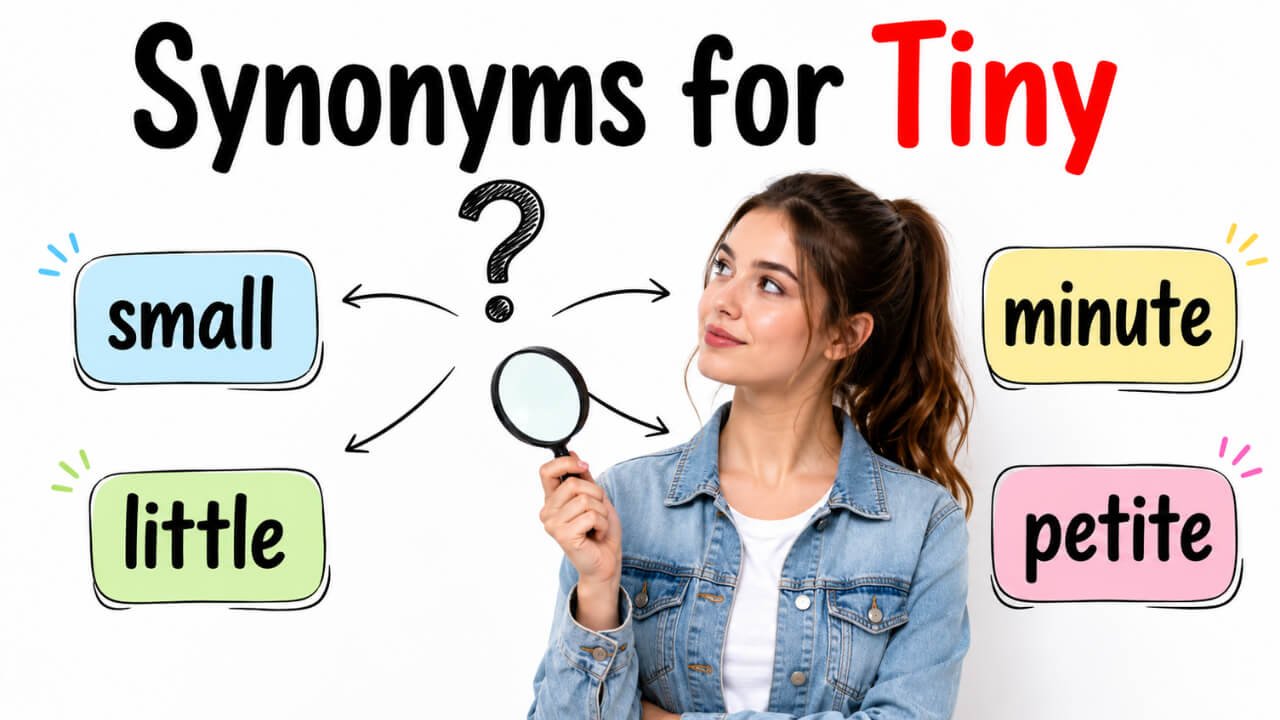
Quick Answer: The best synonyms for tiny include small, little, miniature, minute, minuscule, microscopic, infinitesimal, petite, compact, and diminutive. Use small as the most neutral replacement, little in casual or affectionate speech, miniature for a small copy or model, and minute or minuscule for extremely small details. Microscopic suits scientific or highly exaggerated descriptions, while infinitesimal works well for amounts that are almost immeasurably small. Petite usually describes a small and delicate person or object, compact suggests efficient use of limited space, and diminutive is a more formal word for unusually small size.
Pronunciation and Word Details
Word: Tiny
Pronunciation: /ˈtaɪ.ni/
Part of Speech: Adjective
Meaning: Extremely small in size, amount, degree, or importance.
US Pronunciation:
UK Pronunciation:
What Does “Tiny” Mean?
Tiny means extremely small in physical size, amount, degree, or importance.
Tiny is mainly used as an adjective. It describes a noun by showing that the person, object, place, quantity, or detail is much smaller than usual.
The word can describe physical objects, such as a tiny button, a tiny insect, or a tiny room. It can also describe amounts, such as a tiny portion, a tiny chance, or a tiny difference.
In affectionate contexts, tiny can make something sound delicate, charming, or lovable. In critical contexts, it can suggest that something is insufficient, restricted, or less important than expected.
The precise meaning depends on the noun it describes. A tiny apartment is physically small, while a tiny improvement means the change was limited.
Meaning, Tone, and Context of “Tiny”
Tiny is a common, neutral, and conversational word. It is suitable for everyday speech, descriptive writing, stories, informal emails, product descriptions, and general explanations.
The word often creates a clear visual image. It sounds stronger than small because it suggests an extremely limited size rather than an ordinary small size.
Tiny can carry a warm or affectionate tone when describing babies, animals, decorations, or delicate objects. A phrase such as tiny hands often sounds gentle and caring.
It can also sound negative when it describes an inadequate amount, cramped space, or limited possibility. A tiny salary increase, for example, suggests disappointment because the increase was smaller than expected.
In academic, technical, or scientific writing, words such as minute, microscopic, infinitesimal, minimal, or negligible may be more precise than tiny.
When and How to Use “Tiny”
For Physical Size: Use tiny when a person, animal, place, or object is extremely small.
Example: A tiny bird rested on the narrow branch.
For Small Amounts: Use tiny when the quantity is much lower than usual or expected.
Example: Only a tiny amount of flour remained in the container.
For Minor Differences: Use tiny to describe a difference or change that is difficult to notice.
Example: There was a tiny difference between the two shades.
For Limited Space: Use tiny when a room, house, or area has very little space.
Example: The tiny kitchen required careful organization.
For Affectionate Descriptions: Use tiny to make a person, animal, or object sound delicate and lovable.
Example: The kitten wrapped its tiny paws around the toy.
For Limited Possibility: Use tiny to describe a very low chance of something happening.
Example: There is still a tiny chance that the package will arrive today.
For Unimportant Details: Use tiny when a detail or mistake has little effect on the overall result.
Example: A tiny error appeared in the final paragraph.
For Gradual Progress: Use tiny to describe very small actions or improvements.
Example: Tiny steps can eventually lead to meaningful progress.
Best Synonyms for Tiny
Small: Limited in size compared with something else.
Example: They rented a small room near the entrance.
Little: Small in size, amount, age, or importance.
Example: A little dog followed the children through the garden.
Miniature: A very small version or copy of something larger.
Example: The shelf displayed a miniature wooden house.
Minute: So small that it may be difficult to see or notice.
Example: The researcher examined a minute crack in the surface.
Minuscule: Extremely small in size or amount.
Example: The price difference was minuscule.
Microscopic: Extremely small and usually visible only with special equipment.
Example: Microscopic organisms were present in the water sample.
Infinitesimal: Almost immeasurably small in amount or degree.
Example: The adjustment caused an infinitesimal change in the result.
Petite: Small, delicate, and attractively proportioned.
Example: The petite vase fit neatly on the narrow shelf.
Compact: Small but arranged efficiently within a limited space.
Example: The compact desk provided enough room for basic supplies.
Diminutive: Unusually or noticeably small.
Example: The diminutive cottage stood between two large buildings.
50 Synonyms for Tiny with Short Meanings
- Small: Limited in physical size or amount.
- Little: Small in size, quantity, age, or importance.
- Miniature: Made as a very small version of something.
- Minute: Extremely small and difficult to notice.
- Minuscule: Exceptionally small in size or amount.
- Microscopic: Too small to be seen clearly without special equipment.
- Infinitesimal: Almost immeasurably small.
- Petite: Small, delicate, and neatly proportioned.
- Compact: Small and efficiently arranged.
- Diminutive: Noticeably smaller than normal.
- Wee: Very small in an informal or affectionate way.
- Teeny: Extremely small in casual speech.
- Itsy Bitsy: Very small in a playful or informal way.
- Mini: A shortened informal word for miniature.
- Micro: Extremely small in scale or size.
- Undersized: Smaller than the usual or required size.
- Puny: Small and weak in an unimpressive way.
- Slight: Small in degree, amount, or physical build.
- Modest: Limited rather than large or impressive.
- Narrow: Having very little width.
- Short: Having limited height, length, or duration.
- Low: Small in height, level, amount, or value.
- Scant: Barely enough in amount or quantity.
- Meager: Unusually small and insufficient in amount.
- Negligible: So small that it has little importance.
- Minimal: The smallest possible or necessary amount.
- Limited: Restricted in size, number, or amount.
- Fractional: Representing only a very small part.
- Trace: A barely noticeable amount.
- Speck Sized: As small as a tiny mark or spot.
- Pin Sized: Comparable to the small size of a pinhead.
- Pocket Sized: Small enough to fit inside a pocket.
- Bite Sized: Small enough to eat in one bite.
- Doll Sized: As small as an object made for a doll.
- Thumb Sized: Similar in size to a person’s thumb.
- Small Scale: Limited in size, scope, or activity.
- Reduced: Made smaller than the original size.
- Shrunken: Reduced in size through shrinking.
- Scaled Down: Made smaller while keeping the original form.
- Condensed: Made smaller or shorter by removing extra material.
- Speck: A very small spot, mark, or piece.
- Dot: A tiny round mark or point.
- Particle: An extremely small piece of matter.
- Fragment: A small broken piece of something larger.
- Morsel: A very small piece or amount.
- Crumb: A tiny piece of food or another material.
- Sliver: A long, thin, and very small piece.
- Grain: A tiny hard particle or seed.
- Droplet: A very small drop of liquid.
- Pinpoint: An extremely small point, place, or amount.
Read Also:
Synonyms for Aggressive

Synonyms for Tiny by Context
When Tiny Means Physically Small
When tiny describes physical size, the best synonyms include small, little, miniature, petite, compact, diminutive, wee, and undersized.
Small is the safest general choice because it works with people, animals, rooms, buildings, and objects. Little often sounds more casual or affectionate. Diminutive is more formal and emphasizes that something is unusually small.
Example: A diminutive statue stood in the center of the display.
When Tiny Means Extremely Small
Minute, minuscule, microscopic, infinitesimal, micro, pinpoint, and speck sized emphasize extreme smallness.
Minute and minuscule work well for details, differences, quantities, or objects. Microscopic may be literal in scientific writing or exaggerated in casual descriptions. Infinitesimal is especially useful for extremely small amounts or changes.
Example: The two designs showed only a minuscule difference.
When Tiny Means a Small Amount
Use slight, minimal, negligible, scant, meager, limited, fractional, trace, or modest when tiny describes quantity or degree.
Minimal means the smallest possible or necessary amount. Negligible describes an amount too small to have much importance. Scant and meager often suggest that the amount is insufficient.
Example: The update produced only a negligible improvement.
When Tiny Sounds Affectionate
Little, wee, teeny, itsy bitsy, petite, and miniature can create a warm, playful, or affectionate tone.
These words are useful for describing babies, pets, toys, decorations, and delicate objects. Teeny and itsy bitsy are highly informal, so they are more appropriate in conversation and creative writing than in formal reports.
Example: The puppy carried a teeny ball in its mouth.
When Tiny Describes a Small Version
Miniature, mini, scaled down, reduced, condensed, and compact can describe smaller versions of larger objects or ideas.
Miniature usually keeps the appearance of the original object. Scaled down suggests that the proportions remain similar. Condensed often describes writing, information, or material shortened into a smaller form.
Example: The museum displayed a scaled down model of the building.
When Tiny Describes Limited Space
Compact, cramped, narrow, small, little, and confined are useful when discussing rooms, vehicles, storage areas, or workspaces.
Compact usually has a positive tone because it suggests efficient design. Cramped has a negative tone because it suggests discomfort and insufficient room.
Example: The compact kitchen included several clever storage solutions.
When Tiny Means Unimportant
Minor, slight, negligible, trivial, and insignificant may replace tiny when the meaning concerns importance rather than physical size.
These words should be chosen carefully. Minor and slight describe limited importance without sounding strongly dismissive. Trivial and insignificant may sound more negative.
Example: The editor corrected a minor formatting error.
Another Word for Tiny
Small is the best general replacement for tiny because it works naturally in most physical and descriptive contexts. However, the best alternative depends on the exact meaning.
Use miniature for a small copy, minuscule for an extremely small amount, compact for something efficiently designed, and petite for something small and delicate.
Original: A tiny table stood beside the bed.
Better Option: A small table stood beside the bed.
Original: The artist created a tiny version of the castle.
Better Option: The artist created a miniature version of the castle.
Original: The report showed a tiny change in demand.
Better Option: The report showed a minuscule change in demand.
Original: They chose a tiny camera for travelling.
Better Option: They chose a compact camera for travelling.
When Not to Use “Tiny”
Avoid tiny when the sentence requires an exact measurement, technical term, formal tone, or clearer description.
Tiny is subjective because different readers may imagine different sizes. In scientific, academic, or technical writing, measurable language may be more accurate.
The word can also sound too casual when discussing financial data, research findings, legal requirements, or serious problems. Use minimal, negligible, microscopic, or a precise measurement when appropriate.
Avoid using tiny repeatedly in the same paragraph. Select different words based on whether you mean physically small, insufficient, delicate, unimportant, or highly compact.
Weak: The machine contains a tiny component.
Better: The machine contains a microscopic component measuring less than one millimeter.
Weak: The company reported a tiny increase in revenue.
Better: The company reported a negligible increase in revenue.
Weak: She placed the tiny model beside the original building.
Better: She placed the miniature model beside the original building.
Weak: The tiny office had shelves built into every wall.
Better: The compact office had shelves built into every wall.
Words Commonly Confused With Tiny
Tiny vs Small: Tiny means extremely small, while small simply means below average in size. Every tiny object is small, but not every small object is tiny.
Tiny vs Little: Tiny emphasizes very limited size. Little can describe size, age, affection, quantity, or importance.
Tiny vs Miniature: Tiny describes size in general. Miniature describes a small version or representation of something larger.
Tiny vs Minute: Tiny is common and conversational. Minute is more formal and often describes details, differences, cracks, particles, or amounts that are difficult to notice.
Tiny vs Minuscule: Both words mean extremely small, but minuscule often sounds stronger and more formal.
Tiny vs Microscopic: Tiny describes anything extremely small. Microscopic literally describes something visible only through special equipment, although it can also be used figuratively.
Tiny vs Petite: Tiny can describe almost any object or amount. Petite usually describes a small, delicate, and well proportioned person or object.
Tiny vs Compact: Tiny focuses on limited size. Compact suggests that something uses a small amount of space efficiently.
Tiny vs Puny: Tiny is usually neutral. Puny is negative and suggests that something is both small and weak.
Tiny vs Insignificant: Tiny usually describes size or amount. Insignificant describes a lack of importance or influence.
Which Synonym Should You Choose?
Choose small for a neutral replacement that works in most sentences.
Choose little for casual speech, affectionate descriptions, children, pets, and familiar objects.
Choose miniature for models, copies, replicas, toys, and smaller versions of larger items.
Choose minute for formal writing about cracks, details, particles, differences, and measurements.
Choose minuscule when emphasizing an extremely small amount, change, possibility, or object.
Choose microscopic for scientific writing or descriptions of objects that cannot be clearly seen without special equipment.
Choose infinitesimal for mathematical, scientific, academic, or highly formal descriptions of almost immeasurably small quantities.
Choose petite for small and delicate people, clothing sizes, furniture, decorations, or objects.
Choose compact for rooms, devices, vehicles, furniture, or designs that use limited space efficiently.
Choose diminutive in essays, descriptions, and formal writing when something is unusually small.
Choose wee, teeny, or itsy bitsy for playful, affectionate, or casual conversation.
Choose slight, minimal, or negligible for small differences, effects, amounts, risks, and changes.
Choose scant or meager when the amount is too small or insufficient.
Choose puny when criticizing something for being small, weak, or unimpressive.
Choose pocket sized when describing a portable object that can fit inside a pocket.
Choose bite sized when describing small food portions or information divided into manageable sections.
Real Life Examples of “Tiny” in Sentences
Original: A tiny lamp stood on the desk.
Better Option: A petite lamp stood on the desk.
Original: The scientist discovered a tiny crack in the material.
Better Option: The scientist discovered a minute crack in the material.
Original: They live in a tiny apartment near the station.
Better Option: They live in a compact apartment near the station.
Original: The new policy caused a tiny improvement.
Better Option: The new policy caused a negligible improvement.
Original: She bought a tiny copy of the sculpture.
Better Option: She bought a miniature copy of the sculpture.
Original: A tiny amount of dust covered the screen.
Better Option: A trace of dust covered the screen.
Original: The baby held the toy with tiny fingers.
Better Option: The baby held the toy with little fingers.
Original: There was a tiny chance of rain.
Better Option: There was a slight chance of rain.
Original: The two documents had a tiny difference.
Better Option: The two documents had a minuscule difference.
Original: He noticed a tiny dot near the corner.
Better Option: He noticed a pinpoint mark near the corner.
Synonym Groups and Usage Differences
General Size Group
Small, little, tiny, diminutive, and undersized describe objects or living things that are below average in size.
Small is neutral and widely useful. Little often sounds familiar or affectionate. Diminutive is formal, while undersized suggests that something is smaller than it should be.
Example: The undersized package could not hold all the items.
Extreme Smallness Group
Minute, minuscule, microscopic, infinitesimal, micro, and pinpoint emphasize extreme smallness.
Minute and minuscule suit details or differences. Microscopic is common in science. Infinitesimal describes quantities or changes that are almost impossible to measure.
Example: The calculation contained an infinitesimal error.
Affectionate Size Group
Little, wee, teeny, itsy bitsy, petite, and miniature can create a gentle or playful tone.
These words often appear in descriptions of children, pets, toys, clothing, decorations, and delicate objects.
Example: A wee rabbit appeared beside the garden wall.
Limited Amount Group
Slight, minimal, negligible, scant, meager, fractional, trace, and limited refer to small amounts or degrees.
Minimal may be neutral or positive when only a small amount is needed. Scant and meager are usually negative because they suggest insufficiency.
Example: The workers received only a meager supply of materials.
Efficient Design Group
Compact, condensed, reduced, scaled down, pocket sized, and bite sized describe something made smaller for convenience.
Compact emphasizes efficient arrangement. Condensed often refers to shortened information. Pocket sized emphasizes portability.
Example: The guide provides a condensed explanation of the subject.
Small Piece Group
Speck, dot, particle, fragment, morsel, crumb, sliver, grain, and droplet describe tiny individual pieces or amounts.
The correct choice depends on the material. Droplet suits liquid, crumb suits food, and sliver describes a thin piece.
Example: A droplet of water remained on the leaf.
Negative Smallness Group
Puny, cramped, meager, scant, and insignificant describe smallness negatively.
Puny suggests weakness. Cramped describes uncomfortable space. Meager and scant suggest that the quantity is inadequate.
Example: The cramped room had space for only one narrow bed.
Antonyms of Tiny
The opposite of tiny depends on whether the word describes physical size, amount, space, or importance.
Large: Greater than average in size or amount.
Big: Considerable in size, degree, or importance.
Huge: Extremely large.
Enormous: Unusually or impressively large.
Gigantic: Extremely large in physical size.
Massive: Very large, heavy, or substantial.
Vast: Extremely great in size, area, or amount.
Immense: Extremely large in scale or degree.
Substantial: Considerable in size, value, amount, or importance.
Considerable: Large enough to be noticed or important.
Spacious: Providing plenty of physical room.
Oversized: Larger than the normal or expected size.
Expansive: Covering a wide area or offering extensive space.
Significant: Important or large enough to have an effect.
Abundant: Available in a large quantity.
Comparison: Tiny vs Related Words
Tiny vs Small
Tiny is stronger than small. Tiny suggests extreme smallness, while small describes anything below average in size.
Example With Tiny: A tiny insect landed on the page.
Example With Small: A small bird landed on the fence.
Tiny vs Little
Tiny focuses mainly on extreme size. Little may describe size, age, affection, importance, or quantity.
Example With Tiny: She noticed a tiny hole in the fabric.
Example With Little: A little girl carried the basket.
Tiny vs Miniature
Tiny is a general size description. Miniature describes a small copy, model, or version of something larger.
Example With Tiny: A tiny chair stood in the corner.
Example With Miniature: A miniature chair was placed inside the dollhouse.
Tiny vs Minute
Tiny is suitable for everyday communication. Minute is more formal and often describes details that are difficult to detect.
Example With Tiny: There was a tiny mark on the wall.
Example With Minute: The inspector found a minute defect in the surface.
Tiny vs Minuscule
Both words emphasize extreme smallness. Minuscule is usually more formal and may add stronger emphasis.
Example With Tiny: The recipe requires a tiny amount of salt.
Example With Minuscule: The final adjustment made a minuscule difference.
Tiny vs Microscopic
Tiny describes anything very small. Microscopic describes something extremely small, often beyond normal vision.
Example With Tiny: A tiny seed rested in her hand.
Example With Microscopic: Microscopic particles floated in the sample.
Tiny vs Petite
Tiny can describe almost anything. Petite usually suggests smallness combined with delicacy or attractive proportions.
Example With Tiny: A tiny vase stood near the window.
Example With Petite: A petite vase decorated the narrow table.
Tiny vs Compact
Tiny emphasizes limited size. Compact emphasizes efficiency and practical arrangement within a small space.
Example With Tiny: They worked in a tiny office.
Example With Compact: They worked in a compact office with built in storage.
Tiny vs Puny
Tiny is generally neutral. Puny is critical and suggests weakness, poor quality, or lack of strength.
Example With Tiny: A tiny plant grew beside the path.
Example With Puny: The puny plant struggled to survive without sunlight.
Common Phrases and Expressions With Tiny
Tiny Amount: A very small quantity of something.
Tiny Bit: A very small portion or degree.
Tiny Detail: A small feature that may be difficult to notice.
Tiny Difference: A very limited distinction between two things.
Tiny Chance: A very low possibility of something happening.
Tiny Fraction: A very small part of a larger whole.
Tiny Room: A room with very limited physical space.
Tiny House: A very small home designed to use space efficiently.
Tiny Steps: Small actions taken gradually toward a larger goal.
Tiny Voice: A very quiet, weak, or delicate voice.
Tiny Creature: An extremely small animal or living thing.
Tiny Mistake: A minor error with limited effect.
Tiny Hands: Very small hands, often belonging to a baby or child.
Tiny Pieces: Extremely small parts of something larger.
Tiny Space: A place with very little available room.
Common Mistakes to Avoid
Using Tiny for Exact Measurements: Tiny does not tell the reader the actual size. Use a specific measurement when accuracy matters.
Repeating Tiny Too Often: Repeated use can make descriptive writing sound basic. Replace some instances with small, miniature, minute, compact, petite, or minuscule.
Confusing Tiny With Miniature: A tiny object is simply very small. A miniature object is usually a small copy or model of something larger.
Using Petite for Every Small Object: Petite usually suggests delicacy, attractive proportions, or a smaller body or clothing size. It does not naturally describe every small item.
Using Microscopic Too Literally: Something described as microscopic may require special equipment to be seen. In casual writing, it can be an exaggeration, but technical writing should use it accurately.
Choosing Puny in a Neutral Sentence: Puny has a negative tone and suggests weakness. Use small or tiny when no criticism is intended.
Using Minuscule for Medium Sized Objects: Minuscule strongly emphasizes extreme smallness. It sounds unnatural when an object is only slightly below average.
Confusing Minute Pronunciations: Minute meaning extremely small is pronounced differently from minute meaning sixty seconds. Context determines the meaning and pronunciation.
Using Tiny for Importance Without Context: A tiny issue may mean a physically small issue or an unimportant issue. Minor or insignificant may be clearer when importance is the intended meaning.
Ignoring Tone: Teeny and itsy bitsy are playful and informal. They are unsuitable for serious reports, academic essays, or technical explanations.
Using Scant and Meager Positively: These words suggest that an amount is insufficient. Use modest or limited when you want a more neutral tone.
Creating Unnatural Phrases: Not every synonym can replace tiny directly. For example, compact works for rooms or devices, but it may not work naturally for a small amount of sugar.
Conclusion
Synonyms for tiny include small, little, miniature, minute, minuscule, microscopic, infinitesimal, petite, compact, and diminutive. Choose small for neutral descriptions, miniature for small copies, and compact for efficiently designed spaces or objects. Minute and minuscule suit extremely small details or differences, while minimal and negligible describe limited amounts or effects. Petite adds a delicate tone, and teeny works in casual speech. Selecting the right alternative makes descriptions clearer, more natural, and better suited to the intended tone and context.
FAQs About Synonyms for Tiny
What is the best synonym for tiny?
Small is the best general synonym because it works naturally with most people, objects, places, and amounts.
What is a stronger word than tiny?
Minuscule, microscopic, and infinitesimal can express a stronger degree of smallness than tiny.
What is a formal synonym for tiny?
Minute, diminutive, minuscule, infinitesimal, and microscopic are suitable formal alternatives.
Is little the same as tiny?
Little and tiny can both describe small size, but tiny suggests a more extreme degree of smallness. Little may also express affection or young age.
What is another word for a tiny amount?
A trace, fraction, minimal amount, negligible amount, morsel, or speck may describe a tiny quantity.
Can miniature replace tiny?
Miniature can replace tiny when describing a small model, replica, or version of something larger. It is not suitable in every context.
What is the opposite of tiny?
Common opposites include large, huge, enormous, massive, gigantic, immense, and substantial.
