
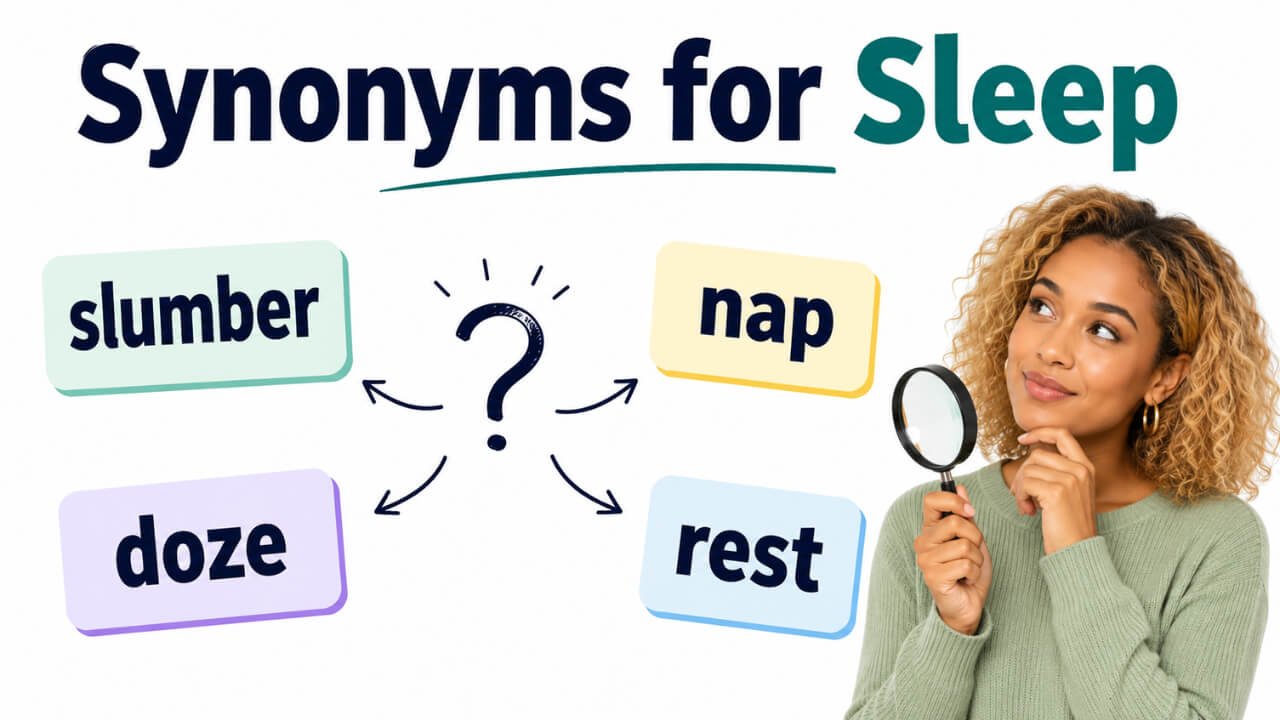
Quick Answer: Common synonyms for sleep include slumber, rest, repose, doze, nap, snooze, drowse, shut eye, dormancy, and unconsciousness. Slumber is a gentle or literary replacement, while rest is the most neutral choice in everyday and formal writing. Nap and doze describe brief periods of sleep. Snooze is more casual, and repose has a peaceful or literary tone. Dormancy works for inactivity in animals, plants, or systems, while unconsciousness refers to a lack of awareness rather than normal sleep.
Pronunciation and Word Details
Word: Sleep.
Pronunciation: /sliːp/
Part of Speech: Noun and verb.
Meaning: A natural state of rest in which the body becomes less active and awareness of the surroundings decreases.
US Pronunciation:
UK Pronunciation:
What Does “Sleep” Mean?
Sleep means to enter or remain in a natural state of physical and mental rest. As a verb, it describes the action of resting with reduced awareness. As a noun, it refers to the state or period of being asleep.
The word appears in many everyday contexts. A person can sleep for eight hours, need more sleep, fall asleep, lose sleep, or have a peaceful sleep. It can describe nighttime rest, a brief nap, deep unconscious rest, or a figurative state of inactivity.
Sleep can also be used in expressions that are not completely literal. A machine may be placed in sleep mode, a town may appear to sleep at night, and an idea may remain dormant until someone develops it.
Meaning, Tone, and Context of “Sleep”
Sleep is a neutral and widely understood word. It is common in casual conversation, formal writing, health discussions, literature, academic explanations, and technical contexts.
In everyday speech, sleep refers to normal nighttime rest. Words such as nap, snooze, and doze are more casual and usually describe shorter or lighter periods of rest.
Slumber and repose have softer, more literary tones. They may appear in stories, poetry, descriptive writing, or peaceful expressions. Rest is neutral and polite, but it can also include relaxation without actual sleep.
In scientific or technical contexts, dormancy, hibernation, unconsciousness, and inactivity may replace sleep when the subject is not ordinary human rest. The correct choice depends on duration, depth, cause, and context.
When and How to Use “Sleep”
For Nighttime Rest: Use sleep when describing the normal period of rest that usually happens at night.
Example: She needs at least seven hours of sleep to feel refreshed.
For the Action of Resting: Use sleep as a verb when someone enters or remains in a state of rest.
Example: The children sleep in separate rooms.
For a Brief Rest: Use sleep when the exact length is not important, or choose nap or doze for a short period.
Example: He slept for thirty minutes after lunch.
For Deep Rest: Use sleep when describing a strong or uninterrupted state of rest.
Example: The sound of rain helped her enter a deep sleep.
For Difficulty Resting: Use sleep in expressions involving tiredness, worry, or interrupted rest.
Example: He could not sleep because he was thinking about the examination.
For Figurative Inactivity: Use sleep when something appears quiet, inactive, or temporarily unused.
Example: The village seemed to sleep beneath the winter sky.
For Technical Settings: Use sleep when a device enters a low activity state without fully turning off.
Example: The computer entered sleep mode after several minutes of inactivity.
Best Synonyms for Sleep
Slumber: A peaceful or gentle period of sleep.
Example: The child remained in a quiet slumber throughout the afternoon.
Rest: A period of relaxation or sleep that restores energy.
Example: She needed a good rest after the long journey.
Repose: A calm and peaceful state of rest.
Example: The garden provided a perfect place for repose.
Doze: A short and light period of sleep.
Example: He began to doze while sitting beside the fire.
Nap: A brief period of sleep, usually during the day.
Example: The baby took a nap after lunch.
Snooze: A short, casual period of sleep.
Example: She enjoyed a quick snooze before returning to work.
Drowse: To become sleepy or enter a light sleep.
Example: The passenger started to drowse during the quiet ride.
Shut Eye: An informal expression for sleep.
Example: I need some shut eye before the early meeting.
Dormancy: A temporary state of inactivity or reduced activity.
Example: The plant enters dormancy during the colder months.
Unconsciousness: A state in which a person is not aware of the surroundings.
Example: The injury caused a brief period of unconsciousness.
50 Synonyms for Sleep with Short Meanings
- Slumber: Peaceful or gentle sleep.
- Rest: Relaxation that restores energy.
- Repose: Calm and peaceful rest.
- Doze: A brief and light sleep.
- Nap: A short period of daytime sleep.
- Snooze: A casual short sleep.
- Drowse: A light or half conscious sleep.
- Shut Eye: An informal term for sleep.
- Catnap: A very brief period of sleep.
- Siesta: An afternoon period of rest or sleep.
- Forty Winks: A short and refreshing sleep.
- Bedtime Rest: Sleep taken at the usual nighttime hour.
- Nightly Rest: The regular sleep taken each night.
- Deep Sleep: A strong and less easily disturbed sleep.
- Sound Sleep: Peaceful sleep without interruption.
- Heavy Sleep: Very deep sleep that is difficult to disturb.
- Light Sleep: Sleep from which someone wakes easily.
- Peaceful Sleep: Calm and comfortable rest.
- Refreshing Sleep: Rest that restores energy and alertness.
- Unbroken Sleep: Sleep that continues without interruption.
- Dreamless Sleep: Sleep without remembered dreams.
- Natural Rest: Ordinary physical and mental sleep.
- Night Rest: A period of sleep during the night.
- Beauty Sleep: Sleep believed to support a fresh appearance.
- Power Nap: A short sleep intended to restore energy.
- Quick Nap: A very brief period of sleep.
- Afternoon Nap: Sleep taken during the afternoon.
- Lie In: Extra sleep taken later than usual in the morning.
- Turn In: To go to bed and prepare for sleep.
- Retire: To go to bed for the night.
- Bed Down: To settle somewhere for sleep.
- Nod Off: To fall asleep unintentionally.
- Drop Off: To begin sleeping.
- Drift Off: To fall asleep slowly and gently.
- Fall Asleep: To enter the state of sleep.
- Go to Sleep: To begin sleeping.
- Get Some Rest: To sleep or relax for recovery.
- Catch Some Sleep: To find time for needed rest.
- Sleep Soundly: To sleep deeply and peacefully.
- Sleep In: To remain asleep later than usual.
- Hibernate: To spend a long period in deep seasonal inactivity.
- Hibernation: A prolonged state of reduced activity and rest.
- Dormancy: A temporary state of inactivity.
- Inactivity: A condition of little or no action.
- Unconsciousness: A state without awareness.
- Stupor: A state of greatly reduced awareness.
- Trance: A state of limited awareness resembling sleep.
- Dreaming: Experiencing thoughts or images during sleep.
- Respite: A short period of relief and rest.
- Relaxation: A state of reduced tension that may support sleep.
Read Also:
Synonyms for Tiny
Synonyms for Sleep by Context
When Sleep Means Nighttime Rest
Rest, nightly rest, night rest, slumber, and repose can describe the normal period of sleep taken at night.
Example: A full night of rest helped her feel more focused the next morning.
Rest is the most flexible alternative because it sounds natural in casual and formal writing. Slumber creates a softer or more descriptive image. Repose sounds peaceful and literary.
When Sleep Means a Brief Nap
Nap, doze, snooze, catnap, forty winks, and power nap describe short periods of sleep.
Example: He took a quick nap before beginning the evening shift.
Nap is the most common neutral choice. Snooze and forty winks are casual. Catnap suggests a particularly short sleep, while power nap emphasizes renewed energy.
When Sleep Means Falling Asleep
Drift off, drop off, nod off, fall asleep, and go to sleep describe the beginning of sleep.
Example: She drifted off while listening to the soft rain.
Drift off suggests a slow and peaceful transition. Nod off often describes accidental sleep. Drop off is informal and commonly used in conversation.
When Sleep Means Going to Bed
Turn in, retire, bed down, and go to bed describe preparing to sleep.
Example: After finishing the book, he decided to turn in for the night.
Turn in is casual. Retire is more formal or traditional. Bed down often describes settling into a temporary or unusual sleeping place.
When Sleep Means Deep Rest
Deep sleep, sound sleep, heavy sleep, peaceful sleep, and unbroken sleep describe the quality or depth of rest.
Example: The quiet room allowed the baby to enjoy an unbroken sleep.
Sound sleep suggests peaceful and uninterrupted rest. Heavy sleep means the sleeper is difficult to awaken. Deep sleep emphasizes intensity rather than comfort.
When Sleep Means Inactivity
Dormancy, hibernation, inactivity, repose, and suspension can describe a temporary lack of action.
Example: Many plants remain in dormancy during winter.
Dormancy is useful for plants, animals, ideas, and systems. Hibernation has a specific biological meaning but may also be used figuratively for long inactivity.
Another Word for Sleep
Rest is often the best single replacement for sleep because it works naturally in many everyday and formal contexts. However, it does not always mean actual sleep. Slumber is better for gentle or literary descriptions, nap for short sleep, doze for light sleep, and dormancy for inactivity.
Original: She needed more sleep after the exhausting trip.
Better Option: She needed more rest after the exhausting trip.
Original: The baby was in a peaceful sleep.
Better Option: The baby was in a peaceful slumber.
Original: He had a short sleep during the afternoon.
Better Option: He took a short nap during the afternoon.
Original: The plant appears to sleep during winter.
Better Option: The plant enters dormancy during winter.
When Not to Use “Sleep”
Do not use sleep when another word would explain the length, depth, cause, or type of rest more accurately.
Sleep may sound too general when the writer means a brief nap, light doze, deep slumber, medical unconsciousness, or seasonal dormancy.
Weak: He had a sleep for ten minutes at his desk.
Better: He took a ten minute nap at his desk.
Avoid using sleep when someone is merely relaxing but remains awake.
Weak: She slept on the sofa while reading.
Better: She rested on the sofa while reading.
Do not call medical unconsciousness sleep because the two states are not always the same.
Weak: The patient remained in sleep after the accident.
Better: The patient remained unconscious after the accident.
Avoid using sleep for plants, systems, or ideas when dormancy or inactivity is more precise.
Weak: The seeds remain asleep throughout the cold season.
Better: The seeds remain dormant throughout the cold season.
Do not replace sleep with a literary word when the surrounding language is simple and conversational.
Weak: I require slumber before tomorrow’s appointment.
Better: I need some sleep before tomorrow’s appointment.
Words Commonly Confused With Sleep
Sleep vs Rest: Sleep is a natural state of reduced awareness. Rest includes sleep but can also mean relaxing while awake.
Sleep vs Nap: Sleep is the general state of resting. A nap is a short period of sleep, usually taken during the day.
Sleep vs Slumber: Sleep is neutral and common. Slumber sounds softer, more peaceful, and more literary.
Sleep vs Doze: Sleep may be deep or long. A doze is usually brief, light, and sometimes unplanned.
Sleep vs Snooze: Sleep is standard in every context. Snooze is informal and usually refers to a short sleep.
Sleep vs Unconsciousness: Sleep is natural and normally reversible through waking. Unconsciousness may result from illness, injury, medication, or another cause.
Sleep vs Dormancy: Sleep usually describes humans and animals. Dormancy describes temporary inactivity in living organisms, systems, projects, or ideas.
Sleep vs Hibernation: Sleep is a regular daily state. Hibernation is a prolonged seasonal state involving greatly reduced activity.
Which Synonym Should You Choose?
Choose rest when writing generally about recovery, relaxation, or sleep.
Choose slumber when creating a peaceful, gentle, or literary description.
Choose nap when referring to a short period of daytime sleep.
Choose doze when the sleep is brief, light, or accidental.
Choose snooze for casual conversation about a short sleep.
Choose catnap when the period of sleep is especially brief.
Choose power nap when the purpose is to restore energy quickly.
Choose repose in formal, descriptive, or literary writing about peaceful rest.
Choose drift off when describing a gradual and gentle transition into sleep.
Choose nod off when someone falls asleep unintentionally.
Choose retire when describing going to bed in formal or traditional language.
Choose dormancy when discussing plants, animals, systems, projects, or ideas that become temporarily inactive.
Choose unconsciousness when awareness is lost because of illness, injury, medication, or another nonstandard cause.
Real Life Examples of “Sleep” in Sentences
Original: I need more sleep before the long journey.
Better Option: I need more rest before the long journey.
Original: The baby entered a peaceful sleep.
Better Option: The baby entered a peaceful slumber.
Original: He had a short sleep after lunch.
Better Option: He took a short nap after lunch.
Original: She began to sleep during the lecture.
Better Option: She began to doze during the lecture.
Original: The passenger slowly went to sleep.
Better Option: The passenger slowly drifted off.
Original: He accidentally slept in the chair.
Better Option: He nodded off in the chair.
Original: We decided to sleep early that evening.
Better Option: We decided to turn in early that evening.
Original: The seeds sleep during the colder months.
Better Option: The seeds remain dormant during the colder months.
Original: She enjoyed an uninterrupted sleep.
Better Option: She enjoyed an unbroken rest.
Original: He needs a little sleep before returning to work.
Better Option: He needs a quick snooze before returning to work.
Synonym Groups and Usage Differences
General Rest Group
Rest, sleep, repose, and relaxation describe recovery from activity or tiredness.
Rest is the broadest word because it may involve sleeping or simply becoming less active. Repose is peaceful and formal, while relaxation focuses on releasing tension.
Example: A period of rest helped him recover his energy.
Short Sleep Group
Nap, doze, snooze, catnap, forty winks, and power nap describe brief periods of sleep.
Nap is neutral and widely understood. Doze suggests light sleep. Snooze is casual, while power nap emphasizes practical recovery.
Example: She took a power nap before the evening event.
Peaceful Sleep Group
Slumber, repose, sound sleep, peaceful sleep, and refreshing sleep emphasize comfort and calmness.
Slumber works especially well in descriptive writing. Sound sleep suggests that the person was not easily disturbed.
Example: The soft music helped the child enjoy a peaceful slumber.
Falling Asleep Group
Drift off, drop off, nod off, and fall asleep describe the transition from wakefulness to sleep.
Drift off sounds gradual and calm. Nod off often suggests accidental or unwanted sleep.
Example: He nodded off while waiting for the train.
Bedtime Group
Turn in, retire, bed down, and go to bed refer to preparing for nighttime rest.
Retire is more formal. Turn in is conversational, while bed down often describes sleeping in a temporary place.
Example: The travelers bedded down beside the quiet shelter.
Inactivity Group
Dormancy, hibernation, inactivity, and suspension describe periods when activity stops or becomes limited.
These words are useful when sleep is figurative or when the subject is not a person taking ordinary rest.
Example: The project remained in dormancy until new funding became available.
Antonyms of Sleep
The opposite of sleep depends on whether the word refers to resting, awareness, physical activity, or inactivity.
Wakefulness: The state of being awake.
Awareness: Conscious knowledge of the surroundings.
Alertness: The condition of being attentive and ready to respond.
Consciousness: The state of being mentally aware.
Activity: The state of doing or moving.
Energy: The strength needed for action.
Motion: Physical movement rather than stillness.
Vigilance: Careful and continued attention.
Attention: Focused mental awareness.
Arousal: A state of increased physical or mental activity.
Restlessness: Difficulty remaining calm or asleep.
Insomnia: Persistent difficulty falling asleep or staying asleep.
Waking: The process of becoming awake.
Stimulation: Something that increases activity or alertness.
Animation: Liveliness, energy, and active movement.
Comparison: Sleep vs Related Words
Sleep vs Rest
Sleep requires a state of reduced awareness. Rest can occur while a person remains fully awake.
Example With Sleep: She slept for eight hours during the night.
Example With Rest: She rested on the sofa without closing her eyes.
Sleep vs Slumber
Sleep is neutral and suitable for nearly every context. Slumber is gentler and often creates a peaceful literary image.
Example With Sleep: The child needs more sleep.
Example With Slumber: The child remained in a peaceful slumber.
Sleep vs Nap
Sleep can last for any amount of time. A nap is usually brief and commonly occurs during the day.
Example With Sleep: He gets enough sleep each night.
Example With Nap: He took a nap after lunch.
Sleep vs Doze
Sleep can be deep and continuous. A doze is usually light, short, and sometimes accidental.
Example With Sleep: She slept throughout the storm.
Example With Doze: She began to doze beside the warm fire.
Sleep vs Snooze
Sleep is neutral and standard. Snooze is informal and often refers to a brief, comfortable period of sleep.
Example With Sleep: I need some sleep before the journey.
Example With Snooze: I need a quick snooze before the journey.
Sleep vs Unconsciousness
Sleep is a normal biological state from which someone can usually be awakened. Unconsciousness is a lack of awareness that may have a medical or physical cause.
Example With Sleep: He entered a deep sleep after midnight.
Example With Unconsciousness: The fall caused a brief period of unconsciousness.
Sleep vs Dormancy
Sleep commonly describes people and animals. Dormancy refers to temporary inactivity in organisms, systems, plans, and ideas.
Example With Sleep: The dog sleeps near the window.
Example With Dormancy: The plant remains in dormancy until spring.
Common Phrases and Expressions With Sleep
Deep Sleep: A strong state of rest from which waking may be difficult.
Sound Sleep: Peaceful and uninterrupted sleep.
Light Sleep: Sleep that is easily disturbed.
Good Night’s Sleep: A restful and sufficient period of nighttime sleep.
Lose Sleep: To remain awake because of worry or another disturbance.
Fall Asleep: To enter the state of sleep.
Go to Sleep: To begin sleeping.
Sleep Soundly: To rest deeply without interruption.
Sleep In: To remain asleep later than usual.
Sleep Like a Log: To sleep very deeply.
Common Mistakes to Avoid
Confusing Sleep With Rest: Rest does not always involve sleep. A person can rest while sitting, reading, or relaxing with open eyes.
Using Nap for Long Sleep: Nap normally refers to a short period of sleep. Use sleep or nightly rest for a full night.
Using Unconsciousness as a Casual Synonym: Unconsciousness may describe a medical or physical condition. It should not replace normal sleep without a clear reason.
Choosing an Unnatural Literary Word: Slumber and repose may sound overly formal in simple conversation. Match the synonym to the tone of the sentence.
Repeating Sleep Too Often: Use nap, rest, doze, slumber, or drift off when they express the intended meaning more accurately.
Confusing Actions With States: Sleep is both a noun and a verb, while asleep is an adjective. Write “I need sleep,” “I sleep well,” and “I am asleep” correctly.
Using the Wrong Verb Form: The past tense of sleep is slept, not sleeped.
Writing Vague Descriptions: Instead of saying someone slept, explain whether the person dozed briefly, slept soundly, drifted off slowly, or took a nap.
Conclusion
The best synonyms for sleep depend on the duration, depth, tone, and purpose of the rest. Rest is the most flexible alternative, while slumber creates a peaceful or literary tone. Nap, doze, snooze, and catnap describe shorter periods. Drift off and nod off explain how sleep begins, while dormancy and hibernation suit inactivity in nature or systems. Choosing precise synonyms for sleep helps readers understand whether the subject is relaxing, sleeping deeply, resting briefly, or becoming temporarily inactive.
FAQs About Synonyms for Sleep
What is the best synonym for sleep?
Rest is the most flexible synonym for sleep. Slumber is better for peaceful descriptions, while nap is best for a short period of sleep.
What is a formal synonym for sleep?
Repose and slumber are more formal alternatives. Retire is a formal way to describe going to bed.
What is a casual word for sleep?
Snooze, shut eye, and forty winks are casual expressions for sleep.
What is another word for a short sleep?
Nap, doze, catnap, snooze, and power nap all describe a short period of sleep.
Is rest the same as sleep?
Not completely. Sleep involves reduced awareness, while rest can include relaxation without actually falling asleep.
What word describes falling asleep slowly?
Drift off is the best expression for gradually and peacefully falling asleep.
What is the opposite of sleep?
Wakefulness is the clearest opposite of sleep. Other antonyms include alertness, consciousness, activity, and awareness.
