
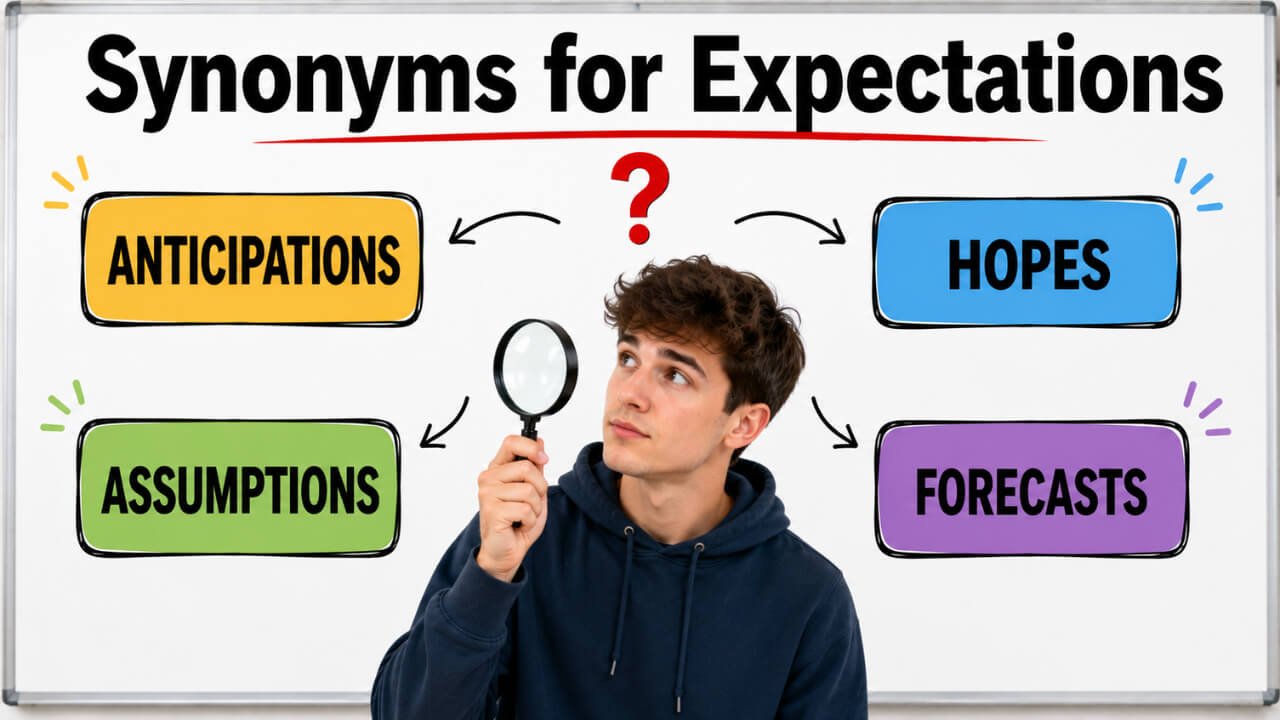
Quick Answer: Common synonyms for expectations include anticipations, assumptions, beliefs, predictions, hopes, aspirations, standards, requirements, demands, and goals. Use anticipations for future events, assumptions for beliefs without full proof, predictions for likely outcomes, hopes for desired results, and aspirations for personal ambitions. Standards and criteria work best when discussing quality, while requirements and demands describe what someone must provide or achieve. The best synonym depends on whether expectations refers to future beliefs, desired outcomes, performance standards, or obligations.
Pronunciation and Word Details
Word: Expectations
Pronunciation: /ˌek.spekˈteɪ.ʃənz/
Part of Speech: Plural noun
Meaning: Beliefs, hopes, standards, or requirements about what should happen or how someone should behave.
US Pronunciation:
UK Pronunciation:
What Does “Expectations” Mean?
Expectations are beliefs or ideas about what is likely to happen, what someone should do, or what result should be achieved.
The word expectations is the plural form of expectation. It functions as a plural noun and can describe predictions, hopes, standards, requirements, or assumptions.
In future focused sentences, expectations describe what people believe will happen. In personal contexts, they may refer to hopes and ambitions. At work or school, expectations often mean standards, responsibilities, or required levels of performance.
The meaning becomes clear from the surrounding sentence. High expectations usually refer to demanding standards, while future expectations usually describe predicted outcomes.
Meaning, Tone, and Context of “Expectations”
Expectations is a neutral and widely used word. It can appear in formal writing, academic discussions, professional communication, personal conversations, and everyday speech.
The word may carry a positive tone when it describes hope, confidence, ambition, or excitement. It can sound negative when expectations are unrealistic, demanding, disappointing, or stressful.
In professional contexts, expectations commonly refer to performance standards, responsibilities, deadlines, and required behavior. In relationships, they often describe beliefs about trust, communication, support, and commitment.
In economic or technical writing, expectations may describe predictions about future conditions. In personal development, the word can refer to goals, hopes, or beliefs about success.
When and How to Use “Expectations”
For Future Predictions: Use expectations when describing what people believe will probably happen.
Example: Economic expectations improved after several months of steady growth.
For Performance Standards: Use expectations when explaining the quality or level of work that someone should achieve.
Example: Every employee received a clear explanation of the company’s performance expectations.
For Personal Hopes: Use expectations when discussing desired results or experiences.
Example: Her expectations for the holiday were simple and realistic.
For Responsibilities: Use expectations when describing behavior, duties, or actions required from a person.
Example: The teacher explained the classroom expectations on the first day.
For Relationships: Use expectations when discussing what people believe others should provide emotionally or practically.
Example: Honest conversations can prevent misunderstandings about relationship expectations.
For Products or Services: Use expectations when comparing an actual experience with an expected level of quality.
Example: The finished design exceeded the client’s expectations.
Best Synonyms for Expectations
Anticipations: Thoughts or feelings about something that is likely to happen.
Example: Their anticipations grew as the opening date approached.
Assumptions: Beliefs accepted as true without complete evidence.
Example: The plan was based on assumptions about customer behavior.
Predictions: Statements or beliefs about future events.
Example: Weather predictions suggested several days of rain.
Hopes: Desired results that someone wants to happen.
Example: Her hopes for the new project remained high.
Aspirations: Strong desires to achieve something meaningful.
Example: His career aspirations encouraged him to continue learning.
Standards: Accepted levels of quality, behavior, or achievement.
Example: The final report met the required standards.
Requirements: Conditions or tasks that must be completed.
Example: Applicants must understand all job requirements.
Demands: Strong requests or difficult conditions that must be satisfied.
Example: The demands of the position require patience and experience.
Goals: Results that a person or group intends to achieve.
Example: The team reached its annual goals ahead of schedule.
Criteria: Rules or conditions used to judge quality or suitability.
Example: Every application was reviewed according to the same criteria.
50 Synonyms for Expectations with Short Meanings
- Anticipations: Beliefs or feelings about what will happen.
- Predictions: Statements about likely future events.
- Forecasts: Estimates of future conditions or results.
- Projections: Calculated estimates of future performance.
- Assumptions: Ideas accepted without complete proof.
- Beliefs: Ideas considered to be true.
- Presumptions: Beliefs formed before all facts are known.
- Suppositions: Possible explanations or uncertain beliefs.
- Impressions: Opinions formed from available information.
- Outlooks: General views about future possibilities.
- Prospects: Possibilities of future success or development.
- Expectancies: States of expecting particular outcomes.
- Hopes: Desires for positive results.
- Aspirations: Strong wishes for achievement or improvement.
- Wishes: Things someone wants to happen.
- Desires: Strong feelings of wanting something.
- Ambitions: Determined aims for future success.
- Aims: Intended purposes or results.
- Goals: Results someone plans to achieve.
- Objectives: Specific results toward which effort is directed.
- Intentions: Things someone plans or means to do.
- Plans: Organized ideas about future actions.
- Visions: Clear ideas of desired future situations.
- Standards: Expected levels of quality or behavior.
- Requirements: Conditions that must be satisfied.
- Demands: Strong expectations that require action.
- Criteria: Standards used to make judgments.
- Benchmarks: Reference points used to measure performance.
- Norms: Commonly accepted patterns or standards.
- Guidelines: General rules for proper action.
- Conditions: Circumstances or terms that must be met.
- Obligations: Actions someone is required to perform.
- Responsibilities: Duties for which someone is accountable.
- Duties: Tasks that a person is expected to complete.
- Targets: Specific results someone is expected to reach.
- Quotas: Fixed amounts that must be achieved.
- Ideals: Perfect standards or desired principles.
- Principles: Basic beliefs that guide behavior.
- Conventions: Accepted ways of behaving or doing something.
- Rules: Instructions that control actions or behavior.
- Prerequisites: Conditions required before something can happen.
- Stipulations: Specific conditions included in an agreement.
- Probabilities: Measures of how likely events are.
- Likelihoods: Chances that particular events will happen.
- Estimates: Approximate judgments about future amounts or results.
- Expected Outcomes: Results believed to be likely.
- Desired Results: Outcomes that someone wants to achieve.
- Predicted Results: Outcomes suggested by evidence or analysis.
- Preconceived Notions: Opinions formed before gaining full knowledge.
- Performance Standards: Expected levels of work or achievement.
Read Also:
Synonyms for Health

Synonyms for Expectations by Context
When Expectations Means Future Beliefs
When expectations refers to ideas about the future, useful synonyms include anticipations, predictions, forecasts, projections, prospects, estimates, probabilities, and outlooks.
Anticipations often involve thoughts or feelings about an approaching event. Predictions and forecasts are more suitable when evidence or analysis supports the future belief.
Example: Market forecasts indicated that demand would increase during the summer.
When Expectations Means Assumptions
Expectations may describe beliefs about what someone will do or what a situation will be like. Suitable alternatives include assumptions, presumptions, suppositions, beliefs, impressions, and preconceived notions.
Assumptions are beliefs made without complete evidence. Presumptions often sound more formal and may suggest that a conclusion was reached before all facts were examined.
Example: His assumptions about the new employee proved inaccurate.
When Expectations Means Hopes
When expectations describes wanted or desired results, strong alternatives include hopes, wishes, desires, aspirations, ambitions, aims, visions, and goals.
Hopes are appropriate for general desired outcomes. Aspirations and ambitions describe stronger long term desires involving personal development or success.
Example: Her aspirations included becoming a skilled writer and respected teacher.
When Expectations Means Standards
Expectations often refers to the quality, behavior, or performance someone should demonstrate. Useful synonyms include standards, benchmarks, criteria, norms, guidelines, rules, and ideals.
Standards describe an accepted level of quality. Benchmarks are reference points used to compare progress or performance.
Example: The product passed every quality benchmark during testing.
When Expectations Means Requirements
In professional, educational, or official contexts, expectations may mean duties or conditions that must be fulfilled. Suitable alternatives include requirements, obligations, responsibilities, duties, conditions, prerequisites, and stipulations.
Requirements identify what must be done. Responsibilities describe tasks for which someone is personally accountable.
Example: Clear responsibilities helped each team member understand what to complete.
When Expectations Means Goals
Expectations may also refer to planned achievements. Useful synonyms include goals, objectives, targets, aims, plans, intentions, and quotas.
Goals can be broad, while objectives and targets are often more specific and measurable.
Example: The department reached its quarterly targets before the final deadline.
Another Word for Expectations
Anticipations is one of the best general replacements for expectations when discussing future events. However, the most accurate alternative depends on the intended meaning.
Use hopes for desired results, standards for quality, requirements for necessary conditions, assumptions for unsupported beliefs, and goals for planned achievements.
Original: Our expectations for the event were positive.
Better Option: Our anticipations for the event were positive.
Original: The manager explained her expectations for the team.
Better Option: The manager explained her performance standards for the team.
Original: His expectations about the result were not based on evidence.
Better Option: His assumptions about the result were not based on evidence.
Original: She has high expectations for her future career.
Better Option: She has ambitious career aspirations.
When Not to Use “Expectations”
Avoid expectations when a more precise word can communicate the intended meaning clearly.
The word may sound vague if the reader cannot determine whether it refers to hopes, predictions, standards, goals, or requirements. It may also become repetitive when used several times in the same paragraph.
Use requirements when something is compulsory. Use hopes when discussing desired outcomes. Use predictions when describing future events supported by evidence. Use standards when evaluating quality or performance.
Weak: The expectations for the assignment include three pages and five sources.
Better: The requirements for the assignment include three pages and five sources.
Weak: Her expectations are to become a successful designer.
Better: Her aspiration is to become a successful designer.
Weak: The report contains expectations about next year’s sales.
Better: The report contains projections for next year’s sales.
Weak: The product did not reach customer expectations for quality.
Better: The product did not meet customer quality standards.
Words Commonly Confused With Expectations
Expectations vs Assumptions: Expectations are beliefs about what should or probably will happen. Assumptions are beliefs accepted without complete evidence.
Expectations vs Predictions: Expectations may come from personal beliefs, hopes, or experience. Predictions usually focus on future outcomes and may be supported by evidence.
Expectations vs Hopes: Expectations often suggest that a result is considered likely. Hopes express a desire without claiming that the result will occur.
Expectations vs Goals: Expectations describe what someone believes should happen. Goals describe what someone actively intends to achieve.
Expectations vs Standards: Expectations can include general beliefs or hopes. Standards specifically describe accepted levels of quality, conduct, or performance.
Expectations vs Requirements: Expectations may be flexible or implied. Requirements are usually clear conditions that must be fulfilled.
Expectations vs Demands: Expectations can be reasonable and politely expressed. Demands are stronger and may involve pressure or authority.
Expectations vs Aspirations: Expectations concern likely or required outcomes. Aspirations are strong personal desires for future achievement.
Which Synonym Should You Choose?
Choose anticipations when describing thoughts or feelings about an approaching event.
Choose predictions when discussing future outcomes based on evidence, patterns, or analysis.
Choose assumptions when describing beliefs that have not been fully proven.
Choose hopes when referring to desired results that are not guaranteed.
Choose aspirations when discussing personal growth, career success, education, or long term achievement.
Choose standards when describing an accepted level of quality, behavior, or performance.
Choose requirements when identifying conditions that must be satisfied.
Choose demands when the expectations are strong, difficult, or forcefully expressed.
Choose criteria when explaining how a person, product, or result will be judged.
Choose goals when discussing planned achievements.
Choose objectives for formal plans, projects, reports, and measurable results.
Choose responsibilities when explaining tasks or behavior for which a person is accountable.
Choose forecasts or projections for business, economic, scientific, or financial writing.
Choose norms when discussing behavior commonly accepted by a group or society.
Real Life Examples of “Expectations” in Sentences
Original: The new employee clearly understood the manager’s expectations.
Better Option: The new employee clearly understood the manager’s performance standards.
Original: Our expectations for the weekend were affected by the weather report.
Better Option: Our plans for the weekend were affected by the weather forecast.
Original: Her expectations for the future remained positive.
Better Option: Her outlook for the future remained positive.
Original: The students struggled to meet the teacher’s expectations.
Better Option: The students struggled to meet the teacher’s requirements.
Original: His expectations about the meeting were incorrect.
Better Option: His assumptions about the meeting were incorrect.
Original: The final result exceeded everyone’s expectations.
Better Option: The final result surpassed everyone’s hopes.
Original: Parents often have different expectations for their children.
Better Option: Parents often have different hopes and standards for their children.
Original: The report explains expectations for future sales.
Better Option: The report explains projections for future sales.
Original: Clear expectations can improve teamwork.
Better Option: Clear responsibilities and standards can improve teamwork.
Original: Her career expectations changed after graduation.
Better Option: Her career goals changed after graduation.
Synonym Groups and Usage Differences
Future Belief Group
Anticipations, predictions, forecasts, projections, outlooks, and estimates describe beliefs about future events.
Predictions may be general, while forecasts and projections usually rely on evidence, calculations, or observable patterns.
Example: The sales projections showed steady growth for the next quarter.
Hope and Desire Group
Hopes, wishes, desires, aspirations, ambitions, and visions describe wanted outcomes.
Hopes and wishes are broad. Aspirations and ambitions suggest stronger motivation and long term effort.
Example: Her professional aspirations encouraged her to apply for advanced training.
Standard and Quality Group
Standards, benchmarks, criteria, norms, guidelines, and ideals describe expected levels of quality or conduct.
Criteria are used for judgment, while benchmarks are used for comparison and measurement.
Example: The judges assessed every entry according to the same criteria.
Duty and Requirement Group
Requirements, obligations, responsibilities, duties, conditions, and prerequisites describe actions or terms that must be fulfilled.
Requirements focus on necessary conditions. Responsibilities focus on personal accountability.
Example: One of his main responsibilities was preparing the weekly report.
Goal and Achievement Group
Goals, objectives, aims, targets, quotas, and plans describe intended results.
Goals may be broad, while targets and quotas are usually specific and measurable.
Example: The sales team reached its monthly quota.
Belief and Assumption Group
Assumptions, presumptions, suppositions, beliefs, impressions, and preconceived notions describe ideas that may not be fully proven.
Assumptions are common in everyday speech. Presumptions and suppositions often sound more formal.
Example: The decision was based on an incorrect assumption.
Antonyms of Expectations
The opposite of expectations depends on whether the word refers to predictions, hopes, standards, or certainty.
Surprise: An unexpected event or result.
Uncertainty: A lack of confidence about what will happen.
Doubt: A feeling that something may not be true or likely.
Disbelief: An inability or refusal to accept something as true.
Hopelessness: A feeling that no positive result is possible.
Indifference: A lack of interest in the result.
Improvisation: Action taken without a prepared plan.
Unexpectedness: The quality of not being anticipated.
Aimlessness: A lack of goals or intended direction.
Unpredictability: The condition of being difficult to forecast.
Flexibility: Willingness to accept different outcomes or methods.
Acceptance: Recognition of reality without insisting on a particular result.
Comparison: Expectations vs Related Words
Expectations vs Anticipations
Expectations are beliefs about what should or probably will happen. Anticipations focus more directly on thoughts or feelings about an approaching event.
Example With Expectations: The audience had high expectations for the performance.
Example With Anticipations: The audience’s anticipations grew as the curtain began to rise.
Expectations vs Assumptions
Expectations may be based on experience, standards, or promises. Assumptions are accepted as true even when complete proof is unavailable.
Example With Expectations: Her expectations were based on the project agreement.
Example With Assumptions: Her assumptions were based on incomplete information.
Expectations vs Hopes
Expectations suggest that an outcome is considered likely or reasonable. Hopes simply express what someone wants to happen.
Example With Expectations: We expect the repairs to be completed tomorrow.
Example With Hopes: We hope the repairs will be completed tomorrow.
Expectations vs Predictions
Expectations may be personal and subjective. Predictions are statements about future outcomes and are often based on evidence.
Example With Expectations: Customer expectations changed after the announcement.
Example With Predictions: Industry predictions suggested that prices would increase.
Expectations vs Standards
Expectations can describe beliefs, hopes, or requirements. Standards describe specific levels of quality, behavior, or performance.
Example With Expectations: The results exceeded our expectations.
Example With Standards: The results met all professional standards.
Expectations vs Requirements
Expectations may be informal or implied. Requirements are official or necessary conditions that must be completed.
Example With Expectations: The supervisor discussed her expectations during the meeting.
Example With Requirements: The supervisor listed the position’s requirements in writing.
Expectations vs Goals
Expectations describe beliefs about future results. Goals describe outcomes that someone intentionally works toward.
Example With Expectations: Their expectations for growth were realistic.
Example With Goals: Their growth goals included opening two new locations.
Common Phrases and Expressions With Expectations
High Expectations: Demanding or ambitious beliefs about performance or results.
Low Expectations: Limited beliefs about likely success or quality.
Realistic Expectations: Beliefs that match reasonable possibilities.
Unrealistic Expectations: Beliefs that are difficult or impossible to satisfy.
Meet Expectations: Achieve the required or predicted standard.
Exceed Expectations: Perform better than anticipated.
Fall Below Expectations: Fail to reach the desired standard.
Manage Expectations: Help people understand what can realistically happen.
Set Expectations: Clearly explain required behavior, quality, or results.
Clear Expectations: Standards or requirements that are easy to understand.
Customer Expectations: Beliefs about the quality, value, or service a customer should receive.
Performance Expectations: Required levels of work, behavior, or achievement.
Beyond Expectations: Better or more impressive than anticipated.
Contrary to Expectations: Different from what people believed would happen.
Common Mistakes to Avoid
Using Expectations for Every Meaning: Expectations can refer to hopes, standards, assumptions, predictions, or requirements. Choose a more specific synonym when the intended meaning needs clarification.
Confusing Expectations With Hopes: A hope is something a person wants. An expectation is something a person believes is likely or reasonable.
Treating Assumptions as Facts: Expectations based on assumptions should not be presented as proven results.
Using Singular and Plural Forms Incorrectly: Expectation refers to one belief, standard, or anticipated result. Expectations refers to two or more beliefs, standards, or outcomes.
Repeating the Word Too Often: Repeated use can make a paragraph sound dull. Replace some instances with standards, goals, hopes, predictions, or requirements when appropriate.
Choosing a Synonym Without Considering Tone: Demands sounds stronger than expectations. Aspirations sounds more personal and ambitious. Requirements sounds more official and compulsory.
Writing Vague Sentences: Explain whose expectations are being discussed and what result or behavior is expected.
Vague: The expectations were not met.
Clear: The product did not meet the customers’ expectations for durability.
Using Unrealistic With the Wrong Meaning: Unrealistic expectations are beliefs or standards that are difficult to satisfy. The phrase does not simply mean an unexpected event.
Ignoring Context: In a workplace, expectations may mean responsibilities. In personal planning, they may mean hopes. In a report, they may mean predictions or projections.
Conclusion
Synonyms for expectations include anticipations, assumptions, predictions, hopes, aspirations, standards, requirements, demands, criteria, and goals. The right choice depends on the intended meaning. Use anticipations or predictions for future events, hopes or aspirations for desired results, and standards or criteria for quality. Requirements and responsibilities work best for necessary duties, while assumptions describe beliefs without complete proof. Choosing a precise synonym makes writing clearer, reduces repetition, and helps readers understand whether you are discussing beliefs, ambitions, obligations, or likely outcomes.
FAQs About Synonyms for Expectations
What is the best synonym for expectations?
Anticipations is a strong general synonym when expectations refers to future events. Standards, hopes, assumptions, and requirements may be more accurate in other contexts.
What is another word for high expectations?
Strong alternatives include demanding standards, ambitious goals, high hopes, strict requirements, and elevated standards.
Are expectations and assumptions the same?
No. Expectations are beliefs about what should or probably will happen. Assumptions are beliefs accepted without complete proof.
What is a formal synonym for expectations?
Anticipations, projections, criteria, requirements, objectives, and performance standards are suitable formal alternatives.
What word can replace expectations in professional writing?
Standards, requirements, objectives, responsibilities, criteria, or projections may work, depending on the sentence.
What is the difference between hopes and expectations?
Hopes describe desired outcomes. Expectations describe outcomes that someone believes are likely, reasonable, or required.
Can goals be used as a synonym for expectations?
Goals can replace expectations when the sentence refers to planned achievements. They are not suitable when expectations means assumptions, predictions, or standards.
