
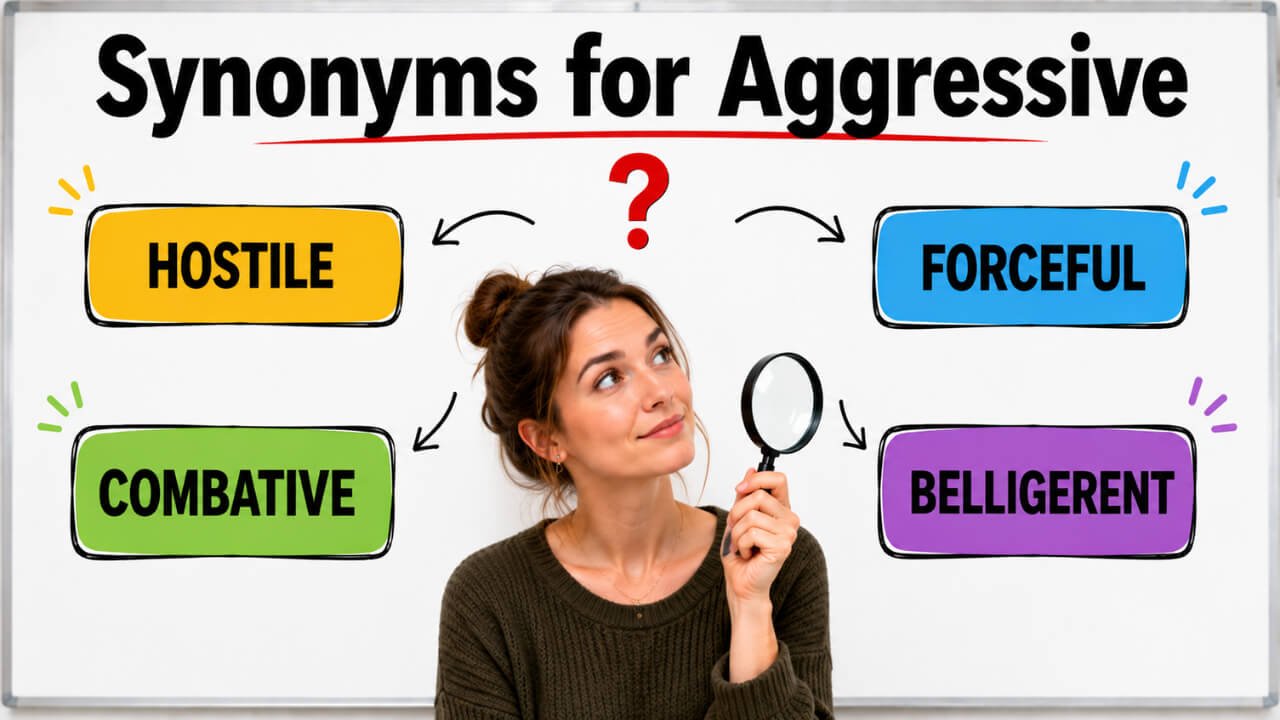
Quick Answer: Common synonyms for aggressive include assertive, forceful, hostile, combative, confrontational, fierce, belligerent, pushy, domineering, and driven. Assertive is usually best for confident but respectful behavior. Forceful suits strong speech or action, while hostile, combative, and belligerent describe conflict. Fierce works well for intense competition, and driven or ambitious can describe someone pursuing goals energetically. The most accurate synonym depends on whether aggressive expresses confidence, pressure, hostility, ambition, competition, or physical violence.
Pronunciation and Word Details
Word: Aggressive.
Pronunciation: /əˈɡrɛsɪv/
Part of Speech: Adjective.
Meaning: Ready to attack, confront, compete, or pursue a goal with unusual force and determination.
US Pronunciation:
UK Pronunciation:
What Does “Aggressive” Mean?
Aggressive means behaving or acting with unusual force, determination, hostility, or readiness to attack. It is an adjective that can describe a person, attitude, action, strategy, disease, style, or approach.
When aggressive describes behavior, it often suggests anger, confrontation, or an attempt to control others. An aggressive person may speak harshly, invade personal boundaries, or react as though every disagreement is a conflict.
The word can also describe intense effort without necessarily suggesting anger. An aggressive business plan, training schedule, or growth strategy is designed to produce rapid or ambitious results.
In competitive contexts, aggressive may describe someone who acts boldly and applies constant pressure. In physical contexts, it may refer to threatening, attacking, or violent behavior.
Meaning, Tone, and Context of “Aggressive”
Aggressive is a strong and often negative word. In everyday conversation, it commonly describes behavior that feels hostile, threatening, rude, or overly forceful. Calling someone aggressive may suggest that the person does not respect boundaries or communicate calmly.
In formal writing, aggressive can describe conduct, policies, strategies, competition, or rapid development. Its meaning depends greatly on the noun it modifies.
An aggressive tone usually sounds confrontational. An aggressive strategy may simply be bold and ambitious. An aggressive animal may be likely to attack, while an aggressive competitor may be intensely determined to win.
The word is common in conversational, professional, academic, medical, psychological, and technical contexts. Writers should choose a more precise synonym whenever aggressive could be misunderstood.
When and How to Use “Aggressive”
For Hostile Behavior: Use aggressive when someone acts angrily, threateningly, or confrontationally.
Example: His aggressive behavior made the other guests uncomfortable.
For Forceful Communication: Use aggressive when speech is unusually harsh, demanding, or intimidating.
Example: Her aggressive tone turned a simple discussion into an argument.
For Competitive Action: Use aggressive when a person or team applies strong pressure to gain an advantage.
Example: The players adopted an aggressive approach during the final minutes.
For Ambitious Goals: Use aggressive when a plan aims for fast, difficult, or unusually large results.
Example: The organization created an aggressive expansion plan.
For Physical Threats: Use aggressive when a person or animal appears ready to attack.
Example: The dog became aggressive when strangers approached the gate.
For Persistent Pursuit: Use aggressive when someone follows a goal with intense energy and determination.
Example: She took an aggressive approach to finding new opportunities.
For Rapid Development: Use aggressive when a condition, process, or trend develops unusually quickly.
Example: The researchers examined the aggressive spread of the problem.
Best Synonyms for Aggressive
Assertive: Confident and direct without being disrespectful.
Example: She remained assertive while explaining her concerns.
Forceful: Expressed or performed with strength and authority.
Example: He made a forceful argument for changing the policy.
Hostile: Unfriendly and ready for conflict.
Example: The conversation became hostile after the accusation.
Combative: Eager to argue, challenge, or fight.
Example: His combative attitude prevented a calm discussion.
Confrontational: Likely to create or invite direct conflict.
Example: Her confrontational response surprised the entire group.
Belligerent: Angry, threatening, and eager to fight.
Example: The belligerent customer refused to lower his voice.
Fierce: Powerful, intense, and strongly competitive.
Example: The two candidates faced fierce competition.
Pushy: Too forceful when trying to get something.
Example: The pushy salesperson ignored the customer’s hesitation.
Domineering: Attempting to control other people.
Example: His domineering manner made cooperation difficult.
Driven: Highly motivated to achieve a goal.
Example: She is a driven professional who works toward clear objectives.
50 Synonyms for Aggressive with Short Meanings
- Hostile: Unfriendly and ready for conflict.
- Combative: Eager to argue or fight.
- Belligerent: Angry and threatening.
- Confrontational: Likely to cause direct conflict.
- Forceful: Strong and persuasive.
- Assertive: Confident and direct.
- Fierce: Intensely powerful or competitive.
- Pushy: Excessively forceful or persistent.
- Domineering: Controlling toward other people.
- Attacking: Acting against someone with force.
- Antagonistic: Showing active opposition or hostility.
- Militant: Strongly active and confrontational.
- Pugnacious: Eager to argue or fight.
- Quarrelsome: Frequently willing to argue.
- Argumentative: Inclined to challenge and disagree.
- Bellicose: Demonstrating a desire to fight.
- Threatening: Suggesting possible danger or harm.
- Intimidating: Causing fear or nervousness.
- Bullying: Using power to frighten or control.
- Overbearing: Unpleasantly controlling or dominant.
- Controlling: Trying to direct other people’s actions.
- Coercive: Using pressure or threats.
- Demanding: Expecting a great deal from others.
- Insistent: Refusing to accept delay or disagreement.
- Relentless: Continuing without reducing effort.
- Determined: Firmly committed to a goal.
- Driven: Strongly motivated to succeed.
- Ambitious: Eager to achieve important goals.
- Competitive: Strongly motivated to win.
- Vigorous: Full of strength and energy.
- Intense: Showing extreme force or concentration.
- Bold: Confident and willing to take risks.
- Energetic: Acting with great energy.
- Proactive: Taking action before it becomes necessary.
- Offensive: Designed to attack or gain ground.
- Invasive: Entering or spreading in an unwanted way.
- Predatory: Seeking advantage by exploiting weakness.
- Violent: Using or involving physical force.
- Savage: Extremely fierce or brutal.
- Brutal: Cruel, harsh, or violent.
- Ferocious: Extremely fierce and threatening.
- Provocative: Likely to cause anger or conflict.
- Menacing: Appearing dangerous or threatening.
- Irritable: Easily annoyed or angered.
- Hot tempered: Becoming angry very quickly.
- Ruthless: Showing no sympathy when pursuing a goal.
- Uncompromising: Unwilling to change a position.
- Adversarial: Based on opposition or conflict.
- Hard charging: Pursuing goals with intense energy.
- Pressuring: Strongly pushing someone to act.
Read Also:
Synonyms for Expectations
Synonyms for Aggressive by Context
When Aggressive Means Hostile
Hostile, antagonistic, combative, confrontational, and belligerent describe behavior that creates conflict or shows active opposition.
Example: His hostile response made a peaceful solution less likely.
Hostile is a broad word for unfriendly behavior. Combative suggests eagerness to argue. Belligerent is stronger and often implies anger or threats. Confrontational describes a manner that directly invites conflict.
When Aggressive Means Forceful
Forceful, assertive, insistent, demanding, and bold describe strong communication or action.
Example: She gave a forceful presentation without becoming disrespectful.
Assertive is normally positive because it combines confidence with respect. Forceful suggests strength and authority. Insistent describes persistence, while demanding suggests high expectations or pressure.
When Aggressive Means Competitive
Fierce, competitive, relentless, intense, and hard charging describe a strong desire to win or advance.
Example: The athlete remained fiercely competitive throughout the tournament.
Fierce emphasizes intensity. Relentless suggests continuous pressure. Hard charging describes energetic pursuit, while competitive focuses specifically on the desire to outperform others.
When Aggressive Means Ambitious
Driven, ambitious, determined, proactive, energetic, and vigorous describe strong efforts toward a goal.
Example: Her ambitious plan required careful preparation and sustained effort.
Driven and ambitious are useful positive alternatives when aggressive would sound unnecessarily hostile. Proactive emphasizes early action, while determined focuses on commitment.
When Aggressive Means Violent
Violent, attacking, savage, brutal, and ferocious describe physical danger or destructive force.
Example: The animal displayed ferocious behavior when it felt trapped.
Violent directly refers to physical force. Ferocious and savage suggest extreme fierceness. Brutal emphasizes cruelty or severity.
When Aggressive Means Controlling
Domineering, overbearing, coercive, bullying, intimidating, and pushy describe attempts to pressure or control others.
Example: His overbearing management style discouraged honest feedback.
Domineering suggests a desire to control. Coercive involves pressure or threats. Pushy is more conversational and usually describes annoying persistence.
Another Word for Aggressive
Assertive is often the best single replacement for aggressive when describing confident communication. However, the most suitable alternative depends on the intended meaning. Use hostile for unfriendly behavior, forceful for strong expression, fierce for intense competition, and driven for ambitious effort.
Original: Maria was aggressive when presenting her opinion.
Better Option: Maria was assertive when presenting her opinion.
Original: The speaker used an aggressive argument.
Better Option: The speaker used a forceful argument.
Original: The two teams faced aggressive competition.
Better Option: The two teams faced fierce competition.
Original: He followed an aggressive career plan.
Better Option: He followed an ambitious career plan.
When Not to Use “Aggressive”
Do not use aggressive when a more precise word would explain the situation better. The word can sound negative even when the intended meaning is confidence, energy, ambition, or determination.
Avoid calling respectful communication aggressive. Assertive is usually more accurate when someone speaks confidently while respecting others.
Weak: She was aggressive when she calmly defended her decision.
Better: She was assertive when she calmly defended her decision.
Avoid using aggressive for every strong action. Forceful, vigorous, bold, or determined may provide a clearer meaning.
Weak: He gave an aggressive explanation of the proposal.
Better: He gave a forceful explanation of the proposal.
Do not use aggressive when describing healthy ambition unless the person is applying excessive pressure.
Weak: The student was aggressive about completing her degree.
Better: The student was determined to complete her degree.
Avoid vague descriptions when the behavior is specifically threatening, violent, controlling, or argumentative.
Weak: The customer became aggressive.
Better: The customer became verbally threatening.
Words Commonly Confused With Aggressive
Aggressive vs Assertive: Aggressive behavior may ignore boundaries or create conflict. Assertive behavior expresses needs and opinions confidently while respecting others.
Aggressive vs Hostile: Aggressive can describe forceful action, ambition, or conflict. Hostile specifically suggests unfriendliness, opposition, or anger.
Aggressive vs Violent: Aggressive behavior may involve harsh speech or pressure without physical harm. Violent behavior involves physical force or destructive action.
Aggressive vs Ambitious: Aggressive may suggest excessive force or competition. Ambitious describes a strong desire to achieve important goals and is usually more positive.
Aggressive vs Forceful: Aggressive can sound threatening or hostile. Forceful describes strength, confidence, or persuasive power without necessarily suggesting anger.
Aggressive vs Proactive: Aggressive means acting with unusual force or intensity. Proactive means acting early to prevent a problem or create an opportunity.
Aggressive vs Competitive: Aggressive can describe hostile conduct or intense effort. Competitive specifically describes a desire to win or perform better than others.
Which Synonym Should You Choose?
Choose assertive when describing confident, respectful communication in meetings, emails, discussions, or personal boundaries.
Choose forceful when describing a powerful argument, speech, statement, reaction, or action.
Choose hostile when someone is unfriendly, angry, or actively opposed to another person.
Choose combative when someone repeatedly challenges others or appears eager to argue.
Choose confrontational when a person directly invites or creates conflict.
Choose belligerent when the behavior is openly angry, threatening, or ready for a fight.
Choose fierce when describing strong competition, determination, loyalty, or intensity.
Choose driven or ambitious when describing energetic efforts toward professional, academic, or personal goals.
Choose pushy when someone applies annoying or excessive social pressure.
Choose domineering or overbearing when someone tries to control other people.
Choose coercive when pressure, intimidation, or threats are used to force agreement.
Choose violent when the behavior involves actual physical force or destruction.
Real Life Examples of “Aggressive” in Sentences
Original: The manager used an aggressive tone during the meeting.
Better Option: The manager used a confrontational tone during the meeting.
Original: She became aggressive when her idea was questioned.
Better Option: She became combative when her idea was questioned.
Original: The company followed an aggressive growth plan.
Better Option: The organization followed an ambitious growth plan.
Original: He was aggressive about reaching his career goals.
Better Option: He was driven to reach his career goals.
Original: The salesperson became aggressive after the customer declined.
Better Option: The salesperson became pushy after the customer declined.
Original: The lawyer made an aggressive argument.
Better Option: The lawyer made a forceful argument.
Original: The team played aggressively throughout the match.
Better Option: The team played fiercely throughout the match.
Original: The animal showed aggressive behavior near its food.
Better Option: The animal showed threatening behavior near its food.
Original: Her aggressive leadership style upset the staff.
Better Option: Her domineering leadership style upset the staff.
Original: His aggressive questioning made the witness uncomfortable.
Better Option: His intimidating questioning made the witness uncomfortable.
Synonym Groups and Usage Differences
Conflict Group
Hostile, combative, belligerent, confrontational, antagonistic, and adversarial describe opposition and conflict.
Hostile is broadly unfriendly. Combative suggests a desire to argue. Belligerent is more openly angry and threatening. Adversarial is common in formal contexts involving opposing sides.
Example: The discussion became adversarial once both sides refused to compromise.
Confidence Group
Assertive, bold, forceful, determined, and insistent describe strong expression or action.
Assertive is respectful and confident. Bold suggests courage. Forceful emphasizes strength, while insistent focuses on persistence.
Example: She was assertive when requesting a clear answer.
Pressure Group
Pushy, coercive, demanding, domineering, overbearing, and controlling describe attempts to influence or direct others.
Pushy is conversational and often describes social pressure. Coercive is more serious because it may involve threats or intimidation.
Example: The supervisor’s coercive tactics damaged trust within the group.
Competition Group
Fierce, competitive, relentless, intense, driven, and hard charging describe strong effort and a desire to succeed.
Driven and competitive may be positive when the person behaves fairly. Relentless can be positive or negative depending on whether the pressure becomes excessive.
Example: The driven candidate prepared carefully for every interview.
Violence Group
Violent, savage, brutal, ferocious, threatening, attacking, and menacing describe physical danger or extreme hostility.
Violent is the clearest word for physical force. Menacing describes the appearance of danger, while brutal emphasizes cruelty or severity.
Example: The threatening gesture caused everyone to move away.
Antonyms of Aggressive
The opposite of aggressive depends on whether the word refers to conflict, communication, personality, strategy, or physical behavior.
Passive: Unwilling to take strong action.
Calm: Free from anger or agitation.
Peaceful: Avoiding violence and conflict.
Gentle: Kind, mild, and not forceful.
Friendly: Pleasant and supportive toward others.
Cooperative: Willing to work peacefully with others.
Accommodating: Willing to adjust for other people.
Restrained: Controlled and not excessive.
Respectful: Showing consideration for others.
Diplomatic: Handling disagreement carefully and politely.
Timid: Lacking confidence or courage.
Defensive: Focused on protection rather than attack.
Patient: Able to wait without becoming angry.
Mild: Not severe, intense, or forceful.
Submissive: Willing to accept another person’s authority.
Comparison: Aggressive vs Related Words
Aggressive vs Assertive
Aggressive behavior attempts to dominate, pressure, or confront. Assertive behavior communicates needs confidently while respecting boundaries.
Example With Aggressive: He interrupted everyone and demanded immediate agreement.
Example With Assertive: He clearly explained his position and listened to other opinions.
Aggressive vs Hostile
Aggressive can describe ambition, pressure, attack, or intensity. Hostile specifically communicates unfriendliness or opposition.
Example With Aggressive: The team adopted an aggressive strategy.
Example With Hostile: The audience gave the speaker a hostile response.
Aggressive vs Forceful
Aggressive often carries a negative suggestion of conflict. Forceful emphasizes strength, authority, or persuasive power.
Example With Aggressive: Her aggressive manner made the discussion uncomfortable.
Example With Forceful: Her forceful explanation convinced the committee.
Aggressive vs Violent
Aggressive behavior may involve words, gestures, pressure, or competition. Violent behavior involves physical force or destruction.
Example With Aggressive: The customer spoke in an aggressive tone.
Example With Violent: The attacker used violent physical force.
Aggressive vs Ambitious
Aggressive may describe intense pursuit that ignores limits or pressures others. Ambitious focuses on a strong desire to achieve success.
Example With Aggressive: He used aggressive tactics to gain control.
Example With Ambitious: He developed an ambitious plan for professional growth.
Aggressive vs Competitive
Aggressive describes the manner in which someone acts. Competitive describes a desire to win or perform better than others.
Example With Aggressive: The player argued aggressively with the official.
Example With Competitive: The player remained competitive until the final moment.
Common Phrases and Expressions With Aggressive
Aggressive Behavior: Conduct that is hostile, threatening, or forceful.
Aggressive Tone: A manner of speaking that sounds confrontational or intimidating.
Aggressive Approach: A method involving strong, rapid, or forceful action.
Aggressive Strategy: A plan designed to achieve ambitious results quickly.
Aggressive Competitor: A person or group that applies intense pressure to win.
Aggressive Growth: Rapid and ambitious development.
Aggressive Questioning: Persistent or intimidating requests for information.
Aggressive Driving: Dangerous or hostile behavior while operating a vehicle.
Aggressive Stance: A position that communicates readiness for conflict.
Aggressive Expansion: Rapid movement into new areas, markets, or activities.
Common Mistakes to Avoid
Confusing Aggressive With Assertive: Do not call respectful confidence aggressive. Use assertive when a person communicates clearly without threatening or controlling anyone.
Using Aggressive Too Repeatedly: Repeating aggressive throughout a paragraph makes the writing vague. Replace it with precise words such as hostile, forceful, combative, fierce, or ambitious.
Choosing an Overly Strong Synonym: Belligerent, brutal, and violent are much stronger than aggressive. Use them only when the context involves serious threats, cruelty, or physical harm.
Using a Positive Synonym for Negative Conduct: Driven and ambitious do not accurately describe bullying, intimidation, or hostility. Select a word that preserves the negative meaning.
Ignoring the Context: Aggressive can describe a tone, person, plan, disease, animal, strategy, or action. The correct synonym changes with the subject.
Writing Unnatural Phrases: Some synonyms cannot replace aggressive directly in every sentence. Check whether the new word naturally modifies the noun.
Being Too Vague: Instead of saying someone acted aggressively, explain whether the person shouted, threatened, interrupted, pressured, or attacked.
Conclusion
The best synonyms for aggressive depend on the type and intensity of behavior being described. Assertive works for respectful confidence, forceful for strong expression, and fierce for intense competition. Hostile, combative, confrontational, and belligerent describe conflict, while pushy, coercive, and domineering describe pressure or control. Driven and ambitious are better choices for energetic goal seeking. Choosing precise synonyms for aggressive makes descriptions clearer, improves tone, and prevents confident or determined behavior from sounding unnecessarily hostile.
FAQs About Synonyms for Aggressive
What is the best synonym for aggressive?
Assertive is the best positive synonym when someone is confident and direct. Hostile is better when the behavior is unfriendly or threatening.
What is a positive word for aggressive?
Driven, ambitious, determined, proactive, bold, and assertive are positive alternatives when aggression refers to energy, confidence, or strong motivation.
Is assertive the same as aggressive?
No. Assertive behavior respects other people while expressing a clear opinion. Aggressive behavior may pressure, threaten, interrupt, or ignore boundaries.
What is a stronger word than aggressive?
Belligerent, ferocious, brutal, violent, and savage can be stronger, but each describes a more specific and serious form of aggression.
What is another word for an aggressive tone?
Confrontational, hostile, combative, forceful, threatening, and intimidating can describe an aggressive tone.
Which synonym describes aggressive competition?
Fierce, intense, relentless, and highly competitive are suitable choices for aggressive competition.
Can aggressive have a positive meaning?
Yes. Aggressive may describe an ambitious strategy, determined effort, or energetic pursuit. However, driven, bold, proactive, or ambitious often communicate the positive meaning more clearly.
