
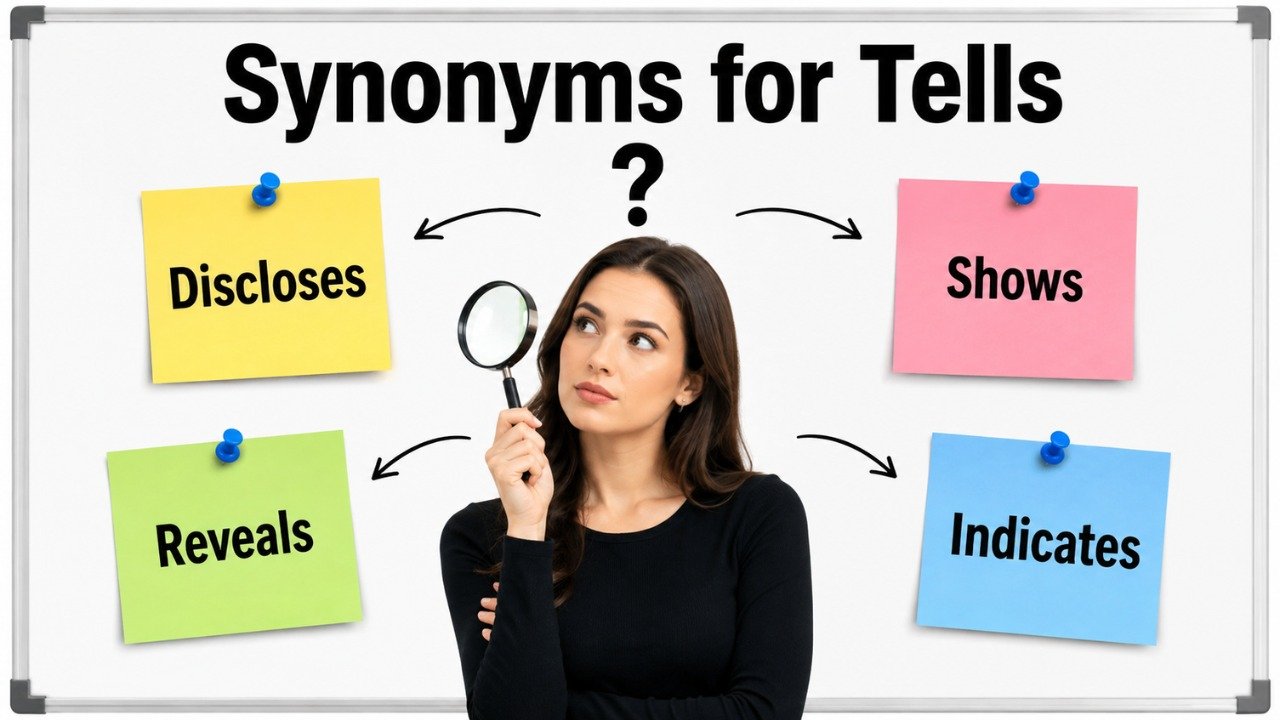
Quick Answer: Common synonyms for tells include informs, says, explains, reveals, reports, describes, narrates, indicates, advises, and instructs. The best choice depends on context. Informs works well when someone gives information, says is natural in conversation, explains suits detailed clarification, reports fits formal or factual writing, narrates works for storytelling, indicates is useful for signs or evidence, advises fits recommendations, and instructs works when someone gives directions or commands.
Pronunciation and Word Details
Word: Tells.
Pronunciation: /tɛlz/
Part of Speech: Verb, third person singular form of tell.
Meaning: Gives information, communicates something, reveals a fact, gives instructions, or relates a story to someone.
US Pronunciation:
UK Pronunciation:
What Does “Tells” Mean?
Tells means gives information, communicates an idea, reveals something, describes an event, gives instructions, or relates a story.
Tells is the third person singular present form of the verb tell. It is commonly used with subjects such as he, she, it, a person, or a singular noun.
Example: She tells me the truth every morning.
The exact meaning changes with context. Someone may tell a story, tell the truth, tell a person what happened, tell someone what to do, or tell the difference between two things.
In some sentences, tells means communicates directly.
Example: The teacher tells the students when the lesson begins.
In others, it means reveals or indicates.
Example: His expression tells us that something is wrong.
It can also refer to storytelling.
Example: The author tells the story through the eyes of a child.
Meaning, Tone, and Context of “Tells”
Tells is a common, neutral, and conversational word. It appears frequently in everyday speech, stories, essays, instructions, descriptions, and general writing.
In casual conversation, tells often means says or informs.
Example: She tells me what happened.
In storytelling, it can mean narrates, recounts, or relates.
Example: The novel tells the story of a young explorer.
In formal or academic writing, tells may sometimes sound too simple. More precise alternatives such as indicates, demonstrates, reveals, reports, explains, or informs can make the meaning clearer.
In instructional contexts, tells can mean advises, directs, orders, instructs, or commands.
Example: The supervisor tells the workers to check the equipment.
The word can therefore have a neutral, informative, authoritative, emotional, or descriptive tone depending on how it is used.
When and How to Use “Tells”
For Giving Information: Use tells when someone communicates facts, details, or news.
Example: She tells her parents about the meeting.
For Speaking: Tells can describe what someone says to another person.
Example: He tells me that the office closes early.
For Explaining: Use tells when someone communicates how or why something happens.
Example: The guide tells visitors how the system works.
For Storytelling: Tells can mean narrates or relates a story.
Example: The book tells the story of a family moving to a new city.
For Revealing Information: Tells may describe something that makes a fact clear.
Example: Her expression tells me that she is worried.
For Giving Advice: Tells can refer to guidance or recommendations.
Example: The doctor tells him to rest for several days.
For Giving Instructions: Use tells when one person directs another to do something.
Example: The coach tells the players to remain focused.
For Showing Evidence: Tells can mean indicates or suggests when facts, signs, or results communicate information.
Example: The data tells us that demand is increasing.
Best Synonyms for Tells
Informs: Gives someone information about something.
Example: The manager informs the team about the schedule change.
Says: Expresses something in spoken or written words.
Example: She says that the meeting begins at noon.
Explains: Makes an idea, process, or situation clear.
Example: The teacher explains why the answer is correct.
Reveals: Makes previously unknown information known.
Example: The report reveals several important changes.
Reports: Gives factual information about an event or situation.
Example: The journalist reports what happened during the event.
Describes: Gives details about a person, place, object, or situation.
Example: The witness describes what she saw.
Narrates: Tells a story or sequence of events.
Example: The speaker narrates the events in chronological order.
Indicates: Shows or suggests that something is true.
Example: The evidence indicates that the plan is working.
Advises: Gives a recommendation or useful guidance.
Example: The counselor advises students to prepare early.
Instructs: Gives directions or explains what someone should do.
Example: The manual instructs users to save their work first.
50 Synonyms for Tells with Short Meanings
- Informs: Gives information to someone.
- Says: Expresses something in words.
- Explains: Makes something easier to understand.
- Reveals: Makes hidden or unknown information known.
- Reports: Gives factual information about something.
- Describes: Gives details about someone or something.
- Narrates: Relates a story or sequence of events.
- Indicates: Shows that something is likely or true.
- Advises: Gives guidance or a recommendation.
- Instructs: Gives directions about what to do.
- Relates: Communicates or tells an event or experience.
- Recounts: Describes past events in detail.
- Mentions: Refers briefly to something.
- States: Expresses something clearly or formally.
- Declares: Announces something clearly and confidently.
- Announces: Makes information publicly known.
- Communicates: Shares information, ideas, or feelings.
- Notifies: Formally informs someone about something.
- Updates: Gives the latest information.
- Shares: Communicates information or experiences with others.
- Confides: Tells something private or personal.
- Discloses: Reveals information that was previously private.
- Divulges: Makes private or secret information known.
- Admits: Acknowledges something as true.
- Confesses: Admits something personal, wrong, or secret.
- Expresses: Communicates a thought, feeling, or idea.
- Voices: Expresses an opinion, concern, or feeling.
- Remarks: Says something briefly.
- Comments: Gives an opinion or observation.
- Observes: Makes a spoken or written comment.
- Adds: Says something further.
- Replies: Responds to someone.
- Answers: Responds to a question.
- Responds: Gives a spoken or written reaction.
- Specifies: Gives exact or particular details.
- Clarifies: Makes information clearer.
- Outlines: Gives the main points of something.
- Details: Gives specific information.
- Summarizes: Gives the main points briefly.
- Shows: Makes something clear through evidence or signs.
- Demonstrates: Clearly shows that something is true.
- Suggests: Indicates something indirectly.
- Signals: Gives a sign that communicates something.
- Implies: Communicates something indirectly.
- Directs: Tells someone what action to take.
- Orders: Gives a firm command.
- Commands: Gives an authoritative instruction.
- Guides: Gives direction or helpful advice.
- Warns: Tells someone about possible danger or trouble.
- Reminds: Helps someone remember something important.
Read Also:
Synonyms for Style

Synonyms for Tells by Context
When Tells Means Informs
When tells means giving information directly to another person, useful alternatives include informs, notifies, updates, communicates, shares, reports, and advises.
Example: The manager informs employees about the new schedule.
Example: She updates her family about her travel plans.
Informs is often more formal than tells, while updates emphasizes giving new or recent information.
When Tells Means Says
When tells simply refers to spoken communication, suitable alternatives include says, states, remarks, comments, declares, mentions, and adds.
Example: She says that the room is available.
Example: The speaker states that the results are final.
Says is natural in everyday conversation, while states is usually more formal.
When Tells Means Explains
When tells involves making information understandable, choose explains, clarifies, details, outlines, specifies, describes, or summarizes.
Example: The instructor explains how the process works.
Example: The report outlines the main stages of the project.
Explains focuses on understanding, while outlines gives only the main points.
When Tells Means Reveals
When something makes hidden or previously unknown information known, useful synonyms include reveals, discloses, divulges, admits, confesses, shows, and demonstrates.
Example: The investigation reveals several important facts.
Example: The document discloses previously private information.
Reveals is broad, while discloses often sounds more formal and may involve information that was not public.
When Tells Means Narrates
For stories, experiences, and sequences of events, use narrates, recounts, relates, describes, or shares.
Example: The grandfather recounts stories from his youth.
Example: The narrator relates the events from a personal perspective.
Narrates is particularly useful in literary analysis and storytelling.
When Tells Means Indicates
When signs, evidence, behavior, or data communicate something indirectly, choose indicates, shows, suggests, signals, implies, or demonstrates.
Example: The evidence indicates that the method is effective.
Example: Her expression suggests that she is uncertain.
Indicates is stronger and more direct than suggests, while implies often refers to indirect meaning.
When Tells Means Gives Instructions
When tells means directing someone to take an action, useful choices include instructs, directs, orders, commands, advises, guides, warns, and reminds.
Example: The supervisor instructs employees to follow the procedure.
Example: The officer orders everyone to leave the area.
Instructs is neutral and practical, while orders and commands are much stronger.
Another Word for Tells
A strong general replacement for tells is informs when the meaning involves giving someone information. However, the best alternative depends on context. Says works for ordinary speech, explains works for clarification, reveals suits previously unknown facts, narrates fits stories, and instructs works for directions.
Original: She tells the team about the new deadline.
Better Option: She informs the team about the new deadline.
Original: The teacher tells students how the experiment works.
Better Option: The teacher explains how the experiment works.
Original: The report tells us that costs are increasing.
Better Option: The report indicates that costs are increasing.
Original: The novel tells the story of a young musician.
Better Option: The novel narrates the story of a young musician.
When Not to Use “Tells”
Avoid tells when a more specific verb can communicate the meaning more clearly.
In formal writing, tells may sound too conversational when the intended meaning is indicates, demonstrates, reports, or reveals.
When a person gives detailed clarification, explains is more accurate than tells.
When evidence communicates a conclusion, indicates or suggests may sound more natural.
When someone gives a firm command, orders or instructs provides greater precision.
Weak: The survey tells that most participants prefer the second option.
Better: The survey indicates that most participants prefer the second option.
Weak: The report tells several hidden problems.
Better: The report reveals several hidden problems.
Weak: The instructor tells the complex process.
Better: The instructor explains the complex process.
Weak: The manager tells everyone to leave immediately.
Better: The manager instructs everyone to leave immediately.
Words Commonly Confused With Tells
Tells vs Says: Says focuses on the words someone speaks. Tells usually involves communicating information to a person and often takes an indirect object.
Tells vs Informs: Tells is broad and conversational. Informs specifically means giving someone information and often sounds more formal.
Tells vs Explains: Tells gives information, while explains makes something understandable by providing reasons, details, or clarification.
Tells vs Reveals: Tells may communicate any information. Reveals specifically makes something previously hidden or unknown known.
Tells vs Reports: Tells is general. Reports usually communicates factual information in a formal, organized, or professional manner.
Tells vs Indicates: Tells often involves direct communication. Indicates usually means that evidence, signs, or behavior show something indirectly.
Tells vs Narrates: Tells can have many meanings. Narrates specifically refers to relating a story or sequence of events.
Tells vs Instructs: Tells can simply provide information. Instructs specifically gives directions or teaches someone what to do.
Which Synonym Should You Choose?
Choose informs when someone gives another person clear information.
Choose says for natural everyday speech and conversation.
Choose explains when a person makes a complex idea, process, or reason easier to understand.
Choose reports for facts, news, findings, formal updates, or professional writing.
Choose reveals when previously unknown information becomes known.
Choose describes when details about a person, place, event, or object are being communicated.
Choose narrates when writing about storytelling, novels, personal accounts, or sequences of events.
Choose indicates for essays, reports, data, evidence, research findings, and formal analysis.
Choose advises when someone gives guidance or a recommendation.
Choose instructs when someone gives directions about what another person should do.
Choose states for formal declarations, essays, reports, and factual claims.
Choose suggests when the evidence is not strong enough to justify a definite conclusion.
For casual conversation, says, tells, mentions, and shares usually sound natural.
For formal writing, informs, states, indicates, reports, reveals, demonstrates, and specifies are often stronger choices.
Real Life Examples of “Tells” in Sentences
Original: She tells her coworkers about the schedule change.
Better Option: She informs her coworkers about the schedule change.
Original: The teacher tells the class why the formula works.
Better Option: The teacher explains to the class why the formula works.
Original: The report tells us that sales increased.
Better Option: The report indicates that sales increased.
Original: The author tells the story through several characters.
Better Option: The author narrates the story through several characters.
Original: His expression tells us that he is worried.
Better Option: His expression suggests that he is worried.
Original: The document tells important information about the agreement.
Better Option: The document reveals important information about the agreement.
Original: She tells the students to submit their work before noon.
Better Option: She instructs the students to submit their work before noon.
Original: The witness tells what happened before the accident.
Better Option: The witness recounts what happened before the accident.
Original: The guide tells visitors about the history of the building.
Better Option: The guide informs visitors about the history of the building.
Original: The graph tells a clear story about rising demand.
Better Option: The graph demonstrates a clear pattern of rising demand.
Synonym Groups and Usage Differences
Information Group
Informs, notifies, updates, communicates, shares, and reports describe giving information to another person or group.
Informs is useful in formal contexts, while shares is warmer and more conversational.
Example: The coordinator informs everyone about the revised schedule.
Speech Group
Says, states, remarks, comments, mentions, adds, replies, and answers relate to spoken or written communication.
Says is broad and conversational, while states sounds more formal and definite.
Example: The speaker states that the decision is final.
Explanation Group
Explains, clarifies, specifies, details, outlines, summarizes, and describes focus on making information understandable or precise.
Use explains for reasoning and details, while clarifies is best when removing confusion.
Example: The teacher clarifies the difference between the two concepts.
Revelation Group
Reveals, discloses, divulges, admits, and confesses involve making information known.
Reveals is broad, while confesses often involves personal responsibility or something previously kept secret.
Example: The investigation reveals several unexpected facts.
Evidence Group
Indicates, shows, demonstrates, suggests, signals, and implies describe what evidence, behavior, or signs communicate.
Indicates is common in analytical writing, while suggests expresses greater uncertainty.
Example: The data indicates a steady increase in demand.
Storytelling Group
Narrates, recounts, relates, and describes are useful when communicating events or experiences.
Narrates often sounds literary or formal, while recounts emphasizes retelling past events.
Example: The memoir recounts the author’s early experiences.
Instruction Group
Instructs, directs, orders, commands, advises, guides, warns, and reminds involve influencing what another person should do.
Instructs is practical and neutral, while commands carries greater authority.
Example: The supervisor instructs employees to follow the safety procedure.
Antonyms of Tells
The opposite of tells depends on whether the word means sharing information, revealing facts, or giving instructions.
Conceals: Keeps information hidden.
Hides: Prevents something from becoming known.
Withholds: Deliberately does not provide information.
Suppresses: Prevents information from being communicated.
Denies: Says that something is not true.
Keeps Secret: Refuses to reveal private information.
Silences: Prevents speech or communication.
Omits: Leaves information out.
Ignores: Gives no attention or response.
Misleads: Causes someone to believe something inaccurate.
Obscures: Makes information difficult to understand.
Disguises: Hides the true nature of something.
Comparison: Tells vs Related Words
Tells vs Says
Tells often involves communicating information to another person, while says focuses on the words someone expresses.
Example With Tells: She tells her friend the answer.
Example With Says: She says that the answer is correct.
Tells vs Informs
Tells is broad and conversational, while informs is more specific and often more formal.
Example With Tells: He tells the staff about the change.
Example With Informs: He informs the staff about the change.
Tells vs Explains
Tells gives information, while explains provides enough detail or reasoning to make something understandable.
Example With Tells: She tells him how the machine works.
Example With Explains: She explains how the machine works.
Tells vs Reveals
Tells may communicate ordinary information, while reveals makes something hidden, secret, or previously unknown known.
Example With Tells: She tells us the results.
Example With Reveals: The investigation reveals the cause of the problem.
Tells vs Reports
Tells is general and conversational. Reports usually communicates factual information in a more organized or formal way.
Example With Tells: The witness tells what happened.
Example With Reports: The witness reports what happened.
Tells vs Indicates
Tells commonly involves direct communication. Indicates often describes what evidence, data, signs, or behavior show.
Example With Tells: The manager tells us that demand is increasing.
Example With Indicates: The data indicates that demand is increasing.
Tells vs Narrates
Tells can describe many types of communication. Narrates specifically involves relating a story or connected sequence of events.
Example With Tells: The book tells the story of a young traveler.
Example With Narrates: The book narrates the journey of a young traveler.
Common Phrases and Expressions With Tells
Tells the Truth: Gives accurate and honest information.
Tells a Story: Relates a sequence of events.
Tells a Lie: Gives information that is intentionally false.
Tells Someone About Something: Gives another person information about a subject.
Tells Someone What to Do: Gives instructions or directions.
Tells the Difference: Recognizes how two things are not the same.
Tells It Like It Is: Speaks directly and honestly about a situation.
Tells Everyone: Shares information with all the people involved.
Tells Us Something: Communicates or indicates a particular fact.
Tells From Experience: Communicates something based on personal knowledge or past events.
Common Mistakes to Avoid
A common mistake is using tells when says is required. Tells usually needs a person or audience when it means communicating directly.
Incorrect: She tells that the meeting is canceled.
Better: She says that the meeting is canceled.
Another mistake is using tells with information that would be more naturally expressed through indicates, shows, or suggests.
Weak: The chart tells that temperatures are rising.
Better: The chart indicates that temperatures are rising.
Avoid repeatedly using tells in essays or reports. Precise verbs such as explains, reports, states, reveals, indicates, demonstrates, and describes can make writing clearer.
Do not treat informs and tells as identical in every sentence. Informs usually takes a person as the object.
Natural: She informs the team about the decision.
Be careful when replacing tells with commands or orders. These words imply authority and are much stronger.
Also avoid vague usage. Determine whether the sentence involves speaking, explaining, reporting, storytelling, revealing, showing evidence, giving advice, or giving instructions before selecting a synonym.
Conclusion
Synonyms for tells include informs, says, explains, reveals, reports, narrates, indicates, advises, and instructs. The best alternative depends on the meaning of the sentence. Use informs for giving information, explains for clarification, reports for factual communication, narrates for storytelling, indicates for evidence, and instructs for directions. Says works naturally in conversation, while reveals is stronger when new or hidden information becomes known. Choosing a precise synonym makes sentences clearer, more natural, and better suited to their context.
FAQs About Synonyms for Tells
What is the best synonym for tells?
Informs is one of the best general synonyms when tells means giving someone information. Says, explains, reports, or reveals may be better in other contexts.
What is another word for tells in writing?
Useful alternatives include states, explains, reports, indicates, describes, reveals, and narrates, depending on what the sentence means.
What is a formal synonym for tells?
Informs, states, reports, indicates, communicates, notifies, and discloses are useful formal alternatives.
What is another word for tells a story?
Narrates, recounts, relates, and describes are strong alternatives when tells refers to storytelling.
What is another word for tells someone what to do?
Instructs, directs, advises, orders, commands, guides, and reminds can work depending on the level of authority involved.
What is the difference between tells and says?
Tells often communicates information to a specific person, while says focuses more directly on spoken or written words.
Can indicates replace tells?
Yes, especially when evidence, data, signs, or behavior show something rather than a person directly communicating it.
