
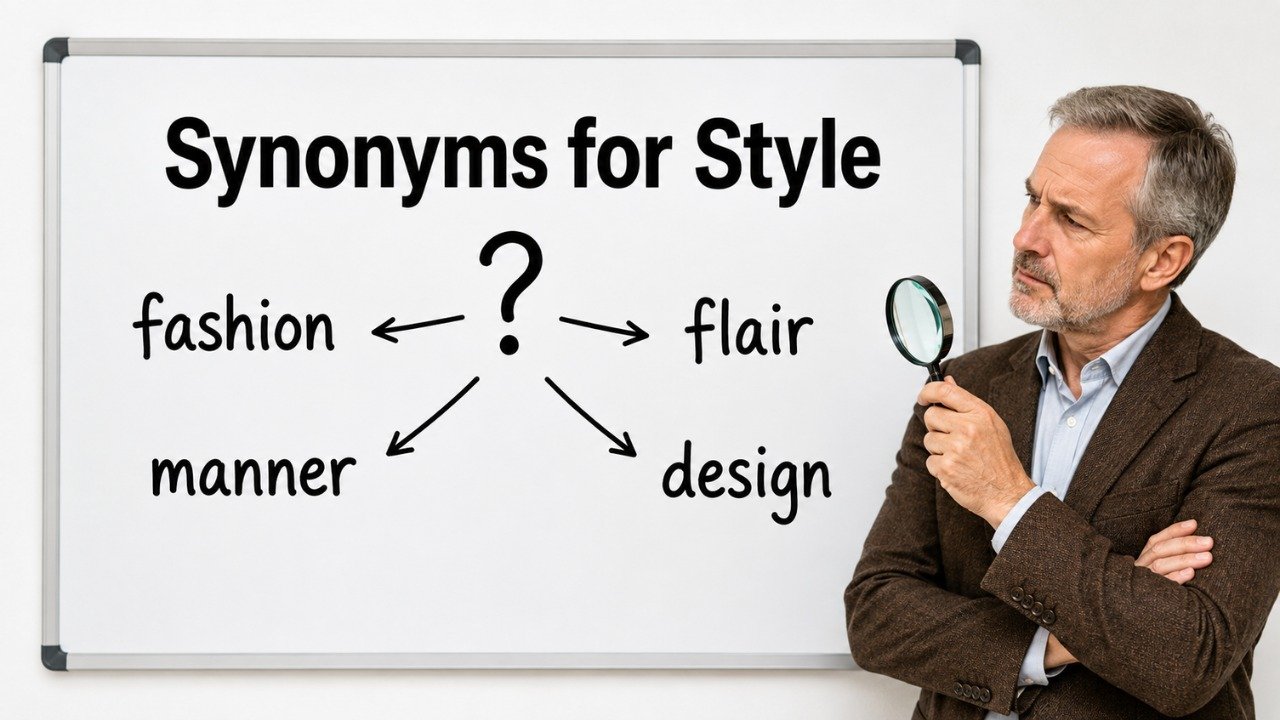
Quick Answer: Common synonyms for style include manner, fashion, approach, method, design, appearance, form, technique, taste, and expression. The best choice depends on context. Use manner for the way someone behaves or communicates, fashion for clothing and appearance, approach or method for how something is done, design for visual creation, technique for a developed skill, taste for aesthetic preference, and expression for a distinctive creative identity. These synonyms for style help make writing clearer and more precise.
Pronunciation and Word Details
Word: Style.
Pronunciation: /staɪl/
Part of Speech: Noun and verb.
Meaning: A distinctive way of doing, presenting, creating, dressing, writing, or expressing something.
US Pronunciation:
UK Pronunciation:
What Does “Style” Mean?
Style means a particular way of doing, creating, presenting, or expressing something. It is most commonly used as a noun, although it can also function as a verb.
As a noun, style can describe someone’s appearance, clothing choices, writing method, artistic character, behavior, design, or way of completing a task.
Example: Her writing style is clear and direct.
In fashion, style refers to someone’s characteristic way of dressing or presenting themselves.
Example: His personal style is simple and elegant.
In art and design, style describes recognizable visual features or creative choices.
Example: The building has a traditional architectural style.
As a verb, style means to arrange, design, or present something in a particular way.
Example: She styled the room with natural materials.
The exact meaning depends heavily on context, which is why choosing the right synonym is important.
Meaning, Tone, and Context of “Style”
Style is a neutral and highly versatile word. It works naturally in casual conversation, formal writing, academic discussion, creative work, fashion, literature, art, architecture, design, communication, and professional contexts.
When discussing appearance, style often has a positive or expressive tone.
Example: She has a distinctive style.
When discussing writing or communication, style refers to how ideas are presented.
Example: The author’s style is concise and descriptive.
In academic or professional contexts, style may describe a method, format, approach, or recognizable pattern.
Example: Different leadership styles can affect team communication.
In fashion, style can refer to clothing choices, visual identity, elegance, or trends.
In art, style can identify the features that make one artist, period, movement, or work different from another.
Because style has several meanings, it is important to choose a synonym that matches the intended context rather than replacing it mechanically.
When and How to Use “Style”
For Personal Appearance: Use style when describing someone’s characteristic way of dressing or presenting themselves.
Example: Her style combines simple clothing with elegant accessories.
For Writing: Use style to describe the way an author organizes language, tone, sentences, and ideas.
Example: His writing style is conversational and easy to follow.
For Art and Design: Use style when discussing recognizable visual features or creative choices.
Example: The artist developed a bold painting style.
For Methods: Style can describe a particular way of completing an activity.
Example: Her management style encourages open communication.
For Communication: Use style when referring to someone’s characteristic way of speaking or interacting.
Example: His communication style is calm and respectful.
For Fashion: Style can describe clothing choices, appearance, and personal presentation.
Example: Classic style remains appealing across changing trends.
For Technique: Style can describe how someone performs an artistic or practical skill.
Example: The dancer’s style combines precision with graceful movement.
For Arrangement: As a verb, style means to arrange or present something in a chosen way.
Example: She styled the table with simple flowers and white dishes.
Best Synonyms for Style
Manner: A particular way of behaving, speaking, or doing something.
Example: His calm manner made the discussion easier.
Fashion: A popular or characteristic way of dressing or presenting oneself.
Example: She prefers classic fashion over temporary trends.
Approach: A particular way of dealing with a task, problem, or situation.
Example: Their collaborative approach improved the project.
Method: An organized way of doing something.
Example: The teacher introduced a different method for explaining the concept.
Design: The planned appearance, structure, or arrangement of something.
Example: The room has a clean and practical design.
Appearance: The way someone or something looks.
Example: The new arrangement improved the appearance of the room.
Form: The shape, structure, or manner in which something appears.
Example: Poetry is a creative form of expression.
Technique: A particular skillful method of performing or creating something.
Example: The artist developed a precise painting technique.
Taste: A person’s preference or judgment concerning beauty, fashion, or design.
Example: Her taste in furniture is simple and refined.
Expression: A distinctive way of communicating personality, emotion, or creativity.
Example: Clothing can become a form of personal expression.
50 Synonyms for Style with Short Meanings
- Manner: A particular way of acting or doing something.
- Fashion: A characteristic or popular way of dressing.
- Approach: A way of handling a task or situation.
- Method: An organized way of doing something.
- Design: The planned appearance or structure of something.
- Appearance: The way someone or something looks.
- Form: The shape, structure, or type of something.
- Technique: A developed way of performing a skill.
- Taste: Personal judgment about beauty or appearance.
- Expression: A way of showing ideas, personality, or emotion.
- Mode: A particular way or form of doing something.
- Way: A manner or method of doing something.
- Methodology: A systematic approach to completing work.
- Pattern: A recognizable arrangement or repeated manner.
- Format: The structure or arrangement of something.
- Presentation: The way something is displayed or communicated.
- Look: The visual appearance of a person or thing.
- Image: The appearance or impression presented to others.
- Aesthetic: A distinctive sense of visual beauty or design.
- Character: A recognizable quality or distinctive nature.
- Flair: Natural talent for creating an attractive effect.
- Elegance: Graceful and refined appearance or manner.
- Sophistication: Refined quality in appearance or taste.
- Tastefulness: Good judgment in appearance or decoration.
- Grace: Smooth and attractive manner or appearance.
- Individuality: A quality that makes a style personally distinctive.
- Identity: A recognizable character or personal expression.
- Signature: A distinctive feature strongly associated with someone.
- Convention: An established way of doing or presenting something.
- Tradition: A customary style passed through time.
- Custom: An established way of behaving or doing something.
- Practice: A usual or accepted way of doing something.
- Procedure: A particular sequence or method of action.
- System: An organized method or arrangement.
- Strategy: A planned approach to achieving something.
- Behavior: A characteristic way of acting.
- Bearing: The way a person carries or presents themselves.
- Demeanor: A person’s outward manner or behavior.
- Air: A noticeable manner or impression.
- Tone: The characteristic quality of communication or presentation.
- Voice: A distinctive manner of expression in writing or speech.
- Genre: A category defined by recognizable creative features.
- School: A group sharing a recognizable artistic approach.
- Movement: A creative trend with shared principles or characteristics.
- Trend: A currently popular direction in fashion or design.
- Vogue: A style that is currently popular.
- Cut: The shape or design of clothing.
- Silhouette: The overall outline or shape of clothing or design.
- Arrangement: The way elements are organized or presented.
- Configuration: A particular arrangement of parts or elements.
Read Also:
Synonyms for Polite

Synonyms for Style by Context
When Style Means Manner
When style describes someone’s characteristic way of behaving, communicating, leading, or working, useful alternatives include manner, approach, way, behavior, demeanor, bearing, and mode.
Example: Her leadership style is supportive.
Alternative: Her leadership approach is supportive.
When Style Means Fashion
When style refers to clothing, grooming, or personal appearance, good alternatives include fashion, look, appearance, taste, aesthetic, elegance, flair, and image.
Example: She prefers a simple style.
Alternative: She prefers a simple look.
When Style Means Method
When style refers to how a task is performed, approach, method, technique, procedure, system, and strategy may be more precise.
Example: His teaching style encourages discussion.
Alternative: His teaching approach encourages discussion.
When Style Means Artistic Character
In art, literature, architecture, or design, useful alternatives include aesthetic, form, character, technique, expression, voice, movement, and school.
Example: The artist has a recognizable style.
Alternative: The artist has a recognizable aesthetic.
When Style Means Writing Expression
For writing and speaking, voice, tone, manner, expression, format, and presentation can replace style depending on the intended meaning.
Example: The writer’s style feels warm and conversational.
Alternative: The writer’s voice feels warm and conversational.
When Style Means Visual Design
For rooms, products, clothing, or visual materials, design, appearance, aesthetic, arrangement, look, and configuration can work well.
Example: The kitchen has a modern style.
Alternative: The kitchen has a modern design.
Another Word for Style
Manner is one of the broadest replacements for style when referring to the way someone acts, communicates, or performs an activity. However, the best alternative always depends on context.
Use fashion for clothing, approach for problem solving, technique for skill, design for appearance, aesthetic for creative identity, and voice for writing.
Original: Her teaching style keeps students engaged.
Better Option: Her teaching approach keeps students engaged.
Original: The room has a modern style.
Better Option: The room has a modern design.
Original: His writing style is easy to recognize.
Better Option: His writing voice is easy to recognize.
Original: She has a sophisticated personal style.
Better Option: She has sophisticated taste in clothing.
When Not to Use “Style”
Style is useful, but it can become vague when a more specific word would explain the meaning better.
Weak: The report follows a professional style.
Better: The report follows a professional format.
If you are describing how a task is completed, method or approach may communicate the idea more accurately.
Weak: We need a different style for solving this problem.
Better: We need a different approach for solving this problem.
Style can also sound unclear when discussing physical appearance.
Weak: The building has an interesting style.
Better: The building has an interesting architectural design.
Avoid repeating style several times in the same paragraph.
Weak: Her writing style has a formal style that differs from her speaking style.
Better: Her writing has a formal tone that differs from her conversational manner.
Avoid using fashion as an automatic substitute when style refers to writing, leadership, design, or behavior.
Weak: His fashion of management is very direct.
Better: His management approach is very direct.
Words Commonly Confused With Style
Style vs Fashion: Style is broader and can describe appearance, writing, behavior, design, or method. Fashion mainly refers to popular clothing, appearance, and trends.
Style vs Trend: Style can remain personal or consistent for years. A trend is something that becomes popular during a particular period.
Style vs Design: Style describes a characteristic appearance or manner. Design refers more directly to the planned structure or appearance of something.
Style vs Technique: Style is the overall recognizable way someone performs or creates. Technique refers to the specific skills or methods used to achieve a result.
Style vs Approach: Style may describe a characteristic manner, while approach describes the way someone handles a task or problem.
Style vs Aesthetic: Style has a broad meaning, while aesthetic focuses more strongly on visual appearance, beauty, atmosphere, and artistic choices.
Style vs Tone: Style describes the overall manner of expression. Tone reflects the attitude, feeling, or emotional quality communicated.
Style vs Voice: In writing, style includes word choice, sentence structure, tone, and other features. Voice is the distinctive personality readers recognize in the writing.
Which Synonym Should You Choose?
Choose manner when referring to someone’s behavior, speech, conduct, or personal way of doing something.
Choose fashion when discussing clothing, popular appearance, or dress.
Choose approach when explaining how someone handles a problem, responsibility, or task.
Choose method when emphasizing an organized process or procedure.
Choose technique when discussing developed skill in art, writing, sport, performance, or practical work.
Choose design when describing the planned visual appearance or structure of something.
Choose aesthetic when discussing artistic identity, visual atmosphere, or creative appearance.
Choose voice when describing a distinctive writing or speaking identity.
Choose tone when emphasizing attitude or emotional quality in communication.
Choose appearance or look when talking mainly about how someone or something visually appears.
In formal reports and essays, approach, method, technique, format, design, and manner are often more precise than style.
In casual conversation, look, way, manner, and fashion usually sound natural.
In creative writing or literary analysis, voice, tone, expression, form, and aesthetic can provide greater precision.
Real Life Examples of “Style” in Sentences
Original: Her writing style is simple and direct.
Better Option: Her writing voice is simple and direct.
Original: His management style encourages independence.
Better Option: His management approach encourages independence.
Original: The house has a traditional style.
Better Option: The house has a traditional design.
Original: She developed her own painting style.
Better Option: She developed her own artistic technique.
Original: His clothing style is relaxed.
Better Option: His fashion sense is relaxed.
Original: The speaker’s style made the topic easy to understand.
Better Option: The speaker’s presentation made the topic easy to understand.
Original: Their teaching style focuses on practical examples.
Better Option: Their teaching method focuses on practical examples.
Original: The restaurant has a simple interior style.
Better Option: The restaurant has a simple interior aesthetic.
Original: Her style of communication is polite but firm.
Better Option: Her manner of communication is polite but firm.
Original: The designer created a style that feels modern and elegant.
Better Option: The designer created an aesthetic that feels modern and elegant.
Synonym Groups and Usage Differences
Manner Group
Manner, way, behavior, demeanor, bearing, and mode describe how someone behaves or carries out an action.
Manner is especially useful for behavior and communication.
Example: His professional manner earned the trust of the team.
Method Group
Approach, method, technique, procedure, system, and strategy describe ways of completing tasks or solving problems.
Approach is broad, while technique often refers to developed skill.
Example: The instructor introduced a practical teaching method.
Fashion Group
Fashion, look, appearance, trend, vogue, cut, and silhouette relate to clothing and visual presentation.
Fashion often refers to popular clothing choices, while look describes someone’s complete visual appearance.
Example: She prefers a timeless look rather than temporary trends.
Creative Expression Group
Aesthetic, expression, voice, character, signature, form, and identity describe distinctive creative qualities.
These words are especially useful in art, literature, architecture, and design.
Example: The artist developed a distinctive visual aesthetic.
Writing Group
Voice, tone, form, manner, presentation, and expression can describe different aspects of writing style.
Voice concerns personality, while tone concerns attitude and emotional effect.
Example: The essay uses a formal tone throughout.
Design Group
Design, arrangement, configuration, appearance, format, and aesthetic describe how visual or structural elements are organized.
Example: The new design creates a cleaner visual experience.
Personal Taste Group
Taste, flair, elegance, sophistication, and tastefulness describe someone’s ability or preference in choosing attractive things.
Example: Her taste in interior decoration favors natural materials.
Antonyms of Style
Because style has several meanings, its opposite depends on the intended context.
Clumsiness: Lack of grace or skill in manner or appearance.
Awkwardness: Lack of smoothness or elegance.
Plainness: Lack of decoration or distinctive visual character.
Sameness: Lack of individuality or difference.
Uniformity: Complete similarity without distinctive variation.
Disorder: Lack of planned arrangement or organization.
Messiness: Untidy or poorly arranged appearance.
Carelessness: Lack of attention to presentation or method.
Inelegance: Lack of grace, refinement, or sophistication.
Unfashionableness: Lack of conformity with current fashion.
Conventionality: Excessive dependence on familiar or ordinary forms.
Imitation: Copying another person’s manner rather than showing individuality.
Comparison: Style vs Related Words
Style vs Fashion
Style is broader and can refer to personal expression, writing, art, design, behavior, or clothing. Fashion usually describes popular ways of dressing or presenting oneself.
Example With Style: She has developed a distinctive personal style.
Example With Fashion: She follows current fashion carefully.
Style vs Approach
Style describes a characteristic manner, while approach focuses on how someone handles a particular task or situation.
Example With Style: His leadership style is relaxed.
Example With Approach: His leadership approach encourages collaboration.
Style vs Method
Style can describe a person’s characteristic way of working. Method refers more specifically to an organized process.
Example With Style: Her teaching style is flexible.
Example With Method: Her teaching method uses practical exercises.
Style vs Technique
Style is the overall recognizable quality of someone’s work. Technique describes the skills and methods used to produce it.
Example With Style: The painter’s style is distinctive.
Example With Technique: The painter’s brush technique requires careful control.
Style vs Design
Style refers to a recognizable visual character. Design describes how something is intentionally planned and arranged.
Example With Style: The room has a minimalist style.
Example With Design: The room’s design makes efficient use of space.
Style vs Aesthetic
Style can describe many kinds of distinctive manners. Aesthetic mainly concerns visual or artistic qualities and the overall sense of beauty.
Example With Style: Her decorating style is simple.
Example With Aesthetic: Her interior aesthetic uses natural textures and soft shapes.
Style vs Tone
Style describes the broader way language is written or spoken. Tone expresses the speaker’s or writer’s attitude.
Example With Style: The article uses a conversational style.
Example With Tone: The article maintains a friendly tone.
Style vs Voice
Style includes the techniques and patterns used in expression. Voice is the distinctive personality that comes through in writing or speech.
Example With Style: The author’s style uses short sentences.
Example With Voice: The author’s voice feels confident and personal.
Common Phrases and Expressions With Style
Personal Style: A person’s distinctive way of dressing, behaving, or expressing themselves.
Writing Style: The characteristic way someone uses language in written communication.
Leadership Style: A person’s characteristic approach to guiding or managing others.
Communication Style: The way someone usually shares ideas and interacts with others.
Fashion Style: A characteristic choice of clothing, accessories, and appearance.
Signature Style: A distinctive look or method strongly associated with one person.
Classic Style: An appearance or design that remains appealing over time.
Modern Style: An appearance characterized by current or contemporary design choices.
In Style: Currently considered fashionable or attractive.
Out of Style: No longer considered fashionable or commonly preferred.
Common Mistakes to Avoid
One common mistake is assuming that every synonym for style can work in every sentence. Style has meanings connected with fashion, writing, art, behavior, method, and design, so context determines the correct replacement.
Another mistake is confusing style with fashion. Fashion is mainly associated with clothing and popular trends, while style can describe a much broader range of ideas.
Writers also sometimes use style where a more precise term such as method, approach, technique, format, or tone would improve clarity.
Repetition is another problem. Instead of writing style several times in one paragraph, consider alternatives such as manner, approach, design, voice, aesthetic, or technique when their meanings fit.
Avoid using aesthetic as a direct replacement for every visual use of style. Aesthetic mainly concerns visual or artistic qualities, while style can also include structure, method, tradition, and personal identity.
Do not confuse tone with style in writing. Tone describes attitude, while style includes broader choices such as vocabulary, sentence structure, pacing, organization, and expression.
Finally, avoid vague claims such as good style or bad style when a more specific description would help readers. Words such as elegant, formal, casual, minimalist, traditional, refined, expressive, or practical communicate more detail.
Conclusion
The best synonyms for style depend on whether you are discussing fashion, writing, behavior, design, art, or methods. Manner works well for behavior, approach and method suit practical processes, design and aesthetic describe visual choices, technique emphasizes skill, fashion relates to clothing, and voice is useful for writing. Other helpful synonyms for style include appearance, expression, taste, form, and presentation. Choosing the most precise alternative makes descriptions clearer, reduces repetition, and helps readers understand exactly what kind of style you mean.
FAQs About Synonyms for Style
What is the best synonym for style?
Manner is one of the broadest synonyms for style, especially when describing behavior or the way something is done. The best choice still depends on context.
What is another word for style in fashion?
Fashion, look, appearance, aesthetic, taste, and image can replace style when discussing clothing or personal presentation.
What is another word for writing style?
Voice, tone, manner, expression, form, and presentation can describe different aspects of writing style.
What is a synonym for style when describing a method?
Approach, method, technique, system, procedure, and strategy are useful when style refers to how something is done.
Are style and fashion the same?
No. Fashion usually refers to popular clothing and appearance, while style can describe clothing, writing, behavior, design, art, communication, and methods.
Is aesthetic a synonym for style?
Yes, aesthetic can replace style when discussing visual or artistic character. It is less suitable when style means behavior, method, or communication.
What is the opposite of style?
Possible opposites include plainness, awkwardness, disorder, sameness, clumsiness, and carelessness, depending on which meaning of style is intended.
