
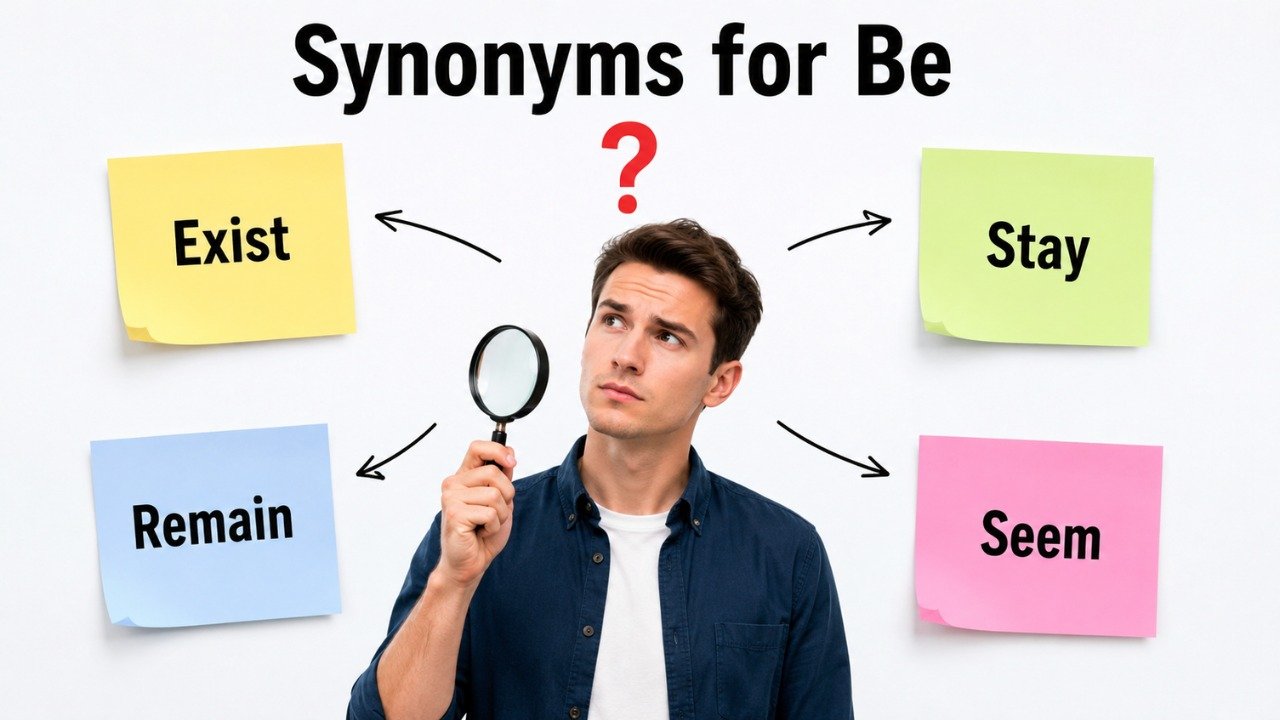
Quick Answer: Common synonyms for be include exist, remain, stay, live, occur, happen, constitute, represent, equal, and mean. The best replacement depends heavily on context because be is one of the most flexible verbs in English. Use exist when discussing existence, remain or stay for continuing states, occur or happen for events, constitute for formal definitions, represent for identity or symbolism, and equal or mean when expressing equivalence. In many sentences, be functions as an auxiliary verb and should not be replaced at all.
Pronunciation and Word Details
Word: Be
Pronunciation: /biː/
Part of Speech: Verb and auxiliary verb
Meaning: To exist, have a particular state or identity, occupy a place, occur, or help form certain verb structures.
US Pronunciation:
UK Pronunciation:
What Does “Be” Mean?
Be means to exist, remain in a condition, have an identity, occupy a location, or occur. It is also one of the most important auxiliary verbs in English.
Be is an irregular verb with several forms, including am, is, are, was, were, being, and been. Its meaning changes according to the sentence in which it appears.
When be refers to existence, it can sometimes be replaced by exist.
Example: There will be many opportunities.
Alternative: Many opportunities will exist.
When be connects a subject with a description or identity, it functions as a linking verb.
Example: She wants to be a doctor.
Here, be connects she with the identity doctor.
Be can also describe location.
Example: The meeting will be in the main hall.
It can indicate an event or occurrence.
Example: The ceremony will be tomorrow.
In other sentences, be helps form continuous or passive constructions.
Example: They will be working tonight.
In this sentence, be is grammatical rather than a word that should normally be replaced with a synonym.
Meaning, Tone, and Context of “Be”
Be is a neutral and extremely common English verb. It is used in casual conversation, professional communication, academic writing, formal documents, instructions, descriptions, stories, reports, and almost every other type of English.
Its tone is usually determined by the words around it rather than by the verb itself.
Be can sound simple and conversational.
Example: Be careful near the stairs.
It can also appear in formal statements.
Example: Applicants must be eligible before submitting a request.
In academic or professional writing, writers sometimes replace be with a more precise verb when doing so improves clarity.
Example: The committee is responsible for reviewing applications.
A more direct version may be:
Example: The committee reviews applications.
However, replacing be is not always necessary. Clear writing often uses forms of be naturally and correctly.
When and How to Use “Be”
For Existence
Use be when saying that someone or something exists.
Example: There may be another solution.
A more precise alternative may use exist.
Example: Another solution may exist.
For Identity
Use be to connect a person or thing with an identity, role, category, or description.
Example: Maya hopes to be a teacher.
In some contexts, serve as or become may communicate the intended idea more precisely.
For a Continuing State
Use be when describing a condition that continues.
Example: Please be quiet during the presentation.
Depending on the sentence, remain or stay may be more specific.
Example: Please remain quiet during the presentation.
For Location
Be can identify where someone or something is located.
Example: The documents will be on the desk.
More precise alternatives include sit, stand, lie, remain, or reside, depending on the subject.
For Events
Be can indicate when or where something happens.
Example: The meeting will be at noon.
In some sentences, occur or take place provides a more descriptive alternative.
Example: The meeting will take place at noon.
For Equivalence
Be can indicate that one thing is equal to or means another.
Example: Two plus three is five.
Depending on the sentence, equal or mean may replace a form of be.
For Passive Voice
Forms of be help create passive constructions.
Example: The report will be reviewed tomorrow.
In this use, be usually cannot be replaced by an ordinary synonym without restructuring the sentence.
For Continuous Tenses
Be also helps form continuous verb structures.
Example: She will be studying tonight.
Here, be performs a grammatical function and normally remains unchanged.
Best Synonyms for Be
Exist: To have actual presence or reality.
Example: Several possible solutions exist.
Remain: To continue in the same state, place, or condition.
Example: Please remain seated until the doors open.
Stay: To continue in a particular condition or location.
Example: Stay calm while the problem is being handled.
Live: To exist as a living person or organism.
Example: Many species live in this forest.
Occur: To happen or take place.
Example: Changes may occur during the process.
Happen: To take place or become an event.
Example: Unexpected problems can happen.
Constitute: To amount to or form something, especially in formal writing.
Example: These actions constitute a serious violation.
Represent: To stand for, correspond to, or serve as an example of something.
Example: The symbol represents peace.
Equal: To have the same value, amount, or status.
Example: Ten divided by two equals five.
Mean: To signify or have a particular meaning.
Example: A red signal can mean stop.
50 Synonyms for Be with Short Meanings
Because be has many grammatical functions, there are no 50 words that can replace it in every sentence. The following are useful synonyms and contextual alternatives for its different meanings.
- Exist: Have real presence or reality.
- Remain: Continue in the same state or place.
- Stay: Continue in a condition or location.
- Live: Exist as a living being.
- Persist: Continue to exist despite difficulty.
- Continue: Keep existing or happening.
- Endure: Continue through time or difficulty.
- Survive: Continue to exist despite danger or change.
- Last: Continue for a period of time.
- Subsist: Continue to exist or maintain life.
- Occur: Take place or happen.
- Happen: Become an event.
- Arise: Come into existence or become noticeable.
- Take place: Happen at a particular time or location.
- Come about: Happen or develop.
- Transpire: Occur or become known.
- Unfold: Develop or happen gradually.
- Emerge: Come into existence or become apparent.
- Develop: Come into a particular state over time.
- Appear: Seem or become present.
- Constitute: Form or amount to something.
- Represent: Stand for or correspond to something.
- Equal: Have the same value or amount.
- Mean: Signify or express a particular idea.
- Signify: Have a particular meaning.
- Embod y: Give concrete form to an idea or quality.
- Form: Make or constitute something.
- Make up: Form the parts of something.
- Amount to: Be equivalent to something in effect or value.
- Correspond to: Match or be equivalent to something.
- Stand for: Represent or symbolize something.
- Serve as: Perform the role or function of something.
- Act as: Perform a particular role.
- Function as: Operate in a particular role or capacity.
- Operate as: Work or serve in a specified capacity.
- Reside: Live or have a home somewhere.
- Dwell: Live in a particular place.
- Sit: Occupy a particular position or location.
- Stand: Occupy an upright position or location.
- Lie: Be positioned or situated somewhere.
- Occupy: Take up a particular position or space.
- Belong: Fit within a group, place, or category.
- Remain present: Continue to exist in a location.
- Exist as: Have a particular identity or form.
- Remain as: Continue to hold a particular role or identity.
- Serve: Hold or perform a particular role.
- Seem: Give the impression of having a quality or state.
- Appear to be: Give the impression of having a condition or identity.
- Prove: Turn out to have a particular quality.
- Turn out: Eventually prove to have a certain identity or condition.
Read Also:
Synonyms for Tells

Synonyms for Be by Context
When Be Means Exist
When be refers to existence, useful alternatives include exist, live, persist, survive, remain, and subsist.
Example: Few records from that period still exist.
Exist is usually the clearest direct alternative when discussing whether something has reality or presence.
When Be Means Remain in a State
When be describes continuing in a condition, remain, stay, continue, persist, and endure can work well.
Example: Please remain patient while the application is reviewed.
Stay sounds more conversational, while remain is often more formal.
When Be Means Happen
When be relates to an event, useful alternatives include occur, happen, take place, arise, transpire, and come about.
Example: The conference will take place next month.
Occur is often more formal than happen.
When Be Means Represent
When be connects something with its meaning, identity, or function, possible alternatives include represent, constitute, signify, mean, stand for, and embody.
Example: The white flower represents peace in the ceremony.
When Be Means Equal
For mathematics, measurements, comparisons, or equivalence, equal, correspond to, and amount to can sometimes replace be.
Example: One hundred centimeters equal one meter.
When Be Means Serve in a Role
When be identifies a function or responsibility, serve as, act as, function as, and operate as may offer greater precision.
Example: This room will serve as the temporary office.
When Be Refers to Location
For physical position or residence, useful alternatives include sit, stand, lie, reside, dwell, and occupy.
Example: The old farmhouse stands near the river.
These words provide more detail than simply saying that something is somewhere.
Another Word for Be
The best single replacement for be is often exist when the sentence is about existence. However, be has so many meanings that no single synonym can replace it everywhere. The correct alternative depends on whether the sentence refers to existence, location, identity, condition, equivalence, or an event.
Original: There may be life elsewhere in the universe.
Better Option: Life may exist elsewhere in the universe.
Original: The meeting will be on Friday.
Better Option: The meeting will take place on Friday.
Original: The old statue is near the entrance.
Better Option: The old statue stands near the entrance.
Original: This room will be our temporary workspace.
Better Option: This room will serve as our temporary workspace.
When Not to Use “Be”
Be is grammatically correct in countless sentences, but excessive use can sometimes make writing less precise or energetic.
Avoid replacing a more descriptive action verb with be when the action itself matters.
Weak: The manager was in discussion with the team.
Better: The manager discussed the issue with the team.
Be may also create vague descriptions when a more specific verb is available.
Weak: Several problems were in the system.
Better: Several problems remained in the system.
Repeated forms of be can make prose sound flat.
Weak: The building is old, and it is near the river, and it is a local landmark.
Better: The old building stands near the river and serves as a local landmark.
However, do not remove be simply to make a sentence sound more complicated.
Weak: She continues as happy.
Better: She is happy.
Simple forms of be are often the most natural option.
Words Commonly Confused With Be
Be vs Become: Be describes existence, identity, or a state. Become describes changing from one state into another.
Example: She wants to be confident.
Example: She became more confident with practice.
Be vs Exist: Exist specifically refers to having reality or presence. Be has many broader grammatical and semantic uses.
Example: Such problems exist in many systems.
Be vs Remain: Be describes a state, while remain emphasizes continuing in that state.
Example: Please be calm.
Example: Please remain calm.
Be vs Stay: Stay means continue in a place or condition and is often more conversational than remain.
Example: Be quiet.
Example: Stay quiet.
Be vs Seem: Be states a condition directly. Seem describes an impression that may or may not be accurate.
Example: The task is difficult.
Example: The task seems difficult.
Be vs Happen: Be can identify when an event takes place, while happen directly describes the event occurring.
Example: The ceremony will be tomorrow.
Example: The ceremony will happen tomorrow.
Be vs Exist: Be can function as a linking or auxiliary verb, while exist normally works as a main verb referring specifically to existence.
Which Synonym Should You Choose?
Choose exist when writing about reality, presence, availability, or whether something is real.
Choose remain for formal writing when a person or thing continues in a particular state or position.
Choose stay in casual conversation when someone continues in a condition or place.
Choose occur in reports, essays, academic writing, or formal explanations involving events.
Choose happen in everyday conversation when describing events.
Choose constitute in formal writing when one thing forms, amounts to, or qualifies as another.
Choose represent when discussing symbols, ideas, categories, or meanings.
Choose serve as when describing a person’s or object’s function or role.
Choose equal for numbers, quantities, values, and mathematical relationships.
Choose mean or signify when explaining what a word, sign, action, or symbol communicates.
Choose stand, sit, or lie when precise physical location matters.
Keep be when it functions as an auxiliary verb or when replacing it would make the sentence unnatural.
Real Life Examples of “Be” in Sentences
Original: There could be another explanation.
Better Option: Another explanation could exist.
Original: Please be calm while we check the information.
Better Option: Please remain calm while we check the information.
Original: The meeting will be in the conference room.
Better Option: The meeting will take place in the conference room.
Original: The monument is beside the main entrance.
Better Option: The monument stands beside the main entrance.
Original: This area will be our temporary classroom.
Better Option: This area will serve as our temporary classroom.
Original: Several problems may be during the transition.
Better Option: Several problems may arise during the transition.
Original: The symbol is a sign of cooperation.
Better Option: The symbol represents cooperation.
Original: Five plus five is ten.
Better Option: Five plus five equals ten.
Original: The final result may be different from what we expected.
Better Option: The final result may prove different from what we expected.
Original: These three departments are most of the organization.
Better Option: These three departments constitute most of the organization.
Synonym Groups and Usage Differences
Existence Group
Exist, live, persist, survive, endure, subsist, and remain describe different forms of continued presence.
Exist is the broadest choice, while survive suggests continuing despite difficulty.
Example: Some traditions survive for centuries.
Continuing State Group
Remain, stay, continue, and persist describe something that keeps the same condition.
Remain is generally more formal, while stay is common in conversation.
Example: The doors will remain closed until noon.
Event Group
Occur, happen, arise, transpire, take place, and come about relate to events or developments.
Occur works well in formal writing, while happen sounds natural in everyday conversation.
Example: The error occurred during installation.
Identity and Function Group
Constitute, represent, serve as, act as, function as, and operate as describe what something is or what role it performs.
Example: The document serves as proof of registration.
Meaning Group
Mean, signify, represent, embody, and stand for describe meaning or symbolism.
Example: The symbol signifies unity.
Equivalence Group
Equal, amount to, and correspond to express sameness in value, meaning, or effect.
Example: Twelve months equal one year.
Location Group
Stand, sit, lie, reside, dwell, and occupy give more precise information about where something or someone is.
Example: A small village lies beyond the hills.
Antonyms of Be
Be is unusual because it has no single antonym that works in every context. Its opposite depends on the meaning intended.
Not exist: Lack existence or reality.
Cease: Stop existing or continuing.
Disappear: Stop being visible or present.
Vanish: Suddenly cease to be present or visible.
End: Stop continuing or happening.
Depart: Leave a place rather than remain there.
Leave: Stop staying in a location.
Change: Become different rather than remain in the same state.
Differ: Be unlike rather than equal or correspond.
Contradict: Express the opposite rather than represent the same meaning.
Fail to occur: Not happen or take place.
Dissolve: Stop existing as an organized form.
Comparison: Be vs Related Words
Be vs Exist
Be has many uses, including identity, condition, location, and grammatical structures. Exist specifically means to have reality or presence.
Example With Be: There may be another answer.
Example With Exist: Another answer may exist.
Be vs Remain
Be describes a state without necessarily emphasizing duration. Remain means to continue in that state.
Example With Be: Be patient.
Example With Remain: Remain patient while we complete the review.
Be vs Stay
Stay emphasizes continuing in a place or condition. Be simply identifies the state.
Example With Be: Be quiet during the test.
Example With Stay: Stay quiet until everyone finishes.
Be vs Become
Be describes an existing state or identity. Become describes a change into a new state.
Example With Be: She wants to be independent.
Example With Become: She became independent after graduation.
Be vs Seem
Be presents something as a fact or state. Seem presents it as an impression.
Example With Be: The room is empty.
Example With Seem: The room seems empty.
Be vs Occur
Be can identify the timing or location of an event. Occur directly expresses that an event happens.
Example With Be: The inspection will be next week.
Example With Occur: The inspection will occur next week.
Be vs Represent
Be directly identifies something. Represent shows that something symbolizes, stands for, or corresponds to another thing.
Example With Be: This is our final option.
Example With Represent: This symbol represents our final option.
Be vs Constitute
Be is broad and neutral. Constitute is more formal and means form, amount to, or qualify as something.
Example With Be: These errors are a serious problem.
Example With Constitute: These errors constitute a serious problem.
Common Phrases and Expressions With Be
Be Able To: Have the ability or opportunity to do something.
Be About To: Be very close to doing something.
Be Aware Of: Know or understand something.
Be Certain: Feel sure that something is true.
Be Responsible For: Have a duty or obligation regarding something.
Be Ready: Be prepared for an action or event.
Be Willing To: Agree or be prepared to do something.
Be Likely To: Have a strong possibility of doing or experiencing something.
Be Supposed To: Be expected or required to do something.
Be Part Of: Belong to a group, system, organization, or whole.
Common Mistakes to Avoid
One common mistake is assuming that every use of be has a direct synonym. It does not. Be performs several grammatical functions, and many of its uses cannot be replaced word for word.
Do not replace be with exist when the sentence describes identity.
Incorrect: She wants to exist a teacher.
Correct: She wants to be a teacher.
Exist works when actual existence is the meaning.
Correct: Do intelligent life forms exist elsewhere?
Another mistake is confusing be with become. Be describes a state, while become describes a transition.
Incorrect: He wants to become at home.
Correct: He wants to be at home.
Writers should also avoid replacing every form of be simply because they believe forms such as is and are are weak. Be verbs are essential parts of natural English.
Sometimes a stronger verb improves a sentence.
Less Precise: The tower is near the river.
More Precise: The tower stands near the river.
At other times, be is clearer.
Natural: The answer is correct.
Trying to replace it unnecessarily may produce awkward writing.
Another common issue is confusing auxiliary be with linking be.
In this sentence, be helps create a continuous structure:
Example: They will be traveling tomorrow.
In this sentence, be connects the subject with a description:
Example: They will be tired tomorrow.
The first use cannot normally be replaced with exist, remain, occur, or another lexical synonym.
Finally, consider meaning before choosing a replacement. Use occur for events, exist for existence, remain for continuing conditions, represent for symbolism, and equal for mathematical equivalence.
Conclusion
The best synonyms for be depend entirely on how the verb functions in a sentence. Exist works for existence, remain and stay describe continuing states, occur and happen fit events, while represent, constitute, equal, and mean express identity, meaning, or equivalence. More precise verbs such as stand, reside, and serve as can improve descriptions in certain contexts. However, be is also an essential auxiliary and linking verb, so replacing it is not always possible or desirable. Choose alternatives only when they make the meaning clearer.
FAQs About Synonyms for Be
What is the best synonym for be?
Exist is one of the closest alternatives when be refers to existence. In other contexts, remain, stay, occur, represent, or constitute may be more suitable.
What is another word for be in formal writing?
Remain, exist, occur, constitute, represent, correspond to, and serve as can work in formal writing depending on the intended meaning.
Can exist always replace be?
No. Exist only works when be refers to existence. It cannot normally replace be when describing identity, qualities, continuous actions, or passive constructions.
What can I use instead of be in an essay?
Use a more precise verb when appropriate. Possible choices include exist, remain, constitute, represent, occur, signify, serve as, stand, or equal.
Are be and become synonyms?
No. Be describes existence or a current state, while become describes changing into a new state or condition.
Is be always a main verb?
No. Be can function as a main linking verb or as an auxiliary verb used to form continuous and passive constructions.
Should I avoid the word be in writing?
No. Be is an essential and natural English verb. Replace it only when another verb communicates the intended meaning more clearly and precisely.
