
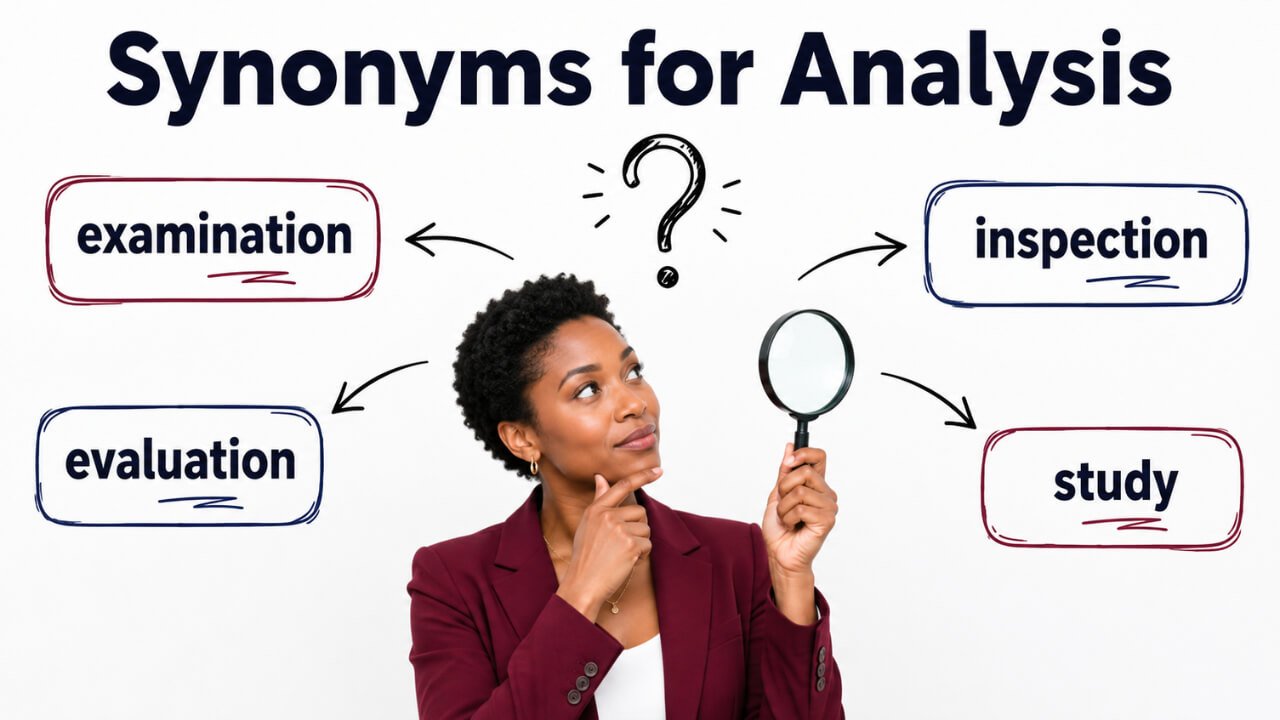
Quick Answer: Synonyms for analysis include examination, evaluation, assessment, study, review, investigation, interpretation, scrutiny, appraisal, and breakdown. Use examination for a careful general study, evaluation when judging value or quality, assessment for measuring performance or condition, investigation for discovering facts, interpretation for explaining meaning, and breakdown for presenting complex information in simpler parts. Scrutiny suits highly careful inspection, while appraisal is useful in professional and financial contexts.
Pronunciation and Word Details
Word: Analysis
Pronunciation: /əˈnæləsɪs/
Part of Speech: Noun
Meaning: Analysis is the careful study of something by examining its parts, meaning, evidence, causes, or results.
US Pronunciation:
UK Pronunciation:
What Does “Analysis” Mean?
Analysis means examining something carefully to understand its structure, meaning, causes, quality, or importance. It is a noun commonly used in academic writing, research, business, science, literature, finance, education, and everyday problem solving.
The word often describes a process in which a complicated subject is divided into smaller parts. Each part is then studied before a conclusion is reached.
In a research sentence, analysis may involve studying evidence or data. In an essay, it may involve explaining a writer’s ideas, language, or argument. In business, it can describe the evaluation of performance, costs, risks, or market conditions.
Example: The analysis revealed several reasons for the decline in sales.
In this sentence, analysis refers to a careful examination of information that helped identify causes.
Meaning, Tone, and Context of “Analysis”
Analysis usually has a neutral, formal, academic, or technical tone. It suggests careful thought rather than a quick opinion. The word is especially common when evidence, facts, measurements, arguments, or complex ideas must be examined.
In academic contexts, analysis means explaining how and why something works. A good literary analysis, for example, does more than summarize a story. It examines themes, symbols, structure, language, and meaning.
In scientific and technical contexts, analysis often involves data, testing, calculation, comparison, and interpretation. In professional settings, it may refer to reviewing performance, financial records, customer behavior, risks, or future opportunities.
The word can also appear in ordinary conversation when someone studies a problem carefully.
Example: After some analysis, we found a simpler solution.
Although analysis sounds natural in formal communication, words such as review, look, or breakdown may sound more conversational.
When and How to Use “Analysis”
For Examining Information
Use analysis when information must be studied carefully to identify patterns, relationships, or important details.
Example: The team completed an analysis of the survey results.
For Explaining Meaning
Analysis is useful when discussing the meaning of a text, speech, image, event, or idea.
Example: Her analysis of the poem focused on memory and loss.
For Understanding Causes
Use analysis when identifying why a problem, event, or change occurred.
Example: The analysis showed that poor planning caused the delay.
For Judging Performance
Analysis can describe the examination of progress, quality, efficiency, or results.
Example: A performance analysis helped the manager identify areas for improvement.
For Studying Data
Use the word when numbers, measurements, statistics, or research findings are examined.
Example: The data analysis revealed a steady increase in demand.
For Comparing Options
Analysis is appropriate when several choices are compared before a decision is made.
Example: Our analysis suggests that the second proposal offers greater value.
Best Synonyms for Analysis
Examination: A careful and detailed study of something.
Example: A close examination of the evidence revealed an important detail.
Evaluation: A process of judging quality, value, success, or effectiveness.
Example: The evaluation showed that the training program was successful.
Assessment: A judgment based on collected information, measurements, or observations.
Example: The teacher completed an assessment of each student’s progress.
Study: A detailed effort to learn about a subject or issue.
Example: The study explored changes in customer behavior.
Review: A careful consideration of information, work, or performance.
Example: The committee conducted a review of the current policy.
Investigation: A systematic effort to discover facts, causes, or explanations.
Example: The investigation uncovered the source of the error.
Interpretation: An explanation of the meaning or importance of something.
Example: Her interpretation of the results differed from ours.
Scrutiny: Extremely careful and critical examination.
Example: The financial records came under close scrutiny.
Appraisal: A professional judgment of value, condition, or performance.
Example: The property appraisal provided an updated estimate of its value.
Breakdown: A clear division of complicated information into smaller parts.
Example: The report includes a breakdown of monthly expenses.
50 Synonyms for Analysis with Short Meanings
- Examination: A careful study of something.
- Evaluation: A judgment of quality, value, or success.
- Assessment: A measured judgment based on available information.
- Study: Detailed learning or research about a subject.
- Review: Careful consideration of information or performance.
- Investigation: A search for facts, causes, or explanations.
- Inspection: A close check of condition, quality, or accuracy.
- Interpretation: An explanation of meaning or importance.
- Inquiry: A systematic search for knowledge or facts.
- Scrutiny: Very careful and critical examination.
- Research: Organized study intended to discover new information.
- Diagnosis: Identification of a condition, problem, or cause.
- Appraisal: A professional judgment of value or quality.
- Audit: An official examination of records, processes, or accounts.
- Survey: A broad study of opinions, conditions, or features.
- Exploration: A detailed effort to understand a subject.
- Dissection: A close examination of separate parts.
- Breakdown: A division of information into understandable sections.
- Deconstruction: An examination of hidden ideas and structures.
- Critique: A reasoned discussion of strengths and weaknesses.
- Commentary: An explanation or discussion of a subject.
- Reasoning: A process of using facts and logic.
- Consideration: Careful thought about a subject or decision.
- Deliberation: Detailed thought before reaching a decision.
- Reflection: Serious thought about meaning, experience, or results.
- Observation: Careful attention to facts, actions, or conditions.
- Comparison: An examination of similarities and differences.
- Classification: Organization into meaningful groups or categories.
- Calculation: Use of numbers to determine a result.
- Computation: Mathematical processing of numerical information.
- Measurement: Determination of size, amount, quality, or performance.
- Testing: Examination through trials, checks, or experiments.
- Verification: Confirmation that information is correct.
- Validation: Confirmation that a method or result is reliable.
- Estimation: An approximate judgment based on available evidence.
- Projection: A calculated prediction of a future result.
- Modeling: Representation of a system for detailed study.
- Data Review: Careful examination of collected information.
- Statistical Study: Examination of information through numerical methods.
- Case Study: Detailed examination of one person, event, or situation.
- Content Review: Examination of written, visual, or recorded material.
- Textual Examination: Close study of language, structure, and meaning.
- Discourse Study: Examination of language within communication and society.
- Risk Assessment: Evaluation of possible dangers and consequences.
- Performance Review: Examination of results, progress, or effectiveness.
- Financial Review: Examination of income, costs, records, or investments.
- Market Study: Research into customers, demand, and competition.
- Trend Evaluation: Examination of changes and patterns over time.
- Cause Investigation: A search for the reason behind a problem or event.
- Problem Solving: Careful examination used to develop a solution.
Read Also:
Synonyms for Sleep
Synonyms for Analysis by Context
For Academic and Research Writing
Examination, study, research, inquiry, critique, and interpretation are useful in academic work. Each word highlights a different part of the thinking process.
Use examination for a detailed look at evidence. Study and research suit organized investigations. Critique focuses on strengths, weaknesses, and arguments. Interpretation explains meaning.
Example: The study provides a detailed examination of language development.
For Data and Statistics
Data review, statistical study, calculation, computation, measurement, validation, and modeling suit numerical contexts.
Calculation and computation focus on mathematical work. Validation checks whether results or methods are dependable. Modeling creates a simplified representation of a real process or system.
Example: Statistical study revealed a connection between price and demand.
For Business and Performance
Evaluation, assessment, appraisal, audit, performance review, financial review, and market study work well in professional contexts.
Evaluation judges effectiveness. Assessment measures current conditions. An audit checks records or procedures, while an appraisal estimates value or quality.
Example: The performance review identified several opportunities for growth.
For Problems and Causes
Investigation, diagnosis, cause investigation, breakdown, scrutiny, and problem solving are useful when examining difficulties.
Diagnosis identifies the nature of a problem. Investigation gathers evidence. A breakdown separates the issue into smaller parts, making it easier to understand.
Example: The investigation found that unclear instructions caused the mistake.
For Literature and Communication
Interpretation, critique, commentary, textual examination, discourse study, and deconstruction are useful for studying language and ideas.
Interpretation explains meaning. Critique judges how effectively ideas are presented. Deconstruction examines assumptions, contrasts, and hidden structures within a text.
Example: Her interpretation of the character’s actions was supported by several passages.
Another Word for Analysis
Examination is often the best general replacement for analysis because it communicates the idea of studying something carefully. However, the strongest alternative depends on what is being studied and why.
Use evaluation when judging quality, investigation when finding causes, interpretation when explaining meaning, and assessment when measuring performance or condition.
Original: The analysis of the evidence took several weeks.
Better Option: The examination of the evidence took several weeks.
Original: Our analysis showed that the project was successful.
Better Option: Our evaluation showed that the project was successful.
Original: The analysis identified the cause of the technical problem.
Better Option: The investigation identified the cause of the technical problem.
Original: Her analysis of the final scene was convincing.
Better Option: Her interpretation of the final scene was convincing.
When Not to Use “Analysis”
Analysis can sound too broad when the exact type of work is known. Replacing it with a more specific word can make a sentence clearer and more informative.
Avoid using analysis repeatedly in the same paragraph. Words such as evaluation, review, examination, and interpretation can reduce repetition while preserving the intended meaning.
Do not use analysis when you only mean a short summary. Analysis explains relationships, causes, techniques, or meanings, while a summary mainly presents the central points.
Weak: The analysis analyzed the results of the analysis.
Better: The review examined the results of the earlier study.
Weak: We completed an analysis to check the financial records.
Better: We completed an audit of the financial records.
Weak: The paragraph gives an analysis of what happened in the story.
Better: The paragraph gives a summary of what happened in the story.
Weak: Her analysis explains what the poem means.
Better: Her interpretation explains what the poem means.
Words Commonly Confused With Analysis
Analysis vs Evaluation: Analysis studies parts, patterns, causes, or relationships. Evaluation uses information to judge quality, value, effectiveness, or success.
Analysis vs Assessment: Analysis examines information deeply. Assessment measures a condition, level, ability, risk, or performance.
Analysis vs Interpretation: Analysis studies how separate details work together. Interpretation explains what those details mean.
Analysis vs Summary: Analysis explains how, why, or with what effect something happens. A summary gives the main points without detailed examination.
Analysis vs Research: Research is the broader process of collecting and studying information. Analysis is often one stage within that process.
Analysis vs Review: Analysis usually involves deeper explanation and reasoning. A review may simply check, reconsider, or judge something.
Analysis vs Critique: Analysis explains parts and relationships. A critique also judges strengths, weaknesses, choices, or effectiveness.
Which Synonym Should You Choose?
Choose examination when you need a general word for careful study.
Choose evaluation when judging quality, value, effectiveness, or success.
Choose assessment when measuring ability, performance, risk, progress, or condition.
Choose investigation when searching for hidden facts, causes, errors, or responsibility.
Choose interpretation when explaining the meaning of a text, result, action, or event.
Choose scrutiny when the examination is especially careful, strict, or critical.
Choose review for reports, emails, meetings, policies, plans, and everyday professional communication.
Choose appraisal when discussing value, condition, employee performance, or professional judgment.
Choose breakdown when presenting complicated information in smaller and clearer parts.
Choose critique for essays, art, literature, arguments, presentations, and creative work.
Choose statistical study when examining numerical patterns, data, measurements, or research results.
Choose diagnosis when identifying the nature or cause of a medical, technical, or organizational problem.
Real Life Examples of “Analysis” in Sentences
Original: The analysis showed that customers preferred the simpler design.
Better Option: The evaluation showed that customers preferred the simpler design.
Original: We need a complete analysis of the damaged equipment.
Better Option: We need a complete inspection of the damaged equipment.
Original: Her analysis of the novel focused on family relationships.
Better Option: Her interpretation of the novel focused on family relationships.
Original: The analysis revealed why the system stopped working.
Better Option: The investigation revealed why the system stopped working.
Original: The manager requested an analysis of employee progress.
Better Option: The manager requested an assessment of employee progress.
Original: The report contains an analysis of monthly expenses.
Better Option: The report contains a breakdown of monthly expenses.
Original: Their analysis of the proposal was highly critical.
Better Option: Their critique of the proposal was highly critical.
Original: The analysis confirmed that the records were accurate.
Better Option: The audit confirmed that the records were accurate.
Original: A careful analysis of the options helped us decide.
Better Option: Careful consideration of the options helped us decide.
Original: The analysis predicted stronger demand next year.
Better Option: The projection predicted stronger demand next year.
Synonym Groups and Usage Differences
Examination Group
Examination, inspection, scrutiny, review, and study all involve looking closely at something. Examination is the broadest choice. Inspection often concerns physical condition or standards, while scrutiny suggests intense attention.
Example: The documents were placed under careful scrutiny.
Judgment Group
Evaluation, assessment, appraisal, and critique involve forming a judgment. Evaluation focuses on effectiveness or quality. Assessment often measures progress or condition. Appraisal commonly concerns professional performance or value.
Example: The annual appraisal considered both achievements and future goals.
Investigation Group
Investigation, inquiry, research, exploration, and diagnosis focus on discovering information. Investigation seeks facts, while diagnosis identifies the nature or cause of a specific problem.
Example: The inquiry examined how the error occurred.
Data Group
Calculation, computation, measurement, modeling, validation, and statistical study are useful when working with numerical or scientific information.
Example: The statistical study found a clear pattern in the results.
Interpretation Group
Interpretation, commentary, critique, deconstruction, and textual examination are commonly used when studying language, meaning, ideas, and communication.
Example: The commentary offered a new interpretation of the historical event.
Antonyms of Analysis
The opposite of analysis depends on whether analysis means careful study, logical reasoning, detailed examination, or division into parts.
Synthesis: The combination of separate ideas or parts into a whole.
Guesswork: An opinion formed without enough evidence or examination.
Assumption: A belief accepted without careful checking.
Neglect: Failure to give a subject proper attention.
Oversight: Failure to notice or examine an important detail.
Confusion: A lack of clear understanding or organization.
Ignorance: A lack of knowledge or information.
Generalization: A broad statement that may ignore important details.
Acceptance: Agreement with information without questioning or examining it.
Simplification: Reduction of complexity, sometimes by removing important details.
Comparison Analysis vs Related Words
Analysis vs Examination
Analysis studies parts, relationships, causes, and meanings. Examination is broader and may refer to any careful inspection or study.
Example With Analysis: The analysis explained why the campaign succeeded.
Example With Examination: The examination covered every stage of the campaign.
Analysis vs Evaluation
Analysis helps a person understand information. Evaluation uses that understanding to judge quality, value, or success.
Example With Analysis: The analysis identified changes in customer behavior.
Example With Evaluation: The evaluation determined whether the new strategy was effective.
Analysis vs Assessment
Analysis explores information in detail. Assessment measures the current level, condition, ability, or risk of something.
Example With Analysis: The analysis explored the reasons for lower performance.
Example With Assessment: The assessment measured each employee’s current performance.
Analysis vs Interpretation
Analysis explains how details connect or function. Interpretation explains the meaning that can be drawn from those details.
Example With Analysis: The analysis examined the repeated images in the poem.
Example With Interpretation: The interpretation connected those images with the idea of freedom.
Analysis vs Summary
Analysis explains how, why, and with what effect something occurs. A summary briefly states the central information.
Example With Analysis: The analysis explains how the conflict changes the main character.
Example With Summary: The summary describes the major events in the story.
Analysis vs Critique
Analysis explains structure, ideas, evidence, and relationships. Critique includes analysis but also makes judgments about effectiveness, quality, strengths, or weaknesses.
Example With Analysis: The analysis examines the speaker’s use of evidence.
Example With Critique: The critique argues that the evidence is incomplete.
Common Phrases and Expressions With Analysis
Detailed Analysis: A careful examination containing substantial information.
Data Analysis: The process of examining collected facts and figures.
Critical Analysis: A reasoned examination of ideas, evidence, strengths, and weaknesses.
Financial Analysis: The examination of income, expenses, investments, and financial performance.
Statistical Analysis: The use of numerical methods to examine data and patterns.
Risk Analysis: The examination of possible dangers, losses, and consequences.
Comparative Analysis: A study of similarities and differences between subjects.
Content Analysis: A systematic examination of written, visual, or recorded material.
Root Cause Analysis: A process used to identify the main reason a problem occurred.
Cost Benefit Analysis: A comparison of expected costs with possible advantages.
Common Mistakes to Avoid
One common mistake is using analysis when summary is intended. A summary describes the main information, while analysis explains causes, meanings, relationships, methods, or effects.
Writers also repeat analysis too often. Replace repeated uses with examination, evaluation, review, interpretation, or assessment when those words accurately express the intended meaning.
Another mistake is choosing a synonym without considering context. Audit is appropriate for financial records, but it does not naturally replace analysis in a literary essay. Interpretation works well for meaning, but it may be unsuitable for measuring performance.
Avoid vague phrases such as analysis of things or analysis of many areas. Name the exact subject being examined.
Vague: The report provides an analysis of several things.
Clear: The report evaluates costs, customer satisfaction, and delivery times.
Do not confuse the plural form. The singular form is analysis, while the plural form is analyses.
Singular: The analysis was completed yesterday.
Plural: The analyses produced similar conclusions.
Conclusion
Understanding synonyms for analysis helps you choose language that accurately reflects your purpose. Examination is a strong general alternative, while evaluation suits judgments about quality or success. Use assessment for performance or condition, investigation for facts and causes, interpretation for meaning, and breakdown for clear explanations of complex information. Scrutiny suggests intense attention, while appraisal works well in professional contexts. Choosing a precise synonym makes essays, reports, research, and everyday communication clearer, more natural, and more informative.
FAQs About Synonyms for Analysis
What is the best synonym for analysis?
Examination is the best general synonym because it describes the careful study of a subject, issue, or piece of information.
Is evaluation another word for analysis?
Evaluation can replace analysis when the purpose is to judge quality, effectiveness, value, or success. It is not always suitable when the goal is only to understand information.
What is a simple word for analysis?
Review is a simple and natural alternative. Look can also work in very casual conversation, although it is less precise.
What is a formal synonym for analysis?
Examination, evaluation, assessment, scrutiny, appraisal, and investigation are strong formal alternatives.
What is another word for analysis in an essay?
Interpretation, examination, critique, discussion, and textual examination are useful choices in essay writing.
What is the difference between analysis and assessment?
Analysis examines information to understand parts, patterns, or causes. Assessment measures or judges a condition, level, ability, risk, or performance.
What is the plural of analysis?
The plural of analysis is analyses. The final part is pronounced differently from the singular form.
