
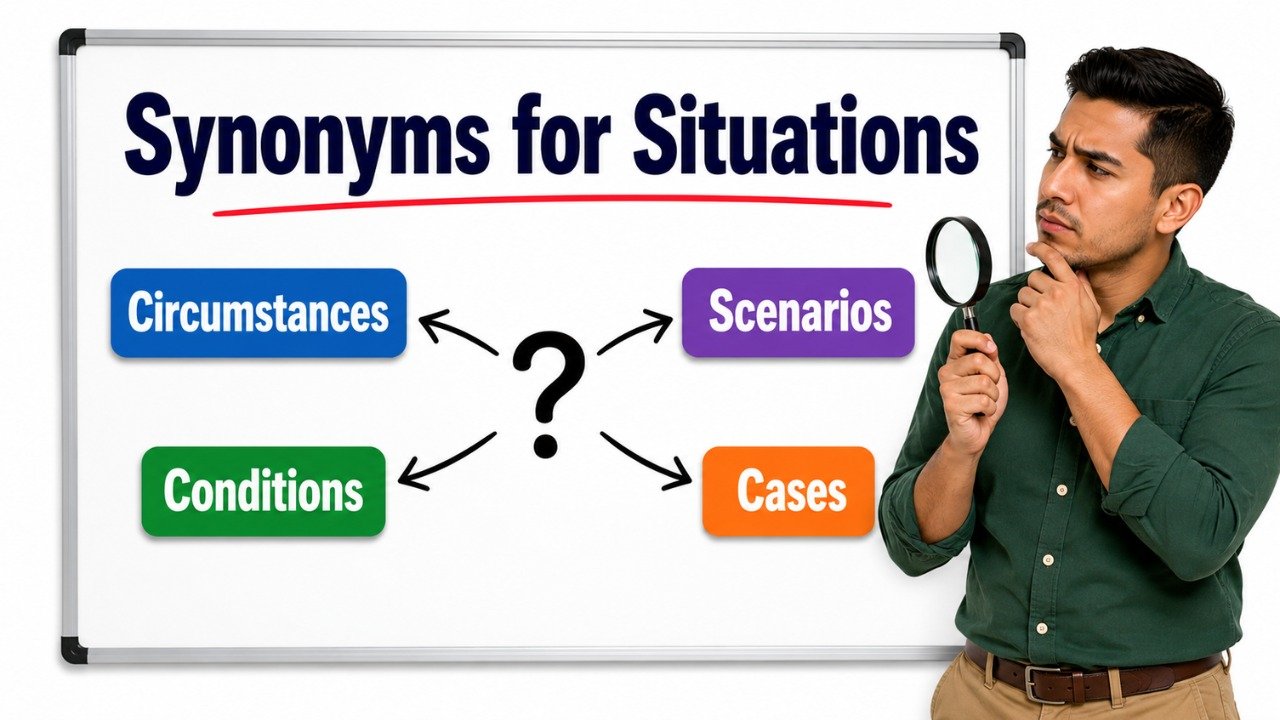
Quick Answer: The best synonyms for situations include circumstances, conditions, scenarios, cases, positions, settings, contexts, events, states, and predicaments. Use circumstances for surrounding facts, conditions for existing factors, scenarios for possible or imagined developments, cases for specific examples, settings for places or environments, contexts for background information, events for happenings, states for current conditions, and predicaments when the situation is difficult or uncomfortable. The best choice depends on whether you are describing everyday circumstances, formal analysis, problems, environments, possibilities, or specific events.
Pronunciation and Word Details
Word: Situations
Pronunciation: /ˌsɪtʃuˈeɪʃənz/
Part of Speech: Plural noun
Meaning: Conditions, circumstances, events, or sets of facts affecting people, places, or things at a particular time.
US Pronunciation:
UK Pronunciation:
What Does “Situations” Mean?
Situations means sets of circumstances, conditions, events, or facts that exist at a particular time.
The word is the plural form of situation and functions as a noun. It can describe everyday circumstances, difficult problems, social settings, professional conditions, possible scenarios, or positions in which people find themselves.
In a simple sentence, situations may refer to events or circumstances.
Example: Different situations require different solutions.
In formal writing, situations may describe conditions that need analysis.
Example: The report examined several situations affecting workplace performance.
In personal conversation, the word may describe experiences or difficult circumstances.
Example: She stays calm in stressful situations.
The exact meaning depends on context. Sometimes situations means circumstances, while in other sentences scenarios, cases, conditions, settings, or predicaments may be more precise.
Meaning, Tone, and Context of “Situations”
Situations is usually neutral in tone. It can sound formal, casual, professional, academic, or conversational depending on the sentence.
In everyday speech, situations often refers broadly to things that happen or conditions people experience.
Example: I have been in similar situations before.
In professional writing, situations may refer to specific business, workplace, financial, or operational circumstances.
Example: Managers should be prepared for unexpected situations.
In academic or analytical writing, scenarios, cases, circumstances, and conditions may sometimes sound more precise.
Example: The study considered several possible scenarios.
Situations can also carry an emotional meaning when referring to difficult experiences.
Example: Families in difficult situations may need additional support.
When referring specifically to troublesome circumstances, predicament, difficulty, crisis, or dilemma may communicate the meaning more clearly.
When and How to Use “Situations”
For Everyday Circumstances: Use situations when speaking generally about experiences or conditions people encounter.
Example: People react differently in unfamiliar situations.
For Difficult Circumstances: Use situations when describing problems or challenging conditions.
Example: Good communication helps people manage stressful situations.
For Possible Outcomes: Situations can describe imagined or future possibilities.
Example: The training prepared employees for several emergency situations.
For Professional Contexts: Use situations for workplace, business, leadership, or decision making circumstances.
Example: Experienced managers know how to respond to complex situations.
For Social Settings: Situations can describe circumstances involving interaction with other people.
Example: Confidence can make social situations easier to handle.
For Specific Cases: Situations may refer to individual examples that require a certain response.
Example: In some situations, waiting is the better option.
For Changing Conditions: Use situations when circumstances develop or change over time.
Example: The team adapted quickly to changing situations.
For Problem Solving: Situations is useful when discussing conditions that require decisions or solutions.
Example: Creative thinking can help solve unfamiliar situations more effectively.
Best Synonyms for Situations
Circumstances: Facts or conditions surrounding an event or experience.
Example: The decision was reasonable under the circumstances.
Conditions: Existing factors that influence what happens.
Example: Working conditions improved after the changes were introduced.
Scenarios: Possible, imagined, or expected sets of events.
Example: The team discussed several possible scenarios before making a decision.
Cases: Specific examples, instances, or occurrences.
Example: In some cases, additional information may be necessary.
Positions: Particular states, circumstances, or places in which someone finds themselves.
Example: Both applicants found themselves in difficult positions.
Settings: Environments or surroundings in which something happens.
Example: The technique works well in classroom settings.
Contexts: Background conditions that help explain meaning or behavior.
Example: The expression can have different meanings in different contexts.
Events: Things that happen, especially notable occurrences.
Example: Recent events changed the direction of the discussion.
States: Particular conditions existing at a certain time.
Example: The material behaves differently in several physical states.
Predicaments: Difficult or unpleasant situations that are hard to escape.
Example: The unexpected delay placed the travelers in an awkward predicament.
50 Synonyms for Situations with Short Meanings
- Circumstances: Conditions surrounding an event or experience.
- Conditions: Existing factors affecting what happens.
- Scenarios: Possible or imagined sequences of events.
- Cases: Specific examples or instances.
- Positions: Circumstances in which people or things are placed.
- Settings: Environments where events occur.
- Contexts: Background conditions that explain meaning or circumstances.
- Events: Things that happen.
- States: Particular conditions at a given time.
- Predicaments: Difficult or uncomfortable circumstances.
- Circumstance Sets: Groups of surrounding facts or conditions.
- Environments: Surroundings or conditions in which something exists.
- Surroundings: External conditions around a person or thing.
- Occurrences: Events or incidents that take place.
- Instances: Individual examples or occasions.
- Episodes: Particular events or periods within a larger sequence.
- Developments: Changes or events occurring over time.
- Affairs: Matters, events, or circumstances of concern.
- Matters: Subjects, problems, or circumstances requiring attention.
- Experiences: Events or conditions personally encountered.
- Circumstances at Hand: Present facts or conditions requiring consideration.
- Conditions at Hand: Current factors affecting a decision or event.
- Predicaments at Hand: Difficult circumstances currently being faced.
- Dilemmas: Situations requiring a difficult choice.
- Difficulties: Problems or challenging circumstances.
- Problems: Situations requiring solutions.
- Crises: Serious and urgent situations.
- Emergencies: Dangerous situations requiring immediate action.
- Complications: Factors that make a situation more difficult.
- Challenges: Difficult circumstances requiring effort or skill.
- Circumstances of Life: Conditions affecting personal experience.
- Life Conditions: Circumstances shaping daily living.
- Social Settings: Environments involving interaction with others.
- Work Settings: Conditions or environments connected with employment.
- Contexts of Use: Circumstances in which something is applied or understood.
- Backgrounds: Circumstances or histories surrounding events.
- Conditions of Use: Circumstances governing how something is used.
- Cases in Point: Specific examples that illustrate a situation.
- Possibilities: Potential situations that may occur.
- Outcomes: Results produced by particular circumstances.
- Positions in Life: Personal or social circumstances.
- States of Affairs: Existing conditions within a particular matter.
- Sets of Circumstances: Groups of connected facts and conditions.
- Realities: Actual conditions as they exist.
- Circumstantial Conditions: Factors surrounding an event or decision.
- Occurrences at Hand: Current events or incidents requiring attention.
- Phases: Particular stages or periods within changing circumstances.
- Moments: Particular points in time involving specific circumstances.
- Occasions: Particular times or events.
- Junctures: Important points in a developing series of events.
Read Also:
Synonyms for Fairness
Synonyms for Situations by Context
When Situations Means Circumstances
Circumstances, conditions, states of affairs, realities, and sets of circumstances work well when referring to facts or conditions surrounding an event.
Example: The decision made sense given the circumstances.
Example: Economic conditions affected the final outcome.
Circumstances is one of the closest general synonyms because it describes the surrounding facts influencing a person, decision, or event.
When Situations Means Possible Scenarios
Scenarios, possibilities, outcomes, developments, and cases are useful when describing things that might happen.
Example: The team prepared for several possible scenarios.
Example: We considered all likely outcomes before making the decision.
Scenario is especially useful in planning, forecasting, training, and hypothetical discussions.
When Situations Means Specific Cases
Cases, instances, occasions, episodes, and examples are useful when referring to individual situations.
Example: In certain cases, additional testing may be required.
Example: There have been several similar instances this month.
Case is particularly useful in formal writing when discussing a specific example.
When Situations Means Difficult Circumstances
Predicaments, dilemmas, crises, emergencies, difficulties, challenges, complications, and problems are stronger when the circumstances are negative.
Example: She remained calm despite the difficult predicament.
Example: The organization developed a plan for emergency situations.
Predicament suggests an awkward or difficult circumstance, while crisis and emergency suggest greater urgency.
When Situations Means Environments
Settings, environments, surroundings, contexts, and backgrounds work well when the word refers to where or under what conditions something happens.
Example: The technique performs well in different settings.
Example: The phrase can have different meanings in different contexts.
Setting is useful for physical or social environments, while context is stronger for meaning, interpretation, and background information.
Another Word for Situations
Circumstances is usually the best single general replacement for situations because it works naturally in many personal, formal, and professional contexts.
However, the best alternative depends on meaning. Use scenarios for possible events, cases for specific examples, conditions for existing factors, predicaments for difficult circumstances, and settings for environments.
Original: People behave differently in stressful situations.
Better Option: People behave differently under stressful circumstances.
Original: The team discussed several possible situations.
Better Option: The team discussed several possible scenarios.
Original: This rule does not apply in every situation.
Better Option: This rule does not apply in every case.
Original: The method works in many professional situations.
Better Option: The method works in many professional settings.
When Not to Use “Situations”
Situations can sometimes sound too general. A more precise word often improves clarity.
If you mean surrounding facts, circumstances is usually clearer.
Weak: The situations surrounding the decision were unusual.
Better: The circumstances surrounding the decision were unusual.
If you mean possible future events, scenarios is more precise.
Weak: We prepared for several possible situations.
Better: We prepared for several possible scenarios.
If you mean a difficult problem, predicament or dilemma may communicate more information.
Weak: He found himself in a difficult situation.
Better: He found himself in a difficult predicament.
Avoid repeating situations too frequently in formal writing.
Weak: Different situations require different responses, and difficult situations require especially careful responses.
Better: Different circumstances require different responses, while difficult cases require especially careful judgment.
Situations may also sound vague when the reader needs to know exactly what type of condition is being discussed.
Weak: These situations affect performance.
Better: These working conditions affect performance.
Words Commonly Confused With Situations
Situations vs Circumstances: Situations describes general sets of conditions or events, while circumstances emphasizes surrounding facts that influence what happens.
Situations vs Scenarios: Situations may be real or hypothetical. Scenarios often describe imagined, possible, or planned sequences of events.
Situations vs Conditions: Situations refers broadly to circumstances, while conditions often focuses on specific factors affecting an environment, person, or result.
Situations vs Cases: Situations is broad, while cases usually refers to individual examples or specific instances.
Situations vs Contexts: Situations describes circumstances or events. Contexts refers more specifically to background information that helps explain meaning or behavior.
Situations vs Settings: Situations describes what is happening, while settings emphasizes where or under what environmental conditions it happens.
Situations vs Predicaments: Situations can be positive, negative, or neutral. Predicaments are usually difficult or uncomfortable.
Which Synonym Should You Choose?
Choose circumstances when describing surrounding facts or conditions in general writing.
Choose conditions when discussing factors that affect health, work, weather, performance, or an environment.
Choose scenarios when writing about imagined possibilities, planning, forecasting, or future outcomes.
Choose cases when discussing specific examples, legal matters, research findings, or individual instances.
Choose settings when describing workplaces, classrooms, social environments, or physical surroundings.
Choose contexts when explaining language, meaning, behavior, culture, or background information.
Choose predicaments when the circumstances are difficult, awkward, or troublesome.
Choose dilemmas when a difficult choice between alternatives is involved.
Choose crises when the situation is serious and demands urgent attention.
Choose circumstances or conditions in formal reports and essays when situations feels too general.
Choose events or occasions in conversation when referring to things that happened at particular times.
Real Life Examples of “Situations” in Sentences
Original: She handles stressful situations calmly.
Better Option: She handles stressful circumstances calmly.
Original: We discussed several possible situations before the meeting.
Better Option: We discussed several possible scenarios before the meeting.
Original: Some situations require immediate action.
Better Option: Some cases require immediate action.
Original: The method works well in professional situations.
Better Option: The method works well in professional settings.
Original: These situations can affect employee performance.
Better Option: These conditions can affect employee performance.
Original: People behave differently in unfamiliar situations.
Better Option: People behave differently in unfamiliar environments.
Original: Emergency situations require clear communication.
Better Option: Emergencies require clear communication.
Original: The article examines social situations involving group behavior.
Better Option: The article examines social contexts involving group behavior.
Original: He has dealt with similar situations before.
Better Option: He has dealt with similar circumstances before.
Original: Difficult situations often require careful decisions.
Better Option: Difficult predicaments often require careful decisions.
Synonym Groups and Usage Differences
Circumstance Group
Circumstances, conditions, realities, states of affairs, and sets of circumstances describe surrounding facts or existing conditions.
Example: The circumstances changed after new information became available.
Circumstances is broad and natural, while conditions often focuses more specifically on influencing factors.
Scenario Group
Scenarios, possibilities, outcomes, and developments describe possible or changing situations.
Example: The planners considered several possible scenarios.
Scenario is especially useful when discussing events that have not yet happened.
Case Group
Cases, instances, examples, episodes, and occasions refer to individual situations.
Example: In most cases, the problem can be solved quickly.
Case is usually the strongest choice when discussing a specific example.
Difficulty Group
Predicaments, dilemmas, challenges, crises, emergencies, problems, and complications describe negative or demanding situations.
Example: The unexpected expense created a difficult predicament.
Predicament suggests difficulty, dilemma involves a hard choice, and crisis suggests serious urgency.
Environment Group
Settings, environments, surroundings, backgrounds, and contexts describe where something happens or the conditions surrounding it.
Example: The approach is effective in educational settings.
Setting often describes physical or social environments, while context provides explanatory background.
Antonyms of Situations
Situations does not have one exact opposite because it is a broad noun. However, several words can express ideas opposite to difficult, uncertain, or changing situations.
Stability: A condition of being steady and unlikely to change.
Certainty: A state in which there is little or no doubt.
Normality: A condition regarded as usual or expected.
Routine: A regular and predictable pattern.
Consistency: The quality of remaining similar over time.
Order: A condition in which things are organized and controlled.
Security: A state of safety and protection.
Calm: A condition without disturbance or difficulty.
Resolution: The successful ending of a difficult situation.
Simplicity: A state involving little difficulty or complexity.
Comparison: Situations vs Related Words
Situations vs Circumstances
Situations is broader and can describe events, conditions, or experiences. Circumstances emphasizes the surrounding facts influencing an event or person.
Example With Situations: People react differently in stressful situations.
Example With Circumstances: She remained calm despite the difficult circumstances.
Situations vs Scenarios
Situations may describe real circumstances, while scenarios commonly describe possible, imagined, or planned events.
Example With Situations: Unexpected situations can occur during travel.
Example With Scenarios: The training covered several emergency scenarios.
Situations vs Conditions
Situations describes general circumstances. Conditions refers more specifically to factors affecting what happens.
Example With Situations: Some situations require additional preparation.
Example With Conditions: Poor working conditions can reduce productivity.
Situations vs Cases
Situations is broad, while cases normally refers to particular examples or instances.
Example With Situations: These situations are common in large organizations.
Example With Cases: In some cases, additional approval is required.
Situations vs Contexts
Situations refers to circumstances or events. Contexts describes background information that helps explain meaning, behavior, or interpretation.
Example With Situations: People communicate differently in formal situations.
Example With Contexts: The word has different meanings in different contexts.
Situations vs Settings
Situations describes what is happening, while settings describes the environment in which it happens.
Example With Situations: People may feel nervous in unfamiliar situations.
Example With Settings: People may behave differently in formal settings.
Situations vs Predicaments
Situations can be neutral, positive, or negative. Predicaments specifically describe difficult circumstances.
Example With Situations: New situations often require flexibility.
Example With Predicaments: Unexpected expenses can place families in difficult predicaments.
Common Phrases and Expressions With “Situations”
Difficult Situations: Circumstances that are challenging or stressful.
Emergency Situations: Circumstances requiring immediate attention or action.
Social Situations: Circumstances involving interaction with other people.
Real Life Situations: Circumstances that occur in actual everyday experience.
Certain Situations: Specific circumstances in which a statement or rule applies.
Different Situations: Circumstances that vary from one another.
Unexpected Situations: Circumstances that were not predicted or planned.
Stressful Situations: Circumstances that create pressure or anxiety.
Similar Situations: Circumstances that share important characteristics.
Complex Situations: Circumstances involving several connected problems or factors.
Common Mistakes to Avoid
One common mistake is using situations repeatedly when more precise nouns are available.
Weak: Different situations create different problems in different situations.
Better: Different circumstances create different problems in different environments.
Another mistake is using situations when scenarios is more appropriate for hypothetical possibilities.
Weak: The report discusses three future situations.
Better: The report discusses three future scenarios.
Writers may also use situations when they actually mean conditions.
Weak: The company improved the situations for workers.
Better: The company improved the working conditions for employees.
Do not use predicament as a replacement for every situation. Predicament normally implies difficulty or trouble.
Unnatural: She enjoyed several pleasant predicaments during her vacation.
Better: She enjoyed several pleasant experiences during her vacation.
Avoid vague expressions when a specific type of situation can be named.
Weak: These situations are dangerous.
Better: These emergency conditions are dangerous.
Be careful when choosing case, context, setting, and circumstance. Each describes a different aspect of a situation. Case refers to a specific instance, context explains background, setting describes an environment, and circumstance refers to surrounding conditions.
Conclusion
The best synonyms for situations depend on the type of circumstances you are describing. Circumstances works as a strong general alternative, conditions suits influencing factors, scenarios describes possible events, cases refers to specific examples, settings describes environments, and contexts provides background. Predicaments, dilemmas, and crises are stronger choices for difficult circumstances. Choosing precise synonyms for situations can make essays, reports, emails, conversations, and everyday writing clearer, more natural, and more specific.
FAQs About Synonyms for Situations
What is the best synonym for situations?
Circumstances is usually the strongest general synonym for situations. It works naturally in both formal and everyday writing.
What is another word for situations in formal writing?
Circumstances, conditions, cases, contexts, and scenarios are useful formal alternatives. The best choice depends on the intended meaning.
What is another word for difficult situations?
Predicaments, dilemmas, crises, difficulties, challenges, and complications are useful alternatives for difficult situations.
What is another word for situations in an essay?
Circumstances is a strong general choice. Scenarios, cases, conditions, settings, and contexts can be more precise depending on the sentence.
Are situations and circumstances the same?
They are closely related, but not always identical. Situations is broader, while circumstances often emphasizes the surrounding facts or conditions affecting an event.
What is the difference between situations and scenarios?
Situations may describe real or imagined circumstances. Scenarios often refer specifically to possible, hypothetical, or planned events.
What synonym for situations means specific examples?
Cases and instances are strong choices when situations refers to particular examples or individual occurrences.
