
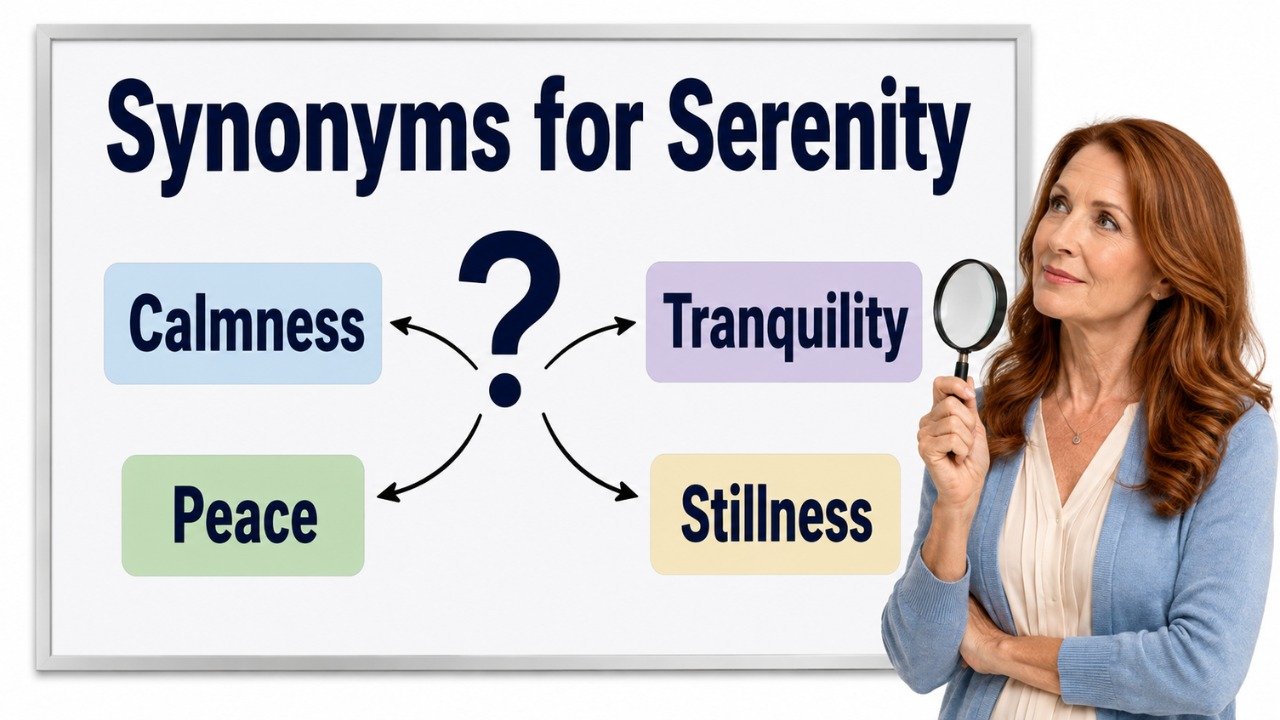
Quick Answer: The best synonyms for serenity include tranquility, peacefulness, calmness, composure, peace, equanimity, stillness, quietude, repose, and placidity. Choose tranquility for deep inner or environmental calm, peacefulness for freedom from disturbance, composure for emotional control, equanimity for balanced reactions under pressure, stillness for physical quiet, and repose for restful calm. Serenity itself works especially well when describing a lasting sense of inner peace, emotional balance, or a quiet and undisturbed atmosphere.
Pronunciation and Word Details
Word: Serenity
Pronunciation: /səˈrɛnəti/
Part of Speech: Noun
Meaning: A state of deep calm, peacefulness, and freedom from worry or disturbance.
US Pronunciation:
UK Pronunciation:
What Does “Serenity” Mean?
Serenity means a state of deep peace, calmness, and freedom from emotional or physical disturbance.
It is a noun commonly used to describe a peaceful state of mind, a calm personality, or an environment that feels quiet and undisturbed.
A person may experience serenity after resolving a difficult problem or finding emotional balance. A place may also possess serenity when it is quiet, peaceful, and free from distracting activity.
Mental State: She felt a sense of serenity after making her decision.
Emotional State: His serenity remained even during the difficult discussion.
Atmosphere: The serenity of the garden helped visitors relax.
Reflective Context: A quiet morning gave her a rare feeling of serenity.
Serenity often suggests more than temporary calm. It can describe a deeper and more settled form of peace that is not easily disturbed.
Meaning, Tone, and Context of “Serenity”
Serenity has a peaceful, positive, and slightly elevated tone. It sounds natural in everyday writing but is especially common in reflective, descriptive, literary, emotional, and formal contexts.
Neutral Use: Serenity can describe any state of calm and peacefulness.
Emotional Use: It often describes freedom from anxiety, stress, anger, or inner conflict.
Formal Use: Serenity works well in essays, reports about emotional states, thoughtful writing, and polished descriptions.
Literary Use: Writers often use serenity to create images of peaceful landscapes, quiet rooms, still water, or calm expressions.
Conversational Use: The word is understandable in ordinary speech, although calm and peace may sound more casual.
Positive Tone: Serenity usually carries a favorable meaning because it suggests balance, comfort, and emotional stability.
Atmospheric Use: It can describe the peaceful quality of a location, moment, sound, or scene.
Serenity is stronger than simple quietness because it often combines external calm with an internal feeling of peace.
When and How to Use “Serenity”
For Inner Peace: Use serenity when describing a settled and peaceful mental state.
Example: Meditation helped her develop a lasting sense of serenity.
For Emotional Control: Use serenity when someone remains calm instead of reacting with fear, anger, or panic.
Example: She answered the criticism with surprising serenity.
For Peaceful Places: Serenity works well when describing environments that feel quiet and undisturbed.
Example: The lake was surrounded by an atmosphere of serenity.
For Reflective Writing: Use serenity when describing thoughtful moments of emotional balance.
Example: The quiet evening filled him with serenity.
For Personal Growth: Serenity can describe the calm that comes from acceptance, understanding, or emotional maturity.
Example: Over time, she found serenity in accepting what she could not change.
For Formal Description: Serenity can make a sentence sound more polished than simple words such as calm or quiet.
Example: The design created a sense of serenity throughout the room.
For Nature Writing: Serenity is useful for describing still landscapes and peaceful natural surroundings.
Example: The serenity of the mountains made the journey memorable.
Best Synonyms for Serenity
Tranquility: A state of deep peace without disturbance or agitation.
Example: The quiet countryside offered complete tranquility.
Peacefulness: The quality of being calm, quiet, and free from conflict.
Example: She enjoyed the peacefulness of the early morning.
Calmness: A state of being relaxed and free from strong emotion.
Example: His calmness helped everyone handle the problem.
Composure: Emotional control, especially during pressure or difficulty.
Example: She maintained her composure throughout the interview.
Peace: Freedom from disturbance, conflict, worry, or anxiety.
Example: He finally found peace after months of uncertainty.
Equanimity: Mental balance and calmness, especially in difficult situations.
Example: She accepted the disappointing result with equanimity.
Stillness: Complete physical quiet or absence of movement.
Example: The stillness of the forest created a peaceful mood.
Quietude: A state of quietness, calm, and peaceful inactivity.
Example: He valued the quietude of the small village.
Repose: A state of rest, relaxation, and peaceful calm.
Example: The room offered a welcome sense of repose.
Placidity: Calmness without noticeable disturbance or excitement.
Example: The placidity of the water reflected the peaceful morning.
50 Synonyms for Serenity with Short Meanings
- Tranquility: Deep peacefulness without disturbance.
- Peacefulness: A calm state free from conflict or agitation.
- Calmness: Freedom from excitement, anxiety, or strong emotion.
- Composure: Emotional control during difficult situations.
- Peace: Freedom from worry, conflict, or disturbance.
- Equanimity: Balanced calmness during pressure or change.
- Stillness: Complete quiet and lack of movement.
- Quietude: Peaceful and undisturbed quietness.
- Repose: Restful and relaxed calm.
- Placidity: Gentle calmness without emotional or physical disturbance.
- Placidness: A peaceful and untroubled condition.
- Quietness: Absence of noise, activity, or agitation.
- Restfulness: A quality that encourages relaxation and peace.
- Harmony: A balanced and peaceful state.
- Contentment: Peaceful satisfaction with one’s situation.
- Poise: Calm and confident self control.
- Collectedness: The state of remaining mentally controlled and calm.
- Self possession: Calm control of emotions and behavior.
- Coolness: Calm behavior under pressure.
- Steadiness: Emotional stability and consistent calm.
- Balance: A stable and emotionally even condition.
- Ease: Freedom from discomfort, tension, or worry.
- Relaxation: A state free from physical or mental tension.
- Rest: Freedom from activity, strain, or disturbance.
- Comfort: A state of physical or emotional ease.
- Hush: A condition of complete or near complete quiet.
- Silence: Absence of sound or noise.
- Quiet: A peaceful state with little noise or disturbance.
- Calm: A peaceful condition without agitation.
- Inner Peace: A deeply settled and peaceful mental state.
- Peace of Mind: Freedom from worry or emotional uncertainty.
- Mental Calm: A state of relaxed and undisturbed thinking.
- Emotional Balance: Stable and controlled emotional functioning.
- Centeredness: A feeling of mental and emotional stability.
- Groundedness: A stable and realistic sense of emotional control.
- Untroubledness: Freedom from worry, anxiety, or disturbance.
- Undisturbedness: A state in which peace is not interrupted.
- Imperturbability: The ability to remain calm despite difficulty.
- Unflappability: Calm confidence that is difficult to disturb.
- Sangfroid: Calm self control during difficult circumstances.
- Ataraxia: A state of deep mental calm and freedom from distress.
- Evenness: Emotional steadiness without extreme reactions.
- Mildness: Gentle calmness in manner or character.
- Gentleness: A soft, calm, and considerate quality.
- Softness: A mild and soothing quality in mood or atmosphere.
- Acceptance: Peaceful recognition of a situation as it is.
- Patience: Calm willingness to wait or endure difficulty.
- Assurance: Calm confidence that reduces uncertainty.
- Reposefulness: A restful and peaceful quality.
- Unruffledness: A condition of remaining calm and emotionally undisturbed.
Read Also:
Synonyms for Situations
Synonyms for Serenity by Context
When Serenity Means Inner Peace
When serenity refers to a peaceful state of mind, the strongest alternatives include tranquility, inner peace, peace of mind, contentment, centeredness, and mental calm.
These words emphasize freedom from worry and emotional disturbance.
Example With Serenity: She discovered serenity after accepting the decision.
Alternative: She discovered inner peace after accepting the decision.
Inner peace sounds more personal and emotional, while tranquility can describe both mental and physical calm.
When Serenity Means Emotional Control
When serenity describes someone remaining calm under pressure, composure, equanimity, poise, self possession, steadiness, and unflappability are useful alternatives.
Example With Serenity: He faced the unexpected criticism with serenity.
Alternative: He faced the unexpected criticism with composure.
Composure emphasizes control over visible emotion. Equanimity suggests a deeper ability to remain emotionally balanced.
When Serenity Means a Peaceful Atmosphere
When serenity describes a place or setting, tranquility, peacefulness, quietude, stillness, restfulness, and repose work well.
Example With Serenity: Visitors admired the serenity of the garden.
Alternative: Visitors admired the tranquility of the garden.
Tranquility is one of the strongest replacements when the sentence describes a peaceful environment.
When Serenity Means Freedom From Disturbance
Useful alternatives include peacefulness, untroubledness, calmness, quiet, undisturbedness, and peace.
Example With Serenity: The morning passed in complete serenity.
Alternative: The morning passed in complete peacefulness.
These words emphasize the absence of noise, worry, conflict, or interruption.
When Serenity Means Restful Calm
When the context focuses on relaxation and relief from stress, repose, restfulness, relaxation, ease, and comfort may be better choices.
Example With Serenity: The quiet room gave her a feeling of serenity.
Alternative: The quiet room gave her a feeling of repose.
Repose has a more literary tone and often suggests peaceful rest.
When Serenity Means Balanced Acceptance
Acceptance, equanimity, contentment, balance, and steadiness work well when serenity comes from accepting circumstances rather than trying to control them.
Example With Serenity: She approached the change with serenity.
Alternative: She approached the change with equanimity.
Equanimity is especially useful in formal writing about emotional balance.
Another Word for Serenity
The best single alternative for serenity is usually tranquility because both words describe deep calm, peacefulness, and freedom from disturbance.
However, the best replacement depends on context. Composure is better when discussing emotional control. Stillness is better for physical quiet. Peace works naturally in everyday conversation, while equanimity suits formal descriptions of balanced reactions.
Original: She felt serenity while sitting beside the lake.
Better Option: She felt tranquility while sitting beside the lake.
Original: He maintained his serenity during the argument.
Better Option: He maintained his composure during the argument.
Original: The serenity of the forest surrounded them.
Better Option: The stillness of the forest surrounded them.
Original: She eventually found serenity after making her choice.
Better Option: She eventually found peace after making her choice.
When Not to Use “Serenity”
Serenity is expressive, but it may sound too formal or abstract when a simpler word communicates the meaning more naturally.
In casual conversation, calm or peace may be more direct.
Weak: I need some serenity before I answer these messages.
Better: I need some peace before I answer these messages.
Avoid serenity when the sentence specifically means emotional control rather than general peacefulness.
Weak: She kept her serenity while answering difficult questions.
Better: She kept her composure while answering difficult questions.
Do not use serenity when the main idea is simply silence.
Weak: The serenity in the library allowed everyone to study.
Better: The quiet in the library allowed everyone to study.
Serenity can also become repetitive in descriptive writing.
Weak: The room had serenity, and the serenity of the lighting increased the serenity of the space.
Better: The room felt peaceful, while the soft lighting added to its tranquility.
Choose a more precise alternative when the cause or type of calm matters.
Words Commonly Confused With Serenity
Serenity vs Tranquility: Both describe deep calm, but tranquility often emphasizes freedom from external disturbance, while serenity frequently suggests inner emotional peace.
Serenity vs Peace: Peace is broader and can mean freedom from conflict, worry, or disturbance. Serenity specifically emphasizes calmness and emotional quiet.
Serenity vs Calmness: Calmness is a general absence of agitation. Serenity often suggests a deeper and more lasting form of calm.
Serenity vs Composure: Serenity describes peacefulness, while composure means maintaining emotional control, especially during pressure.
Serenity vs Equanimity: Serenity suggests peaceful calm. Equanimity emphasizes emotional balance and an even response to positive or negative events.
Serenity vs Stillness: Serenity can describe an emotional or environmental state. Stillness primarily refers to the absence of movement or activity.
Serenity vs Quietness: Quietness mainly concerns limited noise or activity, while serenity includes a stronger sense of peacefulness.
Serenity vs Contentment: Serenity is calmness and peace. Contentment is satisfaction with one’s circumstances.
Which Synonym Should You Choose?
Choose tranquility when describing deep inner calm or a peaceful environment.
Choose peacefulness when emphasizing freedom from noise, conflict, or disturbance.
Choose calmness for general everyday descriptions of relaxed behavior or feelings.
Choose composure when someone remains emotionally controlled during stress, criticism, disagreement, or pressure.
Choose equanimity in formal writing when describing emotional balance during difficult or changing circumstances.
Choose peace in casual speech, emails, conversation, or simple writing when a familiar word works best.
Choose stillness when describing silence, lack of movement, or a peaceful physical setting.
Choose quietude in literary or descriptive writing when you want to emphasize quiet peacefulness.
Choose repose when the sentence focuses on restful calm or relaxation.
Choose contentment when peace comes from satisfaction and acceptance.
Choose poise when calmness is combined with confidence and controlled behavior.
Choose inner peace when writing about personal emotional or mental well being.
For essays and formal reports, tranquility, composure, and equanimity can add precision.
For everyday conversation, peace, calm, and calmness usually sound more natural.
Real Life Examples of “Serenity” in Sentences
Original: She found serenity during her quiet morning walk.
Better Option: She found tranquility during her quiet morning walk.
Original: His serenity impressed everyone during the tense discussion.
Better Option: His composure impressed everyone during the tense discussion.
Original: The serenity of the lake made the afternoon relaxing.
Better Option: The peacefulness of the lake made the afternoon relaxing.
Original: She accepted the unexpected change with serenity.
Better Option: She accepted the unexpected change with equanimity.
Original: The empty room had an unusual sense of serenity.
Better Option: The empty room had an unusual sense of stillness.
Original: After resolving the disagreement, he finally felt serenity.
Better Option: After resolving the disagreement, he finally felt peace.
Original: The garden created serenity for anyone who entered.
Better Option: The garden created tranquility for anyone who entered.
Original: Her face showed serenity despite the stressful situation.
Better Option: Her face showed calmness despite the stressful situation.
Original: He valued the serenity of living far from constant noise.
Better Option: He valued the quietude of living far from constant noise.
Original: The peaceful music filled the room with serenity.
Better Option: The peaceful music filled the room with a sense of repose.
Synonym Groups and Usage Differences
Inner Peace Group
Tranquility, peace, inner peace, peace of mind, centeredness, and contentment belong to this group.
These words describe a settled mental or emotional state with little worry or conflict.
Example: After making her decision, she finally experienced peace of mind.
Emotional Control Group
Composure, equanimity, poise, collectedness, self possession, and unflappability describe calm behavior when pressure is present.
They focus more on emotional control than quiet surroundings.
Example: His composure remained steady during the difficult conversation.
Quiet Atmosphere Group
Stillness, quietude, quietness, silence, hush, and peacefulness describe places or moments with little noise, movement, or disturbance.
Example: The stillness of the empty street made the morning feel peaceful.
Rest and Relaxation Group
Repose, restfulness, relaxation, ease, comfort, and rest emphasize freedom from tension or activity.
Example: The comfortable chair created a feeling of repose.
Stability Group
Steadiness, balance, evenness, groundedness, and centeredness describe emotional stability and consistency.
Example: Her emotional balance helped her respond thoughtfully.
Deep Calm Group
Tranquility, serenity, placidity, imperturbability, ataraxia, and untroubledness describe calm states that are not easily disrupted.
Example: The remote countryside offered complete tranquility.
Antonyms of Serenity
The opposite of serenity depends on whether the sentence refers to mental calm, emotional balance, or a peaceful environment.
Agitation: A state of nervousness, excitement, or disturbance.
Anxiety: Strong worry, fear, or uneasiness.
Stress: Mental or emotional pressure and tension.
Turmoil: A condition of confusion, disturbance, or emotional unrest.
Chaos: Complete disorder or confusion.
Restlessness: An inability to remain relaxed or peaceful.
Tension: Mental, emotional, or physical strain.
Distress: Strong emotional suffering or worry.
Panic: Sudden intense fear that disrupts calm thinking.
Uneasiness: A mild feeling of worry or discomfort.
Disquiet: A state of anxiety or disturbance.
Conflict: A condition of disagreement or struggle that prevents peace.
Commotion: Noisy activity or disturbance.
Disorder: Lack of calm organization or stability.
Unrest: A condition of dissatisfaction, agitation, or disturbance.
Comparison: Serenity vs Related Words
Serenity vs Tranquility
Serenity usually emphasizes peaceful emotional calm, while tranquility can describe either a peaceful mind or a quiet environment.
Example With Serenity: She felt serenity after reaching a difficult decision.
Example With Tranquility: The remote valley offered complete tranquility.
Serenity vs Peace
Peace is broader than serenity. It can describe freedom from conflict, worry, noise, or disagreement. Serenity specifically suggests deep calm and emotional quiet.
Example With Serenity: His face reflected serenity.
Example With Peace: She wanted peace after weeks of arguments.
Serenity vs Calmness
Calmness is a general state without agitation. Serenity often suggests a deeper, more settled form of calm.
Example With Serenity: The retreat gave her a lasting sense of serenity.
Example With Calmness: His calmness helped him solve the immediate problem.
Serenity vs Composure
Serenity describes peacefulness, while composure describes controlled behavior during stress.
Example With Serenity: She enjoyed the serenity of the quiet afternoon.
Example With Composure: She maintained her composure during the difficult interview.
Serenity vs Equanimity
Serenity emphasizes peace. Equanimity emphasizes emotional balance regardless of whether circumstances are pleasant or unpleasant.
Example With Serenity: The peaceful surroundings gave him serenity.
Example With Equanimity: He accepted both praise and criticism with equanimity.
Serenity vs Stillness
Serenity may be emotional or environmental. Stillness focuses primarily on the absence of movement or activity.
Example With Serenity: The room gave her a feeling of serenity.
Example With Stillness: The stillness of the room made every small sound noticeable.
Serenity vs Contentment
Serenity is calmness and peace, while contentment is satisfaction with what one has or experiences.
Example With Serenity: She felt serenity after the difficult conversation ended.
Example With Contentment: She felt contentment while enjoying her simple routine.
Common Phrases and Expressions With “Serenity”
Inner Serenity: Deep peace within a person’s mind or emotions.
Sense of Serenity: A noticeable feeling of calm and peacefulness.
Complete Serenity: A state of total calm without disturbance.
Peace and Serenity: A combination of freedom from conflict and deep calm.
Calm Serenity: A deeply peaceful and emotionally settled condition.
Serenity of Mind: A peaceful and undisturbed mental state.
Moment of Serenity: A short period of peaceful calm.
Atmosphere of Serenity: A setting that feels quiet, calm, and peaceful.
Serenity and Balance: Emotional calm combined with stability.
Find Serenity: To reach a peaceful and emotionally settled state.
Common Mistakes to Avoid
One common mistake is treating serenity as an exact replacement for every word related to calmness.
Serenity has a deeper and often more reflective meaning than ordinary quiet or calm.
Unnatural: Please maintain serenity while waiting in line.
Natural: Please remain calm while waiting in line.
Another mistake is using serenity where composure would be more precise.
Less Precise: She maintained her serenity during the heated debate.
More Precise: She maintained her composure during the heated debate.
Avoid using serenity simply because a place is silent.
Less Precise: There was serenity in the room because nobody spoke.
More Precise: There was complete silence in the room because nobody spoke.
Repetition can also weaken descriptive writing.
Repetitive: The serenity of the lake gave the village serenity and helped visitors experience serenity.
Improved: The tranquility of the lake gave the village a peaceful atmosphere and helped visitors relax.
Do not confuse serenity with contentment. Someone may feel calm without being satisfied, or satisfied without experiencing deep calm.
Avoid overly formal alternatives in ordinary conversation. Ataraxia and equanimity can be useful in academic or philosophical contexts, but calm and peace are often clearer in everyday speech.
Choose synonyms according to the exact meaning rather than replacing serenity mechanically.
Conclusion
The most useful synonyms for serenity include tranquility, peacefulness, calmness, composure, peace, equanimity, stillness, quietude, repose, and placidity. Tranquility works well for deep inner or environmental peace, while composure is better for emotional control and equanimity suits balanced reactions under pressure. Stillness describes physical quiet, and peace is often the simplest choice for everyday communication. Choosing the right alternative makes writing more precise while preserving the gentle, calm meaning associated with serenity.
FAQs About Synonyms for Serenity
What Is the Best Synonym for Serenity?
Tranquility is one of the closest synonyms because both words describe deep calm, peacefulness, and freedom from disturbance.
What Is a Simple Word for Serenity?
Peace and calm are simple alternatives. Peace emphasizes freedom from worry or conflict, while calm describes freedom from agitation.
Is Tranquility the Same as Serenity?
They are very similar. Serenity often emphasizes inner emotional peace, while tranquility can also strongly describe quiet places and surroundings.
What Is a Formal Synonym for Serenity?
Equanimity is a useful formal synonym when discussing emotional balance. Tranquility and composure are also suitable in formal writing, depending on context.
What Is Another Word for Inner Serenity?
Inner peace, peace of mind, centeredness, mental calm, and tranquility are useful alternatives for inner serenity.
Is Composure a Synonym for Serenity?
Composure is a close alternative when serenity refers to calm behavior under pressure. However, composure emphasizes emotional control rather than general peacefulness.
What Is the Opposite of Serenity?
Common opposites include agitation, anxiety, turmoil, stress, unrest, panic, tension, and restlessness. The best antonym depends on the sentence.
