
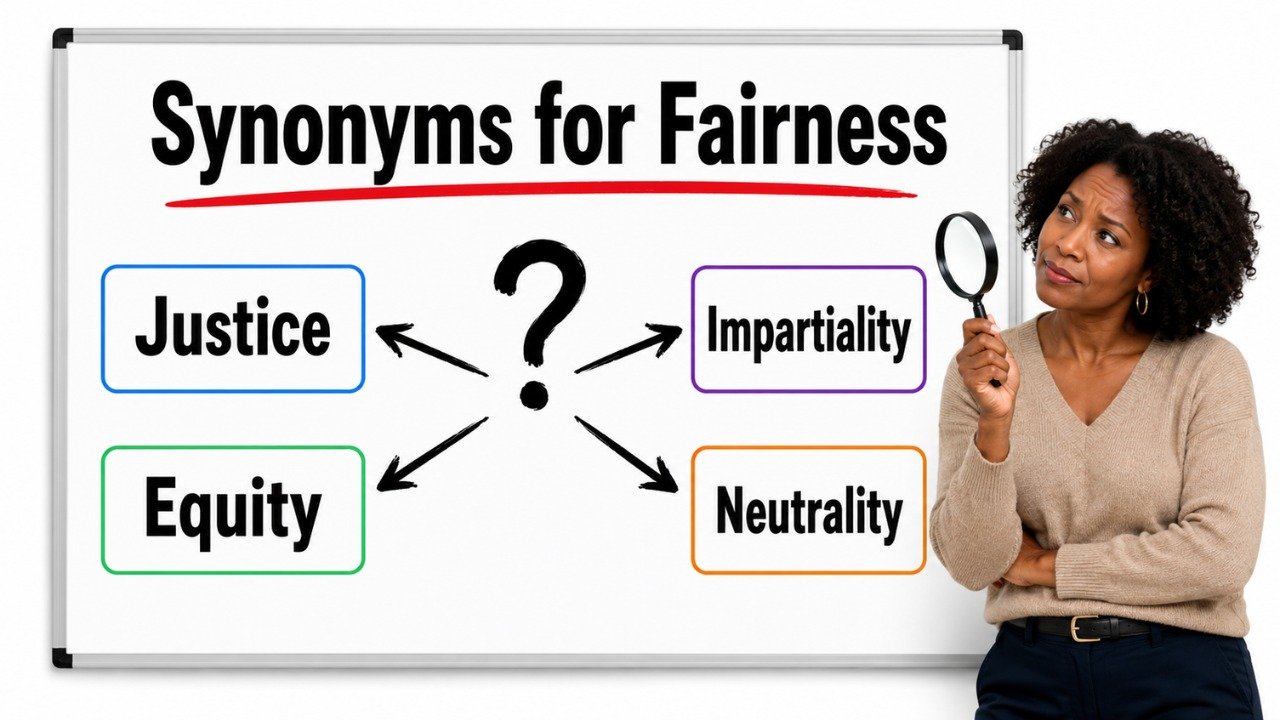
Quick Answer: The best synonyms for fairness include justice, impartiality, equity, equality, objectivity, neutrality, honesty, integrity, reasonableness, and evenhandedness. The right synonym depends on context. Justice works best for legal, moral, and social situations, impartiality suits unbiased decisions, equity emphasizes fair treatment based on circumstances, equality focuses on equal status or opportunity, objectivity works well in reports and evaluations, and reasonableness is useful when describing sensible and balanced treatment.
Pronunciation and Word Details
Word: Fairness
Pronunciation: /ˈfer.nəs/
Part of Speech: Noun
Meaning: The quality of treating people in a just, reasonable, equal, and unbiased way.
US Pronunciation:
UK Pronunciation:
What Does “Fairness” Mean?
Fairness means treating people, situations, or decisions in a just, reasonable, and unbiased way.
Fairness is a noun that describes the quality of being fair. It can refer to equal treatment, impartial judgment, reasonable decisions, balanced opportunities, or morally acceptable behavior.
The word is common in conversations about work, education, law, competition, relationships, leadership, rules, and social responsibility.
In one sentence, fairness may mean treating everyone equally. In another, it may mean considering individual circumstances so that the final outcome is reasonable.
Equal Treatment: Fairness can describe giving people the same rights, opportunities, or consideration.
Impartial Judgment: It can refer to making decisions without favoritism or prejudice.
Reasonable Treatment: Fairness can mean acting in a sensible and balanced way.
Moral Justice: It may describe actions that are ethically right and deserved.
Balanced Opportunity: Fairness can refer to making sure people have a genuine opportunity to participate or succeed.
Meaning, Tone, and Context of “Fairness”
Fairness is usually a neutral to positive word. It carries strong associations with justice, honesty, equality, impartiality, and ethical treatment.
In everyday conversation, fairness is often used when people discuss whether a decision, rule, punishment, reward, or opportunity is reasonable.
In formal writing, the word may appear in essays, reports, policies, evaluations, legal discussions, and academic arguments.
Neutral Tone: Fairness can objectively describe whether treatment or procedures are balanced.
Positive Tone: It often suggests moral responsibility, honesty, and respect.
Formal Tone: The word works naturally in reports, policies, essays, and professional communication.
Conversational Tone: It is also common in everyday statements about rules, relationships, and decisions.
Academic Context: Fairness may be discussed alongside justice, equality, equity, ethics, and impartiality.
Professional Context: It is often used when discussing hiring, evaluation, compensation, leadership, conflict resolution, and workplace treatment.
When and How to Use “Fairness”
For Equal Treatment
For Equal Treatment: Use fairness when describing a situation in which people should receive equal consideration, rights, or opportunities.
Example: The new policy was designed to improve fairness among all applicants.
For Unbiased Decisions
For Unbiased Decisions: Fairness works well when a decision should be made without favoritism or prejudice.
Example: The committee emphasized fairness when reviewing each application.
For Justice
For Justice: Use fairness when discussing whether an outcome is morally right or deserved.
Example: The community questioned the fairness of the final decision.
For Rules and Procedures
For Rules: Fairness can describe procedures that apply reasonable standards consistently.
Example: Clear rules help maintain fairness during the competition.
For Workplace Treatment
For Workplace Treatment: Use fairness when discussing pay, promotion, workload, recognition, or employee opportunities.
Example: Employees valued the manager’s commitment to fairness.
For Education
For Education: Fairness can describe equal opportunities, balanced grading, and unbiased classroom treatment.
Example: Students expected fairness when their assignments were evaluated.
For Conflict Resolution
For Conflict Resolution: Fairness helps describe a balanced solution that considers everyone involved.
Example: Both sides wanted a solution based on fairness and respect.
For Ethical Conduct
For Ethics: Use fairness when discussing morally responsible actions and decisions.
Example: Fairness should guide decisions that affect other people.
Best Synonyms for Fairness
Justice
Synonym: The principle of giving people what is right, deserved, and morally appropriate.
Example: The decision was guided by justice rather than personal preference.
Impartiality
Synonym: The quality of making decisions without favoritism, bias, or prejudice.
Example: The judge was respected for her impartiality.
Equity
Synonym: Fair treatment that considers different needs, circumstances, or disadvantages.
Example: The program focused on equity in access to resources.
Equality
Synonym: The condition of having equal rights, status, opportunities, or treatment.
Example: The policy promoted equality among all participants.
Objectivity
Synonym: The quality of judging based on facts rather than personal feelings.
Example: Objectivity was essential during the evaluation process.
Neutrality
Synonym: The state of not favoring one side over another.
Example: The mediator maintained neutrality throughout the discussion.
Honesty
Synonym: The quality of being truthful, sincere, and morally straightforward.
Example: Honesty helped build trust during the negotiation.
Integrity
Synonym: Strong adherence to moral and ethical principles.
Example: Her integrity influenced every decision she made.
Reasonableness
Synonym: The quality of being sensible, moderate, and fair.
Example: The reasonableness of the proposal made it acceptable to both sides.
Evenhandedness
Synonym: The quality of treating different people or sides equally and impartially.
Example: His evenhandedness earned respect from both groups.
50 Synonyms for Fairness with Short Meanings
- Justice: Morally right and deserved treatment.
- Impartiality: Freedom from favoritism or bias.
- Equity: Fair treatment based on individual circumstances.
- Equality: Equal rights, status, or opportunities.
- Objectivity: Judgment based on facts rather than feelings.
- Neutrality: Absence of preference for either side.
- Honesty: Truthful and sincere behavior.
- Integrity: Strong commitment to moral principles.
- Reasonableness: Sensible and balanced treatment.
- Evenhandedness: Equal and unbiased treatment of all sides.
- Justicefulness: The quality of acting according to justice.
- Equitableness: The quality of being fair and reasonable.
- Fairmindedness: A willingness to judge without prejudice.
- Unbiasedness: Freedom from personal preference or prejudice.
- Balance: Proper consideration of different sides.
- Proportionality: Fair relation between action and consequence.
- Moderation: Avoidance of unreasonable extremes.
- Consistency: Applying rules or standards in a stable way.
- Decency: Respectful and morally acceptable behavior.
- Ethics: Principles guiding right and fair conduct.
- Morality: Principles concerning right and wrong behavior.
- Righteousness: Moral correctness or justice.
- Legitimacy: Acceptability according to proper rules or principles.
- Justness: The quality of being morally fair.
- Candor: Honest and straightforward communication.
- Truthfulness: The quality of being accurate and sincere.
- Sincerity: Genuine and honest intention.
- Propriety: Correct and appropriate conduct.
- Decorum: Proper and respectful behavior.
- Rectitude: Moral uprightness and honesty.
- Honor: Strong ethical and moral character.
- Good Faith: Honest and sincere intention.
- Nonpartisanship: Freedom from favoritism toward a particular side.
- Disinterest: Lack of personal interest influencing judgment.
- Detachment: Emotional distance that supports unbiased judgment.
- Open Mindedness: Willingness to consider different views fairly.
- Tolerance: Willingness to respect differences.
- Respect: Proper consideration for others.
- Consideration: Thoughtful attention to another person’s needs or position.
- Accountability: Responsibility for fair and proper conduct.
- Transparency: Openness that allows decisions to be understood.
- Due Process: Fair procedures before decisions or consequences.
- Equal Treatment: Giving comparable consideration to people in similar situations.
- Equal Opportunity: Giving people a fair chance to participate or succeed.
- Balanced Judgment: Considering all relevant sides fairly.
- Fair Treatment: Acting toward others in a just and reasonable manner.
- Impartial Judgment: Making decisions without favoritism.
- Objective Judgment: Evaluating based on evidence and facts.
- Moral Balance: Maintaining a reasonable and ethical position.
- Just Treatment: Treating people according to fair principles.
Read Also:
Synonyms for Scrutiny
Synonyms for Fairness by Context
When Fairness Means Justice
Justice, justness, righteousness, rectitude, and legitimacy work well when fairness refers to morally correct treatment.
Example: The final decision reflected a strong sense of justice.
Justice is especially useful in legal, ethical, and social discussions.
When Fairness Means Equal Treatment
Equality, equal treatment, equal opportunity, equity, and equitableness emphasize the way people receive rights, opportunities, or resources.
Example: The organization introduced new rules to promote equality.
Equality is best when people should receive the same rights or status, while equity is better when different circumstances must be considered.
When Fairness Means Impartiality
Impartiality, unbiasedness, neutrality, evenhandedness, and nonpartisanship describe decisions made without favoritism.
Example: The interviewer maintained impartiality when evaluating candidates.
These alternatives work especially well in judging, hiring, evaluating, or mediating.
When Fairness Means Objectivity
Objectivity, detachment, balanced judgment, objective judgment, and disinterest emphasize decisions based on evidence rather than emotion.
Example: Objectivity helped the reviewer assess every proposal consistently.
These words work well in formal evaluations, reports, and professional decisions.
When Fairness Means Honesty
Honesty, integrity, sincerity, truthfulness, honor, and good faith describe morally responsible behavior.
Example: Her integrity made others trust her decisions.
These alternatives are useful when fairness is connected with ethical character.
When Fairness Means Reasonableness
Reasonableness, balance, moderation, proportionality, consideration, and decency emphasize sensible and appropriate treatment.
Example: The reasonableness of the agreement satisfied both parties.
These words work well when fairness involves compromise or balanced judgment.
Another Word for Fairness
Justice is one of the strongest general replacements for fairness, especially when discussing moral, legal, or social treatment. However, the best alternative depends on context.
Use impartiality for unbiased decisions, equity for treatment that considers different circumstances, equality for equal rights or opportunities, and objectivity when facts should guide judgment.
Original: Everyone questioned the fairness of the decision.
Better Option: Everyone questioned the justice of the decision.
Original: The panel was praised for its fairness.
Better Option: The panel was praised for its impartiality.
Original: The policy was created to improve fairness in resource distribution.
Better Option: The policy was created to improve equity in resource distribution.
Original: The report emphasized fairness during the evaluation process.
Better Option: The report emphasized objectivity during the evaluation process.
When Not to Use “Fairness”
Fairness is a useful general word, but it can sometimes be too broad.
Do not use fairness when a more precise word clearly expresses your meaning.
Weak: The judge showed fairness toward both parties.
Better: The judge showed impartiality toward both parties.
Use equity when you specifically mean adjusting treatment based on different needs or circumstances.
Weak: The program promotes fairness by giving additional resources to those who need them most.
Better: The program promotes equity by giving additional resources to those who need them most.
Use equality when the emphasis is identical rights, status, or opportunity.
Weak: The law guarantees fairness between citizens.
Better: The law guarantees equality between citizens.
Avoid repeating fairness several times in one paragraph.
Weak: Fairness matters because fairness creates trust and fairness improves decisions.
Better: Fairness matters because impartial treatment creates trust and improves decisions.
Use reasonableness when the issue is whether a rule or demand is sensible rather than whether everyone receives equal treatment.
Weak: They questioned the fairness of the requested deadline.
Better: They questioned the reasonableness of the requested deadline.
Words Commonly Confused With Fairness
Fairness vs Justice: Fairness is a broad idea involving reasonable and unbiased treatment. Justice more strongly refers to what is morally, legally, or ethically right.
Fairness vs Equality: Fairness concerns reasonable treatment, while equality means giving people equal rights, status, opportunities, or treatment.
Fairness vs Equity: Fairness is the general principle. Equity often means adjusting support or treatment according to different needs or circumstances.
Fairness vs Impartiality: Fairness describes the overall quality of just treatment. Impartiality specifically means making decisions without bias or favoritism.
Fairness vs Objectivity: Fairness concerns reasonable treatment, while objectivity means evaluating information based on facts instead of personal feelings.
Fairness vs Neutrality: Fairness involves just treatment. Neutrality means not supporting one side over another.
Fairness vs Honesty: Fairness concerns how people are treated. Honesty concerns truthfulness and sincerity.
Fairness vs Integrity: Fairness describes a principle of treatment, while integrity refers to strong moral character and consistent ethical behavior.
Which Synonym Should You Choose?
Choose justice when discussing moral rights, laws, consequences, or deserved treatment.
Choose impartiality when describing judges, interviewers, evaluators, mediators, or decision makers who should avoid favoritism.
Choose equity when writing about different needs, resources, access, or support.
Choose equality when discussing equal rights, status, opportunity, representation, or treatment.
Choose objectivity when writing reports, evaluations, research, reviews, or evidence based assessments.
Choose neutrality when someone should avoid taking sides.
Choose evenhandedness when emphasizing equal and balanced treatment of opposing groups.
Choose integrity when describing ethical character rather than a specific decision.
Choose reasonableness when discussing whether a demand, rule, price, response, or decision is sensible.
Choose honesty in casual or professional communication when truthful and straightforward behavior matters.
For essays, justice, equity, equality, impartiality, and objectivity are usually strong choices.
For reports, objectivity, consistency, transparency, and impartiality may be more precise.
For emails and professional communication, fairness, reasonableness, equal treatment, and good faith often sound natural.
For casual conversation, fairness, honesty, balance, and equal treatment are usually easy to understand.
Real Life Examples of “Fairness” in Sentences
Original: Employees appreciated the fairness of the promotion process.
Better Option: Employees appreciated the impartiality of the promotion process.
Original: The teacher emphasized fairness when grading assignments.
Better Option: The teacher emphasized objectivity when grading assignments.
Original: The policy was created to improve fairness between different groups.
Better Option: The policy was created to improve equality between different groups.
Original: The new program focuses on fairness in access to support.
Better Option: The new program focuses on equity in access to support.
Original: Everyone trusted her because of her fairness.
Better Option: Everyone trusted her because of her integrity.
Original: The mediator handled the disagreement with fairness.
Better Option: The mediator handled the disagreement with evenhandedness.
Original: The fairness of the punishment was debated.
Better Option: The proportionality of the punishment was debated.
Original: The committee promised fairness throughout the selection process.
Better Option: The committee promised impartiality throughout the selection process.
Original: The manager tried to maintain fairness when assigning tasks.
Better Option: The manager tried to maintain balance when assigning tasks.
Original: Students demanded fairness in access to academic opportunities.
Better Option: Students demanded equal opportunity in access to academic opportunities.
Synonym Groups and Usage Differences
Justice Group
Justice, justness, righteousness, legitimacy, rectitude, and just treatment describe fairness as a moral or ethical principle.
Example: The community demanded justice after questioning the decision.
Use this group when discussing what is right, deserved, or morally acceptable.
Equality Group
Equality, equal treatment, equal opportunity, and consistency emphasize comparable rights, opportunities, or standards.
Example: The new rule promotes equal opportunity for every applicant.
This group works best when people should receive the same basic rights or chance.
Equity Group
Equity, equitableness, consideration, proportionality, and balanced judgment focus on adjusting treatment according to circumstances.
Example: Equity may require different levels of support for people facing different barriers.
This group is useful when identical treatment would not produce a fair result.
Impartiality Group
Impartiality, unbiasedness, neutrality, evenhandedness, nonpartisanship, and disinterest emphasize freedom from favoritism.
Example: The review panel demonstrated impartiality throughout the process.
Use this group for judging, evaluating, interviewing, mediating, or selecting.
Objectivity Group
Objectivity, detachment, objective judgment, and balanced judgment emphasize factual rather than emotional evaluation.
Example: Objectivity is essential when reviewing evidence.
This group is useful in reports, research, evaluations, and professional decisions.
Integrity Group
Integrity, honesty, sincerity, truthfulness, honor, good faith, and decency emphasize ethical conduct.
Example: Her integrity influenced the way she treated everyone.
These terms work best when describing character rather than a specific rule or procedure.
Antonyms of Fairness
The opposite of fairness depends on whether the context involves justice, equality, impartiality, or reasonable treatment.
Unfairness: Treatment that is unjust or unreasonable.
Injustice: A lack of moral or legal fairness.
Bias: Preference that influences judgment unfairly.
Prejudice: Unfair judgment based on preconceived beliefs.
Favoritism: Giving unfair preference to one person or group.
Partiality: Unfair preference toward one side.
Discrimination: Unfair treatment based on particular characteristics or categories.
Inequality: Unequal rights, status, treatment, or opportunity.
Inequity: Lack of fair treatment or distribution.
Dishonesty: Lack of truthfulness or sincerity.
Corruption: Dishonest or unethical use of power.
Arbitrariness: Decision making without reasonable or consistent principles.
Imbalance: Lack of proper proportion or equal consideration.
Unreasonableness: Lack of sensible or fair judgment.
Deception: Deliberately misleading another person.
Comparison: Fairness vs Related Words
Fairness vs Justice
Fairness focuses on reasonable and unbiased treatment. Justice has a stronger connection with morality, law, rights, and deserved outcomes.
Example With Fairness: The manager wanted fairness when assigning responsibilities.
Example With Justice: The community demanded justice after the wrongful decision.
Fairness vs Equality
Fairness means treating people reasonably, while equality means giving people the same rights, status, or opportunities.
Example With Fairness: Fairness may require considering individual circumstances.
Example With Equality: Equality gives every participant the same formal rights.
Fairness vs Equity
Fairness is the broad principle of just treatment. Equity is a more specific concept involving treatment adjusted according to different needs or circumstances.
Example With Fairness: Fairness guided the distribution process.
Example With Equity: Equity required additional support for participants facing greater barriers.
Fairness vs Impartiality
Fairness is the overall quality of just treatment. Impartiality focuses specifically on avoiding favoritism.
Example With Fairness: The students trusted the fairness of the process.
Example With Impartiality: The evaluator demonstrated impartiality when reviewing each submission.
Fairness vs Objectivity
Fairness involves treating people or situations reasonably. Objectivity means making judgments based on facts instead of personal feelings.
Example With Fairness: The committee wanted fairness for every applicant.
Example With Objectivity: The committee used objective criteria to assess every applicant.
Fairness vs Neutrality
Fairness concerns just treatment. Neutrality concerns refusing to favor either side.
Example With Fairness: Fairness required both sides to receive an opportunity to speak.
Example With Neutrality: The mediator maintained neutrality during the disagreement.
Fairness vs Integrity
Fairness describes how people are treated. Integrity describes a person’s moral principles and ethical consistency.
Example With Fairness: Her decisions reflected fairness.
Example With Integrity: Her integrity prevented her from changing the rules for personal advantage.
Common Phrases and Expressions With “Fairness”
Sense of Fairness: A personal understanding of what is just and reasonable.
Basic Fairness: The fundamental expectation of just treatment.
Procedural Fairness: Fairness in the way decisions and processes are carried out.
Social Fairness: Just treatment and opportunity within society.
Workplace Fairness: Reasonable and unbiased treatment of employees.
Fairness Principle: A general rule supporting equal or just treatment.
Fairness in Decision Making: The use of impartial and reasonable standards when choosing an outcome.
Fairness and Equality: The relationship between just treatment and equal rights or opportunities.
Fairness and Justice: Closely related principles concerning morally acceptable treatment.
Fairness in the Process: The quality of ensuring that procedures are impartial, transparent, and reasonable.
Common Mistakes to Avoid
One common mistake is using fairness as if it always means equality. Equality means people receive the same rights, opportunities, or treatment, while fairness may require considering different circumstances.
Another mistake is using equity and fairness as perfect replacements in every sentence. Equity is usually more specific and often refers to distributing support according to need.
Avoid using impartiality when the issue is not bias. Impartiality specifically concerns freedom from favoritism.
Writers also confuse objectivity with fairness. Objectivity focuses on facts, while fairness focuses on reasonable and just treatment.
Do not repeat fairness too frequently in essays or reports. Use more precise terms such as justice, impartiality, equity, equality, objectivity, or reasonableness when appropriate.
Avoid vague statements such as “The situation needs more fairness” when you can identify the actual issue.
Vague: The process needs more fairness.
Better: The process needs greater transparency and impartiality.
Be careful with unnatural synonym substitutions. A synonym should match the intended meaning, not simply appear similar in a word list.
Conclusion
The most useful synonyms for fairness include justice, impartiality, equity, equality, objectivity, neutrality, integrity, evenhandedness, and reasonableness. Each word highlights a different aspect of fair treatment. Justice suits moral or legal contexts, impartiality emphasizes freedom from bias, equity considers individual circumstances, equality focuses on equal rights and opportunity, and objectivity works well for factual evaluations. When choosing synonyms for fairness, consider whether your sentence emphasizes justice, equal treatment, unbiased judgment, ethics, or balanced decision making.
FAQs About Synonyms for Fairness
What Is the Best Synonym for Fairness?
Justice is one of the strongest general synonyms for fairness. Impartiality, equity, equality, and reasonableness may be better in more specific contexts.
Is Equity a Synonym for Fairness?
Yes. Equity is closely related to fairness, especially when fair treatment requires considering different circumstances or needs.
Is Equality the Same as Fairness?
Not exactly. Equality focuses on equal treatment or opportunity, while fairness can involve considering different needs to reach a just result.
What Is a Formal Synonym for Fairness?
Impartiality, equity, justice, objectivity, evenhandedness, and reasonableness are strong formal alternatives.
What Is Another Word for Fair Treatment?
Equal treatment, just treatment, impartial treatment, equitable treatment, and evenhanded treatment are useful alternatives.
What Is a Synonym for Fairness in Decision Making?
Impartiality and objectivity are especially useful. Impartiality emphasizes freedom from favoritism, while objectivity emphasizes decisions based on facts.
What Is the Opposite of Fairness?
Common opposites include unfairness, injustice, bias, favoritism, inequality, inequity, prejudice, and partiality.
