
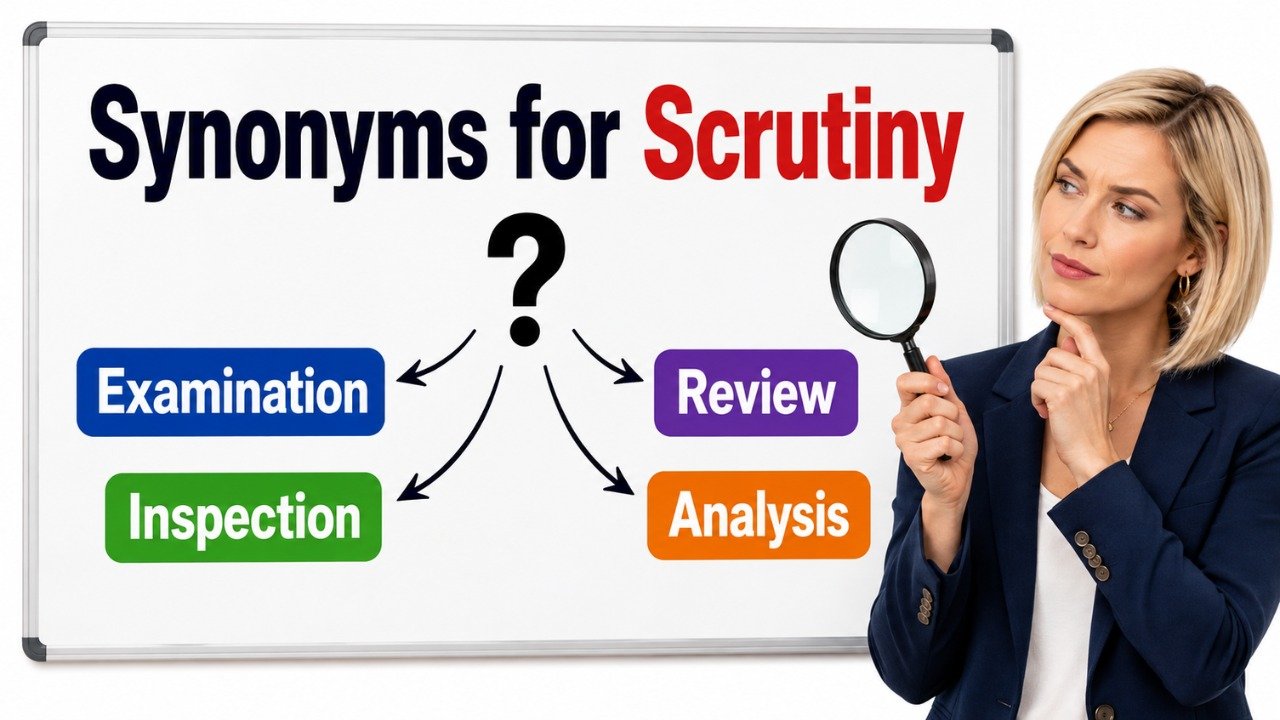
Quick Answer: The best synonyms for scrutiny include examination, inspection, review, analysis, investigation, assessment, evaluation, inquiry, observation, and audit. Use examination for careful study, inspection for checking condition or quality, review for formal consideration, analysis for detailed interpretation, investigation when searching for facts, assessment for judging performance or value, and audit for financial or procedural checking. The best choice depends on whether the context involves close attention, official review, research, investigation, public attention, or quality checking.
Pronunciation and Word Details
Word: Scrutiny
Pronunciation: /ˈskruː.tə.ni/
Part of Speech: Noun
Meaning: Careful, detailed, and often critical examination of someone or something.
US Pronunciation:
UK Pronunciation:
What Does “Scrutiny” Mean?
Scrutiny means very careful and detailed examination of something, especially when people are looking for problems, errors, weaknesses, facts, or important details.
Scrutiny is a noun. It usually describes a level of attention rather than a quick look. A document, decision, person, organization, claim, process, or performance can all come under scrutiny.
General Use: The proposal was placed under careful scrutiny.
Official Use: The financial records faced additional scrutiny.
Public Use: His decision attracted considerable public scrutiny.
Academic Use: The theory remained strong under detailed scrutiny.
Quality Use: Every part of the product underwent close scrutiny.
The word often suggests that someone is examining something seriously and may question, challenge, or evaluate what they find.
Meaning, Tone, and Context of “Scrutiny”
Scrutiny has a neutral to serious tone. It is more formal than simple words such as look or check and is common in professional, academic, legal, financial, political, technical, and analytical writing.
Formal Tone: Scrutiny works naturally in reports, essays, official documents, and professional discussions.
Serious Tone: The word often implies that the examination is careful enough to identify faults or questionable details.
Academic Context: Scrutiny can describe detailed evaluation of an argument, theory, method, source, or result.
Professional Context: Businesses, projects, decisions, records, and procedures may be subjected to scrutiny.
Public Context: A person or decision may face public scrutiny when many people closely examine or question it.
Financial Context: Records, expenses, accounts, and transactions can receive scrutiny when accuracy or compliance matters.
Conversational Context: Scrutiny is understandable in everyday conversation, but examination, checking, or a close look may sound more natural in casual speech.
Scrutiny does not always imply criticism. It can simply mean careful examination, although it often carries the possibility that weaknesses or mistakes may be discovered.
When and How to Use “Scrutiny”
For Careful Examination
For Detailed Examination: Use scrutiny when something is being studied very closely.
Example: The evidence did not survive close scrutiny.
For Official Review
For Formal Review: Scrutiny works well when authorities, committees, or professionals carefully examine a decision or process.
Example: The proposed changes came under official scrutiny.
For Public Attention
For Public Attention: Use scrutiny when a person, action, or decision is being closely watched and questioned.
Example: The announcement attracted intense public scrutiny.
For Financial Checking
For Financial Records: Scrutiny can describe detailed examination of spending, accounts, budgets, or transactions.
Example: The expense reports were subjected to careful scrutiny.
For Academic Analysis
For Research: Scrutiny is useful when theories, evidence, claims, and methods are examined critically.
Example: The conclusion remained convincing after academic scrutiny.
For Quality Control
For Quality: Use scrutiny when products, materials, designs, or results are carefully checked for faults.
Example: Each component passed rigorous scrutiny before approval.
For Decisions
For Decision Making: Scrutiny can describe the process of closely examining reasons, consequences, and evidence before accepting a decision.
Example: The proposal deserves greater scrutiny before approval.
For Claims
For Accuracy: Use scrutiny when a statement or claim needs careful checking.
Example: His explanation failed to hold up under scrutiny.
Best Synonyms for Scrutiny
Examination
Synonym: A careful study or inspection of something.
Example: The document requires closer examination before approval.
Inspection
Synonym: A careful check of condition, quality, or correctness.
Example: The equipment passed a detailed inspection.
Review
Synonym: A careful consideration or evaluation of information, work, or decisions.
Example: The policy is currently undergoing a formal review.
Analysis
Synonym: Detailed study intended to understand meaning, structure, causes, or results.
Example: The data requires further analysis.
Investigation
Synonym: A detailed search for facts, causes, or explanations.
Example: The complaint led to a thorough investigation.
Assessment
Synonym: Careful judgment of quality, value, condition, or performance.
Example: The project underwent a detailed assessment.
Evaluation
Synonym: A process of judging effectiveness, quality, importance, or value.
Example: The program received a comprehensive evaluation.
Inquiry
Synonym: A formal or careful effort to discover facts and information.
Example: The incident became the subject of an official inquiry.
Observation
Synonym: Careful watching or examination of someone or something.
Example: The patient remained under close observation.
Audit
Synonym: An official examination of records, processes, accounts, or performance.
Example: The accounts were checked during the annual audit.
50 Synonyms for Scrutiny with Short Meanings
- Examination: Careful study of something in detail.
- Inspection: Close checking of condition, quality, or accuracy.
- Review: Careful consideration of information or decisions.
- Analysis: Detailed study of meaning, structure, or evidence.
- Investigation: Careful search for facts or explanations.
- Assessment: Judgment of quality, value, or performance.
- Evaluation: Careful determination of effectiveness or worth.
- Inquiry: Formal effort to discover facts.
- Observation: Careful watching or studying.
- Study: Detailed consideration of a subject.
- Audit: Official examination of records or procedures.
- Appraisal: Careful judgment of quality or value.
- Checking: Examination intended to confirm correctness.
- Verification: Examination to establish truth or accuracy.
- Vetting: Careful investigation before approval or selection.
- Screening: Examination used to identify suitability or problems.
- Monitoring: Continuous observation of activity or progress.
- Supervision: Close oversight of actions or performance.
- Oversight: Careful supervision and review.
- Surveillance: Continuous close observation.
- Attention: Concentrated notice given to something.
- Consideration: Careful thought before judgment or action.
- Probing: Searching examination intended to uncover details.
- Questioning: Careful challenge or examination through questions.
- Interrogation: Intensive questioning intended to obtain information.
- Close Examination: Very careful study of details.
- Careful Examination: Thoughtful and attentive study.
- Detailed Examination: Study focused on individual details.
- Thorough Examination: Complete and careful inspection.
- Critical Examination: Careful study that evaluates strengths and weaknesses.
- Close Inspection: Very careful checking of something.
- Careful Inspection: Attentive checking for quality or problems.
- Detailed Inspection: Examination of individual features or parts.
- Thorough Inspection: Complete checking of all important details.
- Close Review: Careful reconsideration of information.
- Careful Review: Attentive evaluation before a decision.
- Detailed Review: Examination covering specific information thoroughly.
- Thorough Review: Comprehensive examination of the whole subject.
- Critical Review: Evaluation that questions strengths and weaknesses.
- Close Analysis: Detailed interpretation of information or evidence.
- Critical Analysis: Careful evaluation using evidence and reasoning.
- Careful Analysis: Thoughtful study of information.
- Detailed Analysis: Examination of specific elements or data.
- Close Observation: Careful watching over time.
- Careful Observation: Attentive watching for important details.
- Intensive Review: Highly concentrated examination.
- Formal Review: Official or structured examination.
- Official Review: Examination conducted through an authorized process.
- Watchfulness: Careful attention to what is happening.
- Investigation Process: Organized examination intended to establish facts.
Read Also:
Synonyms for Storm
Synonyms for Scrutiny by Context
When Scrutiny Means Careful Examination
Examination, inspection, close examination, detailed examination, and thorough examination are strong choices when something is being studied carefully.
Example With Scrutiny: The evidence deserves closer scrutiny.
Example With Examination: The evidence deserves closer examination.
Examination is one of the most versatile replacements because it works in academic, professional, medical, and general contexts.
When Scrutiny Means Formal Review
Review, assessment, evaluation, formal review, and appraisal work well when a decision, policy, plan, or performance is being judged.
Example With Scrutiny: The proposal is currently under scrutiny.
Example With Review: The proposal is currently under review.
Review is usually more neutral, while scrutiny often suggests more intense attention.
When Scrutiny Means Investigation
Investigation, inquiry, probing, questioning, and examination are useful when the goal is to uncover facts or determine what happened.
Example With Scrutiny: The unusual transactions attracted further scrutiny.
Example With Investigation: The unusual transactions prompted further investigation.
Investigation is stronger when fact finding is the main purpose.
When Scrutiny Means Checking for Accuracy
Inspection, checking, verification, audit, and screening work well when accuracy, quality, compliance, or correctness is being tested.
Example With Scrutiny: The records were subjected to additional scrutiny.
Example With Audit: The records were subjected to an additional audit.
Audit is more specific when financial records or formal procedures are involved.
When Scrutiny Means Critical Analysis
Analysis, critical analysis, detailed analysis, assessment, and critical examination fit academic and analytical contexts.
Example With Scrutiny: The argument weakens under scrutiny.
Example With Critical Analysis: The argument weakens under critical analysis.
Critical analysis focuses on reasoning, evidence, strengths, and weaknesses.
When Scrutiny Means Continuous Observation
Monitoring, observation, surveillance, supervision, and oversight describe ongoing attention rather than a single examination.
Example With Scrutiny: The process remained under constant scrutiny.
Example With Monitoring: The process remained under constant monitoring.
Monitoring is more natural when observation continues over time.
When Scrutiny Means Public Attention
Attention, examination, questioning, observation, and review may replace scrutiny when a person or decision attracts widespread interest.
Example With Scrutiny: The decision attracted intense public scrutiny.
Example With Attention: The decision attracted intense public attention.
Attention is softer. Scrutiny implies that people are not only noticing the decision but also examining and questioning it.
Another Word for Scrutiny
The best general replacement for scrutiny is examination. It preserves the idea of careful study without always carrying the stronger critical tone of scrutiny. However, review, inspection, analysis, investigation, and assessment may be more precise in particular contexts.
Original: The proposal came under close scrutiny.
Better Option: The proposal underwent close examination.
Original: The financial records were subjected to scrutiny.
Better Option: The financial records underwent an audit.
Original: The research findings deserve further scrutiny.
Better Option: The research findings deserve further analysis.
Original: Her performance remained under scrutiny.
Better Option: Her performance remained under careful review.
When Not to Use “Scrutiny”
Scrutiny is useful when careful or critical attention is genuinely involved. It can sound overly formal or unnecessarily severe in simple everyday situations.
When a Simple Check Is Enough
Weak: I gave the grocery list careful scrutiny before leaving.
Better: I checked the grocery list before leaving.
Scrutiny sounds too serious for a routine action.
When Review Is More Neutral
Use review when the process is organized but not especially critical.
Weak: The team completed its monthly scrutiny of the schedule.
Better: The team completed its monthly review of the schedule.
When Investigation Is More Precise
If people are actively searching for causes or facts, investigation can communicate the purpose more clearly.
Weak: The incident is undergoing scrutiny to determine what happened.
Better: The incident is undergoing investigation to determine what happened.
When Inspection Describes Physical Checking
Inspection is often better for equipment, buildings, products, and physical condition.
Weak: The machinery passed its annual scrutiny.
Better: The machinery passed its annual inspection.
When Analysis Describes Data
Analysis is more precise when information or data is being interpreted.
Weak: The results require additional scrutiny before conclusions are drawn.
Better: The results require additional analysis before conclusions are drawn.
When Scrutiny Becomes Repetitive
Weak: The plan faced scrutiny, the budget faced scrutiny, and the timeline also faced scrutiny.
Better: The plan faced examination, the budget underwent review, and the timeline received careful assessment.
Varied vocabulary makes the meaning more precise and the writing easier to read.
Words Commonly Confused With Scrutiny
Scrutiny vs Examination: Scrutiny usually suggests especially close or critical examination. Examination is broader and can be neutral.
Scrutiny vs Inspection: Scrutiny can apply to ideas, behavior, evidence, or decisions. Inspection more often involves checking physical condition, quality, or compliance.
Scrutiny vs Review: Scrutiny suggests intense attention. Review can simply mean reconsidering or evaluating something.
Scrutiny vs Analysis: Scrutiny emphasizes careful examination. Analysis focuses on breaking information into parts to understand meaning, causes, or relationships.
Scrutiny vs Investigation: Scrutiny means close examination, while investigation usually seeks specific facts, explanations, causes, or evidence.
Scrutiny vs Assessment: Scrutiny focuses on examining details. Assessment focuses on judging quality, value, performance, or condition.
Scrutiny vs Evaluation: Evaluation involves making a judgment about effectiveness or worth. Scrutiny may happen before that judgment is reached.
Scrutiny vs Monitoring: Scrutiny may be a focused examination, while monitoring usually involves continued observation over time.
Which Synonym Should You Choose?
Choose examination when you need a broad and neutral word for careful study.
Choose inspection when checking equipment, products, buildings, documents, or physical conditions.
Choose review when writing about policies, decisions, plans, reports, applications, or performance.
Choose analysis when discussing data, evidence, arguments, research, results, or complex information.
Choose investigation when the purpose is to discover facts, causes, wrongdoing, or explanations.
Choose assessment when judging performance, risk, quality, ability, or condition.
Choose evaluation when deciding how effective, useful, valuable, or successful something is.
Choose inquiry for formal fact finding or organized questioning.
Choose audit for financial records, procedures, controls, or formal compliance checking.
Choose checking in casual conversation when scrutiny sounds unnecessarily formal.
Choose monitoring when the examination continues over a period of time.
In essays and reports, examination, analysis, evaluation, and assessment are often useful alternatives. In professional communication, review and inspection may sound more natural. In casual speech, check, look, or examination may be easier than scrutiny.
Real Life Examples of “Scrutiny” in Sentences
Original: The proposal came under intense scrutiny before approval.
Better Option: The proposal underwent detailed review before approval.
Original: The financial records faced additional scrutiny.
Better Option: The financial records underwent an additional audit.
Original: Her explanation did not survive close scrutiny.
Better Option: Her explanation did not survive close examination.
Original: The research methods deserve further scrutiny.
Better Option: The research methods deserve further evaluation.
Original: Every part of the machine was subjected to scrutiny.
Better Option: Every part of the machine underwent careful inspection.
Original: The unusual activity attracted greater scrutiny.
Better Option: The unusual activity prompted a deeper investigation.
Original: The evidence remained convincing under scrutiny.
Better Option: The evidence remained convincing under critical analysis.
Original: The process is under constant scrutiny.
Better Option: The process is under constant monitoring.
Original: The application received careful scrutiny before a decision was made.
Better Option: The application received careful review before a decision was made.
Original: His claims could not withstand serious scrutiny.
Better Option: His claims could not withstand detailed examination.
Synonym Groups and Usage Differences
Examination Group
Examination, close examination, careful examination, detailed examination, and thorough examination describe careful study of something.
These options are useful when you want to emphasize attention to detail without automatically suggesting criticism.
Example: The evidence requires detailed examination.
Inspection Group
Inspection, close inspection, detailed inspection, checking, and verification focus on confirming condition, quality, accuracy, or compliance.
They work especially well for objects, records, procedures, and physical conditions.
Example: The equipment passed a thorough inspection.
Review Group
Review, formal review, official review, assessment, evaluation, and appraisal describe organized consideration or judgment.
These terms are useful for policies, decisions, applications, reports, and performance.
Example: The application is undergoing formal review.
Analysis Group
Analysis, critical analysis, close analysis, detailed analysis, and critical examination emphasize reasoning and interpretation.
They are strong choices for essays, research, arguments, evidence, and data.
Example: The results require more detailed analysis.
Investigation Group
Investigation, inquiry, probing, questioning, and interrogation focus on discovering facts or explanations.
Investigation is broad, while interrogation specifically involves intensive questioning.
Example: The complaint led to a formal investigation.
Observation Group
Observation, monitoring, surveillance, watchfulness, and supervision involve continued attention.
These alternatives are useful when something is watched over time.
Example: The situation remains under close observation.
Accuracy Group
Checking, verification, screening, vetting, and audit focus on confirming whether something meets requirements or is correct.
Vetting is common when suitability is being examined before approval or selection.
Example: Every application goes through careful vetting.
Antonyms of Scrutiny
The opposite of scrutiny depends on whether the original meaning involves examination, attention, criticism, or review.
Neglect: Failure to give something proper attention.
Disregard: Deliberate lack of attention or consideration.
Inattention: Failure to notice or examine carefully.
Indifference: Lack of interest or concern.
Carelessness: Lack of careful attention.
Oversight: An accidental failure to notice something.
Acceptance: Willingness to accept something without further challenge.
Approval: Positive acceptance rather than critical examination.
Trust: Confidence that may reduce the need for close examination.
Assumption: Acceptance of an idea without detailed verification.
Ignorance: Lack of knowledge or awareness.
Negligence: Failure to exercise appropriate care or attention.
Comparison: Scrutiny vs Related Words
Scrutiny vs Examination
Scrutiny is a type of very careful examination and often has a more critical tone. Examination is broader and may simply involve studying something carefully.
Example With Scrutiny: The claim failed to withstand close scrutiny.
Example With Examination: The document requires further examination.
Scrutiny vs Inspection
Inspection often involves checking physical condition, quality, safety, or compliance. Scrutiny can apply to both physical things and abstract matters such as arguments and decisions.
Example With Scrutiny: The proposal came under intense scrutiny.
Example With Inspection: The building passed its final inspection.
Scrutiny vs Review
A review is a general reconsideration or evaluation. Scrutiny implies closer and sometimes more skeptical attention.
Example With Scrutiny: The spending decisions attracted public scrutiny.
Example With Review: The spending plan is undergoing review.
Scrutiny vs Analysis
Scrutiny describes close examination. Analysis involves studying components, relationships, evidence, or causes to understand something better.
Example With Scrutiny: The evidence remained convincing under scrutiny.
Example With Analysis: The evidence was examined through detailed analysis.
Scrutiny vs Investigation
Investigation has a specific goal of discovering facts or explanations. Scrutiny may simply involve looking closely at information that is already available.
Example With Scrutiny: The transaction attracted additional scrutiny.
Example With Investigation: The transaction became part of a wider investigation.
Scrutiny vs Assessment
Assessment focuses on reaching a judgment about condition, performance, ability, or value.
Example With Scrutiny: The plan was subjected to close scrutiny.
Example With Assessment: The plan underwent a risk assessment.
Scrutiny vs Evaluation
Evaluation measures quality, success, effectiveness, or value. Scrutiny emphasizes the careful examination that may occur before evaluation.
Example With Scrutiny: The evidence deserves further scrutiny.
Example With Evaluation: The program requires a complete evaluation.
Scrutiny vs Monitoring
Scrutiny can happen during a focused period of examination. Monitoring usually continues over time.
Example With Scrutiny: The decision came under immediate scrutiny.
Example With Monitoring: The system remains under continuous monitoring.
Common Phrases and Expressions With “Scrutiny”
Under Scrutiny: Being carefully examined or questioned.
Close Scrutiny: Very detailed and attentive examination.
Careful Scrutiny: Examination performed with considerable attention.
Intense Scrutiny: Extremely close and serious examination.
Public Scrutiny: Examination or questioning by the wider public.
Official Scrutiny: Careful examination through an authorized process.
Financial Scrutiny: Detailed examination of money, spending, or accounts.
Regulatory Scrutiny: Careful examination related to rules and requirements.
Withstand Scrutiny: Remain convincing or acceptable after careful examination.
Come Under Scrutiny: Begin receiving close attention or examination.
Common Mistakes to Avoid
Using Scrutiny as a Verb
Scrutiny is a noun. The related verb is scrutinize.
Incorrect: We will scrutiny the report tomorrow.
Correct: We will scrutinize the report tomorrow.
Correct: The report will undergo scrutiny tomorrow.
Confusing Scrutiny With Criticism
Scrutiny does not automatically mean criticism. Something can be carefully examined and still be judged positively.
Incorrect Idea: Scrutiny always means that something is considered wrong.
Better Understanding: Scrutiny means close examination that may reveal strengths or weaknesses.
Using Scrutiny for Routine Actions
The word can sound overly serious when only a simple check is meant.
Unnatural: I gave my shopping list intense scrutiny.
Natural: I checked my shopping list carefully.
Choosing Investigation When Examination Is Meant
Investigation suggests an effort to uncover facts, causes, or explanations. It is not always interchangeable with scrutiny.
Less Precise: The essay requires further investigation for grammar mistakes.
Better: The essay requires further examination for grammar mistakes.
Repeating Scrutiny Too Often
Repeated use can make formal writing sound heavy.
Repetitive: The plan faced scrutiny, the budget faced scrutiny, and the results faced scrutiny.
Improved: The plan faced examination, the budget underwent review, and the results received detailed analysis.
Using a Weak Synonym in a Serious Context
A simple word such as look may fail to communicate the depth implied by scrutiny.
Weak: The evidence received a look from the committee.
Better: The evidence received careful examination from the committee.
Ignoring the Difference Between Review and Scrutiny
Review is usually more neutral. Scrutiny often signals especially close, demanding, or critical attention.
Use the stronger word only when the context supports that meaning.
Conclusion
Understanding synonyms for scrutiny helps you choose a word that matches the depth and purpose of an examination. Examination is the strongest general alternative, while inspection suits physical checking, review fits organized consideration, analysis works for evidence and data, and investigation is best for discovering facts. Assessment and evaluation focus more on judgment, while monitoring describes ongoing observation. Because scrutiny usually suggests close and sometimes critical attention, choosing a precise synonym can make both formal and everyday writing clearer and more natural.
FAQs About Synonyms for Scrutiny
What Is the Best Synonym for Scrutiny?
Examination is the best general synonym. Review, inspection, analysis, investigation, assessment, and evaluation may be more precise in specific contexts.
What Is a Formal Synonym for Scrutiny?
Examination, evaluation, assessment, investigation, analysis, and formal review are strong formal alternatives.
What Is Another Word for Close Scrutiny?
Close examination, detailed examination, thorough review, careful inspection, and critical analysis are useful alternatives.
What Is the Difference Between Scrutiny and Review?
Scrutiny suggests especially close or critical attention. Review is broader and can describe any organized reconsideration or evaluation.
What Is a Synonym for Scrutiny in an Essay?
Examination, analysis, evaluation, assessment, and critical analysis are strong choices for academic writing.
Can Inspection Replace Scrutiny?
Yes, when the context involves checking condition, quality, accuracy, or compliance. Inspection is less suitable when discussing abstract ideas or arguments.
Is Scrutiny a Negative Word?
Not necessarily. Scrutiny means close examination. It can feel serious or critical, but the examination may result in either a positive or negative judgment.
