
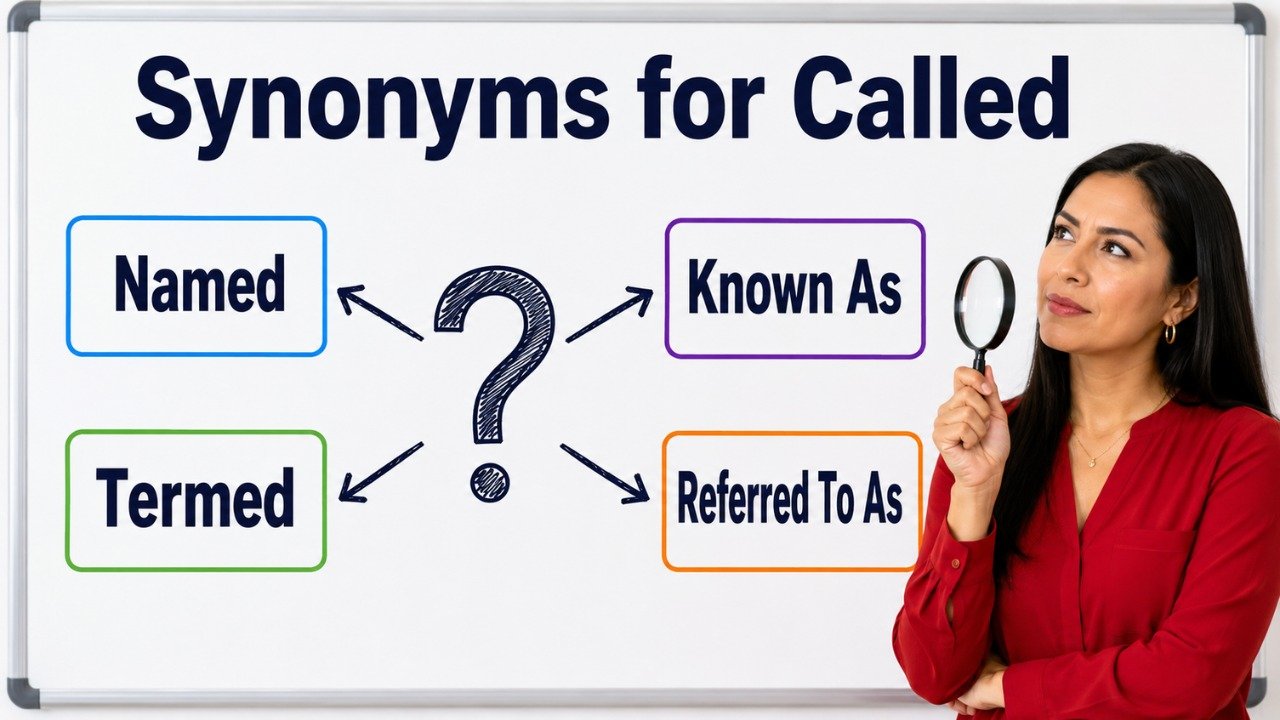
Quick Answer: The best synonyms for called include named, termed, titled, known as, referred to as, contacted, phoned, summoned, invited, and addressed. Use named or titled when identifying a person, place, book, or object. Use termed or referred to as in formal and academic writing. Use contacted or phoned when called means communicating by telephone. Use summoned when someone was asked to appear, and addressed when someone was spoken to directly. The best synonyms for called depend on the exact meaning and context of the sentence.
Pronunciation and Word Details
Word: Called.
Pronunciation: /kɔːld/
Part of Speech: Verb, past tense and past participle of call.
Meaning: Named, contacted, summoned, addressed, or described someone or something, depending on context.
US Pronunciation:
UK Pronunciation:
What Does “Called” Mean?
Called means named, contacted, summoned, addressed, or described someone or something.
It is the past tense and past participle form of the verb call. Its exact meaning changes according to the sentence.
When called refers to a name, it identifies what a person, place, object, idea, or event is known as.
Example: The small village was called Greenfield.
When called refers to communication, it usually means contacted someone by telephone.
Example: She called her brother after work.
When called refers to requesting someone’s presence, it may mean summoned, invited, or asked to come.
Example: The manager called the team into the office.
Called can also describe how someone or something was characterized.
Example: Critics called the proposal unrealistic.
It can additionally mean speaking loudly to get someone’s attention.
Example: He called her name from across the room.
Because the word has several meanings, choosing the right synonym requires understanding what called is doing in the sentence.
Meaning, Tone, and Context of “Called”
Called is a common, neutral, and highly versatile English word. It appears naturally in casual speech, professional communication, academic writing, stories, reports, biographies, and everyday conversation.
When it means named, called is neutral and conversational.
Example: The new park is called Riverside Garden.
In more formal writing, named, termed, designated, or referred to as may provide greater precision.
Example: The condition is formally termed seasonal variation.
When called means contacted by telephone, the tone is usually casual or neutral.
Example: I called her yesterday.
In formal writing, contacted may sound broader and more professional because it does not specify the communication method.
Example: The applicant was contacted regarding the interview.
When called means summoned, it can sound more serious or authoritative.
Example: The witness was called before the committee.
When called means described or labeled, the word can be neutral, positive, or negative depending on the description.
Example: The performance was called outstanding.
Example: The decision was called unnecessary.
The best alternative should therefore reflect not only meaning but also tone, formality, and purpose.
When and How to Use “Called”
For Naming: Use called when stating the name of a person, place, object, event, idea, or work.
Example: They adopted a dog called Milo.
For Identifying a Term: Use called when explaining what something is commonly known as.
Example: This process is called evaporation.
For Telephone Contact: Use called when describing communication by telephone.
Example: She called the office before leaving home.
For Summoning Someone: Use called when someone was requested or ordered to appear.
Example: The supervisor called him into the meeting room.
For Getting Attention: Use called when someone spoke loudly to attract another person’s attention.
Example: She called his name from the doorway.
For Describing Someone: Use called when assigning a description, judgment, or label.
Example: The journalist called the discovery remarkable.
For Requesting Assistance: Use called when someone requested help or support.
Example: They called a technician to inspect the equipment.
For Inviting Participation: Use called when someone was asked to join, attend, or take part.
Example: The members were called together for an urgent discussion.
For Announcing Something: Called can describe publicly declaring or arranging an event.
Example: The chairperson called a meeting for Monday morning.
Best Synonyms for Called
Named: Gave a particular name to someone or something.
Example: They named their daughter Olivia.
Termed: Described something using a particular word or expression.
Example: The researchers termed the result unexpected.
Titled: Gave a name or title to a book, article, work, or event.
Example: She titled the painting Morning Light.
Known As: Identified by a particular name or description.
Example: The area is known as the old district.
Referred To As: Mentioned or identified using a particular term.
Example: The method is referred to as guided practice.
Contacted: Communicated with someone by telephone or another method.
Example: The office contacted all applicants yesterday.
Phoned: Contacted someone by telephone.
Example: He phoned his parents after arriving.
Summoned: Ordered or requested someone to appear.
Example: The director summoned the staff for an urgent discussion.
Invited: Asked someone to attend or participate.
Example: She invited the entire team to the presentation.
Addressed: Spoke directly to someone or referred to them in a particular way.
Example: The speaker addressed the audience calmly.
50 Synonyms for Called with Short Meanings
- Named: Gave someone or something a particular name.
- Termed: Described using a particular word.
- Titled: Gave a title or formal name.
- Designated: Officially identified by a particular name or role.
- Labeled: Described or classified using a particular term.
- Dubbed: Gave someone or something an informal or descriptive name.
- Styled: Gave or used a particular title or description.
- Known As: Identified by a commonly used name.
- Referred To As: Mentioned using a particular term.
- Described As: Characterized using certain words.
- Identified As: Recognized or presented as a particular person or thing.
- Classified As: Placed into a particular category.
- Characterized As: Described according to notable qualities.
- Branded: Gave a strong or often negative label.
- Nicknamed: Gave an informal or familiar name.
- Christened: Gave a name formally or ceremonially.
- Entitled: Gave a title to a written or creative work.
- Headed: Gave a heading or title to something.
- Contacted: Communicated with someone.
- Phoned: Contacted someone by telephone.
- Telephoned: Called someone using a telephone.
- Rang: Contacted someone by telephone in informal usage.
- Reached: Successfully made contact with someone.
- Got In Touch With: Established communication with someone.
- Communicated With: Exchanged information with someone.
- Spoke To: Communicated verbally with someone.
- Summoned: Ordered or requested someone to appear.
- Requested: Asked for someone’s presence or assistance.
- Invited: Asked someone to attend or participate.
- Asked For: Requested a person, service, or thing.
- Sent For: Requested that someone come.
- Brought In: Requested someone’s presence or assistance.
- Called Upon: Asked someone to act, speak, or help.
- Convened: Brought people together for a meeting.
- Assembled: Gathered people together.
- Gathered: Brought people into one place.
- Addressed: Spoke directly to someone.
- Shouted: Spoke loudly to attract attention.
- Cried Out: Spoke loudly or suddenly.
- Yelled: Called loudly, often with strong emotion.
- Hailed: Called out to attract someone’s attention.
- Signaled: Used a sound or action to attract attention.
- Announced: Made something publicly known.
- Declared: Stated something clearly or formally.
- Proclaimed: Announced something publicly and strongly.
- Pronounced: Declared or described something formally.
- Considered: Judged or regarded someone or something in a certain way.
- Regarded As: Considered someone or something to have a particular quality.
- Deemed: Formally judged or considered something to be a certain way.
- Judged: Formed or expressed an opinion about someone or something.
Read Also:
Synonyms for Consume

Synonyms for Called by Context
When Called Means Named
When called identifies the name of someone or something, useful alternatives include named, titled, known as, designated, dubbed, nicknamed, and referred to as.
Named is one of the most direct substitutes.
Example: The street was named after a local teacher.
Titled works especially well for books, articles, films, paintings, and other creative works.
Example: She titled her essay The Value of Patience.
Known as is useful when discussing a commonly recognized name.
Example: The region is known as the Valley of Lakes.
Designated sounds more formal and often refers to official names, roles, or classifications.
Example: The site was designated a protected area.
When Called Means Contacted by Telephone
When called refers to telephone communication, useful synonyms include phoned, telephoned, rang, contacted, reached, and got in touch with.
Phoned is clear and natural.
Example: She phoned her friend after dinner.
Contacted is more general because it does not necessarily mean telephone communication.
Example: The office contacted the applicant about the opening.
Reached emphasizes successful communication.
Example: I finally reached him in the afternoon.
When Called Means Summoned
Useful alternatives include summoned, requested, sent for, brought in, called upon, and invited.
Summoned is strong and often suggests authority.
Example: The employee was summoned to the director’s office.
Sent for is useful when someone is requested to come to a particular place.
Example: A doctor was sent for immediately.
Invited is more polite and voluntary.
Example: The students were invited to attend the discussion.
When Called Means Described or Labeled
Useful synonyms include termed, labeled, described as, characterized as, branded, deemed, considered, and regarded as.
Termed works well in academic and technical contexts.
Example: The pattern was termed unusual by the researchers.
Labeled can be neutral, but it may imply that a description has been attached to someone or something.
Example: The proposal was labeled impractical.
Deemed is especially common in formal judgments.
Example: The building was deemed safe for use.
When Called Means Shouted To
Useful choices include shouted, yelled, cried out, hailed, and addressed.
Shouted emphasizes volume.
Example: She shouted his name across the field.
Hailed can mean calling out to attract someone’s attention.
Example: He hailed the driver from the roadside.
When Called Means Requested
When someone called for a person, service, action, or response, useful alternatives include requested, asked for, sought, summoned, and called upon.
Example: They requested immediate assistance.
Example: The committee called upon members to submit suggestions.
Another Word for Called
The best single replacement for called depends on what the sentence means.
Named is usually the strongest choice when called identifies a name. Contacted works when called refers to communication. Summoned is best when someone was ordered or requested to appear. Termed or described as works when called introduces a description or label.
Original: The new café is called Garden House.
Better Option: The new café is named Garden House.
Original: She called the office yesterday.
Better Option: She contacted the office yesterday.
Original: The manager called him into the room.
Better Option: The manager summoned him to the room.
Original: Researchers called the result unusual.
Better Option: Researchers termed the result unusual.
When Not to Use “Called”
Called is convenient, but it can become vague when the sentence does not make its meaning immediately clear.
When discussing formal terminology, termed or referred to as may be more precise.
Weak: This process is called thermal expansion in the report.
Better: This process is referred to as thermal expansion in the report.
When discussing communication without specifying the method, contacted may be more accurate.
Weak: The organization called every applicant about the decision.
Better: The organization contacted every applicant about the decision.
When someone was ordered to appear, summoned adds useful detail.
Weak: The director called the employee to her office.
Better: The director summoned the employee to her office.
When describing a judgment, deemed or considered may sound more appropriate in formal writing.
Weak: The proposal was called unsuitable by the review panel.
Better: The proposal was deemed unsuitable by the review panel.
Avoid repeating called several times in the same paragraph.
Weak: She called the company, called the manager, and called the issue serious.
Better: She contacted the company, spoke to the manager, and described the issue as serious.
Words Commonly Confused With Called
Called vs Named: Called is broad and can refer to naming, contacting, summoning, or describing. Named specifically refers to giving or using a name.
Called vs Titled: Called can describe almost any person or thing by name. Titled is mainly used for works such as books, articles, paintings, presentations, and creative pieces.
Called vs Termed: Called is neutral and common. Termed is more formal and usually refers to terminology or classification.
Called vs Contacted: Called often specifically suggests telephone communication. Contacted can refer to communication by telephone, message, letter, or another method.
Called vs Phoned: Called has many meanings, while phoned specifically means contacted someone by telephone.
Called vs Summoned: Called may simply mean asked someone to come. Summoned usually suggests a stronger, more formal, or authoritative request.
Called vs Labeled: Called can provide a neutral description. Labeled often suggests assigning a category or judgment to someone or something.
Called vs Referred To As: Called is conversational and flexible. Referred to as is more formal and useful when defining terminology.
Which Synonym Should You Choose?
Choose named when identifying the official or ordinary name of a person, place, object, or event.
Example: The new building was named Harmony Hall.
Choose titled when discussing books, articles, paintings, reports, presentations, or other works.
Example: The article was titled Understanding Language.
Choose termed for formal, scientific, technical, or academic descriptions.
Example: The researchers termed the change significant.
Choose referred to as when introducing a formal term or alternative name.
Example: This pattern is referred to as circular reasoning.
Choose contacted in professional writing when the exact method of communication is unimportant.
Example: All participants were contacted before the event.
Choose phoned or telephoned when you specifically mean communication by telephone.
Example: She phoned the office before noon.
Choose summoned when someone was formally or authoritatively requested to appear.
Example: The witness was summoned to give evidence.
Choose invited when the request was voluntary and polite.
Example: The guests were invited to join the discussion.
Choose described as when explaining how someone or something was characterized.
Example: The new approach was described as practical.
Choose deemed in reports or formal decisions.
Example: The application was deemed complete.
Choose shouted, yelled, or cried out when called means using a loud voice.
Example: He shouted her name from the entrance.
For essays, termed, referred to as, described as, and designated are often more precise than called.
For emails, contacted, requested, invited, and reached usually sound professional and natural.
For casual conversation, called, phoned, named, and asked for are generally clear and comfortable.
Real Life Examples of “Called” in Sentences
Original: The small town is called Brookhaven.
Better Option: The small town is named Brookhaven.
Original: She called her sister after dinner.
Better Option: She phoned her sister after dinner.
Original: The teacher called the student to the front.
Better Option: The teacher asked the student to come to the front.
Original: The report called the result encouraging.
Better Option: The report described the result as encouraging.
Original: The manager called everyone into the conference room.
Better Option: The manager summoned everyone to the conference room.
Original: This technique is called visual mapping.
Better Option: This technique is referred to as visual mapping.
Original: He called my name from across the street.
Better Option: He shouted my name from across the street.
Original: Critics called the novel imaginative.
Better Option: Critics described the novel as imaginative.
Original: They called a technician to repair the machine.
Better Option: They requested a technician to repair the machine.
Original: The committee called the proposal acceptable.
Better Option: The committee deemed the proposal acceptable.
Synonym Groups and Usage Differences
Naming Group
Named, titled, designated, dubbed, christened, nicknamed, and known as belong to the naming group.
Named is broad and direct. Titled usually applies to works. Dubbed often introduces an informal or memorable name. Designated sounds official.
Example: The new center was named after its founder.
Terminology Group
Termed, referred to as, labeled, classified as, identified as, and described as are useful when explaining terminology or categories.
Termed and referred to as are particularly effective in formal writing.
Example: The phenomenon is referred to as selective attention.
Communication Group
Contacted, phoned, telephoned, rang, reached, and got in touch with describe communication.
Phoned and telephoned specify telephone contact, while contacted is broader.
Example: The coordinator contacted all participants.
Summoning Group
Summoned, requested, sent for, called upon, invited, and brought in describe asking someone to appear, participate, or help.
Summoned is authoritative. Invited is polite and voluntary.
Example: An expert was brought in to examine the problem.
Description Group
Described as, characterized as, labeled, branded, deemed, considered, and regarded as explain how someone or something was judged or presented.
Deemed is formal, while branded often carries a negative tone.
Example: The solution was deemed practical.
Attention Group
Shouted, yelled, cried out, hailed, and addressed can replace called when the word refers to attracting attention through speech.
Shouted and yelled emphasize loudness, while hailed specifically involves calling out to attract attention.
Example: She hailed the driver from the entrance.
Antonyms of Called
The opposite of called depends on the meaning because called has several uses.
Unnamed: Not given or identified by a name.
Untitled: Having no title.
Anonymous: Not identified by name.
Unidentified: Not recognized or specified by name.
Ignored: Given no attention or response.
Avoided: Deliberately not contacted or approached.
Dismissed: Sent away rather than summoned or requested to appear.
Excluded: Not invited or included.
Uninvited: Not asked to attend or participate.
Unrequested: Not asked for or demanded.
Unaddressed: Not spoken to or dealt with.
Unclassified: Not assigned to a category.
Unlabeled: Not given a descriptive label.
Rejected: Refused rather than requested or accepted.
Comparison: Called vs Related Words
Called vs Named
Called has several meanings, while named specifically concerns the name of someone or something.
Example With Called: The village is called Pine Valley.
Example With Named: The village is named Pine Valley.
Named is usually more precise when the sentence deals only with a name.
Called vs Termed
Called is common in everyday English. Termed is more formal and often appears in academic, technical, or explanatory writing.
Example With Called: The effect is called visual adaptation.
Example With Termed: The effect is termed visual adaptation.
Termed may sound more precise when introducing specialist vocabulary.
Called vs Titled
Called may identify the name of almost anything. Titled usually refers to the name of a creative or written work.
Example With Called: The book is called Silent Rivers.
Example With Titled: The book is titled Silent Rivers.
Titled is usually the more specific choice for books, articles, essays, paintings, and presentations.
Called vs Contacted
Called commonly means contacted by telephone. Contacted does not specify how communication occurred.
Example With Called: She called the office yesterday.
Example With Contacted: She contacted the office yesterday.
Use contacted when the communication method is unknown or unimportant.
Called vs Phoned
Called can mean many things. Phoned specifically means communicated by telephone.
Example With Called: I called him after lunch.
Example With Phoned: I phoned him after lunch.
Phoned removes ambiguity when telephone contact is important.
Called vs Summoned
Called may simply mean asked someone to come. Summoned suggests a more formal or authoritative request.
Example With Called: The manager called him into the office.
Example With Summoned: The manager summoned him to the office.
Summoned creates a stronger sense of authority.
Called vs Labeled
Called can neutrally describe someone or something. Labeled often emphasizes classification or judgment.
Example With Called: The idea was called unconventional.
Example With Labeled: The idea was labeled unconventional.
Labeled can suggest that a description has been deliberately attached to the subject.
Called vs Deemed
Called is broad and conversational. Deemed means formally judged or considered.
Example With Called: The plan was called acceptable.
Example With Deemed: The plan was deemed acceptable.
Deemed is usually stronger in reports, evaluations, and formal decisions.
Common Phrases and Expressions With “Called”
Called By Name: Addressed or identified using a person’s name.
Called After Someone: Given a name in honor of another person.
Called On: Visited someone or requested someone to speak or act.
Called Upon: Formally asked or requested to perform an action.
Called Back: Contacted again or asked to return.
Called Up: Contacted by telephone or summoned for a particular purpose.
Called In: Asked someone to come and provide assistance or expertise.
Called For: Required, requested, or demanded something.
Called Out: Spoke loudly, challenged someone, or requested someone to appear.
Called Together: Gathered people for a meeting or shared purpose.
Common Mistakes to Avoid
One common mistake is replacing called with the same synonym in every situation. The meaning of called changes significantly across sentences.
Named works when discussing names, but it does not replace called when referring to telephone communication.
Incorrect: She named me yesterday about the appointment.
Correct: She called me yesterday about the appointment.
Phoned works for telephone communication but not for naming.
Incorrect: The village is phoned Riverside.
Correct: The village is called Riverside.
Avoid using titled for people or ordinary objects when named is more natural.
Unnatural: Their daughter is titled Emma.
Natural: Their daughter is named Emma.
Do not use summoned when the request was casual or friendly unless a strong tone is intended.
Too Strong: I summoned my friend to dinner.
Better: I invited my friend to dinner.
Be careful with labeled and branded because they can suggest judgment.
Neutral: The approach was described as unusual.
Stronger: The approach was labeled unusual.
Avoid excessive repetition of called.
Repetitive: She called the office, called the manager, and called the situation unacceptable.
Improved: She contacted the office, spoke to the manager, and described the situation as unacceptable.
In academic writing, choose precise alternatives. Use termed for terminology, referred to as for formal naming, deemed for judgments, and characterized as for descriptions.
In conversation, called is often simpler and more natural than formal substitutes, so do not replace it unnecessarily.
Conclusion
Choosing accurate synonyms for called depends on identifying its meaning in the sentence. Use named, titled, or known as for names, and termed or referred to as for formal terminology. Choose contacted, phoned, or reached for communication. Summoned and invited work when someone is asked to appear, while described as, labeled, and deemed fit judgments or descriptions. Understanding these differences helps you avoid vague wording, reduce repetition, and select a natural alternative for essays, reports, emails, and everyday conversation.
FAQs About Synonyms for Called
What Is the Best Synonym for Called?
The best synonym depends on context. Named works for naming, contacted for communication, summoned for requesting someone’s presence, and termed for formal descriptions.
What Is Another Word for Called When Naming Something?
Named is usually the closest alternative. Titled, known as, designated, dubbed, and referred to as may also work depending on the situation.
What Is a Formal Synonym for Called?
Termed, designated, referred to as, deemed, and summoned are useful formal alternatives, but each represents a different meaning of called.
What Is Another Word for Called on the Phone?
Phoned, telephoned, rang, contacted, and reached are common alternatives. Phoned is one of the clearest direct substitutes.
Can Summoned Be a Synonym for Called?
Yes. Summoned works when called means formally ordering or requesting someone to appear.
Is Named the Same as Called?
Named and called can mean the same thing when identifying a person’s or object’s name. Called has additional meanings, including contacted, summoned, and described.
What Is a Better Word Than Called in Formal Writing?
Use a more precise word based on context. Termed works for terminology, contacted for communication, summoned for formal requests, deemed for judgments, and referred to as for formal naming.
