
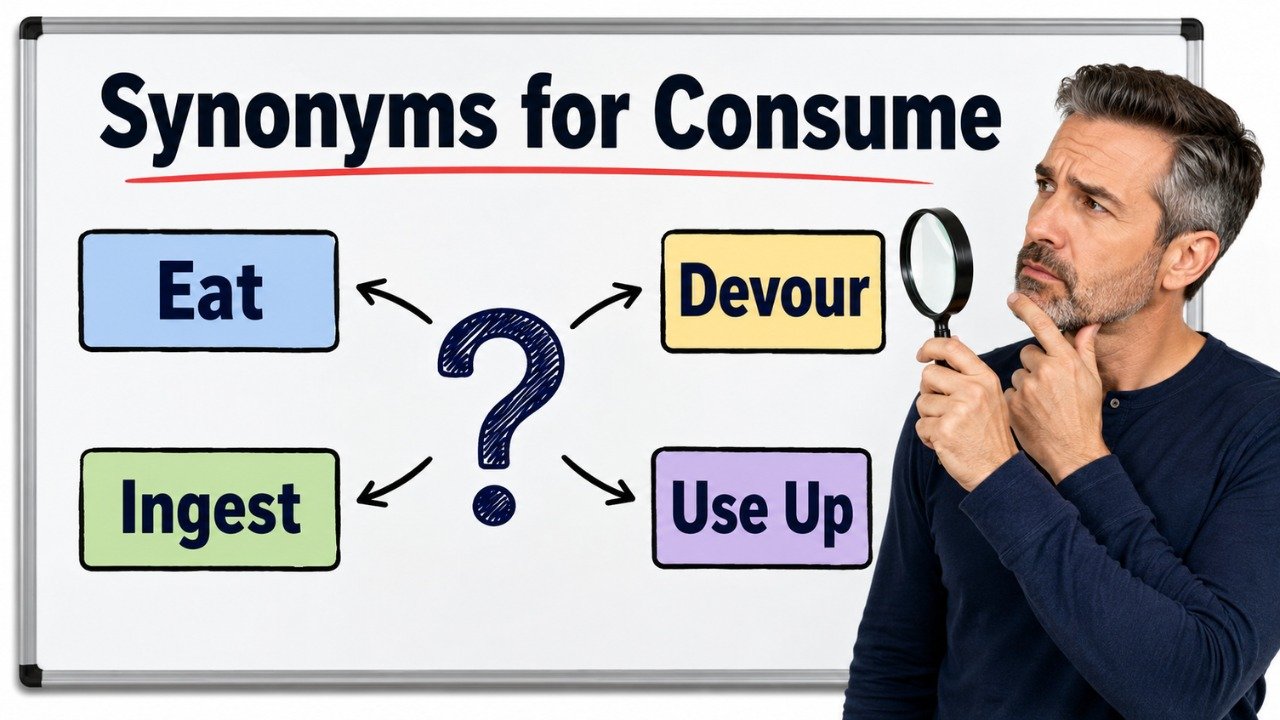
Quick Answer: The best synonyms for consume include eat, ingest, devour, drink, use, expend, deplete, absorb, exhaust, and utilize. Use eat or drink for food and beverages, ingest in formal or scientific writing, devour when something is eaten quickly or eagerly, use and utilize for resources, expend for money or energy, deplete when supplies are reduced, absorb for information or substances, and exhaust when something is completely used up. These synonyms for consume vary because consume can refer to eating, drinking, using resources, spending energy, absorbing information, or destroying something completely.
Pronunciation and Word Details
Word: Consume
Pronunciation: /kənˈsuːm/
Part of Speech: Verb
Meaning: To eat, drink, use, spend, absorb, or completely use up something.
US Pronunciation:
UK Pronunciation:
What Does “Consume” Mean?
Consume means to eat, drink, use, absorb, spend, or use something until part or all of it is gone.
Consume is a verb with several closely related meanings. In everyday language, it often refers to eating food or drinking beverages.
Example: The athletes consume nutritious meals before major competitions.
The word can also describe the use of energy, fuel, electricity, money, time, materials, or other resources.
Example: Older equipment may consume more electricity.
Consume can also mean to take in information, entertainment, or ideas.
Example: Readers consume large amounts of information each day.
In a stronger sense, consume can describe something being destroyed completely by fire or another force.
Example: The flames consumed the abandoned structure.
The word may also describe an emotion or thought that completely occupies a person’s attention.
Example: Worry consumed his thoughts throughout the evening.
Because consume has several meanings, the most natural synonym depends on what is being eaten, used, absorbed, spent, destroyed, or mentally experienced.
Meaning, Tone, and Context of “Consume”
Consume has a neutral to formal tone and is common in everyday, professional, academic, scientific, economic, and technical writing.
When referring to food, consume sounds more formal than eat.
Casual Context: Eat and drink usually sound more natural in ordinary conversation.
Formal Context: Consume is useful when discussing nutrition, resources, products, behavior, or measurable quantities.
Scientific Context: Consume and ingest may describe substances entering the body.
Economic Context: Consume may describe the use or purchase of goods, services, energy, and resources.
Technical Context: Consume often refers to the amount of power, memory, fuel, material, or capacity required by a process.
Environmental Context: Consume commonly describes the use of natural resources, water, electricity, fuel, and materials.
Emotional Context: Consume can have a strong figurative meaning when an emotion or thought takes complete control of someone’s attention.
Example: Jealousy consumed him.
The tone becomes more intense when consume means destroy, overwhelm, or completely occupy.
When and How to Use “Consume”
For Eating Food
For Food: Use consume when discussing eating in a formal, nutritional, medical, or general informational context.
Example: Adults should consume enough protein to support normal body functions.
For Drinking Liquids
For Beverages: Consume can refer to drinking water, juice, or other liquids, especially in formal writing.
Example: Participants were encouraged to consume sufficient water during the activity.
For Using Resources
For Resources: Use consume when something requires fuel, electricity, materials, water, or another resource.
Example: Large machines can consume significant amounts of energy.
For Spending Time
For Time: Consume can describe activities that require a large amount of time.
Example: Administrative tasks can consume several hours each week.
For Spending Energy
For Energy: Consume works when physical processes, machines, or activities require energy.
Example: Intensive exercise consumes considerable energy.
For Using Supplies
For Supplies: Use consume when materials or supplies are gradually used.
Example: The project consumed most of the available materials.
For Absorbing Information
For Information: Consume can describe reading, watching, listening to, or otherwise taking in information.
Example: Students consume information from many different formats.
For Destruction
For Destruction: Consume can mean completely destroy or engulf.
Example: The fire consumed the wooden building.
For Strong Emotions
For Emotion: Consume can describe a feeling that dominates someone’s thoughts.
Example: Fear consumed her as the storm became stronger.
Best Synonyms for Consume
Eat
Synonym: Eat means to take food into the mouth, chew it, and swallow it.
Example: The children ate their lunch before returning to class.
Ingest
Synonym: Ingest means to take food, drink, medicine, or another substance into the body.
Example: Patients should not ingest the substance without proper guidance.
Devour
Synonym: Devour means to eat something quickly, eagerly, or completely.
Example: The hungry hikers devoured their meal.
Drink
Synonym: Drink means to take liquid into the mouth and swallow it.
Example: She drank a glass of water after exercising.
Use
Synonym: Use means to employ or spend something for a particular purpose.
Example: The device uses less electricity than the older model.
Expend
Synonym: Expend means to use money, time, effort, or energy.
Example: The team expended considerable effort completing the project.
Deplete
Synonym: Deplete means to reduce the amount of a resource by using it.
Example: Long periods without rain depleted the region’s water reserves.
Absorb
Synonym: Absorb means to take in a substance, information, energy, or attention.
Example: The material absorbs moisture quickly.
Exhaust
Synonym: Exhaust means to use something completely or almost completely.
Example: The long journey exhausted their remaining fuel supply.
Utilize
Synonym: Utilize means to make practical use of something, often for a specific purpose.
Example: The facility utilizes renewable energy whenever possible.
50 Synonyms for Consume with Short Meanings
- Eat: Take food into the body.
- Ingest: Take food, drink, or another substance into the body.
- Devour: Eat quickly, eagerly, or completely.
- Drink: Take liquid into the body.
- Swallow: Cause food, drink, or another substance to pass down the throat.
- Partake: Eat or drink something, usually in a formal sense.
- Feast On: Eat a large or enjoyable amount of food.
- Gobble: Eat something very quickly.
- Wolf Down: Eat food rapidly and eagerly.
- Finish: Eat or use all of something.
- Use: Employ something for a particular purpose.
- Utilize: Put something to practical use.
- Employ: Use something as a means or resource.
- Expend: Use money, effort, time, or energy.
- Spend: Use money, time, effort, or resources.
- Burn: Use fuel or energy through operation or activity.
- Use Up: Consume the entire available amount.
- Exhaust: Use something until little or nothing remains.
- Deplete: Reduce a supply through continued use.
- Drain: Remove or use most of a supply, resource, or energy.
- Diminish: Reduce the amount or strength of something.
- Reduce: Make the available quantity smaller through use.
- Deplete Resources: Use resources until their supply is greatly reduced.
- Run Through: Use a supply rapidly.
- Go Through: Use a considerable amount of something.
- Absorb: Take in a substance, information, or energy.
- Take In: Receive food, information, substances, or impressions.
- Assimilate: Absorb and understand information or nutrients.
- Process: Take in and deal with information, food, or materials.
- Digest: Break down food or mentally understand information.
- Read: Take in written information.
- Watch: Take in visual information or entertainment.
- Listen To: Receive spoken information or sound.
- Study: Take in information through careful learning.
- Engage With: Actively take in or interact with material.
- Occupy: Take up time, space, thought, or attention.
- Engross: Completely hold someone’s attention.
- Absorb Attention: Fully occupy mental focus.
- Preoccupy: Dominate someone’s thoughts or attention.
- Overwhelm: Completely fill or overpower a person emotionally.
- Engulf: Surround or overwhelm completely.
- Destroy: Damage something so completely that it cannot continue normally.
- Ravage: Cause severe destruction or damage.
- Devastate: Destroy or damage something extensively.
- Burn Up: Destroy or use completely through fire or heat.
- Incinerate: Burn something until it is largely or completely destroyed.
- Eat Away At: Gradually destroy, reduce, or weaken something.
- Erode: Gradually wear away or reduce.
- Sap: Gradually use or weaken energy, strength, or resources.
- Drain Away: Gradually remove energy, resources, or supply.
Read Also:
Synonyms for Reluctant
Synonyms for Consume by Context
When Consume Means Eat
When consume refers to food, useful synonyms include eat, ingest, devour, partake, gobble, swallow, and wolf down.
Eat is the most natural choice in everyday language.
Example: The children ate their breakfast before school.
Ingest is more formal and often refers to food, medicine, chemicals, or other substances entering the body.
Example: Do not ingest the substance without proper instructions.
Devour suggests eating quickly or eagerly.
Example: The hungry guests devoured the meal.
Partake has a more formal or traditional tone.
Example: Everyone was invited to partake in the meal.
When Consume Means Drink
When consume refers specifically to liquids, drink is usually the clearest synonym.
Example: She drank plenty of water during the hike.
In formal contexts, ingest may also apply to liquids.
Example: Participants were asked to ingest only the approved solution.
Take in can work when discussing a broader amount of liquid or nutrients.
Example: The body must take in enough fluids to function properly.
When Consume Means Use Resources
Use, utilize, expend, spend, burn, exhaust, drain, and deplete are strong alternatives when consume refers to resources.
Example: The machine uses a considerable amount of electricity.
Use is the broadest and most natural alternative.
Example: Modern equipment uses less energy.
Expend is especially appropriate for effort, money, energy, or time.
Example: Workers expended considerable energy completing the task.
Deplete emphasizes reducing a limited supply.
Example: Heavy irrigation can deplete groundwater reserves.
Exhaust suggests using nearly or completely all of something.
Example: The group exhausted its emergency supplies.
When Consume Means Take In Information
When consume refers to information, media, knowledge, or ideas, useful alternatives include absorb, take in, read, study, process, digest, and assimilate.
Example: Students absorbed the information quickly.
Digest is often figurative when someone needs time to understand complex information.
Example: She needed several minutes to digest the unexpected news.
Assimilate suggests incorporating new knowledge into existing understanding.
Example: Learners need time to assimilate unfamiliar concepts.
When Consume Means Occupy Attention
Consume can mean dominate someone’s thoughts, emotions, time, or attention.
Useful alternatives include engross, preoccupy, absorb, occupy, and overwhelm.
Example: The mystery engrossed him for hours.
Preoccupy suggests that a thought repeatedly holds someone’s attention.
Example: Concerns about the deadline preoccupied the entire team.
Overwhelm is stronger and often describes intense emotions.
Example: Anxiety overwhelmed her before the presentation.
When Consume Means Destroy
When consume refers to destruction, especially by fire, useful alternatives include engulf, destroy, devastate, burn up, incinerate, and ravage.
Example: Flames engulfed the empty structure.
Destroy is the broadest alternative.
Example: The fire destroyed several wooden buildings.
Incinerate specifically means to destroy something by burning it intensely.
Example: The intense heat incinerated the dry material.
Another Word for Consume
Eat is often the best single replacement for consume when the subject is food, but there is no single synonym that works for every meaning.
For resources, use is usually the most natural alternative. For money or energy, expend may be more precise. For information, absorb or digest can be better. When something is completely destroyed, engulf or destroy may fit the sentence more accurately.
Original: Adults should consume a balanced diet.
Better Option: Adults should eat a balanced diet.
Original: This appliance consumes a large amount of electricity.
Better Option: This appliance uses a large amount of electricity.
Original: She consumes a great deal of information every morning.
Better Option: She absorbs a great deal of information every morning.
Original: The flames consumed the old warehouse.
Better Option: The flames engulfed the old warehouse.
When Not to Use “Consume”
Consume can sound unnecessarily formal when a simpler word communicates the meaning more naturally.
When Talking Casually About Food
Eat usually sounds more natural than consume in ordinary conversation.
Weak: I consumed a sandwich for lunch.
Better: I ate a sandwich for lunch.
When Talking Specifically About Drinks
Drink is clearer when the meaning involves only a beverage.
Weak: She consumed three glasses of water.
Better: She drank three glasses of water.
When Describing Resource Use
Use may be more direct when formality is unnecessary.
Weak: This lamp consumes very little electricity.
Better: This lamp uses very little electricity.
Both sentences are correct, but use is often simpler.
When You Mean Complete Depletion
Consume may not show clearly that nothing remains.
Weak: The project consumed the available budget.
Better: The project exhausted the available budget.
When You Mean Attention
Use a more precise emotional or mental word when possible.
Weak: The novel consumed her attention.
Better: The novel engrossed her completely.
When You Mean Destruction
Destroy, engulf, or incinerate may communicate the type of destruction more clearly.
Weak: The fire consumed the storage area.
Better: The fire engulfed the storage area.
Words Commonly Confused With Consume
Consume vs Eat: Eat specifically refers to taking food into the body. Consume is broader and can refer to food, drinks, energy, resources, information, time, or destruction.
Consume vs Ingest: Ingest means to take a substance into the body, usually through eating or drinking. Consume has additional meanings involving resources, attention, and destruction.
Consume vs Devour: Devour suggests eating quickly or eagerly. Consume does not necessarily indicate speed or enthusiasm.
Consume vs Use: Use means to employ something for a purpose. Consume often implies that using something reduces its available quantity.
Consume vs Expend: Expend commonly refers to using money, energy, effort, or resources. Consume has a broader range of meanings.
Consume vs Deplete: Consume describes using something, while deplete emphasizes that the available supply has been significantly reduced.
Consume vs Absorb: Absorb means to take in a substance, energy, information, or attention. Consume can mean take in, but it can also mean eat, use, destroy, or exhaust.
Consume vs Exhaust: Exhaust emphasizes using something completely or almost completely. Consume does not always mean that the full supply is gone.
Which Synonym Should You Choose?
Choose eat when talking naturally about food in everyday speech or writing.
Choose drink when the object is a beverage or another liquid.
Choose ingest when writing formally about food, medicine, chemicals, nutrients, or substances entering the body.
Choose devour when someone eats rapidly, eagerly, or completely.
Choose use when discussing electricity, fuel, materials, equipment, or ordinary resources.
Choose utilize when emphasizing practical application rather than simple consumption.
Choose expend when discussing money, energy, time, effort, or other measurable resources in formal writing.
Choose deplete when the important idea is that a limited supply is becoming smaller.
Choose exhaust when the supply is almost or completely used.
Choose absorb when describing information, energy, liquid, or knowledge being taken in.
Choose digest when describing food processing or figuratively understanding complicated information.
Choose engross when an activity, story, or thought completely captures attention.
Choose overwhelm when a strong emotion dominates someone.
Choose engulf when fire, water, smoke, or another force completely surrounds something.
Choose destroy when the central meaning is severe damage rather than ordinary use.
For essays and reports, consume, ingest, expend, deplete, absorb, and exhaust often provide useful precision.
For everyday conversation, eat, drink, use, take in, and use up usually sound more natural.
For technical writing, choose the synonym that describes the measurable action most precisely, such as use, expend, absorb, or deplete.
Real Life Examples of “Consume” in Sentences
Original: Children need to consume nutritious food as they grow.
Better Option: Children need to eat nutritious food as they grow.
Original: The machine consumes more electricity during heavy operation.
Better Option: The machine uses more electricity during heavy operation.
Original: The athletes consumed several bottles of water after training.
Better Option: The athletes drank several bottles of water after training.
Original: The project consumed most of the available budget.
Better Option: The project depleted most of the available budget.
Original: The students consumed a large amount of information during the course.
Better Option: The students absorbed a large amount of information during the course.
Original: The long journey consumed nearly all of their fuel.
Better Option: The long journey exhausted nearly all of their fuel.
Original: Fear consumed his thoughts throughout the night.
Better Option: Fear preoccupied his thoughts throughout the night.
Original: The flames consumed the dry vegetation.
Better Option: The flames engulfed the dry vegetation.
Original: The task consumed several hours of her afternoon.
Better Option: The task occupied several hours of her afternoon.
Original: The workers consumed considerable energy completing the demanding job.
Better Option: The workers expended considerable energy completing the demanding job.
Synonym Groups and Usage Differences
Eating Group
Eat, ingest, devour, swallow, partake, gobble, and wolf down all relate to taking food or substances into the body.
Eat is neutral and common. Ingest is formal. Devour suggests eagerness. Gobble and wolf down imply speed.
Example: The hungry children devoured their evening meal.
Resource Use Group
Use, utilize, expend, spend, burn, use up, drain, deplete, and exhaust describe the consumption of resources.
Use is general. Expend suits effort, money, and energy. Deplete emphasizes reduction. Exhaust suggests that very little remains.
Example: The equipment uses less fuel than the previous version.
Information Group
Absorb, assimilate, digest, process, take in, read, and study can describe consuming information or knowledge.
Absorb suggests successful learning. Digest suggests understanding something gradually. Assimilate suggests integrating new information into existing knowledge.
Example: Students need time to digest complex material.
Attention Group
Engross, preoccupy, occupy, absorb, and overwhelm describe something taking control of attention or thought.
Engross is often positive or neutral. Preoccupy suggests persistent mental focus. Overwhelm has a stronger emotional meaning.
Example: The fascinating puzzle engrossed her for the entire evening.
Depletion Group
Use up, exhaust, drain, deplete, diminish, and sap emphasize reduction or loss.
Exhaust is strongest when nearly nothing remains. Sap often describes gradual loss of energy or strength.
Example: The prolonged effort sapped his remaining energy.
Destruction Group
Destroy, engulf, ravage, devastate, burn up, incinerate, erode, and eat away at describe damaging or eliminating something.
Engulf works especially well with fire, water, or smoke. Ravage and devastate emphasize severe damage. Erode describes gradual destruction.
Example: Years of exposure gradually eroded the surface.
Antonyms of Consume
The antonyms of consume depend on whether the meaning involves eating, using, spending, preserving, creating, or supplying.
Preserve: Keep something from being used, damaged, or lost.
Save: Keep something for future use instead of spending it.
Conserve: Use resources carefully to prevent unnecessary loss.
Store: Keep something available for later use.
Retain: Continue to possess or hold something.
Accumulate: Gather increasing amounts rather than using them.
Produce: Create or generate something rather than consume it.
Generate: Cause energy, materials, or resources to be produced.
Supply: Provide something for use.
Replenish: Restore a supply that has been reduced.
Restore: Bring something back to an earlier or adequate condition.
Create: Bring something new into existence.
Reserve: Keep something available for a later purpose.
Replace: Provide a new amount after something has been used.
Comparison: Consume vs Related Words
Consume vs Eat
Consume can refer to food, drinks, resources, information, time, or destruction. Eat specifically relates to food.
Example With Consume: People should consume enough vegetables as part of a balanced diet.
Example With Eat: People should eat enough vegetables as part of a balanced diet.
Eat sounds more natural in everyday conversation.
Consume vs Ingest
Consume is broad, while ingest specifically refers to taking a substance into the body.
Example With Consume: Participants consumed the prepared meal.
Example With Ingest: Participants ingested the measured nutritional solution.
Ingest is more formal and technical.
Consume vs Devour
Consume is neutral about speed. Devour suggests eating eagerly, rapidly, or completely.
Example With Consume: He consumed his dinner before leaving.
Example With Devour: He devoured his dinner after the long hike.
Devour adds intensity.
Consume vs Use
Consume often implies that a resource decreases through use. Use simply means to employ something for a purpose.
Example With Consume: The engine consumes a significant amount of fuel.
Example With Use: The engine uses a significant amount of fuel.
Use is simpler, while consume can emphasize resource demand.
Consume vs Expend
Consume works with many types of objects. Expend is particularly suitable for energy, effort, money, and resources.
Example With Consume: The activity consumes considerable energy.
Example With Expend: Athletes expend considerable energy during intense exercise.
Expend often sounds more formal and precise.
Consume vs Deplete
Consume describes the action of using a resource. Deplete emphasizes the resulting reduction.
Example With Consume: Agriculture can consume large quantities of water.
Example With Deplete: Excessive water use can deplete underground reserves.
The words focus on different parts of the same process.
Consume vs Exhaust
Consume does not always mean that everything is gone. Exhaust suggests nearly complete or complete use.
Example With Consume: The journey consumed much of their fuel.
Example With Exhaust: The journey exhausted their fuel supply.
Exhaust expresses a more complete level of depletion.
Consume vs Absorb
Consume can mean take in, while absorb specifically emphasizes receiving or taking something into another substance, body, or mind.
Example With Consume: Students consume information from many sources.
Example With Absorb: Students absorb information more easily when explanations are clear.
Absorb is often more precise for learning.
Common Phrases and Expressions With Consume
Consume Food: Eat food or take it into the body.
Consume Water: Drink or use water.
Consume Energy: Use energy during an activity or process.
Consume Electricity: Use electrical power.
Consume Fuel: Use fuel to operate a vehicle, machine, or system.
Consume Resources: Use materials, money, water, energy, or other available supplies.
Consume Time: Require or occupy a considerable amount of time.
Consume Information: Read, watch, hear, or otherwise take in information.
Consumed by Fear: Completely dominated by fear.
Consumed by Anger: Completely occupied or controlled by anger.
Common Mistakes to Avoid
Using Consume When Eat Sounds More Natural
Consume can sound overly formal in casual sentences about ordinary meals.
Weak: I consumed cereal before work.
Better: I ate cereal before work.
Use consume when the context is formal, technical, nutritional, or analytical.
Treating Every Synonym as Interchangeable
Synonyms for consume have different meanings.
Weak: The machine devours electricity efficiently.
Better: The machine uses electricity efficiently.
Devour may be used figuratively for very heavy consumption, but it is too dramatic for many neutral contexts.
Confusing Consume With Deplete
Consume describes using something. Deplete describes reducing the available supply.
Weak: The drought consumed the groundwater supply.
Better: The drought depleted the groundwater supply.
Choose the word that matches the action or result you mean.
Using Ingest for Resources
Ingest applies mainly to substances entering a living body or system.
Weak: The building ingests large amounts of electricity.
Better: The building consumes large amounts of electricity.
Repeating Consume Too Often
Repeated use can make a paragraph sound mechanical.
Weak: People consume food, consume water, consume electricity, and consume information every day.
Better: People eat food, drink water, use electricity, and absorb information every day.
Varying vocabulary makes the meaning clearer.
Ignoring Figurative Meaning
Consume can describe emotions and thoughts as well as physical resources.
Weak: Worry ate his thoughts all evening.
Better: Worry consumed his thoughts all evening.
The figurative use of consume often carries a sense of complete mental or emotional domination.
Choosing a Word That Is Too Strong
Devour, exhaust, ravage, and destroy are stronger than consume in many sentences.
Weak: She devoured a small snack slowly.
Better: She ate a small snack slowly.
The verb should match the intensity of the action.
Using Vague Resource Language
A precise synonym can make technical writing easier to understand.
Weak: The process consumes things quickly.
Better: The process depletes raw materials quickly.
Specific wording tells the reader exactly what is being used.
Conclusion
The best synonyms for consume depend on the meaning of the sentence. Eat and drink are natural for food and beverages, while ingest suits more formal contexts. Use, expend, deplete, and exhaust work well for resources, energy, money, and supplies. Absorb, digest, and assimilate fit information and learning, while engross and preoccupy describe attention. For destruction, engulf and destroy may be clearer. Understanding these synonyms for consume helps you choose precise vocabulary for everyday, professional, academic, and technical writing.
FAQs About Synonyms for Consume
What is the best synonym for consume?
The best synonym depends on context. Eat works for food, drink for liquids, use for resources, expend for energy or money, and absorb for information.
What is another word for consume food?
Eat is the most natural alternative. Ingest is more formal, while devour suggests eating quickly or eagerly.
What is a formal synonym for consume?
Ingest, expend, utilize, deplete, and exhaust are useful formal alternatives depending on the intended meaning.
What is a synonym for consume resources?
Use, expend, deplete, exhaust, drain, and use up are useful alternatives for consuming resources.
What is a synonym for consume information?
Absorb, digest, assimilate, process, read, and take in can describe consuming information.
Does consume mean use up?
Consume can mean use up, especially when discussing fuel, energy, food, materials, or supplies. However, consume does not always mean that the entire amount is gone.
What is the difference between consume and devour?
Consume is a neutral and broad verb. Devour usually means to eat something very quickly or eagerly, although it can also be used figuratively for reading or enjoying something intensely.
