
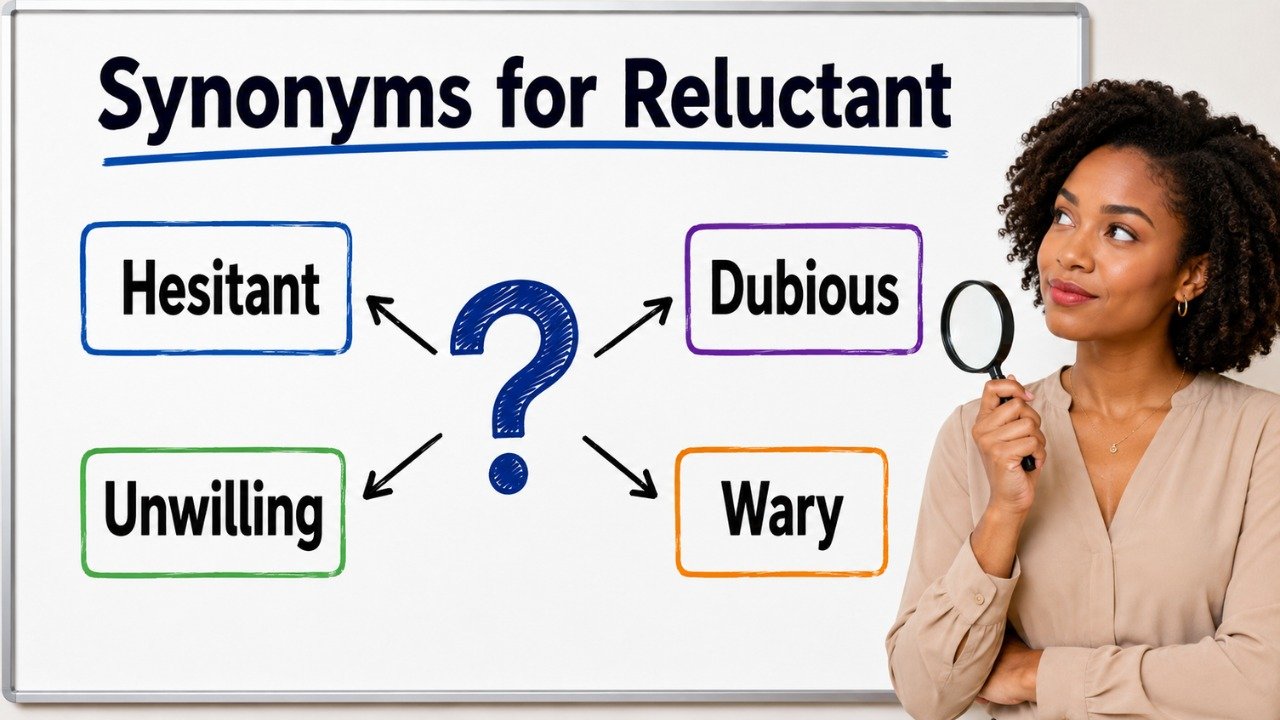
Quick Answer: The best synonyms for reluctant include hesitant, unwilling, disinclined, resistant, averse, loath, apprehensive, wary, cautious, and unenthusiastic. Hesitant is the best general choice when someone is unsure about acting, while unwilling is stronger when a person does not want to do something. Disinclined works well in formal writing, wary emphasizes caution, and apprehensive suggests worry about what may happen. Averse and loath express stronger unwillingness, while resistant is useful when someone actively opposes an idea, request, or change.
Pronunciation and Word Details
Word: Reluctant.
Pronunciation: /rɪˈlʌktənt/
Part of Speech: Adjective.
Meaning: Unwilling, hesitant, or not eager to do, accept, or agree to something.
US Pronunciation:
UK Pronunciation:
What Does “Reluctant” Mean?
Reluctant means unwilling or hesitant to do something because of doubt, discomfort, lack of enthusiasm, fear, or personal preference.
Reluctant is an adjective. It normally describes a person, group, or attitude toward an action, decision, request, change, or situation.
Someone can be reluctant because they do not want to participate, because they are unsure about the consequences, or because they need more time before making a decision.
Personal Decision: She was reluctant to leave her familiar neighborhood.
Professional Situation: The manager was reluctant to approve the proposal without more information.
Social Situation: He felt reluctant to speak in front of the large audience.
Change: Some employees were reluctant to adopt the new procedure.
Admission: She was reluctant to admit that she had made a mistake.
The exact meaning depends on why the person is holding back. Sometimes reluctant suggests simple hesitation, while in other situations it suggests stronger unwillingness or resistance.
Meaning, Tone, and Context of “Reluctant”
Reluctant has a neutral and widely useful tone. It appears naturally in everyday conversation, formal writing, essays, reports, professional communication, narratives, and descriptive writing.
The word usually suggests that someone may eventually do something even though they are not eager to do it.
Neutral Tone: Reluctant can describe ordinary hesitation without sounding overly emotional.
Formal Tone: It is suitable for reports, essays, professional writing, and academic explanations.
Conversational Tone: It also sounds natural in normal speech.
Emotional Context: Reluctant may suggest fear, discomfort, embarrassment, uncertainty, or lack of enthusiasm.
Professional Context: It can describe hesitation about decisions, changes, investments, commitments, requests, or responsibilities.
Academic Context: Writers can use reluctant when discussing attitudes, choices, reactions, or resistance to change.
Strong Context: Averse, loath, opposed, and resistant can express stronger unwillingness than reluctant.
Cautious Context: Wary, apprehensive, and guarded are better when concern about risk or consequences is important.
Reluctant therefore covers a broad middle ground between simple uncertainty and direct refusal.
When and How to Use “Reluctant”
For Hesitation: Use reluctant when someone is unsure about taking an action.
Example: She was reluctant to make a decision without considering every option.
For Unwillingness: Use reluctant when someone does not really want to do something but may still agree.
Example: He was reluctant to attend the meeting but eventually decided to go.
For Fear Or Concern: Reluctant can describe hesitation caused by possible negative consequences.
Example: They were reluctant to invest because the outcome was uncertain.
For Social Discomfort: Use reluctant when someone does not feel comfortable speaking, participating, or drawing attention to themselves.
Example: She was reluctant to share her opinion with the entire group.
For Change: Reluctant frequently describes people who are hesitant to accept a new idea, method, habit, or situation.
Example: Some members were reluctant to change the established routine.
For Agreement: Use reluctant when someone is not immediately willing to accept a proposal or suggestion.
Example: He was reluctant to agree until the details were explained clearly.
For Admission: Reluctant can describe unwillingness to acknowledge something uncomfortable.
Example: She was reluctant to admit that the original plan had failed.
Best Synonyms for Reluctant
Hesitant: Unsure or slow to act because of doubt or uncertainty.
Example: She was hesitant to answer the difficult question.
Unwilling: Not wanting or prepared to do something.
Example: He was unwilling to accept the terms of the agreement.
Disinclined: Not willing or interested in doing something.
Example: She seemed disinclined to continue the discussion.
Resistant: Opposed to an idea, action, influence, or change.
Example: Several members remained resistant to the proposed changes.
Averse: Strongly unwilling or opposed to something.
Example: He was averse to taking unnecessary risks.
Loath: Very unwilling to do something.
Example: She was loath to abandon a project she had worked on for years.
Apprehensive: Hesitant because of worry about what might happen.
Example: He felt apprehensive about speaking before such a large audience.
Wary: Cautious because of possible danger, difficulty, or problems.
Example: Investors remained wary of making an immediate commitment.
Cautious: Careful about acting because of possible consequences.
Example: She was cautious about agreeing before reviewing the details.
Unenthusiastic: Showing little interest or eagerness.
Example: The group appeared unenthusiastic about the proposed activity.
50 Synonyms for Reluctant with Short Meanings
- Hesitant: Unsure or slow to act.
- Unwilling: Not wanting to do something.
- Disinclined: Not naturally willing or interested.
- Resistant: Opposed to an action or change.
- Averse: Strongly unwilling or opposed.
- Loath: Very unwilling to act.
- Unenthusiastic: Showing little eagerness or interest.
- Apprehensive: Hesitant because of worry.
- Wary: Cautious because of possible problems.
- Cautious: Careful before acting or deciding.
- Uncertain: Not sure what to do.
- Unsure: Lacking confidence about a decision.
- Doubtful: Feeling uncertainty about something.
- Dubious: Uncertain or unconvinced about an idea.
- Skeptical: Unwilling to accept something without evidence.
- Guarded: Careful and restrained in response.
- Uneasy: Uncomfortable or worried about acting.
- Uncomfortable: Not feeling at ease with a situation.
- Tentative: Cautious and not fully decided.
- Wavering: Moving between different decisions or opinions.
- Indecisive: Having difficulty making a choice.
- Undecided: Not yet having made a decision.
- Reticent: Unwilling to speak or reveal thoughts.
- Reserved: Restrained about expressing thoughts or feelings.
- Inhibited: Held back by discomfort or self consciousness.
- Grudging: Done with unwillingness or resentment.
- Begrudging: Given or done unwillingly.
- Halfhearted: Lacking full enthusiasm or commitment.
- Lukewarm: Showing limited enthusiasm or support.
- Opposed: Unwilling because of disagreement.
- Recalcitrant: Stubbornly resistant to control or change.
- Resistant To Change: Unwilling to accept something new.
- Slow To Agree: Hesitant before giving approval.
- Slow To Act: Hesitant before taking action.
- Slow To Commit: Unwilling to make a firm decision quickly.
- Not Eager: Lacking enthusiasm about doing something.
- Not Keen: Not particularly willing or interested.
- Not Inclined: Not disposed to take a certain action.
- Unwilling To Proceed: Not wanting to continue with an action.
- Hesitant To Proceed: Unsure about moving forward.
- Holding Back: Avoiding immediate action or commitment.
- Hanging Back: Remaining hesitant instead of moving forward.
- Shying Away: Avoiding something because of discomfort or concern.
- Dragging Your Feet: Delaying action because of reluctance.
- Having Reservations: Feeling doubts about a decision.
- Thinking Twice: Reconsidering before taking action.
- Of Two Minds: Unable to decide between alternatives.
- On The Fence: Undecided about what position to take.
- Unreceptive: Not willing to consider or accept something.
- Unamenable: Unwilling to agree, cooperate, or respond positively.
Read Also:
Synonyms for Yay

Synonyms for Reluctant by Context
When Reluctant Means Unwilling
Unwilling, disinclined, loath, averse, and not inclined are useful when someone simply does not want to do something.
Example: She was unwilling to accept the additional responsibility.
Example: He was disinclined to discuss the matter further.
Loath and averse are stronger choices when the unwillingness is particularly noticeable.
Example: She was loath to give up control of the project.
When Reluctant Means Hesitant
Hesitant, uncertain, unsure, tentative, wavering, and undecided work well when doubt rather than refusal is the main issue.
Example: He was hesitant to make a commitment before reviewing the details.
Example: She remained uncertain about which option would be best.
Hesitant is usually the closest general alternative when someone may act but needs more confidence or information first.
When Reluctant Means Cautious
Wary, cautious, apprehensive, guarded, uneasy, and doubtful are useful when someone holds back because of possible risk or consequences.
Example: She was wary of accepting the offer without reading the conditions.
Example: He felt apprehensive about making such a major change.
These words add a sense of concern that reluctant does not always express by itself.
When Reluctant Means Resistant
Resistant, opposed, unreceptive, recalcitrant, and unamenable fit situations where someone actively pushes against an idea, request, or change.
Example: Some members remained resistant to changing the established procedure.
Example: The committee was unreceptive to the proposed revision.
Recalcitrant is much stronger and normally suggests stubborn resistance.
When Reluctant Means Unenthusiastic
Unenthusiastic, lukewarm, halfhearted, grudging, and begrudging describe limited enthusiasm or willingness.
Example: Her response to the proposal was lukewarm.
Example: He gave a grudging agreement after a lengthy discussion.
These alternatives are useful when the issue is lack of enthusiasm rather than uncertainty.
Another Word for Reluctant
Hesitant is one of the best general replacements for reluctant because both words can describe someone who is slow or uncertain about taking action. However, the most accurate alternative depends on the reason for the reluctance.
Use unwilling when the person clearly does not want to act. Use apprehensive when fear or worry causes the hesitation. Use resistant when someone actively opposes a change or proposal.
Original: She was reluctant to answer the question.
Better Option: She was hesitant to answer the question.
Original: He was reluctant to accept the additional responsibility.
Better Option: He was unwilling to accept the additional responsibility.
Original: They were reluctant to invest because the outcome was uncertain.
Better Option: They were apprehensive about investing because the outcome was uncertain.
Original: Some employees were reluctant to adopt the new procedure.
Better Option: Some employees were resistant to adopting the new procedure.
When Not to Use “Reluctant”
Reluctant is useful, but it can become vague when the reason behind the hesitation is important.
Use a more precise synonym when you need to distinguish fear, refusal, doubt, resistance, or lack of enthusiasm.
Weak: She was reluctant because she was afraid something might go wrong.
Better: She was apprehensive because she was afraid something might go wrong.
Weak: He was reluctant and completely refused the request.
Better: He was unwilling and refused the request.
Weak: The employees were reluctant to every proposed change.
Better: The employees were resistant to every proposed change.
Weak: Her reluctant support showed that she did not care much about the idea.
Better: Her lukewarm support showed that she did not care much about the idea.
Avoid using reluctant repeatedly within the same paragraph when hesitant, unwilling, wary, or resistant would communicate the intended meaning more clearly.
Reluctant should also describe a genuine lack of willingness or eagerness. It is less accurate when someone is merely taking reasonable time to think.
Words Commonly Confused With Reluctant
Reluctant vs Hesitant: Reluctant usually suggests unwillingness or lack of eagerness, while hesitant places greater emphasis on uncertainty or delay before acting.
Reluctant vs Unwilling: Reluctant is often softer because the person may eventually agree. Unwilling can suggest a firmer refusal or lack of desire.
Reluctant vs Reticent: Reluctant can apply to almost any action. Reticent more specifically describes unwillingness to speak, reveal information, or express thoughts.
Reluctant vs Resistant: Reluctant describes hesitation or unwillingness, while resistant suggests more active opposition.
Reluctant vs Averse: Reluctant expresses unwillingness, while averse usually indicates a stronger dislike or opposition to something.
Reluctant vs Apprehensive: Reluctant describes hesitation in general. Apprehensive specifically suggests worry or anxiety about what may happen.
Reluctant vs Cautious: Reluctant suggests not wanting to act, while cautious suggests acting carefully because of possible consequences.
Which Synonym Should You Choose?
Choose hesitant when you want the closest general alternative for someone who is unsure about acting.
Choose unwilling when someone clearly does not want to do something.
Choose disinclined in formal writing when you want a polished way to express a lack of willingness or interest.
Choose apprehensive when fear, worry, or concern causes the hesitation.
Choose wary when someone is reluctant because they recognize possible risk.
Choose resistant when a person or group actively opposes a proposal, request, change, or influence.
Choose averse when expressing strong dislike or opposition.
Choose loath when someone is strongly unwilling to take a particular action.
Choose unenthusiastic or lukewarm when the main idea is a lack of excitement or support.
Choose tentative when writing about decisions, plans, responses, or commitments that are not yet firm.
Choose reticent when the reluctance specifically concerns speaking or sharing information.
In reports and essays, hesitant, disinclined, resistant, apprehensive, and averse often provide precise distinctions.
In professional emails, hesitant or reluctant usually sound more diplomatic than unwilling.
In casual conversation, not eager, not keen, holding back, and thinking twice may sound more natural.
Real Life Examples of “Reluctant” in Sentences
Original: She was reluctant to express her opinion during the meeting.
Better Option: She was hesitant to express her opinion during the meeting.
Original: He was reluctant to take responsibility for the additional task.
Better Option: He was unwilling to take responsibility for the additional task.
Original: They were reluctant to make such a risky investment.
Better Option: They were wary of making such a risky investment.
Original: The committee was reluctant to approve the proposal.
Better Option: The committee was disinclined to approve the proposal.
Original: She was reluctant to travel alone because of her concerns.
Better Option: She was apprehensive about traveling alone because of her concerns.
Original: Several employees were reluctant to accept the new system.
Better Option: Several employees were resistant to accepting the new system.
Original: He was reluctant to give up the project.
Better Option: He was loath to give up the project.
Original: She seemed reluctant to support the idea.
Better Option: She seemed unenthusiastic about supporting the idea.
Original: The customer was reluctant to share personal details.
Better Option: The customer was reticent about sharing personal details.
Original: He remained reluctant to choose between the two options.
Better Option: He remained undecided between the two options.
Synonym Groups and Usage Differences
Hesitation Group
Hesitant, tentative, uncertain, unsure, wavering, and undecided describe difficulty or delay in taking action.
These words are best when uncertainty is more important than opposition.
Example: She remained hesitant until she received more information.
Unwillingness Group
Unwilling, disinclined, loath, averse, and not inclined describe a lack of desire to do something.
Some are stronger than others. Unwilling is direct, while disinclined sounds more measured and formal.
Example: He was disinclined to continue the discussion.
Caution Group
Wary, cautious, apprehensive, guarded, uneasy, and doubtful suggest that concern or possible risk is causing the hesitation.
Example: The buyers remained wary until they understood all the conditions.
Resistance Group
Resistant, opposed, unreceptive, recalcitrant, and unamenable indicate resistance to a proposal, influence, request, or change.
These words are usually stronger than hesitant.
Example: The group remained resistant to changing the existing policy.
Low Enthusiasm Group
Unenthusiastic, lukewarm, halfhearted, grudging, and begrudging describe limited enthusiasm or willingness.
Example: His lukewarm response suggested that he was not excited about the proposal.
Social Restraint Group
Reticent, reserved, inhibited, holding back, and hanging back are useful when reluctance involves speaking, participating, or becoming involved.
Example: She remained reticent when asked to discuss the personal issue.
Antonyms of Reluctant
The opposite of reluctant changes slightly depending on whether the intended meaning is willingness, enthusiasm, confidence, or openness.
Willing: Ready to do something without strong resistance.
Eager: Very interested and excited to act.
Enthusiastic: Showing strong interest or excitement.
Ready: Prepared and willing to begin.
Inclined: Naturally willing or disposed toward something.
Keen: Strongly interested or eager.
Receptive: Willing to consider an idea or suggestion.
Cooperative: Willing to work with others or follow a reasonable request.
Confident: Comfortable and certain about taking action.
Decisive: Able to make decisions clearly and promptly.
Agreeable: Willing to agree or cooperate.
Committed: Firmly dedicated to an action, plan, or goal.
Comparison: Reluctant vs Related Words
Reluctant vs Hesitant
Reluctant suggests that someone does not particularly want to do something. Hesitant emphasizes uncertainty about whether or how to act.
Example With Reluctant: She was reluctant to accept another responsibility.
Example With Hesitant: She was hesitant to answer because she was unsure of the facts.
Reluctant vs Unwilling
Reluctant is softer and can suggest that a person may eventually agree. Unwilling often indicates a stronger lack of desire or intention.
Example With Reluctant: He was reluctant to join the discussion at first.
Example With Unwilling: He was unwilling to sign the agreement.
Reluctant vs Disinclined
Both describe unwillingness, but disinclined often sounds more formal and can suggest a personal preference against doing something.
Example With Reluctant: She was reluctant to stay late.
Example With Disinclined: She was disinclined to extend the meeting beyond the scheduled time.
Reluctant vs Apprehensive
Reluctant does not explain why someone is hesitant. Apprehensive specifically suggests concern or worry about possible consequences.
Example With Reluctant: He was reluctant to travel alone.
Example With Apprehensive: He was apprehensive about traveling alone in unfamiliar surroundings.
Reluctant vs Resistant
Reluctant describes hesitation or unwillingness. Resistant suggests active opposition or refusal to accept influence or change.
Example With Reluctant: Some employees were reluctant to change their routine.
Example With Resistant: Some employees were resistant to every proposed change.
Reluctant vs Averse
Reluctant suggests hesitation or lack of eagerness. Averse expresses stronger opposition or dislike.
Example With Reluctant: She was reluctant to take the risk.
Example With Averse: She was averse to taking unnecessary risks.
Reluctant vs Reticent
Reluctant can describe unwillingness to perform any action. Reticent is most appropriate when someone avoids speaking or revealing information.
Example With Reluctant: He was reluctant to attend the meeting.
Example With Reticent: He was reticent about explaining why he had missed the meeting.
Common Phrases and Expressions With Reluctant
Reluctant To Agree: Hesitant or unwilling to give approval.
Reluctant To Admit: Unwilling to acknowledge something openly.
Reluctant To Accept: Hesitant about receiving or agreeing to something.
Reluctant To Change: Unwilling or hesitant to adopt something different.
Reluctant To Speak: Hesitant about expressing thoughts aloud.
Reluctant To Participate: Not eager to become involved in an activity.
Reluctant To Commit: Hesitant to make a firm promise or decision.
Reluctant To Leave: Unwilling or unhappy about going away.
Reluctant To Decide: Hesitant about making a final choice.
Reluctant To Ask: Uncomfortable about requesting something.
Common Mistakes to Avoid
One common mistake is treating every synonym for reluctant as completely interchangeable.
Hesitant and unwilling are related, but they express different degrees of resistance. A hesitant person may simply be uncertain, while an unwilling person may clearly not want to act.
Another mistake is confusing reluctant with reticent.
Incorrect: He was reticent to attend the event.
Better: He was reluctant to attend the event.
Reticent is usually more appropriate when someone is unwilling to speak or reveal information.
Do not use averse carelessly. Averse normally expresses stronger opposition than reluctant.
Weak: She was averse to answering because she needed another minute to think.
Better: She was hesitant to answer because she needed another minute to think.
Avoid using apprehensive when there is no fear or concern involved.
Weak: He was apprehensive about choosing the blue folder instead of the green one.
Better: He was uncertain about choosing the blue folder instead of the green one.
Do not overuse reluctant within the same paragraph.
Repetitive: She was reluctant to attend because she was reluctant to speak and reluctant to meet new people.
Better: She was reluctant to attend because she felt hesitant about speaking and uncomfortable meeting new people.
Another common problem is vague usage. If the reason for a person’s reluctance is important, select a synonym that identifies it clearly.
Use wary for caution, apprehensive for worry, resistant for opposition, unwilling for refusal, and hesitant for uncertainty.
Conclusion
The best synonyms for reluctant depend on why someone is unwilling or hesitant. Hesitant works well for uncertainty, while unwilling expresses stronger resistance. Disinclined offers a formal alternative, apprehensive highlights worry, and wary suggests caution. Resistant is useful when someone opposes a change, while averse and loath communicate stronger unwillingness. Understanding these differences makes it easier to choose accurate synonyms for reluctant and create clearer sentences in essays, reports, professional writing, and everyday conversation.
FAQs About Synonyms for Reluctant
What Is The Best Synonym for Reluctant?
Hesitant is one of the best general synonyms for reluctant. Use unwilling when the lack of desire is stronger and apprehensive when worry causes the hesitation.
What Is A Formal Synonym for Reluctant?
Disinclined is a useful formal synonym. Averse, hesitant, resistant, and unwilling can also work in formal writing depending on context.
Does Reluctant Mean Unwilling?
Yes, reluctant can mean unwilling, but it often expresses a softer form of unwillingness. A reluctant person may eventually agree even though they are not eager to do so.
What Is The Difference Between Reluctant And Hesitant?
Reluctant usually emphasizes unwillingness or lack of eagerness. Hesitant emphasizes uncertainty or delay before making a decision or taking action.
What Is A Stronger Word Than Reluctant?
Averse, loath, resistant, and unwilling can be stronger than reluctant. The best choice depends on whether the person feels opposition, dislike, or firm unwillingness.
Can Reluctant Mean Afraid?
Reluctant does not directly mean afraid, but fear can cause reluctance. Apprehensive is more precise when worry or fear explains why someone is hesitant.
Is Reticent A Synonym for Reluctant?
Reticent can be a close alternative when someone is reluctant to speak or reveal information. It is not a general replacement for reluctant in every context.
