
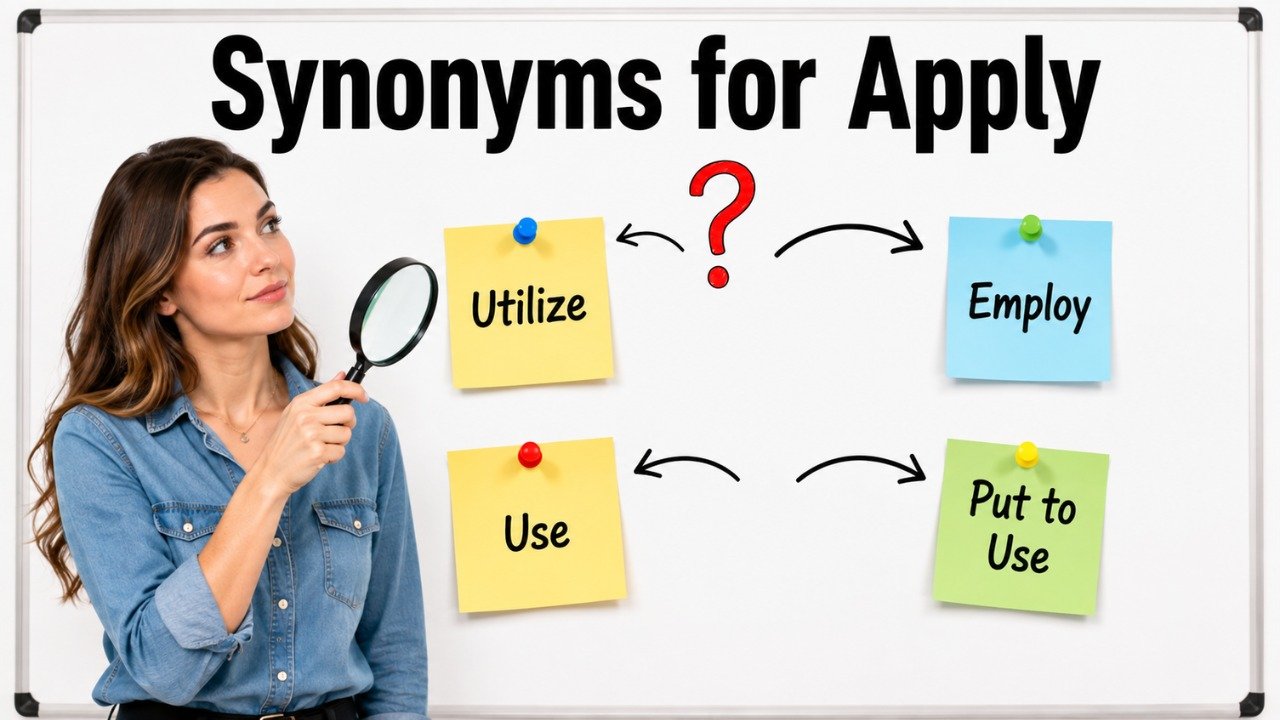
Quick Answer: Common synonyms for apply include use, employ, utilize, implement, submit, request, put on, spread, enforce, and relate. The best choice depends on context. Use and employ work well when applying a method, skill, or rule. Implement suits formal writing about plans or policies. Submit is best for applications and documents. Put on or spread works for creams, paint, or substances. Enforce fits rules and regulations, while relate works when something applies to a particular person, case, or situation.
Pronunciation and Word Details
Word: Apply
Pronunciation: /əˈplaɪ/
Part of Speech: Verb
Meaning: To use something, put something onto a surface, make a formal request, or make something relevant to a particular situation.
US Pronunciation:
UK Pronunciation:
What Does “Apply” Mean?
Apply means to use something for a particular purpose, put a substance onto a surface, formally request something, or make a rule, idea, or condition relevant to a situation.
Apply is a verb with several common meanings. You can apply a skill to a task, apply paint to a wall, apply for a position, or say that a rule applies to everyone.
The word also appears in academic, professional, technical, legal, and everyday contexts. Its exact meaning changes according to what follows it in the sentence.
For example, apply for usually means to make a formal request, while apply to often means to be relevant to someone or something. Apply something can also mean to use, enforce, or place it somewhere.
Meaning, Tone, and Context of “Apply”
Apply is generally neutral and widely accepted in both formal and casual English. It is common in conversation, business communication, education, instructions, law, science, and professional writing.
When apply means use, it has a neutral or slightly formal tone. A person may apply knowledge, a technique, a principle, or a method.
When apply means submit a formal request, it is standard in professional and administrative contexts. People apply for jobs, courses, permits, positions, grants, and opportunities.
When apply refers to putting something on a surface, it is common in instructions. You may apply cream, paint, pressure, glue, or another material.
When apply means be relevant, it often appears in rules, policies, conditions, and explanations. A rule may apply to all users or only to a particular situation.
When and How to Use “Apply”
For Using Knowledge or Methods
For Practical Use: Use apply when putting knowledge, a principle, skill, technique, or method into practice.
Example: Students should apply what they learned during the exercise.
For Formal Requests
For Applications: Use apply when making a formal request for a job, course, position, permit, or opportunity.
Example: She plans to apply for the training program.
For Putting Something on a Surface
For Physical Placement: Use apply when placing cream, paint, glue, pressure, or another substance onto something.
Example: Apply the cream gently to the affected area.
For Rules and Conditions
For Relevance: Use apply when explaining that a rule, condition, statement, or principle is relevant to a person or situation.
Example: The same rule applies to every participant.
For Enforcement
For Rules or Standards: Apply can mean to put a law, rule, standard, or procedure into effect.
Example: Managers must apply the policy consistently.
For Effort
For Concentrated Effort: Apply yourself means to work seriously and give focused attention to a task.
Example: If you apply yourself, your writing will improve quickly.
Best Synonyms for Apply
Use: To put something into action for a particular purpose.
Example: Use this method when checking the results.
Employ: To use a skill, method, tool, or strategy effectively.
Example: The researcher employed several techniques to examine the data.
Utilize: To make practical use of something, especially in formal contexts.
Example: The team utilized available resources efficiently.
Implement: To put a plan, policy, method, or decision into action.
Example: The organization implemented a new process.
Submit: To formally send an application, document, or request for consideration.
Example: Applicants must submit the form before the deadline.
Request: To formally or politely ask for something.
Example: She requested permission to join the program.
Spread: To distribute a substance across a surface.
Example: Spread the mixture evenly over the surface.
Enforce: To make sure that a rule, law, or requirement is followed.
Example: Officials enforce the regulation throughout the region.
Relate: To be relevant or connected to a particular person, subject, or situation.
Example: These instructions relate to new applicants.
Administer: To give, provide, or officially carry out something.
Example: The nurse administered the treatment carefully.
50 Synonyms for Apply with Short Meanings
- Use: Put something into action.
- Employ: Make practical use of something.
- Utilize: Use something effectively or practically.
- Implement: Put a plan or method into action.
- Exercise: Use a right, skill, authority, or power.
- Practice: Put knowledge or a method into regular use.
- Execute: Carry out a plan, order, or task.
- Perform: Carry out an action or procedure.
- Operate: Use or control a system, method, or tool.
- Adopt: Begin using an idea, method, or approach.
- Introduce: Put a new method or system into use.
- Put into practice: Use knowledge or ideas in a real situation.
- Put to use: Make practical use of something.
- Carry out: Perform a plan, instruction, or duty.
- Make use of: Use something for a purpose.
- Bring into effect: Cause a rule or plan to become active.
- Enforce: Make a rule or law effective.
- Impose: Officially place a rule, condition, or requirement on someone.
- Administer: Officially provide or carry out something.
- Invoke: Use a rule, law, principle, or authority.
- Submit: Formally send something for consideration.
- Request: Ask formally for something.
- Petition: Make a formal written request.
- Seek: Try to obtain something.
- Register: Officially sign up or record interest.
- Enroll: Officially join a course, program, or organization.
- Candidate: Present oneself for consideration for a position.
- Put in: Submit a request or application.
- Ask for: Request something.
- File: Officially submit a document or request.
- Spread: Distribute something across a surface.
- Coat: Cover a surface with a substance.
- Smear: Spread a substance over a surface.
- Rub on: Put a substance onto a surface by rubbing.
- Brush on: Apply a substance using a brush.
- Dab: Apply a small amount lightly.
- Place: Put something in a particular position.
- Add: Put something onto or into another thing.
- Attach: Join or place something onto another object.
- Administer topically: Put a substance directly onto a surface or body area.
- Relate: Be connected or relevant to something.
- Concern: Be relevant to or affect someone or something.
- Pertain: Relate directly to a subject or situation.
- Refer: Relate to a particular person, thing, or subject.
- Affect: Have an influence on someone or something.
- Cover: Include or apply to particular people or situations.
- Extend: Make a rule or condition apply to additional cases.
- Govern: Control or apply to a situation through rules.
- Suit: Be appropriate or relevant to a situation.
- Fit: Be suitable for a particular case or purpose.
Read Also:
Synonyms for Be

Synonyms for Apply by Context
When Apply Means Use
When apply means to use knowledge, a method, skill, rule, or technique, the strongest synonyms include use, employ, utilize, practice, implement, and exercise.
Example: You should apply this strategy during difficult conversations.
Alternative: You should use this strategy during difficult conversations.
Use is the most natural general replacement. Employ sounds slightly more formal, while utilize is common when emphasizing practical use.
When Apply Means Put a Plan Into Action
Implement, execute, carry out, introduce, adopt, and put into practice work well when apply refers to a plan, policy, method, or procedure.
Example: The department will apply the new procedure next week.
Alternative: The department will implement the new procedure next week.
Implement is usually more precise when a new policy or process is being introduced.
When Apply Means Request Something
Submit, request, seek, petition, register, enroll, and file are useful alternatives when apply refers to making a formal request.
Example: He decided to apply for the position.
Alternative: He decided to submit an application for the position.
Submit focuses on sending the application, while seek emphasizes trying to obtain the opportunity.
When Apply Means Put Something on a Surface
Spread, coat, dab, smear, rub on, brush on, and place can replace apply depending on the substance and action.
Example: Apply a thin layer of paint to the surface.
Alternative: Spread a thin layer of paint across the surface.
Spread emphasizes covering an area, while dab suggests using only a small amount.
When Apply Means Be Relevant
Relate, pertain, concern, refer, cover, govern, and affect are useful alternatives.
Example: These conditions apply to all participants.
Alternative: These conditions pertain to all participants.
Pertain is more formal, while relate is natural in both conversation and professional writing.
When Apply Means Enforce
Enforce, impose, administer, invoke, and implement are suitable when apply refers to rules, laws, penalties, or standards.
Example: The organization will apply the rule equally.
Alternative: The organization will enforce the rule equally.
Enforce is clearer when the focus is making sure a rule is followed.
Another Word for Apply
The best single replacement for apply is often use when the word means putting something into practice. However, the best alternative depends strongly on context. Submit works for formal applications, implement works for plans and policies, spread works for substances, and relate works when something is relevant to a situation.
Original: Apply this technique during the exercise.
Better Option: Use this technique during the exercise.
Original: The team will apply the new procedure.
Better Option: The team will implement the new procedure.
Original: She will apply for the position tomorrow.
Better Option: She will submit her application for the position tomorrow.
Original: The rule applies to every employee.
Better Option: The rule relates to every employee.
When Not to Use “Apply”
Apply is useful, but it can sound vague when the sentence does not make clear whether it means use, submit, spread, enforce, or relate.
A more specific synonym often improves clarity.
Weak: The manager applied the plan.
Better: The manager implemented the plan.
Implement clearly shows that the plan was put into action.
Apply can also sound unnatural when describing simple everyday use.
Weak: Apply the spoon to stir the mixture.
Better: Use the spoon to stir the mixture.
Use is more natural because no special technique or formal action is involved.
When discussing applications, apply and submit are related but not identical.
Weak: She submitted for the course.
Better: She applied for the course.
Apply for is the natural construction when a person requests admission or consideration.
For substances, choose a more descriptive verb when the method matters.
Weak: Apply the paint everywhere.
Better: Brush the paint evenly across the wall.
The better version describes exactly how the paint should be placed.
Words Commonly Confused With Apply
Apply vs Use: Apply often suggests using something in a particular situation, while use is broader and works in almost any practical context.
Apply vs Implement: Apply can refer to using a rule, method, or principle, while implement usually means putting a plan, system, or policy into operation.
Apply vs Utilize: Both can mean use, but utilize is more formal and often suggests making effective practical use of a resource.
Apply vs Submit: Apply describes making a request for consideration, while submit means formally sending the required form, document, or material.
Apply vs Enforce: Apply can mean using a rule in a particular case, while enforce emphasizes making sure the rule is obeyed.
Apply vs Employ: Both can mean use, but employ often sounds more deliberate and is common with methods, techniques, and strategies.
Apply vs Pertain: Apply may mean be relevant to a person or situation, while pertain specifically means relate to or concern a subject.
Apply vs Spread: Apply is broad when describing substances, while spread specifically describes distributing something across a surface.
Which Synonym Should You Choose?
Choose use for everyday conversation, instructions, and general writing when you mean putting something into action.
Choose employ for formal or academic writing involving methods, techniques, strategies, or skills.
Choose utilize when emphasizing the practical or effective use of resources.
Choose implement when discussing plans, policies, systems, procedures, or decisions.
Choose submit when referring to sending applications, documents, forms, or requests.
Choose seek when emphasizing an attempt to obtain a position, opportunity, benefit, or result.
Choose spread when applying a substance across a surface.
Choose dab when placing a small amount of liquid, cream, or another substance on one area.
Choose enforce when rules, laws, standards, or requirements must be followed.
Choose pertain when formal writing requires a precise way to say that something applies to a particular subject or situation.
Choose relate in essays, explanations, emails, and conversation when describing relevance or connection.
Real Life Examples of “Apply” in Sentences
Original: You can apply this method to similar problems.
Better Option: You can use this method for similar problems.
Original: The school will apply the new policy next month.
Better Option: The school will implement the new policy next month.
Original: She plans to apply for the course.
Better Option: She plans to submit an application for the course.
Original: Apply the lotion gently to your hands.
Better Option: Spread the lotion gently over your hands.
Original: The rule applies to everyone in the building.
Better Option: The rule pertains to everyone in the building.
Original: The manager applied strict standards to every report.
Better Option: The manager enforced strict standards for every report.
Original: Students should apply their knowledge during the activity.
Better Option: Students should use their knowledge during the activity.
Original: He applied pressure to the handle.
Better Option: He exerted pressure on the handle.
Original: The same principle applies in this situation.
Better Option: The same principle relates to this situation.
Original: They applied several strategies to improve efficiency.
Better Option: They employed several strategies to improve efficiency.
Synonym Groups and Usage Differences
Practical Use Group
Use, employ, utilize, practice, exercise, and put to use describe making practical use of knowledge, methods, skills, or resources.
Use is the broadest choice. Employ is more deliberate, while utilize can sound more formal.
Example: The writer employed several techniques to make the explanation clearer.
Implementation Group
Implement, execute, carry out, adopt, introduce, and put into practice describe turning ideas, plans, or procedures into action.
Implement is especially common for policies, systems, and formal plans.
Example: The team implemented the revised procedure successfully.
Application and Request Group
Submit, request, seek, petition, register, enroll, and file describe formal attempts to gain permission, consideration, membership, or access.
Submit focuses on sending documents, while seek focuses on trying to obtain something.
Example: Applicants must submit the completed form before the closing date.
Surface Placement Group
Spread, coat, smear, dab, brush on, rub on, and place describe putting a substance or material onto a surface.
Spread is general, while dab refers to a small amount and coat suggests covering the whole surface.
Example: Coat the surface evenly with the mixture.
Relevance Group
Relate, pertain, concern, cover, govern, refer, and affect describe situations where a statement, rule, or condition has relevance.
Pertain is especially suitable for formal writing.
Example: These guidelines pertain to all new participants.
Enforcement Group
Enforce, impose, administer, invoke, and implement describe putting rules, penalties, standards, or requirements into effect.
Enforce is strongest when compliance is required.
Example: Authorities enforce the regulations consistently.
Antonyms of Apply
The opposite of apply changes according to its meaning. If apply means use, an opposite may involve ignoring or withholding. If it means submit a request, the opposite may involve withdrawing. If it means be relevant, an opposite may involve being irrelevant or excluded.
Ignore: Pay no attention to something instead of using it.
Disregard: Choose not to follow or consider something.
Neglect: Fail to use, perform, or give proper attention.
Withhold: Keep something back rather than use or provide it.
Withdraw: Remove an application, request, or proposal.
Cancel: End or remove a request or action.
Remove: Take a substance or object away from a surface.
Wipe off: Remove something that has been applied.
Exclude: Leave someone or something outside the scope of a rule.
Exempt: Free someone from a rule or requirement.
Reject: Refuse an application, request, idea, or proposal.
Abandon: Stop using or carrying out a plan or method.
Comparison: Apply vs Related Words
Apply vs Use
Apply usually suggests using something in a specific situation or for a particular purpose. Use is broader and more conversational.
Example With Apply: Apply the formula to the next problem.
Example With Use: Use the formula to solve the next problem.
Apply vs Implement
Apply can mean using a principle or procedure, while implement means putting a plan, policy, system, or decision into action.
Example With Apply: Apply the rule consistently.
Example With Implement: Implement the new policy across the department.
Apply vs Employ
Apply and employ can both describe practical use. Employ often sounds more deliberate and formal.
Example With Apply: Apply this technique during the task.
Example With Employ: Employ this technique when analyzing complex data.
Apply vs Utilize
Apply usually focuses on using something in a specific context, while utilize often emphasizes making practical use of an available resource.
Example With Apply: Apply your knowledge to the problem.
Example With Utilize: Utilize the available tools to complete the task.
Apply vs Submit
Apply means seek consideration for something, while submit means formally send the required material.
Example With Apply: She will apply for the position.
Example With Submit: She will submit her application before Friday.
Apply vs Enforce
Apply may mean using a rule in a certain case. Enforce means ensuring that people obey that rule.
Example With Apply: The committee will apply the rule fairly.
Example With Enforce: The committee will enforce the rule strictly.
Apply vs Pertain
Apply and pertain can both describe relevance. Pertain is more formal and focuses directly on connection to a subject.
Example With Apply: The rule applies to all applicants.
Example With Pertain: The rule pertains to all applicants.
Apply vs Spread
Apply is a general instruction for placing something onto a surface. Spread explains the physical action more precisely.
Example With Apply: Apply the cream evenly.
Example With Spread: Spread the cream evenly across the skin.
Common Phrases and Expressions With Apply
Apply For: Make a formal request for a position, opportunity, course, permit, or benefit.
Apply To: Be relevant to a person, situation, group, or subject.
Apply Yourself: Give serious effort and attention to a task.
Apply Pressure: Use physical or figurative force to influence something.
Apply a Rule: Use a rule in a particular situation.
Apply a Method: Put a method into practical use.
Apply a Principle: Use a principle to guide a decision or action.
Apply a Coat: Put a layer of paint, cream, polish, or another substance onto a surface.
Apply in Practice: Use an idea or theory in a real situation.
Apply Equally: Use the same rule, condition, or standard for everyone.
Common Mistakes to Avoid
One common mistake is using one synonym for every meaning of apply. Because apply has several distinct senses, the replacement must match the sentence.
For example, implement works well for a policy but sounds unnatural for cream. Spread works for a substance but cannot normally replace apply when discussing a job application.
Another mistake is confusing apply for with apply to. Apply for normally introduces the thing a person wants, such as a job or course. Apply to often introduces the organization, person, situation, or group connected with the application or rule.
Writers also sometimes use utilize when simple use would sound clearer. Utilize is grammatically correct in many cases, but it can make casual sentences unnecessarily formal.
Avoid confusing submit with apply. A person applies for an opportunity but submits an application or form.
Be careful with enforce and apply as well. A rule can be applied to a particular case, while enforcing the rule means making sure people follow it.
Finally, avoid vague phrasing when the method of application matters. Instead of saying apply paint, you may choose brush on, spread, coat, or dab when those verbs describe the action more precisely.
Conclusion
Synonyms for apply depend on whether the word means use, implement, request, place something on a surface, enforce a rule, or describe relevance. Use and employ are strong choices for methods and skills, while implement suits plans and policies. Submit works for formal applications, spread and dab fit substances, and enforce suits rules. Relate and pertain are useful when something applies to a particular situation. Choosing the correct alternative improves precision, readability, and natural sentence flow.
FAQs About Synonyms for Apply
What is the best synonym for apply?
Use is the broadest synonym when apply means putting something into practice. Other strong choices include employ, implement, submit, spread, enforce, and relate.
What is another word for apply in formal writing?
Employ, utilize, implement, execute, administer, and pertain are useful formal alternatives depending on the meaning.
What is a synonym for apply for a job?
Submit an application, seek a position, request consideration, and put in an application can express similar ideas.
What is another word for apply a method?
Use, employ, implement, practice, and put into practice are natural alternatives.
What is a synonym for apply cream or paint?
Spread, coat, dab, smear, brush on, and rub on can work depending on how the substance is placed.
What does apply to mean?
Apply to usually means be relevant to, concern, pertain to, or affect a particular person, group, subject, or situation.
Are apply and implement the same?
Not exactly. Apply can mean use something in a specific situation, while implement usually means put a plan, policy, system, or procedure into operation.
