
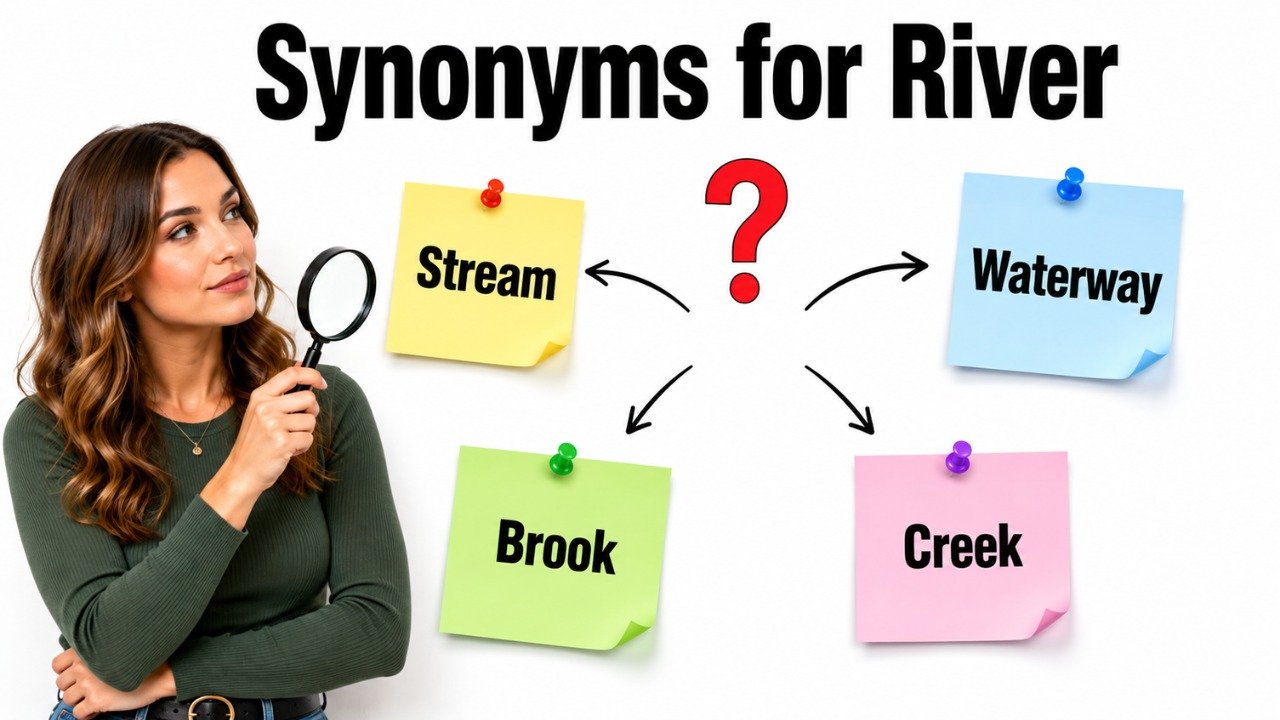
Quick Answer: Common synonyms for river include stream, watercourse, waterway, channel, tributary, creek, brook, rivulet, current, and flow. The best choice depends on context. Stream is the clearest general alternative for naturally flowing water, while watercourse works well in formal, geographical, and technical writing. Waterway is useful when discussing navigation or transportation. Tributary describes a smaller river that flows into a larger one. Creek, brook, and rivulet usually describe smaller bodies of flowing water, while current and flow emphasize the movement of the water rather than the entire river.
Pronunciation and Word Details
Word: River.
Pronunciation: /ˈrɪvər/
Part of Speech: Noun.
Meaning: A river is a large natural stream of water that flows through land toward another river, lake, sea, or ocean.
US Pronunciation:
UK Pronunciation:
What Does “River” Mean?
River means a natural body of flowing water that travels through a channel across the land.
River is primarily a noun. It usually describes a substantial stream of fresh water flowing from a higher area toward a lower destination such as a lake, another river, a sea, or an ocean.
The word can refer to the entire natural feature, including its water, channel, banks, and direction of flow.
In geographical writing, river often identifies a major part of a drainage system. In everyday conversation, it can simply describe flowing water that is larger than a creek or brook.
River can also appear figuratively. A writer might describe a river of people, light, tears, or traffic to suggest something moving continuously in a large quantity.
Meaning, Tone, and Context of “River”
River is a neutral and widely understood word. It fits casual conversation, academic writing, geographical descriptions, environmental discussions, travel writing, literature, science, and technical explanations.
In everyday language, river sounds natural and direct.
In academic or geographical writing, watercourse, channel, tributary, drainage channel, or waterway may provide greater precision depending on the feature being described.
In literary writing, words such as stream, current, flow, torrent, and cascade can create different visual or emotional effects.
The word itself does not normally carry a positive or negative tone. Its emotional effect depends on context. A calm river may suggest peace, while a swollen or rushing river may suggest danger, strength, or movement.
When and How to Use “River”
For Natural Geography: Use river when describing a significant natural stream flowing across land.
Example: The river winds through the valley before reaching the coast.
For Landscape Description: River works naturally when describing scenery, ecosystems, valleys, banks, bridges, and surrounding land.
Example: Tall trees grew along both sides of the river.
For Direction of Water Flow: Use river when explaining how water moves through a drainage system.
Example: Several smaller streams eventually join the river.
For Environmental Writing: River is appropriate when discussing habitats, water quality, flooding, erosion, or freshwater ecosystems.
Example: The river provides an important habitat for fish and birds.
For Figurative Language: River can describe a large continuous flow of something other than water.
Example: A river of people moved through the entrance.
For Movement and Energy: River can suggest continuous natural motion.
Example: The river rushed rapidly through the narrow gorge.
Best Synonyms for River
Stream: A natural body of flowing water, often smaller than a river.
Example: A clear stream flowed through the forest.
Watercourse: A natural or artificial channel through which water flows.
Example: The watercourse passes through several farming areas.
Waterway: A body or channel of water that may be used for travel, transport, or drainage.
Example: Boats moved slowly along the busy waterway.
Channel: A defined passage through which water flows.
Example: Heavy rain caused the channel to fill quickly.
Tributary: A smaller river or stream that flows into a larger river.
Example: The tributary joins the main river several miles downstream.
Creek: A small natural stream, usually narrower than a river.
Example: Children walked beside the shallow creek.
Brook: A small stream of naturally flowing water.
Example: A peaceful brook crossed the meadow.
Rivulet: A very small stream.
Example: A narrow rivulet formed after the rain.
Current: The movement of water in a particular direction.
Example: The current carried fallen leaves downstream.
Flow: The continuous movement of water.
Example: Heavy rainfall increased the flow through the valley.
50 Synonyms for River with Short Meanings
- Stream: A natural body of flowing water.
- Watercourse: A channel through which water naturally or artificially flows.
- Waterway: A navigable or naturally flowing body of water.
- Channel: A passage through which water moves.
- Tributary: A smaller river or stream flowing into a larger one.
- Creek: A relatively small stream.
- Brook: A small natural stream.
- Rivulet: A very small stream of water.
- Rill: A tiny shallow stream.
- Runnel: A small narrow stream or channel.
- Burn: A regional term for a small stream.
- Beck: A regional word for a small stream.
- Run: A small flowing stream in some regional usage.
- Branch: A division or smaller section of a river system.
- Fork: One branch of a divided river or stream.
- Tributary Stream: A smaller stream feeding a larger river.
- Feeder Stream: A stream that supplies water to a larger body.
- Affluent: A stream that flows into a larger river.
- Distributary: A branch flowing away from a main river.
- Water Channel: A passage that carries flowing water.
- Natural Channel: A naturally formed route for flowing water.
- Freshwater Stream: A flowing body of fresh water.
- Flowing Water: Water moving continuously through a course.
- Inland Waterway: A body of water located within the land.
- Drainage Channel: A course carrying water away from an area.
- Drainage Course: A natural path followed by draining water.
- Current: Water moving in a particular direction.
- Flow: Continuous movement of water.
- Torrent: A strong and rapidly flowing stream.
- Rush: A rapid movement or flow of water.
- Race: A fast flowing current or water channel.
- Cascade: Water flowing rapidly downward over a slope or rocks.
- Floodwater: Large quantities of overflowing moving water.
- Arroyo: A stream channel common in dry regions, sometimes seasonally filled.
- Wadi: A valley or channel that may contain seasonal flowing water.
- Wash: A dry or seasonal stream channel in an arid area.
- Bayou: A slow moving waterway found in low lying areas.
- Slough: A slow moving or marshy water channel.
- Outlet: A watercourse through which water leaves another body.
- Inlet: A narrow water passage leading into a larger body.
- Canal: An artificial water channel used for transport or drainage.
- Drain: A channel designed to carry water away.
- Runoff Channel: A path carrying water produced by rainfall or melting snow.
- Streamway: A course or path followed by a stream.
- Riverway: The course or area associated with a river.
- River Channel: The physical channel occupied by a river.
- Main Stream: The principal flowing channel within a drainage system.
- Main Channel: The primary channel through which river water flows.
- Water Flow: Moving water within a natural or artificial course.
- Aquatic Course: A descriptive term for a course through which water flows.
Read Also:
Synonyms for Apply

Synonyms for River by Context
When River Means a Natural Flowing Body of Water
Stream, watercourse, waterway, and channel are the strongest general alternatives.
Stream is broader because it can describe flowing water of different sizes. Watercourse is more formal and is especially useful in geographical, environmental, and technical writing.
Example: A stream runs through the center of the valley.
Example: The natural watercourse carries rainwater toward the coast.
When River Means a Smaller Flowing Waterway
Creek, brook, rivulet, rill, runnel, burn, and beck refer to smaller bodies of flowing water.
These words should not always replace river because they usually suggest a smaller feature.
Example: A narrow creek passed behind the farmhouse.
Example: A gentle brook flowed through the woodland.
When River Means Part of a Drainage System
Tributary, feeder stream, branch, fork, distributary, and main channel describe specific parts of a river system.
Example: The tributary carries water into the main river.
Example: The river divides into several distributaries near its lower course.
When River Emphasizes Moving Water
Current, flow, rush, and torrent focus more on movement than on the physical river itself.
Example: The current became stronger after the storm.
Example: A powerful torrent rushed through the narrow passage.
When River Refers to a Water Route
Waterway, inland waterway, channel, and riverway are useful when discussing transportation, navigation, movement, or access.
Example: The waterway connects several communities.
Example: The main channel is deep enough for larger vessels.
When River Refers to Seasonal Water
Arroyo, wash, wadi, runoff channel, and drainage course may describe channels that carry water seasonally or after rainfall.
Example: Rainwater rushed through the normally dry arroyo.
Example: The wadi filled rapidly after heavy rain.
Another Word for River
Another word for river is stream, although the best alternative depends on size, geography, movement, and context. Watercourse is often better in formal writing, while tributary identifies a smaller waterway feeding a larger river. Waterway works especially well when navigation or transportation is important.
Original: A river flows through the forest.
Better Option: A stream flows through the forest.
Original: The river carries water across the agricultural region.
Better Option: The watercourse carries water across the agricultural region.
Original: Several small rivers feed the larger river.
Better Option: Several tributaries feed the larger river.
Original: Boats frequently travel along the river.
Better Option: Boats frequently travel along the waterway.
When Not to Use “River”
River is not always the most precise word. Avoid it when the size, function, movement, or geographical type of the water feature matters.
A very small natural flow may be better described as a brook, creek, or rivulet.
Weak: A tiny river crossed the garden.
Better: A tiny stream crossed the garden.
When describing a smaller watercourse that joins a larger one, tributary is more accurate.
Weak: The small river enters the main river from the east.
Better: The tributary enters the main river from the east.
River can also be too broad in technical descriptions of water movement.
Weak: Engineers measured how quickly the river moved.
Better: Engineers measured the speed of the current.
Do not use river for every water feature. Lakes, ponds, canals, estuaries, streams, and oceans have different meanings and should be named accurately.
Words Commonly Confused With River
River vs Stream: A river is generally considered a larger natural body of flowing water, while stream is a broader term that can describe smaller flowing waterways.
River vs Creek: A creek is normally smaller than a major river, although local usage can vary.
River vs Brook: A brook usually refers to a small natural stream, often associated with gentle flowing water.
River vs Tributary: A river can be a major watercourse, while a tributary specifically flows into another larger river or stream.
River vs Canal: A river is normally natural, while a canal is usually constructed or modified for transportation, irrigation, or drainage.
River vs Channel: A river is the complete flowing water feature, while a channel is the physical passage through which its water moves.
River vs Current: River describes the body of flowing water, while current describes the movement of that water.
River vs Estuary: A river carries flowing inland water, while an estuary is the coastal area where freshwater and seawater meet.
River vs Lake: A river flows along a channel, while a lake is a relatively still body of inland water.
Which Synonym Should You Choose?
Choose stream when you need a general and natural alternative for flowing water.
Choose watercourse for formal, geographical, academic, environmental, or technical writing.
Choose waterway when discussing navigation, transport, routes, or access by water.
Choose tributary when describing a smaller river or stream that flows into a larger one.
Choose creek when referring to a relatively small natural stream.
Choose brook when describing a small, often gentle stream in descriptive or conversational writing.
Choose rivulet or rill when the flowing water is very small.
Choose channel when focusing on the physical passage containing the water.
Choose current when emphasizing the direction or speed of water movement.
Choose torrent when describing water flowing with great speed and force.
Choose distributary when describing a branch that leaves a main river and carries water away from it.
Choose arroyo, wash, or wadi when geographical context involves dry or seasonally flowing channels.
Real Life Examples of “River” in Sentences
Original: The river flows through a narrow valley.
Better Option: The stream flows through a narrow valley.
Original: Scientists examined the river after the heavy rainfall.
Better Option: Scientists examined the watercourse after the heavy rainfall.
Original: A smaller river joins the main river near the village.
Better Option: A tributary joins the main river near the village.
Original: Boats moved slowly along the river.
Better Option: Boats moved slowly along the waterway.
Original: The river was moving dangerously fast.
Better Option: The current was moving dangerously fast.
Original: A tiny river crossed the meadow.
Better Option: A brook crossed the meadow.
Original: Rain created a small river along the path.
Better Option: Rain created a rivulet along the path.
Original: Water rushed through the river after the storm.
Better Option: Water rushed through the channel after the storm.
Original: The river became extremely powerful after several days of rain.
Better Option: The stream became a powerful torrent after several days of rain.
Original: Several rivers carry water into the main channel.
Better Option: Several tributaries carry water into the main channel.
Synonym Groups and Usage Differences
General Flowing Water Group
Stream, watercourse, waterway, and channel are broad alternatives related to a river.
Stream is the most natural general alternative, while watercourse has a more formal or technical tone.
Example: The watercourse passes through a broad agricultural valley.
Small Stream Group
Creek, brook, rivulet, rill, runnel, beck, and burn generally refer to smaller bodies of flowing water.
These words can create a more specific image than river.
Example: A narrow rivulet ran beside the trail.
River System Group
Tributary, branch, fork, distributary, feeder stream, and main channel describe relationships within a drainage network.
These terms are useful in geography and environmental writing.
Example: Several tributaries feed the main channel.
Water Movement Group
Current, flow, rush, race, and torrent focus on the movement or force of water.
They are not always direct replacements for river because they describe how water moves rather than the entire geographical feature.
Example: The strong current made crossing difficult.
Seasonal Channel Group
Arroyo, wash, wadi, runoff channel, and drainage course describe waterways or channels that may carry water only during certain seasons or after rainfall.
Example: Stormwater quickly filled the normally dry wash.
Navigation Group
Waterway, inland waterway, main channel, canal, and riverway relate to routes through water.
Waterway is especially useful when transportation or navigation matters.
Example: The inland waterway supports regular movement between communities.
Antonyms of River
River does not have one exact dictionary antonym because it is a physical geographical feature. However, several contrasting terms can be useful depending on the meaning being emphasized.
Still Water: Water with little or no noticeable movement.
Standing Water: Water that remains relatively motionless in one place.
Dry Land: Land rather than a flowing body of water.
Desert: A very dry region with limited permanent surface water.
Dry Channel: A water channel containing no flowing water.
Watershed Divide: High ground separating neighboring drainage systems rather than carrying flowing water.
Lake: A relatively still inland body of water, contrasting with the continuous flow of a river.
Pond: A smaller body of mostly standing water.
Reservoir: A stored body of water rather than a naturally flowing watercourse.
Stagnant Water: Water with little or no circulation or movement.
Comparison: River vs Related Words
River vs Stream
River usually suggests a larger natural watercourse. Stream is a broader word that often describes smaller flowing water.
Example With River: The river crosses several regions before reaching the sea.
Example With Stream: A small stream runs through the forest.
River vs Creek
A creek is generally smaller than a river and may carry less water.
Example With River: A wide river separates the two areas.
Example With Creek: A shallow creek runs behind the house.
River vs Brook
Brook usually suggests a small and relatively gentle stream.
Example With River: The river became wider near the valley.
Example With Brook: The brook flowed quietly through the meadow.
River vs Watercourse
River is common in everyday language, while watercourse is more formal and broadly refers to a channel through which water flows.
Example With River: The river provides water for nearby farms.
Example With Watercourse: The natural watercourse crosses several agricultural areas.
River vs Waterway
River describes a natural flowing body of water. Waterway can refer to natural or artificial water routes, especially those connected with navigation.
Example With River: The river curves around the hillside.
Example With Waterway: The waterway provides an important transport route.
River vs Tributary
A river may be the main body of flowing water, while a tributary specifically feeds another watercourse.
Example With River: The river continues south toward the coast.
Example With Tributary: The tributary enters the main river from the west.
River vs Channel
River includes the water and broader natural feature. Channel refers more specifically to the physical path containing flowing water.
Example With River: The river flooded after days of rain.
Example With Channel: Sediment accumulated along the channel.
River vs Current
River refers to the body of water. Current refers to the movement of water within it.
Example With River: The river passes beneath the bridge.
Example With Current: The current became stronger near the narrow passage.
Common Phrases and Expressions With River
River Bank: The land along the edge of a river.
River Bed: The ground forming the bottom of a river.
River Basin: The area of land drained by a river and its tributaries.
River Valley: A valley shaped or occupied by a river.
River Channel: The passage through which a river flows.
River Mouth: The place where a river enters another body of water.
River Source: The place where a river begins.
River System: A main river together with its tributaries and related waterways.
River Crossing: A place or action involving movement from one side of a river to the other.
Down the River: In the direction toward which river water naturally flows.
Common Mistakes to Avoid
A common mistake is treating every water related word as an exact synonym for river. Lake, pond, ocean, sea, and reservoir are bodies of water, but they do not mean river.
Another mistake is using creek, brook, or rivulet for a major river without considering size and context. These terms normally suggest smaller waterways.
Avoid using tributary as a direct replacement unless the watercourse actually flows into another river or stream.
Incorrect: The large tributary reaches the ocean directly.
Better: The large river reaches the ocean directly.
Do not confuse the river with its current. The river is the whole water feature, while the current is the movement of water.
Incorrect: The river pulled the floating branch downstream at great speed.
Clearer: The strong current pulled the floating branch downstream at great speed.
Waterway is also broader than river because it can describe different navigable bodies or channels.
Avoid repetitive phrasing in geographical descriptions.
Repetitive: The river enters the valley, and the river passes through the forest before the river reaches the plain.
Better: The river enters the valley, passes through the forest, and continues toward the plain.
Choose synonyms according to size, flow, physical form, drainage role, and geographical setting rather than replacing river mechanically.
Conclusion
Understanding synonyms for river makes geographical, environmental, descriptive, and everyday writing more precise. Stream is the strongest general alternative, while watercourse suits formal or technical contexts. Waterway works well for navigation, tributary identifies a smaller stream feeding a larger one, and creek, brook, and rivulet describe smaller flows. Current and flow emphasize water movement, while torrent suggests powerful rushing water. The best synonym depends on whether you are describing size, movement, location, function, or the river’s role within a drainage system.
FAQs About Synonyms for River
What is the best synonym for river?
Stream is the most useful general synonym for river, although watercourse may be better in formal or geographical writing.
What is another word for a small river?
Creek, brook, stream, rivulet, rill, and runnel can describe smaller bodies of flowing water.
Is stream the same as river?
They are closely related, but stream is a broader term and often refers to flowing water that is smaller than a river.
Is waterway a synonym for river?
Yes, in some contexts. Waterway is especially suitable when discussing navigation, transportation, or routes through water, but it can also include channels other than rivers.
What is a formal synonym for river?
Watercourse is one of the strongest formal alternatives. Channel and waterway may also work depending on context.
What do you call a river that flows into another river?
A smaller river or stream that flows into a larger one is called a tributary.
What word describes a fast flowing river?
Torrent can describe a rapidly and forcefully flowing stream of water, while current describes the movement of water within the river.
