
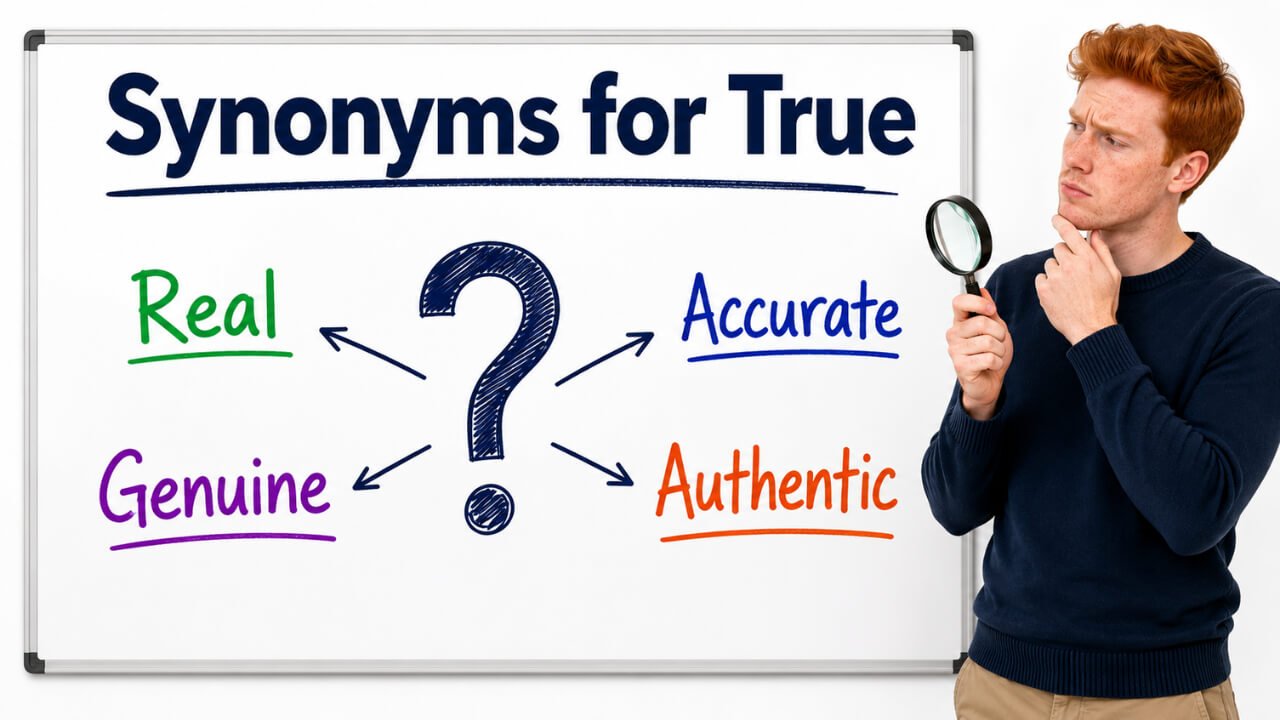
Quick Answer: The best synonyms for true include accurate, correct, factual, genuine, authentic, real, valid, truthful, honest, and faithful. Use accurate or correct for facts, answers, and details. Use factual for formal writing and reports. Use genuine or authentic when something is real and not fake. Use truthful or honest for speech and character. Use valid for logic, claims, or arguments. Use faithful when true means loyal or close to the original meaning.
Pronunciation and Word Details
Word: True.
Pronunciation: /truː/.
Part of Speech: Adjective, adverb, and sometimes noun.
Meaning: True means correct, real, honest, accurate, or faithful to fact, reality, or belief.
US Pronunciation:
UK Pronunciation:
What Does “True” Mean?
True means correct, real, honest, or based on fact. It is most commonly used as an adjective, but it can also appear in phrases where it works like an adverb, such as come true or hold true.
True can describe a statement, answer, story, feeling, person, belief, copy, or relationship. A true answer is correct. A true story is based on real events. A true friend is loyal. A true feeling is sincere. The exact meaning depends on how the word is used in the sentence.
Meaning, Tone, and Context of “True”
True is a clear, neutral, and common word. It works in casual speech, academic writing, formal reports, essays, emails, personal messages, and everyday conversation. It is simple, direct, and easy to understand.
The tone of true changes by context. In facts and reports, it sounds objective. In emotions, it sounds sincere. In relationships, it sounds loyal and warm. In logic or debate, true may mean valid or supported by facts. Because true has several meanings, choosing the right synonym helps make your writing more exact.
When and How to Use “True”
For Accuracy: Use true when something is correct and agrees with facts.
Example: Her answer was true, but it needed more explanation.
For Facts: Use true when a statement is based on real information, not opinion or guesswork.
Example: It is true that regular practice improves skill.
For Reality: Use true when something is real and not fake, imagined, or invented.
Example: The movie was based on a true story.
For Honesty: Use true when a person speaks honestly or shows sincere feelings.
Example: His true feelings were clear in his words.
For Loyalty: Use true when someone remains faithful, steady, or supportive.
Example: A true friend stays kind during hard times.
For Agreement: Use true when accepting that another person’s point is correct.
Example: That is true, but we should also consider the cost.
Best Synonyms for True
Accurate: Correct and free from mistakes.
Example: The article gives an accurate description of the event.
Correct: Right according to facts, rules, or standards.
Example: Your answer is correct.
Factual: Based on facts rather than opinions.
Example: The report gives a factual account of what happened.
Genuine: Real, sincere, and not fake.
Example: She showed genuine concern for her neighbor.
Authentic: Real, original, and not copied or false.
Example: The painting is authentic.
Real: Existing in fact and not imagined.
Example: His fear was real.
Valid: Reasonable, acceptable, or supported by logic.
Example: She made a valid point in the discussion.
Truthful: Honest and not false.
Example: The witness gave a truthful statement.
Honest: Sincere, open, and not deceptive.
Example: He gave an honest answer.
Faithful: Loyal or accurate to the original.
Example: The translation is faithful to the original text.
50 Synonyms for True with Short Meanings
- Accurate: Correct and free from error.
- Correct: Right according to facts or rules.
- Factual: Based on real facts.
- Truthful: Honest and not false.
- Genuine: Real and sincere.
- Authentic: Original and not fake.
- Real: Existing in fact.
- Actual: Existing or happening in reality.
- Valid: Supported by reason or facts.
- Verified: Checked and confirmed as correct.
- Confirmed: Accepted as true after checking.
- Proven: Shown to be true.
- Verifiable: Able to be checked as true.
- Exact: Fully correct in detail.
- Precise: Clear, exact, and accurate.
- Right: Correct or suitable.
- Reliable: Able to be trusted.
- Trustworthy: Deserving trust.
- Credible: Believable and convincing.
- Legitimate: Real, lawful, or acceptable.
- Honest: Sincere and not deceptive.
- Sincere: Real in feeling or intention.
- Frank: Open and honest.
- Candid: Direct and truthful.
- Forthright: Clear, direct, and honest.
- Faithful: Loyal or true to the original.
- Loyal: Steady and supportive.
- Devoted: Strongly loyal and committed.
- Steadfast: Firm, loyal, and constant.
- Constant: Unchanging and dependable.
- Dependable: Reliable and trustworthy.
- Sound: Reasonable, solid, or correct.
- Just: Fair and morally right.
- Proper: Correct, suitable, or acceptable.
- Bona fide: Genuine and real.
- Unquestionable: Too clear to doubt.
- Undeniable: Impossible to deny.
- Indisputable: Not open to serious argument.
- Certain: Known or accepted as sure.
- Sure: Confidently correct or real.
- Literal: True to the exact meaning.
- Objective: Based on facts, not feelings.
- Fact based: Built on facts.
- Evidence based: Supported by evidence.
- Substantiated: Supported by proof.
- Well founded: Based on good reasons.
- Unfeigned: Real and not pretended.
- Unvarnished: Plain, honest, and direct.
- Original: Real and not copied.
- Unmistaken: Not wrong or confused.
Read Also:
Synonyms for Highlights

Synonyms for True by Context
When True Means Accurate or Correct
Use these synonyms when true means right, exact, or free from error.
Accurate: Correct in facts or details.
Example: The report gives accurate information.
Correct: Right according to rules, facts, or standards.
Example: Her answer was correct.
Exact: Completely correct in detail.
Example: We need the exact address.
Precise: Very clear and accurate.
Example: The instructions were precise.
When True Means Real or Genuine
Use these synonyms when true means not fake, not imagined, or not artificial.
Real: Existing in fact.
Example: The problem is real and needs attention.
Genuine: Real, sincere, and not fake.
Example: He showed genuine interest in her work.
Authentic: Real, original, and not false.
Example: The shop sells authentic handmade items.
Actual: Existing or happening in reality.
Example: The actual cost was higher than expected.
When True Means Honest
Use these synonyms when true describes honesty, sincerity, or open speech.
Truthful: Honest and not false.
Example: She gave a truthful answer.
Honest: Open and not deceptive.
Example: I want an honest opinion.
Sincere: Real in feeling or intention.
Example: His apology sounded sincere.
Candid: Honest, direct, and open.
Example: The teacher gave candid feedback.
When True Means Loyal or Faithful
Use these synonyms when true describes loyalty, support, or devotion.
Faithful: Loyal and dependable.
Example: She has been a faithful friend for years.
Loyal: Steady in support.
Example: The fans remained loyal to the team.
Devoted: Strongly committed.
Example: He is a devoted parent.
Steadfast: Firm and loyal through difficulty.
Example: Her steadfast support helped him continue.
When True Means Valid or Proven
Use these synonyms when true means supported by facts, evidence, logic, or proof.
Valid: Reasonable and supported by logic.
Example: That is a valid concern.
Verified: Checked and confirmed.
Example: The details were verified before the report was shared.
Proven: Shown to be true.
Example: The method has proven results.
Substantiated: Supported by evidence.
Example: The claim was substantiated with clear facts.
When True Means Agreement
Use these synonyms when true is used to agree with someone.
Correct: Used to confirm that something is right.
Example: Correct, the meeting begins at ten.
Right: Natural and simple in conversation.
Example: Right, that is the main point.
Exactly: Used for strong agreement.
Example: Exactly, that is what I was trying to say.
Fair: Used when accepting a reasonable point.
Example: Fair, we should review the plan again.
Another Word for True
Another word for true is accurate when you mean correct according to facts. The best replacement depends on context. Use real when something is not fake, genuine when something is sincere, valid when an idea is reasonable, and faithful when someone or something stays loyal or close to the original.
Original: The statement is true.
Better Option: The statement is accurate.
Original: Her smile was true.
Better Option: Her smile was genuine.
Original: His argument is true.
Better Option: His argument is valid.
Original: This is a true copy of the letter.
Better Option: This is a faithful copy of the letter.
When Not to Use “True”
Do not use true when a more exact word would make the sentence clearer. In reports, accurate, factual, verified, or valid may sound stronger. In emotional writing, genuine or sincere may be more natural. For objects or identity, authentic or real may be better.
Avoid using true too often in one paragraph. It can sound basic or repetitive when stronger synonyms are available.
Weak: The data is true.
Better: The data is accurate.
Weak: She gave a true apology.
Better: She gave a sincere apology.
Weak: This is a true diamond.
Better: This is a genuine diamond.
Weak: His point is true.
Better: His point is valid.
Weak: The story has true details.
Better: The story has factual details.
Words Commonly Confused With True
True vs Correct: True means not false or real. Correct means right according to facts, rules, or standards.
True vs Accurate: True means factually right in a general way. Accurate means correct in detail, especially with data, numbers, descriptions, or reports.
True vs Real: True means based on fact or not false. Real means actually existing and not fake or imagined.
True vs Genuine: True can mean correct, real, or loyal. Genuine means sincere, authentic, or not fake.
True vs Valid: True means factually right. Valid means reasonable, acceptable, or supported by logic.
True vs Truthful: True describes statements, facts, stories, or qualities. Truthful describes honest speech, answers, or people.
True vs Faithful: True can mean loyal or accurate to the original. Faithful is clearer when describing loyalty, devotion, translations, copies, or original meaning.
Which Synonym Should You Choose?
Choose accurate when writing about facts, numbers, data, reports, results, or descriptions.
Choose correct when writing about answers, grammar, rules, spelling, or right choices.
Choose factual when writing about information based on facts rather than opinions.
Choose genuine when writing about feelings, kindness, concern, personality, or sincerity.
Choose authentic when writing about original items, identity, style, culture, or real quality.
Choose real for casual speech or when comparing something with fake, imaginary, or artificial things.
Choose valid when writing about arguments, reasons, concerns, opinions, claims, or logic.
Choose truthful when writing about honest speech, testimony, answers, or statements.
Choose faithful when writing about loyalty, relationships, translations, copies, or original meaning.
Choose verified when information has been checked and confirmed.
Real Life Examples of “True” in Sentences
Original: Her answer was true.
Better Option: Her answer was correct.
Original: The report contains true information.
Better Option: The report contains factual information.
Original: His feelings were true.
Better Option: His feelings were genuine.
Original: The story is true.
Better Option: The story is based on real events.
Original: The claim is true.
Better Option: The claim is verified.
Original: She is a true friend.
Better Option: She is a faithful friend.
Original: His concern was true.
Better Option: His concern was sincere.
Original: The argument seems true.
Better Option: The argument seems valid.
Original: This is a true copy of the document.
Better Option: This is an exact copy of the document.
Original: The witness gave a true statement.
Better Option: The witness gave a truthful statement.
Synonym Groups and Usage Differences
Accuracy Group
This group includes accurate, correct, exact, precise, and right. Use these words when true means free from error or right according to facts.
Example: The final answer is correct.
Fact Group
This group includes factual, verified, proven, confirmed, substantiated, and evidence based. Use these words when true means supported by facts, proof, or checking.
Example: The claim was verified before it was shared.
Realness Group
This group includes real, genuine, authentic, actual, bona fide, and original. Use these words when true means not fake, copied, artificial, or imagined.
Example: The artist used authentic materials.
Honesty Group
This group includes honest, truthful, sincere, frank, candid, and forthright. Use these words when true relates to speech, feelings, intentions, or character.
Example: She gave a candid answer.
Loyalty Group
This group includes faithful, loyal, devoted, steadfast, constant, and dependable. Use these words when true describes commitment, trust, or support.
Example: He remained loyal to his team.
Validity Group
This group includes valid, sound, credible, legitimate, well founded, and reasonable. Use these words when true means acceptable in logic, reasoning, discussion, or rules.
Example: Her concern is valid and should be considered.
Antonyms of True
The opposite of true depends on the meaning. If true means correct, the opposite may be false or incorrect. If true means real, the opposite may be fake or artificial. If true means honest, the opposite may be dishonest. If true means loyal, the opposite may be unfaithful.
False: Not true or not based on fact.
Incorrect: Wrong or not accurate.
Inaccurate: Containing mistakes or errors.
Wrong: Not correct.
Untrue: False or not real.
Fake: Not real or genuine.
Artificial: Made to imitate something real.
Counterfeit: Made to look real but not genuine.
Dishonest: Not truthful or sincere.
Insincere: Not showing real feelings.
Misleading: Giving a wrong idea.
Invalid: Not supported by logic or rules.
Unreliable: Not able to be trusted.
Disloyal: Not faithful or supportive.
Unfaithful: Not loyal or true to someone or something.
Comparison: True vs Related Words
True vs Accurate
True means not false or real. Accurate means correct in details, facts, numbers, or descriptions.
Example With True: The story is true.
Example With Accurate: The report gives an accurate timeline.
True vs Correct
True is often about facts or reality. Correct is about being right according to rules, answers, or standards.
Example With True: It is true that the meeting was delayed.
Example With Correct: Your spelling is correct.
True vs Real
True means based on fact or not false. Real means actually existing or not fake.
Example With True: Her statement was true.
Example With Real: Her fear was real.
True vs Genuine
True can mean correct, real, honest, or loyal. Genuine means sincere, authentic, or not fake.
Example With True: He told a true story.
Example With Genuine: He showed genuine kindness.
True vs Valid
True means factually correct. Valid means reasonable, acceptable, or supported by logic.
Example With True: The statement is true.
Example With Valid: Her objection is valid.
True vs Truthful
True describes facts, statements, copies, stories, or qualities. Truthful often describes a person, answer, or statement that is honest.
Example With True: The claim is true.
Example With Truthful: The child gave a truthful reply.
True vs Faithful
True can mean loyal or accurate to the original. Faithful is clearer for loyalty, devotion, translation, and copies.
Example With True: She has always been a true friend.
Example With Faithful: She has always been a faithful friend.
Common Phrases and Expressions With True
True Story: A story based on real events.
True Friend: A loyal and dependable friend.
True Meaning: The real or intended meaning.
True Value: The real worth of something.
True Nature: The real character or quality of someone or something.
True Love: Deep, sincere, and lasting love.
True Colors: Someone’s real character or intentions.
True Copy: An exact and faithful copy.
True to Life: Very realistic or close to reality.
Hold True: Remain correct or valid.
Come True: Become real or happen as hoped.
Common Mistakes to Avoid
One common mistake is using true when accurate would be more precise. For data, facts, numbers, and reports, accurate often sounds stronger. Another mistake is using true when genuine, real, valid, or faithful would better match the meaning.
Avoid repeating true in every sentence. It can make writing sound simple or unclear. Also avoid vague phrases like very true information when factual information would be cleaner.
Weak: This is a true report with true details.
Better: This is an accurate report with factual details.
Weak: His reason is true.
Better: His reason is valid.
Weak: She showed true care.
Better: She showed genuine care.
Weak: The item is true.
Better: The item is authentic.
Conclusion
The keyword synonyms for true can help you choose a clearer word for every context. Use accurate, correct, factual, verified, or proven for facts and information. Use real, genuine, authentic, or actual for things that are not fake. Use honest, truthful, sincere, or candid for speech and feelings. Use faithful, loyal, or steadfast for trust and commitment. The best synonym depends on whether true means correct, real, honest, valid, or loyal.
FAQs About Synonyms for True
What are the best synonyms for true?
The best synonyms for true are accurate, correct, factual, genuine, authentic, real, valid, truthful, honest, and faithful.
What is another word for true in formal writing?
In formal writing, use accurate, factual, valid, verified, confirmed, substantiated, or evidence based, depending on the sentence.
What is another word for true when something is real?
Use real, genuine, authentic, actual, original, or bona fide when true means not fake or not imagined.
What is another word for true when someone is honest?
Use truthful, honest, sincere, candid, frank, or forthright when true refers to honest speech or sincere character.
What is another word for true friend?
Another word for true friend is faithful friend, loyal friend, dependable friend, or devoted friend.
Are true and correct the same?
They are close, but not always the same. True means not false or real. Correct means right according to facts, rules, answers, or standards.
What is the opposite of true?
The opposite of true can be false, incorrect, wrong, untrue, fake, dishonest, invalid, disloyal, or unfaithful, depending on the meaning.
