
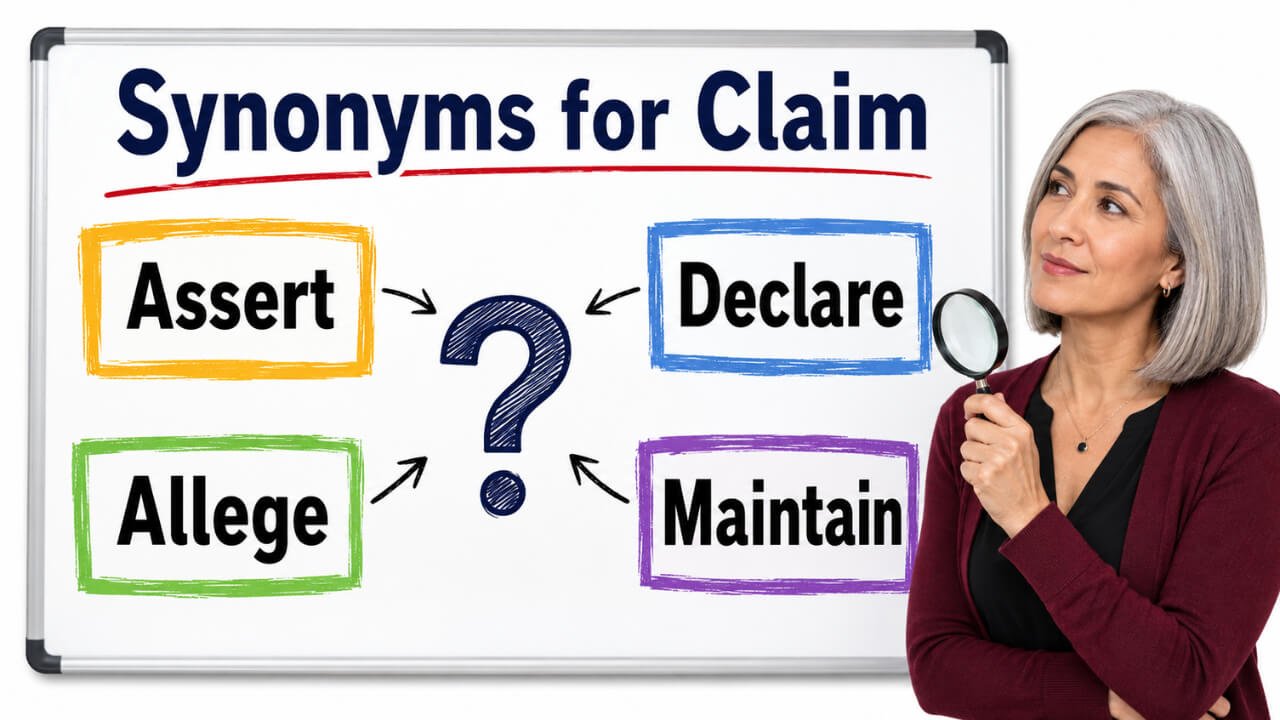
Quick Answer: The best synonyms for claim include assertion, statement, allegation, declaration, argument, demand, request, entitlement, right, and application. For formal writing, use assertion, statement, declaration, or argument. For legal or serious contexts, use allegation, demand, entitlement, or right. For casual speech, use say, state, or request. For essays and reports, assertion works well when someone presents an idea as true, while allegation is better when the statement has not been proven.
Pronunciation and Word Details
Word: Claim.
Pronunciation: /kleɪm/.
Part of Speech: Noun and verb.
Meaning: Claim means a statement that something is true, a demand for something, or a right to something.
US Pronunciation:
UK Pronunciation:
What Does “Claim” Mean?
Claim means to say that something is true, to ask for something as a right, or to make a formal demand. It can be used as both a noun and a verb.
As a noun, claim can mean a statement, demand, right, or request. As a verb, claim means to state, argue, demand, request, or say that something belongs to someone. In writing, claim is common in essays, reports, debates, legal language, insurance forms, and everyday speech.
Meaning, Tone, and Context of “Claim”
Claim is a neutral but strong word. It can sound formal, legal, academic, or conversational depending on the sentence. In essays, a claim is an argument or main point that needs support. In legal writing, a claim can mean a formal demand or accusation. In everyday speech, it can mean someone says something is true.
The tone can also depend on evidence. Claim sometimes suggests that the statement may need proof. For example, he claims he saw the accident sounds less certain than he proved he saw the accident. This makes claim useful when writing about opinions, arguments, reports, allegations, rights, and requests.
When and How to Use “Claim”
For Statements: Use claim when someone says something is true, especially when proof may be needed.
Example: The scientist made a claim about the new method.
For Arguments: Use claim when writing about an opinion or point that must be supported with reasons.
Example: The essay’s main claim is supported by strong examples.
For Allegations: Use claim when someone reports something serious that has not yet been proven.
Example: The worker made a claim about unfair treatment.
For Rights: Use claim when someone says they have a right to something.
Example: She has a claim to part of the property.
For Requests: Use claim when someone asks for money, benefits, property, or support through a formal process.
Example: He filed a claim after the accident.
For Ownership: Use claim when someone says that something belongs to them.
Example: Several people claimed the lost bag.
Best Synonyms for Claim
Assertion: A strong statement that something is true.
Example: His assertion needs more evidence.
Statement: Something said or written clearly.
Example: The witness gave a statement to explain what happened.
Allegation: A serious claim that has not been proven.
Example: The allegation must be investigated carefully.
Declaration: A clear and formal statement.
Example: The leader made a declaration about the new policy.
Argument: A reasoned claim supported by evidence.
Example: Her argument was clear and persuasive.
Demand: A strong request for something believed to be owed.
Example: The customer made a demand for a refund.
Request: A polite or formal act of asking for something.
Example: He submitted a request for help.
Entitlement: A right to receive something.
Example: The form explains her entitlement to benefits.
Right: A legal, moral, or fair claim to something.
Example: Every worker has a right to safe conditions.
Application: A formal request for money, benefits, service, or approval.
Example: She completed an application for financial support.
50 Synonyms for Claim with Short Meanings
- Assertion: A confident statement.
- Statement: Something said or written.
- Allegation: An unproven serious claim.
- Declaration: A clear formal statement.
- Argument: A point supported by reasons.
- Position: A viewpoint or opinion.
- Viewpoint: A way of seeing an issue.
- Opinion: A personal belief or judgment.
- Contention: A claim made in debate.
- Thesis: A main argument in writing.
- Point: A main idea or argument.
- Case: A set of reasons supporting a claim.
- Plea: A formal request or appeal.
- Demand: A strong request.
- Request: A polite act of asking.
- Petition: A formal written request.
- Appeal: A request for help or review.
- Application: A formal request for approval.
- Submission: A formal document or request.
- Entitlement: A right to receive something.
- Right: A fair or legal claim.
- Title: A legal right to ownership.
- Interest: A legal or financial share.
- Ownership: The state of having something.
- Possession: Control or ownership of something.
- Privilege: A special right or benefit.
- Due: Something owed or deserved.
- Compensation: Payment for loss or damage.
- Reimbursement: Money paid back.
- Benefit: Help, payment, or advantage.
- Insurance claim: A formal request for insurance payment.
- Legal claim: A demand made under law.
- Accusation: A statement blaming someone.
- Charge: A formal accusation.
- Complaint: A statement of dissatisfaction.
- Protest: A statement of disagreement.
- Insistence: A firm demand or belief.
- Profession: A public statement or claim.
- Avowal: An open declaration.
- Affirmation: A positive statement of truth.
- Attestation: A statement confirming something.
- Testimony: A formal statement of facts.
- Report: An account of information.
- Account: A description of events.
- Explanation: A statement that makes something clear.
- Proposal: A suggested plan or idea.
- Submission: A formal presented claim or request.
- State: To say clearly.
- Assert: To state firmly.
- Maintain: To continue saying something is true.
Read Also:
Synonyms for True
Synonyms for Claim by Context
When Claim Means Statement
Use these synonyms when claim means something someone says or writes as true.
Statement: A clear spoken or written expression.
Example: The company released a statement about the issue.
Assertion: A strong statement that needs support.
Example: The writer’s assertion was bold but unclear.
Declaration: A clear and formal statement.
Example: Her declaration surprised the audience.
Affirmation: A positive statement that something is true.
Example: His affirmation gave the team confidence.
When Claim Means Argument
Use these synonyms when claim is used in essays, debates, research, or opinion writing.
Argument: A reasoned point supported by evidence.
Example: The argument becomes stronger with examples.
Thesis: The main argument of an essay or paper.
Example: The thesis appears in the first paragraph.
Contention: A claim made during debate or disagreement.
Example: His contention was that the rule was unfair.
Position: A clear opinion on an issue.
Example: Her position was supported by facts.
When Claim Means Allegation
Use these synonyms when claim means a serious statement that has not been proven.
Allegation: A serious unproven statement.
Example: The allegation requires careful review.
Accusation: A statement blaming someone.
Example: The accusation caused a serious argument.
Charge: A formal accusation.
Example: The charge was discussed during the hearing.
Complaint: A formal statement of dissatisfaction or wrongdoing.
Example: The employee filed a complaint about the manager.
When Claim Means Demand
Use these synonyms when claim means asking strongly or formally for something.
Demand: A firm request for something.
Example: The tenant made a demand for repairs.
Request: A polite or formal act of asking.
Example: She sent a request for more information.
Petition: A formal written request.
Example: The residents signed a petition for safer roads.
Appeal: A request for help, support, or review.
Example: He made an appeal for financial assistance.
When Claim Means Right
Use these synonyms when claim means a legal, moral, or fair right to something.
Right: A legal or moral claim.
Example: Every person has a right to fair treatment.
Entitlement: A right to receive something.
Example: The document explains his entitlement to benefits.
Title: A legal right to own property.
Example: She proved her title to the land.
Privilege: A special right or advantage.
Example: Access to the records is a privilege.
When Claim Means Request for Payment
Use these synonyms when claim refers to money, benefits, or support requested through a formal process.
Application: A formal request for approval or payment.
Example: She submitted an application for aid.
Submission: A formal document sent for review.
Example: The submission included all required forms.
Reimbursement: Money paid back after a cost.
Example: He requested reimbursement for travel expenses.
Compensation: Payment for loss, harm, or damage.
Example: The worker asked for compensation after the injury.
Another Word for Claim
Another word for claim is assertion when you mean a statement that someone presents as true. The best alternative depends on context. Use allegation for an unproven serious statement, demand for a strong request, right for something someone is entitled to, and application for a formal request.
Original: The article makes a claim about student behavior.
Better Option: The article makes an assertion about student behavior.
Original: He filed a claim for the damaged car.
Better Option: He filed an application for compensation for the damaged car.
Original: She made a claim against her employer.
Better Option: She made an allegation against her employer.
Original: They have a claim to the land.
Better Option: They have a right to the land.
When Not to Use “Claim”
Do not use claim when a clearer word would show the exact meaning. If someone is giving proven information, statement or fact may be better. If someone is making an accusation, allegation is more precise. If someone is asking for money or support, application, request, or demand may be stronger.
Claim can also sound uncertain because it may suggest that proof is missing. Avoid it when you want to show that something is already verified.
Weak: The report claims the final number is 500.
Better: The report states the final number is 500.
Weak: She made a claim that he stole the file.
Better: She made an allegation that he stole the file.
Weak: He sent a claim for vacation leave.
Better: He sent a request for vacation leave.
Weak: The document claims the payment amount.
Better: The document states the payment amount.
Weak: The student’s claim is about the topic.
Better: The student’s argument explains the topic.
Words Commonly Confused With Claim
Claim vs Statement: A claim often needs proof or support. A statement is any spoken or written expression.
Claim vs Assertion: A claim can be a statement, demand, or right. An assertion is a confident statement that something is true.
Claim vs Allegation: A claim can be general, while an allegation is usually serious and unproven.
Claim vs Argument: A claim is a point being made. An argument includes reasons and evidence used to support that point.
Claim vs Demand: A claim may be a demand, but demand sounds stronger and more forceful.
Claim vs Request: A request is usually polite or formal. A claim often suggests a right, demand, or expected approval.
Claim vs Entitlement: A claim can be the act of asking or stating a right. Entitlement means the right itself.
Claim vs Application: A claim can refer to a formal demand for money or benefits. Application is the form or process used to ask officially.
Which Synonym Should You Choose?
Choose assertion when writing about a statement that someone presents as true.
Choose statement when you need a neutral word for something spoken or written.
Choose allegation when the claim is serious, unproven, and connected to blame or wrongdoing.
Choose argument when writing essays, debates, academic content, or opinion based writing.
Choose thesis when referring to the main claim of an essay or research paper.
Choose demand when the claim is strong and forceful.
Choose request when the tone should be polite, simple, or professional.
Choose entitlement when writing about a right to benefits, money, or support.
Choose right when the meaning is legal, moral, or fair ownership.
Choose application when the claim is made through a formal process.
Real Life Examples of “Claim” in Sentences
Original: The writer makes a claim about education.
Better Option: The writer makes an assertion about education.
Original: The report claims that the system is improving.
Better Option: The report states that the system is improving.
Original: She filed a claim after the accident.
Better Option: She filed a request for compensation after the accident.
Original: The customer made a claim for a refund.
Better Option: The customer made a demand for a refund.
Original: His claim was not supported by evidence.
Better Option: His argument was not supported by evidence.
Original: The employee made a claim about unfair treatment.
Better Option: The employee made an allegation about unfair treatment.
Original: They claim ownership of the house.
Better Option: They assert ownership of the house.
Original: She has a claim to the property.
Better Option: She has a right to the property.
Original: The essay claim is too broad.
Better Option: The essay thesis is too broad.
Original: He claimed that the result was unfair.
Better Option: He maintained that the result was unfair.
Synonym Groups and Usage Differences
Statement Group
This group includes statement, assertion, declaration, affirmation, and avowal. Use these words when claim means something expressed as true.
Example: Her assertion needs clearer evidence.
Argument Group
This group includes argument, thesis, position, contention, point, and case. Use these words when claim appears in essays, debates, reasoning, or analysis.
Example: The essay’s thesis is clear and focused.
Legal Group
This group includes allegation, charge, complaint, demand, legal claim, and right. Use these words when claim appears in legal, workplace, property, or official contexts.
Example: The complaint was reviewed by the committee.
Request Group
This group includes request, petition, application, appeal, submission, and plea. Use these words when claim means asking for something formally.
Example: She submitted an application for support.
Ownership Group
This group includes right, title, ownership, possession, interest, and entitlement. Use these words when claim means someone has a legal or fair connection to something.
Example: He proved his title to the property.
Payment Group
This group includes compensation, reimbursement, benefit, due, and application. Use these words when claim refers to money, repayment, or benefits.
Example: The worker requested compensation for the injury.
Antonyms of Claim
The opposite of claim depends on the meaning. If claim means to state something as true, the opposite may be deny or reject. If claim means a right, the opposite may be surrender or waive. If claim means a demand, the opposite may be give up or withdraw.
Denial: A statement that something is not true.
Rejection: Refusal to accept a claim.
Refusal: A decision not to accept or provide something.
Disavowal: A formal denial of responsibility or connection.
Retraction: A withdrawal of a statement.
Withdrawal: Removing a claim, request, or statement.
Surrender: Giving up a right or possession.
Waiver: Giving up a legal right.
Concession: Accepting another side’s point.
Admission: Accepting that something is true.
Disclaimer: A statement denying responsibility.
Renunciation: Formal giving up of a claim or right.
Comparison: Claim vs Related Words
Claim vs Assertion
Claim is broader and can mean a statement, demand, right, or request. Assertion mainly means a confident statement that something is true.
Example With Claim: The article makes a claim about health habits.
Example With Assertion: The article makes an assertion about health habits.
Claim vs Statement
Claim often suggests that proof may be needed. Statement simply means something spoken or written.
Example With Claim: He made a claim about the missing file.
Example With Statement: He gave a statement about the missing file.
Claim vs Allegation
Claim can be general or formal. Allegation is usually serious and suggests blame, wrongdoing, or an unproven accusation.
Example With Claim: The worker made a claim about unfair hours.
Example With Allegation: The worker made an allegation of unfair treatment.
Claim vs Argument
Claim is the point being made. Argument is the reasoning and evidence used to support that point.
Example With Claim: The claim needs proof.
Example With Argument: The argument needs stronger examples.
Claim vs Demand
Claim may sound formal or neutral. Demand sounds stronger and more forceful.
Example With Claim: She made a claim for payment.
Example With Demand: She made a demand for payment.
Claim vs Right
Claim can mean saying or asking for something. Right means the legal or moral basis for receiving or doing something.
Example With Claim: He has a claim to the land.
Example With Right: He has a right to the land.
Claim vs Application
Claim may mean a formal request for money or benefits. Application usually refers to the official process or form used to ask for approval.
Example With Claim: He filed a claim for support.
Example With Application: He completed an application for support.
Common Phrases and Expressions With Claim
Make a Claim: Say that something is true or ask for something formally.
File a Claim: Submit a formal request for money, benefits, or support.
Insurance Claim: A request for payment from insurance.
Legal Claim: A demand or right made under law.
False Claim: A statement or request that is not true.
Strong Claim: A claim supported by clear reasons or evidence.
Main Claim: The central argument in writing or speech.
Claim Ownership: Say that something belongs to someone.
Claim Responsibility: Accept responsibility for an action or result.
Claim a Right: Say that one has a legal or moral right.
Common Mistakes to Avoid
A common mistake is using claim when the meaning is already proven. In that case, state, show, confirm, or prove may be better. Another mistake is using claim for every kind of statement. Statement, assertion, argument, allegation, demand, request, and right each have a more specific use.
Avoid vague writing such as his claim is good. Explain whether the claim is clear, valid, supported, weak, broad, or unproven. Also remember that claim can be both a noun and a verb, so the sentence structure should match the meaning.
Weak: The report claims the data in a chart.
Better: The report presents the data in a chart.
Weak: Her claim was nice.
Better: Her argument was clear and well supported.
Weak: He claimed for help.
Better: He asked for help.
Weak: The claim is very true.
Better: The claim is supported by evidence.
Conclusion
The keyword synonyms for claim can help you choose a sharper word for each meaning. Use assertion, statement, or declaration when claim means something said as true. Use argument, thesis, or position in essays and debates. Use allegation, charge, or complaint for serious unproven statements. Use demand, request, application, entitlement, or right when claim means asking for something or showing ownership. The best synonym depends on whether the context is academic, legal, formal, casual, or practical.
FAQs About Synonyms for Claim
What are the best synonyms for claim?
The best synonyms for claim are assertion, statement, allegation, declaration, argument, demand, request, entitlement, right, and application.
What is another word for claim in an essay?
In an essay, another word for claim is thesis, argument, assertion, position, or main point. Thesis is best for the central argument.
What is another word for claim in legal writing?
In legal writing, use allegation, legal claim, demand, right, entitlement, complaint, charge, or petition depending on the situation.
What is another word for claim when asking for money?
Use request, application, demand, reimbursement, compensation, or benefit when claim means asking for money or payment.
Are claim and allegation the same?
They are related but not exactly the same. A claim is any statement, demand, or right. An allegation is a serious unproven claim, often connected to blame or wrongdoing.
Is claim formal or informal?
Claim can be formal, academic, legal, or conversational. It becomes formal in reports, essays, legal contexts, and official requests.
What is the opposite of claim?
The opposite of claim can be denial, rejection, withdrawal, retraction, surrender, waiver, or disavowal depending on the meaning.
