
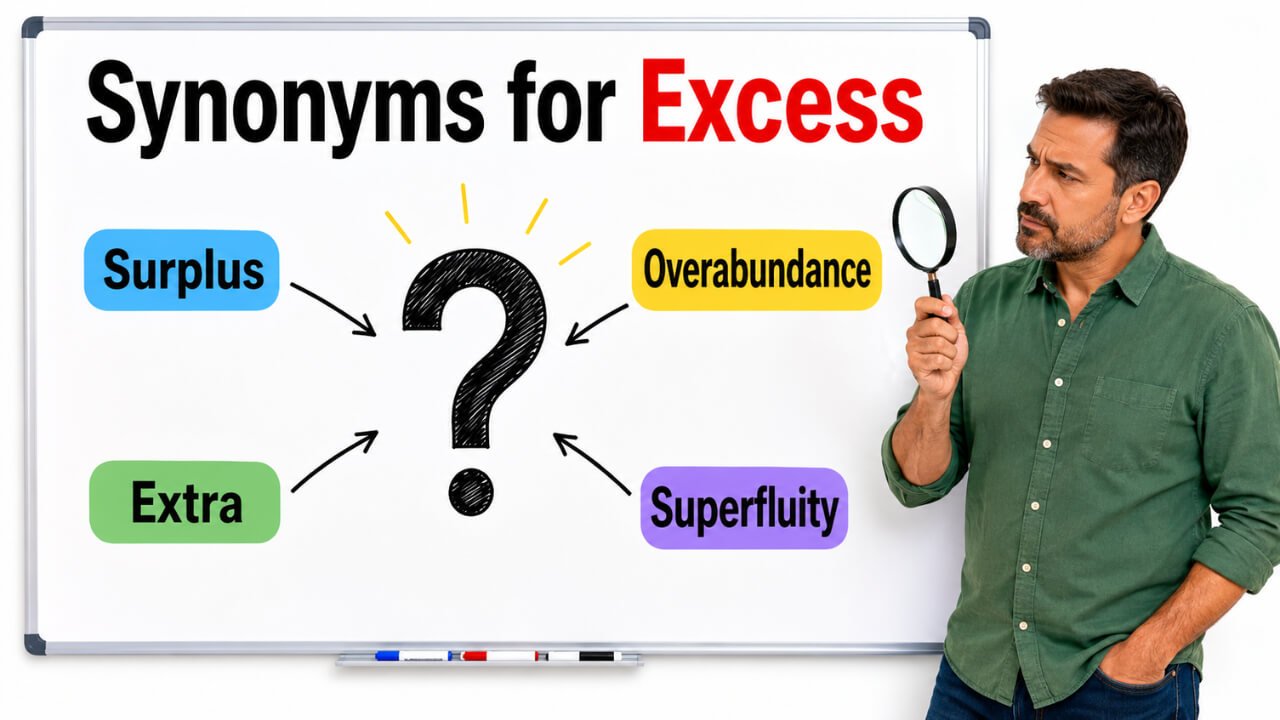
Quick Answer: Synonyms for excess include surplus, extra, overflow, abundance, overabundance, oversupply, superfluity, remainder, glut, and surplusage. Use surplus for a formal extra amount, extra for everyday speech, overflow for more than a space can hold, abundance for a large positive amount, overabundance for too much of something, oversupply for business or market contexts, and glut for a harmful or unwanted excess.
Pronunciation and Word Details
Word: Excess.
Pronunciation: /ɪkˈses/.
Part of Speech: Noun and adjective.
Meaning: Excess means an amount that is more than what is needed, allowed, usual, or useful.
US Pronunciation:
UK Pronunciation:
What Does “Excess” Mean?
Excess means more than the necessary, normal, accepted, or useful amount. It is commonly used as a noun when talking about an extra amount, such as excess food, excess weight, excess cost, or excess water.
As an adjective, excess describes something that is additional or beyond the required amount. For example, excess baggage means baggage that is over the allowed limit. The word can appear in everyday, academic, business, medical, legal, and technical contexts.
In most sentences, excess suggests that something has gone beyond a proper limit. Sometimes the meaning is neutral, as in excess material. Sometimes it is negative, as in excess spending, excess sugar, or excess pressure.
Meaning, Tone, and Context of “Excess”
Excess is a neutral to slightly formal word. It is more precise than extra because it often suggests that the amount is not needed or may create a problem. In casual speech, people often use too much or extra. In formal writing, excess sounds cleaner and more exact.
The tone depends on context. Excess food can sound neutral, excess kindness can sound positive, while excess debt sounds negative. In academic and technical writing, excess is useful because it describes quantity, limits, and imbalance.
It is common in business, health, law, finance, science, travel, and everyday descriptions. Writers use it when discussing waste, overuse, limits, supply, storage, cost, emotion, behavior, or measurement.
When and How to Use “Excess”
For Extra Amounts: Use excess when something is more than required, allowed, or expected.
Example: The company sold its excess inventory at a discount.
For Waste or Overuse: Use excess when too much of something creates waste or inefficiency.
Example: Excess packaging increases cost and creates unnecessary waste.
For Rules and Limits: Use excess when an amount passes a set limit.
Example: Passengers must pay for excess baggage.
For Health and Lifestyle: Use excess when discussing harmful amounts of food, sugar, fat, stress, or weight.
Example: Excess sugar can affect energy levels and overall health.
For Business and Supply: Use excess when describing inventory, production, demand, or market imbalance.
Example: Excess supply can lower prices in the market.
For Strong Emphasis: Use excess when you want to show that the amount is clearly beyond what is reasonable.
Example: The report warned against excess spending on unnecessary tools.
Best Synonyms for Excess
Surplus: An extra amount left after needs are met.
Example: The school donated its surplus supplies.
Extra: More than the usual or required amount.
Example: We ordered extra chairs for the event.
Overflow: An amount that spills over or exceeds capacity.
Example: The overflow from the tank reached the floor.
Abundance: A large amount, often positive or useful.
Example: The garden produced an abundance of fresh herbs.
Overabundance: Too much of something, often more than is useful.
Example: An overabundance of details made the message hard to read.
Oversupply: More supply than demand requires.
Example: An oversupply of products reduced market prices.
Superfluity: An unnecessary extra amount, often formal.
Example: The paragraph contained a superfluity of technical terms.
Remainder: What is left after the main part is used, taken, or removed.
Example: The remainder of the budget will be saved.
Glut: A harmful or excessive supply of something.
Example: A glut of cheap imports affected local sellers.
Surplusage: Extra material, wording, or amount that is unnecessary.
Example: The editor removed surplusage from the draft.
50 Synonyms for Excess with Short Meanings
- Surplus: An amount left beyond what is needed.
- Extra: More than the usual amount.
- Overflow: More than a container or limit can hold.
- Abundance: A large amount of something.
- Overabundance: More than is useful or necessary.
- Oversupply: More supply than demand requires.
- Glut: Too much of something available.
- Superfluity: An unnecessary extra amount.
- Remainder: What is left after use or removal.
- Surplusage: Extra wording, material, or quantity.
- Plenty: A large enough or more than enough amount.
- Profusion: A very large and impressive amount.
- Exuberance: Rich or overflowing amount, energy, or feeling.
- Overload: Too much for a system, person, or space.
- Overstock: More stock than needed.
- Surfeit: Too much of something, often unpleasant.
- Excessiveness: The quality of being more than reasonable.
- Redundancy: Extra presence that may not be needed.
- Leftover: Something remaining after the main use.
- Residue: What remains after a process or action.
- Balance: The remaining amount after calculation or use.
- Remaining amount: The part still left.
- Spare: Extra and available for use.
- Unused amount: A quantity not used.
- Additional amount: Something added beyond the main amount.
- Excess amount: A quantity beyond the limit.
- Overage: An amount above the expected or allowed total.
- Exceedance: The act or amount of going beyond a limit.
- Exorbitance: An unreasonably high amount, price, or degree.
- Extravagance: Excessive spending or behavior.
- Immoderation: Lack of reasonable limits.
- Intemperance: Excessive behavior, especially in habits.
- Overuse: Too much use of something.
- Overconsumption: Taking or using more than needed.
- Overindulgence: Enjoying too much of something.
- Overproduction: Producing more than needed.
- Overspending: Spending more money than needed or allowed.
- Overcapacity: More than a place or system can handle.
- Exaggeration: Making something seem more than it is.
- Overstatement: Saying something in a stronger way than is accurate.
- Amplification: Making something larger, stronger, or more intense.
- Bloat: Unnecessary increase in size, amount, or complexity.
- Bulk: Large size or mass.
- Mass: A large quantity or body of something.
- Heap: A large pile or collection.
- Pile: A stack or large amount of things.
- Load: A large amount carried or handled.
- Surge: A sudden increase or rush.
- Flood: A very large flow or amount.
- Deluge: An overwhelming amount arriving at once.
Read Also:
Synonyms for Illustrate

Synonyms for Excess by Context
When Excess Means More Than Needed
Use these synonyms when something is beyond the necessary amount.
Useful Synonyms: Surplus, extra, spare, additional amount, overage.
Example: The restaurant donated its surplus meals after closing.
Example: We kept extra copies for new students.
When Excess Means Too Much
Use these words when the amount is beyond a healthy, useful, or reasonable limit.
Useful Synonyms: Overabundance, surfeit, overload, excessiveness, immoderation.
Example: A surfeit of information can confuse readers.
Example: The system slowed down because of data overload.
When Excess Means Business or Market Oversupply
Use these synonyms in supply, inventory, sales, production, and demand contexts.
Useful Synonyms: Oversupply, overstock, overproduction, surplus inventory, glut.
Example: The store reduced prices because of overstock.
Example: A glut of similar products made competition stronger.
When Excess Means What Remains
Use these alternatives when talking about an amount left after use, payment, cutting, or removal.
Useful Synonyms: Remainder, leftover, residue, balance, unused amount.
Example: The remainder of the material was stored for later use.
Example: The balance of the funds stayed in the account.
When Excess Means Unnecessary Wording or Detail
Use these synonyms when writing about language, editing, style, or communication.
Useful Synonyms: Surplusage, redundancy, bloat, overstatement, superfluity.
Example: The editor removed surplusage from the introduction.
Example: Redundancy made the report longer than necessary.
When Excess Means Sudden Large Quantity
Use these words when a large amount comes quickly or feels overwhelming.
Useful Synonyms: Flood, deluge, surge, overflow, mass.
Example: The office received a flood of applications.
Example: A surge of interest followed the announcement.
Another Word for Excess
Surplus is often the best single replacement for excess when you mean an amount beyond what is needed. However, the best alternative depends on context. Use extra in casual writing, oversupply in business, overflow for capacity, and overabundance when the amount feels too large or unnecessary.
Original: The warehouse had excess stock after the sale.
Better Option: The warehouse had surplus stock after the sale.
Original: Excess water spilled onto the road.
Better Option: Overflow water spilled onto the road.
Original: The article contains excess details.
Better Option: The article contains unnecessary details.
Original: The market faced excess supply.
Better Option: The market faced an oversupply.
When Not to Use “Excess”
Do not use excess when a simpler word sounds more natural. In casual speech, extra may be clearer. In emotional writing, too much may sound more direct. In business reports, surplus or oversupply may be more precise. In editing, unnecessary may be better than excess.
Avoid using excess when the meaning is positive and you do not want to suggest a problem. Abundance may work better for positive quantity.
Weak: We had excess fun at the picnic.
Better: We had so much fun at the picnic.
Weak: The farmer enjoyed excess crops this season.
Better: The farmer enjoyed an abundance of crops this season.
Weak: The store has excess products because customers are not buying them.
Better: The store has an oversupply of products because customers are not buying them.
Weak: Please remove the excess words in this paragraph.
Better: Please remove the unnecessary words in this paragraph.
Words Commonly Confused With Excess
Excess vs Access: Excess means too much or more than needed. Access means the ability or permission to enter, use, or reach something.
Excess vs Surplus: Excess often suggests more than needed and may sound negative. Surplus means extra remaining after requirements are met and is often used in formal or business contexts.
Excess vs Extra: Excess can suggest unnecessary or harmful quantity. Extra simply means more than usual and is often neutral or casual.
Excess vs Abundance: Excess may suggest too much. Abundance usually suggests a rich or positive large amount.
Excess vs Overflow: Excess describes the extra amount. Overflow describes what spills over a limit, container, or capacity.
Excess vs Overload: Excess is a general extra amount. Overload means too much for a person, system, machine, or structure to handle.
Excess vs Remainder: Excess is more than needed. Remainder is what is left after something has been used, removed, or completed.
Which Synonym Should You Choose?
Choose surplus when writing about an extra amount left after needs are met.
Choose extra for casual speech, simple instructions, and everyday situations.
Choose overflow when the amount goes beyond physical space, storage, capacity, or limit.
Choose abundance when the large amount is positive, useful, or welcome.
Choose overabundance when there is too much of something that may reduce quality or clarity.
Choose oversupply when writing about markets, stock, demand, production, or business.
Choose glut when the excess amount is harmful, unwanted, or difficult to manage.
Choose superfluity when you need a formal word for unnecessary extra quantity.
Choose redundancy when discussing repeated words, ideas, roles, or systems.
Choose overindulgence when talking about too much pleasure, food, comfort, or luxury.
Real Life Examples of “Excess” in Sentences
Original: The school donated excess books to nearby libraries.
Better Option: The school donated surplus books to nearby libraries.
Original: The kitchen had excess food after the dinner.
Better Option: The kitchen had leftover food after the dinner.
Original: The company reduced excess spending this year.
Better Option: The company reduced unnecessary spending this year.
Original: Excess sugar can affect a balanced diet.
Better Option: Too much sugar can affect a balanced diet.
Original: The machine removes excess moisture from the air.
Better Option: The machine removes extra moisture from the air.
Original: Excess demand raised prices quickly.
Better Option: Strong demand raised prices quickly.
Original: The store cleared excess inventory before the new season.
Better Option: The store cleared surplus inventory before the new season.
Original: The article had excess explanation in the first section.
Better Option: The article had an overabundance of explanation in the first section.
Original: Excess water flowed into the street.
Better Option: Overflow water flowed into the street.
Original: The team avoided excess detail in the final report.
Better Option: The team avoided unnecessary detail in the final report.
Synonym Groups and Usage Differences
Quantity Group
This group includes words that describe a larger amount than needed or expected.
Synonyms: Surplus, extra, spare, additional amount, overage.
Example: The project used the spare materials for repairs.
Limit Group
This group works when something goes beyond an allowed, safe, or normal limit.
Synonyms: Overflow, exceedance, overload, overcapacity.
Example: The building reached overcapacity during the event.
Business Group
This group fits supply, inventory, production, sales, and market writing.
Synonyms: Oversupply, overstock, overproduction, glut.
Example: Overproduction caused prices to fall.
Negative Excess Group
This group suggests that the amount is too large, wasteful, unhealthy, or unreasonable.
Synonyms: Surfeit, extravagance, immoderation, excessiveness.
Example: Extravagance weakened the company budget.
Remaining Amount Group
This group refers to what is left after something is used, paid, removed, or completed.
Synonyms: Remainder, leftover, residue, balance.
Example: The balance of the payment is due next week.
Writing and Editing Group
This group helps when excess means unnecessary words, ideas, or details.
Synonyms: Redundancy, surplusage, bloat, superfluity.
Example: The final draft improved after the writer removed redundancy.
Antonyms of Excess
Shortage: Less than what is needed.
Lack: Absence or not enough of something.
Deficiency: A shortage of an important amount or quality.
Scarcity: Limited availability of something needed.
Insufficiency: Not enough to meet a need or standard.
Need: A required amount or condition.
Limit: A boundary or maximum amount.
Moderation: A balanced amount without going too far.
Restraint: Careful control over amount, behavior, or desire.
Minimum: The smallest required or possible amount.
Comparison: Excess vs Related Words
Excess vs Surplus
Excess often suggests too much or more than is useful. Surplus means an extra amount left after needs are met, and it is common in business, finance, and inventory contexts.
Example With Excess: The factory had excess waste after production.
Example With Surplus: The factory sold its surplus materials.
Excess vs Extra
Extra is more casual and neutral. Excess is more formal and may suggest that the amount is unnecessary or beyond a limit.
Example With Excess: Excess salt changed the taste of the soup.
Example With Extra: She added extra salt to the soup.
Excess vs Abundance
Abundance usually has a positive tone. Excess can have a negative tone when the amount creates waste, harm, or imbalance.
Example With Excess: Excess rain damaged the crops.
Example With Abundance: The farm had an abundance of fresh vegetables.
Excess vs Overflow
Excess describes too much quantity. Overflow describes the part that spills out or goes beyond a boundary.
Example With Excess: The tank held excess water.
Example With Overflow: The overflow from the tank reached the floor.
Excess vs Oversupply
Excess is general. Oversupply is specific to business, markets, inventory, and demand.
Example With Excess: The shop had excess items in storage.
Example With Oversupply: The market faced an oversupply of similar items.
Excess vs Overload
Excess means more than needed. Overload means too much for a person, machine, system, or space to handle.
Example With Excess: Excess data slowed the review process.
Example With Overload: The server crashed because of overload.
Common Phrases and Expressions With “Excess”
Excess Amount: A quantity beyond what is needed or allowed.
Excess Baggage: Bags or weight beyond the allowed travel limit.
Excess Weight: Body weight or load beyond a desired or allowed amount.
Excess Cost: Extra cost beyond the planned amount.
Excess Supply: More supply than demand requires.
Excess Demand: More demand than supply can meet.
Excess Inventory: Stock that is more than needed.
Excess Water: Water beyond the normal or safe amount.
Excess Pressure: Pressure that is too high or beyond a safe level.
Excess Detail: More detail than needed for clarity.
Common Mistakes to Avoid
One common mistake is using excess when extra sounds more natural. Extra is better for simple everyday meaning, while excess often suggests too much or unnecessary quantity.
Another mistake is confusing excess with access. Excess is about amount. Access is about permission, entry, or availability.
Writers also overuse excess when a more specific synonym is clearer. Use oversupply for market supply, surplus for remaining stock, overflow for capacity, and unnecessary for wording or details.
Avoid using excess in positive contexts where abundance sounds better. Excess flowers may sound like a problem, while an abundance of flowers sounds pleasant and natural.
Do not repeat excess too many times in one paragraph. Replace it with surplus, extra, overflow, oversupply, overabundance, or unnecessary when the context allows.
Conclusion
Synonyms for excess help you describe extra amounts with better accuracy and tone. Use surplus for formal or business writing, extra for casual speech, overflow for capacity, abundance for positive quantity, and overabundance when something becomes too much. Choose oversupply for market contexts, glut for harmful supply, and unnecessary for wording or detail. The best synonym depends on whether excess means more than needed, beyond a limit, left over, wasteful, or simply additional.
FAQs About Synonyms for Excess
What are the best synonyms for excess?
The best synonyms for excess are surplus, extra, overflow, abundance, overabundance, oversupply, glut, superfluity, remainder, and surplusage.
What is another word for excess in formal writing?
Surplus is often the best formal word for excess. It works well in business, finance, inventory, and official writing.
What is a simple synonym for excess?
Extra is the simplest synonym for excess. It is natural in everyday speech and easy for most readers to understand.
Is excess always negative?
No. Excess can be neutral, but it often suggests more than needed. In some contexts, it can sound negative because it may imply waste, imbalance, or overuse.
What is the difference between excess and surplus?
Excess means more than needed or allowed. Surplus means an extra amount left after needs are met, often in business, finance, or supply contexts.
What is the opposite of excess?
Common opposites of excess include shortage, lack, deficiency, scarcity, insufficiency, moderation, restraint, and minimum.
Which synonym is best for excess food?
Leftover is best when food remains after a meal. Surplus is better when food is extra after planned needs are met, especially in formal writing.
