
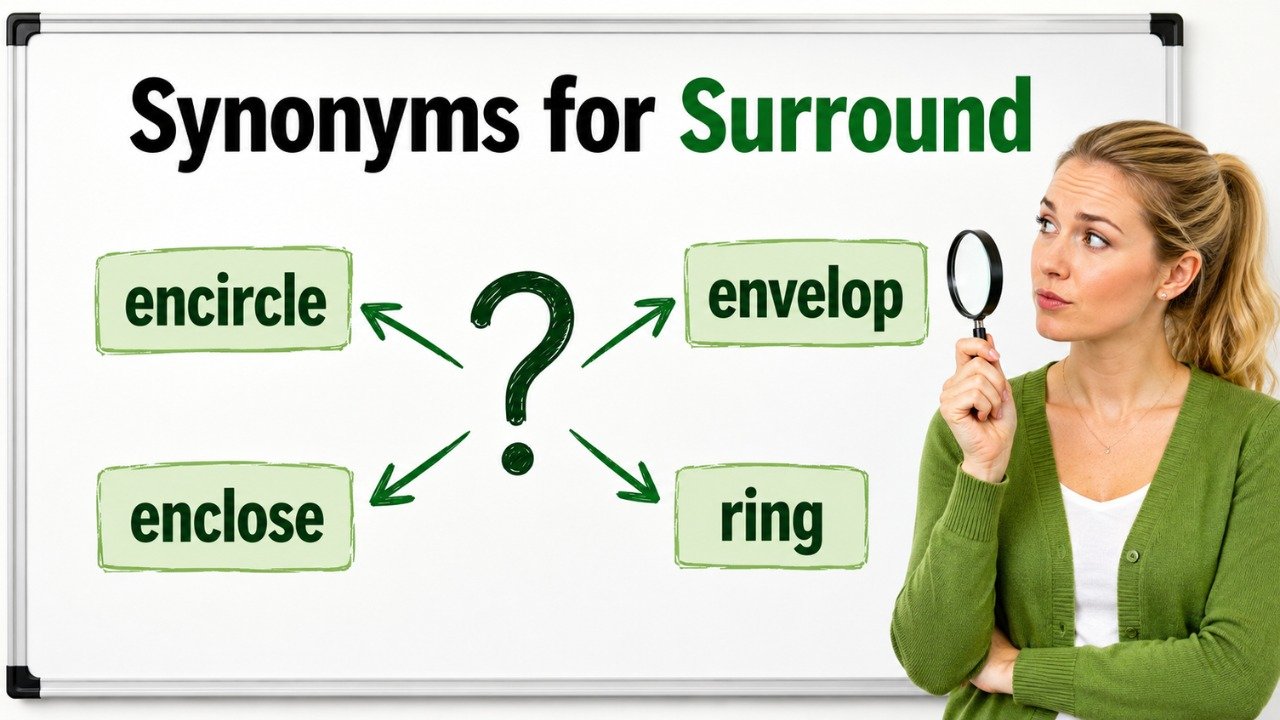
Quick Answer: The best synonyms for surround include encircle, enclose, encompass, ring, envelop, border, hem in, flank, encase, and engulf. Use encircle when people or objects form a circle around something. Choose enclose when boundaries, walls, or barriers contain an area. Encompass works well in formal writing when something extends around or includes another thing. Ring is concise and descriptive, while envelop suggests complete coverage. Hem in and trap express restricted movement, whereas border and flank describe positions along the sides of a place.
Pronunciation and Word Details
Word: Surround.
Pronunciation: /səˈraʊnd/.
Part of Speech: Verb and noun.
Meaning: To be, move, or form a complete or partial boundary around a person, place, or object.
US Pronunciation:
UK Pronunciation:
What Does “Surround” Mean?
Surround means to be present, move, stand, or form a boundary on every side of someone or something.
It is most commonly used as a verb. It can describe people, objects, buildings, landscapes, sounds, emotions, problems, or conditions that exist around a central subject.
Physical Position: Trees can surround a house, meaning they grow on several or all sides of it.
Example: Tall trees surround the cottage.
Movement: People or animals may move around someone or something.
Example: Reporters surrounded the speaker after the event.
Enclosure: Walls, fences, water, or natural features may contain an area.
Example: A stone wall surrounds the garden.
Complete Coverage: Smoke, darkness, light, or sound may seem to cover a person or place.
Example: Thick fog surrounded the village.
Figurative Situation: Problems, uncertainty, support, or attention may exist all around a person.
Example: Mystery surrounded the sudden decision.
Surround can also appear as a noun, although this use is less common. As a noun, it may refer to a border, frame, or material placed around an object.
The exact synonym depends on whether the sentence describes a circle, boundary, enclosure, covering, crowd, danger, protection, or general presence.
Meaning, Tone, and Context of “Surround”
Surround is a neutral and widely used word. It is natural in conversation, descriptive writing, news reports, essays, instructions, and formal communication.
The word can have a calm, positive, negative, or dramatic tone depending on the context.
Neutral Tone: Surround can simply describe the position of objects or features.
Example: Several small villages surround the city.
Positive Tone: The word may describe comfort, beauty, support, or protection.
Example: She surrounded herself with caring friends.
Negative Tone: Surround can suggest danger, pressure, restriction, or lack of escape.
Example: The guards surrounded the building.
Descriptive Tone: Writers often use surround for landscapes, sounds, light, weather, and atmosphere.
Example: Silence surrounded the abandoned house.
Formal Tone: Encompass, enclose, encircle, and border may sound more precise in reports or academic descriptions.
Example: Mountains encompass the entire valley.
Conversational Tone: Phrases such as gather around, crowd around, and stand around sound natural in everyday speech.
Example: The children gathered around the table.
The word is especially useful because it can describe both literal and figurative situations. However, a more specific synonym often creates a clearer picture.
When and How to Use “Surround”
For Objects on Every Side
Use surround when objects, buildings, plants, or natural features are positioned around a central place.
Example: Green hills surround the town.
For Forming a Circle
Use surround when people or objects create a circular arrangement.
Example: The students surrounded the instructor.
For Enclosing an Area
Use surround when walls, fences, barriers, or boundaries contain a place.
Example: A metal fence surrounds the playground.
For Crowding Around Someone
Use surround when several people move close to a person or object.
Example: Fans surrounded the performer at the entrance.
For Natural Landscapes
Use surround to describe mountains, forests, water, fields, or other features around a location.
Example: Dense forest surrounds the lake.
For Covering Completely
Use surround when smoke, mist, darkness, sound, or light seems to cover a person or place.
Example: Warm light surrounded the stage.
For Protection
Use surround when guards, walls, or defensive structures are placed around something.
Example: Security officers surrounded the vehicle.
For Danger or Pressure
Use surround when someone faces threats, difficulties, or hostile forces on all sides.
Example: The soldiers were surrounded by opposing forces.
For Emotional Support
Use surround figuratively when people create a supportive or encouraging environment.
Example: He surrounded himself with honest and helpful people.
For Mystery or Uncertainty
Use surround when questions, doubt, rumors, or secrecy are connected with a subject.
Example: Uncertainty surrounds the future of the project.
Best Synonyms for Surround
Encircle
Synonym: Encircle means to form a complete or nearly complete circle around something.
Example: A ring of trees encircled the clearing.
Enclose
Synonym: Enclose means to close off or contain an area within walls, fences, or boundaries.
Example: A wooden fence enclosed the garden.
Encompass
Synonym: Encompass means to extend around, include, or contain something completely.
Example: High mountains encompass the valley.
Ring
Synonym: Ring means to form a circular boundary around a person, place, or object.
Example: Small cottages ring the lake.
Envelop
Synonym: Envelop means to cover or surround something completely.
Example: Thick mist enveloped the road.
Border
Synonym: Border means to lie along the edge of a place or area.
Example: Tall trees border the path.
Hem In
Synonym: Hem in means to surround someone or something so movement becomes difficult.
Example: Heavy traffic hemmed in the bus.
Flank
Synonym: Flank means to be positioned on one or both sides of someone or something.
Example: Two stone towers flank the entrance.
Encase
Synonym: Encase means to cover or enclose something completely within a protective material.
Example: The fragile object was encased in glass.
Engulf
Synonym: Engulf means to surround and cover something completely, often suddenly or powerfully.
Example: Smoke engulfed the building.
50 Synonyms for Surround with Short Meanings
- Encircle: To form a circle around something.
- Enclose: To contain within walls or boundaries.
- Encompass: To extend around or include completely.
- Ring: To form a circular boundary around something.
- Envelop: To cover or surround completely.
- Border: To lie along the edge of an area.
- Hem In: To surround and restrict movement.
- Flank: To stand or lie on the sides.
- Circle: To move or form a shape around something.
- Gird: To encircle or surround firmly.
- Embrace: To hold or extend around something.
- Contain: To hold something within limits.
- Cover: To spread over or around something.
- Wrap: To place material around an object.
- Engulf: To surround and cover completely.
- Encase: To enclose within a covering.
- Fence In: To enclose with a fence or barrier.
- Wall In: To enclose with walls.
- Close In On: To move nearer from several directions.
- Form a Ring Around: To create a circular boundary.
- Cluster Around: To gather closely around something.
- Gather Around: To come together near a central point.
- Crowd Around: To gather closely in large numbers.
- Stand Around: To remain positioned near something.
- Lie Around: To be located on several sides.
- Extend Around: To continue along the sides of something.
- Spread Around: To occupy the area surrounding something.
- Occupy the Area Around: To be present near every side.
- Bound: To form the edge or limit of an area.
- Fringe: To form a decorative or natural border.
- Edge: To form the outer line of something.
- Line: To stand or extend along the sides.
- Rim: To form an outer edge around something.
- Skirt: To pass along or lie near the edge.
- Bracket: To position one thing on each side.
- Beset: To surround with problems or threats.
- Blockade: To surround and prevent movement or access.
- Besiege: To surround a place with hostile forces.
- Trap: To prevent escape by closing around someone.
- Confine: To keep within limited boundaries.
- Isolate: To separate by creating distance or barriers.
- Envelop Completely: To cover on every side.
- Encircle Closely: To form a tight circle around something.
- Guard: To protect by remaining around something.
- Protect: To keep safe from danger or harm.
- Shield: To form a protective barrier around something.
- Encompass Fully: To include or surround completely.
- Frame: To create a visible border around something.
- Wrap Around: To curve or extend around an object.
- Close Around: To move inward from all sides.
Read Also:
Synonyms for I Love You
Synonyms for Surround by Context
When Surround Means Form a Circle
Encircle, ring, circle, gird, and form a ring around are suitable when people or objects create a circular shape around something.
Encircle is the clearest formal synonym. Ring is shorter and works well in descriptive writing. Circle can describe either movement or position.
Example With Surround: Trees surround the open field.
Example With Encircle: Trees encircle the open field.
Example With Ring: Trees ring the open field.
When Surround Means Enclose an Area
Enclose, fence in, wall in, contain, and bound work well when a physical boundary limits an area.
Enclose is the strongest general choice. Fence in and wall in identify the type of barrier. Bound is more formal and often describes geographical limits.
Example With Surround: A stone wall surrounds the courtyard.
Example With Enclose: A stone wall encloses the courtyard.
Example With Bound: Stone walls bound the courtyard on every side.
When Surround Means Cover Completely
Envelop, engulf, encase, cover, and wrap are useful when something spreads over or around another thing.
Envelop often describes fog, darkness, sound, warmth, or emotion. Engulf is stronger and suggests sudden or overwhelming coverage. Encase usually involves a solid protective covering.
Example With Surround: Thick smoke surrounded the building.
Example With Engulf: Thick smoke engulfed the building.
Example With Envelop: Thick smoke enveloped the building.
When Surround Means Gather Around
Gather around, cluster around, crowd around, stand around, and close in describe people or animals moving near a central subject.
Gather around is neutral. Cluster around suggests a close group. Crowd around implies limited space or many people.
Example With Surround: The children surrounded the storyteller.
Example With Gather Around: The children gathered around the storyteller.
Example With Crowd Around: The children crowded around the storyteller.
When Surround Means Border a Place
Border, edge, fringe, line, rim, and skirt are useful when something lies along the outer part of an area.
Border is the broadest choice. Fringe often describes trees, plants, or decorative material. Line suggests a row along an edge.
Example With Surround: Flowers surround the path.
Example With Border: Flowers border the path.
Example With Line: Flowers line the path.
When Surround Means Restrict Movement
Hem in, trap, confine, close in on, and blockade express limited movement or escape.
Hem in is common when objects, crowds, or conditions restrict someone. Trap is stronger and emphasizes inability to escape. Blockade often involves deliberately preventing entry or exit.
Example With Surround: Parked vehicles surrounded the small car.
Example With Hem In: Parked vehicles hemmed in the small car.
Example With Trap: Parked vehicles trapped the small car.
When Surround Means Attack or Threaten
Besiege, beset, encircle, blockade, and close in on are useful in hostile or dangerous contexts.
Besiege usually describes armed forces surrounding a place. Beset often refers to problems or difficulties rather than physical forces.
Example With Surround: Enemy forces surrounded the town.
Example With Besiege: Enemy forces besieged the town.
Example With Encircle: Enemy forces encircled the town.
When Surround Means Protect
Guard, shield, protect, enclose, and secure are suitable when the purpose is safety.
Guard focuses on people or forces providing protection. Shield suggests protection from danger, damage, or attention. Enclose emphasizes the protective boundary.
Example With Surround: Officers surrounded the witness.
Example With Guard: Officers guarded the witness.
Example With Shield: Officers formed a barrier to shield the witness.
When Surround Is Figurative
Encompass, envelop, beset, attend, and accompany can express ideas, emotions, problems, support, or uncertainty around a subject.
Encompass works well when many related matters are included. Beset is appropriate for difficulties. Envelop often describes powerful emotions or atmosphere.
Example With Surround: Doubt surrounded the decision.
Example With Envelop: Doubt enveloped the decision.
Example With Beset: The decision was beset by doubt.
Another Word for Surround
Encircle is often the best single replacement for surround when something forms a complete or nearly complete circle around a person, place, or object.
However, the most accurate option depends on the context. Enclose is better for walls and fences, envelop is better for fog or darkness, and border is better when something lies along the edge of an area.
Original: Tall trees surround the lake.
Better Option: Tall trees encircle the lake.
Original: A metal fence surrounds the property.
Better Option: A metal fence encloses the property.
Original: Dense fog surrounded the village.
Better Option: Dense fog enveloped the village.
Original: Colorful flowers surround the walkway.
Better Option: Colorful flowers border the walkway.
When Not to Use “Surround”
Surround is broad and sometimes less precise than a context specific synonym.
When Something Is Only on Two Sides
Use flank when objects stand on the left and right rather than on every side.
Weak: Two columns surround the doorway.
Better: Two columns flank the doorway.
When a Barrier Completely Contains an Area
Use enclose when a fence, wall, or boundary fully contains a place.
Weak: A high fence surrounds the private garden.
Better: A high fence encloses the private garden.
When Something Covers Rather Than Stands Around
Use envelop, engulf, encase, or cover when the subject spreads over another object.
Weak: Flames surrounded the wooden structure.
Better: Flames engulfed the wooden structure.
When Describing an Edge
Use border, line, rim, or fringe when something exists only along an outer boundary.
Weak: Flowers surround both sides of the road.
Better: Flowers line both sides of the road.
When Movement Is Restricted
Use hem in, trap, confine, or blockade when lack of movement is the main idea.
Weak: The parked trucks surrounded the car.
Better: The parked trucks hemmed in the car.
When the Context Is Hostile
Use besiege or encircle when military forces or hostile groups close around a place.
Weak: The army surrounded the fortress for several weeks.
Better: The army besieged the fortress for several weeks.
When the Word Becomes Repetitive
Repeated use of surround can make a paragraph sound plain and mechanical.
Weak: Trees surround the house, flowers surround the path, and walls surround the garden.
Better: Trees encircle the house, flowers border the path, and walls enclose the garden.
Words Commonly Confused With Surround
Surround vs Encircle: Surround is broad and can describe any position around something. Encircle specifically suggests a circle or ring.
Surround vs Enclose: Surround means to exist around something. Enclose means to contain it within a boundary or barrier.
Surround vs Encompass: Surround usually describes position. Encompass can mean either surround physically or include many ideas, areas, or subjects.
Surround vs Envelop: Surround means to be around something. Envelop suggests complete coverage, often by fog, darkness, sound, warmth, or emotion.
Surround vs Border: Surround suggests presence on several or all sides. Border means to lie directly along an edge.
Surround vs Flank: Surround means to be on many sides. Flank means to stand specifically on the left and right sides.
Surround vs Encase: Surround describes position around something. Encase means to enclose it completely within a solid or protective covering.
Surround vs Engulf: Surround can be calm and neutral. Engulf suggests complete and often sudden coverage.
Surround vs Besiege: Surround is general. Besiege describes hostile forces surrounding a place, usually for an extended period.
Surround vs Gather Around: Surround can describe a fixed position. Gather around emphasizes movement toward a central person or object.
Which Synonym Should You Choose?
Choose encircle when people, trees, buildings, or objects form a circle around something.
Choose enclose when walls, fences, or barriers contain an area.
Choose encompass in formal writing when something extends around or includes a broad area, idea, or subject.
Choose ring when you need a short and vivid word for objects forming a circular border.
Choose envelop when fog, darkness, sound, warmth, or emotion completely covers a person or place.
Choose engulf when fire, smoke, water, or another powerful force suddenly covers something.
Choose border when something lies directly along the edge of an area.
Choose line when objects appear in a row along a road, path, wall, or entrance.
Choose flank when something stands on the left and right sides.
Choose hem in when objects or conditions restrict movement.
Choose trap when someone cannot escape.
Choose besiege when hostile forces surround a city, building, or defensive position.
Choose cluster around when a small group gathers closely.
Choose crowd around when many people gather in limited space.
Choose encase when something is covered by a solid protective material.
Choose shield when the purpose is protection from danger, damage, or attention.
Choose frame when objects create a decorative or visual border around a subject.
Real Life Examples of “Surround” in Sentences
Original: Mountains surround the quiet valley.
Better Option: Mountains encompass the quiet valley.
Original: A brick wall surrounds the garden.
Better Option: A brick wall encloses the garden.
Original: The children surrounded the birthday cake.
Better Option: The children gathered around the birthday cake.
Original: Heavy smoke surrounded the warehouse.
Better Option: Heavy smoke engulfed the warehouse.
Original: Small houses surround the central park.
Better Option: Small houses ring the central park.
Original: Two statues surround the main entrance.
Better Option: Two statues flank the main entrance.
Original: Colorful plants surround the walking path.
Better Option: Colorful plants border the walking path.
Original: Reporters surrounded the actor after the interview.
Better Option: Reporters crowded around the actor after the interview.
Original: Parked cars surrounded the delivery van.
Better Option: Parked cars hemmed in the delivery van.
Original: Secrecy surrounded the private meeting.
Better Option: Secrecy enveloped the private meeting.
Synonym Groups and Usage Differences
Circle Group
Encircle, ring, circle, gird, and form a ring around describe a circular arrangement.
Encircle is formal and exact. Ring is shorter and more visual. Circle may describe movement as well as position.
Example: A row of lights encircled the stage.
Enclosure Group
Enclose, contain, fence in, wall in, and bound describe limits or barriers around an area.
Enclose is the best general verb. Fence in and wall in identify the material used to form the boundary.
Example: A wooden fence encloses the field.
Coverage Group
Envelop, engulf, cover, wrap, and encase describe something spreading over or around another object.
Envelop is often atmospheric. Engulf is powerful and dramatic. Encase suggests a solid protective layer.
Example: Darkness enveloped the empty road.
Border Group
Border, fringe, edge, line, rim, and skirt describe something positioned along the outside of an area.
Border is neutral and flexible. Fringe often refers to trees or plants. Line suggests an orderly row.
Example: Tall grasses fringe the pond.
Crowd Group
Gather around, cluster around, crowd around, and close in describe people or animals moving near a central subject.
Gather around is neutral. Cluster around suggests a compact group. Crowd around emphasizes limited space.
Example: Visitors clustered around the display.
Restriction Group
Hem in, trap, confine, blockade, and close in on suggest limited freedom or movement.
Hem in is useful for traffic, buildings, crowds, and geography. Trap is stronger and emphasizes no escape.
Example: Construction vehicles hemmed in the small car.
Hostile Group
Besiege, encircle, blockade, and beset describe threats, attacks, or serious pressure.
Besiege applies to hostile forces around a place. Beset commonly refers to repeated problems or difficulties.
Example: The town was besieged by enemy forces.
Protection Group
Guard, shield, protect, secure, and enclose describe safety or defense.
Guard focuses on active protection. Shield emphasizes a barrier. Enclose may describe a secure physical boundary.
Example: Security officers guarded the entrance.
Figurative Group
Encompass, envelop, beset, accompany, and attend can describe emotions, questions, support, or problems around a person or subject.
Encompass is broad and formal. Envelop suggests a strong atmosphere. Beset is used for difficulties.
Example: Uncertainty enveloped the negotiations.
Antonyms of Surround
The opposite of surround depends on whether the sentence concerns position, movement, enclosure, coverage, or restriction.
Expose: To leave open and unprotected.
Uncover: To remove something that covers or surrounds.
Open: To remove barriers or boundaries.
Release: To allow someone or something to escape.
Free: To remove restrictions or confinement.
Separate: To move things apart.
Disperse: To spread people or objects away from a central point.
Scatter: To move in different directions.
Withdraw: To move away from a position.
Retreat: To move back from someone or something.
Unwrap: To remove material placed around an object.
Uncover Completely: To reveal something that was enclosed or hidden.
Leave: To move away from a place or person.
Clear: To remove objects or people from an area.
Isolate from Surroundings: To separate something from nearby objects or conditions.
Comparison: Surround vs Related Words
Surround vs Encircle
Surround is a broad word for being around something. Encircle specifically suggests a circle or ring.
Example With Surround: Trees surround the cabin.
Example With Encircle: Trees encircle the cabin.
Surround vs Enclose
Surround describes position around something. Enclose means to contain it inside a boundary.
Example With Surround: Trees surround the garden.
Example With Enclose: A wall encloses the garden.
Surround vs Encompass
Surround mainly describes physical position. Encompass can describe physical surroundings or the inclusion of many ideas and areas.
Example With Surround: Mountains surround the region.
Example With Encompass: The region encompasses several valleys.
Surround vs Envelop
Surround means to exist around something. Envelop means to cover it completely.
Example With Surround: Fog surrounded the village.
Example With Envelop: Fog enveloped the village.
Surround vs Border
Surround suggests presence on several sides. Border means to lie directly along an outer edge.
Example With Surround: Forests surround the town.
Example With Border: Forests border the town.
Surround vs Flank
Surround means to be positioned around many sides. Flank means to be positioned specifically on the sides.
Example With Surround: Guards surrounded the doorway.
Example With Flank: Two guards flanked the doorway.
Surround vs Engulf
Surround is neutral and does not always imply complete coverage. Engulf suggests that something is completely covered or overwhelmed.
Example With Surround: Smoke surrounded the building.
Example With Engulf: Smoke engulfed the building.
Surround vs Encircle
Surround may describe an irregular arrangement. Encircle creates a clearer image of a complete ring.
Example With Surround: Spectators surrounded the field.
Example With Encircle: Spectators encircled the field.
Surround vs Besiege
Surround is general and neutral. Besiege describes a hostile attempt to capture or pressure a place.
Example With Surround: Troops surrounded the town.
Example With Besiege: Troops besieged the town.
Surround vs Hem In
Surround describes position. Hem in emphasizes that movement or escape has become difficult.
Example With Surround: Buildings surrounded the courtyard.
Example With Hem In: Tall buildings hemmed in the courtyard.
Common Phrases and Expressions With “Surround”
Surround Yourself With Positive People: Choose supportive and encouraging companions.
Surround the Building: Take positions on every side of a structure.
Surround the Area: Form a boundary around a particular location.
Surround the City: Be located or positioned around an urban area.
Surround the House: Exist or gather on every side of a home.
Surround With Care: Provide emotional support, protection, or kindness.
Surround With Beauty: Place attractive objects or scenery around someone.
Surround With Love: Give someone strong affection and emotional support.
Be Surrounded By Friends: Have friends present on every side or nearby.
Be Surrounded By Nature: Live or remain among natural scenery.
Be Surrounded By Problems: Face difficulties from many directions.
Mystery Surrounds Something: Questions or uncertainty remain connected with a subject.
Common Mistakes to Avoid
Using Surround for Only One Side
Surround normally suggests several sides. Use border, line, edge, or flank when the position is more limited.
Incorrect: A row of trees surrounds the northern side of the road.
Better: A row of trees lines the northern side of the road.
Confusing Surround With Enclose
Something may surround an area without forming a closed boundary. Enclose means the boundary contains the area.
Unclear: Mountains enclose the distant village.
Better: Mountains surround the distant village.
Correct When Contained: A fence encloses the village garden.
Using Encircle When the Shape Is Not Circular
Encircle suggests a ring or circle. Use surround when the arrangement is irregular.
Weak: Irregular cliffs encircle the coastline.
Better: Irregular cliffs surround the coastline.
Using Engulf for Calm Situations
Engulf is strong and often describes sudden, complete, or overwhelming coverage.
Weak: Small flowers engulf the pathway.
Better: Small flowers border the pathway.
Using Flank for Every Side
Flank refers to positions on the sides, usually the left and right.
Incorrect: Four walls flank the room.
Correct: Two tall columns flank the entrance.
Confusing Surround and Around
Surround is a verb, while around is usually a preposition or adverb.
Incorrect: Trees around the house on every side.
Correct: Trees surround the house.
Also Correct: Trees grow around the house.
Using Surround With an Unnecessary Preposition
Do not place around immediately after surround.
Incorrect: Mountains surround around the valley.
Correct: Mountains surround the valley.
Forgetting the Passive Form
Surround is commonly used in the passive voice with by.
Incorrect: The village is surrounded with mountains.
Better: The village is surrounded by mountains.
Use with when emphasizing material, atmosphere, or something deliberately placed around a person.
Example: The gift was surrounded with fresh flowers.
Repeating Surround Too Often
Use encircle, border, enclose, ring, envelop, or flank when they express the meaning more precisely.
Repetitive: Trees surround the lake, houses surround the trees, and hills surround the houses.
Improved: Trees ring the lake, houses border the woodland, and hills encircle the settlement.
Choosing a Synonym Without Considering Tone
Besiege, trap, engulf, and hem in sound stronger than surround. Use them only when the situation involves danger, pressure, complete coverage, or restricted movement.
Conclusion
The best synonyms for surround depend on position, shape, movement, and purpose. Encircle and ring work well for circular arrangements, while enclose suits walls, fences, and boundaries. Choose border or line for objects along an edge, flank for positions on two sides, and envelop or engulf for complete coverage. Hem in and trap emphasize restricted movement, while gather around and crowd around describe people moving closer. Using the right alternative makes descriptions clearer, more vivid, and more accurate.
FAQs About Synonyms for Surround
What Is the Best Synonym for Surround?
Encircle is the best general synonym when something forms a circle around a person, place, or object.
Is Enclose a Synonym for Surround?
Yes. Enclose is suitable when a wall, fence, or boundary contains an area.
What Is a Formal Synonym for Surround?
Encompass, encircle, enclose, and gird are useful formal alternatives.
What Is the Difference Between Surround and Encircle?
Surround can describe any arrangement around something. Encircle specifically suggests a circular formation.
What Word Means to Surround Completely?
Envelop, engulf, encase, and encompass can mean to surround completely, depending on the context.
What Is a Synonym for People Surrounding Someone?
Gather around, crowd around, cluster around, and close in are useful choices.
What Is the Opposite of Surround?
Expose, release, uncover, disperse, scatter, and withdraw can act as opposites in different contexts.
