
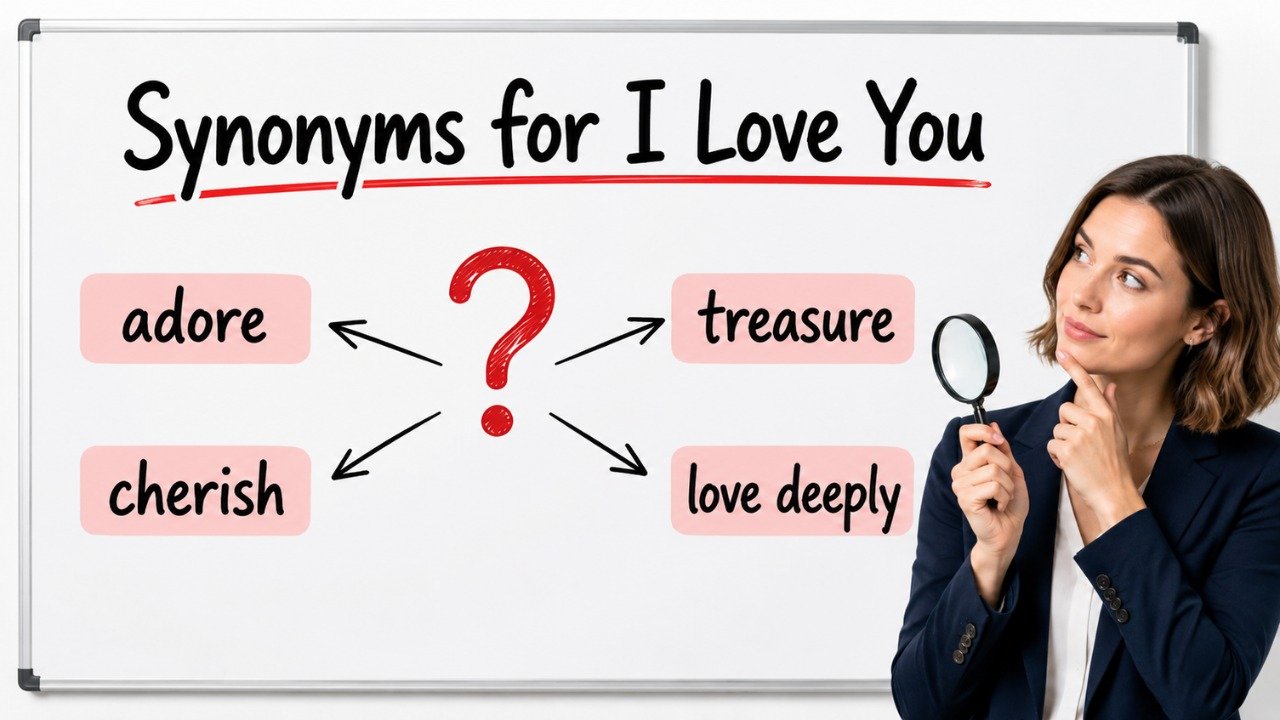
Quick Answer: The best synonyms for I love you include I adore you, I cherish you, I am devoted to you, you mean everything to me, I care deeply about you, I am in love with you, you have my heart, I treasure you, I am crazy about you, and I am fond of you. Use I adore you for strong romantic affection, I cherish you for warm and lasting attachment, and I am devoted to you for serious commitment. I care deeply about you works well for family members and close friends, while you mean everything to me adds emotional emphasis.
Pronunciation and Word Details
Word: I love you.
Pronunciation: /aɪ lʌv juː/.
Part of Speech: Declarative sentence containing a subject, verb, and object.
Meaning: A direct expression of deep affection, emotional attachment, care, or romantic love toward another person.
US Pronunciation:
UK Pronunciation:
What Does “I Love You” Mean?
“I love you” means that the speaker feels deep affection, emotional closeness, care, or romantic attachment toward another person.
The expression is a complete declarative sentence. “I” is the subject, “love” is the verb, and “you” is the object receiving the emotion. Although the grammar is simple, the emotional meaning can vary greatly depending on the relationship and situation.
In a romantic relationship, “I love you” often communicates attraction, emotional intimacy, trust, and commitment. Between family members, it usually expresses lasting care, loyalty, and attachment. Close friends may also use it to show sincere appreciation and emotional support.
The phrase can describe a present feeling, but it may also suggest a lasting bond. Its meaning is shaped by tone, timing, facial expression, relationship history, and surrounding words.
Romantic Context: It can express passion, intimacy, and commitment between partners.
Family Context: It can communicate unconditional care between parents, children, siblings, or relatives.
Friendship Context: It can show deep appreciation and emotional closeness without romantic meaning.
Supportive Context: It can reassure someone that they are valued during a difficult moment.
Grateful Context: It can express affection combined with thankfulness for someone’s kindness or support.
Meaning, Tone, and Context of “I Love You”
“I love you” has an emotional, personal, and generally sincere tone. It is common in everyday conversation, personal messages, family discussions, romantic situations, and meaningful life events.
The phrase is usually conversational rather than academic or technical. It can sound gentle, passionate, comforting, serious, playful, or reassuring depending on how it is delivered.
Romantic Tone: Between partners, it often expresses emotional intimacy, attraction, and commitment.
Warm Tone: Within families, it communicates affection, security, and belonging.
Supportive Tone: During emotional difficulty, it reminds someone that they are not alone.
Serious Tone: In major relationship moments, it may express a long term emotional commitment.
Casual Tone: Friends and relatives sometimes use it naturally when ending a conversation or showing appreciation.
Playful Tone: It can be used lightly after someone does something thoughtful, helpful, or amusing.
Formal Context: The direct phrase is uncommon in formal reports, academic essays, or professional documents. Expressions such as deep appreciation, sincere gratitude, or great admiration may be more suitable in those settings.
The relationship between the speakers determines how the phrase is understood. A romantic partner may hear it as a declaration of commitment, while a friend may understand it as affectionate appreciation.
When and How to Use “I Love You”
“I love you” is appropriate when you want to communicate genuine affection, care, attachment, or emotional support. The most suitable wording depends on the relationship and the strength of the feeling.
For Romantic Affection: Use it to express deep emotional and romantic love toward a partner.
Example: I love you more deeply with every year we spend together.
For Family Love: Use it to remind relatives that they are valued and emotionally important.
Example: I love you, Mom, and I appreciate everything you have done for me.
For Close Friendship: Use it when a friendship is emotionally strong and both people are comfortable expressing affection.
Example: I love you, my friend, and I am grateful that you are always there.
For Reassurance: Use it when someone needs comfort, acceptance, or emotional security.
Example: I love you, and nothing about this difficult moment will change that.
For Gratitude: Use it when affection and appreciation are closely connected.
Example: I love you for always believing in me.
For Commitment: Use it to communicate devotion and a desire to remain emotionally present.
Example: I love you, and I want to build a future with you.
For Celebration: Use it during birthdays, anniversaries, weddings, achievements, or meaningful family occasions.
Example: I love you, and I am so proud of everything you have accomplished.
For Apology and Repair: Use it sincerely when resolving conflict, but do not use it as a substitute for taking responsibility.
Example: I love you, and I am sorry for the way my words hurt you.
For Farewells: Use it when ending a conversation or leaving someone to reinforce emotional closeness.
Example: Travel safely. I love you, and I will call you tomorrow.
Best Synonyms for I Love You
The following expressions are among the strongest and most natural alternatives to “I love you.”
I Adore You
Synonym: A strong expression of love, admiration, and delight in another person.
Example: I adore you and the happiness you bring into my life.
I Cherish You
Synonym: To value someone deeply and hold the relationship close to your heart.
Example: I cherish you and every memory we have created together.
I Am in Love With You
Synonym: A clear statement of romantic love and emotional attachment.
Example: I am in love with you, and my feelings grow stronger every day.
You Mean Everything to Me
Synonym: A powerful expression showing that someone has exceptional emotional importance.
Example: You mean everything to me, and I cannot imagine my life without you.
I Care Deeply About You
Synonym: A warm expression of sincere concern, affection, and emotional attachment.
Example: I care deeply about you and want you to feel supported.
I Am Devoted to You
Synonym: A serious expression of loyalty, commitment, and lasting affection.
Example: I am devoted to you and to the future we are creating together.
You Have My Heart
Synonym: A romantic expression meaning that someone possesses your deepest affection.
Example: You have my heart, now and always.
I Treasure You
Synonym: To consider someone extremely valuable, special, and emotionally important.
Example: I treasure you and the peace you bring into my world.
I Am Crazy About You
Synonym: An enthusiastic and informal expression of strong romantic attraction.
Example: I am crazy about you and cannot stop smiling when you are near.
I Am Fond of You
Synonym: A gentle expression of affection, liking, or emotional warmth.
Example: I am very fond of you and always enjoy our time together.
50 Synonyms for I Love You with Short Meanings
- I Adore You: I feel intense love and admiration for you.
- I Cherish You: I value you deeply and hold you close emotionally.
- I Am in Love With You: I feel deep romantic love for you.
- You Mean Everything to Me: You are extremely important in my life.
- I Care Deeply About You: I feel sincere affection and concern for you.
- I Am Devoted to You: I am loyal, loving, and committed to you.
- You Have My Heart: My deepest romantic feelings belong to you.
- I Treasure You: I consider you precious and emotionally valuable.
- I Am Crazy About You: I feel intense and enthusiastic romantic attraction.
- I Am Fond of You: I feel gentle warmth and affection toward you.
- I Love You Dearly: I feel strong and tender affection for you.
- I Am Deeply Attached to You: I share a powerful emotional bond with you.
- I Hold You Dear: You are precious and important to me.
- You Are My World: You are central to my happiness and emotional life.
- You Are My Everything: You are the most meaningful person in my life.
- I Am Smitten With You: I feel strongly and charmingly attracted to you.
- I Am Enchanted by You: I feel captivated by your personality or presence.
- I Am Mad About You: I feel very strong romantic enthusiasm for you.
- I Am Taken With You: I feel attracted to and impressed by you.
- I Am Captivated by You: You completely hold my emotional attention.
- I Have Deep Feelings for You: My emotions toward you are serious and meaningful.
- My Heart Belongs to You: My romantic loyalty and affection are yours.
- You Are the Love of My Life: You are the person I love most deeply.
- I Cannot Imagine Life Without You: You have become essential to my emotional life.
- You Complete Me: You bring fulfillment and emotional balance to my life.
- I Feel Safe With You: Your presence gives me comfort, trust, and security.
- I Am Yours: I offer you my romantic loyalty and commitment.
- I Choose You: I willingly commit my love and attention to you.
- I Will Always Care for You: My affection and concern will remain lasting.
- I Am Grateful for You: I feel thankful that you are part of my life.
- You Are Precious to Me: I consider you deeply valuable and special.
- You Matter So Much to Me: Your happiness and presence are highly important.
- I Appreciate You Deeply: I recognize and value who you are and what you do.
- I Feel Close to You: I experience emotional intimacy and connection with you.
- I Am Committed to You: I intend to remain loyal and present in the relationship.
- You Bring Me Joy: Your presence creates happiness in my life.
- You Make My Heart Happy: You fill me with affection and emotional joy.
- I Am Grateful to Have You: I feel fortunate that you are in my life.
- I Feel Complete With You: Our relationship gives me emotional fulfillment.
- You Are Special to Me: You have unique emotional importance in my life.
- I Will Stand by You: I promise loyalty, support, and emotional presence.
- I Am Here for You: I offer care, support, and dependable companionship.
- I Want a Future With You: I desire a lasting life and relationship together.
- I Feel at Home With You: Your presence gives me comfort and belonging.
- You Are Dear to My Heart: I hold you in a place of deep affection.
- I Am Emotionally Connected to You: I share a meaningful inner bond with you.
- I Have Affection for You: I feel warmth, tenderness, and care toward you.
- I Am Passionate About You: I feel intense romantic attraction and emotion.
- I Love Being With You: Your company brings me happiness and comfort.
- My Love for You Is Deep: My affection is powerful, sincere, and meaningful.
Read Also:
Synonyms for Censorship
Synonyms for I Love You by Context
Different alternatives express different kinds of love. Some sound romantic and passionate, while others emphasize commitment, friendship, family affection, reassurance, or gratitude.
When I Love You Means Romantic Passion
Use these expressions when speaking to a romantic partner and describing strong attraction or emotional intensity.
I Adore You: Expresses powerful love combined with admiration.
Example: I adore you more than I can put into words.
I Am Crazy About You: Communicates energetic and enthusiastic attraction.
Example: I am crazy about you and look forward to every moment together.
I Am Passionate About You: Emphasizes intense romantic and physical emotion.
Example: I am passionate about you and deeply invested in our relationship.
I Am Smitten With You: Suggests charming, excited, or newly developing attraction.
Example: I am completely smitten with you.
I Am Mad About You: Offers an informal and lively declaration of romantic affection.
Example: I am mad about you and your wonderful sense of humor.
When I Love You Means Lasting Commitment
Use these alternatives when love includes loyalty, responsibility, and a desire for a shared future.
I Am Devoted to You: Emphasizes loyalty and serious emotional commitment.
Example: I am devoted to you through every season of life.
I Am Committed to You: Clearly communicates dedication to the relationship.
Example: I am committed to you and willing to work through our challenges.
I Choose You: Shows that love is an intentional and continuing decision.
Example: I choose you today and every day that follows.
I Want a Future With You: Expresses long term romantic intention.
Example: I want a future with you filled with trust and shared dreams.
I Will Stand by You: Promises loyalty during both easy and difficult times.
Example: I will stand by you no matter what challenges appear.
When I Love You Means Deep Appreciation
These alternatives combine affection with gratitude and recognition.
I Appreciate You Deeply: Focuses on the person’s qualities, effort, or support.
Example: I appreciate you deeply for the patience you always show me.
I Am Grateful for You: Communicates thankfulness for someone’s presence.
Example: I am grateful for you and the kindness you bring into my life.
I Treasure You: Shows that the person is considered precious and valuable.
Example: I treasure you and every quiet moment we share.
You Mean So Much to Me: Expresses emotional importance without sounding overly dramatic.
Example: You mean so much to me, and I value our connection.
When I Love You Means Family Affection
Family love is often warm, protective, loyal, and unconditional.
I Care Deeply About You: Expresses concern, affection, and emotional support.
Example: I care deeply about you and will always be ready to listen.
You Are Precious to Me: Shows that a family member is deeply valued.
Example: You are precious to me, and I am proud to be your parent.
I Will Always Care for You: Communicates lasting family support.
Example: I will always care for you, even when life takes us in different directions.
You Are Dear to My Heart: Offers a tender and traditional expression of family affection.
Example: You are dear to my heart, and nothing will change that bond.
When I Love You Means Close Friendship
Some expressions communicate strong platonic love without suggesting romance.
I Am Here for You: Emphasizes dependable emotional support.
Example: I am here for you whenever you need someone to listen.
You Matter So Much to Me: Shows that the friendship has genuine emotional value.
Example: You matter so much to me, and I never take our friendship for granted.
I Feel Close to You: Communicates trust and emotional intimacy.
Example: I feel close to you because I can always be honest with you.
I Am Grateful to Have You: Expresses appreciation for a meaningful friendship.
Example: I am grateful to have you as one of my closest friends.
When I Love You Means Emotional Safety
Use these expressions when affection is connected with trust, comfort, and belonging.
I Feel Safe With You: Shows emotional trust and security.
Example: I feel safe with you because you listen without judging me.
I Feel at Home With You: Suggests comfort, acceptance, and peaceful connection.
Example: I feel at home with you wherever we happen to be.
You Bring Me Peace: Communicates calmness and emotional stability.
Example: You bring me peace when everything else feels uncertain.
I Trust You Completely: Emphasizes confidence and emotional openness.
Example: I trust you completely and feel able to share my true thoughts.
Another Word for I Love You
“I adore you” is one of the best direct replacements for “I love you” when the meaning is romantic, warm, and emotionally strong. However, the best alternative depends on the relationship, emotional intensity, and purpose of the sentence.
“I cherish you” is better when you want to emphasize lasting value. “I care deeply about you” suits family relationships and close friendships. “I am devoted to you” works best when love includes loyalty and commitment.
Original: I love you more every day.
Better Option: I adore you more deeply every day.
Original: I love you and value our years together.
Better Option: I cherish you and every year we have shared.
Original: I love you and will remain loyal to our relationship.
Better Option: I am devoted to you and committed to our relationship.
Original: I love you and want you to know that you can depend on me.
Better Option: I care deeply about you and will always be here to support you.
When Not to Use “I Love You”
“I love you” is powerful, but it may not always be the clearest or most suitable choice. The phrase can sound repetitive, overly intense, misleading, or too personal in certain contexts.
Avoid using it when you mean simple appreciation, professional respect, casual enjoyment, physical attraction without emotional commitment, or agreement with an idea.
When You Mean Appreciation
“I love you” may sound stronger than intended when you simply want to thank someone.
Weak: I love you for completing the report.
Better: I sincerely appreciate your work on the report.
When You Mean Admiration
Use a more precise expression when you admire someone’s ability, character, or achievement.
Weak: I love you because you are an excellent teacher.
Better: I greatly admire your patience and teaching ability.
When You Mean Enjoyment
Do not use “I love you” for an object, activity, or experience when the person might misunderstand your meaning.
Weak: I love you because you always make good coffee.
Better: I love the coffee you make.
When the Relationship Is Unclear
A direct declaration may create confusion when the relationship has not been emotionally defined.
Weak: I love you, although we have only spoken twice.
Better: I have really enjoyed getting to know you.
During an Unresolved Conflict
Do not use the phrase to avoid responsibility or end a serious discussion without addressing the problem.
Weak: I love you, so we should forget what happened.
Better: I love you, and I want to take responsibility for what happened and repair the harm.
In Formal Professional Writing
The phrase is usually too personal for professional reports, formal requests, or business communication.
Weak: We love you for supporting this project.
Better: We sincerely appreciate your support for this project.
When You Only Mean Attraction
Attraction and love are not always the same. Choose wording that accurately reflects your feelings.
Weak: I love you because I find you attractive.
Better: I feel strongly attracted to you and would like to know you better.
Words Commonly Confused With I Love You
Several expressions are related to “I love you,” but they do not always communicate the same depth, intention, or type of feeling.
I Love You vs I Like You: “I love you” expresses deeper affection and emotional attachment. “I like you” usually communicates enjoyment, approval, friendship, or early romantic interest.
I Love You vs I Adore You: Both express strong affection. “I adore you” often sounds more enthusiastic, admiring, and romantic.
I Love You vs I Care About You: “I love you” is emotionally stronger. “I care about you” focuses on concern, kindness, and emotional support.
I Love You vs I Am in Love With You: “I love you” can describe romantic, family, or platonic affection. “I am in love with you” usually has a specifically romantic meaning.
I Love You vs I Am Fond of You: “I love you” communicates deeper emotional intensity. “I am fond of you” sounds gentler, more reserved, and less committed.
I Love You vs I Appreciate You: Love describes affection and emotional attachment. Appreciation describes gratitude and recognition of someone’s value or actions.
I Love You vs I Am Attracted to You: Love may include emotional closeness, loyalty, and commitment. Attraction can be physical or romantic without deep emotional attachment.
I Love You vs I Need You: Love expresses affection, while need expresses dependence or necessity. A healthy declaration of love should not automatically imply emotional dependence.
I Love You vs I Miss You: Love describes affection. Missing someone describes sadness or longing caused by their absence.
I Love You vs I Admire You: Love is an emotional bond. Admiration is respect or approval for someone’s qualities, behavior, or achievements.
Which Synonym Should You Choose?
Choose the synonym that matches your relationship, emotional intensity, and communication goal.
Choose “I adore you” when expressing strong romantic affection with warmth and admiration.
Choose “I cherish you” when emphasizing that someone is precious and that the relationship has lasting value.
Choose “I am in love with you” when you need to make your romantic feelings completely clear.
Choose “I care deeply about you” for family members, close friends, or relationships where sincere affection is present without romantic meaning.
Choose “I am devoted to you” when communicating loyalty, dedication, and serious commitment.
Choose “you mean everything to me” when you want to add powerful emotional emphasis.
Choose “you have my heart” for a poetic and romantic expression.
Choose “I appreciate you deeply” when your main purpose is to show gratitude and recognition.
Choose “I am fond of you” when you want to express gentle affection without sounding overly intense.
Choose “I am here for you” when the situation requires reassurance, support, and emotional presence.
Choose “I choose you” when emphasizing that love is a deliberate and continuing commitment.
Choose “I feel at home with you” when describing comfort, peace, trust, and belonging.
In formal writing, choose “I sincerely appreciate you,” “I value your contribution,” or “I have great respect for you” instead of a direct declaration of love.
In casual speech, “I adore you,” “I am crazy about you,” and “you mean so much to me” sound natural and emotionally expressive.
In serious relationship conversations, “I am committed to you,” “I am devoted to you,” and “I want a future with you” communicate clearer intentions.
Real Life Examples of “I Love You” in Sentences
Romantic Relationship
Original: I love you more than I knew it was possible to love someone.
Better Option: I adore you more deeply than I ever thought possible.
Long Term Partnership
Original: I love you and value the life we have built together.
Better Option: I cherish you and the life we have built together.
Serious Commitment
Original: I love you and will stay beside you through every challenge.
Better Option: I am devoted to you and will stand beside you through every challenge.
Family Affection
Original: I love you, and I will always support your dreams.
Better Option: I care deeply about you, and I will always support your dreams.
Close Friendship
Original: I love you for always listening when I need to talk.
Better Option: I appreciate you deeply for always listening when I need to talk.
Emotional Reassurance
Original: I love you even when we disagree.
Better Option: You are precious to me even when we disagree.
Romantic Attraction
Original: I love you and cannot stop thinking about you.
Better Option: I am crazy about you and cannot stop thinking about you.
Gratitude
Original: I love you for everything you have done for our family.
Better Option: I am deeply grateful for everything you have done for our family.
Emotional Belonging
Original: I love you because I can always be myself around you.
Better Option: I feel at home with you because I can always be myself around you.
Future Intention
Original: I love you and hope we remain together for many years.
Better Option: I want a future with you and hope we remain together for many years.
Synonym Groups and Usage Differences
Synonyms for “I love you” can be grouped according to emotional purpose. Understanding these differences helps you choose language that sounds sincere and accurate.
Romantic Passion Group
This group includes “I adore you,” “I am crazy about you,” “I am mad about you,” “I am smitten with you,” and “I am passionate about you.”
These expressions emphasize attraction, excitement, and romantic intensity. They work well between romantic partners but may be too strong for friendships or new acquaintances.
Example: I am completely smitten with you and your joyful personality.
Commitment Group
This group includes “I am devoted to you,” “I am committed to you,” “I choose you,” “I am yours,” and “I want a future with you.”
These alternatives communicate loyalty and intention. They are especially suitable for serious relationships, marriage, or discussions about a shared future.
Example: I choose you, and I am committed to building a strong life together.
Appreciation Group
This group includes “I appreciate you deeply,” “I am grateful for you,” “I treasure you,” and “you mean so much to me.”
These expressions focus on someone’s value, kindness, presence, or contribution. They work in romantic, family, and friendship contexts.
Example: I am grateful for you and the encouragement you give me every day.
Family Affection Group
This group includes “I care deeply about you,” “you are precious to me,” “you are dear to my heart,” and “I will always care for you.”
These phrases communicate warmth, protection, and lasting attachment. They are natural between parents, children, siblings, and close relatives.
Example: You are dear to my heart, and I will always be proud of you.
Friendship Group
This group includes “I am here for you,” “you matter so much to me,” “I feel close to you,” and “I am grateful to have you.”
These expressions show emotional closeness without automatically suggesting romantic interest.
Example: You matter so much to me, and I value the trust in our friendship.
Emotional Safety Group
This group includes “I feel safe with you,” “I feel at home with you,” “I trust you completely,” and “you bring me peace.”
These expressions describe the emotional effect of a loving relationship rather than stating love directly.
Example: I feel at home with you because your presence brings me comfort.
Poetic Love Group
This group includes “you have my heart,” “my heart belongs to you,” “you are my world,” and “you are the love of my life.”
These phrases sound expressive, romantic, and dramatic. They are suitable for personal messages, romantic letters, celebrations, and meaningful conversations.
Example: You have my heart, and I will treasure our bond always.
Gentle Affection Group
This group includes “I am fond of you,” “I hold you dear,” “I have affection for you,” and “you are special to me.”
These alternatives sound warm but less intense. They work well when the speaker wants to express affection carefully.
Example: I hold you dear and value the time we spend together.
Antonyms of I Love You
The opposite of “I love you” depends on whether the intended contrast involves affection, interest, attachment, trust, or commitment.
I Do Not Love You: A direct denial of romantic or emotional love.
I Dislike You: An expression of negative personal feeling.
I Hate You: A strong expression of hostility or intense dislike.
I Feel Indifferent Toward You: A statement showing no strong affection or dislike.
I Do Not Care About You: A statement showing a lack of emotional concern.
I Feel Distant From You: An expression of emotional separation or reduced closeness.
I No Longer Feel Connected to You: A statement showing that an emotional bond has weakened or ended.
I Am Not in Love With You: A clear denial of romantic love.
I Do Not Trust You: A statement showing the absence of confidence or emotional safety.
I Do Not Want a Relationship With You: A rejection of romantic involvement or commitment.
I Want to Let You Go: A statement expressing the desire to end an emotional attachment.
You Mean Little to Me: A harsh expression suggesting that someone has limited emotional importance.
Antonyms involving strong rejection should be used carefully. When discussing changing feelings, respectful and specific language is usually better than cruel or exaggerated wording.
Comparison: I Love You vs Related Words
I Love You vs I Adore You
“I love you” is a broad expression that can describe romantic, family, or platonic affection. “I adore you” usually sounds more enthusiastic, admiring, and romantic.
Example With I Love You: I love you and feel grateful for our life together.
Example With I Adore You: I adore you and the warmth you bring into every room.
I Love You vs I Cherish You
“I love you” directly names the emotion. “I cherish you” emphasizes that the person and relationship are deeply valued and protected.
Example With I Love You: I love you more with every passing year.
Example With I Cherish You: I cherish you and every memory we have made.
I Love You vs I Care About You
“I love you” usually expresses stronger emotional attachment. “I care about you” emphasizes concern, kindness, and support and may be romantic or platonic.
Example With I Love You: I love you and want to share my life with you.
Example With I Care About You: I care about you and want to know that you are safe.
I Love You vs I Am in Love With You
“I love you” can be used with partners, relatives, and close friends. “I am in love with you” clearly communicates romantic love.
Example With I Love You: I love you, Dad, and I appreciate your guidance.
Example With I Am in Love With You: I am in love with you and hope we can build a future together.
I Love You vs I Appreciate You
“I love you” expresses affection. “I appreciate you” expresses gratitude, recognition, and respect for someone’s presence or actions.
Example With I Love You: I love you for the person you are.
Example With I Appreciate You: I appreciate you for helping me through a difficult week.
I Love You vs I Am Devoted to You
“I love you” communicates the feeling itself. “I am devoted to you” emphasizes loyalty, dedication, and lasting commitment.
Example With I Love You: I love you with all my heart.
Example With I Am Devoted to You: I am devoted to you and committed to protecting our relationship.
I Love You vs I Am Fond of You
“I love you” is emotionally strong and direct. “I am fond of you” is gentler and may suggest affection without deep commitment.
Example With I Love You: I love you and cannot imagine my life without you.
Example With I Am Fond of You: I am fond of you and enjoy every conversation we share.
I Love You vs I Need You
“I love you” describes affection and emotional attachment. “I need you” describes dependence, necessity, or a desire for support.
Example With I Love You: I love you while respecting your independence.
Example With I Need You: I need you to help me through this difficult situation.
I Love You vs I Miss You
“I love you” expresses affection. “I miss you” communicates longing caused by someone’s absence.
Example With I Love You: I love you and value every moment we share.
Example With I Miss You: I miss you whenever we spend several days apart.
I Love You vs I Admire You
“I love you” describes emotional attachment. “I admire you” describes respect and approval for someone’s qualities or achievements.
Example With I Love You: I love you for your kindness and honesty.
Example With I Admire You: I admire you for remaining calm during difficult situations.
Common Phrases and Expressions With I Love You
I Love You So Much: A stronger declaration emphasizing the depth of affection.
I Love You Dearly: A tender expression of sincere and lasting love.
I Love You With All My Heart: A powerful statement of complete emotional devotion.
I Love You More Than Words Can Say: An expression suggesting that love is too deep to describe fully.
I Love You More Every Day: A statement showing that affection continues to grow.
I Love You Just the Way You Are: An expression of acceptance without requiring the person to change.
I Love You No Matter What: A promise of affection despite difficulties, mistakes, or changing circumstances.
I Love You Forever: A declaration of lasting or permanent love.
I Love You to the Moon and Back: A playful expression of extremely great affection.
I Love You More Than Anything: A strong statement placing the person above other priorities or possessions.
I Love You for Who You Are: An expression of affection based on the person’s true character.
I Love You and I Am Here for You: A supportive expression combining affection with emotional presence.
Common Mistakes to Avoid
The phrase “I love you” is grammatically simple, but mistakes in context, tone, punctuation, and synonym choice can make it sound unclear or unnatural.
Repeating the Same Expression Too Often
Frequent repetition can reduce the emotional effect of the phrase. Vary the wording when another expression better matches your meaning.
Repetitive: I love you because you help me. I love you because you listen. I love you because you understand me.
Improved: I love you because you listen with patience, understand my feelings, and support me when I need you.
Using Romantic Synonyms for Platonic Relationships
Expressions such as “I am in love with you,” “you have my heart,” and “I am passionate about you” usually suggest romance.
For a friend or relative, choose “I care deeply about you,” “you mean so much to me,” or “I am grateful for you.”
Confusing Love With Appreciation
“I love you” and “I appreciate you” are related but not identical. Use appreciation when your main purpose is to recognize someone’s help or effort.
Unclear: I love you for sending the information.
Clearer: I appreciate you for sending the information so quickly.
Using the Phrase to Avoid Accountability
Saying “I love you” does not replace an apology, explanation, or changed behavior.
Incorrect: I love you, so you should stop being upset.
Better: I love you, and I understand why you are upset. I am sorry for what I did.
Choosing Language That Is Too Intense
Expressions such as “you are my entire world” or “I cannot live without you” can sound dramatic or emotionally dependent when the situation does not support that intensity.
Choose a balanced alternative such as “you are deeply important to me” or “I value our relationship.”
Using an Unnatural Object Form
The standard phrase is “I love you.” Avoid incorrect forms such as “I am love you” or “I loving you.”
Incorrect: I am love you.
Correct: I love you.
Incorrect: I loving you.
Correct: I am loving the time we spend together.
Forgetting Capitalization
The pronoun “I” must always be capitalized in standard English.
Incorrect: i love you.
Correct: I love you.
Misusing Love and Like
“Like” usually expresses enjoyment or mild affection, while “love” is stronger.
Mild Feeling: I like spending time with you.
Deep Feeling: I love you and value the bond we share.
Using a Weak Synonym in a Serious Moment
“I am fond of you” may sound too reserved when expressing deep romantic commitment.
Weak: I am fond of you and want to spend my life with you.
Better: I am deeply in love with you and want to spend my life with you.
Ignoring the Relationship Context
The same phrase can carry different meanings in romantic, family, and friendship settings. Add context when there is a risk of misunderstanding.
Unclear: I love you.
Clearer: I love you as one of my closest and most trusted friends.
Conclusion
Synonyms for I love you allow speakers to express affection with greater emotional accuracy. Choose “I adore you” for romantic passion, “I cherish you” for lasting value, and “I am devoted to you” for serious commitment. “I care deeply about you” suits family and friendship, while “I appreciate you” emphasizes gratitude. Expressions such as “you have my heart” add poetic warmth. The best choice depends on the relationship, tone, emotional intensity, and message you want the other person to understand.
FAQs About Synonyms for I Love You
What Is the Best Synonym for I Love You?
“I adore you” is one of the best romantic synonyms. “I cherish you” is better when emphasizing lasting value, while “I care deeply about you” works well for family and friendship.
What Is a Stronger Way to Say I Love You?
“You mean everything to me,” “I am deeply in love with you,” and “you are the love of my life” communicate stronger emotional intensity.
What Is a Romantic Alternative to I Love You?
Romantic alternatives include “you have my heart,” “I am crazy about you,” “I adore you,” and “my heart belongs to you.”
How Can I Say I Love You Without Saying It Directly?
You can say “I am always here for you,” “you mean so much to me,” “I feel at home with you,” or “I am grateful to have you in my life.”
What Can I Say Instead of I Love You to a Friend?
Use “I care deeply about you,” “you matter so much to me,” “I am grateful for your friendship,” or “I am always here for you.”
Is I Adore You Stronger Than I Love You?
“I adore you” can sound more enthusiastic and admiring, but “I love you” may carry greater seriousness and commitment depending on the context.
What Is a Formal Alternative to I Love You?
In formal contexts, use “I sincerely appreciate you,” “I value you greatly,” “I have deep respect for you,” or “your support means a great deal to me.”
