
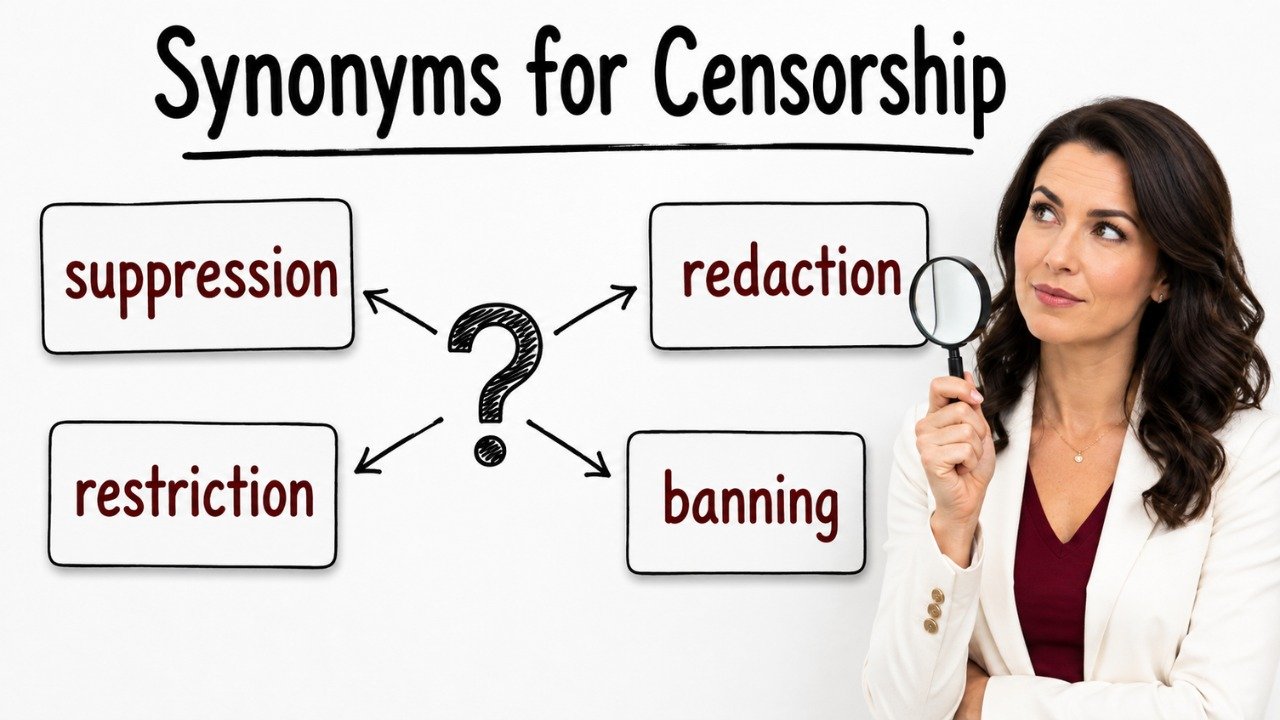
Quick Answer: The best synonyms for censorship include suppression, restriction, control, banning, prohibition, redaction, filtering, expurgation, silencing, and blocking. Use suppression when information or expression is deliberately prevented from reaching people. Choose redaction when specific words or details are removed from a document. Banning and prohibition suit legal or official restrictions, while filtering and blocking are useful for limiting access to content. Silencing is strongest when a person or viewpoint is prevented from being heard. The most accurate choice depends on what is restricted, who imposes the restriction, and how it is enforced.
Pronunciation and Word Details
Word: Censorship.
Pronunciation: /ˈsen.sə.ʃɪp/.
Part of Speech: Noun.
Meaning: The practice of limiting, removing, or preventing access to information, speech, writing, art, or other forms of expression.
US Pronunciation:
UK Pronunciation:
What Does “Censorship” Mean?
Censorship means controlling, limiting, removing, or preventing the communication of information, opinions, images, writing, or creative expression.
The word is a noun. It usually describes an action, policy, system, or practice rather than one individual act. A person or organization may censor something, while the wider practice is called censorship.
Censorship can involve removing part of a document, banning a publication, blocking access to information, preventing someone from speaking, or restricting what may be publicly communicated.
Public Communication: Censorship can limit what people are allowed to publish, report, discuss, or distribute.
Example: The writer criticized the censorship of political commentary.
Documents: Censorship may involve removing names, sentences, images, or confidential details.
Example: The document showed signs of censorship where several passages had been removed.
Creative Work: Censorship can affect books, films, art, music, performances, or other creative material.
Example: The artist argued that censorship weakened the meaning of the exhibition.
Personal Behavior: Self censorship occurs when people limit their own expression because they fear criticism, punishment, rejection, or consequences.
Example: Fear of workplace conflict led to self censorship during the meeting.
The word often carries a negative meaning because it can suggest unfair control over expression. However, not every form of editing, review, restriction, or content management is censorship. The correct term depends on the purpose, authority, method, and effect of the action.
Meaning, Tone, and Context of “Censorship”
Censorship is a serious and generally formal word. It is common in academic writing, political discussions, legal analysis, history, journalism, education, literature, communication studies, and debates about freedom of expression.
The tone is usually negative, critical, or concerned. Calling an action censorship often suggests that ideas or information are being unfairly restricted.
Formal Tone: The word is suitable for essays, reports, research, legal discussion, and public policy writing.
Example: The report examines the effects of censorship on access to information.
Critical Tone: Censorship often expresses disapproval of excessive or unjustified control.
Example: Critics described the publication ban as an act of censorship.
Neutral Academic Tone: In academic writing, censorship can be studied as a historical, political, legal, or cultural practice without emotional language.
Example: The course explores censorship in different historical periods.
Emotional Tone: In personal or public arguments, the word may sound strong because it suggests suppression, fear, unfairness, or loss of freedom.
Example: She felt that the removal of her statement was censorship.
Technical Context: Filtering, access restriction, redaction, moderation, and content removal may be more precise in technical or administrative discussions.
Example: The system uses content filtering to prevent access to restricted material.
Censorship is broader than simple editing. Editing improves or changes content, while censorship limits content because someone considers it unacceptable, dangerous, sensitive, offensive, or unauthorized.
When and How to Use “Censorship”
For Restrictions on Speech
Use censorship when an authority prevents people from expressing opinions, criticism, beliefs, or information.
Example: The policy was criticized as censorship of public debate.
For Restrictions on Publications
Use censorship when books, articles, reports, or other written materials are banned, altered, or prevented from being distributed.
Example: The author opposed censorship of historical books.
For Removed Information
Use censorship when information is deliberately removed to prevent readers from seeing it.
Example: Several missing paragraphs appeared to be the result of censorship.
For Restricted Media
Use censorship when news reports, broadcasts, images, or public messages are controlled.
Example: Media censorship limited public knowledge of the event.
For Creative Expression
Use censorship when artistic, literary, dramatic, or musical work is restricted because of its content or message.
Example: The removal of the painting created a debate about artistic censorship.
For Digital Access
Use censorship when websites, online information, messages, or digital services are blocked or filtered to limit access.
Example: The organization documented several forms of internet censorship.
For Political Control
Use censorship when political authorities restrict criticism, opposition, reporting, or public discussion.
Example: Political censorship prevented independent criticism from reaching the public.
For Personal Restraint
Use self censorship when a person chooses not to express an opinion because of fear, pressure, or possible consequences.
Example: The tense atmosphere encouraged self censorship among employees.
For Historical Analysis
Use censorship when discussing how authorities controlled information in a particular period.
Example: The historian studied wartime censorship of letters and reports.
For Legal Discussion
Use censorship when examining laws or official actions that restrict expression or access to information.
Example: The case raised important questions about censorship and lawful regulation.
Best Synonyms for Censorship
Suppression
Synonym: Suppression means deliberately preventing information, ideas, opinions, or expression from becoming known.
Example: The journalist condemned the suppression of important evidence.
Restriction
Synonym: Restriction means a rule or action that limits what may be said, published, viewed, or distributed.
Example: The publication restriction affected several historical documents.
Control
Synonym: Control means directing or limiting how information is created, shared, or accessed.
Example: Strict control of the press reduced the range of public debate.
Banning
Synonym: Banning means officially preventing something from being published, shown, sold, discussed, or distributed.
Example: The banning of the novel attracted widespread criticism.
Prohibition
Synonym: Prohibition means a formal rule or law that completely forbids an action or item.
Example: The prohibition on distributing the report remained in place.
Redaction
Synonym: Redaction means removing or hiding particular information from a document before it is released.
Example: The redaction protected the identities of private individuals.
Filtering
Synonym: Filtering means screening content and allowing only selected material to pass through.
Example: The network uses filtering to limit access to certain material.
Expurgation
Synonym: Expurgation means removing words, passages, or ideas considered unacceptable from a written work.
Example: The expurgation changed several important scenes in the book.
Silencing
Synonym: Silencing means preventing a person, group, opinion, or viewpoint from being heard.
Example: The speaker described the decision as the silencing of criticism.
Blocking
Synonym: Blocking means preventing access to information, communication, or content.
Example: The blocking of independent reports limited public awareness.
50 Synonyms for Censorship with Short Meanings
- Suppression: The deliberate prevention of expression or information.
- Restriction: A limit placed on speech, access, or publication.
- Control: Authority over what may be communicated or viewed.
- Banning: The official prevention of an activity or publication.
- Prohibition: A formal rule that forbids something.
- Redaction: The removal or concealment of selected details.
- Filtering: The screening of content before access is allowed.
- Screening: The examination of material for approval or removal.
- Expurgation: The removal of material considered unacceptable.
- Silencing: The prevention of a person or opinion from being heard.
- Muzzling: The forceful prevention of speech or criticism.
- Stifling: The suppression of ideas, creativity, or expression.
- Gagging: The prevention of someone from speaking publicly.
- Blocking: The prevention of access to information or content.
- Removal: The act of taking content out of circulation.
- Deletion: The erasure of words, images, files, or information.
- Omission: The deliberate exclusion of information.
- Excision: The cutting out of a passage or section.
- Concealment: The act of keeping information hidden.
- Withholding: The refusal to release or communicate information.
- Sanitization: The removal of material considered sensitive or offensive.
- Bowdlerization: The removal of supposedly improper parts from a text.
- Abridgment: The shortening of a work by removing material.
- Elimination: The complete removal of selected content.
- Exclusion: The act of leaving certain ideas or information out.
- Restraint: A limit placed on communication or publication.
- Curtailment: The reduction of freedom, access, or expression.
- Limitation: A boundary placed on what may be communicated.
- Regulation: Official control through rules or standards.
- Supervision: Oversight of communication or publication.
- Vetting: The careful examination of content before approval.
- Review: The inspection of material before release.
- Content Control: Authority over what content may appear.
- Information Control: Management of what information may be shared.
- Media Control: Restriction of news, reporting, or communication channels.
- Press Control: Authority over what the press may publish.
- Speech Restriction: A limit on spoken or written expression.
- Publication Restriction: A limit on producing or distributing written material.
- Access Restriction: A limit on who may view information.
- Communication Restriction: A rule limiting the exchange of messages or ideas.
- Prior Restraint: Prevention of publication before material is released.
- News Blackout: A deliberate prevention of news coverage.
- Information Blackout: A situation in which information is deliberately withheld.
- Gag Order: An official direction preventing public discussion.
- Embargo: A temporary restriction on releasing information.
- Proscription: A formal act of forbidding something.
- Interdiction: An official act of stopping or prohibiting an activity.
- Thought Control: An attempt to control beliefs, ideas, or opinions.
- Self Censorship: The voluntary limitation of personal expression.
- Content Moderation: The review and management of content according to rules.
Read Also:
Synonyms for Farm
Synonyms for Censorship by Context
When Censorship Means Suppression
Suppression, silencing, muzzling, stifling, and gagging are suitable when someone prevents an idea, opinion, or criticism from being heard.
Suppression is the most neutral formal option. Silencing focuses on the person or viewpoint that loses a voice. Muzzling and gagging are stronger and more emotional.
Example With Censorship: The decision was criticized as censorship of opposing views.
Example With Suppression: The decision was criticized as suppression of opposing views.
Example With Silencing: The decision was described as the silencing of opposing voices.
When Censorship Means Removing Material
Redaction, deletion, excision, omission, expurgation, and bowdlerization describe different forms of removal.
Redaction is best when confidential details are hidden in a document. Expurgation refers to removing material considered unacceptable. Excision means cutting out a particular section.
Example With Censorship: The censorship removed several names from the report.
Example With Redaction: The redaction removed several names from the report.
Example With Excision: The excision of several paragraphs changed the document.
When Censorship Means an Official Ban
Banning, prohibition, proscription, interdiction, and restriction are useful when an authority formally forbids publication, access, or distribution.
Banning is common and direct. Prohibition is more formal. Proscription is especially formal and often appears in legal or official writing.
Example With Censorship: The censorship prevented the book from being sold.
Example With Banning: The banning of the book prevented it from being sold.
Example With Prohibition: The prohibition stopped the report from being distributed.
When Censorship Means Control of Information
Information control, media control, press control, content control, and communication restriction describe organized systems that manage what people can know or share.
These phrases are useful in reports, essays, and policy discussions because they identify the specific type of control.
Example With Censorship: Censorship limited what the public could learn.
Example With Information Control: Information control limited what the public could learn.
Example With Media Control: Media control reduced access to independent reporting.
When Censorship Means Limited Access
Blocking, filtering, access restriction, screening, and content control are useful when material remains available but certain users cannot reach it.
Blocking suggests complete prevention. Filtering suggests selection based on rules. Screening describes examining material before access or publication.
Example With Censorship: The censorship prevented users from viewing the page.
Example With Blocking: The blocking prevented users from viewing the page.
Example With Filtering: The filtering system restricted access to selected material.
When Censorship Means Preventing Publication
Prior restraint, publication restriction, embargo, gag order, and news blackout apply to different forms of publication control.
Prior restraint prevents material from being published in advance. An embargo delays release until a set time. A gag order prevents particular people from discussing information publicly.
Example With Censorship: The court order created censorship before the report was published.
Example With Prior Restraint: The court order acted as prior restraint before publication.
Example With Gag Order: The gag order prevented the participants from discussing the case.
When Censorship Is Self Imposed
Self censorship, restraint, silence, hesitation, and withholding may describe a person limiting their own words.
Self censorship is the clearest term when fear, pressure, or expected consequences cause someone to avoid speaking freely.
Example With Censorship: Fear created censorship among the employees.
Example With Self Censorship: Fear created self censorship among the employees.
Example With Withholding: The employees began withholding their honest opinions.
When Censorship Means Editing Sensitive Material
Sanitization, expurgation, redaction, omission, and content review may be appropriate when parts of a work are changed or removed.
Sanitization suggests making material appear safer or less offensive. Redaction protects specific information. Expurgation removes supposedly unacceptable passages.
Example With Censorship: The censorship made the original story less controversial.
Example With Sanitization: The sanitization made the original story less controversial.
Example With Expurgation: The expurgation removed several important passages.
Another Word for Censorship
Suppression is often the best single replacement for censorship because it broadly describes the deliberate prevention of information, ideas, opinions, or expression.
However, the best alternative depends on the exact action. Redaction is better for removed document details, banning is better for an official prohibition, and filtering is better for controlled access to digital content.
Original: The reporter wrote about censorship of important evidence.
Better Option: The reporter wrote about the suppression of important evidence.
Original: The document contained several examples of censorship.
Better Option: The document contained several redacted sections.
Original: The censorship prevented the novel from being sold.
Better Option: The banning prevented the novel from being sold.
Original: The system uses censorship to limit access to selected pages.
Better Option: The system uses content filtering to limit access to selected pages.
When Not to Use “Censorship”
Censorship is a strong word and should not be used for every form of editing, review, moderation, privacy protection, or rule enforcement.
When Information Is Removed for Privacy
Use redaction when personal, confidential, or legally protected details are hidden.
Weak: The report used censorship to protect the witnesses’ names.
Better: The report used redaction to protect the witnesses’ names.
When Content Is Reviewed Before Publication
Use review, screening, or vetting when material is checked for accuracy, quality, safety, or compliance.
Weak: The editor performed censorship before publishing the article.
Better: The editor performed a factual review before publishing the article.
When a Complete Ban Is Involved
Use banning or prohibition when something is officially and completely forbidden.
Weak: The new rule introduced censorship of the book.
Better: The new rule introduced a ban on the book.
When Access Is Technically Limited
Use blocking, filtering, or access restriction when describing the technical method.
Weak: The network applies censorship to selected pages.
Better: The network applies content filtering to selected pages.
When the Speaker Voluntarily Remains Silent
Use self censorship when a person limits their own expression without a direct external order.
Weak: Employees experienced censorship because they feared criticism.
Better: Employees practiced self censorship because they feared criticism.
When the Meaning Is Too Broad
Censorship may be unclear if the reader does not know what was restricted or who imposed the restriction.
Weak: The organization faced censorship.
Better: The organization faced a publication restriction imposed by the authority.
When the Word Sounds Overly Accusatory
Censorship may imply unfair or oppressive control. Use moderation, regulation, editing, or review when the action is routine and accurately described by those terms.
Weak: Removing repeated comments was censorship.
Better: Removing repeated comments was part of routine content moderation.
Words Commonly Confused With Censorship
Censorship vs Suppression: Censorship is the organized control or removal of expression. Suppression is broader and can involve preventing information, feelings, evidence, protest, or activity.
Censorship vs Redaction: Censorship can affect complete works, ideas, or access. Redaction removes or hides specific information from a document.
Censorship vs Banning: Censorship includes many forms of control. Banning means completely forbidding something.
Censorship vs Moderation: Censorship limits expression, often because content is considered unacceptable or threatening. Moderation manages content according to stated rules and does not always involve unfair suppression.
Censorship vs Editing: Censorship removes or limits content because of its message or acceptability. Editing changes content for clarity, accuracy, structure, length, or style.
Censorship vs Regulation: Censorship controls expression or information. Regulation establishes rules for conduct, access, safety, quality, or operation.
Censorship vs Filtering: Censorship is the broader practice. Filtering is one method used to allow, limit, or block selected content.
Censorship vs Secrecy: Censorship prevents communication or access. Secrecy keeps information hidden, sometimes before anyone attempts to communicate it.
Censorship vs Propaganda: Censorship removes or blocks unwanted information. Propaganda promotes selected messages to influence opinions.
Censorship vs Censure: Censorship means restricting expression. Censure means expressing strong official criticism of someone’s behavior.
Which Synonym Should You Choose?
Choose suppression when writing generally about ideas, evidence, criticism, or information being deliberately prevented from reaching people.
Choose restriction when the action limits expression without completely forbidding it.
Choose banning when a book, report, performance, publication, or topic is officially forbidden.
Choose prohibition in formal or legal writing when a rule completely forbids an action.
Choose redaction when names, details, sentences, or confidential information are removed from a document.
Choose filtering when a system selects which digital content users may access.
Choose blocking when access is completely prevented.
Choose screening when content is examined before approval, release, or access.
Choose expurgation when unacceptable passages are removed from a written or creative work.
Choose silencing when a person, group, or viewpoint is prevented from being heard.
Choose muzzling in strong or emotional writing about forced silence.
Choose press control when discussing restrictions placed on journalism or news publication.
Choose media control when discussing wider control over reporting, broadcasting, or public communication.
Choose prior restraint in legal or academic writing when publication is stopped before it occurs.
Choose news blackout when information about an event is deliberately kept out of news coverage.
Choose gag order when an official direction prevents people from discussing a matter.
Choose self censorship when individuals limit their own speech because of fear, pressure, or expected consequences.
Choose content moderation when material is managed under stated rules and the action does not necessarily amount to censorship.
Real Life Examples of “Censorship” in Sentences
Original: The journalist criticized the censorship of the investigation.
Better Option: The journalist criticized the suppression of information about the investigation.
Original: Censorship prevented the newspaper from publishing the report.
Better Option: Prior restraint prevented the newspaper from publishing the report.
Original: The document contained obvious censorship.
Better Option: The document contained several redacted passages.
Original: The writer opposed censorship of the novel.
Better Option: The writer opposed the banning of the novel.
Original: The system uses censorship to control access.
Better Option: The system uses content filtering to control access.
Original: Employees complained about censorship during meetings.
Better Option: Employees complained about the silencing of critical opinions during meetings.
Original: Fear of punishment caused censorship among the students.
Better Option: Fear of punishment caused self censorship among the students.
Original: The censorship removed several scenes from the play.
Better Option: The expurgation removed several scenes from the play.
Original: The law introduced censorship of public discussion.
Better Option: The law introduced restrictions on public discussion.
Original: Censorship kept important facts away from the public.
Better Option: Information suppression kept important facts away from the public.
Synonym Groups and Usage Differences
Suppression Group
Suppression, silencing, muzzling, stifling, and gagging describe efforts to prevent ideas, criticism, or voices from being heard.
Suppression is formal and broad. Silencing focuses on loss of voice, while muzzling and gagging are stronger and more emotionally charged.
Example: The suppression of criticism prevented an open discussion.
Removal Group
Redaction, deletion, omission, excision, expurgation, and bowdlerization involve taking material out.
Redaction is precise and often protects confidential details. Expurgation removes material considered unacceptable. Bowdlerization usually refers to removing supposedly offensive parts from literature.
Example: The redaction concealed the names of private individuals.
Legal Restriction Group
Banning, prohibition, proscription, interdiction, prior restraint, and gag order describe formal limits imposed by rules, laws, courts, or authorities.
Prior restraint concerns publication before release. A gag order limits what named people may publicly discuss.
Example: The prohibition prevented distribution of the document.
Information Control Group
Information control, media control, press control, content control, and communication restriction focus on organized control over access and communication.
These phrases are especially useful in formal reports and academic essays.
Example: Information control reduced public access to independent accounts.
Access Group
Blocking, filtering, screening, and access restriction describe limits on who may reach particular material.
Blocking is complete. Filtering is selective. Screening involves checking content before it is allowed.
Example: Content filtering restricted access to selected pages.
Document Group
Redaction, excision, omission, abridgment, sanitization, and deletion are useful for documents and written works.
Abridgment shortens a work, while sanitization removes material to make it appear safer or less controversial.
Example: The sanitization weakened the original argument.
Personal Restraint Group
Self censorship, restraint, withholding, silence, and hesitation describe limitations imposed by the speaker.
Self censorship is the clearest term when fear or pressure causes someone to remain silent.
Example: Fear of professional consequences encouraged self censorship.
Publication Group
Publication restriction, news blackout, embargo, prior restraint, and banning relate directly to the release of information.
An embargo usually delays publication, while a ban prevents it entirely.
Example: The temporary embargo delayed publication of the findings.
Antonyms of Censorship
The opposite of censorship depends on whether the sentence concerns speech, access, publication, information, or personal expression.
Freedom of Expression: The ability to communicate ideas and opinions without unfair restriction.
Free Speech: The freedom to express views openly.
Openness: A willingness to allow communication and discussion.
Transparency: The clear and accessible sharing of information.
Disclosure: The act of making information known.
Publication: The act of making written or creative material publicly available.
Release: The act of making information or content available.
Access: The ability to view, obtain, or use information.
Circulation: The distribution of information or publications.
Permission: Official approval to communicate or publish something.
Openness of Debate: The freedom to discuss different ideas publicly.
Unrestricted Communication: The exchange of information without unnecessary limits.
Public Availability: The condition of being accessible to everyone.
Free Inquiry: The ability to investigate and discuss ideas without suppression.
Full Disclosure: The release of all relevant information.
Comparison: Censorship vs Related Words
Censorship vs Suppression
Censorship is usually an organized practice that controls expression, publication, or access. Suppression is broader and may describe any deliberate effort to prevent something from becoming known or active.
Example With Censorship: The censorship prevented publication of the article.
Example With Suppression: The suppression of evidence affected the investigation.
Censorship vs Redaction
Censorship is broad and may affect entire ideas, works, or communication systems. Redaction removes selected details from a document.
Example With Censorship: The censorship prevented the complete report from being released.
Example With Redaction: The redaction concealed private names in the report.
Censorship vs Banning
Censorship can involve partial removal, access limits, or complete prohibition. Banning means something is officially forbidden.
Example With Censorship: The censorship removed several chapters from the book.
Example With Banning: The banning prevented the book from being sold.
Censorship vs Filtering
Censorship describes the wider practice of controlling content. Filtering is a method that screens material according to selected rules.
Example With Censorship: The censorship limited access to political commentary.
Example With Filtering: The filtering system blocked selected terms.
Censorship vs Content Moderation
Censorship often suggests unfair suppression of expression. Content moderation involves managing material according to established rules and may include legitimate removal of harmful, illegal, or irrelevant content.
Example With Censorship: Critics called the removal an attempt at censorship.
Example With Content Moderation: The forum uses content moderation to remove repeated spam.
Censorship vs Editing
Censorship controls material because of its message, viewpoint, or acceptability. Editing improves clarity, correctness, structure, length, or style.
Example With Censorship: The censorship removed criticism from the article.
Example With Editing: The editing made the article clearer and shorter.
Censorship vs Regulation
Censorship controls information or expression. Regulation creates rules governing behavior, safety, access, or operation.
Example With Censorship: The censorship prevented the report from being discussed.
Example With Regulation: The regulation established standards for publishing confidential data.
Censorship vs Secrecy
Censorship prevents information from being communicated or accessed. Secrecy keeps information hidden from others.
Example With Censorship: Censorship prevented the letter from being distributed.
Example With Secrecy: Secrecy surrounded the private negotiations.
Censorship vs Propaganda
Censorship removes or restricts unwanted messages. Propaganda promotes selected messages to influence attitudes or behavior.
Example With Censorship: Censorship blocked opposing reports.
Example With Propaganda: Propaganda repeatedly promoted one approved viewpoint.
Censorship vs Censure
Censorship means controlling or restricting expression. Censure means formally criticizing a person or organization.
Example With Censorship: The censorship limited public discussion.
Example With Censure: The committee issued a formal censure of the official.
Common Phrases and Expressions With “Censorship”
Government Censorship: Control of information or expression by public authorities.
Media Censorship: Restriction of news, broadcasting, or public communication.
Press Censorship: Control over what newspapers and journalists may publish.
Internet Censorship: Blocking or limiting access to online information.
Political Censorship: Restriction of political opinions, criticism, or opposition.
Literary Censorship: Removal, alteration, or banning of written works.
Artistic Censorship: Restriction of visual, dramatic, musical, or creative expression.
Religious Censorship: Restriction of material because of religious beliefs or standards.
Self Censorship: Voluntary restraint caused by fear, pressure, or expected consequences.
Strict Censorship: Severe control over expression, access, or publication.
Official Censorship: Restriction imposed by an authorized institution or authority.
Censorship Laws: Laws that permit or establish limits on information or expression.
Common Mistakes to Avoid
Treating All Editing as Censorship
Editing may improve grammar, clarity, structure, tone, or accuracy. Censorship specifically involves restricting content, expression, or access.
Incorrect: Correcting spelling errors is censorship.
Better: Correcting spelling errors is editing.
Treating All Moderation as Censorship
Moderation and censorship can overlap, but they are not always identical. Moderation may apply clear rules to manage harmful, irrelevant, or repeated content.
Incorrect: Every removed message proves censorship.
Better: The reason, rule, and method of removal determine whether the action is moderation or censorship.
Confusing Censor With Censure
Censor means to examine and remove material. Censure means to express strong formal criticism.
Incorrect: The committee censored the official for misconduct.
Correct: The committee censured the official for misconduct.
Using Censorship When Redaction Is More Accurate
Censorship is too broad when only private or confidential details are hidden.
Weak: The legal document contained censorship.
Better: The legal document contained redactions.
Using a Strong Term Without Evidence
Censorship can sound accusatory. Explain what was removed, restricted, banned, or blocked before applying the term.
Vague: The editor practiced censorship.
Clearer: The editor removed all criticism of the policy before publication.
Failing to Identify the Agent
Readers should know who imposed the restriction whenever that information is relevant.
Vague: The report was affected by censorship.
Clearer: The authority restricted publication of several sections of the report.
Repeating Censorship Too Often
Use precise alternatives such as suppression, redaction, restriction, banning, filtering, or silencing to improve clarity.
Repetitive: Censorship affected the book because censorship removed passages and censorship limited distribution.
Improved: The book was expurgated, and publication restrictions limited its distribution.
Choosing an Overly Broad Synonym
Do not use banning when material is only partly removed. Do not use redaction when an entire work is prohibited.
Incorrect: Three names were banned from the document.
Correct: Three names were redacted from the document.
Using the Wrong Preposition
Use censorship of when identifying the material being restricted. Use censorship by when naming the person, group, or authority imposing it.
Correct: The article discusses censorship of political speech.
Correct: The article discusses censorship by the authorities.
Ignoring Context and Purpose
A privacy measure, safety rule, editorial correction, and political restriction may all remove content for different reasons. Choose a word that accurately reflects the purpose and effect.
Conclusion
The most useful synonyms for censorship depend on the type of restriction involved. Suppression is the strongest general alternative, while banning and prohibition suit complete official restrictions. Redaction is best for removed document details, filtering and blocking describe controlled access, and silencing emphasizes the prevention of a voice or viewpoint. Self censorship applies when people limit their own expression. Understanding these differences helps you choose precise, balanced language when discussing speech, publication, media, information, documents, and creative work.
FAQs About Synonyms for Censorship
What Is the Best Synonym for Censorship?
Suppression is the best general synonym because it describes the deliberate prevention of information, ideas, or expression.
Is Restriction a Synonym for Censorship?
Yes. Restriction is a useful synonym when expression or access is limited rather than completely banned.
What Is a Formal Synonym for Censorship?
Suppression, prohibition, prior restraint, information control, and publication restriction are suitable formal alternatives.
What Is the Difference Between Censorship and Redaction?
Censorship broadly controls expression or access. Redaction removes specific information from a document.
Is Content Moderation the Same as Censorship?
Not always. Content moderation manages material according to rules, while censorship often suggests broader or unfair suppression of expression.
What Is Another Word for Self Censorship?
Personal restraint, withholding, guarded speech, and voluntary silence are close alternatives, although self censorship is usually the clearest term.
What Is the Opposite of Censorship?
Freedom of expression, free speech, openness, transparency, disclosure, and unrestricted communication are common opposites.
