
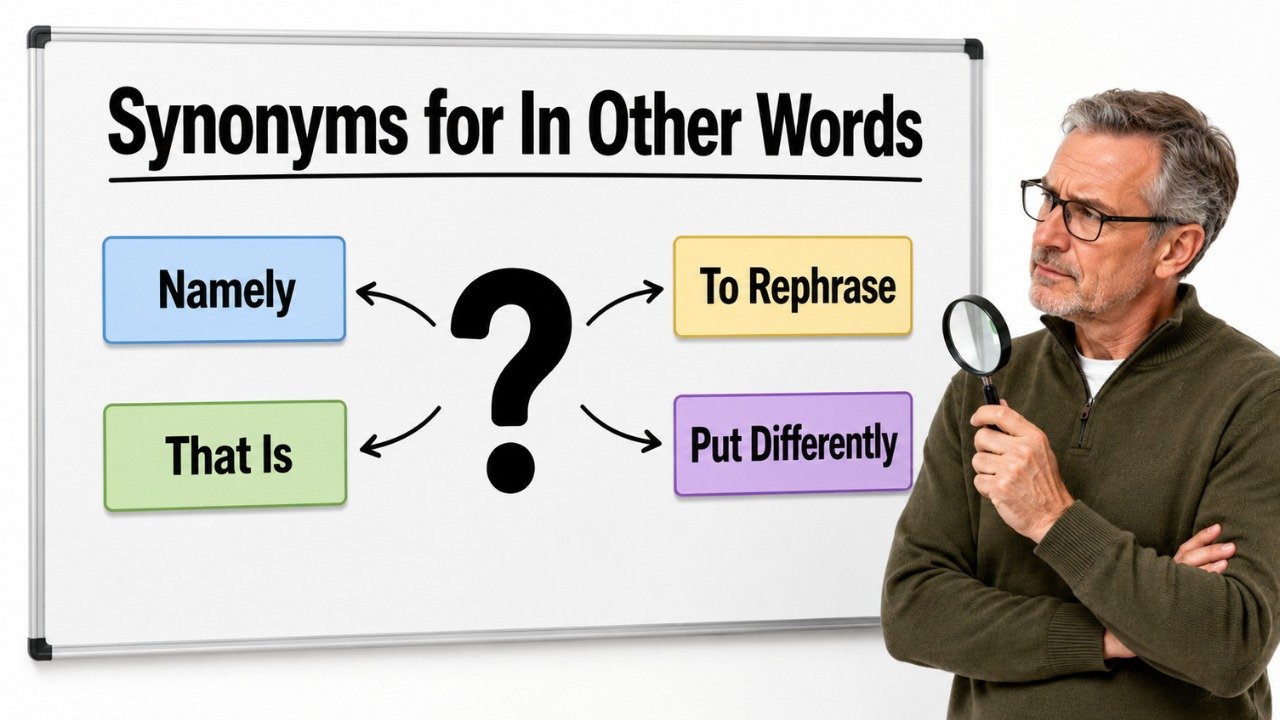
Quick Answer: The best synonyms for in other words include that is to say, put differently, to put it another way, simply put, in simpler terms, stated differently, expressed another way, to rephrase, in plain language, and essentially. Use that is to say in formal writing, put differently when restating an idea, simply put for concise explanations, and in simpler terms when making difficult information easier to understand. The best choice depends on whether you are clarifying, simplifying, summarizing, or explaining an idea more precisely.
Pronunciation and Word Details
Word: In Other Words
Pronunciation: /ɪn ˈʌðə wɜːdz/
Part of Speech: Adverbial phrase and discourse marker
Meaning: A phrase used to restate, clarify, simplify, or explain an idea in a different way.
US Pronunciation:
UK Pronunciation:
What Does “In Other Words” Mean?
In other words means expressing the same idea again using different language so that it becomes clearer, simpler, or easier to understand.
It functions mainly as an adverbial phrase or discourse marker. Writers and speakers use it to introduce a restatement of something already said.
Example: The project must be completed before Friday. In other words, we have only four days left.
The phrase does not normally introduce completely new information. Instead, it explains or reformulates an earlier idea.
Example: She is responsible for coordinating the entire event. In other words, she manages all the major arrangements.
In academic writing, in other words can help clarify a complex argument. In conversation, it can make an explanation easier to follow. In professional communication, it can restate an instruction or conclusion more directly.
Meaning, Tone, and Context of “In Other Words”
In other words has a neutral and explanatory tone. It works naturally in formal, academic, professional, and conversational writing.
The phrase usually signals clarification. It tells the reader that the next statement expresses approximately the same meaning as the previous one but in clearer or different language.
In formal writing, alternatives such as that is to say, stated differently, and expressed another way can sound polished.
Example: The evidence does not establish causation. Stated differently, the relationship does not prove that one factor caused the other.
In casual conversation, phrases such as basically, simply put, and what I mean is may sound more natural.
Example: We need to leave before six. Basically, we cannot stay for dinner.
In educational writing, in simpler terms and put simply are helpful when explaining difficult ideas.
Example: The material expands when heated. In simpler terms, it becomes slightly larger as its temperature rises.
In other words is useful because it guides the reader from one expression of an idea to another without changing the central meaning.
When and How to Use “In Other Words”
For Clarification
Use in other words when the first statement may need additional explanation.
Example: The results were inconclusive. In other words, the evidence was not strong enough to support a definite answer.
For Simplification
Use the phrase when translating technical or difficult information into easier language.
Example: The substance is highly soluble. In other words, it dissolves easily.
For Restating an Idea
Use in other words when you want to repeat the same point with different wording.
Example: The deadline cannot be extended. In other words, the work must be submitted on time.
For Explaining a Conclusion
The phrase can introduce the practical meaning of a previous statement.
Example: Attendance has fallen for three consecutive weeks. In other words, fewer people are participating.
For Emphasis
Restating an important point can make its meaning stronger.
Example: The decision is final. In other words, the matter is no longer open for discussion.
For Academic Writing
In other words can clarify arguments, definitions, evidence, and conclusions.
Example: The variables are positively correlated. In other words, they tend to increase together.
For Professional Communication
The phrase is useful when instructions or responsibilities need to be made clearer.
Example: All requests require approval before processing. In other words, do not proceed without authorization.
Best Synonyms for In Other Words
That Is to Say: Introduces a clearer or more precise explanation of the previous statement.
Example: The policy applies universally, that is to say, every employee must follow it.
Put Differently: Restates the same idea using another form of expression.
Example: Put differently, the problem concerns timing rather than cost.
To Put It Another Way: Introduces another explanation of the same idea.
Example: To put it another way, we need better planning before we expand.
Simply Put: Introduces a short and easy explanation.
Example: Simply put, the plan costs more than we can afford.
In Simpler Terms: Explains difficult information using easier language.
Example: In simpler terms, the machine converts heat into movement.
Stated Differently: Presents the same point using different wording.
Example: Stated differently, success depends on consistent preparation.
Expressed Another Way: Restates an idea through a different expression.
Example: Expressed another way, the proposal asks us to invest now for future benefits.
To Rephrase: Introduces a revised expression of the same meaning.
Example: To rephrase, the issue is not whether we can act but when we should act.
In Plain Language: Explains something without technical or complicated wording.
Example: In plain language, the agreement allows either party to end the arrangement.
Essentially: Introduces the central meaning or basic point.
Example: Essentially, the two proposals seek the same result.
50 Synonyms for In Other Words with Short Meanings
- That Is to Say: Used to clarify what has just been stated.
- That Is: Introduces an explanation or clarification.
- Put Differently: Expresses the same idea using different wording.
- To Put It Differently: Introduces another version of the same thought.
- To Put It Another Way: Restates an idea from a different angle.
- Put Another Way: Gives an alternative explanation.
- Said Differently: Expresses the same meaning with different words.
- Said Another Way: Introduces another wording of the same idea.
- Stated Differently: Restates a statement in different language.
- Stated Another Way: Presents the same point through another expression.
- Expressed Differently: Communicates the same meaning using different wording.
- Expressed Another Way: Gives another verbal form of the same idea.
- Worded Differently: Describes the same message using changed wording.
- Rephrased: Presented again using different words.
- To Rephrase: Introduces a revised version of an earlier statement.
- To Reword It: Introduces the same thought using changed wording.
- In Simpler Terms: Makes a difficult idea easier to understand.
- In Simple Terms: Explains something using uncomplicated language.
- Simply Put: States an idea in a clear and concise way.
- Put Simply: Presents the basic meaning clearly.
- To Put It Simply: Introduces an uncomplicated explanation.
- More Simply: Restates something in an easier form.
- In Plain Language: Explains an idea without complicated terminology.
- In Plain Terms: Expresses something directly and simply.
- In Everyday Language: Explains an idea using familiar vocabulary.
- In Easier Words: Restates something using simpler vocabulary.
- To Explain It Simply: Introduces an easier explanation.
- To Say It Simply: Gives a direct and uncomplicated restatement.
- What This Means Is: Introduces the practical meaning of a statement.
- This Means That: Explains the meaning or consequence of an earlier idea.
- Which Means: Introduces an explanation or result.
- Meaning: Introduces what an earlier statement signifies.
- In Meaning: Refers to the essential sense of what was said.
- In Essence: Expresses the central meaning of an idea.
- Essentially: Introduces the basic or most important point.
- Basically: Gives the central meaning in a less formal way.
- In Effect: Describes the practical meaning or result.
- Effectively: Indicates what something amounts to in practice.
- In Short: Summarizes an idea briefly.
- In Brief: Gives a concise restatement or summary.
- To Sum It Up: Restates the main point concisely.
- To Clarify: Introduces information intended to make an idea clearer.
- For Clarity: Signals that an explanation is being made clearer.
- More Clearly: Introduces a clearer expression of an earlier idea.
- More Precisely: Restates an idea with greater exactness.
- More Specifically: Gives a narrower or more detailed explanation.
- To Be Clear: Introduces a direct clarification.
- What I Mean Is: Clarifies the speaker’s intended meaning.
- In Other Terms: Restates an idea using different terminology.
- Another Way to Say It Is: Introduces a different expression with similar meaning.
Read Also:
Synonyms for Left
Synonyms for In Other Words by Context
When In Other Words Means Restating an Idea
Put differently, stated differently, expressed another way, and to put it another way are strong choices when the purpose is simply to express the same meaning again.
Put Differently: Useful in formal and neutral writing.
Example: Put differently, the problem involves resources rather than motivation.
Stated Differently: Suitable for essays, reports, and academic discussion.
Example: Stated differently, the evidence supports association but not direct causation.
Expressed Another Way: Useful when presenting the same concept from another perspective.
Example: Expressed another way, the strategy values long term stability over immediate growth.
To Put It Another Way: Natural in both formal and conversational writing.
Example: To put it another way, we need to solve the underlying problem first.
When In Other Words Means Simplifying
Simply put, in simpler terms, in plain language, and to put it simply are ideal when the goal is to make an explanation easier.
Simply Put: Best for brief explanations.
Example: Simply put, we are spending more than we earn.
In Simpler Terms: Useful for educational and technical explanations.
Example: In simpler terms, the device stores energy and releases it when needed.
In Plain Language: Helpful when removing technical or formal wording.
Example: In plain language, the rule says that everyone must receive equal treatment.
To Put It Simply: Natural when summarizing a complicated point.
Example: To put it simply, the plan cannot work without additional funding.
When In Other Words Means Clarifying
That is to say, to clarify, to be clear, and what this means is can introduce clarification.
That Is to Say: Formal and precise.
Example: The decision is irreversible, that is to say, it cannot later be cancelled.
To Clarify: Useful when preventing misunderstanding.
Example: To clarify, the meeting has been moved rather than cancelled.
To Be Clear: Direct and useful when emphasizing intended meaning.
Example: To be clear, participation is optional.
What This Means Is: Useful when explaining practical significance.
Example: What this means is that every application must be reviewed individually.
When In Other Words Means Summarizing
In essence, essentially, in short, and in brief work when the restatement focuses on the central point.
In Essence: Suitable for formal summaries.
Example: In essence, the argument is about fairness.
Essentially: Useful in neutral writing and conversation.
Example: Essentially, both approaches solve the same problem.
In Short: Introduces a concise conclusion.
Example: In short, the experiment produced no meaningful improvement.
In Brief: Formal and concise.
Example: In brief, the proposal requires greater investment but offers stronger protection.
When In Other Words Means Explaining a Consequence
This means that, which means, in effect, and effectively can explain what a previous statement implies.
This Means That: Directly explains a consequence.
Example: The permit has expired. This means that work cannot continue legally.
Which Means: Common in conversational and explanatory writing.
Example: The office closes early, which means we need to arrive before four.
In Effect: Explains the practical result.
Example: The new condition increases the minimum requirement. In effect, fewer applicants will qualify.
Effectively: Describes what something amounts to in practice.
Example: The restriction effectively prevents new entries after the deadline.
Another Word for In Other Words
The best single alternative for in other words is often put differently because it directly signals that the same idea is about to be expressed using different language. However, simply put is better for simplification, while that is to say works well in formal clarification.
Original: The plan requires more resources than we currently have. In other words, we cannot begin immediately.
Better Option: The plan requires more resources than we currently have. Put differently, we cannot begin immediately.
Original: The process involves several complex calculations. In other words, it is difficult to complete manually.
Better Option: The process involves several complex calculations. Simply put, it is difficult to complete manually.
Original: The agreement applies to every department. In other words, nobody is exempt.
Better Option: The agreement applies to every department. That is to say, nobody is exempt.
Original: The evidence does not prove the claim. In other words, more research is necessary.
Better Option: The evidence does not prove the claim. Stated differently, more research is necessary.
When Not to Use “In Other Words”
Do not use in other words when the second statement introduces a completely new idea rather than restating the first one.
Weak: The meeting begins at nine. In other words, the presentation includes six sections.
Better: The meeting begins at nine. In addition, the presentation includes six sections.
Avoid using the phrase repeatedly in the same paragraph because it can make writing sound mechanical.
Weak: The proposal is expensive. In other words, it requires significant funding. In other words, the budget must increase.
Better: The proposal is expensive. Put simply, it requires a larger budget.
Do not use in other words when a more precise transition is needed.
Weak: Sales increased by twelve percent. In other words, customer satisfaction also improved.
Better: Sales increased by twelve percent. Additionally, customer satisfaction improved.
The second statement in that example does not restate the first. It adds separate information.
In highly concise writing, in other words can sometimes be unnecessary if the first sentence is already clear.
Weak: The deadline is Friday. In other words, the work must be submitted by Friday.
Better: The work must be submitted by Friday.
Words Commonly Confused With In Other Words
In Other Words vs That Is: Both introduce clarification, but that is is usually shorter and can also introduce a precise definition or correction.
In Other Words vs For Example: In other words restates the same idea. For example introduces an illustration of the idea rather than another wording of it.
In Other Words vs In Other Terms: Both can introduce a restatement, although in other terms often emphasizes a change in terminology.
In Other Words vs In Short: In other words reformulates an idea, while in short summarizes it.
In Other Words vs In Other Ways: In other words refers to different wording. In other ways means through different methods or manners.
In Other Words vs Namely: In other words restates an idea. Namely usually identifies specific people, things, or details.
In Other Words vs Essentially: In other words signals a reformulation, while essentially focuses on the central or fundamental meaning.
In Other Words vs In Effect: In other words normally restates meaning, whereas in effect often explains the practical consequence of something.
Which Synonym Should You Choose?
Choose that is to say when formal writing requires a clear restatement or clarification.
Choose put differently when you want to present the same idea from another angle.
Choose simply put when you want a short and direct explanation.
Choose in simpler terms when explaining difficult concepts to a general audience.
Choose stated differently in essays, reports, research writing, and analytical discussion.
Choose to put it another way when you want a natural alternative that works in both speech and writing.
Choose in plain language when removing technical, legal, academic, or specialized terminology.
Choose essentially when the goal is to communicate the central idea rather than repeat every detail.
Choose to clarify when the main purpose is to prevent misunderstanding.
Choose what I mean is in casual conversation when explaining personal meaning or intention.
For academic writing, stated differently, put differently, that is to say, and more precisely are especially useful.
For reports and professional communication, to clarify, in essence, put differently, and this means that can provide clear transitions.
For casual conversation, basically, what I mean is, simply put, and to put it another way sound natural.
For technical explanations, in simpler terms, in plain language, and put simply can make complex information more accessible.
Real Life Examples of “In Other Words” in Sentences
Original: The proposal exceeds the available budget. In other words, we cannot afford it right now.
Better Option: The proposal exceeds the available budget. Simply put, we cannot afford it right now.
Original: The results did not reach statistical significance. In other words, the evidence was not strong enough.
Better Option: The results did not reach statistical significance. Put differently, the evidence was not strong enough.
Original: Every participant must register before entering. In other words, registration is compulsory.
Better Option: Every participant must register before entering. That is to say, registration is compulsory.
Original: The device requires a continuous electrical supply. In other words, it will stop working during an outage.
Better Option: The device requires a continuous electrical supply. In simpler terms, it will stop working during an outage.
Original: The committee has rejected both proposals. In other words, neither option will move forward.
Better Option: The committee has rejected both proposals. This means that neither option will move forward.
Original: His role includes planning, supervision, and final approval. In other words, he oversees the entire process.
Better Option: His role includes planning, supervision, and final approval. Essentially, he oversees the entire process.
Original: The material absorbs moisture from the surrounding air. In other words, it becomes damp easily.
Better Option: The material absorbs moisture from the surrounding air. In plain language, it becomes damp easily.
Original: The deadline remains unchanged. In other words, additional time will not be provided.
Better Option: The deadline remains unchanged. To be clear, additional time will not be provided.
Original: Demand has exceeded production capacity. In other words, more orders are arriving than can currently be filled.
Better Option: Demand has exceeded production capacity. Put another way, more orders are arriving than can currently be filled.
Original: The evidence supports only one reasonable interpretation. In other words, the conclusion is difficult to dispute.
Better Option: The evidence supports only one reasonable interpretation. Stated differently, the conclusion is difficult to dispute.
Synonym Groups and Usage Differences
Restatement Group
Put differently, stated differently, expressed another way, said another way, and to rephrase belong to the restatement group.
These expressions tell the reader that the next sentence communicates approximately the same meaning through different wording.
Example: Put differently, the disagreement concerns method rather than purpose.
Simplification Group
Simply put, put simply, in simpler terms, in plain language, and in easy words make complex information easier to understand.
They are especially useful in educational, technical, and explanatory writing.
Example: In simpler terms, the system uses stored information to predict what may happen next.
Clarification Group
That is to say, to clarify, to be clear, more clearly, and what this means is focus on removing uncertainty.
These expressions are useful when the original statement could be misunderstood.
Example: To clarify, the new requirement applies only to applications submitted after Monday.
Summary Group
In essence, essentially, in short, and in brief focus on the central message rather than providing a direct word for word restatement.
Example: In essence, the proposal asks for more time and fewer restrictions.
Consequence Group
This means that, which means, in effect, and effectively explain the practical implication of an earlier statement.
Example: The road will remain closed until Friday. This means that drivers must use another route.
Conversational Group
Basically, what I mean is, to put it simply, and another way to say it is are natural in speech and informal explanation.
Example: What I mean is, we should solve the urgent problem before discussing future improvements.
Antonyms of In Other Words
In other words does not have a perfect dictionary antonym because it is a discourse marker used for restatement. However, several expressions perform an opposite communicative function by introducing contrast, difference, or new information rather than repeating the same meaning.
On the Contrary: Introduces an idea that directly opposes an earlier statement.
However: Signals contrast or limitation.
Conversely: Introduces an opposite or reversed relationship.
By Contrast: Highlights a difference between ideas.
Instead: Introduces an alternative rather than a restatement.
Otherwise: Introduces a different condition or consequence.
On the Other Hand: Presents another perspective or contrasting point.
In Addition: Adds new information instead of restating an earlier idea.
Furthermore: Introduces an additional point.
Nevertheless: Introduces a contrasting statement despite what was said before.
Comparison of In Other Words and Related Words
In Other Words vs Put Differently
Both expressions introduce a restatement. Put differently often sounds slightly more concise and polished.
Example With In Other Words: The plan depends entirely on external funding. In other words, it cannot proceed without additional money.
Example With Put Differently: The plan depends entirely on external funding. Put differently, it cannot proceed without additional money.
In Other Words vs That Is to Say
In other words is neutral and common. That is to say can sound more formal and is often used for precise clarification.
Example With In Other Words: The rule applies universally. In other words, everyone must follow it.
Example With That Is to Say: The rule applies universally, that is to say, everyone must follow it.
In Other Words vs Simply Put
In other words can introduce any reformulation, while simply put specifically suggests that the new wording will be easier or shorter.
Example With In Other Words: The proposal lacks sufficient evidence. In other words, its main conclusion remains uncertain.
Example With Simply Put: The proposal lacks sufficient evidence. Simply put, the conclusion has not been proven.
In Other Words vs In Simpler Terms
In simpler terms emphasizes making difficult information easier to understand.
Example With In Other Words: The substance undergoes rapid oxidation. In other words, it reacts quickly with oxygen.
Example With In Simpler Terms: The substance undergoes rapid oxidation. In simpler terms, it reacts quickly with oxygen.
In Other Words vs In Essence
In other words reformulates a statement. In essence reduces an idea to its most important meaning.
Example With In Other Words: The strategy prioritizes stability over rapid expansion. In other words, steady progress matters more than quick growth.
Example With In Essence: The strategy includes several policies. In essence, it prioritizes stability.
In Other Words vs For Example
In other words restates an idea, while for example gives a specific illustration.
Example With In Other Words: The material is fragile. In other words, it can break easily.
Example With For Example: The material is fragile. For example, it may crack if dropped.
In Other Words vs Namely
In other words explains the same idea differently. Namely introduces specific details or names.
Example With In Other Words: Only senior staff can approve the request. In other words, junior employees cannot authorize it.
Example With Namely: Two senior staff members can approve the request, namely the director and the department manager.
Common Phrases and Expressions With “In Other Words”
In Other Words, This Means: Introduces a direct explanation of a statement.
Example: The application was incomplete. In other words, this means it cannot yet be reviewed.
Or, In Other Words: Introduces an alternative wording.
Example: The plan needs greater flexibility, or, in other words, fewer fixed restrictions.
To Say It In Other Words: Signals that the speaker is about to rephrase an idea.
Example: To say it in other words, preparation matters more than speed.
Put It In Other Words: Express the same message using different language.
Example: Could you put it in other words so everyone can understand?
Explain It In Other Words: Describe an idea using alternative wording.
Example: The teacher asked the student to explain it in other words.
Say It In Other Words: Restate something without repeating the exact wording.
Example: Try to say it in other words rather than copying the original sentence.
Describe It In Other Words: Give the same meaning through a different description.
Example: She described it in other words to make the concept easier to understand.
Express It In Other Words: Communicate the same idea using another expression.
Example: He expressed it in other words without changing the meaning.
In Other Words, Simply Put: Strongly signals a simplified restatement.
Example: The resources are insufficient. In other words, simply put, we need more support.
In Other Words, Essentially: Introduces the central meaning of the previous statement.
Example: The two plans differ in detail. In other words, essentially, they seek the same goal.
Common Mistakes to Avoid
One common mistake is using in other words before information that does not actually restate the previous idea.
Incorrect: She completed the report yesterday. In other words, the meeting begins at ten.
Better: She completed the report yesterday. In addition, the meeting begins at ten.
Another mistake is overusing the phrase. Repeating in other words throughout an essay can make the writing sound predictable.
Use alternatives such as put differently, stated differently, simply put, in essence, or to clarify when they better match the intended meaning.
Do not confuse in other words with for example.
For example provides evidence or an illustration. In other words provides a restatement.
Incorrect: Many animals migrate seasonally. In other words, some birds travel south during colder months.
Better: Many animals migrate seasonally. For example, some birds travel south during colder months.
Avoid confusing in other words with in other ways.
Incorrect: The problem can be solved in other words.
Better: The problem can be solved in other ways.
In other ways refers to methods. In other words refers to language and restatement.
Do not choose formal alternatives when casual wording would be clearer. That is to say may sound unnecessarily formal in simple conversation, while basically may sound too casual in a formal academic argument.
Writers should also avoid unnecessary restatement. If a sentence is already clear, adding in other words may create repetition without providing additional value.
Conclusion
The best synonyms for in other words depend on why you are restating an idea. Use put differently or stated differently for neutral reformulation, simply put or in simpler terms for easier explanations, that is to say for formal clarification, and in essence for summaries. Expressions such as to clarify, in plain language, and what this means is can also improve clarity. Choosing the right alternative helps readers understand whether you are simplifying, clarifying, summarizing, or expressing the same idea from another perspective.
FAQs About Synonyms for In Other Words
What Is the Best Synonym for In Other Words?
Put differently is one of the best general synonyms because it clearly signals that the same idea will be expressed using different language.
What Is a Formal Synonym for In Other Words?
That is to say, stated differently, expressed differently, and to rephrase are useful formal alternatives for essays, reports, and professional writing.
What Can I Use Instead of In Other Words in an Essay?
You can use put differently, stated differently, that is to say, in essence, to clarify, or more precisely depending on the meaning of the sentence.
Is Simply Put the Same as In Other Words?
They are similar, but simply put specifically suggests that the following explanation will be easier or more concise. In other words can introduce any type of restatement.
Can I Use In Other Words in Formal Writing?
Yes. In other words is acceptable in formal writing, although alternatives such as stated differently, that is to say, and to clarify may sometimes sound more precise.
What Is a Casual Alternative to In Other Words?
Basically, what I mean is, to put it simply, and put another way are natural alternatives in casual conversation.
What Is the Difference Between In Other Words and For Example?
In other words restates an existing idea using different language. For example introduces a specific case or illustration that supports an idea.
