
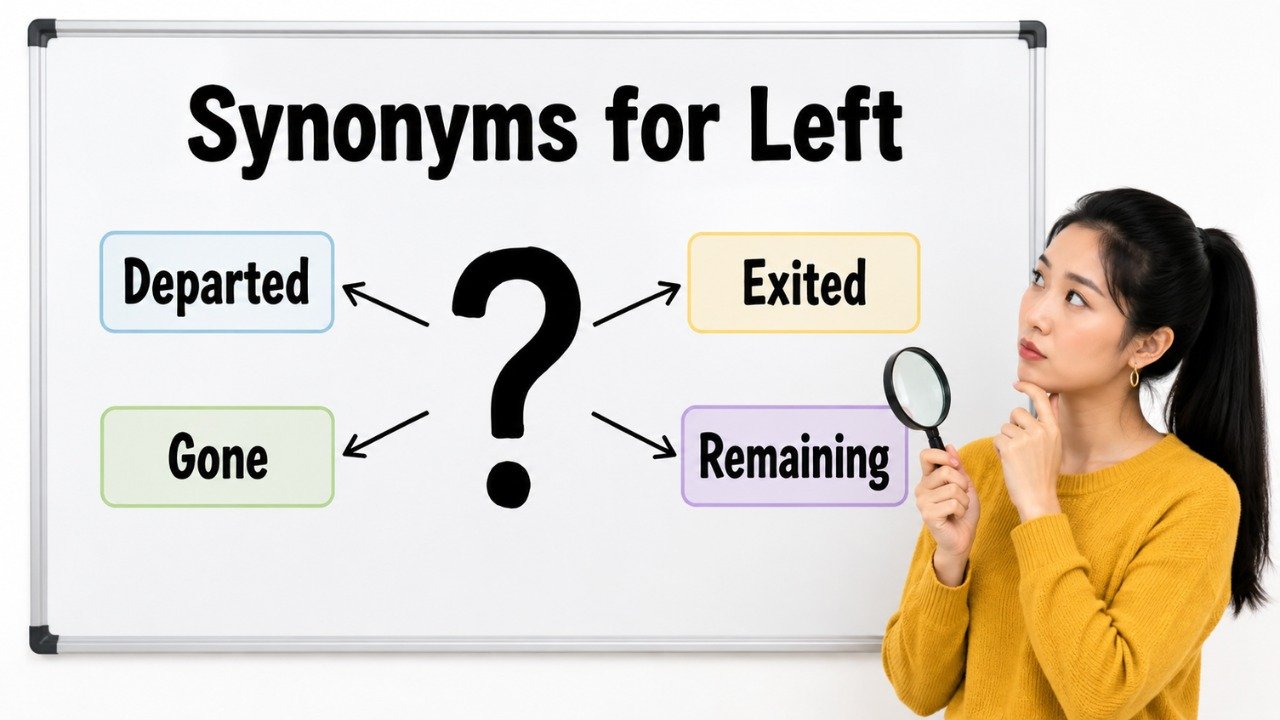
Quick Answer: The best synonyms for left include departed, gone, exited, withdrew, abandoned, remaining, leftover, spare, residual, and leftward. Use departed or exited when left means went away from a place. Gone is natural in everyday conversation, while withdrew works well when someone leaves a meeting, competition, or situation. Use remaining when left means still available, leftover for something unused after the main amount has been used, and residual in formal or technical writing. For direction, leftward means toward the left side. Because left has several meanings, the best replacement always depends on context.
Pronunciation and Word Details
Word: Left
Pronunciation: /lɛft/
Part of Speech: Verb, adjective, adverb, and noun
Meaning: Left can mean went away, remained after other things were used or removed, or the direction opposite right.
US Pronunciation:
UK Pronunciation:
What Does “Left” Mean?
Left has several common meanings, so its correct synonym depends on how it works in the sentence.
As a verb, left is the past tense and past participle of leave. It can mean that someone went away from a place, stopped being part of a group, abandoned something, placed something somewhere, or allowed something to remain.
Example: She left the office at six.
In this sentence, left means departed from the office.
As an adjective, left can mean remaining or still available.
Example: There are three cookies left.
Here, left means remaining.
Left can also describe direction or position. It refers to the side opposite right.
Example: Turn left at the next corner.
As a noun, left can refer to the left side or direction.
Example: The entrance is on the left.
The word also appears in expressions such as left behind, left out, left alone, and left over. Each expression changes the meaning slightly, which is why synonyms for left must be chosen according to context rather than treated as completely interchangeable.
Meaning, Tone, and Context of “Left”
Left is a common, neutral, and highly flexible English word. It appears naturally in casual conversation, formal writing, reports, instructions, stories, emails, academic writing, and everyday descriptions.
When left means departed, it is usually neutral.
Example: He left the building quietly.
More formal alternatives include departed, withdrew, and vacated. Casual alternatives include went away, headed out, and took off.
When left means remaining, it also has a neutral tone.
Example: Only a little time is left.
Remaining is often a stronger choice in formal or professional writing. Leftover is more suitable when referring to food, materials, money, or other things that remain after the main amount has been used.
Residual has a more formal or technical tone. It often describes a small amount that continues to exist after a process has ended.
When left describes direction, it is factual and neutral. Leftward is a useful alternative when describing movement toward the left. Port is used in nautical contexts for the left side of a vessel when facing forward.
The meaning can also become emotional depending on the sentence. Someone who was left alone, left behind, or abandoned may experience the action negatively. In such cases, words such as deserted or abandoned can express a stronger meaning than left.
When and How to Use “Left”
For Departure: Use left when someone went away from a place.
Example: Maria left the building after the meeting.
For Leaving a Group: Left can describe ending membership, employment, or participation.
Example: He left the committee after five years.
For Remaining Amounts: Use left when something is still available after part of it has been used.
Example: We have enough water left for another day.
For Remaining Time: Left can describe time that has not yet passed.
Example: There are only ten minutes left.
For Direction: Use left to describe the side opposite right.
Example: Turn left after the bridge.
For Abandonment: Left can mean that someone stopped caring for or staying with a person, place, or thing.
Example: They left the old building empty for years.
For Placement: Left can mean that someone placed or kept an object somewhere.
Example: She left her keys on the table.
For Omission: Left can appear in left out when something has been excluded.
Example: His name was accidentally left out of the report.
For Responsibility: Left can describe giving responsibility to another person.
Example: She left the final decision to the manager.
For Inheritance: Left can describe giving property or money through a will.
Example: His grandfather left him a small collection of books.
Best Synonyms for Left
Departed: Went away from a place.
Example: The visitors departed shortly after dinner.
Gone: No longer present in a place.
Example: By the time we arrived, everyone was gone.
Exited: Went out of a building, room, or area.
Example: She exited the hall through the side door.
Withdrew: Removed oneself from a situation, activity, or place.
Example: He withdrew from the competition before the final round.
Abandoned: Left a person, place, plan, or object completely.
Example: They abandoned the damaged vehicle beside the road.
Remaining: Still present or available after other parts have been removed or used.
Example: The remaining money was saved for future expenses.
Leftover: Remaining after the main portion has been used or consumed.
Example: They stored the leftover food for the next day.
Spare: Extra and still available for use.
Example: We have a spare chair available for another guest.
Residual: Remaining after most of something has disappeared or been removed.
Example: A small amount of residual moisture remained inside the container.
Leftward: Moving or positioned toward the left side.
Example: The driver made a slight leftward movement.
50 Synonyms for Left with Short Meanings
- Departed: Went away from a place.
- Gone: No longer present.
- Exited: Went out of a place.
- Withdrew: Removed oneself from a situation.
- Retired: Went away or withdrew from activity.
- Went Away: Moved from a place.
- Moved Away: Changed position or residence away from somewhere.
- Walked Away: Left by walking.
- Headed Out: Began leaving a place.
- Set Off: Started a journey.
- Set Out: Began traveling toward a destination.
- Took Off: Left quickly or began a journey.
- Stepped Out: Left briefly.
- Pulled Away: Moved away from a position.
- Drove Away: Left in a vehicle.
- Sailed Away: Left by boat or ship.
- Flew Away: Departed through the air.
- Fled: Left quickly to escape danger.
- Escaped: Got away from a place or situation.
- Vacated: Left a place so it became empty.
- Quit: Stopped participating in a job or activity.
- Abandoned: Left something completely.
- Deserted: Abandoned a person or place.
- Forsook: Abandoned or gave up something.
- Relinquished: Gave up possession or control.
- Gave Up: Stopped keeping or pursuing something.
- Omitted: Left something out.
- Excluded: Prevented something from being included.
- Forgot: Failed to take something when leaving.
- Deposited: Left something in a particular place.
- Placed: Put something somewhere and left it there.
- Entrusted: Left something in another person’s care.
- Bequeathed: Left property to someone through a will.
- Remaining: Still available or present.
- Leftover: Remaining after use or consumption.
- Unused: Not yet used.
- Unspent: Not yet spent.
- Unconsumed: Not yet eaten or used.
- Spare: Extra and available.
- Residual: Remaining after a process or change.
- Outstanding: Still remaining to be completed or dealt with.
- Available: Still ready for use.
- Surviving: Still existing after others are gone.
- Retained: Kept rather than removed.
- Surplus: More than what is needed.
- Excess: An amount beyond what is required.
- Untouched: Remaining without being used or changed.
- Leftward: Toward the left side.
- To the Left: In the direction opposite right.
- Port: The left side of a vessel when facing forward.
Read Also:
Synonyms for Stakeholders

Synonyms for Left by Context
When Left Means Departed
When left describes going away from a place, departed, exited, went away, headed out, and moved away are useful alternatives.
Departed: More formal than left and suitable for travel or formal descriptions.
Example: The guests departed shortly before midnight.
Exited: Best when someone physically goes out through an entrance or opening.
Example: Everyone exited the room calmly.
Went Away: Natural and conversational.
Example: He went away for several days.
Headed Out: Casual and useful when someone begins leaving.
Example: We headed out shortly after breakfast.
Moved Away: Useful when someone changes residence or position.
Example: Their neighbors moved away last month.
When Left Means Remaining
When left means something is still available, remaining is usually the strongest general synonym.
Remaining: Still present after part has been used or removed.
Example: The remaining supplies were stored safely.
Leftover: Remaining after the main amount has been used.
Example: We used the leftover materials for another project.
Spare: Extra and available when needed.
Example: She had a spare notebook in her bag.
Unused: Not yet used.
Example: The unused tickets were returned.
Unspent: Not yet used as money, time, or resources.
Example: The unspent funds remained in the account.
When Left Means Abandoned
Left can sometimes suggest that a person or thing was abandoned.
Abandoned: Completely left without continued care or support.
Example: The abandoned building had been empty for years.
Deserted: Left behind and often empty.
Example: The village appeared deserted after sunset.
Forsook: Gave up or abandoned, often in literary writing.
Example: He forsook his former lifestyle.
Relinquished: Voluntarily gave up control or possession.
Example: She relinquished responsibility for the project.
When Left Means Quit or Withdrew
Left can mean ending participation in a job, group, activity, or competition.
Quit: Stopped doing a job or activity.
Example: He quit the position to pursue another opportunity.
Withdrew: Formally removed oneself from participation.
Example: The candidate withdrew from the contest.
Retired: Stopped working permanently or withdrew from active participation.
Example: She retired after a long career.
When Left Means Placed Somewhere
Left can mean placed or kept something in a location.
Placed: Put something in a particular position.
Example: She placed the document on the desk.
Deposited: Put something somewhere for storage or safekeeping.
Example: He deposited the package at the front desk.
Entrusted: Gave someone responsibility for something.
Example: She entrusted the documents to her assistant.
When Left Means Excluded
The expression left out means that something or someone was not included.
Omitted: Not included in something.
Example: One important detail was omitted from the summary.
Excluded: Deliberately or effectively prevented from being included.
Example: Several unnecessary details were excluded from the final version.
When Left Refers to Direction
When left describes direction, there are fewer true synonyms because it refers to a specific side.
Leftward: Toward the left.
Example: The cyclist moved leftward to avoid the obstacle.
To the Left: In the direction opposite right.
Example: Move slightly to the left.
Port: The left side of a vessel when facing forward.
Example: The harbor appeared on the port side.
Another Word for Left
The best single replacement for left depends on its meaning. If left means went away, departed is one of the strongest alternatives. If left means still available, remaining is usually the clearest replacement.
Original: She left the office before noon.
Better Option: She departed from the office before noon.
Original: Only two pieces are left.
Better Option: Only two pieces remain.
Original: They left the old house several years ago.
Better Option: They vacated the old house several years ago.
Original: A small amount of money was left after the purchase.
Better Option: A small amount of money remained after the purchase.
When Not to Use “Left”
Left is a useful general word, but it can become vague when a more specific verb would explain the situation more clearly.
Avoid using left when the sentence needs to show exactly how someone departed.
Weak: She left through the emergency door.
Better: She exited through the emergency door.
Use a more specific word when someone permanently abandoned something.
Weak: The owners left the building many years ago and never returned.
Better: The owners abandoned the building many years ago and never returned.
When discussing quantities in formal writing, remaining may sound clearer than left.
Weak: Twenty percent of the budget is left.
Better: Twenty percent of the budget remains.
Avoid using left when the meaning could be misunderstood.
Weak: He left the project.
This could mean he stopped working on the project, physically moved away from it, or gave it to someone else.
Better: He withdrew from the project.
Do not replace left with abandoned unless the sentence truly implies neglect, rejection, or permanent departure.
Weak: She abandoned the office at five in the evening.
Better: She left the office at five in the evening.
Do not use leftover for every meaning of remaining.
Weak: We have twenty minutes leftover before the meeting.
Better: We have twenty minutes left before the meeting.
Words Commonly Confused With Left
Left vs Leave: Leave is the base form and present tense verb. Left is the past tense and past participle. Say “I leave at six” for a regular or future action and “I left at six” for a completed past action.
Left vs Gone: Left focuses on the action of departing, while gone usually describes the resulting state of no longer being present.
Left vs Departed: Left is common and neutral. Departed is more formal and specifically means went away.
Left vs Remaining: Left can mean remaining, but remaining is often clearer in formal writing when discussing quantities, time, or resources.
Left vs Leftover: Left can describe anything that remains. Leftover usually describes something remaining after the main portion has been used, especially food or materials.
Left vs Abandoned: Left does not necessarily imply neglect or permanent separation. Abandoned has a stronger meaning and often suggests that someone intentionally stopped caring for or returning to something.
Left vs Vacated: Left is broad. Vacated specifically means that someone departed from a place, making it available or empty.
Left vs Right: Left and right describe opposite directions or sides.
Which Synonym Should You Choose?
Choose departed when left means went away and you want a more formal alternative.
Choose gone when you want to emphasize that someone or something is no longer present.
Choose exited when describing movement out of a room, building, vehicle, or enclosed area.
Choose withdrew when someone stopped participating in a meeting, competition, agreement, project, or situation.
Choose quit when someone voluntarily stopped a job or activity.
Choose abandoned when the departure was permanent or involved giving up responsibility.
Choose vacated when someone moved out of a room, property, position, or occupied space.
Choose remaining when discussing amounts, time, resources, tasks, or other things that are still available.
Choose leftover when referring to food, materials, or other things remaining after the main portion has been used.
Choose residual in technical, scientific, analytical, or formal writing when a small amount continues to remain.
Choose spare when something is extra and available for later use.
Choose omitted when left means left out of a document, list, discussion, or explanation.
Choose entrusted when someone left an object, responsibility, or task in another person’s care.
Choose bequeathed when left refers to property or possessions transferred through a will.
Choose leftward when writing about movement toward the left side.
Choose port only in nautical contexts when referring to the left side of a vessel.
For essays and reports, departed, remaining, residual, omitted, vacated, and withdrew can provide more precise wording.
For professional emails, remaining, available, departed, and withdrawn are often clear choices depending on the sentence.
For casual conversation, left, gone, went away, headed out, and leftover usually sound natural.
Real Life Examples of “Left” in Sentences
Original: She left the restaurant after dinner.
Better Option: She departed from the restaurant after dinner.
Original: Everyone left the room when the meeting ended.
Better Option: Everyone exited the room when the meeting ended.
Original: Only five tickets are left.
Better Option: Only five tickets remain.
Original: We have some food left from dinner.
Better Option: We have some leftover food from dinner.
Original: He left the competition before the final round.
Better Option: He withdrew from the competition before the final round.
Original: The family left the apartment last week.
Better Option: The family vacated the apartment last week.
Original: They left the old structure unused for decades.
Better Option: They abandoned the old structure for decades.
Original: She left the documents with her colleague.
Better Option: She entrusted the documents to her colleague.
Original: One important paragraph was left out of the final report.
Better Option: One important paragraph was omitted from the final report.
Original: The driver moved slightly left.
Better Option: The driver moved slightly leftward.
Synonym Groups and Usage Differences
Departure Group
Departed, exited, went away, moved away, headed out, set off, and took off all describe leaving a place.
Departed is more formal. Exited focuses on physically going out. Went away is neutral and conversational. Headed out and took off are more casual.
Example: The visitors departed after the event ended.
Withdrawal Group
Withdrew, quit, retired, relinquished, and gave up describe leaving a role, activity, competition, or responsibility.
Withdrew often sounds formal. Quit is direct and common. Retired usually relates to ending a career or active role.
Example: She withdrew from the committee before the final decision.
Abandonment Group
Abandoned, deserted, forsook, and relinquished can describe leaving something behind permanently or giving it up.
Abandoned and deserted often carry a stronger emotional meaning than left.
Example: The damaged building was eventually abandoned.
Remaining Group
Remaining, leftover, unused, unspent, spare, available, and surplus describe something that is still present.
Remaining is the broadest formal alternative. Leftover commonly describes food or materials. Spare suggests something extra.
Example: The remaining supplies were distributed among the group.
Residual Group
Residual, surviving, retained, and untouched describe something that continues to exist after change, removal, or use.
Residual often appears in technical or analytical contexts. Surviving emphasizes continued existence.
Example: Some residual moisture remained after the surface was cleaned.
Omission Group
Omitted and excluded are useful when left appears in the expression left out.
Omitted often means something was not included, sometimes accidentally. Excluded can suggest a more deliberate choice.
Example: Several details were omitted from the shortened version.
Placement and Transfer Group
Placed, deposited, entrusted, and bequeathed work when left means putting something somewhere or giving something to another person.
Example: She entrusted the original documents to her lawyer.
Direction Group
Leftward, to the left, and port relate to direction or position.
Leftward describes movement. To the left describes location or direction. Port is restricted to nautical use.
Example: The path curves leftward after the entrance.
Antonyms of Left
The opposite of left changes according to the meaning of the word.
Arrived: Came to a place rather than departing from it.
Came: Moved toward or reached a location.
Stayed: Continued to remain in a place.
Remained: Did not depart.
Returned: Came back after leaving.
Entered: Went into a place rather than out of it.
Joined: Became part of a group rather than leaving it.
Kept: Continued to possess something rather than giving it up.
Used: No longer remaining unused.
Consumed: Used up or eaten rather than left over.
Spent: Used money, time, or resources rather than leaving them available.
Exhausted: Completely used so that nothing remains.
Included: Added rather than left out.
Right: The direction opposite left.
Comparison: Left vs Related Words
Left vs Departed
Left is more common and flexible. Departed specifically means went away and usually sounds more formal.
Example With Left: She left the station at noon.
Example With Departed: She departed from the station at noon.
Left vs Gone
Left describes the action of leaving. Gone commonly describes the state after someone has departed.
Example With Left: He left ten minutes ago.
Example With Gone: He is already gone.
Left vs Exited
Left is broad, while exited specifically describes movement out of a place.
Example With Left: They left the building quietly.
Example With Exited: They exited the building through the rear door.
Left vs Withdrew
Left may simply mean departed. Withdrew usually suggests intentionally ending participation or removing oneself from a situation.
Example With Left: She left the competition.
Example With Withdrew: She withdrew from the competition because of an injury.
Left vs Abandoned
Left is neutral and does not necessarily suggest permanent departure. Abandoned implies that something was given up or deserted.
Example With Left: They left the house for the weekend.
Example With Abandoned: They abandoned the house permanently.
Left vs Vacated
Left can apply to almost any type of departure. Vacated specifically refers to leaving a place, position, or property.
Example With Left: The guests left the room.
Example With Vacated: The tenants vacated the apartment at the end of the month.
Left vs Remaining
Left is natural in everyday speech when discussing quantities. Remaining often sounds clearer and more formal.
Example With Left: We have four tasks left.
Example With Remaining: We have four remaining tasks.
Left vs Leftover
Left describes something that still remains. Leftover usually describes what remains after the main amount has been used or consumed.
Example With Left: There is some rice left.
Example With Leftover: We stored the leftover rice in the refrigerator.
Left vs Residual
Left is general. Residual is more technical and often refers to a small amount remaining after a process.
Example With Left: A little moisture was left on the surface.
Example With Residual: Residual moisture remained on the surface.
Left vs Right
Left and right are opposite directions or sides.
Example With Left: Turn left after the entrance.
Example With Right: Turn right at the next corner.
Common Phrases and Expressions With “Left”
Left Behind: Not taken, included, or brought along.
Example: She accidentally left her notebook behind.
Left Out: Excluded or omitted.
Example: One name was left out of the final list.
Left Over: Remaining after the main portion has been used.
Example: There was enough food left over for another meal.
Left Alone: Not disturbed, accompanied, or assisted.
Example: He wanted to be left alone for a while.
Left in Charge: Given responsibility for managing something.
Example: She was left in charge of the office.
Left Untouched: Not changed, used, or disturbed.
Example: The old room had been left untouched for years.
Left Unfinished: Not completed.
Example: Several tasks were left unfinished.
Left Standing: Still upright or remaining after other things have been removed.
Example: Only one structure was left standing after the storm.
Left to Right: Moving or arranged from the left side toward the right side.
Example: Read the columns from left to right.
On the Left: Positioned on the left side.
Example: The information desk is on the left.
Common Mistakes to Avoid
One of the most common grammar mistakes is confusing leave and left. Leave is the base form and present tense, while left is the past tense and past participle.
Incorrect: She leave the office yesterday.
Correct: She left the office yesterday.
Another mistake is creating an incorrect past tense form.
Incorrect: He leaved early.
Correct: He left early.
Be careful when choosing between left and gone. Left describes what someone did, while gone often describes their present absence.
Less Natural: He has left and is not here anymore.
Better: He is gone.
Do not use abandoned when the departure was ordinary or temporary. Abandoned suggests a much stronger act of giving something up.
Incorrect Meaning: She abandoned the office after work.
Better: She left the office after work.
Do not confuse left with leftover. Left can be used after a noun or quantity to mean remaining.
Correct: Three pieces are left.
Leftover is commonly used before a noun or as a noun.
Correct: We saved the leftover food.
Be careful with left over and leftover. Left over is a phrase that means remained after use, while leftover is commonly an adjective or noun.
Example With Left Over: Some materials were left over after construction.
Example With Leftover: The leftover materials were stored.
Avoid repetitive wording when left appears several times in one paragraph.
Repetitive: She left the meeting, left the building, and left the project completely.
Improved: She exited the meeting, departed from the building, and withdrew from the project completely.
Do not replace left with exited when the sentence does not involve physically going out of a place.
Unnatural: She exited her job last month.
Natural: She left her job last month.
Avoid using residual in ordinary conversation when remaining or left is simpler.
Unnatural: We have three residual cookies.
Natural: We have three cookies left.
For directional meaning, remember that port is not a general synonym for left. It is used specifically for the left side of a vessel when facing forward.
Choose synonyms according to the exact meaning rather than replacing left mechanically. This is especially important because left can describe departure, remaining quantity, abandonment, omission, placement, responsibility, inheritance, and direction.
Conclusion
The best synonyms for left depend on the meaning of the sentence. Departed, exited, gone, and withdrew work when left means went away. Remaining, leftover, spare, and residual fit things that are still available. Abandoned and deserted express stronger forms of leaving, while omitted works when something was left out. Leftward describes direction, and port has a specific nautical use. Understanding these synonyms for left helps you choose clearer, more precise vocabulary in conversation, essays, reports, instructions, and professional writing.
FAQs About Synonyms for Left
What Is the Best Synonym for Left?
Departed is a strong synonym when left means went away. Remaining is usually best when left means still available.
What Is Another Word for Left a Place?
Departed, exited, went away, moved away, headed out, and vacated can all work depending on how and why someone left.
What Is a Formal Synonym for Left?
Departed, withdrew, vacated, relinquished, omitted, and remaining are useful formal alternatives in different contexts.
What Is a Synonym for Left Meaning Remaining?
Remaining is the strongest general choice. Other options include leftover, spare, unused, unspent, residual, and available.
What Is the Difference Between Left and Gone?
Left usually describes the action of departing. Gone describes the state of no longer being present.
Is Abandoned a Synonym for Left?
Yes, but only when left means someone or something was deserted or given up. Abandoned has a stronger meaning than ordinary departure.
What Is the Opposite of Left?
The opposite depends on context. Stayed, remained, arrived, and entered can oppose left when it means departed. Right is the opposite when left describes direction.
