
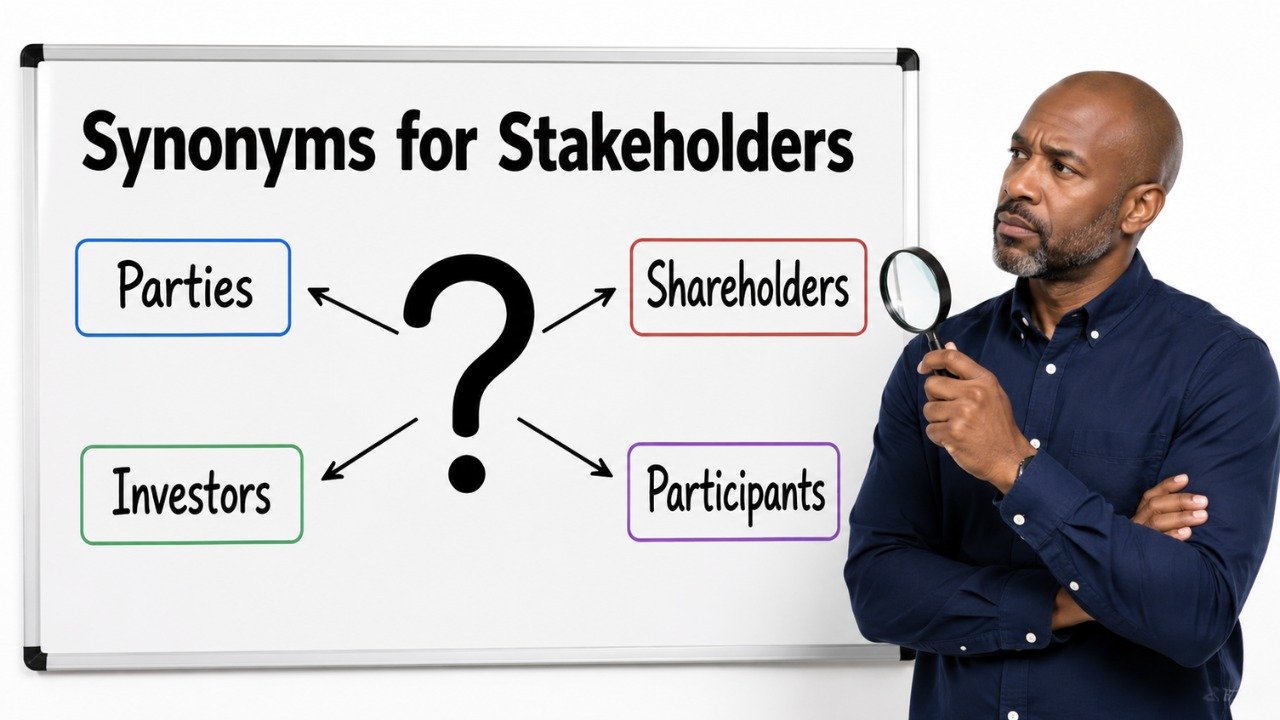
Quick Answer: The best synonyms for stakeholders include interested parties, participants, partners, contributors, investors, decision makers, beneficiaries, affected parties, collaborators, and constituents. Use interested parties as the broadest formal alternative when referring to people or groups with an interest in an outcome. Participants works when people actively take part, while partners suits cooperative relationships. Investors is best when financial involvement matters, beneficiaries when people receive benefits, and affected parties when decisions or changes directly influence them.
Pronunciation and Word Details
Word: Stakeholders
Pronunciation: /ˈsteɪkˌhoʊldərz/
Part of Speech: Plural noun
Meaning: People, groups, or organizations that have an interest in, influence over, or are affected by a decision, project, activity, or organization.
US Pronunciation:
UK Pronunciation:
What Does “Stakeholders” Mean?
Stakeholders means people, groups, or organizations that have an interest in a decision, activity, project, organization, or outcome.
The word is the plural form of stakeholder and is commonly used in business, management, education, government, community planning, research, project work, and organizational communication.
A stakeholder may contribute money, time, knowledge, labor, authority, or support. A stakeholder may also be affected by decisions even without directly participating in them.
Example: The project team consulted stakeholders before making the final decision.
Stakeholders can include people inside an organization, such as employees and managers, as well as people outside it, such as customers, suppliers, investors, residents, partners, or regulators.
Example: Local residents were important stakeholders in the development proposal.
The exact meaning changes with context. In financial writing, stakeholders may include investors. In community planning, stakeholders may include residents and public representatives. In project management, the term may cover sponsors, team members, clients, users, and decision makers.
Meaning, Tone, and Context of “Stakeholders”
Tone: Stakeholders has a formal, professional, and neutral tone.
It is commonly used when discussing people or groups connected to a decision, organization, project, policy, or result.
Business Context: Stakeholders often refers to employees, customers, investors, suppliers, owners, managers, and business partners.
Example: The company gathered feedback from key stakeholders.
Project Context: The word can describe sponsors, team members, clients, users, decision makers, and anyone affected by the project.
Example: Project stakeholders reviewed the proposed timeline.
Community Context: Stakeholders may include residents, community leaders, local groups, service providers, and officials.
Example: Community stakeholders discussed the proposed changes.
Academic Context: Researchers may use stakeholders for groups affected by or involved in a study, policy, or program.
Example: The report examined the needs of major stakeholders.
Formal Context: Stakeholders is especially useful when several different groups share an interest in the same issue.
Example: The committee invited stakeholders to participate in the discussion.
Conversational Context: In everyday conversation, phrases such as people involved, people affected, or interested parties may sound more natural.
Example: We spoke with everyone affected by the change.
When and How to Use “Stakeholders”
For Business Decisions
Use: Stakeholders works well when referring to people or groups who influence or are affected by business decisions.
Example: Senior managers consulted stakeholders before approving the new strategy.
For Project Management
Use: Use stakeholders when a project involves several groups with different responsibilities, interests, or concerns.
Example: The project manager identified all major stakeholders before planning began.
For Community Planning
Use: Stakeholders can refer to residents, local groups, officials, and service providers affected by a public decision.
Example: Community stakeholders attended the planning meeting.
For Financial Interests
Use: Stakeholders may include investors, owners, lenders, and other groups with financial interests.
Example: Financial stakeholders requested more information about the proposal.
For People Affected by Decisions
Use: The term is helpful when a decision influences people who may not directly control it.
Example: The policy was reviewed with affected stakeholders before implementation.
For Collaboration
Use: Stakeholders can describe groups whose cooperation is necessary for a project or initiative to succeed.
Example: The team worked closely with stakeholders throughout the process.
For Reports and Essays
Use: Stakeholders is appropriate in formal writing when discussing groups connected to an issue.
Example: The report explains how different stakeholders may respond to the changes.
For Consultation
Use: Use the word when people or groups are asked to provide opinions, expertise, or feedback.
Example: Stakeholders were consulted during the planning stage.
Best Synonyms for Stakeholders
Interested Parties: People or groups with a direct interest in an issue, decision, or outcome.
Example: All interested parties were invited to attend the meeting.
Participants: People or groups actively taking part in an activity, project, or process.
Example: Participants reviewed the proposal before the discussion.
Partners: People or organizations working together toward a shared objective.
Example: Project partners agreed on the next steps.
Contributors: People or groups who provide ideas, resources, money, effort, or expertise.
Example: Contributors helped improve the final plan.
Investors: People or organizations that provide money with an expectation of financial benefit.
Example: Investors requested an update on the project.
Decision Makers: People with the authority to make or approve important decisions.
Example: Decision makers reviewed the final recommendation.
Beneficiaries: People or groups who receive advantages, services, or benefits from an action or program.
Example: The beneficiaries were asked to describe their needs.
Affected Parties: People or groups directly influenced by a decision, policy, event, or change.
Example: The organization informed all affected parties about the new rules.
Collaborators: People or organizations working jointly on a task or objective.
Example: Collaborators shared information throughout the research process.
Constituents: People represented by a person, group, or institution, especially in public or organizational contexts.
Example: The representatives discussed the concerns of their constituents.
50 Synonyms for Stakeholders with Short Meanings
- Interested Parties: People or groups with an interest in an issue or outcome.
- Participants: People actively involved in an activity or process.
- Partners: People or organizations working together toward shared goals.
- Contributors: People who provide effort, ideas, money, or resources.
- Investors: People or groups with financial involvement in an organization or project.
- Decision Makers: People authorized to make important choices.
- Beneficiaries: People who receive benefits from a decision, program, or activity.
- Affected Parties: People or groups directly influenced by a decision or change.
- Collaborators: People or organizations working jointly on an activity.
- Constituents: People represented by an organization, official, or group.
- Interested Groups: Groups concerned with or affected by an issue.
- Concerned Parties: People or groups with a reason to care about an outcome.
- Involved Parties: People or organizations taking part in a matter.
- Key Parties: Important people or groups connected to an issue.
- Relevant Parties: People or groups directly related to a decision or situation.
- Project Participants: People actively involved in completing a project.
- Project Partners: Organizations or people cooperating on a project.
- Project Sponsors: People or groups providing authority, resources, or funding for a project.
- Team Members: People working together within a project or organization.
- Clients: People or organizations receiving professional services.
- Customers: People or groups buying goods or services.
- Users: People who use a product, service, system, or program.
- Employees: People working within an organization.
- Workers: People performing tasks or labor for an organization or project.
- Managers: People responsible for directing work, resources, or teams.
- Leaders: People who guide groups, organizations, or initiatives.
- Owners: People or groups possessing a business, property, or organization.
- Shareholders: People or organizations owning shares in a company.
- Sponsors: People or organizations providing financial or practical support.
- Funders: People or organizations supplying money for an activity or program.
- Supporters: People who approve of or assist a person, project, or cause.
- Backers: People or groups providing support, money, or approval.
- Advisers: People providing professional advice or guidance.
- Consultants: Specialists providing expert advice to an organization or project.
- Representatives: People acting or speaking for others.
- Authorities: People or organizations with official power or responsibility.
- Officials: People holding formal positions of authority.
- Regulators: Bodies or officials responsible for enforcing rules or standards.
- Suppliers: People or companies providing materials, products, or services.
- Vendors: Sellers or providers of goods and services.
- Contractors: People or organizations hired to perform agreed work.
- Service Providers: People or organizations delivering particular services.
- Community Members: People belonging to a community affected by an issue.
- Residents: People living in an area affected by a decision or project.
- Advocates: People actively supporting a person, group, issue, or cause.
- Represented Groups: Groups whose interests are presented by others.
- Recipients: People or groups receiving something from a program or decision.
- End Users: People who ultimately use a product, service, or system.
- Associates: People or organizations connected through work or shared interests.
- Allies: People or groups providing cooperation or support toward a shared aim.
Read Also:
Synonyms for Susceptible
Synonyms for Stakeholders by Context
When Stakeholders Means Interested Parties
The strongest alternatives include interested parties, concerned parties, relevant parties, involved parties, and key parties.
Interested Parties: A broad formal phrase for people or groups with an interest in an outcome.
Example: Interested parties were invited to submit their comments.
Concerned Parties: Useful when people have a direct concern about a decision.
Example: The concerned parties met to discuss the issue.
Relevant Parties: Best when referring only to people directly connected to the matter.
Example: The information was shared with all relevant parties.
When Stakeholders Means Project Participants
Useful alternatives include participants, project partners, team members, sponsors, contributors, and collaborators.
Participants: Best for people actively taking part.
Example: Participants attended the project workshop.
Collaborators: Suitable when people work jointly and share expertise.
Example: The collaborators developed the proposal together.
Project Sponsors: Appropriate when people or organizations provide authority, funding, or resources.
Example: Project sponsors approved the additional budget.
When Stakeholders Means Financially Interested Groups
Useful words include investors, shareholders, owners, funders, sponsors, and backers.
Investors: Appropriate when money has been invested with an expectation of financial return.
Example: Investors reviewed the financial results.
Shareholders: More precise when people own shares in a company.
Example: Shareholders received information about the proposed changes.
Funders: Best when people or institutions provide money for a project or program.
Example: Funders requested evidence of progress.
When Stakeholders Means People Affected
Useful alternatives include affected parties, beneficiaries, recipients, users, residents, and community members.
Affected Parties: Best for people directly influenced by a change.
Example: The affected parties were informed before the new procedure began.
Beneficiaries: Suitable for people who receive benefits from a program.
Example: Beneficiaries helped evaluate the service.
Residents: Useful when a local decision affects people living in an area.
Example: Residents expressed concerns about the proposed development.
When Stakeholders Means Decision Makers
Useful alternatives include decision makers, leaders, managers, authorities, officials, and representatives.
Decision Makers: Best when emphasizing authority to approve or reject a proposal.
Example: Decision makers reviewed the evidence before voting.
Leaders: Suitable when the people guide an organization or team.
Example: Leaders discussed the long term priorities.
Authorities: Useful when official power or responsibility is involved.
Example: Local authorities reviewed the application.
When Stakeholders Means Business Relationships
Partners, clients, customers, suppliers, vendors, service providers, and contractors can be more precise.
Partners: Best when two groups cooperate toward shared goals.
Example: Business partners discussed future priorities.
Suppliers: Appropriate for organizations providing goods or materials.
Example: Suppliers were informed about the revised schedule.
Clients: Best for people or organizations receiving professional services.
Example: Clients were consulted before the service was redesigned.
Another Word for Stakeholders
The best general replacement for stakeholders is interested parties because it covers people or groups that have an interest in or may be affected by an issue. However, the best alternative depends on the exact relationship involved.
Use participants for active involvement, investors for financial interest, beneficiaries for people receiving benefits, and affected parties for people directly influenced by a decision.
Original: The stakeholders reviewed the proposed changes.
Better Option: The interested parties reviewed the proposed changes.
Original: Project stakeholders attended the workshop.
Better Option: Project participants attended the workshop.
Original: Financial stakeholders requested an update.
Better Option: Investors requested an update.
Original: The program consulted stakeholders who would receive the service.
Better Option: The program consulted beneficiaries who would receive the service.
When Not to Use “Stakeholders”
Stakeholders is useful in professional writing, but it can become vague when the specific people or groups are already known.
When a More Specific Group Name Is Available
If you mean customers, employees, investors, residents, or suppliers, naming that group directly is usually clearer.
Weak: Stakeholders complained about delays in receiving their orders.
Better: Customers complained about delays in receiving their orders.
When Writing Casual Conversation
Stakeholders can sound overly formal in everyday speech.
Weak: We need to talk to all the stakeholders before choosing a restaurant.
Better: We need to talk to everyone involved before choosing a restaurant.
When Only One Group Is Affected
Using stakeholders may suggest several groups when only one specific audience matters.
Weak: The stakeholders living near the construction site raised concerns.
Better: Local residents raised concerns about the construction site.
When Financial Ownership Is the Main Point
Use shareholders or investors when you specifically mean people with financial ownership or investment.
Weak: The stakeholders voted on matters reserved for company owners.
Better: The shareholders voted on matters reserved for company owners.
When the People Are Simply Participants
Participants may be clearer when people are actively taking part in an event or study.
Weak: The stakeholders completed the research questionnaire.
Better: The participants completed the research questionnaire.
Words Commonly Confused With Stakeholders
Stakeholders vs Shareholders: Stakeholders is broader. Stakeholders may include employees, customers, suppliers, communities, investors, and other affected groups. Shareholders specifically own shares in a company.
Stakeholders vs Investors: Investors provide money or capital with the expectation of a return. Stakeholders may have financial interests, but they can also have social, professional, operational, or community interests.
Stakeholders vs Participants: Participants actively take part in an activity. Stakeholders may be affected by a project without directly participating in it.
Stakeholders vs Partners: Partners usually work together toward a shared objective. Stakeholders may have different or even competing interests.
Stakeholders vs Beneficiaries: Beneficiaries receive benefits from a program, policy, or project. Stakeholders can include beneficiaries, but the term also covers decision makers, funders, employees, and other interested groups.
Stakeholders vs Customers: Customers buy or use products or services. They can be stakeholders, but stakeholders may include many other groups.
Stakeholders vs Contributors: Contributors provide money, ideas, labor, expertise, or other resources. A stakeholder may contribute something, but contribution is not required.
Stakeholders vs Constituents: Constituents are usually people represented by a person, organization, or public body. Stakeholders is a broader term for people with an interest in or connection to an issue.
Which Synonym Should You Choose?
Choose interested parties when you need a broad and formal alternative in reports, policies, essays, or professional communication.
Choose participants when referring to people actively taking part in a project, study, meeting, event, or process.
Choose partners when two or more people or organizations cooperate toward shared objectives.
Choose contributors when emphasizing people who provide resources, ideas, money, knowledge, or effort.
Choose investors when the relationship is specifically financial.
Choose shareholders when referring to people or organizations that own shares in a company.
Choose decision makers when emphasizing authority and responsibility for important choices.
Choose beneficiaries when referring to people who receive direct benefits from a program or action.
Choose affected parties when people are influenced by a decision even if they are not directly involved in making it.
Choose collaborators in reports, essays, or professional writing when joint work is the main idea.
Choose people involved in casual conversation when stakeholders sounds too formal.
Real Life Examples of “Stakeholders” in Sentences
Original: The stakeholders discussed the new project timeline.
Better Option: The project participants discussed the new timeline.
Original: Stakeholders were invited to comment on the policy.
Better Option: Interested parties were invited to comment on the policy.
Original: The company informed stakeholders about the financial results.
Better Option: The company informed investors about the financial results.
Original: Local stakeholders raised concerns about traffic.
Better Option: Local residents raised concerns about traffic.
Original: The program asked stakeholders about the quality of the service.
Better Option: The program asked beneficiaries about the quality of the service.
Original: Key stakeholders approved the final proposal.
Better Option: Key decision makers approved the final proposal.
Original: The organization worked with stakeholders to develop the plan.
Better Option: The organization worked with collaborators to develop the plan.
Original: Stakeholders supplied materials for the project.
Better Option: Suppliers provided materials for the project.
Original: Educational stakeholders attended the planning session.
Better Option: Teachers, administrators, and community representatives attended the planning session.
Original: The team kept stakeholders informed throughout development.
Better Option: The team kept all relevant parties informed throughout development.
Synonym Groups and Usage Differences
Interest Group
Interested parties, concerned parties, relevant parties, key parties, and involved parties all emphasize connection to an issue.
Use: These alternatives are useful when the exact type of stakeholder does not need to be specified.
Example: All relevant parties received a copy of the proposal.
Participation Group
Participants, team members, collaborators, contributors, and associates emphasize active involvement.
Use: Choose these terms when people are doing work rather than simply being affected.
Example: Project participants completed the planning exercise.
Financial Group
Investors, shareholders, owners, funders, sponsors, and backers relate to money, ownership, or financial support.
Use: Choose the word that identifies the exact financial relationship.
Example: Investors requested information about future returns.
Decision Group
Decision makers, leaders, managers, authorities, officials, and representatives emphasize influence or authority.
Use: These words are best when power to guide or approve decisions matters.
Example: Decision makers reviewed the recommendation.
Beneficiary Group
Beneficiaries, recipients, users, customers, residents, and community members describe people who receive services or experience an outcome.
Use: These terms make writing more specific when a project affects a defined group.
Example: Beneficiaries evaluated the effectiveness of the program.
Collaboration Group
Partners, collaborators, contributors, allies, contractors, and service providers emphasize cooperation or shared work.
Use: Select these terms when the relationship is based on working together.
Example: Project partners met to review progress.
Antonyms of Stakeholders
Stakeholders does not have one perfect opposite because it describes a relationship to an issue, project, organization, or decision. Contextual opposites describe people with little or no involvement, interest, influence, or connection.
Outsiders: People who are not part of a group or activity.
Nonparticipants: People who do not take part in an activity or process.
Bystanders: People who observe an event without directly participating.
Uninvolved Parties: People or groups with no active role in a matter.
Unaffected Parties: People or groups not influenced by a particular decision or event.
Observers: People who watch or study an activity without participating directly.
Nonmembers: People who do not belong to a particular group or organization.
Third Parties: People or organizations outside the primary relationship between other parties.
Disinterested Parties: People without a personal interest in the outcome.
External Observers: People outside a process who mainly watch or evaluate it.
Comparison: Stakeholders vs Related Words
Stakeholders vs Interested Parties
Stakeholders and interested parties can overlap, but interested parties emphasizes having an interest in an issue. Stakeholders may also be directly affected or able to influence the outcome.
Example With Stakeholders: The stakeholders helped shape the project plan.
Example With Interested Parties: Interested parties submitted comments about the proposal.
Stakeholders vs Shareholders
Stakeholders includes a broad range of groups connected to a company or project. Shareholders specifically own shares in a company.
Example With Stakeholders: Employees and customers are important stakeholders.
Example With Shareholders: Shareholders voted on the proposed change.
Stakeholders vs Participants
Stakeholders can be involved, affected, or interested without actively participating. Participants actively take part.
Example With Stakeholders: Stakeholders were informed about the study.
Example With Participants: Participants completed the survey.
Stakeholders vs Partners
Partners usually cooperate toward shared goals. Stakeholders may have different priorities and do not necessarily work together.
Example With Stakeholders: Stakeholders expressed different opinions about the plan.
Example With Partners: The partners worked together to complete the project.
Stakeholders vs Beneficiaries
Stakeholders is broader and can include people who provide, manage, influence, or receive something. Beneficiaries specifically receive a benefit.
Example With Stakeholders: Stakeholders reviewed the program design.
Example With Beneficiaries: Beneficiaries received training and resources.
Stakeholders vs Decision Makers
Stakeholders may influence a decision, but they do not always have final authority. Decision makers have responsibility for making or approving choices.
Example With Stakeholders: Stakeholders shared their concerns.
Example With Decision Makers: Decision makers approved the final proposal.
Common Phrases and Expressions With “Stakeholders”
Key Stakeholders: The most important people or groups connected to an issue.
Example: The team met with key stakeholders before making the announcement.
Major Stakeholders: Groups with significant influence, interest, or involvement.
Example: Major stakeholders reviewed the final strategy.
Internal Stakeholders: People or groups within an organization.
Example: Employees and managers are common internal stakeholders.
External Stakeholders: People or groups outside an organization who are affected by or connected to it.
Example: Customers and suppliers can be external stakeholders.
Project Stakeholders: People or groups connected to a particular project.
Example: Project stakeholders received regular progress updates.
Community Stakeholders: Residents, groups, leaders, or organizations connected to a community issue.
Example: Community stakeholders attended the public meeting.
Engage Stakeholders: Involve stakeholders in discussion, planning, or decision making.
Example: The team plans to engage stakeholders early in the process.
Consult Stakeholders: Ask stakeholders for views, advice, or feedback.
Example: The committee will consult stakeholders before making changes.
Stakeholder Feedback: Opinions or comments provided by people connected to a project or decision.
Example: Stakeholder feedback helped improve the proposal.
Stakeholder Interests: Needs, concerns, priorities, or goals held by stakeholders.
Example: The final plan considered several stakeholder interests.
Common Mistakes to Avoid
Using Stakeholders Too Broadly: The word can become vague if readers do not know who the stakeholders actually are. Name specific groups when possible.
Weak: Stakeholders were unhappy with the change.
Better: Employees and customers were unhappy with the change.
Confusing Stakeholders With Shareholders: Shareholders are owners of company shares, while stakeholders can include many groups without ownership.
Weak: All stakeholders own part of the company.
Better: All shareholders own shares in the company.
Using Stakeholders for Every Participant: Someone can participate in an activity without having a wider interest in its outcome.
Weak: The conference stakeholders sat in the audience.
Better: The conference participants sat in the audience.
Choosing Investors When Financial Involvement Is Not Present: Investors should only be used when money or capital is actually invested.
Weak: Local residents were investors in the traffic policy.
Better: Local residents were stakeholders in the traffic policy.
Using Beneficiaries for Decision Makers: Beneficiaries receive benefits, while decision makers have authority over choices.
Weak: The senior managers were beneficiaries who approved the plan.
Better: The senior managers were decision makers who approved the plan.
Repeating Stakeholders Too Often: Frequent repetition can make reports or essays sound mechanical.
Weak: Stakeholders met with stakeholders to discuss stakeholder concerns.
Better: Project leaders met with community representatives to discuss their concerns.
Using the Word Without Identifying the Relationship: Explain whether the people are investors, customers, residents, partners, employees, or another group when precision matters.
Weak: Several stakeholders responded to the proposal.
Better: Several local residents and business owners responded to the proposal.
Conclusion
The best synonyms for stakeholders depend on the relationship being described. Interested parties is a strong general alternative, while participants suits active involvement, partners fits cooperation, and investors or shareholders are more precise for financial interests. Use beneficiaries for people receiving benefits, affected parties for those influenced by decisions, and decision makers for people with authority. Choosing a specific alternative makes business, academic, project, and professional writing clearer and more informative.
FAQs About Synonyms for Stakeholders
What Is the Best Synonym for Stakeholders?
Interested parties is one of the best general synonyms because it covers people or groups with a direct interest in an issue or outcome.
What Is a Formal Synonym for Stakeholders?
Interested parties, relevant parties, affected parties, and constituents are useful formal alternatives. The best choice depends on the relationship involved.
What Is Another Word for Stakeholders in Business?
Useful business alternatives include partners, investors, shareholders, customers, employees, suppliers, and decision makers.
What Is Another Word for Stakeholders in a Project?
Good project related alternatives include participants, project partners, contributors, collaborators, sponsors, and team members.
Are Stakeholders and Shareholders the Same?
No. Shareholders own shares in a company. Stakeholders is a broader term that can also include employees, customers, suppliers, investors, communities, and other affected groups.
Can Customers Be Called Stakeholders?
Yes. Customers can be stakeholders because business decisions, products, services, and policies may directly affect them.
What Is a Simpler Word for Stakeholders?
In everyday language, people involved, people affected, or interested parties can be simpler alternatives, depending on the context.
