
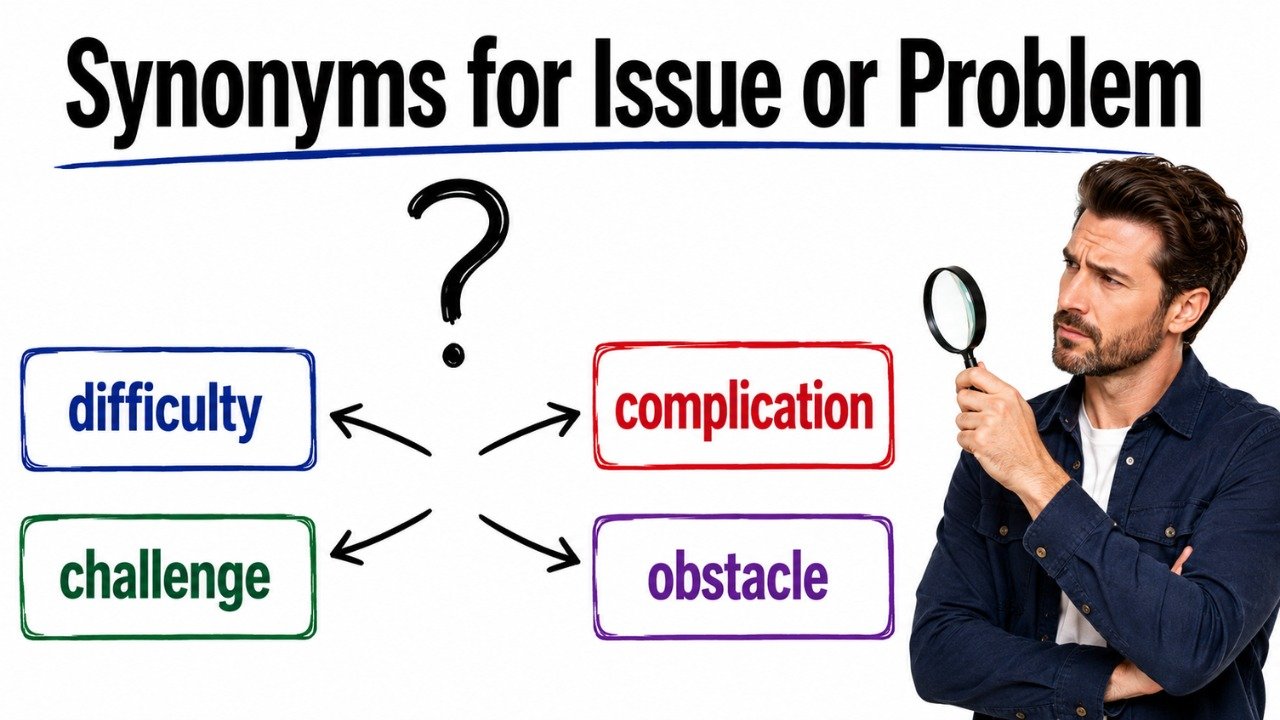
Quick Answer: The best synonyms for issue or problem include difficulty, concern, challenge, complication, obstacle, trouble, dilemma, matter, setback, and defect. Use difficulty for something that is hard to handle, concern for a matter that needs attention, challenge for a problem that can encourage effort or growth, complication for an added difficulty, and obstacle for something blocking progress. Trouble sounds natural in casual speech, while matter is more neutral and suitable for professional communication.
Pronunciation and Word Details
Word: Issue or Problem.
Pronunciation: /ˈɪʃuː ɔːr ˈprɒbləm/
Part of Speech: Noun phrase.
Meaning: A matter, difficulty, or situation that requires attention, discussion, correction, or a solution.
US Pronunciation:
UK Pronunciation:
What Does “Issue or Problem” Mean?
Issue or problem means a difficult situation, concern, question, fault, or matter that needs attention. Both issue and problem are commonly used as nouns, but their meanings and tones are not always identical.
Problem usually refers directly to something wrong, difficult, harmful, or in need of a solution. It often sounds stronger and more direct than issue.
Example: We need to solve the problem before the system can operate normally.
Issue can refer to a problem, but it may also describe a topic, concern, or matter being discussed. It often sounds more neutral, polite, or professional.
Example: The manager raised an issue concerning staff schedules.
In some sentences, issue is used to soften the word problem.
Example: The device has a minor charging issue.
In other contexts, issue means a subject or question rather than a difficulty.
Example: The committee discussed the issue of public safety.
The phrase issue or problem therefore covers several related meanings, including a difficulty, concern, obstacle, fault, disagreement, question, or complicated situation.
Meaning, Tone, and Context of “Issue or Problem”
Issue and problem are both common, neutral words, but they create slightly different impressions.
Problem is direct and often suggests that something is clearly wrong. It is suitable for casual speech, formal writing, technical instructions, academic discussions, reports, and everyday situations.
Example: The main problem is a lack of reliable information.
Issue is often more diplomatic. It can describe something that needs attention without making it sound severe or assigning blame. It is widely used in professional communication, meetings, reports, customer communication, essays, and technical discussions.
Example: We identified an issue with the payment process.
The word issue can sound vague when a more precise term would be clearer. For example, defect, disagreement, delay, risk, or error may explain the exact nature of the problem better.
Challenge usually creates a more positive or constructive tone. It presents the problem as something that can be managed or overcome.
Example: Limited storage space is a challenge that requires careful planning.
Crisis has a much stronger and more urgent tone. It should be used only for serious situations requiring immediate action.
Example: The sudden shortage created a financial crisis.
Matter is formal and neutral. It often refers to a subject requiring consideration rather than a serious problem.
Example: The matter will be reviewed at the next meeting.
The best alternative depends on whether the writer wants to emphasize difficulty, concern, disagreement, damage, urgency, or the need for a solution.
When and How to Use “Issue or Problem”
For a General Difficulty
Use problem when something is wrong and needs to be corrected or solved.
Example: The technician found a problem with the cooling system.
For a Matter Needing Attention
Use issue when you want to describe a concern in a neutral or professional way.
Example: The report identifies an issue with record accuracy.
For a Positive or Constructive Tone
Use challenge when the difficulty can encourage improvement, effort, or creative thinking.
Example: Managing a larger team will be a new challenge for her.
For Something Blocking Progress
Use obstacle, barrier, or hurdle when the difficulty prevents movement toward a goal.
Example: A lack of funding became the main obstacle to expansion.
For an Added Difficulty
Use complication when a new factor makes an existing situation harder to manage.
Example: The missing documents created an unexpected complication.
For a Difficult Choice
Use dilemma or quandary when a person must choose between difficult alternatives.
Example: She faced a dilemma about whether to accept the offer or continue her studies.
For a Fault in a Product or System
Use defect, fault, flaw, glitch, or malfunction when something does not work properly.
Example: Engineers discovered a defect in the control panel.
For a Disagreement
Use dispute, conflict, controversy, or disagreement when the problem involves opposing views or interests.
Example: A dispute developed over the ownership of the property.
For a Personal Complaint
Use complaint or grievance when someone expresses dissatisfaction or believes they have been treated unfairly.
Example: The employee submitted a formal grievance about the decision.
For an Urgent Situation
Use crisis or emergency when the problem is severe and requires immediate action.
Example: The organization created a response plan for the emergency.
Best Synonyms for Issue or Problem
Difficulty
Synonym: Difficulty means something that is hard to understand, complete, manage, or overcome.
Example: She experienced difficulty accessing the online form.
Concern
Synonym: Concern means a matter that causes worry or requires attention.
Example: Data security remains a major concern for the organization.
Challenge
Synonym: Challenge means a difficult task or situation that requires effort, skill, or determination.
Example: Maintaining quality during rapid growth is a significant challenge.
Complication
Synonym: Complication means an additional difficulty that makes a situation harder.
Example: The change in regulations created a complication for the project.
Obstacle
Synonym: Obstacle means something that blocks progress or prevents success.
Example: Limited access to training was a major obstacle for new employees.
Trouble
Synonym: Trouble means a difficult, unpleasant, or harmful situation.
Example: The company had trouble meeting the delivery deadline.
Dilemma
Synonym: Dilemma means a situation in which a person must choose between difficult alternatives.
Example: The director faced a dilemma about reducing costs without affecting quality.
Matter
Synonym: Matter means a subject, situation, or concern that needs consideration.
Example: The payment matter has been referred to the finance department.
Setback
Synonym: Setback means an event that delays progress or causes a temporary failure.
Example: The equipment failure was a temporary setback for the research team.
Defect
Synonym: Defect means a fault or weakness that prevents something from working as intended.
Example: The inspection revealed a defect in the product.
50 Synonyms for Issue or Problem with Short Meanings
- Difficulty: Something that is hard to manage, understand, or overcome.
- Concern: A matter that causes worry or requires attention.
- Challenge: A difficult situation requiring effort, skill, or determination.
- Complication: An added difficulty that makes a situation harder.
- Obstacle: Something that blocks movement or progress.
- Trouble: A difficult, unpleasant, or harmful situation.
- Dilemma: A situation involving a difficult choice.
- Matter: A subject or situation requiring consideration.
- Situation: A set of circumstances requiring attention or action.
- Question: A point that needs discussion, investigation, or an answer.
- Setback: An event that delays progress or causes temporary failure.
- Dispute: A serious disagreement between people or groups.
- Conflict: A struggle or disagreement involving opposing interests.
- Crisis: A serious and urgent situation requiring immediate action.
- Defect: A fault that prevents something from working correctly.
- Fault: A weakness, error, or cause of failure.
- Flaw: An imperfection or weakness in something.
- Error: A mistake in an action, calculation, statement, or judgment.
- Malfunction: A failure of a machine or system to work properly.
- Drawback: A disadvantage or negative feature.
- Disadvantage: A condition that reduces the chance of success.
- Weakness: A feature that reduces strength or effectiveness.
- Limitation: A condition that restricts ability, progress, or performance.
- Barrier: Something that prevents access, communication, or progress.
- Hurdle: A difficulty that must be overcome before progress can continue.
- Impediment: Something that delays, blocks, or restricts progress.
- Hindrance: A person or thing that makes progress more difficult.
- Snag: A small but unexpected difficulty.
- Glitch: A minor and usually temporary technical problem.
- Bug: An error in software, code, or a technical system.
- Risk: The possibility that something harmful or unwanted may happen.
- Threat: Something likely to cause damage, danger, or difficulty.
- Complaint: A statement expressing dissatisfaction.
- Grievance: A formal complaint about unfair treatment or harm.
- Controversy: Public disagreement about an important subject.
- Predicament: A difficult or embarrassing situation.
- Quandary: A state of uncertainty about what decision to make.
- Puzzle: A confusing matter that is difficult to understand or solve.
- Uncertainty: A lack of definite knowledge or confidence.
- Burden: A difficult responsibility or source of pressure.
- Nuisance: A person, thing, or situation that causes annoyance.
- Bother: Something that causes inconvenience, worry, or effort.
- Headache: An informal term for a difficult or annoying problem.
- Mess: A confused, disorganized, or badly managed situation.
- Emergency: A dangerous situation requiring immediate action.
- Shortcoming: A weakness or failure to meet an expected standard.
- Deficiency: A lack of something necessary or important.
- Anomaly: Something that differs from what is normal or expected.
- Discrepancy: A difference between facts, records, figures, or statements.
- Objection: A reason for opposing or questioning something.
Read Also:
Synonyms for Serene
Synonyms for Issue or Problem by Context
When Issue or Problem Means a General Difficulty
Difficulty, trouble, challenge, and complication are useful when describing situations that are hard to manage.
Difficulty is broad and neutral. Trouble is common in conversation. Challenge sounds more constructive. Complication describes an extra factor that makes an existing situation harder.
Example: The team encountered difficulty while transferring the records.
Example: She had trouble understanding the instructions.
Example: Limited time created a challenge for the researchers.
Example: A scheduling conflict added another complication.
When Issue or Problem Means a Concern
Concern, matter, question, and situation work well when something needs attention, discussion, or review.
Concern often suggests worry. Matter is formal and neutral. Question is useful when a point remains unresolved. Situation describes the complete set of circumstances.
Example: Safety is the main concern.
Example: The matter requires further investigation.
Example: The report raises an important question about fairness.
Example: The manager is reviewing the situation.
When Issue or Problem Means an Obstacle
Obstacle, barrier, hurdle, impediment, and hindrance describe something that prevents or delays progress.
Obstacle is the most general term. Barrier often suggests restricted access or communication. Hurdle is commonly used for a difficulty that can be overcome. Impediment is more formal. Hindrance describes anything that makes progress harder.
Example: Cost became the greatest obstacle to completing the project.
Example: Language differences created a barrier to communication.
Example: The final examination was the last hurdle before graduation.
Example: Poor infrastructure remains an impediment to development.
Example: Constant interruptions were a hindrance to productive work.
When Issue or Problem Means a Fault
Defect, fault, flaw, error, malfunction, glitch, and bug are useful for products, systems, processes, and technical situations.
Defect refers to a physical or functional fault. Flaw may refer to design, reasoning, or character. Error describes a mistake. Malfunction means failure to operate correctly. Glitch is usually minor and temporary. Bug is commonly used for software or code.
Example: Inspectors discovered a defect in the frame.
Example: The argument contains a serious flaw.
Example: A calculation error changed the final result.
Example: The machine stopped because of an electrical malfunction.
Example: A temporary glitch interrupted the service.
Example: The developer corrected a bug in the application.
When Issue or Problem Means a Disagreement
Dispute, conflict, controversy, grievance, objection, and complaint describe problems involving people, opinions, rights, or competing interests.
Dispute is a serious disagreement. Conflict can involve ideas, interests, schedules, or people. Controversy is usually public and attracts strong opinions. A grievance is a formal complaint, while an objection is a reason for opposing something.
Example: The neighbors entered a dispute over the property boundary.
Example: A conflict arose between the two schedules.
Example: The proposal caused considerable controversy.
Example: The worker filed a grievance about unequal treatment.
Example: Several residents raised an objection to the plan.
When Issue or Problem Means a Difficult Choice
Dilemma, quandary, predicament, and uncertainty describe situations in which the right action is unclear.
Dilemma often involves two difficult choices. Quandary emphasizes uncertainty. Predicament describes a difficult or embarrassing situation. Uncertainty refers to a lack of clear knowledge or confidence.
Example: She faced a dilemma about accepting the promotion.
Example: The unexpected offer placed him in a quandary.
Example: The missing ticket left us in a difficult predicament.
Example: Economic uncertainty affected long term planning.
When Issue or Problem Means a Disadvantage
Drawback, disadvantage, weakness, limitation, shortcoming, and deficiency describe negative features or areas of reduced effectiveness.
Drawback is a negative feature of an otherwise useful idea. Disadvantage reduces the chance of success. Weakness suggests limited strength. Limitation describes a restriction. Shortcoming means failure to reach an expected standard. Deficiency means an important lack.
Example: The main drawback is the high maintenance cost.
Example: A lack of experience placed him at a disadvantage.
Example: Slow response time is the system’s greatest weakness.
Example: The small sample size was a limitation of the study.
Example: Poor organization was a major shortcoming in the report.
Example: The inspection revealed a deficiency in safety training.
When Issue or Problem Means an Urgent Situation
Crisis, emergency, threat, and risk are appropriate when the situation may cause serious harm.
Crisis suggests a turning point or severe difficulty. Emergency requires immediate action. Threat describes a possible source of harm. Risk means the possibility of a negative outcome.
Example: The sudden loss of funding created a crisis.
Example: Staff followed the emergency procedure.
Example: Flooding poses a threat to nearby homes.
Example: Delaying repairs would increase the risk of failure.
When Issue or Problem Is Minor or Annoying
Snag, nuisance, bother, headache, and glitch describe less serious problems.
Snag is a small unexpected difficulty. Nuisance causes repeated annoyance. Bother is common in casual speech. Headache is an informal term for a frustrating problem. Glitch usually refers to a temporary technical issue.
Example: We encountered a small snag during registration.
Example: The constant noise became a nuisance.
Example: Completing the extra form was a bother.
Example: Organizing the records became a major headache.
Example: The screen froze because of a minor glitch.
Another Word for Issue or Problem
Difficulty is one of the best general replacements for issue or problem. It clearly describes something hard to manage, complete, understand, or overcome.
However, the best alternative depends on the exact context. Use concern for something needing attention, challenge for a constructive difficulty, obstacle for blocked progress, defect for a product fault, and dilemma for a difficult choice.
Original: We experienced an issue during the installation.
Better Option: We experienced a difficulty during the installation.
Original: Cost is the main problem preventing expansion.
Better Option: Cost is the main obstacle preventing expansion.
Original: The report describes a problem with the product design.
Better Option: The report describes a flaw in the product design.
Original: She has an issue about whether to accept the position.
Better Option: She faces a dilemma about whether to accept the position.
When Not to Use “Issue or Problem”
Issue and problem are useful general words, but they can become vague, repetitive, or less accurate than a more specific alternative.
When the Exact Fault Is Known
Use a precise word such as defect, error, delay, shortage, or malfunction when you know what went wrong.
Weak: There is a problem with the machine.
Better: There is a malfunction in the machine’s cooling system.
When Describing a Minor Technical Fault
Use glitch or bug for a temporary or software related problem.
Weak: The application has an issue.
Better: The application contains a login bug.
When the Situation Involves a Disagreement
Use dispute, conflict, controversy, or objection when people or ideas oppose one another.
Weak: The two departments have a problem.
Better: The two departments have a conflict over responsibilities.
When Something Blocks Progress
Use obstacle, barrier, hurdle, or impediment for greater precision.
Weak: Limited funding is a problem for the project.
Better: Limited funding is an obstacle to completing the project.
When the Tone Should Be Constructive
Problem can sound negative. Challenge may present the situation as manageable and encourage action.
Weak: Adapting to the new process is a problem for the team.
Better: Adapting to the new process is a challenge for the team.
When the Situation Is Urgent
Issue may sound too mild for a crisis or emergency.
Weak: The hospital is dealing with a serious staffing issue.
Better: The hospital is dealing with a staffing crisis.
When the Word Is Repeated Too Often
Repeated use of issue or problem can make writing sound vague.
Weak: The first problem is cost, the second problem is timing, and the final problem is quality.
Better: The first concern is cost, the second obstacle is timing, and the final weakness is quality.
When Issue Means a Topic Rather Than a Problem
Issue can mean a subject for discussion. Avoid replacing it with problem when no difficulty is involved.
Weak: The article discusses the problem of education policy.
Better: The article discusses the issue of education policy.
Words Commonly Confused With Issue or Problem
Issue vs Problem: Problem usually describes something clearly wrong or difficult. Issue can mean a problem, but it can also mean a topic, question, or matter for discussion.
Problem vs Challenge: Problem emphasizes something wrong or difficult. Challenge sounds more positive and suggests an opportunity to use skill or determination.
Issue vs Concern: Issue is a broad matter requiring attention. Concern often includes worry or anxiety about possible consequences.
Problem vs Obstacle: Problem is a general difficulty. Obstacle specifically blocks progress toward a goal.
Problem vs Dilemma: Problem may have a clear solution. Dilemma involves a difficult choice between competing options.
Issue vs Matter: Issue may suggest concern, disagreement, or difficulty. Matter is more neutral and often refers to any subject requiring consideration.
Problem vs Complication: Problem can exist independently. Complication is an additional difficulty that makes another situation harder.
Issue vs Complaint: An issue is the matter itself. A complaint is an expression of dissatisfaction about that matter.
Problem vs Crisis: A problem can be minor or serious. A crisis is severe, urgent, and may require immediate action.
Issue vs Fault: Issue is broad and may not identify a cause. Fault describes a specific weakness, error, or cause of failure.
Which Synonym Should You Choose?
Choose difficulty for a general situation that is hard to manage, understand, or complete.
Choose concern when writing about a matter that needs attention or causes worry.
Choose challenge when you want a positive, constructive, or encouraging tone.
Choose complication when a new factor makes an existing situation more difficult.
Choose obstacle when something directly blocks progress toward a goal.
Choose barrier when access, communication, understanding, or participation is restricted.
Choose hurdle when the difficulty is temporary and can be overcome through effort.
Choose trouble in casual conversation when discussing an unpleasant or difficult situation.
Choose matter in formal emails, reports, or meetings when you want a neutral tone.
Choose dilemma when someone must choose between two difficult alternatives.
Choose predicament when describing an awkward, difficult, or embarrassing situation.
Choose defect when a product, material, or component has a physical or functional fault.
Choose flaw when discussing an imperfection in a plan, argument, design, or character.
Choose error when the problem resulted from a mistake in judgment, calculation, writing, or action.
Choose malfunction when a machine, device, or system fails to work properly.
Choose glitch for a minor and temporary technical problem.
Choose bug when discussing an error in software or computer code.
Choose dispute when people or groups strongly disagree.
Choose conflict when interests, schedules, ideas, or responsibilities cannot exist together easily.
Choose controversy when an issue attracts public disagreement and strong opinions.
Choose complaint when someone expresses dissatisfaction.
Choose grievance for a formal complaint involving unfair treatment.
Choose drawback when identifying a negative feature of an otherwise useful option.
Choose limitation in reports, essays, and research discussions when describing a restriction.
Choose shortcoming when something fails to meet an expected standard.
Choose risk when discussing the possibility of a negative result.
Choose threat when something may cause harm or danger.
Choose crisis or emergency only when the situation is serious and urgent.
Real Life Examples of “Issue or Problem” in Sentences
Original: We discovered an issue with the payment process.
Better Option: We discovered a fault in the payment process.
Original: Limited space is a problem for the design team.
Better Option: Limited space is a constraint for the design team.
Original: The company has a problem attracting experienced workers.
Better Option: The company faces a challenge in attracting experienced workers.
Original: A scheduling issue delayed the meeting.
Better Option: A scheduling conflict delayed the meeting.
Original: The device developed a problem after several hours of use.
Better Option: The device developed a malfunction after several hours of use.
Original: Cost remains the biggest issue for the project.
Better Option: Cost remains the biggest obstacle for the project.
Original: She reported an issue concerning unfair treatment.
Better Option: She filed a grievance concerning unfair treatment.
Original: The report has a problem in its reasoning.
Better Option: The report has a flaw in its reasoning.
Original: The team encountered a minor problem during registration.
Better Option: The team encountered a minor snag during registration.
Original: The organization is facing a serious financial issue.
Better Option: The organization is facing a serious financial crisis.
Synonym Groups and Usage Differences
General Difficulty Group
Difficulty, trouble, challenge, concern, matter, and situation are broad alternatives.
Difficulty emphasizes effort. Trouble often sounds conversational. Challenge has a constructive tone. Concern suggests attention or worry. Matter is formal and neutral. Situation describes the complete circumstances.
Example: The delay created a difficult situation for everyone involved.
Obstacle Group
Obstacle, barrier, hurdle, impediment, and hindrance describe something that prevents or delays progress.
Obstacle is broad. Barrier often affects access or communication. Hurdle suggests something that can be overcome. Impediment is formal. Hindrance describes anything that slows progress.
Example: A lack of accurate records became an impediment to the investigation.
Fault Group
Defect, fault, flaw, error, malfunction, glitch, and bug describe something wrong in a product, system, process, or idea.
Defect often refers to manufacturing. Flaw can describe design or reasoning. Error means a mistake. Malfunction is a failure to operate. Glitch is minor and temporary. Bug relates to software.
Example: The review revealed a flaw in the proposed method.
Disagreement Group
Dispute, conflict, controversy, objection, complaint, and grievance involve opposing views or dissatisfaction.
Dispute and conflict describe disagreement. Controversy involves public debate. Objection gives a reason for opposition. Complaint expresses dissatisfaction. Grievance is usually formal.
Example: The policy created controversy among local residents.
Difficult Choice Group
Dilemma, quandary, predicament, puzzle, and uncertainty describe unclear or difficult decisions.
Dilemma involves competing choices. Quandary emphasizes indecision. Predicament describes difficult circumstances. Puzzle refers to something confusing. Uncertainty means a lack of confidence or knowledge.
Example: The conflicting advice left her in a quandary.
Disadvantage Group
Drawback, disadvantage, weakness, limitation, shortcoming, and deficiency identify negative features or reduced effectiveness.
Drawback is a negative feature. Disadvantage reduces opportunity. Weakness reduces strength. Limitation restricts scope. Shortcoming is a failure to meet expectations. Deficiency is a lack of something necessary.
Example: Limited storage is the main drawback of the design.
Minor Problem Group
Snag, glitch, nuisance, bother, and headache describe smaller or temporary problems.
Snag is an unexpected difficulty. Glitch is usually technical. Nuisance causes annoyance. Bother is casual. Headache describes a frustrating problem.
Example: Obtaining the final signature became an unexpected headache.
Serious Problem Group
Crisis, emergency, threat, risk, and burden describe severe, dangerous, or demanding situations.
Crisis requires major action. Emergency requires immediate action. Threat is a possible source of harm. Risk is the possibility of harm. Burden is a heavy responsibility or pressure.
Example: The water shortage developed into a regional crisis.
Antonyms of Issue or Problem
The opposites of issue or problem depend on whether the word refers to difficulty, disagreement, fault, or uncertainty.
Solution: An answer or method that resolves a problem.
Answer: A response that settles a question.
Resolution: The successful settlement of a difficulty or disagreement.
Remedy: An action that corrects or improves a harmful situation.
Fix: A correction that makes something work properly.
Advantage: A feature or condition that improves the chance of success.
Benefit: A useful or positive result.
Strength: A quality that improves effectiveness or performance.
Improvement: A change that makes something better.
Agreement: A shared opinion or accepted arrangement.
Harmony: A state of cooperation without conflict.
Success: The achievement of a desired result.
Opportunity: A favorable situation that makes progress possible.
Aid: Help that makes a task or situation easier.
Support: Assistance that reduces difficulty or pressure.
Clarity: A state in which something is easy to understand.
Certainty: Confidence that something is known or will happen.
Order: A well arranged and controlled condition.
Comparison: Issue or Problem vs Related Words
Issue vs Problem
Issue is broader and often more diplomatic. It can mean a problem, concern, topic, or question. Problem more directly suggests that something is wrong and needs a solution.
Example With Issue: The committee discussed the issue of employee safety.
Example With Problem: The broken alarm system is a serious safety problem.
Problem vs Challenge
Problem has a negative and direct tone. Challenge suggests a difficult task that may encourage growth or improvement.
Example With Problem: A shortage of materials is delaying production.
Example With Challenge: Finding sustainable materials is an important challenge.
Issue vs Concern
Issue is a general matter needing attention. Concern often suggests worry about possible harm or consequences.
Example With Issue: The report addresses the issue of staff turnover.
Example With Concern: High staff turnover is a serious concern.
Problem vs Obstacle
Problem is any difficulty requiring a solution. Obstacle specifically blocks progress.
Example With Problem: The project has a budgeting problem.
Example With Obstacle: The lack of funding is an obstacle to completing the project.
Problem vs Dilemma
Problem may have one or several solutions. Dilemma involves choosing between difficult alternatives.
Example With Problem: She needs to repair her damaged computer.
Example With Dilemma: She must choose between repairing the old computer and buying a new one.
Issue vs Matter
Issue may involve a concern, debate, or difficulty. Matter is neutral and simply describes a subject requiring attention.
Example With Issue: The issue has caused disagreement among the members.
Example With Matter: The matter will be discussed privately.
Problem vs Complication
Problem is the main difficulty. Complication is an added factor that makes the original problem harder.
Example With Problem: The patient developed an infection.
Example With Complication: The allergic reaction created an additional complication.
Issue vs Complaint
Issue describes the situation or concern. Complaint is the statement made by someone who is dissatisfied.
Example With Issue: The customer experienced a delivery issue.
Example With Complaint: The customer submitted a complaint about the delayed delivery.
Problem vs Defect
Problem is broad. Defect is a specific fault in a product, component, design, or material.
Example With Problem: The chair has a stability problem.
Example With Defect: The chair has a defect in one of its supporting joints.
Problem vs Crisis
Problem can range from minor to serious. Crisis describes a severe situation that demands urgent attention.
Example With Problem: The business has a cash flow problem.
Example With Crisis: The sudden loss of all major clients created a financial crisis.
Common Phrases and Expressions With Issue or Problem
Address an Issue: Take action to examine or manage a concern.
Example: The new policy is intended to address the issue of late payments.
Raise an Issue: Mention a concern or subject for discussion.
Example: She raised an issue during the meeting.
Resolve an Issue: Find an answer or settlement for a concern.
Example: The support team resolved the issue quickly.
Identify a Problem: Recognize and describe something that is wrong.
Example: The inspection helped identify the problem.
Solve a Problem: Find an effective answer to a difficulty.
Example: The engineers worked together to solve the problem.
Serious Problem: A difficulty likely to cause significant harm or disruption.
Example: A lack of clean water is a serious problem.
Minor Issue: A small concern that does not cause major harm.
Example: The loose handle is a minor issue.
Underlying Problem: The deeper cause behind a visible difficulty.
Example: Poor communication was the underlying problem.
Potential Issue: A concern that may develop in the future.
Example: Limited storage could become a potential issue.
No Problem: An informal expression meaning that something is acceptable or easy to handle.
Example: Completing the task by Friday will be no problem.
Common Mistakes to Avoid
Using Issue as a Vague Replacement for Every Problem
Issue can become unclear when the exact type of difficulty is known.
Vague: The report identifies several issues.
Clearer: The report identifies several calculation errors and safety concerns.
Repeating Problem in Every Sentence
Too much repetition makes writing sound limited and unnatural.
Repetitive: The first problem is cost. Another problem is time. The final problem is quality.
Improved: The first concern is cost. Another obstacle is limited time. The final weakness is inconsistent quality.
Using Challenge When the Situation Is Truly Harmful
Challenge may sound too positive or mild for a crisis, danger, or serious failure.
Weak: The building collapse created a safety challenge.
Better: The building collapse created a safety emergency.
Using Crisis for a Minor Difficulty
Crisis is a strong word and should not describe ordinary inconvenience.
Exaggerated: Losing one document created a crisis.
Better: Losing one document created a complication.
Confusing a Problem With a Dilemma
A dilemma requires a difficult choice. A problem does not always involve choosing between alternatives.
Incorrect: The broken printer is a dilemma.
Correct: The broken printer is a problem.
Using Defect for Every Kind of Problem
Defect usually refers to a fault in design, manufacture, material, or function. It does not naturally describe disagreements or difficult decisions.
Unnatural: The team has a communication defect.
Better: The team has a communication problem.
Using Glitch for a Serious Failure
Glitch suggests a minor or temporary technical problem.
Weak: The complete loss of all records was a small glitch.
Better: The complete loss of all records was a serious system failure.
Confusing Issue With Topic
Issue can mean a subject for discussion, not only a problem.
Incorrect Meaning: The essay explores the problem of artistic style.
Better: The essay explores the issue of artistic style.
Choosing an Informal Word in Formal Writing
Headache, mess, and bother may sound too casual in reports or academic writing.
Informal: The missing data became a headache for the researchers.
Formal: The missing data became a significant complication for the researchers.
Failing to Explain the Exact Nature of the Problem
General words are useful, but specific details make writing stronger.
Vague: The system has a problem.
Specific: The system fails to save updated records after users sign out.
Conclusion
Synonyms for issue or problem help writers describe difficulties with greater accuracy and the right tone. Use difficulty for general problems, concern for matters needing attention, challenge for constructive situations, obstacle for blocked progress, and complication for added difficulty. Defect, error, glitch, and malfunction fit technical contexts, while dilemma describes a difficult choice. Choosing a precise alternative makes professional, academic, and everyday writing clearer, more informative, and less repetitive.
FAQs About Synonyms for Issue or Problem
What Is the Best Synonym for Issue or Problem?
Difficulty is the best general synonym. Concern, challenge, complication, obstacle, and trouble are also strong choices depending on the context.
Is Issue the Same as Problem?
Issue can mean problem, but it is broader. It may also refer to a topic, question, concern, or matter being discussed.
What Is a Formal Synonym for Problem?
Difficulty, complication, obstacle, impediment, concern, matter, and deficiency are useful formal alternatives.
What Is a Positive Word for Problem?
Challenge is the most common positive alternative because it presents the difficulty as something that can be managed or overcome.
What Is Another Word for a Small Problem?
Snag, glitch, nuisance, bother, and minor complication are natural alternatives for a small problem.
What Is Another Word for a Serious Problem?
Crisis, emergency, threat, severe difficulty, and major complication can describe a serious problem.
Which Word Should I Use in Professional Writing?
Use issue or concern for a neutral tone, problem for directness, challenge for a constructive tone, and complication when an added difficulty makes the situation harder.
