
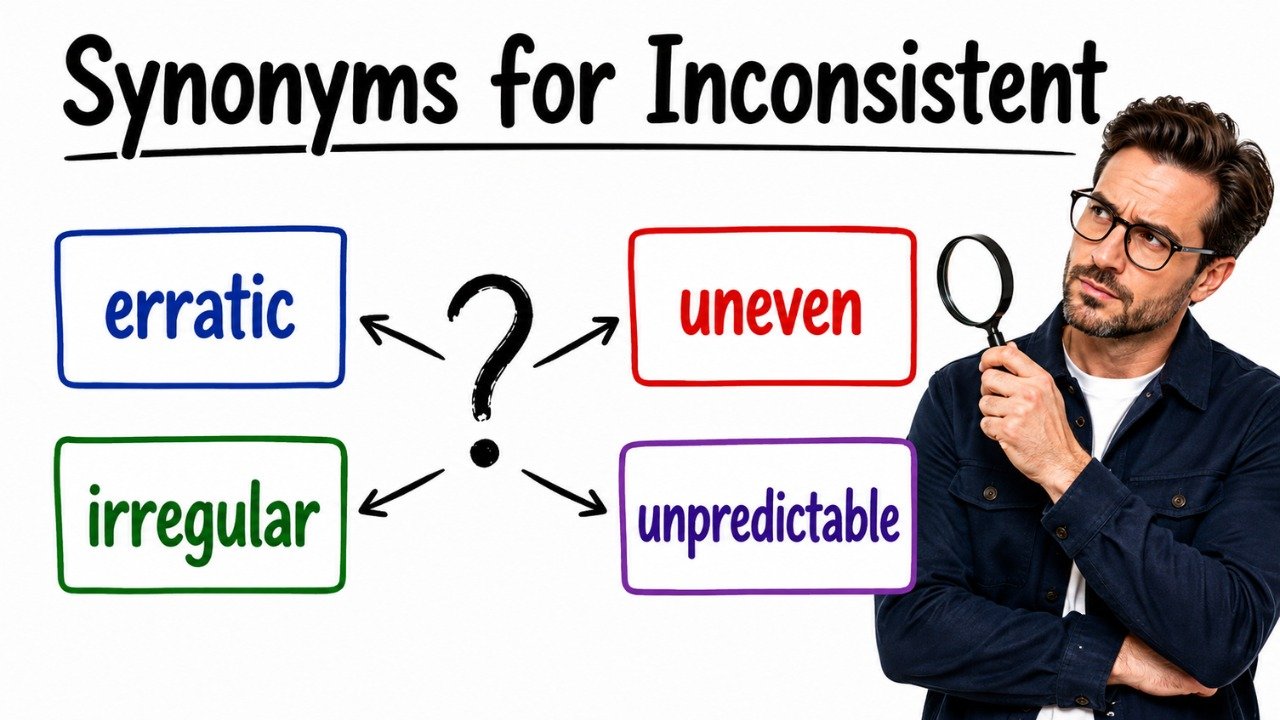
Quick Answer: Common synonyms for inconsistent include irregular, erratic, unpredictable, uneven, variable, contradictory, unreliable, unstable, changeable, and fluctuating. Use irregular for schedules or patterns, uneven for quality or performance, contradictory for statements that do not agree, unreliable for people or systems that cannot be trusted, and fluctuating for numbers or conditions that repeatedly rise and fall.
Pronunciation and Word Details
Word: Inconsistent.
Pronunciation: /ˌɪnkənˈsɪstənt/
Part of Speech: Adjective.
Meaning: Not remaining the same in quality, behavior, accuracy, opinion, or performance.
US Pronunciation:
UK Pronunciation:
What Does “Inconsistent” Mean?
Inconsistent means not staying the same, not following a regular pattern, or not agreeing with something else. It is an adjective used to describe changing behavior, uneven quality, conflicting information, unreliable performance, and irregular results.
A person can be inconsistent when their actions or opinions frequently change. A product or service can be inconsistent when its quality varies. Statements are inconsistent when they contradict each other. Results are inconsistent when they cannot be repeated reliably.
The word can also describe something that does not match an established rule, fact, principle, or expectation.
Example: His explanation was inconsistent with the evidence.
Example: The team produced inconsistent results throughout the season.
Example: Her attendance has been inconsistent this month.
Meaning, Tone, and Context of “Inconsistent”
Inconsistent usually has a neutral or mildly critical tone. It points out that something lacks stability, regularity, agreement, or dependable quality.
In formal writing, inconsistent often appears in reports, essays, research discussions, evaluations, policies, and professional communication. It can describe data, evidence, reasoning, standards, procedures, or performance.
In everyday conversation, the word commonly describes changing behavior, unreliable habits, uneven work, or mixed results.
Formal Use: The findings were inconsistent with the original hypothesis.
Professional Use: Customer service quality has been inconsistent across different locations.
Conversational Use: His mood has been inconsistent lately.
Academic Use: The available evidence is inconsistent and does not support a definite conclusion.
Critical Use: The manager applied the rules in an inconsistent manner.
The word is usually negative because consistency is associated with reliability and fairness. However, it can also be used objectively when describing natural variations in results, conditions, or measurements.
When and How to Use “Inconsistent”
For Changing Quality
Use inconsistent when the quality of something changes from one occasion to another.
Example: The restaurant receives positive reviews, but the food quality is inconsistent.
For Uneven Performance
Use inconsistent when a person, team, machine, or system performs well at some times and poorly at others.
Example: The player is talented but inconsistent under pressure.
For Conflicting Statements
Use inconsistent when two claims, explanations, or accounts do not agree.
Example: Her latest statement is inconsistent with what she said earlier.
For Irregular Behavior
Use inconsistent when someone does not act according to a stable pattern.
Example: His inconsistent study habits affected his examination results.
For Unreliable Results
Use inconsistent when results cannot be repeated or trusted.
Example: The device produced inconsistent readings during testing.
For Changing Opinions
Use inconsistent when a person frequently changes their position or judgment.
Example: The committee has been inconsistent in its response to similar cases.
For Unequal Standards
Use inconsistent when rules or standards are not applied equally.
Example: Employees complained about the inconsistent enforcement of workplace policies.
For Mismatched Information
Use inconsistent when information does not match known facts, evidence, or expectations.
Example: The reported figures appear inconsistent with the financial records.
Best Synonyms for Inconsistent
Irregular
Synonym: Irregular means not following a fixed, normal, or predictable pattern.
Example: Her irregular attendance made it difficult for her to complete the course.
Erratic
Synonym: Erratic means changing suddenly and unpredictably.
Example: The driver’s erratic movements concerned the other people on the road.
Unpredictable
Synonym: Unpredictable means impossible or difficult to anticipate.
Example: The weather in the mountains can be unpredictable.
Uneven
Synonym: Uneven means varying in quality, strength, level, or effectiveness.
Example: The novel contains excellent ideas, but the writing is uneven.
Variable
Synonym: Variable means likely to change or differ according to conditions.
Example: Delivery times are variable during busy periods.
Contradictory
Synonym: Contradictory means containing ideas or statements that oppose each other.
Example: The witnesses provided contradictory accounts of the incident.
Unreliable
Synonym: Unreliable means unable to be trusted or depended upon.
Example: The old machine became unreliable after years of heavy use.
Unstable
Synonym: Unstable means likely to change, fail, or become unbalanced.
Example: The connection remained unstable throughout the meeting.
Changeable
Synonym: Changeable means frequently changing in mood, form, condition, or opinion.
Example: Her changeable attitude confused the rest of the group.
Fluctuating
Synonym: Fluctuating means repeatedly rising, falling, or changing.
Example: The company adjusted its budget because of fluctuating material costs.
50 Synonyms for Inconsistent with Short Meanings
- Irregular: Not following a steady or normal pattern.
- Erratic: Changing suddenly and unpredictably.
- Unpredictable: Difficult or impossible to anticipate.
- Uneven: Varying in quality, strength, or effectiveness.
- Variable: Likely to change according to circumstances.
- Contradictory: Containing statements or ideas that oppose each other.
- Unreliable: Not dependable or trustworthy.
- Unstable: Not remaining firm, steady, or controlled.
- Changeable: Frequently changing in condition, mood, or opinion.
- Fluctuating: Repeatedly rising, falling, or varying.
- Inconstant: Not remaining loyal, steady, or unchanged.
- Intermittent: Starting and stopping at irregular intervals.
- Sporadic: Happening occasionally and without a regular pattern.
- Fitful: Occurring in short, irregular periods.
- Patchy: Good or complete in some areas but poor in others.
- Mixed: Containing different or opposing qualities.
- Conflicting: Failing to agree or exist together peacefully.
- Incompatible: Unable to agree, combine, or function together.
- Incongruous: Not matching the surrounding situation or context.
- Discrepant: Showing an unexpected difference or disagreement.
- Divergent: Developing or moving in different directions.
- At Odds: In disagreement or conflict.
- Self Contradictory: Containing claims that oppose one another.
- Capricious: Changing suddenly according to mood or impulse.
- Fickle: Frequently changing loyalty, interest, or opinion.
- Volatile: Likely to change quickly or become unstable.
- Mutable: Capable of changing easily.
- Shifting: Continually changing position, direction, or emphasis.
- Alternating: Repeatedly changing between two conditions.
- Vacillating: Moving repeatedly between different opinions or choices.
- Wavering: Becoming uncertain or changing a decision.
- Unsteady: Not firm, regular, or dependable.
- Random: Lacking a clear plan, method, or predictable pattern.
- Haphazard: Lacking organization, order, or planning.
- Disordered: Not arranged according to a clear system.
- Unsystematic: Not following an organized or consistent method.
- Nonuniform: Not having the same form, quality, or level throughout.
- Unequal: Not equal in amount, quality, treatment, or importance.
- Imbalanced: Not properly balanced or proportioned.
- Incoherent: Lacking logical connection or clear organization.
- Illogical: Not following sound reasoning or clear principles.
- Confused: Lacking clarity, order, or a definite direction.
- Uncertain: Not definite, settled, or predictable.
- Undependable: Not reliable enough to be trusted.
- Untrustworthy: Not deserving confidence or belief.
- Hit or Miss: Successful on some occasions but unsuccessful on others.
- On and Off: Starting and stopping repeatedly.
- All Over the Place: Lacking consistency, focus, or organization.
- Mercurial: Changing mood or behavior suddenly and frequently.
- Episodic: Occurring in separate and irregular periods.
Read Also:
Synonyms for Essay
Synonyms for Inconsistent by Context
When Inconsistent Means Changing Over Time
Use these synonyms when conditions, numbers, opinions, or behavior change repeatedly.
Variable: Suitable for results, conditions, quality, and measurements.
Example: The treatment produced variable results among participants.
Fluctuating: Best for prices, temperatures, demand, values, and other measurable changes.
Example: The business struggled with fluctuating fuel costs.
Changeable: Useful for moods, weather, attitudes, and opinions.
Example: The region is known for its changeable weather.
Unstable: Suitable for situations that may suddenly change, weaken, or fail.
Example: The system remained unstable after the update.
When Inconsistent Means Conflicting
Use these alternatives when statements, ideas, details, or pieces of evidence do not agree.
Contradictory: Best when one statement directly opposes another.
Example: The two reports contain contradictory conclusions.
Conflicting: Useful when information or opinions differ significantly.
Example: We received conflicting instructions from the supervisors.
Discrepant: Suitable for formal writing about differences between records, figures, or accounts.
Example: The auditor identified discrepant amounts in the financial statements.
Incompatible: Best when ideas, rules, systems, or goals cannot work together.
Example: Their proposed solution is incompatible with the current policy.
When Inconsistent Means Uneven in Quality
Use these synonyms when quality, ability, or performance is strong in some places but weak in others.
Uneven: The most natural choice for writing, performances, service, and quality.
Example: The film was entertaining, although its pacing was uneven.
Patchy: Useful when something is incomplete or effective only in certain areas.
Example: Internet coverage remains patchy in remote communities.
Hit or Miss: A casual phrase for results that are sometimes good and sometimes disappointing.
Example: The service at that cafe can be hit or miss.
Unreliable: Best when something cannot be depended upon to perform correctly.
Example: The application became unreliable after the recent changes.
When Inconsistent Means Irregular
Use these words for events, schedules, habits, or actions that do not follow a normal pattern.
Irregular: A broad alternative for schedules, attendance, sleep, and routines.
Example: Irregular practice prevented him from improving quickly.
Sporadic: Best for events that happen occasionally without a fixed pattern.
Example: The area experienced sporadic power interruptions.
Intermittent: Suitable when something repeatedly stops and starts.
Example: She experienced intermittent problems with the connection.
Fitful: Often used for sleep, progress, movement, or effort that occurs in short periods.
Example: The project made fitful progress during its first few months.
When Inconsistent Describes Behavior or Opinions
Use these alternatives when a person changes decisions, moods, loyalties, or attitudes.
Fickle: Suggests frequent changes in loyalty, interest, or preference.
Example: Public interest in the trend proved fickle.
Capricious: Suggests sudden changes based on impulse rather than reason.
Example: The leader was criticized for making capricious decisions.
Vacillating: Describes someone who repeatedly moves between different choices.
Example: His vacillating position delayed the final decision.
Wavering: Describes uncertainty or weakening commitment.
Example: Her wavering support created doubt among the other members.
Mercurial: Describes rapidly changing moods or behavior.
Example: His mercurial temperament made collaboration difficult.
Another Word for Inconsistent
Irregular is often the best single replacement for inconsistent because it can describe schedules, patterns, attendance, behavior, and performance. However, the strongest alternative depends on what is changing or failing to agree.
Use uneven for quality, contradictory for statements, unreliable for dependability, and fluctuating for measurable values.
Original: Her performance has been inconsistent this year.
Better Option: Her performance has been uneven this year.
Original: The information in the two reports is inconsistent.
Better Option: The information in the two reports is contradictory.
Original: The bus service is inconsistent during the evening.
Better Option: The bus service is unreliable during the evening.
Original: The monthly figures have been inconsistent.
Better Option: The monthly figures have been fluctuating.
When Not to Use “Inconsistent”
Inconsistent is useful, but it can sound too broad when a more precise synonym explains the problem better. Avoid it when you need to identify whether something is irregular, contradictory, unreliable, unstable, or uneven.
When Statements Directly Oppose Each Other
Use contradictory rather than inconsistent when two claims clearly cannot both be true.
Weak: The witness gave inconsistent statements about the time.
Better: The witness gave contradictory statements about the time.
When Quality Changes
Use uneven when discussing variations in writing, service, work, or performance.
Weak: The quality of the report is inconsistent.
Better: The quality of the report is uneven.
When Something Cannot Be Trusted
Use unreliable when the main issue is dependability.
Weak: The old alarm system is inconsistent.
Better: The old alarm system is unreliable.
When Numbers Rise and Fall
Use fluctuating when discussing prices, values, temperatures, or measurable data.
Weak: Demand has been inconsistent throughout the month.
Better: Demand has been fluctuating throughout the month.
When Events Occur Occasionally
Use sporadic or intermittent when something happens only at certain times.
Weak: The building has experienced inconsistent power failures.
Better: The building has experienced sporadic power failures.
When Describing Sudden Behavior
Use erratic when changes are sudden, extreme, or unpredictable.
Weak: His driving became inconsistent.
Better: His driving became erratic.
Words Commonly Confused With Inconsistent
Inconsistent vs Contradictory: Inconsistent is a broad word for something that changes or fails to agree. Contradictory specifically means that two statements, facts, or ideas directly oppose each other.
Inconsistent vs Unpredictable: Inconsistent describes a lack of regularity or dependable quality. Unpredictable emphasizes that future behavior or results cannot be anticipated.
Inconsistent vs Unreliable: Inconsistent describes variation. Unreliable describes something that cannot be trusted or depended upon. Something may be inconsistent without being completely unreliable.
Inconsistent vs Variable: Inconsistent usually carries a negative meaning. Variable can be neutral and simply indicates that something changes according to conditions.
Inconsistent vs Erratic: Inconsistent describes any lack of steadiness. Erratic suggests sudden, unusual, or uncontrolled changes.
Inconsistent vs Uneven: Inconsistent can refer to behavior, statements, patterns, or quality. Uneven mainly refers to varying quality, strength, progress, or performance.
Inconsistent vs Irregular: Inconsistent often emphasizes changing quality or disagreement. Irregular mainly describes something that does not follow a normal schedule, form, or pattern.
Which Synonym Should You Choose?
Choose irregular when describing schedules, attendance, routines, patterns, or events that do not occur at expected times.
Choose uneven when discussing quality, performance, writing, service, skill, or progress that varies from strong to weak.
Choose contradictory when two statements, claims, explanations, or pieces of evidence directly oppose each other.
Choose conflicting when information, opinions, instructions, or interests do not agree.
Choose unreliable when a person, system, machine, service, or source cannot be depended upon.
Choose erratic when behavior, movement, performance, or decisions change suddenly and unpredictably.
Choose unpredictable when the main point is that future actions or results cannot be anticipated.
Choose variable when writing neutrally about results, conditions, measurements, or qualities that naturally differ.
Choose fluctuating when discussing prices, temperatures, demand, values, rates, or other measurable figures that rise and fall.
Choose unstable when describing a condition, system, relationship, structure, or situation that may suddenly change or fail.
Choose sporadic when something happens occasionally without a regular pattern.
Choose intermittent when an activity, signal, sound, pain, or service repeatedly stops and starts.
Choose changeable when describing moods, weather, opinions, or conditions that frequently change.
Choose discrepant in formal reports when figures, records, or accounts contain noticeable differences.
Choose hit or miss in casual conversation when results are sometimes successful and sometimes disappointing.
Real Life Examples of “Inconsistent” in Sentences
Original: Her attendance has been inconsistent since the beginning of the course.
Better Option: Her attendance has been irregular since the beginning of the course.
Original: The team delivered an inconsistent performance during the competition.
Better Option: The team delivered an uneven performance during the competition.
Original: His explanation was inconsistent with the available evidence.
Better Option: His explanation was incompatible with the available evidence.
Original: The machine gives inconsistent readings.
Better Option: The machine gives unreliable readings.
Original: The witness provided inconsistent accounts of the event.
Better Option: The witness provided contradictory accounts of the event.
Original: The internet connection is inconsistent in this area.
Better Option: The internet connection is unstable in this area.
Original: Her attitude toward the proposal has been inconsistent.
Better Option: Her attitude toward the proposal has been changeable.
Original: The company reported inconsistent monthly sales.
Better Option: The company reported fluctuating monthly sales.
Original: His effort during training was inconsistent.
Better Option: His effort during training was sporadic.
Original: The rules were applied inconsistently across different departments.
Better Option: The rules were applied unevenly across different departments.
Synonym Groups and Usage Differences
Regularity Group
Irregular, sporadic, intermittent, fitful, episodic, and on and off describe actions or events that do not follow a steady schedule.
Irregular is the broadest word. Sporadic describes occasional events. Intermittent describes something that repeatedly stops and starts. Fitful suggests short and uneven periods of activity.
Example: Progress remained fitful because the project repeatedly lost funding.
Stability Group
Unstable, unsteady, volatile, fluctuating, variable, and shifting describe changing conditions, values, or situations.
Unstable suggests weakness or possible failure. Volatile suggests rapid and possibly extreme change. Fluctuating is most suitable for measurable rises and falls.
Example: Fluctuating prices made long term budgeting difficult.
Agreement Group
Contradictory, conflicting, incompatible, discrepant, divergent, incongruous, and at odds describe ideas or details that do not match.
Contradictory indicates direct opposition. Conflicting is broader and can describe opinions or instructions. Discrepant is formal and often used for differences in records or figures.
Example: The final figures were discrepant with the amounts recorded earlier.
Quality Group
Uneven, patchy, mixed, hit or miss, nonuniform, and imbalanced describe quality or performance that varies across occasions or areas.
Uneven is useful in formal and general writing. Patchy suggests that some parts are good while others are incomplete or weak. Hit or miss is conversational.
Example: The course received mixed reviews because the teaching quality was uneven.
Reliability Group
Unreliable, undependable, untrustworthy, unpredictable, and uncertain describe something that cannot be confidently trusted or anticipated.
Unreliable emphasizes poor dependability. Untrustworthy often carries a stronger moral meaning when applied to a person or source.
Example: The damaged sensor became unreliable and required replacement.
Behavior Group
Erratic, fickle, capricious, vacillating, wavering, mercurial, and inconstant describe changing behavior, loyalty, mood, or judgment.
Erratic suggests unpredictable actions. Fickle describes changing interests or loyalties. Vacillating describes repeated indecision.
Example: His vacillating leadership prevented the group from choosing a clear direction.
Organization Group
Haphazard, random, disordered, unsystematic, confused, and incoherent describe actions or ideas that lack order and consistency.
Haphazard suggests poor planning. Unsystematic indicates the absence of a clear method. Incoherent describes ideas that do not connect logically.
Example: The investigation was weakened by an unsystematic approach to collecting evidence.
Antonyms of Inconsistent
The opposite of inconsistent depends on whether the word refers to stability, regularity, agreement, quality, or dependability.
Consistent: Remaining the same in quality, behavior, or performance.
Steady: Continuing at a regular and controlled level.
Stable: Unlikely to change, weaken, or fail suddenly.
Reliable: Able to be trusted or depended upon.
Regular: Following a normal or predictable pattern.
Uniform: Remaining the same throughout.
Predictable: Easy to anticipate based on an established pattern.
Dependable: Performing correctly and reliably when needed.
Coherent: Clear, logical, and properly connected.
Compatible: Able to agree, combine, or function together.
Constant: Remaining unchanged over time.
Systematic: Following an organized method or plan.
Balanced: Properly proportioned and evenly arranged.
Accurate: Correct and free from significant errors.
Harmonious: Existing together without disagreement or conflict.
Comparison: Inconsistent vs Related Words
Inconsistent vs Erratic
Inconsistent means not remaining regular, equal, or dependable. Erratic suggests sudden and unpredictable changes that may appear uncontrolled.
Example With Inconsistent: Her work quality has been inconsistent during the past month.
Example With Erratic: Her work habits became erratic after the schedule changed.
Inconsistent vs Unreliable
Inconsistent focuses on variation. Unreliable emphasizes that something cannot be trusted to work or perform when needed.
Example With Inconsistent: The printer produces inconsistent image quality.
Example With Unreliable: The printer is unreliable and frequently stops working.
Inconsistent vs Contradictory
Inconsistent can describe changing behavior, quality, or information. Contradictory specifically describes statements or facts that directly oppose each other.
Example With Inconsistent: His response was inconsistent with his previous behavior.
Example With Contradictory: He gave two contradictory explanations for his absence.
Inconsistent vs Variable
Inconsistent often suggests an undesirable lack of steadiness. Variable is more neutral and can describe natural or expected differences.
Example With Inconsistent: The service quality has been inconsistent.
Example With Variable: Travel times are variable because of changing traffic conditions.
Inconsistent vs Uneven
Inconsistent has a broad meaning and can apply to behavior, rules, statements, or results. Uneven usually describes differences in quality, strength, progress, or performance.
Example With Inconsistent: Her decisions have been inconsistent.
Example With Uneven: Her presentation contained strong research but uneven organization.
Inconsistent vs Irregular
Inconsistent describes something that changes or fails to match. Irregular emphasizes the absence of a normal schedule, pattern, or form.
Example With Inconsistent: His level of effort has been inconsistent.
Example With Irregular: His practice schedule has been irregular.
Inconsistent vs Unpredictable
Inconsistent means not following the same standard or pattern. Unpredictable means that future actions, events, or results cannot be anticipated.
Example With Inconsistent: The system produces inconsistent results.
Example With Unpredictable: The system behaves unpredictably when several users connect at once.
Common Phrases and Expressions With Inconsistent
Inconsistent Behavior: Actions that frequently change or do not follow a dependable pattern.
Inconsistent Results: Outcomes that vary significantly between attempts or occasions.
Inconsistent Performance: Work or ability that changes between strong and weak.
Inconsistent Quality: A level of quality that is not the same every time.
Inconsistent Evidence: Information that does not fully agree or support one clear conclusion.
Inconsistent Statements: Claims or explanations that differ or contradict one another.
Inconsistent Standards: Rules or expectations that are not applied equally.
Inconsistent Application: Unequal or changing use of a policy, rule, or method.
Inconsistent Approach: A method that changes without a clear reason or plan.
Inconsistent With: Not matching or agreeing with a fact, rule, statement, or expectation.
Common Mistakes to Avoid
Repeating Inconsistent Too Often
Using inconsistent repeatedly can make a paragraph sound vague and repetitive. Replace it with a more precise synonym when the context changes.
Repetitive: The service was inconsistent, the timing was inconsistent, and the quality was inconsistent.
Improved: The service was unreliable, the timing was irregular, and the quality was uneven.
Choosing an Overly General Synonym
Not every synonym works in every context. Erratic is stronger than irregular, while contradictory is limited to ideas or information that oppose each other.
Unnatural: The report contains erratic statements.
Improved: The report contains contradictory statements.
Confusing Variation With Unreliability
Something can vary without being unreliable. Variable is often neutral, while unreliable suggests that something cannot be trusted.
Unclear: Seasonal temperatures are unreliable.
Improved: Seasonal temperatures are variable.
Using Inconsistent To Describe Direct Opposition
When two claims clearly oppose each other, contradictory is more exact.
Weak: The two witnesses gave inconsistent descriptions.
Better: The two witnesses gave contradictory descriptions.
Using the Wrong Preposition
The usual expression is inconsistent with, not inconsistent to.
Incorrect: His actions were inconsistent to his promises.
Correct: His actions were inconsistent with his promises.
Ignoring Sentence Agreement
Inconsistent is an adjective, so it usually follows a linking verb or appears before a noun.
Incorrect: The results inconsistently.
Correct: The results were inconsistent.
Correct: The experiment produced inconsistent results.
Using a Casual Phrase in Formal Writing
Hit or miss and all over the place are useful in conversation, but they may sound too informal in academic or professional writing.
Informal: The findings were all over the place.
Formal: The findings were inconsistent and inconclusive.
Adding Unnecessary Intensifiers
Words such as very may not explain the exact type of inconsistency.
Weak: The data was very inconsistent.
Better: The data fluctuated significantly between testing periods.
Conclusion
Synonyms for inconsistent help readers describe changing quality, irregular patterns, conflicting information, and unreliable behavior more precisely. Choose irregular for schedules, uneven for performance, contradictory for opposing statements, unreliable for dependability, and fluctuating for changing numbers. Erratic works best for sudden and unpredictable behavior, while variable is suitable for neutral differences. Selecting the right alternative makes writing clearer, more accurate, and easier to understand in professional, academic, and everyday contexts.
FAQs About Synonyms for Inconsistent
What Is the Best Synonym for Inconsistent?
Irregular is the broadest replacement, but the best choice depends on context. Use uneven for quality, contradictory for statements, and unreliable for dependability.
Does Inconsistent Mean Unreliable?
Inconsistent can mean unreliable, but the words are not identical. Inconsistent describes variation, while unreliable means something cannot be depended upon.
Can Inconsistent Mean Contradictory?
Yes. Inconsistent can describe statements, facts, or explanations that do not agree. Contradictory is more precise when they directly oppose one another.
What Is a Formal Synonym for Inconsistent?
Contradictory, discrepant, incompatible, variable, nonuniform, and irregular are useful formal alternatives, depending on the intended meaning.
What Is Another Word for Inconsistent Performance?
Uneven performance is the most natural alternative. Erratic performance is stronger and suggests sudden or unpredictable changes.
What Is the Opposite of Inconsistent?
Common opposites include consistent, steady, stable, reliable, regular, uniform, predictable, and dependable.
Is “Inconsistent With” Grammatically Correct?
Yes. Inconsistent with is the standard expression used when something does not match or agree with another fact, statement, rule, or expectation.
