
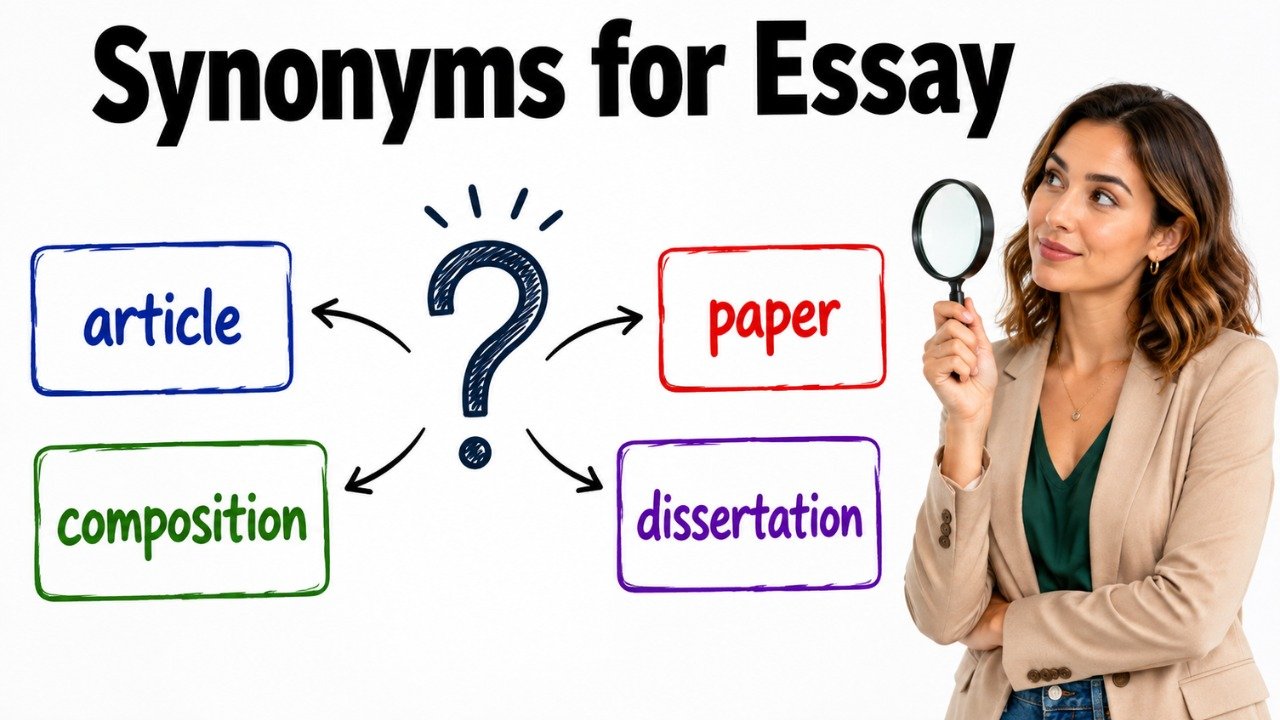
Quick Answer: The best synonyms for essay include composition, paper, article, piece, written work, analysis, discussion, reflection, treatise, and write up. Use composition for a general piece of structured writing, paper for an academic assignment, and article for writing intended for a wider audience. Analysis suits detailed examination, reflection suits personal thought, and treatise describes a serious and extensive discussion. The most suitable synonyms for essay depend on the purpose, length, subject, audience, and level of formality.
Pronunciation and Word Details
Word: Essay.
Pronunciation: /ˈes.eɪ/ as a noun and /eˈseɪ/ as a verb.
Part of Speech: Noun and verb.
Meaning: As a noun, an essay is a structured piece of writing about a subject. As a verb, it means to attempt something.
US Pronunciation:
UK Pronunciation:
What Does “Essay” Mean?
Essay usually means a short or medium length piece of writing that explains, discusses, analyzes, describes, or argues a particular subject.
As a noun, essay commonly refers to school assignments, academic papers, personal reflections, literary discussions, and opinion based writing.
Example: The student wrote an essay about the effects of urban growth.
An essay normally presents a central idea and supports it through explanations, examples, evidence, observations, or reasoning. It often contains an introduction, body paragraphs, and a conclusion.
The word can describe several kinds of writing.
Academic Context: The class submitted an essay on language development.
Personal Context: She wrote an essay about her childhood experiences.
Analytical Context: His essay examines symbolism in the novel.
Argumentative Context: The essay argues that public spaces improve community life.
Essay can also function as a verb meaning to attempt or try something, although this use is formal and uncommon in everyday speech.
Example: The climber essayed the difficult ascent.
Meaning, Tone, and Context of “Essay”
Essay has a neutral to formal tone when it refers to written work. It is especially common in education, literature, criticism, journalism, and academic discussion.
Academic Tone: Essay is widely used for structured assignments that require explanation, analysis, or argument.
Formal Tone: The word can describe serious writing about history, politics, culture, philosophy, language, or society.
Personal Tone: A personal essay may be reflective, emotional, descriptive, or conversational.
Literary Tone: Essay can refer to carefully crafted nonfiction writing that explores an idea, experience, or observation.
Conversational Tone: In everyday speech, students may use essay to mean any extended written assignment.
Technical Tone: In specialized fields, paper, report, study, or analysis may be more precise than essay.
The tone of an essay depends on its purpose. An academic essay usually sounds formal and evidence based. A personal essay may sound intimate and expressive. An opinion essay may sound persuasive, while a descriptive essay may emphasize imagery and detail.
When and How to Use “Essay”
For an Academic Assignment
Use essay for a structured piece of writing completed for a class, examination, or course.
Example: We must submit a two thousand word essay by Friday.
For Explaining a Topic
Use essay when the writer explains a concept, process, issue, or idea in an organized way.
Example: Her essay explains how rainfall affects local agriculture.
For Presenting an Argument
Use essay when the writer supports a position with reasons, examples, and evidence.
Example: The essay argues for greater investment in public libraries.
For Literary Analysis
Use essay when discussing themes, characters, language, structure, or symbolism in a literary work.
Example: He wrote an essay about the role of memory in the story.
For Personal Reflection
Use essay when the writer explores a personal experience, belief, memory, or lesson.
Example: Her personal essay reflects on moving to a new city.
For Description
Use essay for writing that creates a clear picture of a person, place, object, or experience.
Example: The descriptive essay presents a vivid picture of village life.
For Examination Questions
Essay can describe a long answer that requires explanation and organized reasoning.
Example: The examination included three essay questions.
For a Formal Attempt
As a verb, essay can mean to attempt a difficult action, although try or attempt is more natural in modern conversation.
Example: The researcher essayed a new approach to the problem.
Best Synonyms for Essay
Composition: A structured piece of writing created for academic or literary purposes.
Example: The teacher praised her composition for its clear organization.
Paper: A written academic assignment or scholarly work.
Example: He submitted a paper on environmental policy.
Article: A piece of writing prepared for publication or a general audience.
Example: She wrote an article about changes in modern education.
Piece: A general term for a work of writing.
Example: His latest piece explores the meaning of friendship.
Written Work: Any completed text produced by a writer or student.
Example: The written work demonstrates careful research.
Analysis: Writing that examines a subject closely and explains its parts or meaning.
Example: Her analysis of the poem was detailed and convincing.
Discussion: A balanced examination of a subject, question, or issue.
Example: The assignment requires a discussion of both viewpoints.
Reflection: Writing that explores personal thoughts, experiences, and lessons.
Example: His reflection describes what he learned during the project.
Treatise: A formal and detailed piece of writing about a serious subject.
Example: The scholar produced a treatise on political philosophy.
Write Up: An informal term for a written account, explanation, or assignment.
Example: Please prepare a short write up about the event.
50 Synonyms for Essay with Short Meanings
- Composition: A structured piece of writing.
- Paper: An academic or scholarly written work.
- Article: Writing created for publication or general reading.
- Piece: A general work of writing.
- Written Work: Any completed text or composition.
- Prose Piece: A work written in ordinary language rather than verse.
- Write Up: An informal written account or explanation.
- Text: A written work considered as a complete piece.
- Manuscript: A written work before or during publication.
- Work: A product of intellectual or creative effort.
- Study: A detailed examination of a subject.
- Analysis: A careful examination of ideas, evidence, or meaning.
- Discussion: An organized consideration of a topic.
- Exposition: Writing that clearly explains a subject.
- Discourse: A formal and extended treatment of an idea.
- Treatise: A serious and detailed written discussion.
- Monograph: A detailed scholarly work on one subject.
- Thesis: A substantial academic work supporting a central argument.
- Dissertation: An extensive research work for an advanced degree.
- Report: A factual and organized presentation of information.
- Research Paper: Academic writing based on research and evidence.
- Academic Paper: Formal writing produced for study or scholarship.
- Term Paper: A substantial assignment completed during a course.
- School Paper: A written assignment produced by a student.
- Response Paper: Writing that reacts to a text, idea, or experience.
- Position Paper: Writing that presents and supports a viewpoint.
- Reflection Paper: Writing about personal learning or experience.
- Personal Essay: Writing based on the author’s experiences or ideas.
- Narrative: Writing that tells a sequence of events.
- Account: A written description of an event or experience.
- Memoir: Personal writing about meaningful past experiences.
- Reflection: Thoughtful writing about experience or meaning.
- Commentary: Writing that explains or evaluates a subject.
- Critique: A detailed evaluation of a work or idea.
- Review: Writing that assesses the quality or value of something.
- Editorial: Writing that presents a considered opinion.
- Opinion Piece: Writing that expresses and supports a viewpoint.
- Column: A regular piece of writing about a particular subject.
- Feature: A detailed and engaging article about a subject.
- Profile: Writing that describes a person, group, or organization.
- Argument: Writing that supports a claim with reasons and evidence.
- Examination: A detailed written investigation of a subject.
- Interpretation: Writing that explains meaning or significance.
- Assessment: Writing that evaluates quality, value, or performance.
- Composition Exercise: A writing task used to develop skill.
- Written Assignment: A piece of work completed for a course.
- Attempt: An effort to do or achieve something.
- Try: An effort to perform an action.
- Endeavor: A serious or determined attempt.
- Make an Effort: To attempt to complete a task or action.
Read Also:
Synonyms for Goods

Synonyms for Essay by Context
When Essay Means an Academic Assignment
Use these alternatives for writing completed as part of school, university, or formal study.
Paper: A common academic assignment based on reading, research, or argument.
Example: The students submitted a paper on economic development.
Academic Paper: A formal written work using evidence and scholarly reasoning.
Example: Her academic paper examines changes in language use.
Term Paper: A longer assignment completed during or at the end of a course.
Example: He is researching a topic for his term paper.
Written Assignment: A general term for work that must be submitted in writing.
Example: The written assignment is due next week.
When Essay Means an Explanation
Use these words when the purpose is to explain a subject clearly.
Exposition: A clear and organized explanation of an idea or process.
Example: The exposition explains how the legal system developed.
Discussion: A structured consideration of a topic or question.
Example: The paper includes a discussion of possible solutions.
Write Up: An informal account or explanation.
Example: She prepared a short write up about the workshop.
Article: A piece written to inform a general audience.
Example: The article explains why sleep supports concentration.
When Essay Means a Detailed Analysis
Use these alternatives when the writing closely examines evidence, language, ideas, or results.
Analysis: A careful study of parts, causes, patterns, or meanings.
Example: His analysis identifies several weaknesses in the argument.
Examination: A detailed investigation of an issue.
Example: The book offers an examination of social change.
Interpretation: An explanation of meaning or significance.
Example: Her interpretation of the poem focuses on loss and memory.
Critique: An evaluation that discusses strengths and weaknesses.
Example: The assignment requires a critique of the research method.
When Essay Means Personal Writing
Use these alternatives for writing based on personal experience, memory, or reflection.
Personal Essay: A piece that explores the writer’s experiences or beliefs.
Example: Her personal essay describes adjusting to life in a new country.
Reflection: Thoughtful writing about learning, experience, or personal growth.
Example: His reflection explains how the journey changed his priorities.
Memoir: Writing based on meaningful events from the writer’s past.
Example: The memoir recalls her early years in a coastal town.
Account: A description of something that happened.
Example: He wrote an account of his first day as a teacher.
When Essay Means Persuasive Writing
Use these alternatives when the writer presents and supports a position.
Argument: A reasoned case supporting a claim or conclusion.
Example: Her argument is supported by several practical examples.
Position Paper: A formal document explaining and defending a position.
Example: The committee released a position paper on educational reform.
Opinion Piece: Writing that clearly expresses the writer’s viewpoint.
Example: His opinion piece supports stricter safety rules.
Editorial: A formal expression of opinion about an important issue.
Example: The editorial calls for greater public participation.
When Essay Means Published Writing
Use these words when the work is intended for readers beyond a classroom.
Article: An informative or analytical piece prepared for publication.
Example: She published an article about rural education.
Feature: A detailed article written in an engaging style.
Example: The feature explores the daily work of emergency nurses.
Column: A recurring piece written from a particular perspective.
Example: His weekly column discusses language and communication.
Commentary: Writing that explains or evaluates events and ideas.
Example: Her commentary examines changing attitudes toward work.
When Essay Means a Formal Attempt
The verb essay means to try or attempt, although this meaning is uncommon in everyday English.
Attempt: To try to complete a task or achieve a result.
Example: The team attempted a more difficult method.
Try: To make an effort to do something.
Example: She tried to solve the problem independently.
Endeavor: To make a serious and determined effort.
Example: The researchers endeavored to improve the process.
Make an Effort: To actively try to achieve something.
Example: He made an effort to understand the opposing view.
Another Word for Essay
The best general replacement for essay is composition because it refers to an organized piece of writing. However, paper is usually better for academic work, article is more suitable for published writing, and reflection works best for personal or thoughtful content.
Original: The students wrote an essay about water conservation.
Better Option: The students wrote a composition about water conservation.
Original: She submitted an essay for her history course.
Better Option: She submitted a paper for her history course.
Original: He published an essay about modern architecture.
Better Option: He published an article about modern architecture.
Original: We wrote an essay about what we learned during the project.
Better Option: We wrote a reflection about what we learned during the project.
When Not to Use “Essay”
Do not use essay when a more specific term explains the purpose or format better.
A formal document containing findings, statistics, and recommendations is normally a report rather than an essay.
Weak: The committee prepared an essay containing monthly sales figures.
Better: The committee prepared a report containing monthly sales figures.
Do not call a major research project an essay when it is actually a thesis or dissertation.
Weak: She completed a doctoral essay on language acquisition.
Better: She completed a doctoral dissertation on language acquisition.
Avoid essay when referring to a brief factual answer.
Weak: Write a one sentence essay explaining your choice.
Better: Write a one sentence response explaining your choice.
Do not use essay for every published text. Article, feature, review, or editorial may be more accurate.
Weak: He wrote an essay reporting yesterday’s events.
Better: He wrote an article reporting yesterday’s events.
Avoid the verb essay in ordinary conversation because it may sound unusually formal or old fashioned.
Weak: I will essay to complete the work tonight.
Better: I will try to complete the work tonight.
Do not use essay when the writing mainly tells an invented story.
Weak: She wrote an essay about a fictional detective.
Better: She wrote a story about a fictional detective.
Words Commonly Confused With Essay
Essay vs Article: An essay often explores an idea through explanation, argument, or reflection. An article is usually written for publication and may focus on information, news, analysis, or advice.
Essay vs Paper: Essay is a broad term for structured writing. Paper is especially common for academic assignments and research based work.
Essay vs Report: An essay develops ideas through connected paragraphs and interpretation. A report usually presents facts under clear sections and may include findings or recommendations.
Essay vs Thesis: An essay is usually shorter and may explore a limited question. A thesis is a substantial academic work built around original research or a major argument.
Essay vs Dissertation: An essay is normally a course assignment or literary composition. A dissertation is an extensive research project completed for an advanced academic qualification.
Essay vs Story: An essay is generally nonfiction and examines ideas or real experiences. A story presents events through narrative and may be fictional.
Essay vs Composition: Composition is a broad term for a piece of writing and is often used in education. Essay usually describes a more organized discussion of a particular topic.
Essay vs Analysis: Essay describes the overall form of the writing. Analysis describes the method of closely examining evidence, ideas, language, or meaning.
Which Synonym Should You Choose?
Choose composition for a general piece of organized writing.
Choose paper for an assignment completed in a school, university, or academic setting.
Choose academic paper for formal scholarly writing supported by evidence and research.
Choose research paper when the work is based on collected information, sources, findings, or data.
Choose article for writing intended for publication or a broad audience.
Choose piece when you need a flexible and general term for written content.
Choose analysis when the writing examines evidence, ideas, structure, causes, or meaning.
Choose discussion when the writing considers multiple ideas, arguments, or perspectives.
Choose reflection for personal writing about learning, growth, memories, or experiences.
Choose critique when evaluating the strengths and weaknesses of a work, argument, or method.
Choose review when assessing a book, performance, product, event, or creative work.
Choose report when presenting facts, findings, results, and recommendations.
Choose treatise for a serious, formal, and extensive discussion of a complex subject.
Choose thesis or dissertation for major academic research projects.
Choose opinion piece for persuasive writing intended for general readers.
Choose attempt or try when essay is being used as a verb.
Real Life Examples of “Essay” in Sentences
Original: Maria wrote an essay about the importance of clean water.
Better Option: Maria wrote a composition about the importance of clean water.
Original: I submitted my essay before the deadline.
Better Option: I submitted my paper before the deadline.
Original: His essay examines the causes of population growth.
Better Option: His analysis examines the causes of population growth.
Original: She published an essay about workplace communication.
Better Option: She published an article about workplace communication.
Original: The assignment requires an essay on personal development.
Better Option: The assignment requires a reflection on personal development.
Original: Their essay presents the results of the investigation.
Better Option: Their report presents the results of the investigation.
Original: He wrote an essay criticizing the author’s argument.
Better Option: He wrote a critique of the author’s argument.
Original: The student prepared an essay defending the new policy.
Better Option: The student prepared a position paper defending the new policy.
Original: Her essay describes her experiences as a volunteer.
Better Option: Her personal essay describes her experiences as a volunteer.
Original: The explorer essayed a dangerous route through the mountains.
Better Option: The explorer attempted a dangerous route through the mountains.
Synonym Groups and Usage Differences
Academic Writing Group
This group includes paper, academic paper, research paper, term paper, thesis, dissertation, and written assignment.
Paper is the most flexible academic synonym. Research paper emphasizes evidence and investigation. Thesis and dissertation describe much larger and more advanced projects.
Example: The student submitted a research paper based on survey results.
General Writing Group
This group includes composition, piece, written work, prose piece, text, and manuscript.
These words describe writing without always identifying its exact purpose. Composition is common in education, while manuscript often refers to writing prepared for publication.
Example: Her composition was clear, organized, and engaging.
Explanation and Analysis Group
This group includes exposition, analysis, discussion, examination, interpretation, and study.
Use these words when the writing explains a subject or examines it closely. Analysis focuses on parts and meaning, while discussion considers ideas and viewpoints.
Example: The analysis explains how the writer develops the central theme.
Personal Writing Group
This group includes personal essay, reflection, memoir, narrative, and account.
These alternatives work when the writer discusses experiences, memories, emotions, or personal growth. Memoir usually covers meaningful events from the writer’s past.
Example: His reflection describes what he learned from failure.
Opinion and Evaluation Group
This group includes argument, position paper, opinion piece, editorial, commentary, critique, and review.
Argument and position paper defend a claim. Critique and review evaluate something. Commentary explains or interprets an issue.
Example: The critique identifies both strengths and weaknesses in the proposal.
Publication Group
This group includes article, feature, column, profile, and editorial.
Article is the broadest published form. A feature gives detailed and engaging coverage, while a profile focuses on a person or group.
Example: The writer prepared a profile of the local artist.
Attempt Group
This group includes attempt, try, endeavor, and make an effort.
These alternatives replace essay when it functions as a verb. Attempt is formal, try is conversational, and endeavor suggests serious effort.
Example: The team attempted to complete the project ahead of schedule.
Antonyms of Essay
Essay has no single direct antonym when it means a piece of writing. Its opposites depend on the intended contrast.
Speech: Spoken communication rather than written composition.
Silence: The absence of written or spoken expression.
Image: Visual communication rather than an extended written explanation.
Outline: A brief plan rather than a fully developed essay.
Summary: A shortened account rather than a detailed discussion.
Fragment: An incomplete piece rather than a complete composition.
List: Separate points rather than connected paragraphs.
Question: A request for information rather than a developed answer.
When essay means to attempt, the following words can express opposite actions.
Abandon: To stop trying to complete something.
Avoid: To stay away from attempting something.
Refuse: To decide not to make an attempt.
Surrender: To stop making an effort.
Quit: To cease working toward a goal.
Neglect: To fail to make the necessary effort.
Comparison: Essay vs Related Words
Essay vs Composition
Essay usually explores a specific subject through explanation, analysis, reflection, or argument. Composition is a broader term for any organized piece of writing.
Example With Essay: She wrote an essay about the value of public parks.
Example With Composition: Her composition used clear sentences and strong descriptions.
Essay vs Paper
Essay can refer to academic, literary, personal, or published writing. Paper is especially common for academic assignments and research.
Example With Essay: The class wrote an essay about courage.
Example With Paper: He presented a paper based on his scientific research.
Essay vs Article
Essay often expresses the writer’s interpretation, argument, or reflection. Article usually targets a wider audience and may be informative, factual, or journalistic.
Example With Essay: Her essay reflects on the meaning of home.
Example With Article: Her article explains recent changes in housing costs.
Essay vs Report
Essay develops an idea through connected reasoning and paragraphs. Report organizes facts, findings, and recommendations into clear sections.
Example With Essay: The essay discusses the causes of workplace stress.
Example With Report: The report presents employee survey results.
Essay vs Analysis
Essay describes a type of complete written work. Analysis describes close examination and may form one part of an essay.
Example With Essay: He wrote an essay about the poem.
Example With Analysis: His analysis explains the poem’s imagery and rhythm.
Essay vs Reflection
Essay is a broad writing form. Reflection is a type of personal or thoughtful writing focused on experience and learning.
Example With Essay: She completed an essay about community service.
Example With Reflection: She wrote a reflection about what community service taught her.
Essay vs Thesis
An essay is usually shorter and completed for a particular assignment. A thesis is longer, more specialized, and based on substantial research.
Example With Essay: The student wrote an essay for her history class.
Example With Thesis: The graduate student completed a thesis on urban migration.
Essay vs Dissertation
Essay refers to a relatively limited written discussion. Dissertation refers to an extensive and original research project for an advanced degree.
Example With Essay: His essay examines one aspect of language learning.
Example With Dissertation: His dissertation presents several years of original research.
Essay vs Story
An essay generally discusses real ideas, arguments, observations, or experiences. A story presents connected events and may be fictional.
Example With Essay: She wrote an essay about loneliness.
Example With Story: She wrote a story about a traveler lost at sea.
Common Phrases and Expressions With Essay
Write an Essay: To create a structured piece of writing about a topic.
Essay Question: An examination question requiring a developed written answer.
Academic Essay: Formal writing completed for educational purposes.
Personal Essay: Writing based on personal thoughts, experiences, or memories.
Argumentative Essay: Writing that supports a debatable claim with reasons and evidence.
Persuasive Essay: Writing intended to convince the reader to accept a position.
Narrative Essay: Writing that presents an experience through a sequence of events.
Descriptive Essay: Writing that creates a detailed picture through sensory language.
Expository Essay: Writing that explains a subject clearly and logically.
Critical Essay: Writing that analyzes and evaluates a text, idea, or work.
Essay Collection: A published group of essays by one or more writers.
Common Mistakes to Avoid
Using Essay for Every Type of Writing
Essay is a broad word, but it is not always the most accurate choice. Use report for findings, article for published information, and story for fictional narrative.
Unclear: She wrote an essay about the experiment results.
Clearer: She wrote a report about the experiment results.
Confusing an Essay With a Research Paper
An essay may use reasoning and examples without extensive research. A research paper depends more heavily on evidence, investigation, and documented information.
Unclear: The assignment requires an essay based on twenty research studies.
Clearer: The assignment requires a research paper based on twenty studies.
Calling a Dissertation an Essay
A dissertation is much longer and more specialized than an ordinary essay.
Incorrect: He spent four years writing his doctoral essay.
Correct: He spent four years writing his doctoral dissertation.
Using the Wrong Preposition
Essay is commonly followed by “on,” “about,” or “concerning” when introducing its topic.
Natural: She wrote an essay on climate policy.
Natural: She wrote an essay about her childhood.
Repeating Essay Too Often
Using essay repeatedly can make a paragraph sound dull or mechanical.
Repetitive: The essay begins with a question. The essay then gives evidence. The essay ends with a conclusion.
Improved: The essay begins with a question, presents supporting evidence, and ends with a conclusion.
Choosing an Overly Formal Synonym
Treatise, discourse, thesis, and dissertation should not replace essay unless the length and purpose justify them.
Unnatural: The child wrote a treatise about her favorite animal.
Natural: The child wrote a composition about her favorite animal.
Using Essay as a Verb in Casual Speech
The verb essay is correct but uncommon. Try or attempt will usually sound more natural.
Unnatural: We essayed to repair the broken chair.
Natural: We attempted to repair the broken chair.
Confusing a Topic With a Thesis
An essay topic identifies the subject. A thesis states the main claim or controlling idea.
Topic: The effects of exercise on concentration.
Thesis: Regular exercise can improve concentration by reducing stress and increasing alertness.
Writing Vague Sentences About an Essay
Avoid general descriptions that do not explain what the writing actually does.
Vague: The essay is about education.
Specific: The essay examines how smaller classes can improve student participation.
Conclusion
The best synonyms for essay include composition, paper, article, written work, analysis, discussion, reflection, report, and treatise. Choose paper for academic assignments, article for published writing, analysis for close examination, and reflection for personal experience. Report is better for organized findings, while thesis and dissertation suit major research projects. When essay functions as a verb, attempt or try is usually more natural. Selecting the right alternative makes your writing clearer, more accurate, and better suited to its audience.
FAQs About Synonyms for Essay
What Is the Best Synonym for Essay?
Composition is the best general synonym. Paper is usually better in academic contexts, while article suits writing prepared for publication.
Is Paper a Synonym for Essay?
Yes. Paper is a common synonym for essay, especially when referring to a school, university, or research assignment.
What Is a Formal Synonym for Essay?
Formal alternatives include paper, discourse, treatise, analysis, study, thesis, and dissertation. The correct choice depends on length and purpose.
What Is a Casual Synonym for Essay?
Piece and write up are casual alternatives. Paper is also common in everyday conversations about academic work.
What Is Another Word for a Personal Essay?
Reflection, memoir, narrative, account, and personal piece can replace personal essay, depending on the content and style.
What Is the Difference Between an Essay and an Article?
An essay usually develops an idea, argument, or personal reflection. An article is generally written for publication and may focus on facts, explanation, or current issues.
Can Essay Mean Attempt?
Yes. Essay can be a verb meaning to attempt something. However, attempt and try are more common and natural in modern English.
