
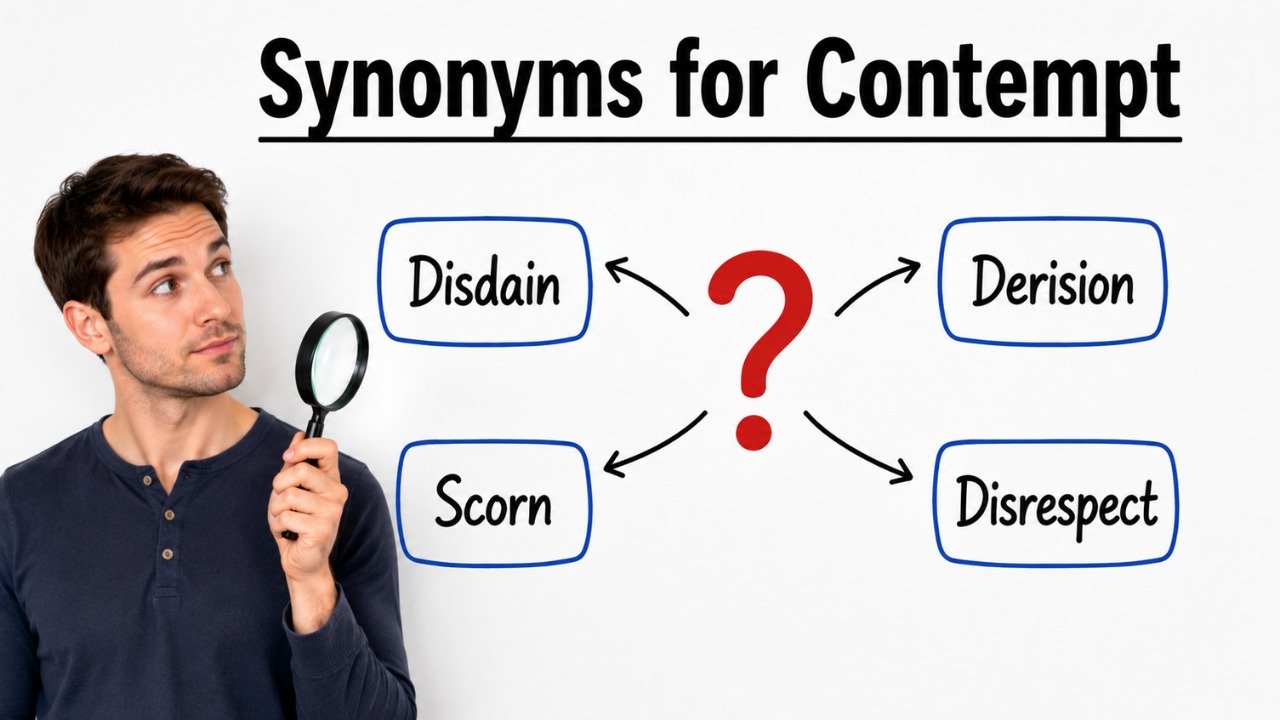
Quick Answer: The best synonyms for contempt include disdain, scorn, disrespect, derision, mockery, disgust, loathing, disregard, disparagement, and dismissiveness. Use disdain for a formal feeling that someone is unworthy of respect. Choose scorn when contempt is openly expressed through words, looks, or behavior. Disrespect is broader and usually less intense, while derision and mockery involve ridicule. Disgust suits strong moral or emotional revulsion, loathing expresses intense dislike, and dismissiveness describes treating a person or idea as unimportant.
Pronunciation and Word Details
Word: Contempt.
Pronunciation: /kənˈtempt/
Part of Speech: Noun.
Meaning: A strong feeling that someone or something is unworthy of respect, often combined with dislike or disgust.
US Pronunciation:
UK Pronunciation:
What Does “Contempt” Mean?
Contempt means a strong belief or feeling that a person, action, idea, or institution is unworthy of respect. It often combines disrespect with dislike, disgust, or a sense of superiority.
Contempt is usually an uncountable noun. It can describe an internal attitude or an outward expression.
Example: She felt contempt for anyone who deliberately deceived vulnerable people.
The word may describe disrespect shown through facial expressions, tone, gestures, laughter, or insulting language.
Example: He looked at the proposal with open contempt.
Contempt can also refer to a dismissive attitude toward rules, responsibilities, or authority.
Example: Their behavior showed contempt for the safety regulations.
In formal legal language, contempt can describe serious disobedience or disrespect toward the authority and procedures of a court.
Example: Refusing to obey the order could be treated as contempt of court.
Contempt is stronger than ordinary dislike. A person can dislike someone without considering that person inferior or undeserving of respect. Contempt normally contains this additional judgment of low worth.
Meaning, Tone, and Context of “Contempt”
Contempt has a strong, negative, and often formal tone. It is more intense than dislike and usually more judgmental than disapproval.
The word is common in essays, reports, legal writing, literary analysis, news style writing, psychology discussions, workplace descriptions, and serious conversation. It may describe an emotion, attitude, facial expression, tone of voice, or pattern of behavior.
In formal writing, contempt often describes an attitude toward dishonesty, corruption, cruelty, weakness, authority, social rules, or another person’s beliefs.
Example: The character expresses contempt for people who value wealth above integrity.
In everyday conversation, people may choose scorn, disrespect, disgust, or look down on instead. These alternatives can sound more natural depending on the situation.
Contempt can be emotional, but it is not always expressed through anger. A person may communicate contempt through cold silence, a dismissive smile, a mocking comment, or a refusal to take someone seriously.
The word can sound accusatory when used to describe another person’s motives. In professional communication, it is often better to describe the observable behavior rather than claim that someone feels contempt.
Accusatory: The manager treated the team with contempt.
More Specific: The manager repeatedly dismissed the team’s concerns without discussion.
When and How to Use “Contempt”
For Feeling Superior: Use contempt when someone believes another person or idea is beneath respect.
Example: His contempt for inexperienced workers made cooperation difficult.
For Open Disrespect: Use contempt when disrespect is clearly shown through words, gestures, tone, or behavior.
Example: She spoke about the opposing group with obvious contempt.
For Moral Disgust: Use contempt when a person strongly condemns behavior considered dishonest, cruel, or shameful.
Example: The community viewed the deliberate deception with contempt.
For Dismissive Behavior: Use contempt when someone refuses to treat another person’s needs, ideas, or concerns seriously.
Example: The official’s contempt for public concerns damaged trust.
For Rules and Authority: Use contempt when a person behaves as though rules, duties, or authority do not deserve respect.
Example: His repeated violations showed contempt for the regulations.
For Facial Expressions: Use contempt to describe a sneer, raised lip, cold smile, or other expression of disrespect.
Example: A look of contempt crossed her face when she heard the excuse.
For Literary Analysis: Use contempt when explaining a character’s judgment, attitude, dialogue, or treatment of others.
Example: The narrator’s contempt for greed becomes clear throughout the story.
For Social Relationships: Use contempt when disrespect has become deeply established between people.
Example: Their conversations were increasingly marked by resentment and contempt.
For Formal Criticism: Use contempt when describing severe rejection rather than ordinary disagreement.
Example: The writer expresses contempt for arguments based on deliberate misinformation.
For Legal Context: Use contempt in the established phrase contempt of court when discussing serious disrespect or disobedience involving court authority.
Example: The judge warned that continued refusal could result in a finding of contempt.
Best Synonyms for Contempt
Disdain: A feeling that someone or something is unworthy of respect or attention.
Example: She regarded the dishonest proposal with disdain.
Scorn: Strong contempt that is often openly expressed.
Example: His suggestion was met with scorn by the other members.
Disrespect: A lack of respect shown through attitude, speech, or behavior.
Example: Interrupting every speaker showed disrespect for the discussion.
Derision: Contempt expressed through mocking laughter or insulting comments.
Example: The unusual idea was initially received with derision.
Mockery: Words or behavior intended to make someone appear foolish.
Example: Her sincere concerns were treated with mockery.
Disgust: A strong feeling of revulsion or moral rejection.
Example: The report described the public’s disgust at the deception.
Loathing: An intense feeling of hatred or deep dislike.
Example: Years of mistreatment filled him with loathing.
Disregard: A lack of attention, concern, or respect.
Example: Their disregard for basic safety placed everyone at risk.
Disparagement: Speech that presents someone or something as unimportant or inferior.
Example: The repeated disparagement of her work affected team morale.
Dismissiveness: An attitude that treats a person, idea, or concern as unworthy of consideration.
Example: His dismissiveness prevented an honest conversation.
50 Synonyms for Contempt with Short Meanings
- Disdain: A belief that someone or something is unworthy of respect.
- Scorn: Openly expressed contempt or severe disrespect.
- Disrespect: A lack of respect for a person, idea, or rule.
- Derision: Mocking contempt expressed through laughter or comments.
- Mockery: Ridicule intended to make someone seem foolish.
- Ridicule: Speech or behavior that exposes someone to laughter or shame.
- Disparagement: Criticism that lowers the value or reputation of something.
- Denigration: Unfair treatment of someone as inferior or unworthy.
- Belittlement: Words or behavior that make someone seem unimportant.
- Dismissiveness: An attitude that refuses to take something seriously.
- Disesteem: A formal lack of respect or favorable opinion.
- Disregard: A lack of attention, concern, or respect.
- Insolence: Bold and offensive disrespect.
- Impudence: Shamelessly rude or disrespectful behavior.
- Contemptuousness: The quality of showing strong disrespect or scorn.
- Scornfulness: An attitude of openly expressed contempt.
- Disdainfulness: A manner that shows someone feels superior.
- Derisiveness: A mocking or scornful quality.
- Sneering: Showing contempt through a facial expression or tone.
- Jeering: Mocking someone with rude remarks or laughter.
- Scoffing: Speaking about something as foolish or unworthy.
- Taunting: Provoking or insulting someone through mocking remarks.
- Disdainful Dismissal: Rejection that shows a lack of respect.
- Scornful Rejection: Refusal expressed with contempt.
- Contemptuous Treatment: Behavior that treats someone as inferior.
- Open Disrespect: Clearly expressed lack of respect.
- Lack of Respect: Absence of proper regard or consideration.
- Low Regard: An unfavorable opinion of someone or something.
- Moral Disgust: Strong rejection of behavior considered wrong.
- Disgust: A powerful feeling of revulsion or rejection.
- Revulsion: An intense desire to avoid something offensive.
- Repugnance: Strong dislike caused by moral or emotional offense.
- Loathing: Extreme dislike or hatred.
- Detestation: Deep and forceful hatred.
- Abhorrence: Intense moral or emotional disgust.
- Aversion: A strong desire to avoid someone or something.
- Antipathy: A deep feeling of dislike or opposition.
- Hatred: An intense feeling of hostility or dislike.
- Hostility: Unfriendly opposition or aggressive dislike.
- Resentment: Anger caused by unfair treatment or insult.
- Disapproval: A negative judgment of behavior or ideas.
- Disfavor: An unfavorable attitude or lack of approval.
- Condemnation: Strong public or moral criticism.
- Public Scorn: Contempt expressed openly before other people.
- Hostile Disregard: A lack of respect combined with opposition.
- Insulting Dismissal: Rejection expressed in an offensive manner.
- Demeaning Treatment: Behavior that lowers another person’s dignity.
- Sneering Disrespect: Contempt shown through a mocking expression or tone.
- Defiance: Open resistance toward authority or commands.
- Disobedience: Refusal to follow a rule, command, or legal order.
Read Also:
Synonyms for Chronic
Synonyms for Contempt by Context
When Contempt Means Disdain
Use disdain, disesteem, low regard, disdainfulness, or disdainful dismissal when the main idea is believing that someone or something deserves little respect.
Disdain is the closest general synonym. It often sounds controlled, formal, and emotionally distant.
Example: She viewed dishonest behavior with disdain.
Disesteem is more formal and less common. It refers to an absence of respect or favorable judgment.
Example: His actions brought him into disesteem among his colleagues.
Low regard is a clear and neutral phrase.
Example: The committee held the proposal in low regard because it lacked evidence.
Disdainfulness describes the quality of a person’s attitude or manner.
Example: Her disdainfulness was evident in the way she ignored every suggestion.
When Contempt Means Open Scorn
Use scorn, scornfulness, sneering, scoffing, jeering, or scornful rejection when contempt is visibly or verbally expressed.
Scorn is strong and direct. It often combines disrespect with open rejection.
Example: The false claim was met with immediate scorn.
Sneering emphasizes a facial expression or tone.
Example: His sneering response made productive discussion impossible.
Scoffing describes speaking as though an idea is foolish or impossible.
Example: Critics initially scoffed at the proposal.
Jeering usually involves rude group behavior, shouting, or mocking laughter.
Example: The speaker continued despite the jeering from the back of the hall.
When Contempt Means Disrespect
Use disrespect, disregard, insolence, impudence, or open disrespect when the emphasis is on behavior rather than emotion.
Disrespect is broader and usually less intense than contempt.
Example: Arriving late without explanation showed disrespect for everyone’s time.
Disregard often applies to rules, safety, feelings, or responsibilities.
Example: The driver showed complete disregard for the warning signs.
Insolence describes bold and offensive disrespect, especially toward someone in authority.
Example: His insolence shocked the senior members of the committee.
Impudence is similar to insolence but often emphasizes shameless rudeness.
Example: She was surprised by the impudence of the response.
When Contempt Means Mocking Ridicule
Use derision, mockery, ridicule, belittlement, taunting, or derisiveness when contempt is expressed by making someone appear foolish.
Derision combines mockery with strong disrespect.
Example: The early design was greeted with derision.
Mockery may involve imitation, jokes, facial expressions, or exaggerated behavior.
Example: His accent became the subject of cruel mockery.
Ridicule emphasizes making a person or idea appear absurd.
Example: No employee should face ridicule for asking a sincere question.
Belittlement lowers someone’s confidence, importance, or dignity.
Example: Constant belittlement damaged the new worker’s confidence.
When Contempt Means Moral Disgust
Use disgust, moral disgust, repugnance, revulsion, abhorrence, or condemnation when the feeling results from behavior considered morally offensive.
Disgust emphasizes emotional or physical revulsion.
Example: She reacted with disgust to the deliberate cruelty.
Repugnance is formal and expresses powerful moral opposition.
Example: The narrator describes his repugnance toward corruption.
Abhorrence is especially strong and often applies to violence, cruelty, or injustice.
Example: The community expressed its abhorrence of the attack.
Condemnation emphasizes criticism and judgment rather than an internal emotion.
Example: The decision received widespread condemnation.
When Contempt Means Intense Dislike
Use loathing, detestation, hatred, antipathy, aversion, or hostility when the main idea is powerful dislike.
Loathing is intense and emotional.
Example: He developed a deep loathing for dishonesty.
Detestation is a formal word for extreme dislike.
Example: Her detestation of cruelty shaped many of her decisions.
Antipathy is a strong and often lasting feeling of dislike or opposition.
Example: There was a clear antipathy between the two leaders.
Hostility adds opposition and possible aggression.
Example: The proposal was received with hostility by several groups.
When Contempt Means Dismissiveness
Use dismissiveness, disregard, belittlement, disparagement, denigration, or insulting dismissal when someone refuses to consider another person or idea seriously.
Dismissiveness is useful in professional and relationship contexts.
Example: His dismissiveness prevented the team from identifying the real problem.
Disparagement involves negative statements that reduce someone’s reputation or value.
Example: The repeated disparagement of junior employees created an unhealthy atmosphere.
Denigration is stronger and often suggests unfair criticism intended to lower someone’s status.
Example: The article relied on denigration rather than reasoned argument.
Insulting dismissal describes a rejection delivered without respect.
Example: Her concerns received an insulting dismissal instead of a proper response.
When Contempt Relates to Authority or Law
Use defiance, disobedience, insolence, open disrespect, or disregard when describing refusal to respect rules, commands, or authority.
Defiance emphasizes open resistance.
Example: His defiance of the order led to further action.
Disobedience focuses on refusing to follow a command or rule.
Example: Repeated disobedience weakened the organization’s safety procedures.
Disregard is suitable when someone acts without concern for legal or official requirements.
Example: The conduct showed disregard for the established process.
These words may describe behavior associated with contempt, but they do not always contain the same feeling of superiority or disgust.
Another Word for Contempt
The best single replacement for contempt is often disdain. Both words describe a belief that someone or something is unworthy of respect. However, disdain usually sounds more controlled, while contempt can feel stronger and may include disgust, hostility, or open disrespect.
The best alternative depends on context. Use scorn for openly expressed contempt, derision for mocking contempt, disrespect for improper behavior, and disgust for moral revulsion.
Original: She looked at the dishonest offer with contempt.
Better Option: She looked at the dishonest offer with disdain.
Original: The audience responded to the false claim with contempt.
Better Option: The audience responded to the false claim with scorn.
Original: His concerns were treated with contempt.
Better Option: His concerns were treated with dismissiveness.
Original: The cruel behavior filled her with contempt.
Better Option: The cruel behavior filled her with moral disgust.
When Not to Use “Contempt”
Do not use contempt for ordinary annoyance, mild disagreement, or temporary frustration. The word is strong and suggests that someone or something is beneath respect.
Use irritation for a minor inconvenience.
Weak: She felt contempt when the meeting started ten minutes late.
Better: She felt irritation when the meeting started ten minutes late.
Use disagreement when people hold different opinions without disrespect.
Weak: The two researchers expressed contempt about the interpretation.
Better: The two researchers expressed disagreement about the interpretation.
Use anger when the main emotion is fury rather than superiority.
Weak: He shouted in contempt after discovering the damage.
Better: He shouted in anger after discovering the damage.
Use disgust when the reaction is primarily revulsion.
Weak: The spoiled food filled her with contempt.
Better: The spoiled food filled her with disgust.
Avoid using contempt when describing behavior that is merely careless.
Weak: Forgetting the appointment showed contempt for the schedule.
Better: Forgetting the appointment showed carelessness.
In professional emails, contempt may sound overly accusatory unless the evidence clearly supports such a strong description.
Weak: Your reply shows contempt for the entire team.
Better: Your reply dismisses several concerns raised by the team.
Do not replace contempt with hatred automatically. Hatred expresses intense hostility, but it does not always suggest that someone is considered inferior.
Weak: His contempt for his rival made him wish for revenge.
Better: His hatred for his rival made him wish for revenge.
Avoid using disdain when the main behavior is public mockery.
Weak: The crowd responded with quiet disdain and shouted insulting jokes.
Better: The crowd responded with derision and shouted insulting jokes.
Words Commonly Confused With Contempt
Contempt vs Disdain: Both describe a lack of respect based on a judgment of low worth. Contempt is often stronger and may include disgust, while disdain can sound colder and more controlled.
Contempt vs Scorn: Contempt may remain internal or be shown indirectly. Scorn is often contempt that is openly expressed through words, laughter, gestures, or rejection.
Contempt vs Disrespect: Contempt is a strong attitude or emotion. Disrespect is any behavior or attitude that fails to show proper respect and may be less intense.
Contempt vs Disgust: Contempt judges something as beneath respect. Disgust is a feeling of revulsion and does not always involve superiority.
Contempt vs Hatred: Contempt involves low regard and perceived inferiority. Hatred involves intense hostility or dislike.
Contempt vs Derision: Contempt is the underlying attitude. Derision is contempt expressed through mockery or ridicule.
Contempt vs Resentment: Contempt judges someone as unworthy. Resentment is anger caused by unfairness, injury, or insult.
Contempt vs Condemnation: Contempt is an emotion or attitude. Condemnation is a strong statement of criticism or moral judgment.
Contempt vs Contemptuous: Contempt is a noun naming the feeling. Contemptuous is an adjective describing a person, expression, tone, or action that shows contempt.
Contempt vs Contemptible: Contempt describes the feeling. Contemptible describes someone or something considered deserving of contempt.
Which Synonym Should You Choose?
Choose disdain in formal essays when describing a controlled feeling that someone or something is unworthy of respect.
Choose scorn when contempt is openly expressed through rejection, laughter, speech, or facial expressions.
Choose disrespect when discussing behavior that violates social, professional, or personal expectations.
Choose derision in literary analysis when a person or idea is treated with mocking laughter.
Choose mockery in everyday conversation when someone copies, jokes about, or imitates another person to make them appear foolish.
Choose ridicule when emphasizing public embarrassment or the act of making something seem absurd.
Choose disgust when the feeling is based on moral offense, unpleasantness, or revulsion.
Choose loathing when the emotion is intense, personal, and close to hatred.
Choose disregard in reports when describing a lack of concern for rules, safety, duties, or consequences.
Choose disparagement when discussing negative comments that reduce a person’s reputation or value.
Choose dismissiveness in workplace emails and relationship discussions when someone refuses to take a concern or idea seriously.
Choose insolence when describing bold and offensive disrespect toward authority.
Choose defiance when a person openly resists an order, rule, or authority.
Choose condemnation in formal reports when the focus is strong criticism rather than a personal feeling.
Choose resentment when anger develops because of perceived injustice or repeated mistreatment.
Choose antipathy in formal writing for a deep and lasting dislike that may not include open mockery.
Real Life Examples of “Contempt” in Sentences
Original: She regarded the dishonest excuse with contempt.
Better Option: She regarded the dishonest excuse with disdain.
Original: The audience reacted to the speaker’s insulting claim with contempt.
Better Option: The audience reacted to the speaker’s insulting claim with scorn.
Original: His contempt for the safety rules placed everyone at risk.
Better Option: His disregard for the safety rules placed everyone at risk.
Original: The students’ concerns were met with contempt.
Better Option: The students’ concerns were met with dismissiveness.
Original: The crowd expressed contempt through mocking laughter.
Better Option: The crowd expressed derision through mocking laughter.
Original: She felt contempt for the deliberate cruelty.
Better Option: She felt moral disgust at the deliberate cruelty.
Original: His tone was filled with contempt for the new employees.
Better Option: His tone was filled with disrespect for the new employees.
Original: The article showed contempt for anyone who disagreed with its argument.
Better Option: The article disparaged anyone who disagreed with its argument.
Original: Their contempt for each other became obvious during the meeting.
Better Option: Their hostility toward each other became obvious during the meeting.
Original: The manager treated the suggestion with contempt.
Better Option: The manager dismissed the suggestion with scorn.
Synonym Groups and Usage Differences
Disdain Group
Disdain, disesteem, low regard, disdainfulness, and scornful superiority describe a judgment that someone or something lacks value or deserves little respect.
Disdain is the most useful formal alternative. Low regard is milder and more neutral. Disesteem is formal and uncommon.
Example: She viewed deliberate dishonesty with disdain.
Open Scorn Group
Scorn, scornfulness, sneering, scoffing, and jeering describe contempt that is outwardly visible.
Scorn is broad and strong. Sneering often involves facial expression or tone. Scoffing involves dismissive speech. Jeering usually describes rude group mockery.
Example: The suggestion was greeted with scorn rather than thoughtful discussion.
Disrespect Group
Disrespect, disregard, insolence, impudence, and defiance focus on improper behavior toward people, rules, or authority.
Disrespect is broad. Disregard suggests lack of concern. Insolence and impudence are stronger and more offensive. Defiance emphasizes resistance.
Example: Ignoring the safety instructions showed complete disregard for others.
Mockery Group
Derision, mockery, ridicule, taunting, and belittlement involve making a person or idea seem foolish, weak, or unimportant.
Derision is formal. Mockery is common in everyday speech. Ridicule often has a public element. Belittlement lowers confidence or status.
Example: The proposal deserved analysis rather than ridicule.
Disgust Group
Disgust, revulsion, repugnance, abhorrence, and moral disgust emphasize strong emotional or ethical rejection.
Disgust is the broadest term. Revulsion is intense and instinctive. Repugnance and abhorrence sound more formal and often have a moral dimension.
Example: The cruelty caused widespread revulsion.
Intense Dislike Group
Loathing, detestation, hatred, antipathy, aversion, and hostility describe powerful dislike.
Loathing and detestation are very strong. Antipathy is formal and may be less emotional. Aversion emphasizes a desire to avoid something. Hostility includes opposition.
Example: Years of conflict created lasting hostility between the groups.
Dismissal Group
Dismissiveness, disparagement, denigration, demeaning treatment, and insulting dismissal describe treating someone or something as unworthy of serious consideration.
Dismissiveness is useful for attitude and communication. Disparagement involves negative remarks. Denigration suggests an attempt to reduce status or reputation.
Example: Her dismissiveness prevented the team from examining the concern fairly.
Moral Judgment Group
Disapproval, condemnation, disfavor, opprobrium, and public scorn describe negative moral or social judgment.
Disapproval may be mild. Condemnation is strong and explicit. Public scorn emphasizes visible rejection by a group.
Example: The dishonest conduct received immediate condemnation.
Antonyms of Contempt
The opposites of contempt express respect, approval, admiration, kindness, or a belief in someone’s worth.
Respect: Recognition of a person’s value, rights, or abilities.
Esteem: High regard based on admiration or approval.
Admiration: Warm approval of someone’s qualities or achievements.
Regard: Respectful attention or consideration.
Reverence: Deep and serious respect.
Honor: Great respect given to someone or something.
Approval: A favorable judgment or acceptance.
Appreciation: Recognition of value, effort, or importance.
Praise: Positive words expressing approval or admiration.
Affection: Warm feelings of care or fondness.
Love: Deep care, attachment, or devotion.
Acceptance: Willingness to recognize or include someone without rejection.
Consideration: Careful attention to another person’s needs or feelings.
Courtesy: Polite and respectful behavior.
Politeness: Behavior that shows good manners and respect.
Deference: Respectful acceptance of another person’s authority or judgment.
Trust: Confidence in someone’s honesty, ability, or reliability.
Support: Approval, encouragement, or assistance.
Validation: Recognition that a person’s feelings or concerns deserve attention.
Compassion: Concern for another person’s suffering or difficulty.
Comparison: Contempt vs Related Words
Contempt vs Disdain
Contempt and disdain both involve viewing someone or something as unworthy of respect. Contempt is often stronger and may include hostility or disgust. Disdain can appear colder and more restrained.
Example With Contempt: He spoke with contempt about anyone who needed assistance.
Example With Disdain: She regarded the shallow argument with disdain.
Contempt vs Scorn
Contempt can be an internal attitude. Scorn is usually contempt expressed openly through words, gestures, laughter, or rejection.
Example With Contempt: She secretly felt contempt for his dishonesty.
Example With Scorn: She rejected his dishonest excuse with scorn.
Contempt vs Disrespect
Contempt is a deep feeling or judgment. Disrespect is any failure to show proper regard and can include minor rudeness.
Example With Contempt: His contempt for the committee was clear in every response.
Example With Disrespect: Arriving late without explanation showed disrespect for the committee.
Contempt vs Derision
Contempt is the underlying belief that something is inferior. Derision is contempt expressed through ridicule or mocking laughter.
Example With Contempt: The critic viewed the proposal with contempt.
Example With Derision: The audience greeted the proposal with derision.
Contempt vs Disgust
Contempt contains a judgment of low worth. Disgust is an emotional or physical reaction of revulsion.
Example With Contempt: She felt contempt for people who abused their authority.
Example With Disgust: She reacted with disgust to the unpleasant smell.
Contempt vs Hatred
Contempt involves disrespect and perceived inferiority. Hatred is intense hostility and may exist even when the other person is respected or feared.
Example With Contempt: He treated the dishonest official with contempt.
Example With Hatred: Years of violence filled him with hatred.
Contempt vs Resentment
Contempt looks downward and judges someone as unworthy. Resentment looks backward at an injury, insult, or unfair action.
Example With Contempt: Her contempt for his laziness became obvious.
Example With Resentment: She felt resentment because he received credit for her work.
Contempt vs Condemnation
Contempt is an emotion or attitude. Condemnation is an expression of strong criticism or moral judgment.
Example With Contempt: The narrator feels contempt for corruption.
Example With Condemnation: The report contains a clear condemnation of corruption.
Contempt vs Dismissiveness
Contempt is the underlying feeling that someone lacks worth. Dismissiveness is the behavior of refusing to take someone or something seriously.
Example With Contempt: He felt contempt for the inexperienced applicant.
Example With Dismissiveness: He responded to the applicant’s questions with dismissiveness.
Contempt vs Insolence
Contempt is a feeling or attitude. Insolence is bold and offensive behavior that shows disrespect.
Example With Contempt: She viewed the rules with contempt.
Example With Insolence: Her insolence toward the supervisor resulted in a formal warning.
Common Phrases and Expressions With Contempt
Hold in Contempt: Consider someone or something completely unworthy of respect.
Treat With Contempt: Behave toward someone in a disrespectful or dismissive way.
Show Contempt: Express strong disrespect through words, tone, gestures, or actions.
Feel Contempt: Experience a powerful lack of respect for someone or something.
Express Contempt: Communicate disdain or scorn openly.
Look With Contempt: Direct a facial expression of scorn or disrespect toward someone.
Speak With Contempt: Use a tone that communicates superiority or disdain.
Beneath Contempt: So shameful or offensive that it deserves no respect.
Utter Contempt: Complete and extremely strong contempt.
Open Contempt: Contempt that is clearly and publicly expressed.
Contempt for Authority: Strong disrespect toward people, rules, or institutions with power.
Contempt of Court: Serious disrespect or disobedience involving the authority or procedures of a court.
Common Mistakes to Avoid
A common mistake is using contempt as a general synonym for dislike. Contempt is stronger and includes a judgment that someone or something is unworthy of respect.
Inaccurate: She felt contempt for the flavor of the soup.
Better: She disliked the flavor of the soup.
Do not confuse contempt with contemptuous. Contempt is a noun, while contemptuous is an adjective.
Incorrect: His voice was full of contemptuous.
Correct: His voice was full of contempt.
Correct: He used a contemptuous tone.
Do not confuse contemptuous with contemptible. Contemptuous describes someone who shows contempt. Contemptible describes someone or something considered deserving of contempt.
Contemptuous: The speaker gave a contemptuous laugh.
Contemptible: Deliberately deceiving vulnerable people is contemptible behavior.
Avoid using contempt when disgust is the exact emotion.
Unnatural: The smell filled the room with contempt.
Better: The smell filled everyone with disgust.
Do not replace contempt with scorn when the feeling is hidden and never expressed.
Less Precise: She secretly showed scorn for the decision.
Better: She secretly felt contempt for the decision.
Avoid repeating contempt several times in one paragraph. Use precise alternatives based on the intended meaning.
Repetitive: His contempt appeared in his contemptuous expression and contempt for the rules.
Better: His disdain appeared in his sneering expression and disregard for the rules.
Do not use contempt of court as a general phrase for any disagreement with a judge or court decision. The expression has a specific formal meaning involving serious disobedience or disrespect toward court authority.
Avoid claiming that someone feels contempt when you only know what that person did. Describe observable conduct when certainty matters.
Assumption: She ignored the message because she felt contempt.
Better: She ignored the message and dismissed the concerns it raised.
Use the correct prepositions in common patterns.
Correct: He felt contempt for dishonesty.
Correct: She treated the suggestion with contempt.
Correct: They held the behavior in contempt.
Do not use contempt as a verb.
Incorrect: She contempted his opinion.
Correct: She held his opinion in contempt.
Correct: She treated his opinion with contempt.
Conclusion
The most useful synonyms for contempt include disdain, scorn, disrespect, derision, mockery, disgust, disregard, and dismissiveness. Choose disdain for a formal feeling of superiority, scorn for openly expressed contempt, and derision for mocking rejection. Disrespect suits improper behavior, while disgust describes moral or emotional revulsion. In reports and professional writing, disregard, disparagement, and dismissiveness often provide greater precision. Understanding these differences makes synonyms for contempt clearer, more natural, and more accurate in every context.
FAQs About Synonyms for Contempt
What Is the Best Synonym for Contempt?
Disdain is the best general synonym. Scorn, disrespect, derision, disgust, and dismissiveness may be more accurate in specific contexts.
Is Scorn the Same as Contempt?
Scorn is closely related to contempt, but it usually describes contempt that is openly expressed through words, gestures, laughter, or rejection.
What Is a Formal Synonym for Contempt?
Disdain, derision, disesteem, repugnance, disparagement, and condemnation are useful formal alternatives.
What Is a Mild Synonym for Contempt?
Disapproval, low regard, disrespect, and dismissiveness are generally milder than contempt.
What Is the Difference Between Contempt and Disgust?
Contempt involves believing someone or something is unworthy of respect. Disgust is a feeling of revulsion that may be physical, emotional, or moral.
Can Disrespect Replace Contempt?
Disrespect can replace contempt when the sentence focuses on rude or improper behavior. It is usually broader and less intense than contempt.
What Is the Opposite of Contempt?
Respect is the clearest opposite. Esteem, admiration, appreciation, approval, and reverence are other useful antonyms.
