
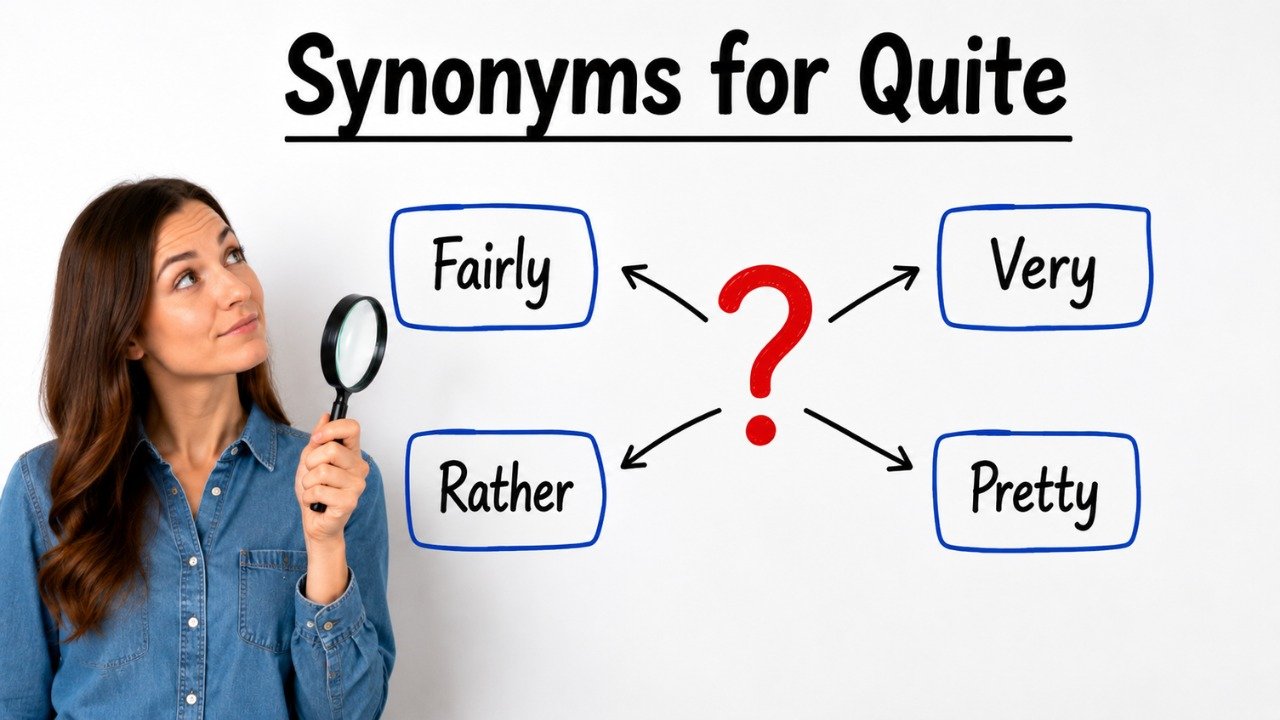
Quick Answer: The best synonyms for quite include very, rather, fairly, completely, entirely, fully, really, somewhat, considerably, and absolutely. Use completely, entirely, or fully when quite means total or complete. Use very, really, or considerably for stronger emphasis. Use fairly, rather, or somewhat when quite means a moderate degree. The best replacement depends on the sentence because quite can express different levels of intensity.
Pronunciation and Word Details
Word: Quite.
Pronunciation: /kwaɪt/
Part of Speech: Adverb.
Meaning: Quite is an adverb used to show a complete, strong, or moderate degree depending on the context.
US Pronunciation:
UK Pronunciation:
What Does “Quite” Mean?
Quite means completely, very, fairly, or rather depending on the word it modifies and the intended level of emphasis.
As an adverb, quite usually modifies adjectives, other adverbs, verbs, or noun phrases. Its exact meaning changes according to context.
Complete Degree: She is quite certain about her decision.
Here, quite means completely or fully.
Strong Degree: The performance was quite impressive.
Here, quite can mean very or considerably.
Moderate Degree: The test was quite difficult.
Depending on context, quite may mean fairly or rather difficult.
Amount: We spent quite a lot of time discussing the problem.
Here, quite emphasizes that the amount was considerable.
Because quite has several meanings, choosing the correct synonym requires understanding both the sentence and the intended strength.
Meaning, Tone, and Context of “Quite”
Quite is a neutral and versatile adverb. It works naturally in conversation, essays, reports, emails, descriptive writing, and formal communication.
Its tone depends mainly on the adjective, adverb, or phrase that follows it.
Neutral Tone: Quite commonly adds degree without making a sentence sound emotional.
Example: The room was quite comfortable.
Strong Emphasis: With words such as certain, impossible, clear, or different, quite may suggest completeness or a strong degree.
Example: The two situations are quite different.
Moderate Emphasis: In other sentences, quite can mean fairly, reasonably, or somewhat.
Example: The restaurant was quite busy during lunch.
Formal Context: Quite appears naturally in formal and academic writing when the degree is clear from context.
Example: The results were quite significant.
Conversational Context: It is also common in everyday speech.
Example: That sounds quite interesting.
The strength of quite is not always fixed. A sentence such as “quite good” may sound moderately positive in one context but strongly positive in another. For clearer writing, words such as fairly, very, completely, or considerably can sometimes communicate the exact degree more precisely.
When and How to Use “Quite”
For Complete Certainty: Use quite when something is fully certain, clear, correct, or definite.
Example: I am quite certain that the information is correct.
For Strong Emphasis: Use quite to strengthen an adjective without always sounding as intense as extremely.
Example: The final presentation was quite impressive.
For Moderate Degree: Use quite when something exists to a noticeable but not necessarily extreme degree.
Example: The assignment was quite challenging.
For Large Amounts: Quite can emphasize that an amount or number is considerable.
Example: We received quite a lot of responses.
For Noticeable Difference: Use quite when two things differ significantly.
Example: Her new approach is quite different from the previous one.
For Agreement: Quite can appear in expressions such as quite right to show complete agreement.
Example: You are quite right about the importance of preparation.
For Surprise: Quite can strengthen nouns in phrases such as quite a surprise.
Example: His unexpected success was quite a surprise.
For Positive Evaluation: Quite can modify adjectives describing quality, ability, or interest.
Example: The explanation was quite useful.
Best Synonyms for Quite
Very: To a strong or high degree.
Example: The presentation was very informative.
Rather: To a noticeable or moderately strong degree.
Example: The problem was rather complicated.
Fairly: To a moderate or reasonable degree.
Example: The instructions were fairly simple.
Completely: In every way or to the fullest extent.
Example: She was completely certain about her answer.
Entirely: Fully and without exception.
Example: The new version is entirely different.
Fully: To the greatest or complete degree.
Example: He was fully aware of the situation.
Really: To a strong degree, especially in conversation.
Example: The documentary was really interesting.
Somewhat: To a limited or moderate degree.
Example: The instructions were somewhat confusing.
Considerably: To a noticeably large degree.
Example: The second option was considerably better.
Absolutely: Completely or without qualification.
Example: Her explanation was absolutely correct.
50 Synonyms for Quite With Short Meanings
- Very: To a high degree.
- Rather: To a noticeable or moderate degree.
- Fairly: To a reasonable or moderate degree.
- Completely: To the fullest possible extent.
- Entirely: Fully and without exception.
- Fully: To a complete degree.
- Really: To a strong or noticeable degree.
- Somewhat: To a limited degree.
- Considerably: To a noticeably large degree.
- Absolutely: Completely and without qualification.
- Totally: In a complete way.
- Wholly: Entirely or completely.
- Utterly: Completely, often with strong emphasis.
- Thoroughly: Completely and in every relevant respect.
- Altogether: Completely or entirely in certain contexts.
- Perfectly: Completely or exactly in certain expressions.
- Extremely: To a very high degree.
- Highly: To a strong degree.
- Remarkably: To an unusually noticeable degree.
- Significantly: To an important or noticeable degree.
- Substantially: To a considerable degree.
- Markedly: In a clearly noticeable way.
- Decidedly: Clearly and noticeably.
- Distinctly: To a clearly noticeable degree.
- Exceptionally: To an unusually high degree.
- Unusually: More than is ordinary or expected.
- Noticeably: To a degree that can clearly be observed.
- Appreciably: To a degree large enough to notice.
- Reasonably: To a moderate or acceptable degree.
- Moderately: To a medium degree.
- Relatively: To a degree judged in comparison with something else.
- Comparatively: To a moderate degree when compared with something.
- Pretty: Fairly or very in informal usage.
- Tolerably: To an acceptable or moderate degree.
- Passably: To a satisfactory but not outstanding degree.
- Certainly: Definitely or unquestionably in emphatic contexts.
- Definitely: Clearly or without doubt.
- Indeed: Used to strengthen or confirm a statement.
- Truly: Genuinely or to a strong degree.
- Positively: Completely or strongly in emphatic usage.
- Simply: Completely or plainly in some emphatic expressions.
- Downright: Completely or strongly, especially in informal emphasis.
- Much: To a considerable degree in comparative contexts.
- Well: To a strong degree in expressions such as well aware.
- To Some Extent: To a limited but noticeable degree.
- To a Degree: To a certain level or extent.
- To a Certain Extent: Partly or moderately.
- In Some Measure: To some degree.
- To a Considerable Extent: To a fairly large degree.
- To a Substantial Degree: To an important or significant extent.
Read Also:
Synonyms for Someone
Synonyms for Quite by Context
When Quite Means Completely
When quite expresses completeness, useful synonyms include completely, entirely, fully, wholly, totally, absolutely, and utterly.
Completely: Best when no part or exception remains.
Example: I am completely certain that the calculation is correct.
Entirely: Useful when something is different, separate, or true in every respect.
Example: Her interpretation was entirely different.
Fully: Natural when discussing awareness, understanding, preparation, or development.
Example: He was fully aware of the risks.
Absolutely: Adds stronger emphasis to certainty or correctness.
Example: Your conclusion is absolutely correct.
Wholly: A more formal option meaning entirely.
Example: The accusation was wholly unfounded.
When Quite Means Very
Quite can strengthen an adjective in much the same way as very, really, highly, or extremely.
Very: The most general replacement for strong degree.
Example: The article was very informative.
Really: A natural conversational alternative.
Example: The lecture was really interesting.
Highly: Useful with words such as successful, effective, skilled, or respected.
Example: The method proved highly effective.
Extremely: Best when the degree is especially strong.
Example: The final question was extremely difficult.
Remarkably: Useful when something is both strong and noteworthy.
Example: The new system is remarkably efficient.
When Quite Means Fairly
In sentences where quite expresses a moderate rather than complete degree, good synonyms include fairly, somewhat, reasonably, moderately, and relatively.
Fairly: A natural choice for a moderate degree.
Example: The instructions were fairly easy to understand.
Somewhat: Useful when the degree is limited.
Example: The explanation was somewhat unclear.
Reasonably: Suggests an acceptable or moderate level.
Example: The hotel was reasonably comfortable.
Moderately: A precise word for a middle degree.
Example: The task was moderately challenging.
Relatively: Useful when the degree depends on comparison.
Example: The second exercise was relatively simple.
When Quite Means Rather
Rather can replace quite when something is noticeably more intense than expected.
Rather: Often adds a sense of noticeable degree.
Example: The decision was rather surprising.
Considerably: Works when the difference or amount is clearly substantial.
Example: The revised plan is considerably better.
Decidedly: Emphasizes that a quality is clearly present.
Example: The second proposal was decidedly more practical.
Markedly: Useful for clearly observable differences.
Example: Performance was markedly stronger this month.
When Quite Means a Large Amount
Quite frequently appears in expressions such as quite a lot, quite a bit, and quite a few.
Considerably: Suitable when emphasizing substantial amount or degree.
Example: The process took considerably longer than expected.
Substantially: Useful in formal writing for a large change or amount.
Example: Costs increased substantially.
Significantly: Best when the degree is important or noticeable.
Example: The revised method performed significantly better.
When Quite Shows Complete Agreement
In phrases such as quite right, quite true, or quite correct, the word often indicates full agreement.
Absolutely: Strongly confirms agreement.
Example: You are absolutely right.
Completely: Emphasizes total agreement or correctness.
Example: That conclusion is completely correct.
Certainly: Politely confirms a statement.
Example: That is certainly true.
Indeed: Adds formal or conversational emphasis.
Example: That is indeed an important point.
Another Word for Quite
Another word for quite is very, but it is not the best replacement in every sentence. Quite can mean completely, fairly, rather, or very, so the most accurate synonym depends on the degree being expressed.
Use very for strong intensity, completely for total degree, fairly for moderate degree, and considerably when emphasizing a large difference or amount.
Original: The movie was quite interesting.
Better Option: The movie was very interesting.
Original: She was quite certain about the answer.
Better Option: She was completely certain about the answer.
Original: The examination was quite difficult.
Better Option: The examination was fairly difficult.
Original: The updated version is quite different.
Better Option: The updated version is considerably different.
When Not to Use “Quite”
Quite is useful, but it can sometimes make a sentence less precise because its intensity changes with context.
When the exact degree matters, choose a clearer synonym.
Weak: The results were quite different.
Better: The results were considerably different.
The better version clearly communicates that the difference was substantial.
Avoid repeating quite several times in the same paragraph.
Weak: The room was quite large, quite bright, and quite comfortable.
Better: The room was fairly large, very bright, and exceptionally comfortable.
Use completely when you mean total certainty or completeness.
Weak: She was quite certain that the information was accurate.
Better: She was completely certain that the information was accurate.
Use somewhat or fairly if you intentionally mean only a moderate degree.
Weak: The instructions were quite confusing.
Better: The instructions were somewhat confusing.
In formal reports, precise degree words may communicate findings more clearly.
Weak: Performance improved quite a lot.
Better: Performance improved considerably.
Do not replace quite mechanically with very. A sentence such as “quite impossible” usually means completely impossible, so completely or absolutely is more accurate than very.
Words Commonly Confused With Quite
Quite vs Very: Very usually expresses a strong degree, while quite can express either a strong, complete, or moderate degree depending on context.
Quite vs Fairly: Fairly normally suggests a moderate degree. Quite may also have this meaning, but it can be stronger in other sentences.
Quite vs Rather: Rather often suggests a noticeable degree and can sometimes carry a sense of surprise or emphasis. Quite is more flexible and may also mean completely.
Quite vs Completely: Completely clearly expresses total degree. Quite expresses total degree only in particular contexts, such as quite certain or quite impossible.
Quite vs Really: Really commonly strengthens adjectives in conversational language. Quite can sound slightly more measured or neutral.
Quite vs Absolutely: Absolutely strongly expresses complete degree. Quite may carry similar force with adjectives that naturally describe complete states.
Quite vs Somewhat: Somewhat means only to a limited degree, while quite can be either moderate or strong.
Quite vs Quiet: Quite is an adverb meaning completely, fairly, or very. Quiet usually describes little or no noise. The similar spelling causes frequent mistakes, but their meanings are completely different.
Which Synonym Should You Choose?
Choose very when you want a clear, general expression of strong degree.
Choose really for natural and conversational emphasis.
Choose fairly when something has a moderate degree of a quality.
Choose rather when the quality is noticeable and sometimes slightly surprising.
Choose somewhat when you want to deliberately soften the strength of a statement.
Choose completely when the meaning is total and no uncertainty remains.
Choose entirely when discussing complete differences, agreement, responsibility, or change.
Choose fully when writing about awareness, understanding, preparation, development, or completion.
Choose absolutely when emphasizing complete certainty, correctness, impossibility, or agreement.
Choose considerably when describing a substantial difference, change, amount, or improvement.
Choose significantly in reports, essays, analysis, and formal writing when the degree or difference is important and clearly noticeable.
Choose reasonably when describing an acceptable or moderate level.
For essays and reports, considerably, significantly, substantially, entirely, and relatively often provide greater precision. For emails and general professional writing, very, fairly, fully, and completely are usually clear choices. In casual conversation, really, pretty, rather, and very often sound natural.
Real Life Examples of “Quite” in Sentences
Original: The book was quite interesting.
Better Option: The book was very interesting.
Original: She is quite certain about her decision.
Better Option: She is completely certain about her decision.
Original: The room became quite warm during the afternoon.
Better Option: The room became fairly warm during the afternoon.
Original: His latest proposal is quite different from the previous one.
Better Option: His latest proposal is considerably different from the previous one.
Original: The instructions were quite clear.
Better Option: The instructions were perfectly clear.
Original: The project was quite successful.
Better Option: The project was highly successful.
Original: I was quite surprised by the result.
Better Option: I was genuinely surprised by the result.
Original: The second task was quite difficult.
Better Option: The second task was rather difficult.
Original: She understands the situation quite well.
Better Option: She understands the situation very well.
Original: The two approaches are quite similar.
Better Option: The two approaches are remarkably similar.
Synonym Groups and Usage Differences
Complete Degree Group
Completely, entirely, fully, wholly, totally, absolutely, and utterly express the strongest sense of quite. They are appropriate when something is complete rather than merely strong.
Example: The final answer was completely correct.
Strong Intensity Group
Very, really, extremely, highly, remarkably, and exceptionally strengthen a quality.
Example: The final presentation was highly effective.
These words are useful when quite means strong degree rather than completeness.
Moderate Degree Group
Fairly, somewhat, moderately, reasonably, and relatively communicate limited or middle intensity.
Example: The assignment was fairly straightforward.
These options are helpful when quite would otherwise sound ambiguous.
Noticeable Degree Group
Rather, considerably, noticeably, appreciably, decidedly, and markedly suggest that a quality or difference is clearly present.
Example: The revised design was considerably simpler.
Formal Degree Group
Significantly, substantially, considerably, relatively, markedly, and appreciably are especially useful when precise or formal wording is needed.
Example: The final results were significantly better.
Conversational Emphasis Group
Really, very, pretty, rather, and downright are natural choices in less formal contexts.
Example: That was really impressive.
The exact choice depends on strength. Pretty is usually informal, while downright often carries very strong emphasis.
Antonyms of Quite
Because quite has several meanings, its opposite depends on the degree expressed in the sentence.
Slightly: To only a small degree.
Barely: Only just or almost not.
Hardly: Almost not at all.
Scarcely: Only to a very limited degree.
Minimally: To the smallest practical degree.
Partly: To some extent rather than completely.
Partially: Not fully or entirely.
Incompletely: Without being completely finished or whole.
Insufficiently: To a degree that is not enough.
Moderately: An opposite when quite means extremely or completely.
Not At All: Expresses complete absence of a quality.
The correct antonym depends on meaning. If quite means completely, partly or partially may provide the clearest contrast. If quite means very, slightly or barely may be more appropriate.
Comparison: Quite vs Related Words
Quite vs Very
Quite is more flexible than very. Very normally expresses a high degree, while quite can mean very, fairly, or completely.
Example With Quite: The lecture was quite interesting.
Example With Very: The lecture was very interesting.
The second sentence communicates strong interest more directly.
Quite vs Fairly
Fairly normally indicates a moderate degree. Quite can also express a moderate degree but may be stronger depending on context.
Example With Quite: The examination was quite difficult.
Example With Fairly: The examination was fairly difficult.
Fairly makes the moderate degree clearer.
Quite vs Rather
Both words can indicate noticeable degree. Rather sometimes adds a stronger sense that the quality is unexpected or noteworthy.
Example With Quite: The room was quite cold.
Example With Rather: The room was rather cold.
Rather can make the coldness sound more noticeable or surprising.
Quite vs Completely
Completely expresses total degree clearly. Quite only has this meaning in suitable contexts.
Example With Quite: I am quite certain.
Example With Completely: I am completely certain.
Both can communicate full certainty, but completely is more explicit.
Quite vs Really
Really is common for strong emphasis, especially in conversation.
Example With Quite: The performance was quite impressive.
Example With Really: The performance was really impressive.
Really usually sounds more direct and conversational.
Quite vs Absolutely
Absolutely strongly communicates complete degree or emphatic agreement.
Example With Quite: You are quite right.
Example With Absolutely: You are absolutely right.
The second sentence carries stronger emphasis.
Quite vs Somewhat
Quite may express a moderate or strong degree, while somewhat consistently suggests a limited degree.
Example With Quite: The instructions were quite confusing.
Example With Somewhat: The instructions were somewhat confusing.
Somewhat clearly softens the criticism.
Quite vs Considerably
Quite can indicate a noticeable difference, but considerably communicates a substantial degree more precisely.
Example With Quite: The second model is quite faster.
Example With Considerably: The second model is considerably faster.
Considerably is the more natural choice with this comparative construction.
Common Phrases and Expressions With Quite
Quite Right: Completely correct or fully justified.
Example: You are quite right to question that assumption.
Quite Sure: Very or completely certain.
Example: Are you quite sure you saved the document?
Quite Certain: Completely or strongly certain.
Example: She was quite certain about the final answer.
Quite Good: Fairly good or very good depending on context.
Example: His first attempt was quite good.
Quite Well: To a fairly strong or satisfactory degree.
Example: She handled the difficult situation quite well.
Quite Different: Significantly or completely different.
Example: The revised approach is quite different from the original.
Quite a Lot: A considerable amount.
Example: We learned quite a lot during the workshop.
Quite a Few: A surprisingly or noticeably large number.
Example: Quite a few people attended the event.
Quite a Bit: A considerable amount or degree.
Example: The schedule has changed quite a bit.
Quite a Surprise: Something notably unexpected.
Example: Her announcement came as quite a surprise.
Common Mistakes to Avoid
One common mistake is assuming that quite always means very. Its meaning changes according to context.
Weak: Replace every instance of quite with very.
Better: Decide whether quite means very, completely, fairly, or rather before choosing a synonym.
Another mistake is using quite when a precise degree is important.
Weak: The second result was quite better.
Better: The second result was considerably better.
With comparative adjectives, words such as considerably, much, or significantly are often more natural than quite.
Writers also sometimes confuse quite with quiet.
Weak: The room became quite after everyone left.
Better: The room became quiet after everyone left.
Quite describes degree. Quiet describes little or no noise.
Be careful with the phrase quite a few. It does not mean only a small number.
Weak: Quite a few means almost none.
Better: Quite a few normally means a fairly large number.
Avoid excessive repetition.
Weak: The report was quite detailed, quite useful, quite clear, and quite informative.
Better: The report was highly detailed, very useful, perfectly clear, and particularly informative.
Do not choose a stronger synonym than the context supports.
Weak: The weather was absolutely warm.
Better: The weather was fairly warm.
Absolutely usually works best when the meaning is complete or strongly emphatic rather than merely moderate.
Use natural word combinations. Not every synonym of quite fits every adjective. Completely certain sounds natural, but completely interesting usually does not. Very interesting is the better choice.
Conclusion
Understanding synonyms for quite makes it easier to express degree with greater accuracy. Use very or really for strong emphasis, fairly or somewhat for moderate degree, and completely, entirely, or fully when the meaning is total. Rather works well for a noticeable degree, while considerably and significantly suit clear differences in formal writing. Because quite changes meaning according to context, the best synonym is the one that communicates the exact level of intensity you intend.
FAQs About Synonyms for Quite
What Is the Best Synonym for Quite?
The best general synonym is very, but quite can also mean fairly, rather, completely, or entirely. Context determines the most accurate replacement.
What Is Another Word for Quite Meaning Very?
Good alternatives include very, really, highly, extremely, considerably, and remarkably.
What Is Another Word for Quite Meaning Completely?
Completely, entirely, fully, wholly, totally, and absolutely are strong choices when quite expresses complete degree.
Is Quite the Same as Fairly?
Not always. Quite can mean fairly in some contexts, but it can also mean very or completely. Fairly consistently suggests a moderate degree.
Is Quite Stronger Than Very?
Not necessarily. Quite can be weaker, similar, or more complete in meaning depending on the adjective and sentence. Very more consistently expresses strong degree.
What Is a Formal Synonym for Quite?
Considerably, significantly, substantially, relatively, entirely, and markedly can work in formal writing depending on the intended meaning.
What Is the Difference Between Quite and Quiet?
Quite is an adverb that describes degree, as in “quite difficult.” Quiet usually describes little or no noise, as in “a quiet room.” The words look similar but have different meanings and pronunciations.
