
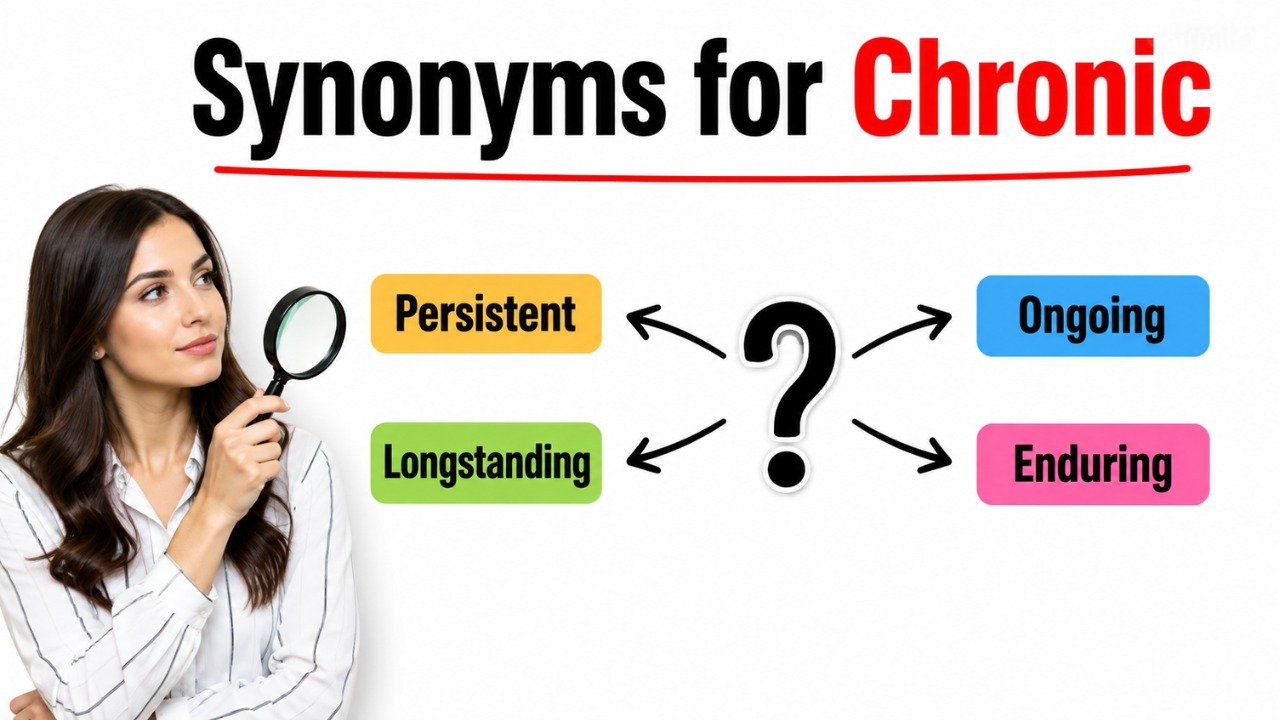
Quick Answer: The best synonyms for chronic include persistent, long lasting, ongoing, recurring, prolonged, continual, habitual, enduring, lingering, and intractable. Among these synonyms for chronic, use persistent for a problem that refuses to disappear, long lasting for a condition that continues over time, recurring for something that repeatedly returns, habitual for repeated behavior, prolonged for an unusually extended situation, and intractable for a problem that is especially difficult to control or resolve.
Pronunciation and Word Details
Word: Chronic.
Pronunciation: /ˈkrɒnɪk/.
Part of Speech: Adjective.
Meaning: Continuing for a long time, returning repeatedly, or becoming firmly established.
US Pronunciation:
UK Pronunciation:
What Does “Chronic” Mean?
Chronic means continuing for a long period, happening repeatedly, or becoming difficult to remove or change.
As an adjective, chronic commonly describes a health condition that continues over an extended period. It can also describe recurring social problems, repeated shortages, persistent delays, and firmly established habits.
The word does not always mean permanent, incurable, or extremely severe. A condition can be chronic because it lasts or repeatedly returns, even when its intensity changes over time.
Chronic can describe people when they repeatedly behave in a particular way. Expressions such as chronic complainer, chronic procrastinator, and chronic latecomer refer to habitual patterns rather than medical conditions.
In informal speech, chronic may sometimes mean very serious, extremely bad, or difficult to manage. This use is less precise and should be avoided in formal reports when a clearer word such as severe, persistent, or widespread would communicate the intended meaning.
Meaning, Tone, and Context of “Chronic”
Chronic is generally a formal, neutral, and serious word. It is common in medical, scientific, academic, professional, social, and policy related writing.
In health contexts, chronic describes a condition that continues over time or requires ongoing attention. It contrasts with acute, which generally refers to something that begins suddenly or lasts for a shorter period.
In reports and essays, chronic often describes a problem that has existed for a long time. Chronic unemployment, chronic shortages, chronic delays, and chronic underfunding all suggest that the situation is persistent rather than temporary.
When describing behavior, chronic can sound critical. Calling someone a chronic liar, complainer, or latecomer suggests that the behavior is repeated, established, and difficult to change.
The word has a stronger tone than occasional, temporary, or recurring. Recurring means that something returns, while chronic often suggests that the problem is ongoing, deeply established, or repeatedly present over a considerable period.
When and How to Use “Chronic”
For Long Lasting Health Conditions
Use chronic when describing a condition that continues for a considerable period or requires ongoing management.
Example: The clinic provides support for people living with chronic conditions.
For Persistent Problems
Use chronic when a problem continues despite repeated efforts to solve it.
Example: The region has experienced a chronic shortage of qualified teachers.
For Recurring Situations
Use chronic when a problem repeatedly returns and has become an established pattern.
Example: Chronic delays have reduced public confidence in the service.
For Habitual Behavior
Use chronic when a person repeatedly behaves in an undesirable or troublesome way.
Example: His chronic lateness affected the entire team.
For Long Standing Social Issues
Use chronic when discussing problems that have existed for many years.
Example: The report examines chronic inequality in access to education.
For Deeply Established Conditions
Use chronic when a situation has become firmly rooted and difficult to change.
Example: Chronic underinvestment weakened the local transport system.
For Serious Informal Emphasis
Chronic may be used informally to mean extremely bad, but a more precise adjective is usually better in formal writing.
Example: The building suffered from chronic neglect.
For Academic and Professional Writing
Use chronic when duration and persistence are central to the meaning.
Example: Researchers examined the effects of chronic workplace stress.
Best Synonyms for Chronic
Persistent
Synonym: Persistent means continuing for a long time or refusing to disappear.
Example: The building developed a persistent moisture problem.
Long Lasting
Synonym: Long lasting describes something that continues for an extended period.
Example: The policy created long lasting changes in the community.
Ongoing
Synonym: Ongoing means continuing at the present time without being completed.
Example: The department is dealing with an ongoing staffing problem.
Recurring
Synonym: Recurring describes something that repeatedly returns after periods of absence.
Example: The engineer investigated the cause of the recurring fault.
Prolonged
Synonym: Prolonged means continuing longer than expected or desired.
Example: Prolonged uncertainty affected employee confidence.
Continual
Synonym: Continual describes something that happens repeatedly over a period.
Example: Continual interruptions made concentration difficult.
Habitual
Synonym: Habitual means done regularly as an established habit.
Example: His habitual lateness caused problems for the entire group.
Enduring
Synonym: Enduring means continuing for a long time and remaining present.
Example: The event had an enduring effect on the community.
Lingering
Synonym: Lingering means remaining present after it might have been expected to disappear.
Example: A lingering sense of uncertainty remained after the meeting.
Intractable
Synonym: Intractable describes a problem that is extremely difficult to control, treat, or solve.
Example: The committee struggled with an intractable funding problem.
50 Synonyms for Chronic with Short Meanings
- Persistent: Continuing despite time or efforts to stop it.
- Long Lasting: Remaining present for an extended period.
- Enduring: Continuing for a long time without disappearing.
- Ongoing: Still continuing or developing at the present time.
- Continuing: Remaining active, present, or in progress.
- Prolonged: Lasting longer than expected or desired.
- Protracted: Continuing for an unusually extended period.
- Lingering: Remaining present longer than expected.
- Sustained: Maintained continuously over a period.
- Constant: Remaining present or occurring without much change.
- Continual: Repeatedly happening over a long period.
- Continuous: Continuing without a complete break.
- Unremitting: Continuing without becoming weaker or stopping.
- Relentless: Continuing in a forceful and difficult manner.
- Incessant: Continuing or occurring repeatedly without relief.
- Ceaseless: Never seeming to stop.
- Recurrent: Returning repeatedly after periods of absence.
- Recurring: Happening again and again over time.
- Repeated: Occurring more than once in a similar way.
- Frequent: Happening often within a period.
- Regular: Occurring repeatedly or according to a pattern.
- Habitual: Repeated as an established habit.
- Inveterate: Firmly established through long habit.
- Ingrained: Deeply fixed in behavior, thought, or practice.
- Entrenched: Firmly established and difficult to change.
- Established: Existing for a considerable time and widely recognized.
- Long Standing: Existing or continuing for many years.
- Lifelong: Continuing throughout a person’s life.
- Permanent: Intended or expected to continue indefinitely.
- Perennial: Repeatedly present or continuing for a very long time.
- Perpetual: Continuing indefinitely or repeatedly without an apparent end.
- Stubborn: Difficult to remove, change, control, or resolve.
- Resistant: Not responding easily to attempts at change or treatment.
- Intractable: Extremely difficult to control, treat, or solve.
- Incorrigible: Unable or unwilling to change repeated bad behavior.
- Compulsive: Driven by a repeated urge that is difficult to control.
- Deeply Rooted: Firmly established over a long period.
- Deep Seated: Existing at a fundamental level and difficult to change.
- Fixed: Firmly established and unlikely to change.
- Ever Present: Consistently present or repeatedly noticeable.
- Never Ending: Continuing without a visible conclusion.
- Abiding: Continuing for a long time with lasting influence.
- Of Long Duration: Continuing across an extended period.
- Long Term: Continuing or affecting events over a lengthy period.
- Recurring Over Time: Returning repeatedly across a long period.
- Resistant to Change: Difficult to improve, remove, or alter.
- Difficult to Control: Not easily managed or reduced.
- Difficult to Resolve: Remaining despite attempts to find a solution.
- Long Established: Existing as a recognized pattern for many years.
- Lasting Indefinitely: Continuing without a clearly known ending.
Read Also:
Synonyms for Quite
Synonyms for Chronic by Context
When Chronic Means Long Lasting
Persistent, long lasting, enduring, prolonged, sustained, and long term are useful when duration is the main idea.
Persistent suggests that something continues despite attempts to remove it. Long lasting is simple and accessible. Enduring often emphasizes lasting influence or importance. Prolonged suggests that something has continued longer than expected.
Example: The community faced chronic water shortages.
Alternative: The community faced persistent water shortages.
When Chronic Means Ongoing
Ongoing, continuing, constant, continuous, and sustained describe something that remains active or present.
Ongoing is useful in professional writing when a situation has not ended. Continuous suggests no complete interruption, while continual often means repeated occurrences with possible breaks.
Example: Chronic staffing difficulties affected the organization.
Alternative: Ongoing staffing difficulties affected the organization.
When Chronic Means Recurring
Recurring, recurrent, repeated, frequent, regular, and perennial describe problems that return.
Recurring is the clearest general choice. Recurrent is slightly more formal. Perennial often describes a familiar problem that returns year after year.
Example: The system has a chronic technical fault.
Alternative: The system has a recurring technical fault.
When Chronic Describes Habitual Behavior
Habitual, inveterate, ingrained, compulsive, and incorrigible are useful when chronic describes repeated behavior.
Habitual is neutral and focuses on repetition. Inveterate suggests a long established habit. Incorrigible is strongly negative and suggests that the person is unlikely to change.
Example: He is a chronic complainer.
Alternative: He is a habitual complainer.
When Chronic Means Deeply Established
Entrenched, ingrained, deeply rooted, deep seated, fixed, and long established describe problems that have become difficult to change.
Entrenched is common in social, political, and organizational contexts. Deep seated often refers to attitudes, fears, beliefs, or structural problems.
Example: The organization struggled with chronic inequality.
Alternative: The organization struggled with deeply rooted inequality.
When Chronic Means Difficult to Solve
Intractable, stubborn, resistant, difficult to control, and difficult to resolve emphasize resistance to improvement.
Intractable is formal and strong. Stubborn is more conversational but can also appear in professional writing. Resistant is suitable when something does not respond easily to treatment, correction, or change.
Example: The city faces a chronic congestion problem.
Alternative: The city faces an intractable congestion problem.
When Chronic Suggests Uninterrupted Pressure
Unremitting, relentless, incessant, ceaseless, and never ending emphasize a lack of relief.
These words are stronger than chronic and should be used only when the situation is truly constant or repeatedly intense.
Example: Workers experienced chronic pressure during the project.
Alternative: Workers experienced relentless pressure during the project.
Another Word for Chronic
Persistent is the best single replacement for chronic in many general contexts. It clearly communicates that a condition, behavior, or problem continues and is difficult to remove.
However, the best alternative depends on meaning. Use long lasting for duration, recurring for repeated return, habitual for behavior, and intractable for something especially difficult to solve.
Original: The building has a chronic dampness problem.
Better Option: The building has a persistent dampness problem.
Original: Chronic delays affected the project schedule.
Better Option: Recurring delays affected the project schedule.
Original: His chronic lateness frustrated his coworkers.
Better Option: His habitual lateness frustrated his coworkers.
Original: The region faces a chronic housing shortage.
Better Option: The region faces a long standing housing shortage.
When Not to Use “Chronic”
Chronic is not always the most precise word. It may sound overly medical, unnecessarily serious, vague, or inaccurate when the situation is temporary or occasional.
When the Situation Is Temporary
Do not use chronic for a short lived problem that is expected to disappear soon.
Weak: The office had a chronic internet problem for one afternoon.
Better: The office had a temporary internet problem for one afternoon.
When the Problem Happens Only Once
Chronic suggests duration or repetition. Use isolated, single, or one time when an event occurs only once.
Weak: A chronic error appeared in yesterday’s report.
Better: A single error appeared in yesterday’s report.
When Recurring Is More Accurate
A problem that disappears completely and then returns may be better described as recurring.
Weak: The machine developed a chronic fault that appeared every few months.
Better: The machine developed a recurring fault that appeared every few months.
When Severe Is the Intended Meaning
Chronic refers mainly to duration or repetition, not intensity. Use severe when describing how serious something is.
Weak: The storm caused chronic damage overnight.
Better: The storm caused severe damage overnight.
When Writing About a Specific Condition
In medical or health related writing, use the correct condition name and avoid replacing it with a vague synonym.
Weak: She was receiving care for a chronic issue.
Better: She was receiving ongoing care for a long lasting health condition.
When Describing Positive Qualities
Chronic usually has a negative or serious tone. Use enduring, lasting, or lifelong for positive qualities.
Weak: They shared a chronic friendship.
Better: They shared an enduring friendship.
When the Word Becomes Repetitive
Repeated use of chronic can make writing sound heavy and imprecise.
Weak: Chronic shortages created chronic delays and chronic frustration.
Better: Persistent shortages created recurring delays and lasting frustration.
Words Commonly Confused With Chronic
Chronic vs Acute: Chronic describes something long lasting or repeatedly present. Acute generally describes something sudden, intense, or short in duration.
Chronic vs Severe: Chronic refers primarily to duration or repetition. Severe refers to intensity, seriousness, or harmfulness.
Chronic vs Persistent: Both describe something that continues. Chronic often has medical or serious negative associations, while persistent is broader and more neutral.
Chronic vs Recurring: Chronic suggests that something continues over time or repeatedly remains present. Recurring describes something that disappears and then returns.
Chronic vs Permanent: Chronic conditions continue for a long time, but they are not necessarily permanent. Permanent means expected to remain indefinitely.
Chronic vs Continuous: Chronic refers to long duration. Continuous specifically means without interruption.
Chronic vs Continual: Chronic suggests a long lasting pattern. Continual means repeated frequently, sometimes with breaks between occurrences.
Chronic vs Habitual: Chronic can describe an established behavior or problem. Habitual applies specifically to actions performed repeatedly as a habit.
Chronic vs Incurable: Chronic means long lasting. Incurable means unable to be cured. The two meanings should not be treated as identical.
Which Synonym Should You Choose?
Choose persistent when describing a problem, symptom, difficulty, or condition that refuses to disappear.
Choose long lasting when writing for a general audience and duration is the main point.
Choose ongoing in reports, updates, professional messages, and workplace communication when the situation is still continuing.
Choose recurring when the issue disappears and then returns repeatedly.
Choose recurrent in formal, academic, scientific, or technical writing about repeated events.
Choose prolonged when a situation lasts longer than expected, such as a delay, dispute, absence, or period of uncertainty.
Choose continual when something happens repeatedly over a period, possibly with short breaks.
Choose continuous when something continues without interruption.
Choose habitual when discussing repeated behavior, routines, or personal actions.
Choose inveterate for a deeply established habit that has existed for a long time.
Choose ingrained or entrenched for beliefs, customs, attitudes, or institutional problems that are difficult to change.
Choose enduring when describing a lasting effect, influence, relationship, or positive quality.
Choose lingering when something remains after the main event should have ended.
Choose intractable in formal writing for a problem that is extremely difficult to manage or solve.
Choose stubborn in conversational writing for a problem that resists improvement.
Choose severe when intensity matters more than duration.
Real Life Examples of “Chronic” in Sentences
Original: The city has a chronic traffic problem.
Better Option: The city has a persistent traffic problem.
Original: Chronic delays affected every stage of the project.
Better Option: Recurring delays affected every stage of the project.
Original: The organization faces chronic staff shortages.
Better Option: The organization faces long standing staff shortages.
Original: His chronic lateness frustrated his classmates.
Better Option: His habitual lateness frustrated his classmates.
Original: The building has suffered from chronic neglect.
Better Option: The building has suffered from prolonged neglect.
Original: Chronic uncertainty made planning difficult.
Better Option: Ongoing uncertainty made planning difficult.
Original: The village experienced chronic water shortages.
Better Option: The village experienced persistent water shortages.
Original: The team addressed a chronic communication problem.
Better Option: The team addressed an entrenched communication problem.
Original: She struggled with a chronic sense of dissatisfaction.
Better Option: She struggled with a lingering sense of dissatisfaction.
Original: The committee searched for a solution to the chronic funding issue.
Better Option: The committee searched for a solution to the intractable funding issue.
Synonym Groups and Usage Differences
Duration Group
Long lasting, prolonged, protracted, enduring, sustained, and long term focus on how long something continues.
Long lasting is the clearest everyday option. Prolonged and protracted suggest an excessive or unwelcome duration. Enduring can be positive or neutral.
Example: The prolonged dispute delayed construction for several months.
Persistence Group
Persistent, ongoing, continuing, constant, and ever present describe something that remains.
Persistent emphasizes resistance to disappearance. Ongoing means still in progress. Ever present suggests that something is repeatedly noticeable or always nearby.
Example: Persistent noise made it difficult to work.
Recurrence Group
Recurring, recurrent, repeated, frequent, regular, and perennial describe repeated return.
Recurring is common in everyday writing. Recurrent is more formal. Perennial often refers to a familiar problem that keeps returning over many years.
Example: The department developed a plan to address recurring delays.
Habit Group
Habitual, inveterate, compulsive, ingrained, and incorrigible relate to established behavior.
Habitual is broad and neutral. Inveterate suggests a deeply established habit. Incorrigible adds criticism and suggests little willingness to change.
Example: His habitual procrastination created unnecessary pressure.
Resistance Group
Stubborn, resistant, intractable, fixed, and entrenched emphasize difficulty of change.
Stubborn works for faults, stains, problems, and attitudes. Intractable is more formal and suggests exceptional difficulty. Entrenched often describes systems, customs, and inequalities.
Example: The organization faced an entrenched culture of poor communication.
Unbroken Intensity Group
Unremitting, relentless, incessant, ceaseless, and never ending suggest little or no relief.
These alternatives are stronger than chronic and can create an emotional or dramatic tone.
Example: The workers faced relentless pressure to meet the deadline.
Deep Establishment Group
Deeply rooted, deep seated, long established, ingrained, and abiding describe something that has existed at a fundamental level.
These words suit attitudes, traditions, fears, beliefs, relationships, and structural problems.
Example: The reforms attempted to address deeply rooted inequality.
Antonyms of Chronic
The opposite of chronic depends on whether the word refers to duration, recurrence, permanence, or habitual behavior.
Acute: Beginning suddenly or lasting for a comparatively short period.
Temporary: Existing for only a limited time.
Brief: Continuing for a short duration.
Short Lived: Ending soon after beginning.
Momentary: Lasting for only a moment.
Passing: Present briefly and likely to disappear.
Occasional: Happening infrequently rather than regularly.
Rare: Not occurring often.
Isolated: Occurring as a single separate incident.
Intermittent: Stopping and starting rather than remaining continuously present.
Curable: Capable of being successfully cured.
Reversible: Capable of being changed back or corrected.
Improving: Becoming better over time.
Resolved: Successfully ended or solved.
New: Recently appearing rather than long established.
Comparison of Chronic and Related Words
Chronic vs Persistent
Chronic often has a medical, institutional, or strongly negative tone. Persistent is broader and simply means continuing despite time or attempts to stop it.
Example With Chronic: The region has a chronic shortage of affordable housing.
Example With Persistent: The region has a persistent shortage of affordable housing.
Chronic vs Recurring
Chronic suggests long duration or repeated presence over time. Recurring means returning after periods when the problem is absent.
Example With Chronic: The department faces chronic understaffing.
Example With Recurring: The system experiences a recurring error every few weeks.
Chronic vs Ongoing
Chronic suggests that something has continued for a substantial period. Ongoing only means that it is still continuing and does not specify how long it has existed.
Example With Chronic: Chronic underfunding weakened the program over many years.
Example With Ongoing: An ongoing review will examine the program’s current costs.
Chronic vs Prolonged
Chronic describes an established long term condition or pattern. Prolonged describes an event or situation that continues longer than expected.
Example With Chronic: The organization has a chronic staffing shortage.
Example With Prolonged: A prolonged hiring process delayed the appointment.
Chronic vs Habitual
Chronic can describe conditions, problems, and behaviors. Habitual specifically describes behavior that occurs regularly as a habit.
Example With Chronic: His chronic lateness affected the whole team.
Example With Habitual: His habitual lateness affected the whole team.
Chronic vs Severe
Chronic refers to duration or recurrence. Severe refers to intensity or seriousness.
Example With Chronic: The town has experienced chronic water shortages.
Example With Severe: The town experienced severe flooding after the storm.
Chronic vs Permanent
Chronic means continuing for a long time. Permanent means expected to remain indefinitely.
Example With Chronic: The patient discussed a chronic condition with a qualified professional.
Example With Permanent: The construction caused a permanent change to the landscape.
Chronic vs Intractable
Chronic emphasizes duration. Intractable emphasizes difficulty of control, treatment, or resolution.
Example With Chronic: The city has a chronic congestion problem.
Example With Intractable: Officials struggled to solve the intractable congestion problem.
Common Phrases and Expressions With “Chronic”
Chronic Condition: A condition that continues over a long period.
Chronic Illness: An illness that lasts for an extended time.
Chronic Pain: Pain that continues or repeatedly returns over time.
Chronic Disease: A disease characterized by long duration or continuing effects.
Chronic Problem: A persistent problem that is difficult to resolve.
Chronic Shortage: A repeated or long standing lack of something necessary.
Chronic Stress: Stress that continues over an extended period.
Chronic Lateness: An established pattern of arriving late.
Chronic Underfunding: A long standing lack of sufficient financial support.
Chronic Unemployment: Unemployment that continues for an extended period or repeatedly affects a group.
Common Mistakes to Avoid
Treating Chronic as a Synonym for Severe
A problem can be chronic without being severe, and it can be severe without being chronic. Use chronic for duration and severe for intensity.
Incorrect: The accident caused chronic damage in a few seconds.
Correct: The accident caused severe damage in a few seconds.
Assuming Chronic Means Permanent
Chronic describes long duration, but it does not automatically mean that something will last forever.
Incorrect: Chronic always means permanent.
Correct: Chronic usually means long lasting or recurring.
Assuming Chronic Means Incurable
Do not use chronic and incurable as exact synonyms. A long lasting condition is not automatically impossible to improve or resolve.
Incorrect: The condition is chronic, so it must be incurable.
Correct: The condition is long lasting, but chronic does not by itself mean incurable.
Using Chronic for One Time Events
A single mistake, delay, or failure is not chronic unless it forms part of a long standing pattern.
Incorrect: Yesterday’s chronic delay lasted twenty minutes.
Correct: Yesterday’s unexpected delay lasted twenty minutes.
Confusing Continual With Continuous
Continual often means repeated with possible interruptions. Continuous means without interruption.
Unclear: The alarm made a chronic sound for ten minutes.
Better: The alarm made a continuous sound for ten minutes.
Using Chronic Too Casually
Chronic can carry medical or serious negative associations. Avoid using it merely as an exaggerated replacement for bad.
Weak: The meal was chronic.
Better: The meal was extremely disappointing.
Choosing a Medical Synonym Without Precision
Persistent, recurring, severe, and incurable do not have identical meanings in health related writing. Choose the word that accurately communicates duration, frequency, or intensity.
Vague: She had a severe chronic recurring issue.
Better: She described a long lasting condition that returned at regular intervals.
Repeating Chronic in Every Sentence
Varying the vocabulary can improve clarity, but only when the alternatives preserve the original meaning.
Repetitive: Chronic shortages caused chronic delays and chronic frustration.
Improved: Persistent shortages caused recurring delays and lasting frustration.
Conclusion
The most useful synonyms for chronic include persistent, long lasting, ongoing, recurring, habitual, prolonged, and intractable. Choose persistent for something that refuses to disappear, recurring for a problem that repeatedly returns, habitual for established behavior, and prolonged for an unusually extended event. Intractable suits a problem that is difficult to resolve, while enduring can describe a lasting influence. The right alternative depends on whether you want to emphasize duration, repetition, habit, seriousness, or resistance to change.
FAQs About Synonyms for Chronic
What Is the Best Synonym for Chronic?
Persistent is the best general synonym for chronic. It works for long lasting problems, symptoms, conditions, and difficulties.
What Is a Simple Word for Chronic?
Long lasting is the clearest simple alternative. Ongoing and persistent are also easy to understand.
Is Chronic the Same as Severe?
No. Chronic describes duration or repeated presence, while severe describes intensity or seriousness.
Is Chronic the Same as Permanent?
No. Chronic means long lasting or recurring, but permanent means expected to remain indefinitely.
What Is a Synonym for a Chronic Problem?
Persistent, ongoing, long standing, entrenched, stubborn, and intractable can describe a chronic problem.
What Is a Synonym for Chronic Behavior?
Habitual, inveterate, ingrained, compulsive, and repeated are useful alternatives for chronic behavior.
What Is the Opposite of Chronic?
Acute, temporary, brief, occasional, short lived, and resolved can function as opposites, depending on the sentence.
