
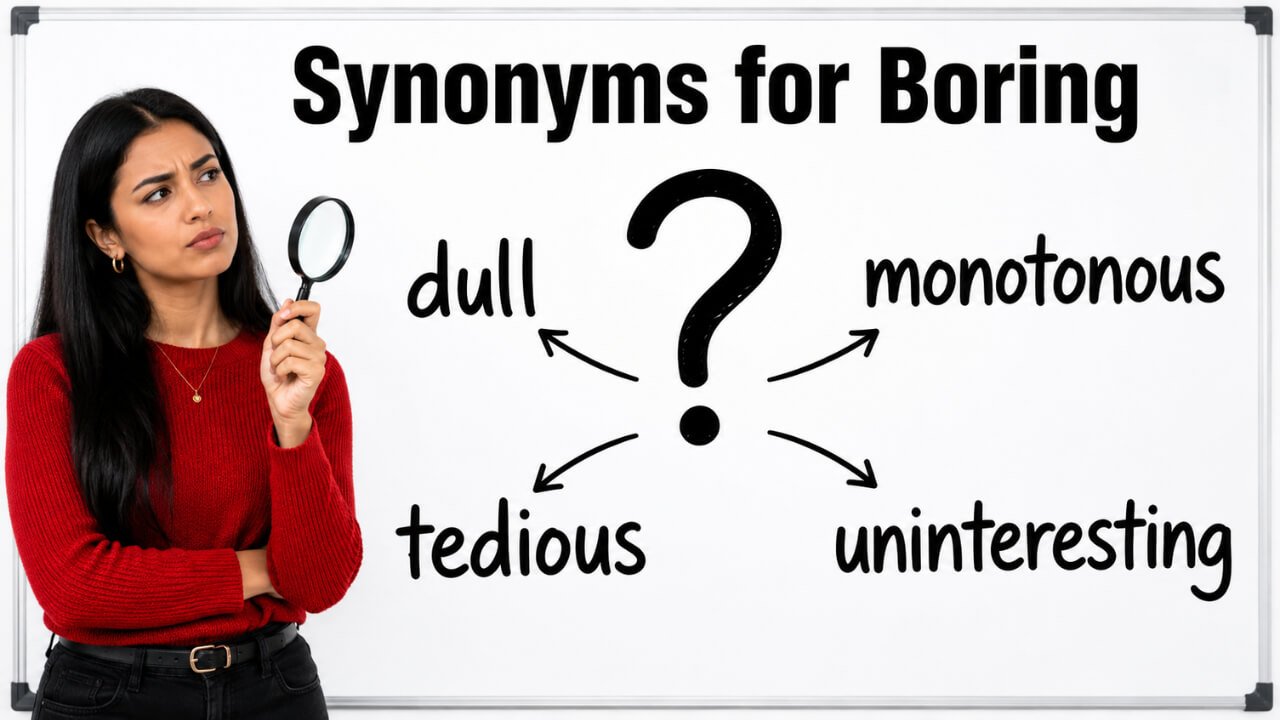
Quick Answer: Synonyms for boring include dull, tedious, monotonous, uninteresting, tiresome, lifeless, dry, stale, repetitive, and mind numbing. Use dull for something lacking excitement, tedious for something long and tiring, monotonous for something repetitive, uninteresting for neutral writing, and dry for topics, lectures, or writing that feel flat or hard to enjoy.
Pronunciation and Word Details
Word: Boring.
Pronunciation: /ˈbɔːrɪŋ/.
Part of Speech: Adjective.
Meaning: Not interesting, exciting, lively, or enjoyable.
US Pronunciation:
UK Pronunciation:
What Does “Boring” Mean?
Boring means not interesting, exciting, enjoyable, or mentally engaging. It is most commonly used as an adjective to describe a person, activity, place, story, subject, speech, routine, or experience that fails to hold attention.
The word can describe something mild and harmless, such as a boring movie, or something more frustrating, such as a boring meeting that feels too long. It can also describe style, tone, or presentation, as in boring writing, boring clothes, or a boring explanation.
In sentences, boring usually comes before a noun or after a linking verb.
Before a noun: It was a boring lecture.
After a linking verb: The lecture was boring.
Meaning, Tone, and Context of “Boring”
Boring has a mostly negative tone. It is common in everyday speech, casual writing, reviews, conversations, and personal opinions. The word is clear and direct, but it can sometimes sound blunt or impolite if used to describe a person or someone’s work.
In formal writing, words like uninteresting, repetitive, uninspiring, or monotonous may sound more polished. In academic or professional contexts, lacks engagement, limited in variety, or overly repetitive can sound more objective.
Tone: Negative, direct, and conversational.
Formality: Neutral to casual.
Common Use: Movies, books, classes, meetings, speeches, routines, jobs, conversations, tasks, and descriptions.
Polite Alternative: Uninteresting, repetitive, or lacking variety.
Stronger Alternative: Tedious, lifeless, tiresome, or mind numbing.
When and How to Use “Boring”
For a Dull Experience: Use boring when an activity does not feel enjoyable or engaging.
Example: The trip sounded exciting, but the tour was boring.
For Repetition: Use boring when something repeats too much and loses interest.
Example: The same daily routine became boring after a few weeks.
For Weak Writing or Speech: Use boring when words, tone, or delivery fail to hold attention.
Example: The article had useful facts, but the writing felt boring.
For Entertainment: Use boring when a movie, book, show, or game lacks excitement.
Example: The movie looked promising, but the story was boring.
For Polite Criticism: Use a softer synonym when you want to sound respectful.
Example: The presentation was informative, but a little uninteresting.
Best Synonyms for Boring
Dull: Lacking excitement, energy, or interest.
Example: The lecture was dull and difficult to follow.
Tedious: Long, tiring, and unpleasant because of too much detail or repetition.
Example: Filling out the same form again was tedious.
Monotonous: Repetitive in a way that feels flat or unchanging.
Example: The speaker’s monotonous voice made the lesson hard to enjoy.
Uninteresting: Not able to attract attention or curiosity.
Example: The topic seemed uninteresting at first.
Tiresome: Annoying or tiring because it continues for too long.
Example: The long explanation became tiresome.
Lifeless: Lacking energy, emotion, or freshness.
Example: The performance felt lifeless.
Dry: Serious, plain, or lacking warmth and excitement.
Example: The textbook was useful but dry.
Stale: No longer fresh, original, or exciting.
Example: The jokes felt stale after being repeated many times.
Repetitive: Repeating the same thing too often.
Example: The lesson became repetitive after the first hour.
Mind Numbing: Extremely boring and mentally tiring.
Example: The task was mind numbing after several hours.
50 Synonyms for Boring with Short Meanings
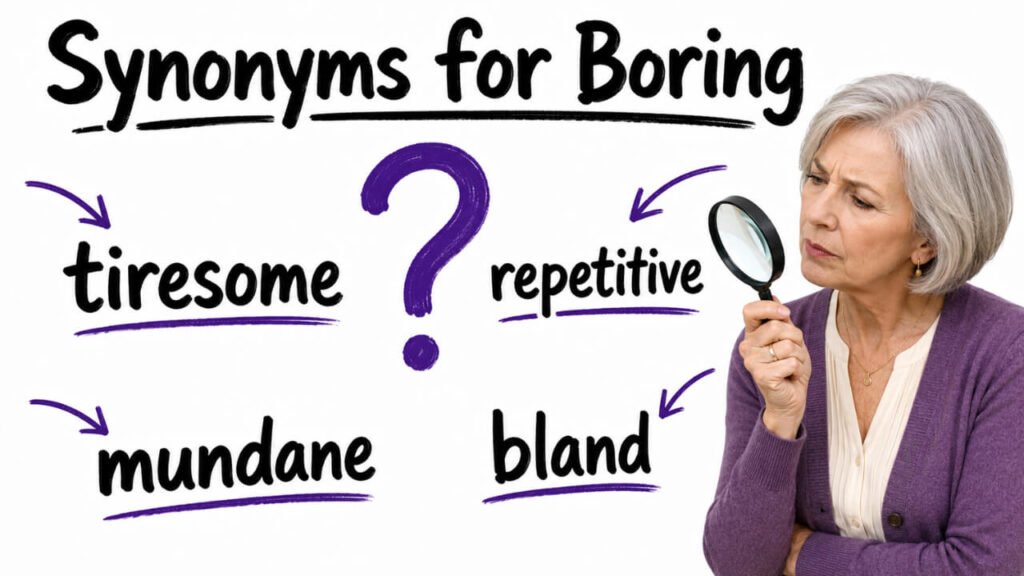
- Dull: Lacking interest or excitement.
- Tedious: Long, tiring, and unpleasant.
- Monotonous: Repetitive and unchanging.
- Uninteresting: Not attracting attention.
- Tiresome: Annoying or tiring over time.
- Lifeless: Lacking energy or spirit.
- Dry: Plain, serious, or lacking warmth.
- Stale: No longer fresh or original.
- Repetitive: Repeating too much.
- Mind Numbing: Extremely dull and mentally tiring.
- Unexciting: Not creating excitement.
- Flat: Lacking energy, emotion, or impact.
- Bland: Lacking strong character or interest.
- Wearisome: Causing tiredness or boredom.
- Drab: Dull in appearance, style, or mood.
- Colorless: Lacking personality or vivid detail.
- Vapid: Empty, dull, or lacking meaning.
- Humdrum: Ordinary and lacking excitement.
- Routine: Regular in a dull or predictable way.
- Uneventful: Having nothing interesting happen.
- Uninspiring: Not encouraging interest or emotion.
- Forgettable: Not memorable or impressive.
- Banal: Too ordinary or lacking originality.
- Plain: Simple and lacking special interest.
- Slow: Lacking pace, action, or energy.
- Laborious: Requiring effort in a tiring way.
- Heavy: Hard to enjoy because it feels serious or slow.
- Unvaried: Lacking change or variety.
- Samey: Too similar throughout.
- Predictable: Easy to guess and lacking surprise.
- Lackluster: Lacking energy, brightness, or quality.
- Dreary: Dull, gloomy, and unpleasant.
- Prosaic: Ordinary, plain, and not imaginative.
- Sleepy: Quiet, slow, and lacking energy.
- Mechanical: Done without feeling or freshness.
- Formulaic: Following a familiar pattern too closely.
- Overlong: Too long and tiring.
- Pointless: Lacking clear purpose or value.
- Empty: Lacking substance or meaningful content.
- Unappealing: Not attractive or interesting.
- Weak: Lacking force, quality, or interest.
- Tame: Too mild or lacking excitement.
- Stodgy: Heavy, dull, and old fashioned in style.
- Mundane: Ordinary and lacking excitement.
- Run of the mill: Ordinary and not special.
- Nothing Special: Average and not memorable.
- Unremarkable: Not worth special attention.
- Spiritless: Lacking energy or enthusiasm.
- Deadening: Making the mind feel tired or inactive.
- Ho Hum: Mildly boring or unimpressive.
Read Also:
Synonyms For Perspective
Synonyms for Boring by Context
When Boring Means Dull or Not Interesting
Use these words when something fails to catch attention or create curiosity.
Dull: The speech was dull from the beginning.
Uninteresting: The topic sounded uninteresting to most students.
Flat: The story had a flat ending.
Bland: The description was bland and forgettable.
When Boring Means Long and Tiring
Use these words when something feels too long, slow, or mentally exhausting.
Tedious: The paperwork was tedious.
Tiresome: The repeated instructions became tiresome.
Wearisome: The long process felt wearisome.
Laborious: The task was laborious and slow.
When Boring Means Repetitive
Use these words when something repeats too often or lacks variety.
Monotonous: The job became monotonous after a month.
Repetitive: The song felt repetitive after the first verse.
Unvaried: The lesson was unvaried and hard to follow.
Samey: The chapters felt samey.
When Boring Means Lifeless or Weak
Use these words when something lacks energy, emotion, or expression.
Lifeless: The acting seemed lifeless.
Lackluster: The performance was lackluster.
Spiritless: The event felt spiritless.
Colorless: The writing was colorless.
When Boring Means Ordinary or Predictable
Use these words when something feels too common, expected, or plain.
Mundane: The task was mundane.
Predictable: The ending was predictable.
Banal: The remarks sounded banal.
Run of the mill: The design was run of the mill.
Another Word for Boring
Another word for boring is dull. It is the most common and flexible replacement because it works for people, places, tasks, stories, speeches, and experiences. However, the best alternative depends on context. Use tedious when something is long and tiring, monotonous when it repeats too much, and uninteresting when you want a neutral or polite tone.
Original: The class was boring.
Better Option: The class was dull.
Original: The report was boring to read.
Better Option: The report was dry and repetitive.
Original: The task became boring after one hour.
Better Option: The task became tedious after one hour.
Original: His speech was boring.
Better Option: His speech was monotonous and lacked energy.
When Not to Use “Boring”
Do not use boring when you need a more exact or polite word. It can sound too general, especially in essays, reviews, reports, or professional feedback. It can also sound rude when used to describe a person directly.
Weak: The presentation was boring.
Better: The presentation was informative but lacked variety.
Weak: The book was boring.
Better: The book had a slow pace and repetitive scenes.
Weak: She is boring.
Better: She has a quiet communication style.
Weak: The meeting was boring and bad.
Better: The meeting felt overlong and unfocused.
Weak: The lesson was very boring.
Better: The lesson was monotonous and difficult to stay engaged with.
Words Commonly Confused With Boring
Boring vs Dull: Boring means not interesting. Dull also means lacking interest, but it can sound slightly softer and more general.
Boring vs Tedious: Boring can describe anything uninteresting. Tedious describes something long, slow, detailed, or tiring.
Boring vs Monotonous: Boring is broad. Monotonous specifically means repetitive or unchanging.
Boring vs Dry: Boring is general. Dry often describes writing, teaching, humor, or speech that lacks warmth or liveliness.
Boring vs Bland: Boring means not engaging. Bland means lacking strong character, flavor, color, or personality.
Boring vs Lifeless: Boring means lacking interest. Lifeless means lacking energy, emotion, or spirit.
Boring vs Predictable: Boring can be caused by many things. Predictable means something is easy to guess and has no surprise.
Which Synonym Should You Choose?
Choose dull when describing something generally uninteresting or lacking excitement.
Choose tedious when the activity is long, detailed, tiring, or annoying.
Choose monotonous when something repeats the same pattern, sound, routine, or action.
Choose uninteresting when you want a neutral and polite word.
Choose dry when talking about writing, lectures, explanations, or serious material.
Choose lifeless when something lacks energy, emotion, or expression.
Choose stale when something feels old, overused, or no longer fresh.
Choose repetitive when the main problem is repeated content, ideas, or actions.
Choose lackluster when a performance, result, or effort is weak and unimpressive.
Choose mind numbing when something is extremely boring and mentally exhausting.
Real Life Examples of “Boring” in Sentences
Original: The movie was boring.
Better Option: The movie was dull and predictable.
Original: The meeting was boring.
Better Option: The meeting was tedious and overlong.
Original: His voice was boring.
Better Option: His voice was monotonous.
Original: The article was boring.
Better Option: The article was dry and repetitive.
Original: The party was boring.
Better Option: The party felt lifeless.
Original: The story became boring near the end.
Better Option: The story became predictable near the end.
Original: My daily routine is boring.
Better Option: My daily routine is monotonous.
Original: The lesson was boring for students.
Better Option: The lesson was uninteresting for students.
Original: The design looks boring.
Better Option: The design looks plain and lackluster.
Original: The game was boring after a while.
Better Option: The game became repetitive after a while.
Synonym Groups and Usage Differences
General Interest Group
Words like dull, uninteresting, flat, and bland describe something that does not catch attention.
Example: The explanation was dull because it lacked clear examples.
Repetition Group
Words like monotonous, repetitive, samey, and unvaried describe something that repeats too much.
Example: The routine became monotonous after several weeks.
Tiredness Group
Words like tedious, tiresome, wearisome, and laborious describe something that feels tiring or too long.
Example: The editing process was tedious but necessary.
Weak Energy Group
Words like lifeless, spiritless, lackluster, and colorless describe something without energy or feeling.
Example: The speech sounded lifeless despite the important topic.
Ordinary Quality Group
Words like mundane, banal, unremarkable, and run of the mill describe something too ordinary to stand out.
Example: The plot was unremarkable and easy to forget.
Antonyms of Boring
Interesting: Able to attract attention or curiosity.
Exciting: Full of energy, action, or strong interest.
Engaging: Holding attention in a pleasant way.
Fascinating: Extremely interesting or captivating.
Entertaining: Enjoyable and amusing to experience.
Lively: Full of energy, movement, or spirit.
Stimulating: Encouraging thought, attention, or activity.
Fresh: New, original, or full of life.
Dynamic: Active, changing, and energetic.
Memorable: Worth remembering because it stands out.
Comparison: Boring vs Related Words
Boring vs Dull
Boring is a direct word for something that does not interest people. Dull is very similar, but it can sound slightly softer and more flexible.
Example With Boring: The lecture was boring.
Example With Dull: The lecture was dull and slow.
Boring vs Tedious
Boring means not interesting. Tedious means boring because something is too long, repetitive, detailed, or tiring.
Example With Boring: The task was boring.
Example With Tedious: The task was tedious because it involved hundreds of repeated steps.
Boring vs Monotonous
Boring is broad. Monotonous focuses on repetition, sameness, or lack of change.
Example With Boring: The job was boring.
Example With Monotonous: The job was monotonous because every day followed the same routine.
Boring vs Dry
Boring can describe any uninteresting thing. Dry is often used for writing, lessons, speeches, explanations, and formal content that lacks warmth or emotion.
Example With Boring: The textbook was boring.
Example With Dry: The textbook was dry but accurate.
Boring vs Bland
Boring means not engaging. Bland means lacking strong features, personality, taste, or style.
Example With Boring: The room looked boring.
Example With Bland: The room looked bland because it had no color or character.
Common Phrases and Expressions With Boring
Boring Day: A day with little excitement or activity.
Boring Job: Work that feels repetitive or uninteresting.
Boring Person: A blunt phrase for someone who seems uninteresting.
Boring Story: A story that fails to hold attention.
Boring Class: A lesson that lacks energy or engagement.
Boring Meeting: A meeting that feels slow, long, or unnecessary.
Boring Routine: A repeated pattern that lacks variety.
Boring Life: A life that feels too predictable or uneventful.
Boring Topic: A subject that does not create curiosity.
Boring Voice: A voice that sounds flat, slow, or monotonous.
Common Mistakes to Avoid
One common mistake is using boring too often when a more exact synonym would be better. Repeating the same word can make writing sound weak.
Another mistake is using boring in formal feedback when a polite phrase would work better. Instead of saying someone’s work is boring, say it lacks variety, needs stronger examples, or could be more engaging.
Writers also confuse boring, tedious, and monotonous. Use tedious for long and tiring tasks. Use monotonous for repeated patterns. Use boring when the general meaning is simply not interesting.
Avoid calling people boring in professional or polite writing. It can sound personal and harsh. Describe the behavior, tone, or communication style instead.
Conclusion
Learning synonyms for boring helps you choose clearer, more accurate, and more natural words. Use dull for general lack of interest, tedious for long and tiring tasks, monotonous for repeated routines, dry for serious writing or speech, and lifeless for weak energy or emotion. The best synonym depends on the reason something feels boring, so match the word to the context, tone, and purpose of your sentence.
FAQs About Synonyms for Boring
What is the best synonym for boring?
The best synonym for boring is dull because it is simple, natural, and works in many contexts.
What is a formal synonym for boring?
A formal synonym for boring is uninteresting. You can also use repetitive, uninspiring, or lacking engagement.
What is a stronger word than boring?
Stronger words than boring include tedious, mind numbing, lifeless, and wearisome.
What is another word for a boring person?
A softer phrase is uninteresting person, but it is usually better to describe the behavior, such as quiet, reserved, or not very expressive.
Is dull the same as boring?
Dull and boring are very similar. Dull often sounds slightly softer, while boring is more direct.
What is a synonym for boring work?
Good synonyms for boring work include tedious work, monotonous work, routine work, and repetitive work.
What is the opposite of boring?
The opposite of boring includes interesting, exciting, engaging, fascinating, lively, and entertaining.
