
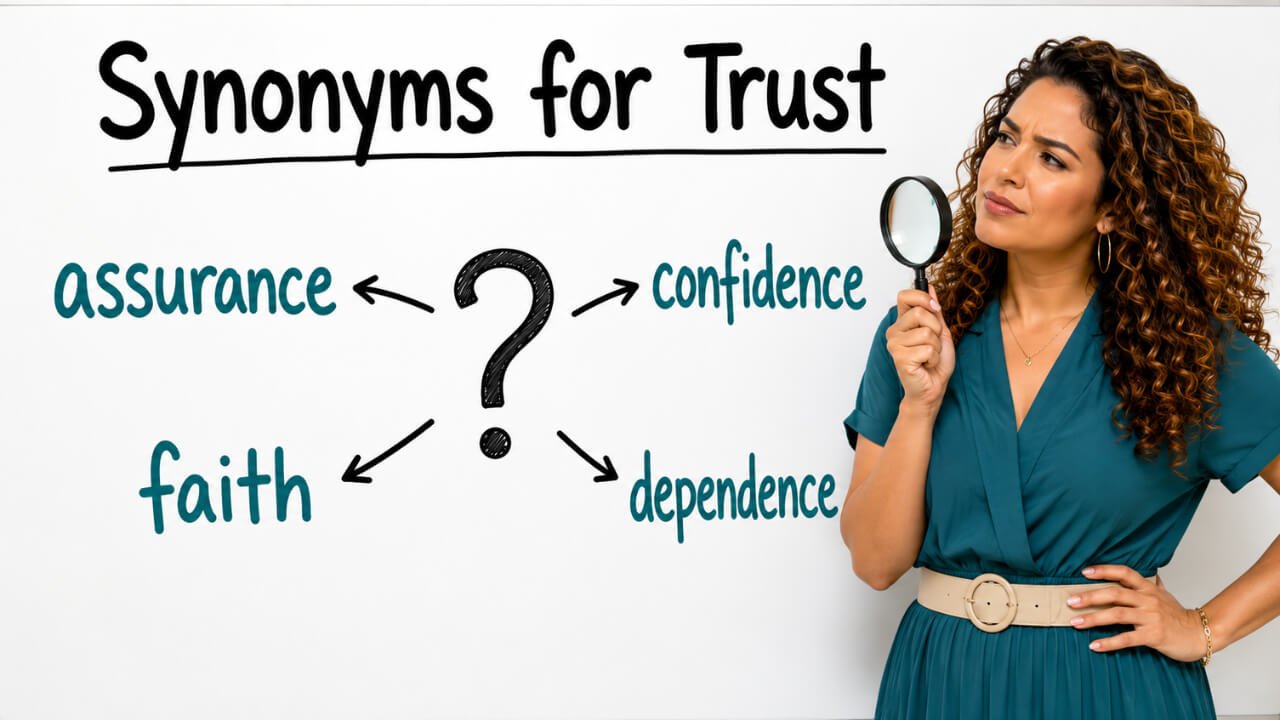
Quick Answer: The best synonyms for trust include confidence, faith, belief, reliance, assurance, dependence, credence, loyalty, conviction, and certainty. In formal writing, confidence and reliance often work best. In emotional or personal contexts, faith and belief feel warmer. In professional or legal contexts, confidence, credence, and assurance can sound more precise. The right synonym depends on whether you mean believing someone, depending on someone, feeling secure, or giving responsibility to someone.
Pronunciation and Word Details
Word: Trust
Pronunciation: /trʌst/
Part of Speech: Noun and verb
Meaning: Trust means firm belief in the honesty, ability, reliability, or truth of someone or something.
US Pronunciation:
UK Pronunciation:
What Does “Trust” Mean?
Direct Answer: Trust means believing that someone or something is honest, reliable, safe, or able to do what is expected.
As a noun, trust refers to confidence, belief, or reliance. For example, you can have trust in a friend, a system, a promise, or a decision. As a verb, trust means to believe in someone or depend on something. For example, you can trust a person, trust advice, trust your judgment, or trust a process.
Trust is commonly used in personal relationships, business communication, academic writing, legal contexts, leadership, teamwork, safety, and decision making.
Meaning, Tone, and Context of “Trust”
Tone: Trust is usually neutral, positive, and meaningful.
Formality: Trust works in both formal and casual writing.
Emotional Use: It can feel warm and personal when used in relationships, family, friendship, and love.
Professional Use: It can sound serious and practical when used in business, leadership, customer service, law, and teamwork.
Academic Use: Trust can describe social confidence, public belief, institutional reliability, or evidence based confidence.
Conversational Use: In everyday speech, trust is simple and natural. People say “I trust you,” “trust me,” or “I do not trust that idea.”
Trust is a strong word because it suggests belief, safety, honesty, and dependability at the same time.
When and How to Use “Trust”
For Personal Relationships: Use trust when talking about honesty, loyalty, and emotional safety.
Example: A strong friendship needs trust and respect.
For Reliability: Use trust when someone or something can be depended on.
Example: We trust this method because it has worked before.
For Belief: Use trust when you believe something is true or sincere.
Example: I trust her explanation because it sounds honest.
For Responsibility: Use trust when someone is given control, care, or duty.
Example: The manager trusted him with an important task.
For Confidence: Use trust when you feel sure about a person, plan, choice, or result.
Example: She trusted her judgment during the interview.
For Safety: Use trust when something feels secure or dependable.
Example: Drivers need to trust the safety system before using it.
Best Synonyms for Trust
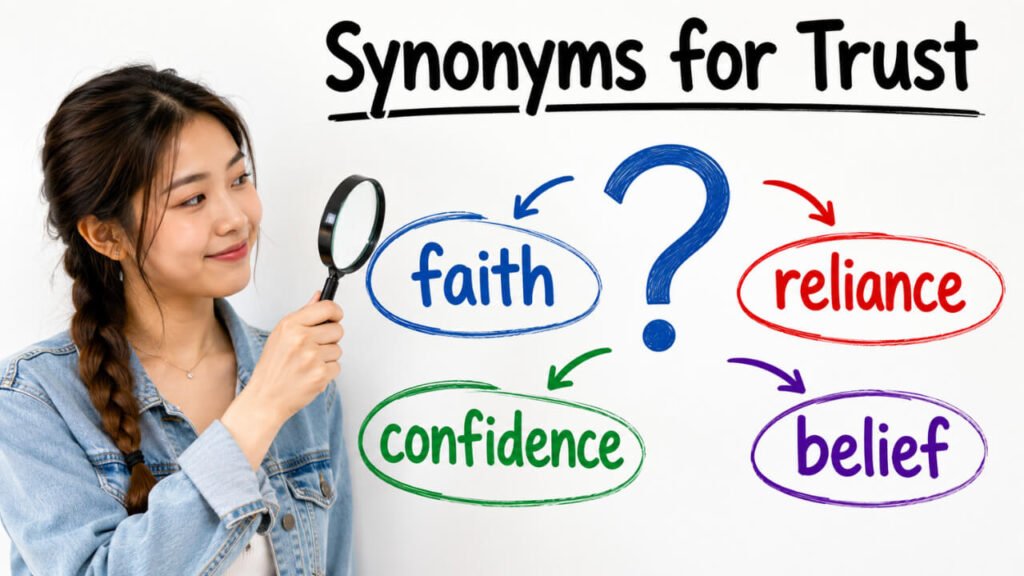
Confidence: A strong feeling that someone or something is reliable.
Example: I have confidence in your ability to lead the team.
Faith: Deep belief or strong confidence, often emotional or personal.
Example: She had faith in her friend even during difficult times.
Belief: Acceptance that something is true, real, or dependable.
Example: His belief in the plan helped everyone stay focused.
Reliance: Dependence on someone or something for support or success.
Example: The project showed our reliance on clear communication.
Assurance: A feeling of certainty, safety, or confidence.
Example: Her calm voice gave everyone assurance.
Dependence: The state of needing or relying on someone or something.
Example: The company reduced its dependence on one supplier.
Credence: Belief or acceptance that something is true.
Example: The evidence gave credence to his claim.
Loyalty: Faithful support, commitment, or trust toward a person or group.
Example: His loyalty made him a trusted member of the team.
Conviction: A strong belief that something is true or right.
Example: She spoke with conviction about the value of honesty.
Certainty: A sure feeling that something is true, safe, or correct.
Example: He answered with certainty after checking the facts.
50 Synonyms for Trust with Short Meanings
- Confidence: Firm belief in reliability or ability.
- Faith: Strong belief or emotional confidence.
- Belief: Acceptance that something is true.
- Reliance: Dependence on support or reliability.
- Assurance: Feeling of safety or certainty.
- Dependence: Need for support or help.
- Credence: Acceptance that something is true.
- Loyalty: Faithful support and commitment.
- Conviction: Strong personal belief.
- Certainty: Complete confidence or sureness.
- Dependability: Quality of being reliable.
- Reliability: Ability to be trusted consistently.
- Integrity: Honesty and strong moral character.
- Honesty: Truthfulness and sincerity.
- Sincerity: Genuine and honest feeling.
- Security: Feeling of safety and protection.
- Safety: Freedom from danger or risk.
- Support: Help, backing, or dependable assistance.
- Allegiance: Loyal commitment to a person or cause.
- Fidelity: Faithfulness and loyalty.
- Hope: Expectation that something good or true will happen.
- Expectation: Belief that something will occur.
- Certitude: Strong certainty or confidence.
- Credibility: Quality of being believable.
- Authority: Accepted power, expertise, or reliability.
- Responsibility: Duty that others can rely on.
- Commitment: Dedicated promise or loyalty.
- Devotion: Deep loyalty or faithful care.
- Dependableness: Quality of being worthy of reliance.
- Trustworthiness: Quality of deserving trust.
- Truthfulness: Habit of telling the truth.
- Openness: Honest and clear communication.
- Transparency: Clear and honest behavior.
- Goodwill: Friendly and sincere intention.
- Respect: Positive regard and confidence in someone.
- Admiration: Respectful approval or high regard.
- Approval: Acceptance or positive judgment.
- Acceptance: Willing belief or agreement.
- Believability: Quality of seeming true.
- Reliableness: State of being reliable.
- Steadfastness: Firm and loyal dependability.
- Constancy: Steady loyalty or reliability.
- Surety: Assurance or guarantee.
- Guarantee: Promise of dependability or result.
- Pledge: Serious promise or commitment.
- Promise: Statement that creates expectation and reliance.
- Confidence in: Belief in someone or something.
- Faith in: Strong belief in someone or something.
- Reliance on: Dependence on someone or something.
- Dependence on: Need for support from someone or something.
Read Also:
Synonyms For Boring
Synonyms for Trust by Context
When Trust Means Confidence
Use these synonyms when trust means feeling sure about a person, choice, plan, or result.
Confidence: I have confidence in your decision.
Assurance: Her preparation gave the team assurance.
Certainty: He spoke with certainty after reviewing the details.
Conviction: She defended her view with conviction.
When Trust Means Belief
Use these synonyms when trust means accepting something as true or honest.
Belief: His belief in the story remained strong.
Credence: The report gave credence to the claim.
Faith: They had faith in the promise.
Acceptance: Her acceptance of the facts was immediate.
When Trust Means Reliance
Use these synonyms when trust means depending on someone or something.
Reliance: The plan requires reliance on accurate information.
Dependence: The team reduced its dependence on outside help.
Dependability: His dependability made him valuable.
Reliability: The reliability of the system improved over time.
When Trust Means Loyalty
Use these synonyms when trust includes faithful support, commitment, or emotional closeness.
Loyalty: Her loyalty was clear during difficult times.
Fidelity: Fidelity is important in a strong relationship.
Commitment: Their commitment kept the group united.
Devotion: His devotion earned deep respect.
When Trust Means Honesty
Use these synonyms when trust is connected to truth, sincerity, and moral character.
Integrity: Integrity builds lasting trust.
Honesty: Honesty is the foundation of trust.
Sincerity: Her sincerity made the apology meaningful.
Truthfulness: Truthfulness helps people feel secure.
Another Word for Trust
Direct Answer: The best single word for trust is usually confidence. It works in many formal, casual, personal, and professional contexts. However, the best alternative depends on the exact meaning. Use faith for emotional belief, reliance for dependence, credence for accepting something as true, and loyalty for faithful support.
Original: I have trust in your leadership.
Better Option: I have confidence in your leadership.
Original: The team placed trust in the new system.
Better Option: The team placed reliance on the new system.
Original: She showed trust in his promise.
Better Option: She showed faith in his promise.
Original: The evidence increased trust in the report.
Better Option: The evidence gave credence to the report.
When Not to Use “Trust”
Do not use trust when another word gives a more exact meaning. Trust can sound too general if you mean proof, accuracy, loyalty, responsibility, or legal control. It can also become repetitive if used many times in one paragraph.
Weak: I trust the numbers are trustful and show trust in the results.
Better: I believe the numbers are accurate and support confidence in the results.
Weak: The company has trust because its products have trust.
Better: The company has credibility because its products are reliable.
Weak: She trusted the task to him.
Better: She entrusted the task to him.
Weak: I trust the answer is correct because it looks nice.
Better: I believe the answer is correct because the facts support it.
Use confidence when you mean a strong feeling of reliability. Use evidence or proof when you need factual support. Use entrust when you mean giving someone responsibility.
Words Commonly Confused With Trust
Trust vs Confidence: Trust is belief in honesty, reliability, or safety. Confidence is a strong feeling that someone or something will succeed or perform well.
Trust vs Faith: Trust can be practical or emotional. Faith is often deeper, more personal, or based on strong belief without complete proof.
Trust vs Reliance: Trust focuses on belief. Reliance focuses on dependence.
Trust vs Credence: Trust is broader and can apply to people, systems, and feelings. Credence means accepting an idea, claim, or report as true.
Trust vs Loyalty: Trust is confidence in someone. Loyalty is faithful support for someone.
Trust vs Integrity: Trust is what people feel. Integrity is the honest character that helps create trust.
Trust vs Entrust: Trust means believe in someone. Entrust means give someone responsibility for something.
Which Synonym Should You Choose?
Choose confidence when writing about ability, leadership, decisions, or professional reliability.
Choose faith when writing about emotional belief, relationships, hope, or personal support.
Choose belief when writing about accepting an idea, statement, or possibility as true.
Choose reliance when writing about depending on a person, system, process, or resource.
Choose assurance when writing about comfort, certainty, safety, or peace of mind.
Choose credence when writing about giving belief to a claim, report, argument, or explanation.
Choose loyalty when writing about faithful support, commitment, and long term relationship strength.
Choose integrity when writing about honesty, character, ethics, and moral reliability.
Choose reliability when writing about consistent performance, systems, service, or results.
Choose trustworthiness when describing a person or thing that deserves trust.
Real Life Examples of “Trust” in Sentences
Original: I trust your advice.
Better Option: I have confidence in your advice.
Original: She trusts her best friend completely.
Better Option: She has deep faith in her best friend.
Original: The workers trust the safety rules.
Better Option: The workers rely on the safety rules.
Original: We trust the report because it is detailed.
Better Option: We give credence to the report because it is detailed.
Original: He earned their trust through honesty.
Better Option: He earned their confidence through honesty.
Original: The teacher trusted the student with the keys.
Better Option: The teacher entrusted the student with the keys.
Original: Customers trust products that last.
Better Option: Customers value products with proven reliability.
Original: I trust that she will arrive on time.
Better Option: I believe that she will arrive on time.
Original: A team cannot work well without trust.
Better Option: A team cannot work well without mutual confidence.
Original: His actions helped rebuild trust.
Better Option: His actions helped restore credibility.
Synonym Groups and Usage Differences
Confidence Group
This group includes confidence, assurance, certainty, and conviction. Use these words when trust means feeling sure or secure.
Example: Her careful planning gave everyone confidence.
Belief Group
This group includes belief, faith, credence, and acceptance. Use these words when trust means accepting something as true.
Example: The clear evidence gave credence to the statement.
Reliance Group
This group includes reliance, dependence, dependability, and reliability. Use these words when trust means depending on someone or something.
Example: The project depends on the reliability of the data.
Loyalty Group
This group includes loyalty, fidelity, commitment, and devotion. Use these words when trust means faithful support or emotional closeness.
Example: Their loyalty helped the group survive a difficult period.
Honesty Group
This group includes integrity, honesty, sincerity, and truthfulness. Use these words when trust comes from moral character and truthful behavior.
Example: Her integrity made people believe her words.
Antonyms of Trust
Distrust: Lack of trust or confidence.
Mistrust: Suspicion or doubt about someone or something.
Doubt: Uncertainty or lack of belief.
Suspicion: Feeling that something may be wrong or dishonest.
Skepticism: Careful doubt before accepting something as true.
Disbelief: Refusal or inability to believe something.
Uncertainty: Lack of confidence or sure knowledge.
Insecurity: Feeling unsafe, unsure, or not confident.
Betrayal: Breaking someone’s trust through disloyal action.
Deception: Dishonest behavior that destroys trust.
Dishonesty: Lack of truthfulness or integrity.
Unreliability: Quality of not being dependable.
Comparison: Trust vs Related Words
Trust vs Confidence
Trust is belief in honesty, reliability, or safety. Confidence is a strong feeling that someone or something can succeed or perform well.
Example With Trust: I trust her because she always tells the truth.
Example With Confidence: I have confidence in her ability to manage the project.
Trust vs Faith
Trust can be based on experience, proof, or relationship. Faith can be deeper and more emotional, sometimes without full evidence.
Example With Trust: I trust this doctor because she explains everything clearly.
Example With Faith: I have faith that things will improve.
Trust vs Reliance
Trust is about belief. Reliance is about depending on someone or something for support.
Example With Trust: We trust his judgment.
Example With Reliance: Our reliance on his judgment helped us decide quickly.
Trust vs Credence
Trust is broad and can relate to people, systems, feelings, or promises. Credence is usually used for claims, ideas, reports, or explanations.
Example With Trust: I trust her opinion.
Example With Credence: The new facts gave credence to her opinion.
Trust vs Loyalty
Trust is confidence in someone’s honesty or reliability. Loyalty is faithful support over time.
Example With Trust: She gained my trust by being honest.
Example With Loyalty: She proved her loyalty by standing with the team.
Trust vs Entrust
Trust means to believe in someone. Entrust means to give responsibility or care to someone.
Example With Trust: I trust him.
Example With Entrust: I entrusted him with the documents.
Common Phrases and Expressions With Trust
Build Trust: Create confidence through honest and reliable actions.
Earn Trust: Gain confidence by proving honesty or ability.
Break Trust: Damage confidence through dishonesty or betrayal.
Lose Trust: No longer be believed or relied on.
Rebuild Trust: Restore confidence after a problem.
Mutual Trust: Shared confidence between two people or groups.
Trust Issues: Difficulty believing or depending on others.
Trust Your Instincts: Believe your natural feelings or judgment.
Trust the Process: Believe that a method will work over time.
Public Trust: Confidence people have in an institution, person, or system.
Common Mistakes to Avoid
Repeating Trust Too Often: Do not use trust in every sentence. Replace it with confidence, faith, reliance, credibility, or loyalty when needed.
Choosing a Weak Synonym: Do not use belief when you clearly mean dependence. Use reliance instead.
Confusing Trust and Entrust: Trust means believe in someone. Entrust means give someone responsibility.
Using Trust When Proof Is Needed: Trust is not the same as evidence. In formal writing, use evidence, proof, or support when facts matter.
Using Too Casual a Phrase: Phrases like “trust me” can sound informal. In professional writing, use “I am confident” or “the evidence suggests.”
Ignoring Context: Trust in a friend, trust in data, and trust in a legal agreement may need different synonyms.
Overusing Abstract Language: Instead of saying “trust is important” repeatedly, explain what creates it, such as honesty, reliability, consistency, and transparency.
Conclusion
Synonyms for trust help you express belief, confidence, reliance, honesty, and loyalty with more precision. Use confidence when you mean strong assurance, faith for emotional belief, reliance for dependence, credence for accepting a claim, and loyalty for faithful support. In formal writing, choose clear words like confidence, reliability, integrity, and credibility. In personal writing, faith, belief, and loyalty often feel more natural. The best synonym always depends on the meaning you want your sentence to carry.
FAQs About Synonyms for Trust
What are the best synonyms for trust?
The best synonyms for trust are confidence, faith, belief, reliance, assurance, credence, loyalty, certainty, integrity, and reliability.
What is another word for trust in formal writing?
In formal writing, the best words for trust are confidence, reliance, credibility, assurance, and integrity.
What is a stronger word than trust?
A stronger word than trust can be faith, conviction, certainty, or complete confidence, depending on the sentence.
What is another word for trust in a relationship?
In a relationship, good alternatives include faith, loyalty, honesty, confidence, devotion, and fidelity.
What is another word for trust in business?
In business, strong alternatives include confidence, reliability, credibility, assurance, dependability, and integrity.
Is trust a noun or a verb?
Trust can be both a noun and a verb. As a noun, it means confidence or belief. As a verb, it means to believe in or rely on someone.
What is the opposite of trust?
The opposite of trust can be distrust, mistrust, doubt, suspicion, skepticism, disbelief, or uncertainty.
