
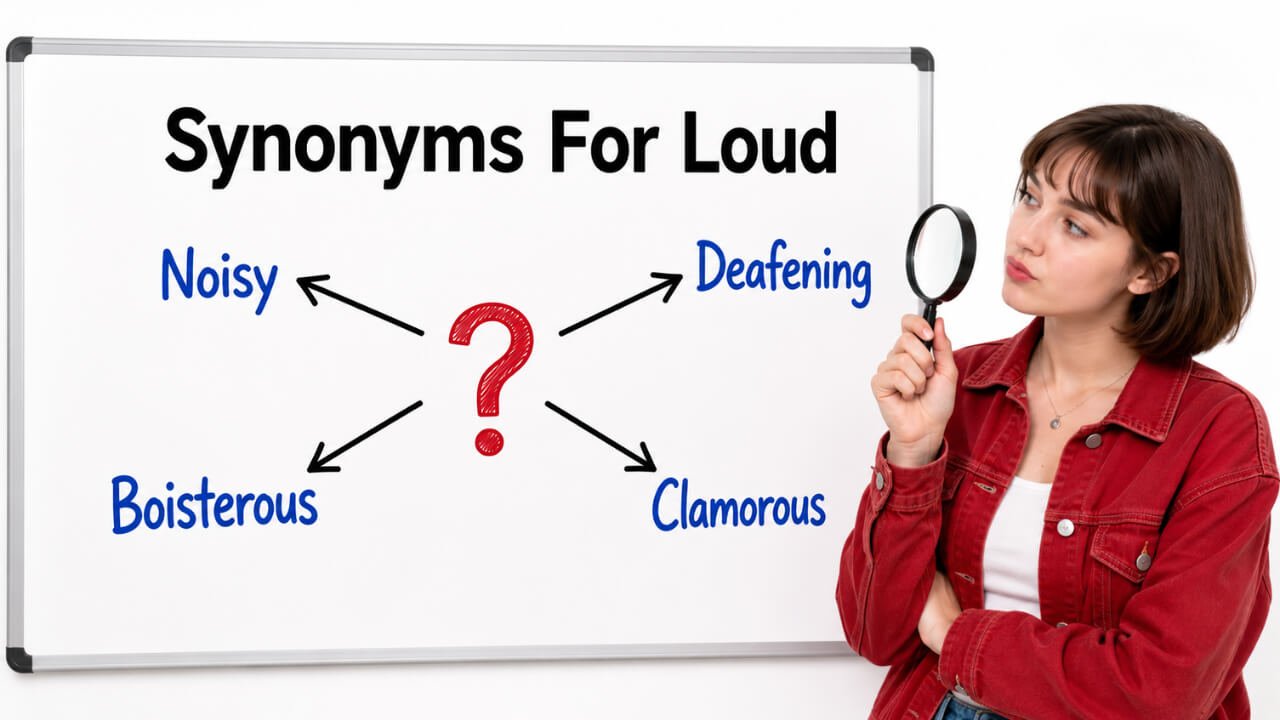
Quick Answer: Synonyms for loud include noisy, booming, blaring, deafening, thunderous, piercing, shrill, raucous, clamorous, and roaring. The best synonym depends on context. Use noisy for general sound, booming for a deep powerful sound, blaring for a harsh sound from speakers or alarms, deafening for extremely loud noise, piercing for sharp sound, and raucous for rough or uncontrolled voices.
Pronunciation and Word Details
Word: Loud.
Pronunciation: /laʊd/.
Part of Speech: Adjective and sometimes adverb.
Meaning: Loud means making, producing, or having a strong sound that is easy to hear.
US Pronunciation:
UK Pronunciation:
What Does “Loud” Mean?
Direct Answer: Loud means producing a strong, clear, or intense sound that can be heard easily.
The word loud is most commonly used as an adjective. It describes voices, music, alarms, machines, crowds, noises, and other sounds that have high volume. For example, a loud voice is easy to hear, and loud music has strong sound.
Loud can also describe something that feels visually bold or attention grabbing, such as loud colors or loud clothing. In this sense, it does not mean sound. It means noticeable, bright, or hard to ignore.
Meaning, Tone, and Context of “Loud”
Loud is a common, neutral, and conversational word. It is simple enough for everyday speech but also useful in clear writing.
In normal use, loud describes sound volume. It can be neutral, positive, or negative depending on context. A loud cheer may sound joyful, while a loud argument may sound unpleasant. A loud alarm may be useful, while loud noise at night may be annoying.
In descriptive writing, loud can create emotion and atmosphere. In technical or formal writing, more exact words such as high volume, intense, audible, or excessive may work better.
When and How to Use “Loud”
For General Noise: Use loud when describing a sound that is strong or easy to hear.
Example: The loud music filled the entire room.
For Voice Volume: Use loud when someone speaks, laughs, shouts, or calls with a strong voice.
Example: Her loud voice carried across the hall.
For Warning Sounds: Use loud for alarms, sirens, bells, and signals that are meant to catch attention.
Example: A loud alarm woke everyone in the building.
For Emotional Scenes: Use loud when a sound adds energy, tension, anger, fear, or excitement.
Example: The loud cheers made the final moment feel unforgettable.
For Visual Boldness: Use loud when colors, patterns, or styles are very bright or noticeable.
Example: He wore a loud jacket with bright red and yellow stripes.
Best Synonyms for Loud
Noisy: Full of loud or distracting sounds.
Example: The noisy classroom made it hard to focus.
Booming: Deep, powerful, and resonant in sound.
Example: His booming voice echoed through the room.
Blaring: Very loud and harsh, often from speakers, horns, or alarms.
Example: The radio was blaring from the kitchen.
Deafening: So loud that it almost hurts the ears.
Example: The deafening thunder shook the windows.
Thunderous: Extremely loud and powerful like thunder.
Example: The crowd gave a thunderous cheer.
Piercing: Loud, sharp, and high in pitch.
Example: A piercing scream came from the hallway.
Shrill: Loud, sharp, and unpleasantly high.
Example: The shrill whistle stopped the players.
Raucous: Loud, rough, and uncontrolled.
Example: A raucous group laughed near the entrance.
Clamorous: Loud because many voices or sounds are happening at once.
Example: The clamorous market was full of shouting vendors.
Roaring: Very loud, deep, and continuous.
Example: The roaring engine shook the ground.
50 Synonyms for Loud with Short Meanings
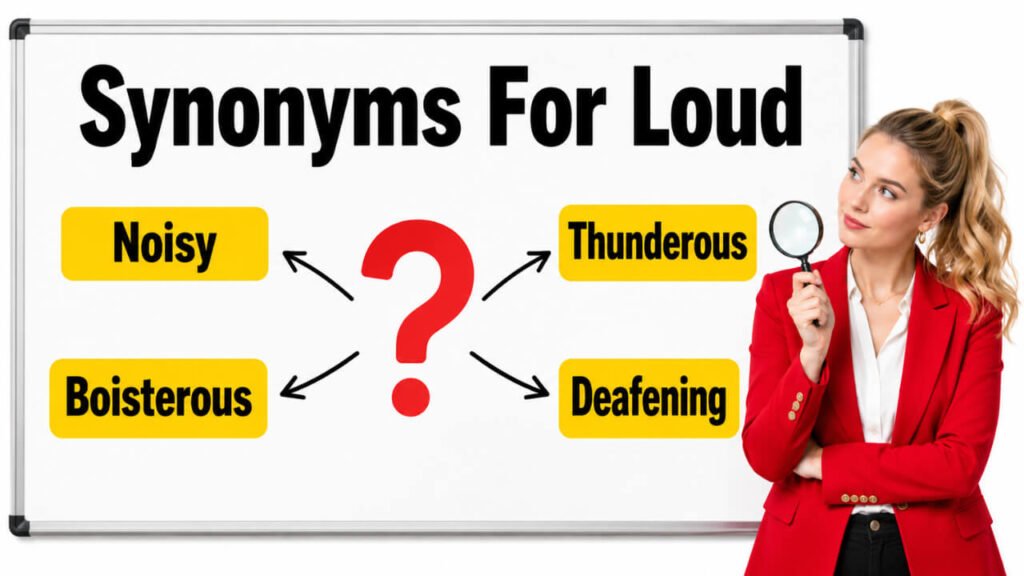
- Noisy: Full of loud sounds.
- Booming: Deep and powerful in sound.
- Blaring: Loud and harsh.
- Deafening: Extremely loud.
- Thunderous: Loud like thunder.
- Piercing: Sharp and loud.
- Shrill: High, sharp, and loud.
- Raucous: Rough and loud.
- Clamorous: Loud with mixed noise.
- Roaring: Deep, loud, and continuous.
- Resounding: Loud and echoing.
- Sonorous: Deep, full, and rich in sound.
- Ear splitting: Painfully loud.
- Vociferous: Loud and forceful in speech.
- Boisterous: Loud, energetic, and lively.
- Stentorian: Very loud and powerful in voice.
- Strident: Loud, harsh, and unpleasant.
- Clanging: Loud with metallic sound.
- Clattering: Loud with repeated hard sounds.
- Ringing: Loud and clear.
- Echoing: Loud because sound repeats.
- Shouting: Speaking very loudly.
- Yelling: Crying out loudly.
- Screaming: Very loud and high in voice.
- Howling: Loud like wind, animals, or cries.
- Blasting: Playing or sounding very loudly.
- Blatant: Loud in an obvious or forceful way.
- Turbulent: Loud and unsettled in movement or sound.
- Uproarious: Extremely loud with laughter or excitement.
- Rowdy: Loud and disorderly.
- Rambunctious: Loud, energetic, and hard to control.
- Tumultuous: Loud, confused, and full of activity.
- Explosive: Sudden and very loud.
- Crashingly: Loud with a crashing effect.
- Thumping: Loud with heavy beats.
- Pounding: Loud with strong repeated beats.
- Thundering: Loud and heavy like thunder.
- Rumbling: Low, deep, and loud.
- Growling: Low, rough, and loud.
- Bellowing: Loud and deep in voice.
- Crying: Calling out loudly.
- High volume: Having strong sound level.
- Full volume: At the highest sound level.
- Intense: Strong in sound or effect.
- Audible: Easy to hear.
- Clear: Easy to hear or understand.
- Forceful: Strong and powerful in sound.
- Overpowering: Too strong to ignore.
- Harsh: Loud and unpleasant.
- Bold: Very noticeable, especially in color or style.
Read Also:
Synonyms For Information
Synonyms for Loud by Context
When Loud Means High Volume
Use these synonyms when the sound level is strong and easy to hear.
Synonyms: Noisy, high volume, full volume, audible, clear, intense.
Example: The loud speaker could be heard from across the street.
Better Option: The high volume speaker could be heard from across the street.
When Loud Means Extremely Strong Sound
Use these words when a sound is more than normal and feels powerful.
Synonyms: Deafening, thunderous, ear splitting, explosive, overpowering.
Example: The loud crash made everyone jump.
Better Option: The deafening crash made everyone jump.
When Loud Means Deep and Powerful
Use these synonyms for deep voices, engines, thunder, drums, and heavy sounds.
Synonyms: Booming, roaring, rumbling, thundering, bellowing.
Example: His loud voice filled the hall.
Better Option: His booming voice filled the hall.
When Loud Means Sharp or Unpleasant
Use these words when the sound is high, harsh, or irritating.
Synonyms: Piercing, shrill, strident, harsh, blaring.
Example: The loud whistle hurt my ears.
Better Option: The shrill whistle hurt my ears.
When Loud Means Noisy People or Crowds
Use these synonyms when describing groups, laughter, cheering, or uncontrolled voices.
Synonyms: Raucous, boisterous, rowdy, clamorous, uproarious.
Example: The loud crowd celebrated after the match.
Better Option: The raucous crowd celebrated after the match.
When Loud Means Visually Bold
Use these words when loud describes colors, clothes, design, or style.
Synonyms: Bold, bright, flashy, vivid, striking.
Example: She chose a loud pattern for the curtains.
Better Option: She chose a bold pattern for the curtains.
Another Word for Loud
The best single replacement for loud is often noisy when you mean a general sound that is strong or distracting. However, the best alternative depends on context. Use booming for a deep voice, blaring for speakers or alarms, deafening for extreme volume, and piercing for sharp high sounds.
Original: The loud music kept us awake.
Better Option: The blaring music kept us awake.
Original: He had a loud voice.
Better Option: He had a booming voice.
Original: The loud noise scared the child.
Better Option: The deafening noise scared the child.
Original: She wore a loud dress.
Better Option: She wore a bold dress.
When Not to Use “Loud”
Avoid using loud when a more exact word would describe the sound better. Loud is useful, but it can feel basic if repeated too often.
Use deafening when the sound is extremely strong. Use piercing when the sound is sharp. Use booming when the sound is deep. Use raucous when people are noisy and disorderly. Use bold when describing colors or patterns.
Weak: The loud loud crowd made loud noises.
Better: The raucous crowd filled the stadium with thunderous cheers.
Weak: The loud alarm made a loud sound.
Better: The blaring alarm rang through the hallway.
Weak: He wore a loud shirt.
Better: He wore a bold shirt with bright colors.
Weak: The loud scream was loud and scary.
Better: The piercing scream frightened everyone nearby.
Words Commonly Confused With Loud
Loud vs Noisy: Loud means strong in sound, while noisy often means full of unwanted or distracting sound.
Loud vs Booming: Loud can describe any strong sound, while booming describes a deep, powerful sound.
Loud vs Blaring: Loud is general, while blaring usually describes harsh sound from speakers, horns, alarms, or music.
Loud vs Deafening: Loud can be strong but still normal, while deafening means extremely loud and almost painful.
Loud vs Piercing: Loud refers to volume, while piercing refers to a sharp high sound that cuts through other noise.
Loud vs Raucous: Loud describes volume, while raucous describes rough, uncontrolled noise from people or groups.
Loud vs Bold: Loud usually describes sound, while bold can replace loud when describing bright colors or noticeable style.
Which Synonym Should You Choose?
Choose noisy when describing a place, room, street, or area full of sound.
Choose booming when writing about a deep voice, drum, announcement, or powerful sound.
Choose blaring when describing alarms, horns, speakers, music, or sound systems.
Choose deafening when the sound is extremely loud and almost painful.
Choose piercing when the sound is sharp, high, and difficult to ignore.
Choose shrill when the sound is high, thin, and unpleasant.
Choose raucous when describing loud laughter, crowds, parties, or disorderly groups.
Choose thunderous when the sound is powerful, dramatic, and impressive.
Choose bold when loud describes colors, clothing, design, or visual style.
Choose audible when you simply mean something can be heard clearly.
Real Life Examples of “Loud” in Sentences
Original: The loud alarm woke the whole family.
Better Option: The blaring alarm woke the whole family.
Original: His loud voice carried across the room.
Better Option: His booming voice carried across the room.
Original: The loud thunder shook the windows.
Better Option: The thunderous noise shook the windows.
Original: A loud scream came from the kitchen.
Better Option: A piercing scream came from the kitchen.
Original: The loud crowd celebrated outside.
Better Option: The raucous crowd celebrated outside.
Original: The loud machine made it hard to talk.
Better Option: The noisy machine made it hard to talk.
Original: She wore a loud coat to the event.
Better Option: She wore a bold coat to the event.
Original: The loud engine started suddenly.
Better Option: The roaring engine started suddenly.
Original: Loud laughter came from the next table.
Better Option: Uproarious laughter came from the next table.
Original: The loud sound echoed through the tunnel.
Better Option: The resounding sound echoed through the tunnel.
Synonym Groups and Usage Differences
General Sound Group
Words such as noisy, audible, clear, and high volume describe sound that can be heard easily. These are useful in everyday writing.
Example: The noisy street made conversation difficult.
Extreme Volume Group
Words such as deafening, ear splitting, overpowering, and thunderous describe sound that feels very strong or intense.
Example: The deafening explosion startled the crowd.
Deep Sound Group
Words such as booming, roaring, rumbling, and bellowing describe low, heavy, powerful sounds.
Example: His booming laugh filled the room.
Sharp Sound Group
Words such as piercing, shrill, strident, and harsh describe sounds that are loud and unpleasant because of their pitch.
Example: The piercing whistle stopped the game.
Crowd Noise Group
Words such as raucous, clamorous, boisterous, and rowdy describe loud groups of people.
Example: The boisterous fans cheered for their team.
Visual Style Group
Words such as bold, bright, flashy, and vivid describe something that looks loud rather than sounds loud.
Example: The bold wallpaper changed the entire room.
Antonyms of Loud
Quiet: Making little or no sound.
Soft: Gentle and low in volume.
Silent: Having no sound.
Muted: Reduced or softened in sound.
Hushed: Very quiet, often because people are speaking softly.
Low: Not high in volume.
Faint: Hard to hear.
Subtle: Not strong, obvious, or attention grabbing.
Calm: Peaceful and not noisy.
Gentle: Mild, soft, and not harsh.
Comparison: Loud vs Related Words
Loud vs Noisy
Loud means strong in sound. Noisy often means filled with sound in a way that may be annoying or distracting.
Example With Loud: The loud bell rang at noon.
Example With Noisy: The noisy cafeteria made it hard to study.
Loud vs Booming
Loud is general. Booming describes a deep and powerful sound that often echoes.
Example With Loud: He spoke in a loud voice.
Example With Booming: He spoke in a booming voice that filled the hall.
Loud vs Blaring
Loud describes volume. Blaring suggests a harsh, forceful sound, especially from music, speakers, horns, or alarms.
Example With Loud: The loud music came from next door.
Example With Blaring: The blaring music came from next door.
Loud vs Deafening
Loud can be strong but bearable. Deafening means so loud that it is overwhelming or painful.
Example With Loud: The loud applause lasted for minutes.
Example With Deafening: The deafening applause shook the room.
Loud vs Piercing
Loud focuses on volume. Piercing focuses on sharpness and high pitch.
Example With Loud: A loud sound came from the street.
Example With Piercing: A piercing siren came from the street.
Loud vs Raucous
Loud describes strong sound. Raucous describes rough, wild, or uncontrolled noise, usually from people.
Example With Loud: The loud group walked past the house.
Example With Raucous: The raucous group laughed outside the house.
Loud vs Bold
Loud usually describes sound. Bold can describe a strong visual style that attracts attention.
Example With Loud: The loud music played all night.
Example With Bold: The bold colors made the painting stand out.
Common Phrases and Expressions With Loud
Loud and Clear: Easy to hear and understand.
Loud Noise: A strong or high volume sound.
Loud Voice: A voice that can be heard easily.
Loud Music: Music played at high volume.
Loud Alarm: An alarm with a strong warning sound.
Loud Laugh: A strong and noticeable laugh.
Loud Colors: Very bright or noticeable colors.
Loud Pattern: A bold pattern that attracts attention.
Loud Crowd: A group of people making strong noise.
Think Out Loud: Say your thoughts as you are thinking.
Common Mistakes to Avoid
One common mistake is using loud too many times in the same paragraph. Repetition makes writing feel plain. Replace some uses with more specific synonyms such as booming, blaring, piercing, or raucous.
Another mistake is choosing a synonym that does not match the sound. Shrill works for high sharp sounds, but it does not fit a deep drum. Booming works for deep sounds, but it does not fit a high whistle.
Writers also confuse sound meaning with visual meaning. A loud shirt means bold or bright, not noisy. In that context, bold, flashy, or vivid may be clearer.
Avoid using extreme words such as deafening for normal volume. Save them for sounds that truly feel overwhelming.
Conclusion
Synonyms for loud help you describe sound with more accuracy, emotion, and detail. Use noisy for general sound, booming for deep volume, blaring for harsh alarms or music, deafening for extreme noise, piercing for sharp sounds, and raucous for uncontrolled crowd noise. When loud describes color or style, choose bold or vivid instead. The best word always depends on the type, strength, tone, and purpose of the sound.
FAQs About Synonyms for Loud
What are the best synonyms for loud?
The best synonyms for loud are noisy, booming, blaring, deafening, thunderous, piercing, shrill, raucous, clamorous, and roaring.
What is another word for loud noise?
Another word for loud noise is deafening noise when the sound is extremely strong. You can also use blaring noise, thunderous noise, or piercing noise depending on the sound.
What is a formal synonym for loud?
A formal synonym for loud can be audible, high volume, resounding, or sonorous. The best choice depends on whether you mean clear, strong, deep, or intense sound.
What is a synonym for a loud voice?
A good synonym for a loud voice is booming voice. You can also use stentorian voice, powerful voice, or bellowing voice depending on tone.
What is a synonym for very loud?
Synonyms for very loud include deafening, ear splitting, thunderous, overpowering, and blaring. These words suggest stronger sound than loud.
Can loud describe colors?
Yes, loud can describe colors, patterns, or clothing that are very bright or attention grabbing. In this context, better synonyms include bold, vivid, flashy, and striking.
What is the opposite of loud?
The opposite of loud is quiet. Other antonyms include soft, silent, muted, hushed, low, and faint.
