
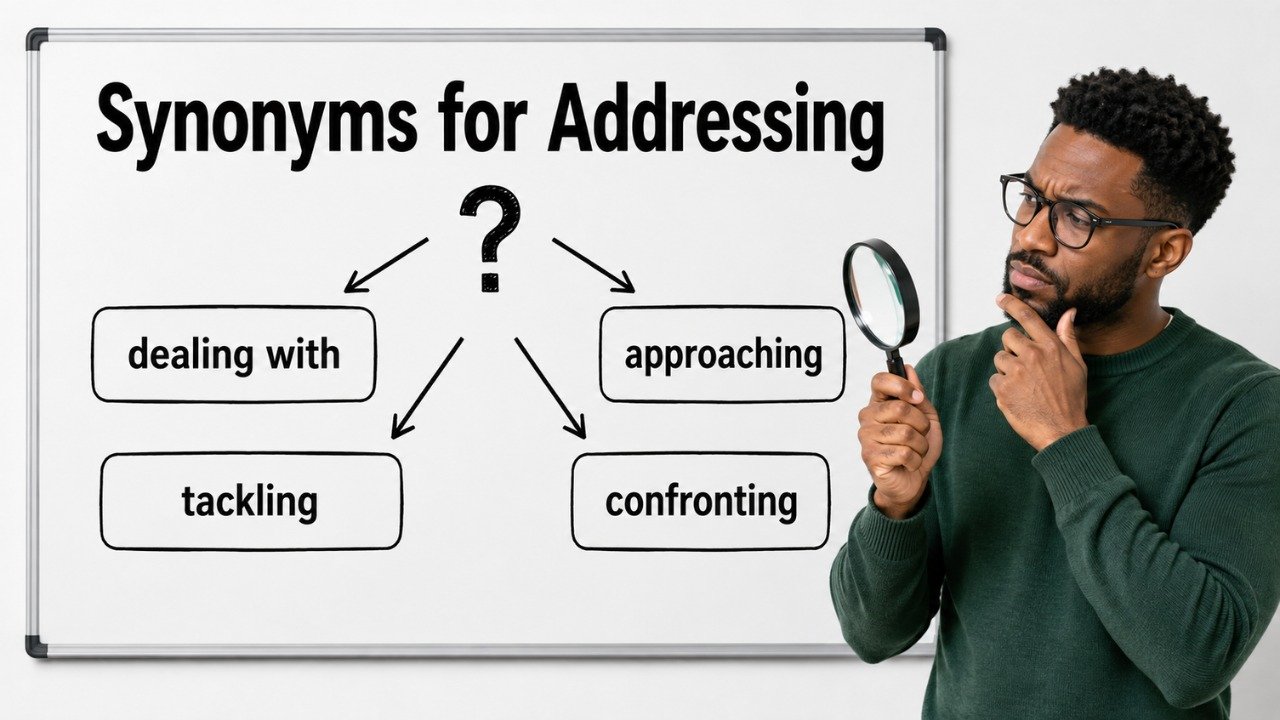
Quick Answer: Common synonyms for addressing include dealing with, handling, tackling, discussing, confronting, resolving, speaking to, directing, considering, and responding to. The best choice depends on context. Use dealing with or handling for general problems, tackling for active problem solving, discussing for conversation or writing, confronting for serious difficulties, resolving when seeking a solution, speaking to when communicating with a person or audience, and directing when guiding words, attention, or information toward someone.
Pronunciation and Word Details
Word: Addressing.
Pronunciation: /əˈdresɪŋ/
Part of Speech: Verb, present participle and gerund form of address.
Meaning: Giving attention to an issue, speaking to someone, directing communication, or writing destination details for a recipient.
US Pronunciation:
UK Pronunciation:
What Does “Addressing” Mean?
Addressing means giving attention to something, dealing with an issue, speaking directly to someone, or directing communication toward a particular person or group.
Addressing is the present participle and gerund form of the verb address. Its exact meaning changes according to the sentence.
When discussing a problem, addressing means dealing with or trying to solve it.
Example: The committee is addressing the safety concerns.
When referring to communication, addressing can mean speaking to a person or audience.
Example: She is addressing the audience.
It can also mean directing remarks, questions, or written communication toward someone.
Example: He was addressing his comments to the entire class.
In another practical sense, addressing means writing a recipient’s name and destination information on a letter, parcel, or similar item.
Example: She is addressing the envelope.
Because the word has several meanings, choosing the best synonym requires understanding what action is actually taking place.
Meaning, Tone, and Context of “Addressing”
Addressing is a neutral and versatile word. It appears naturally in formal writing, professional communication, academic discussion, reports, everyday conversation, speeches, instructions, and problem solving contexts.
When addressing refers to a problem, concern, challenge, or need, it often has a practical and purposeful tone.
Example: The plan focuses on addressing housing needs.
In professional and academic writing, addressing can suggest that a subject is being examined, discussed, managed, or acted upon.
Example: The report is addressing several important questions.
When the word describes communication, it can sound slightly more formal than speaking to or talking to.
Formal: The chairperson is addressing the audience.
Conversational: She is talking to the audience.
Addressing can also sound diplomatic because it does not always imply that a problem has already been solved. It may simply mean that someone is giving the matter serious attention.
For this reason, context is important. Resolving suggests a successful solution, while addressing can describe the broader process of recognizing, discussing, managing, or attempting to solve an issue.
When and How to Use “Addressing”
For Problems and Challenges
For Problem Solving: Use addressing when someone is giving attention to a problem and taking action toward improving it.
Example: The team is addressing several technical difficulties.
For Concerns
For Responding to Concerns: Use addressing when a person or organization is considering and responding to questions, worries, or complaints.
Example: The manager spent the meeting addressing employee concerns.
For Topics and Issues
For Discussion: Addressing can mean examining or discussing a topic in speech or writing.
Example: The article is addressing the causes of the problem.
For an Audience
For Public Speaking: Use addressing when someone speaks directly to a group of people.
Example: The speaker is addressing a large audience.
For a Person
For Direct Communication: Addressing can describe speaking directly to a particular person.
Example: She was addressing the new employee when she explained the rule.
For Questions
For Answering Issues: Use addressing when responding seriously to a question or concern.
Example: The report does a good job of addressing the main question.
For Needs
For Meeting Needs: Addressing can describe recognizing and responding to a particular requirement or need.
Example: The program is designed to help with addressing local needs.
For Written Communication
For Recipient Details: Addressing can mean placing the correct name and destination information on a letter or parcel.
Example: He was addressing the envelope before leaving.
Best Synonyms for Addressing
Dealing With
Synonym: Giving attention to and managing a problem, situation, or issue.
Example: The team is dealing with several customer concerns.
Handling
Synonym: Managing or taking responsibility for an issue or situation.
Example: She is handling the complaint professionally.
Tackling
Synonym: Making an active and determined effort to deal with a difficult problem.
Example: The group is tackling the problem directly.
Discussing
Synonym: Talking or writing about a subject in detail.
Example: The report is discussing several possible causes.
Confronting
Synonym: Facing and dealing directly with a serious problem or difficulty.
Example: The community is confronting a major challenge.
Resolving
Synonym: Finding a solution to a problem or disagreement.
Example: The team is resolving the remaining issues.
Speaking To
Synonym: Communicating directly with a person or audience.
Example: She is speaking to the entire class.
Responding To
Synonym: Giving an answer, reaction, or action in relation to something.
Example: The organization is responding to public concerns.
Considering
Synonym: Giving careful thought or attention to a matter.
Example: The committee is considering the concerns raised by residents.
Directing
Synonym: Aiming words, remarks, questions, or communication toward someone.
Example: He was directing his comments toward the new members.
50 Synonyms for Addressing with Short Meanings
- Dealing with: Managing or giving attention to an issue.
- Handling: Taking responsibility for a problem or situation.
- Tackling: Actively working on a difficult problem.
- Discussing: Talking or writing about a topic.
- Confronting: Facing a difficult issue directly.
- Resolving: Finding a solution to a problem.
- Managing: Controlling or organizing a situation.
- Considering: Giving careful thought to something.
- Examining: Looking closely at a subject or issue.
- Exploring: Investigating a subject in detail.
- Approaching: Beginning to deal with a matter in a particular way.
- Responding to: Reacting or replying to an issue or concern.
- Attending to: Giving necessary care or attention.
- Taking on: Accepting responsibility for a challenge.
- Working on: Making an effort to improve or solve something.
- Looking into: Investigating a matter carefully.
- Focusing on: Giving particular attention to something.
- Engaging with: Actively considering or interacting with a subject.
- Considering solutions to: Thinking about ways to solve an issue.
- Correcting: Making something wrong or inaccurate right.
- Remedying: Taking action to improve or correct a problem.
- Solving: Finding an answer to a problem.
- Rectifying: Correcting an undesirable situation.
- Improving: Making a situation or condition better.
- Responding: Reacting to a question, concern, or situation.
- Answering: Giving a response to a question or issue.
- Acknowledging: Recognizing that an issue or concern exists.
- Recognizing: Identifying and giving attention to something.
- Covering: Including or discussing a subject.
- Treating: Dealing with a subject in speech or writing.
- Analyzing: Examining a subject carefully.
- Reviewing: Looking at a matter again or in detail.
- Investigating: Examining facts or circumstances closely.
- Speaking to: Communicating directly with someone.
- Talking to: Speaking directly with a person.
- Speaking before: Giving remarks in front of an audience.
- Communicating with: Sharing information with someone.
- Directing: Aiming communication toward a person or group.
- Appealing to: Speaking or communicating directly to a particular audience.
- Referring to: Mentioning or directing attention toward something.
- Calling: Referring to someone by a particular name or title.
- Greeting: Speaking to someone when making contact.
- Presenting to: Delivering information before an audience.
- Explaining to: Making information clear to someone.
- Replying to: Giving a direct response to someone or something.
- Engaging: Interacting with a person, group, or issue.
- Targeting: Directing attention or action toward a specific matter.
- Labeling: Writing or placing identifying information on something.
- Inscribing: Writing information on a surface or item.
- Writing on: Placing written details on an envelope, package, or object.
Read Also:
Synonyms for Nostalgic

Synonyms for Addressing by Context
When Addressing Means Dealing With a Problem
When addressing refers to giving attention to a problem, useful synonyms include dealing with, handling, tackling, managing, working on, confronting, and taking on.
Example: The department is tackling the shortage.
Example: She is handling the situation carefully.
Tackling suggests determined action, while handling focuses more on management. Dealing with is broad and works in both formal and conversational language.
When Addressing Means Solving an Issue
Resolving, solving, correcting, remedying, and rectifying are stronger choices when the goal is not merely to consider a problem but to fix it.
Example: The team is resolving the remaining errors.
Example: Engineers are working on remedying the defect.
Resolving suggests that a solution is being reached. Addressing is broader because a person may address an issue without completely solving it.
When Addressing Means Discussing a Topic
Discussing, examining, exploring, analyzing, reviewing, covering, and treating can replace addressing when a subject is being considered in speech or writing.
Example: The chapter examines the effects of stress.
Example: The presentation covers several important topics.
Examining and analyzing sound more academic, while discussing is a natural general choice.
When Addressing Means Speaking to Someone
Speaking to, talking to, communicating with, explaining to, and replying to are useful when addressing refers to direct communication.
Example: She is speaking to the new students.
Example: He was talking to his supervisor.
Speaking to works in both formal and neutral contexts, while talking to usually sounds more conversational.
When Addressing Means Speaking Before an Audience
Speaking before, presenting to, appealing to, and speaking to can replace addressing when someone is communicating publicly.
Example: The researcher is presenting to a group of students.
Example: She is speaking before a large audience.
Presenting to is best when information is formally delivered, while speaking before emphasizes the public setting.
When Addressing Means Responding to Concerns
Responding to, answering, acknowledging, considering, and engaging with are useful when someone reacts to questions, concerns, or criticism.
Example: The report responds to several common concerns.
Example: The speaker acknowledged the audience’s questions.
Responding to suggests a direct reaction, while acknowledging may only mean recognizing that the issue exists.
When Addressing Means Writing Recipient Information
Writing on, labeling, and inscribing can be alternatives in contexts involving envelopes, parcels, or written identification.
Example: She was writing the recipient’s details on the envelope.
Example: He finished labeling the package.
In this meaning, problem solving synonyms such as tackling or resolving are not appropriate.
Another Word for Addressing
A strong general replacement for addressing is dealing with when the sentence refers to a problem, concern, need, or difficult situation. However, there is no single synonym that works for every meaning of addressing.
Use tackling for active problem solving, discussing for subjects and ideas, resolving when finding a solution, and speaking to when communicating with a person or audience.
Original: The team is addressing the problem.
Better Option: The team is dealing with the problem.
Original: The report is addressing the causes of unemployment.
Better Option: The report is examining the causes of unemployment.
Original: She is addressing the audience.
Better Option: She is speaking to the audience.
Original: The committee is addressing the complaints.
Better Option: The committee is responding to the complaints.
When Not to Use “Addressing”
Addressing can become vague when the reader needs to know exactly what action is being taken.
Weak: The organization is addressing the problem.
Better: The organization is investigating the problem and developing a solution.
The better sentence explains what addressing actually involves.
Avoid addressing when you mean that a problem has already been solved. In that situation, resolving or solving is more precise.
Weak: The repair addressed the fault completely.
Better: The repair resolved the fault completely.
Addressing can also sound unnecessarily formal in simple conversation.
Weak: I was addressing my brother about dinner.
Better: I was talking to my brother about dinner.
Avoid repeating addressing several times in formal writing.
Weak: The report addresses costs, addresses staffing problems, and addresses safety concerns.
Better: The report examines costs, discusses staffing problems, and considers safety concerns.
When describing written destination information, choose a phrase that makes the physical action clear if there could be confusion.
Weak: She was addressing something at the desk.
Better: She was writing the address on an envelope at the desk.
Words Commonly Confused With Addressing
Addressing vs Resolving: Addressing means giving attention to or dealing with a problem. Resolving means successfully finding a solution. A problem can be addressed without being resolved.
Addressing vs Discussing: Addressing can involve action, discussion, or communication. Discussing specifically means talking or writing about a topic.
Addressing vs Handling: Both can mean dealing with something, but handling often emphasizes managing responsibility or controlling a situation.
Addressing vs Tackling: Tackling suggests energetic and determined action against a problem. Addressing is broader and can include simply considering or discussing it.
Addressing vs Confronting: Confronting emphasizes facing a difficult or uncomfortable matter directly. Addressing is usually more neutral.
Addressing vs Speaking To: Speaking to is the clearest replacement when addressing refers to communicating directly with a person or audience.
Addressing vs Responding To: Responding to emphasizes reaction to a question, concern, event, or statement. Addressing can involve a broader effort to deal with the matter.
Addressing vs Considering: Considering means thinking carefully about something, while addressing usually suggests some form of attention, discussion, response, or action.
Which Synonym Should You Choose?
Choose dealing with when you need a broad and natural replacement for addressing a problem or situation.
Choose handling when someone is managing a responsibility, complaint, request, or practical difficulty.
Choose tackling when the sentence emphasizes active and determined problem solving.
Choose resolving when the problem is being solved rather than merely considered.
Choose confronting when describing a serious challenge that requires direct action.
Choose discussing when the subject is being talked or written about.
Choose examining or analyzing for essays, academic writing, research, and detailed reports.
Choose responding to when answering questions, criticism, complaints, or public concerns.
Choose acknowledging when someone recognizes an issue but may not yet be solving it.
Choose speaking to for direct communication with a person or audience.
Choose talking to for casual conversation.
Choose presenting to when someone is formally delivering information to an audience.
Choose directing when words, remarks, questions, or attention are aimed toward a particular person or group.
Choose labeling or writing on when addressing refers to placing destination or identifying information on a letter or parcel.
For reports and essays, examining, analyzing, discussing, tackling, and responding to often provide more precise wording.
For professional communication, handling, resolving, responding to, and dealing with are natural options.
For casual speech, talking to, dealing with, and working on usually sound less formal.
Real Life Examples of “Addressing” in Sentences
Original: The team is addressing the customer complaints.
Better Option: The team is handling the customer complaints.
Original: The council is addressing traffic problems in the area.
Better Option: The council is tackling traffic problems in the area.
Original: The report is addressing several causes of poor performance.
Better Option: The report is examining several causes of poor performance.
Original: She is addressing the audience from the front of the room.
Better Option: She is speaking to the audience from the front of the room.
Original: The committee is addressing concerns about safety.
Better Option: The committee is responding to concerns about safety.
Original: Researchers are addressing an important question.
Better Option: Researchers are investigating an important question.
Original: The new procedure is addressing a recurring error.
Better Option: The new procedure is correcting a recurring error.
Original: He spent the afternoon addressing the remaining problems.
Better Option: He spent the afternoon resolving the remaining problems.
Original: The teacher was addressing the students about the upcoming assignment.
Better Option: The teacher was speaking to the students about the upcoming assignment.
Original: She was addressing the envelope carefully.
Better Option: She was writing the recipient’s details on the envelope carefully.
Synonym Groups and Usage Differences
Problem Management Group
Dealing with, handling, managing, attending to, working on, and taking on describe practical attention to a problem or responsibility.
These words do not necessarily mean that the problem has been solved.
Example: She is handling the situation calmly.
Active Problem Solving Group
Tackling, confronting, correcting, remedying, resolving, rectifying, and solving suggest stronger action.
Some indicate the process of working against a problem, while others suggest successful correction.
Example: The engineers are tackling the technical problem.
Discussion and Analysis Group
Discussing, examining, exploring, analyzing, reviewing, covering, and treating are useful when addressing refers to a topic in writing, research, or conversation.
Example: The report examines several possible explanations.
Response Group
Responding to, answering, acknowledging, considering, and engaging with describe reactions to questions, complaints, concerns, or ideas.
Example: The speaker is responding to questions from the audience.
Communication Group
Speaking to, talking to, communicating with, explaining to, and presenting to refer to communication with another person or group.
Example: She is speaking to the participants about the new procedure.
Public Speaking Group
Speaking before, presenting to, appealing to, and addressing an audience all involve communicating publicly.
Example: He is presenting to a large group of professionals.
Written Information Group
Writing on, labeling, and inscribing relate to adding names, addresses, or identifying information to an object.
Example: She finished labeling the parcel before sending it.
Antonyms of Addressing
The antonyms of addressing depend on its meaning. When addressing means dealing with a problem, opposites usually involve avoiding or neglecting it. When addressing means speaking to someone, opposites involve remaining silent or withholding communication.
Ignoring: Giving no attention to something.
Neglecting: Failing to give necessary attention or care.
Avoiding: Staying away from a problem or subject.
Overlooking: Failing to notice or deal with something.
Disregarding: Paying no attention to something.
Dismissing: Treating an issue as unimportant.
Evading: Deliberately avoiding a question or problem.
Abandoning: Stopping efforts to deal with something.
Bypassing: Going around an issue instead of dealing with it directly.
Postponing: Delaying action on an issue.
Remaining silent: Not speaking or responding.
Withholding: Choosing not to provide information or communication.
Comparison: Addressing vs Related Words
Addressing vs Handling
Addressing means giving attention to an issue, while handling emphasizes managing it practically or responsibly.
Example With Addressing: The department is addressing customer concerns.
Example With Handling: The department is handling customer complaints efficiently.
Addressing vs Tackling
Addressing is neutral and broad. Tackling suggests stronger, more active effort.
Example With Addressing: The group is addressing the problem.
Example With Tackling: The group is tackling the problem with a new strategy.
Addressing vs Resolving
Addressing describes dealing with a problem. Resolving suggests bringing the problem to a successful conclusion.
Example With Addressing: Officials are addressing the dispute.
Example With Resolving: Officials are resolving the dispute.
Addressing vs Discussing
Addressing may involve discussion or practical action, while discussing means talking or writing about the subject.
Example With Addressing: The report is addressing the issue of waste.
Example With Discussing: The report is discussing the causes of waste.
Addressing vs Confronting
Addressing is generally neutral. Confronting suggests directly facing something difficult, serious, or uncomfortable.
Example With Addressing: The organization is addressing its financial difficulties.
Example With Confronting: The organization is confronting serious financial difficulties.
Addressing vs Responding To
Addressing involves dealing with a matter broadly. Responding to focuses specifically on giving a reaction or answer.
Example With Addressing: The speaker is addressing concerns about the proposal.
Example With Responding To: The speaker is responding to questions about the proposal.
Addressing vs Speaking To
Addressing can refer to problems, subjects, or people. Speaking to specifically describes communication with someone.
Example With Addressing: She is addressing the audience.
Example With Speaking To: She is speaking to the audience.
Common Phrases and Expressions With Addressing
Addressing a Problem: Giving attention to a difficulty and trying to deal with it.
Addressing an Issue: Considering, discussing, or taking action on a particular matter.
Addressing Concerns: Responding to worries, objections, or questions.
Addressing a Need: Taking action in response to a requirement.
Addressing a Challenge: Working toward managing or overcoming a difficulty.
Addressing the Audience: Speaking directly to a group of listeners.
Addressing a Question: Responding to or discussing a particular question.
Addressing the Causes: Examining or acting on the reasons behind a problem.
Addressing a Complaint: Responding to dissatisfaction or criticism.
Addressing an Envelope: Writing recipient and destination information on an envelope.
Common Mistakes to Avoid
A common mistake is assuming that addressing and solving mean exactly the same thing. Addressing a problem means giving it attention or taking action, but the problem may still remain unresolved.
Unclear: The team addressed the issue, so it no longer exists.
Better: The team resolved the issue, so it no longer exists.
Another mistake is using addressing repeatedly in reports.
Repetitive: The plan addresses costs, addresses staffing, and addresses safety.
Better: The plan examines costs, improves staffing, and tackles safety concerns.
Avoid using problem related synonyms when addressing refers to speaking.
Incorrect: She was tackling the audience.
Better: She was addressing the audience.
Likewise, speaking to cannot normally replace addressing when the sentence concerns a problem.
Incorrect: The policy is speaking to the shortage.
Better: The policy is addressing the shortage.
Another error is choosing resolving when only discussion has occurred.
Inaccurate: The meeting resolved all concerns by discussing them.
Better: The meeting addressed several concerns through discussion.
Be careful with vague expressions such as addressing the situation when readers need specific information. Explain whether someone is investigating, managing, correcting, discussing, or solving the situation.
Use the synonym that communicates the exact action rather than replacing addressing mechanically.
Conclusion
Synonyms for addressing vary according to whether the word refers to problems, topics, communication, concerns, or written information. Dealing with and handling are strong general choices for issues, while tackling emphasizes active effort and resolving suggests a solution. Discussing, examining, and analyzing work well for subjects in writing, while speaking to is best for direct communication. Responding to fits questions and concerns. Choosing a context specific alternative makes sentences clearer, more accurate, and easier to understand.
FAQs About Synonyms for Addressing
What is the best synonym for addressing?
Dealing with is a strong general synonym when addressing refers to a problem or issue. Speaking to is better when the word refers to communication with a person or audience.
What is a formal synonym for addressing?
Examining, considering, responding to, tackling, and resolving can all work in formal writing depending on the intended meaning.
Is handling a synonym for addressing?
Yes. Handling is a good synonym when addressing means managing a problem, complaint, request, or responsibility.
What is another word for addressing a problem?
Useful alternatives include dealing with, tackling, handling, confronting, working on, remedying, and resolving.
What is another word for addressing an audience?
Speaking to, speaking before, and presenting to are natural alternatives when someone is communicating with an audience.
Are addressing and resolving the same?
No. Addressing means dealing with or giving attention to a problem, while resolving means successfully solving it.
What synonym for addressing is best in an essay?
Discussing, examining, analyzing, exploring, and considering are useful choices when addressing refers to a topic or argument in an essay.
