
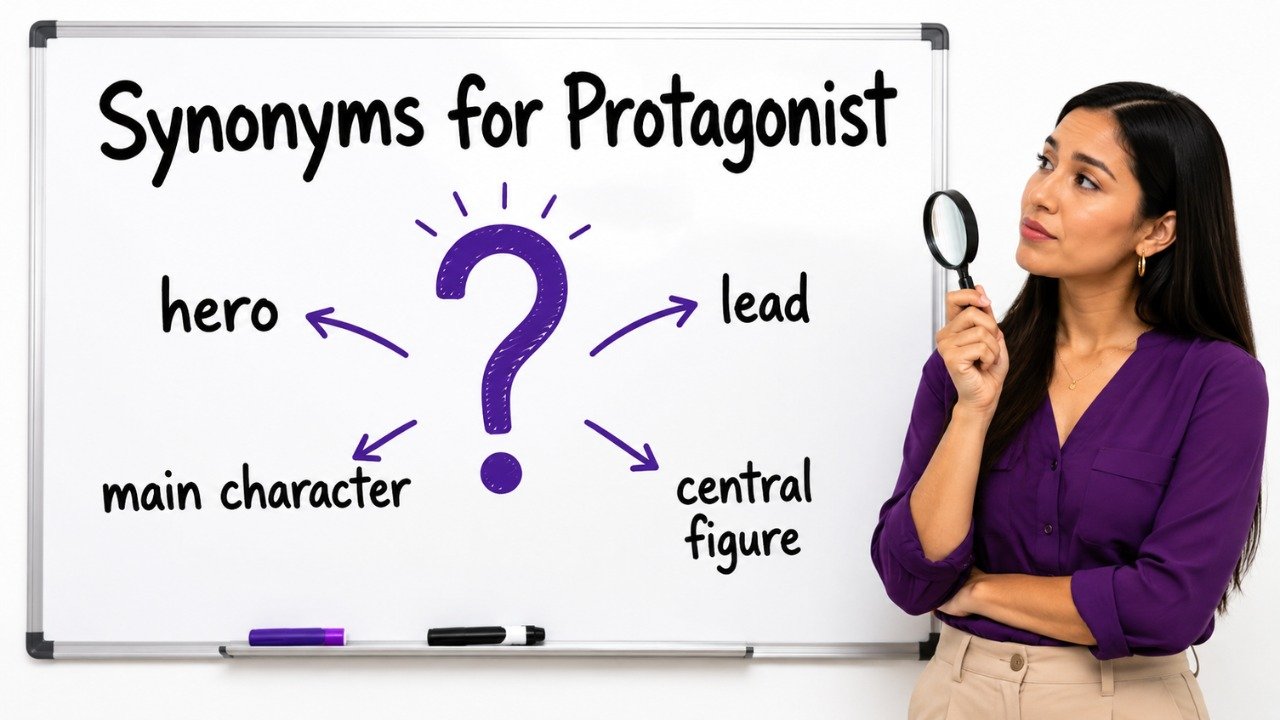
Quick Answer: Common synonyms for protagonist include main character, lead, central character, principal character, hero, leading character, central figure, focal character, key character, and main figure. The best choice depends on context. Main character is the clearest general replacement in stories and everyday discussion. Lead works well in film, drama, and performance contexts. Central character and principal character suit literary analysis and formal writing. Hero is appropriate when the protagonist is admirable or heroic, but it is not always an exact replacement because a protagonist can be morally flawed or even unlikeable.
Pronunciation and Word Details
Word: Protagonist
Pronunciation: /prəˈtæɡənɪst/
Part of Speech: Noun
Meaning: The main character or central figure in a story, drama, film, or situation.
US Pronunciation:
UK Pronunciation:
What Does “Protagonist” Mean?
A protagonist is the main character or central figure around whom a story, conflict, or series of events develops.
The word is a noun and is most commonly used in literature, drama, film, storytelling, and literary criticism. A protagonist usually has an important goal, faces challenges, makes significant decisions, and experiences the main conflict of the narrative.
In a novel, the protagonist may be the person whose journey the reader follows most closely. In a play, the protagonist may occupy the central dramatic role. In a film, the protagonist is often the character whose actions drive the plot forward.
A protagonist does not have to be a good person. Some protagonists are heroic, while others are selfish, troubled, morally uncertain, or even destructive. This is why hero and protagonist are related words but are not always interchangeable.
The word can also occasionally describe a leading figure, supporter, or advocate in a movement, argument, or cause, although this use is less common in everyday language.
Meaning, Tone, and Context of “Protagonist”
Protagonist has a neutral to formal tone. It is especially common in literary, academic, critical, dramatic, and storytelling contexts.
In everyday conversation, people often say main character instead because it sounds simpler and more natural.
In academic writing, protagonist is useful because it identifies the character at the center of a narrative without suggesting that the character is morally good.
In literary criticism, protagonist can describe someone who drives the main action, develops through conflict, or provides the central perspective of a story.
In film and theater discussions, lead, leading character, and central character may sound more natural depending on whether the focus is on the performer, role, or narrative.
The word can carry emotional importance because readers and audiences often experience major events through the protagonist. However, protagonist itself is not an emotional word. It describes narrative importance rather than personality or morality.
When and How to Use “Protagonist”
For Literary Analysis: Use protagonist when discussing the main character in a novel, short story, poem, or other narrative.
Example: The protagonist gradually realizes that ambition has damaged his closest relationships.
For Storytelling: Use protagonist when identifying the character whose goals and conflicts shape the story.
Example: The protagonist must decide whether to protect her family or reveal the truth.
For Drama: Protagonist works well when discussing the principal character involved in a dramatic conflict.
Example: The protagonist confronts his rival during the final scene.
For Film Discussion: Use protagonist when focusing on the narrative role rather than the performer.
Example: The protagonist spends most of the film searching for a way home.
For Character Analysis: Use protagonist when explaining development, motivation, conflict, or transformation.
Example: The protagonist becomes more confident after overcoming several personal failures.
For Formal Writing: Protagonist is useful in essays because it is more precise than vague expressions such as important person or main person.
Example: The protagonist represents the struggle between personal freedom and social expectation.
Best Synonyms for Protagonist
Main Character
Synonym: The most important character in a story.
Example: The main character struggles to rebuild his life after losing everything.
Lead
Synonym: The principal character or role in a story, play, or film.
Example: The lead faces a difficult choice during the final act.
Central Character
Synonym: The character around whom the main events develop.
Example: The central character connects every major part of the story.
Principal Character
Synonym: The character holding the most important narrative position.
Example: The principal character changes dramatically throughout the novel.
Hero
Synonym: A central character who is admired for courage, virtue, or achievement.
Example: The hero risks his safety to protect the village.
Leading Character
Synonym: A character with one of the most important roles in a narrative.
Example: The leading character discovers a secret that changes the course of the story.
Central Figure
Synonym: The person who occupies the most important position in a story or situation.
Example: She remains the central figure throughout the family drama.
Focal Character
Synonym: The character who receives the greatest narrative attention.
Example: The focal character allows readers to experience the conflict from a personal perspective.
Key Character
Synonym: A character whose actions are especially important to the plot.
Example: The key character makes the decision that begins the final conflict.
Main Figure
Synonym: The person at the center of the events or discussion.
Example: He becomes the main figure in the story of political change.
50 Synonyms for Protagonist with Short Meanings
- Main character: The most important character in a story.
- Lead: The principal character or central role.
- Central character: The character around whom the story develops.
- Principal character: The character with the primary narrative role.
- Leading character: A character with major importance in the story.
- Hero: A central character who is usually courageous or admirable.
- Heroine: A female central character who is often courageous or admirable.
- Central figure: The person at the center of events.
- Main figure: The most prominent person in a story or situation.
- Principal figure: The person holding primary importance.
- Leading figure: A person who plays a major role.
- Key figure: A person whose actions strongly affect events.
- Focal character: The character receiving the main narrative focus.
- Primary character: A character of greatest importance.
- Key character: A character essential to the development of the plot.
- Chief character: The most important character in a narrative.
- Title character: The character whose name or identity appears in the title.
- Viewpoint character: The character through whose perspective events are experienced.
- Narrative lead: The character who carries the central narrative.
- Story lead: The character who occupies the main story role.
- Narrative focus: The character or figure receiving central attention.
- Story focus: The person around whom the main story is organized.
- Central personality: The personality dominating the main action.
- Principal personality: The personality holding the most important position.
- Dominant character: A character with strong influence over the narrative.
- Core character: A character essential to the central story.
- Pivotal character: A character whose actions strongly affect the plot.
- Essential character: A character necessary to the main narrative.
- Featured character: A character given major prominence.
- Primary figure: The figure receiving the greatest importance.
- Main player: A person with a major role in events.
- Key player: A person whose actions significantly influence events.
- Leading player: A person occupying an important role.
- Principal player: The person with a primary role in a situation.
- Central player: A person at the center of an important event or conflict.
- Main role: The most important character position in a performance or story.
- Leading role: A principal role in drama or film.
- Principal role: The role of greatest importance.
- Central role: The role around which other events develop.
- Lead role: The principal role in a dramatic production or narrative.
- Literary hero: The central figure in a literary work.
- Dramatic hero: The principal figure in a dramatic story.
- Story hero: The central heroic figure in a narrative.
- Central person: The person receiving the greatest attention.
- Primary person: The person of greatest importance in a particular situation.
- Main subject: The person who forms the primary focus of a narrative.
- Central subject: The person around whom discussion or events are organized.
- Champion: A leading supporter or defender of a cause.
- Advocate: A person who actively supports a cause or idea.
- Proponent: A person who strongly supports a position, idea, or movement.
Read Also:
Synonyms for Creator

Synonyms for Protagonist by Context
When Protagonist Means the Main Character
Main character, central character, principal character, primary character, and lead are the strongest alternatives when discussing the person who occupies the central position in a story.
Example: The main character spends years searching for the truth about her family.
Example: The central character learns that success does not guarantee happiness.
When Protagonist Means a Heroic Character
Hero, heroine, literary hero, dramatic hero, and story hero work when the main character is presented as brave, admirable, or morally courageous.
Example: The hero returns to rescue the people who once rejected him.
Remember that hero should not automatically replace protagonist. A protagonist can behave badly, while hero normally suggests positive qualities.
When Protagonist Means the Central Figure
Central figure, main figure, leading figure, principal figure, and key figure are useful when discussing a person who is important in a broader situation rather than only in fiction.
Example: She became the central figure in the struggle for control of the family business.
When Protagonist Means the Narrative Focus
Focal character, viewpoint character, narrative lead, narrative focus, and story focus are useful when discussing perspective and narrative attention.
Example: The focal character allows readers to see how the community changes over time.
When Protagonist Means a Leading Supporter
Champion, advocate, and proponent may fit when protagonist is used in the less common sense of an active supporter of an idea, cause, or movement.
Example: He became a passionate advocate for educational reform.
Another Word for Protagonist
The best general replacement for protagonist is main character.
Main character is clear, natural, and easy to understand in most discussions of novels, films, plays, and stories. However, the best alternative depends on what you want to emphasize. Lead is useful in performance contexts, central character works well in literary discussion, and hero is suitable only when the protagonist is genuinely heroic.
Original: The protagonist discovers that her closest friend has betrayed her.
Better Option: The main character discovers that her closest friend has betrayed her.
Original: The protagonist appears in almost every scene.
Better Option: The lead appears in almost every scene.
Original: The protagonist represents the conflict between tradition and freedom.
Better Option: The central character represents the conflict between tradition and freedom.
Original: The protagonist bravely protects the village during the attack.
Better Option: The hero bravely protects the village during the attack.
When Not to Use “Protagonist”
Do not use protagonist simply to describe every important character in a story. A narrative may contain several major characters, but the protagonist is usually the one most closely connected with the central conflict.
Weak: Every member of the family is the protagonist of the novel.
Better: Every member of the family is a major character in the novel.
Avoid using protagonist as an automatic synonym for hero when morality matters.
Weak: The protagonist is always the good person who defeats evil.
Better: The protagonist is the central character, but that character may be heroic, flawed, or morally questionable.
In very casual conversation, protagonist can sound unnecessarily formal.
Weak: My favorite protagonist in the comedy was the young chef.
Better: My favorite main character in the comedy was the young chef.
Do not use protagonist when a person is important but does not occupy the central narrative role.
Weak: The teacher appears twice but is the protagonist of the story.
Better: The teacher appears twice but remains an important supporting character.
Words Commonly Confused With Protagonist
Protagonist vs Hero: A protagonist is the central character. A hero is usually admired for courage, morality, or achievement. A protagonist can be a hero, but not every protagonist is heroic.
Protagonist vs Main Character: These words are usually very close in meaning. Main character is more conversational, while protagonist often sounds more literary or analytical.
Protagonist vs Lead: Lead often refers to the principal role in a film, play, or performance. Protagonist focuses more specifically on narrative importance.
Protagonist vs Antagonist: The protagonist is the central character, while the antagonist is the person, force, institution, or obstacle opposing the protagonist.
Protagonist vs Narrator: A narrator tells or presents the story. The protagonist experiences the central conflict. Sometimes the same character performs both roles, but not always.
Protagonist vs Supporting Character: A protagonist occupies the main narrative position, while a supporting character contributes to the story without carrying its central conflict.
Protagonist vs Title Character: A title character is named or identified in the title. A title character is often the protagonist, but the two roles do not have to be the same.
Which Synonym Should You Choose?
Choose main character when you want the clearest and most natural general alternative.
Choose lead when discussing films, plays, television drama, acting, or performance roles.
Choose central character when writing essays, literary analysis, reviews, or formal discussions of a story.
Choose principal character when you need a formal alternative that emphasizes primary importance.
Choose hero when the protagonist is clearly brave, admirable, or morally positive.
Choose focal character when discussing narrative attention, perspective, or storytelling technique.
Choose viewpoint character when the story is presented largely through one character’s experience or perception.
Choose central figure when the person is important in both fictional and real situations.
Choose key figure when the person’s influence matters more than whether the person is technically the main character.
Choose advocate, champion, or proponent when protagonist refers to a leading supporter of an idea or cause rather than a fictional character.
Real Life Examples of “Protagonist” in Sentences
Original: The protagonist leaves her hometown after discovering a hidden family secret.
Better Option: The main character leaves her hometown after discovering a hidden family secret.
Original: The protagonist becomes increasingly suspicious of his closest adviser.
Better Option: The central character becomes increasingly suspicious of his closest adviser.
Original: The protagonist appears in nearly every important scene.
Better Option: The lead appears in nearly every important scene.
Original: The protagonist risks his life to save the children.
Better Option: The hero risks his life to save the children.
Original: The protagonist struggles with guilt throughout the novel.
Better Option: The principal character struggles with guilt throughout the novel.
Original: Readers understand the conflict through the protagonist’s experiences.
Better Option: Readers understand the conflict through the focal character’s experiences.
Original: The protagonist becomes more independent as the story develops.
Better Option: The main character becomes more independent as the story develops.
Original: The protagonist is not particularly kind or admirable.
Better Option: The central character is not particularly kind or admirable.
Original: The protagonist connects the different events in the narrative.
Better Option: The narrative lead connects the different events in the narrative.
Original: The protagonist becomes the most influential person in the conflict.
Better Option: The central figure becomes the most influential person in the conflict.
Synonym Groups and Usage Differences
Main Character Group
Main character, principal character, primary character, chief character, and central character describe the person occupying the main position in a narrative.
Main character is the simplest choice, while principal character sounds more formal.
Example: The main character begins the story as an inexperienced student.
Leadership Group
Lead, leading character, leading role, principal role, and lead role are especially useful in drama, film, and performance discussions.
These terms often emphasize prominence within a production.
Example: She accepted the leading role in the historical drama.
Central Importance Group
Central figure, main figure, key figure, principal figure, and primary figure emphasize a person’s importance to events.
These alternatives can work outside fiction as well.
Example: He becomes a key figure in the conflict between the two families.
Narrative Perspective Group
Focal character, viewpoint character, narrative focus, and story focus describe the character through whom readers may experience much of the narrative.
These terms are particularly useful when discussing storytelling technique.
Example: The viewpoint character does not understand the full significance of the events until the final chapter.
Heroic Character Group
Hero, heroine, literary hero, dramatic hero, and story hero imply that the central character has admirable, brave, or traditionally heroic qualities.
Use these words carefully when the protagonist is morally complex.
Example: The hero refuses to abandon his companions despite the danger.
Supporter Group
Champion, advocate, and proponent describe someone who actively supports an idea, principle, or cause.
These words fit only the less common supporter sense of protagonist.
Example: She became a leading advocate for changes in education.
Antonyms of Protagonist
The most direct opposite of protagonist in storytelling is antagonist. Other opposites depend on whether you are describing narrative importance, opposition, or level of involvement.
Antagonist: A character or force opposing the protagonist.
Opponent: A person who competes with or resists another person.
Adversary: Someone who actively challenges or fights another.
Enemy: A person or force showing strong hostility.
Rival: Someone competing for the same goal or position.
Supporting character: A character with an important but secondary role.
Minor character: A character with limited importance in the narrative.
Background character: A character who appears without driving the central story.
Secondary figure: A person who has less importance than the central figure.
Bystander: A person who observes events without playing the main role.
Comparison: Protagonist vs Related Words
Protagonist vs Main Character
Protagonist and main character are often interchangeable. Protagonist sounds more literary and analytical, while main character is more common in everyday conversation.
Example With Protagonist: The protagonist must confront the consequences of his earlier decisions.
Example With Main Character: The main character must confront the consequences of his earlier decisions.
Protagonist vs Hero
A protagonist is defined by narrative importance. A hero is defined more by admirable qualities, courage, or achievement.
Example With Protagonist: The protagonist manipulates everyone around him to gain power.
Example With Hero: The hero gives up his chance to escape so that others can survive.
Protagonist vs Lead
Lead emphasizes the principal role, particularly in performance, while protagonist emphasizes the central character in the story itself.
Example With Protagonist: The protagonist’s search for her missing brother drives the plot.
Example With Lead: The lead appears on stage during most of the performance.
Protagonist vs Antagonist
The protagonist is at the center of the main narrative, while the antagonist creates or represents opposition.
Example With Protagonist: The protagonist wants to expose the truth.
Example With Antagonist: The antagonist tries to prevent the truth from becoming public.
Protagonist vs Narrator
The protagonist experiences the main conflict, while the narrator presents the story to the audience.
Example With Protagonist: The protagonist enters the abandoned building despite the warning.
Example With Narrator: The narrator explains why the building has remained empty for decades.
Protagonist vs Central Figure
Protagonist is strongly associated with narratives. Central figure is broader and can describe an important person in fiction, history, business, family events, or public situations.
Example With Protagonist: The protagonist changes after experiencing a major personal loss.
Example With Central Figure: She became the central figure in the dispute.
Common Phrases and Expressions With Protagonist
Main Protagonist: A phrase sometimes used for emphasis, although protagonist alone normally already means the central character.
Central Protagonist: The character receiving the strongest narrative focus, especially when several important characters exist.
Female Protagonist: A woman or girl occupying the central role in a story.
Male Protagonist: A man or boy occupying the central role in a story.
Young Protagonist: A young person serving as the main character.
Primary Protagonist: The most important protagonist when a story contains several central characters.
Story Protagonist: The main character around whom the narrative develops.
Novel’s Protagonist: The central character in a novel.
Tragic Protagonist: A central character whose flaws, choices, or circumstances contribute to suffering or downfall.
Unlikely Protagonist: A central character who does not initially seem suited to a heroic or important role.
Common Mistakes to Avoid
One common mistake is assuming that protagonist always means hero. A protagonist can be selfish, dishonest, cruel, confused, or morally complex. Use hero only when positive or heroic qualities are part of the meaning.
Another mistake is calling every major character a protagonist. Some stories have multiple protagonists, but many important characters are supporting characters rather than central ones.
Avoid writing main protagonist when protagonist alone communicates the meaning clearly. Main protagonist can make sense when distinguishing one primary protagonist from several central characters, but it is often unnecessary.
Do not confuse protagonist with antagonist. The antagonist opposes the protagonist or creates an important obstacle to the protagonist’s goals.
Be careful when replacing protagonist with narrator. The narrator may tell the story without being the person experiencing the central conflict.
Avoid choosing a synonym simply because it sounds sophisticated. Central character may be more accurate than hero, while main character may be clearer than principal personality.
Repetition can also weaken literary analysis. If protagonist appears repeatedly within the same paragraph, natural alternatives such as main character, central character, lead, or central figure can improve flow, provided the meaning remains accurate.
Conclusion
The best synonyms for protagonist include main character, lead, central character, principal character, hero, leading character, central figure, focal character, key character, and main figure. Main character is the safest general replacement, while lead suits performance contexts and central character works especially well in literary analysis. Hero should be used only when the character has genuinely heroic qualities. Choosing among synonyms for protagonist according to narrative role, perspective, importance, and tone makes writing clearer, more precise, and more natural.
FAQs About Synonyms for Protagonist
What is the best synonym for protagonist?
The best general synonym is main character. It is clear, natural, and works in most storytelling contexts.
Is hero a synonym for protagonist?
Yes, but only in some contexts. A hero is usually admirable or courageous, while a protagonist simply occupies the central narrative role.
Can lead replace protagonist?
Yes. Lead is especially natural when discussing films, plays, drama, and performance roles.
What is a formal synonym for protagonist?
Central character, principal character, and central figure are strong formal alternatives.
What is the opposite of protagonist?
Antagonist is the most direct opposite in storytelling because the antagonist opposes the protagonist or creates obstacles for them.
Can a villain be the protagonist?
Yes. A protagonist is defined by being central to the narrative, not by being morally good. A villainous or deeply flawed character can therefore be the protagonist.
What is the difference between protagonist and main character?
The meanings are usually very similar. Main character is more common in everyday language, while protagonist is especially common in literary analysis, storytelling, and formal discussion.
