
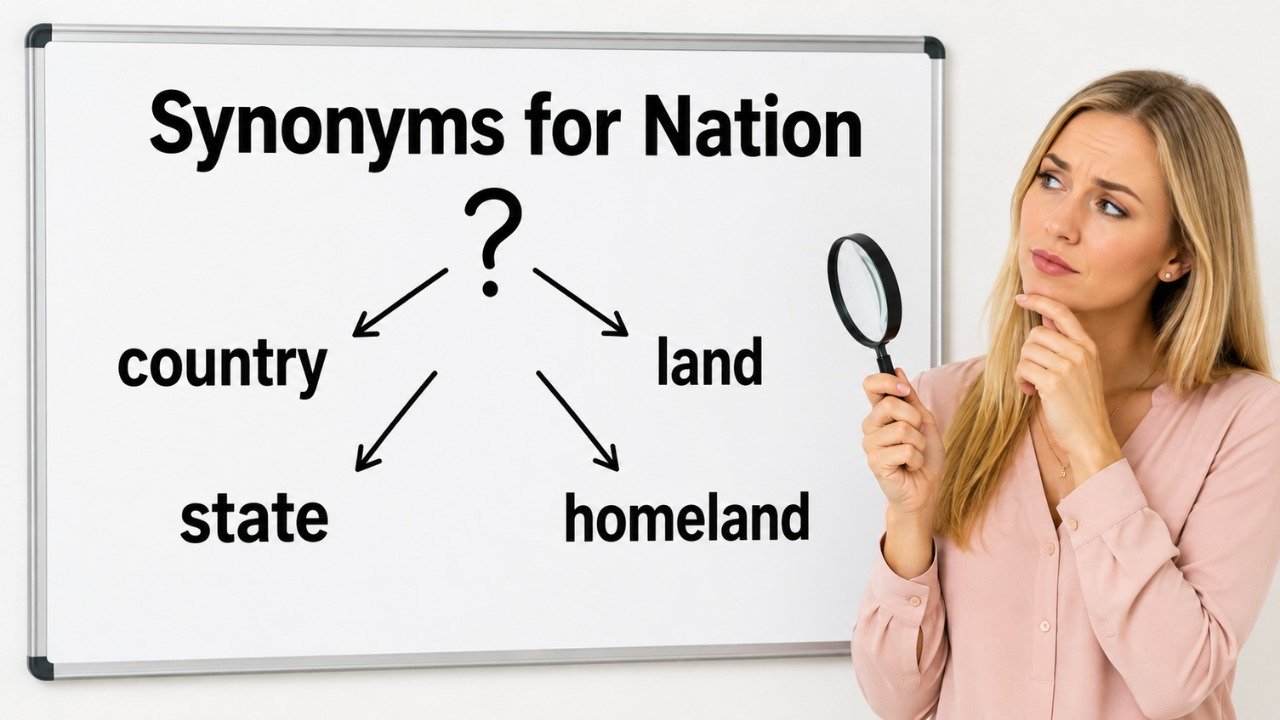
Quick Answer: Common synonyms for nation include country, state, homeland, land, realm, republic, kingdom, federation, commonwealth, and polity. The best choice depends on context. Country is the clearest general replacement in everyday speech. State works well in political, legal, and academic writing. Homeland emphasizes emotional or cultural connection. Republic and kingdom describe specific forms of government. Federation suits countries formed from several regions or states, while polity is useful in formal discussions of organized political communities.
Pronunciation and Word Details
Word: Nation.
Pronunciation: /ˈneɪʃən/
Part of Speech: Noun.
Meaning: A large community of people connected by territory, government, culture, history, identity, or shared political organization.
US Pronunciation:
UK Pronunciation:
What Does “Nation” Mean?
Nation means a large community of people united by political organization, territory, culture, history, identity, or a sense of belonging.
As a noun, nation can refer to an independent country, the people living within that country, or a cultural community that shares a common identity. Its exact meaning changes according to context.
In everyday conversation, nation is often used in a similar way to country.
Example: The nation celebrated an important national event.
In political writing, nation may describe a community connected by shared identity, while state may refer more specifically to a political system with territory, laws, and government.
Example: A nation may share a cultural identity even when its people live across several regions.
Nation can also refer collectively to the citizens or population of a country.
Example: The announcement attracted the attention of the entire nation.
Meaning, Tone, and Context of “Nation”
Nation is generally a neutral to formal word. It appears frequently in political, historical, cultural, academic, legal, and everyday contexts.
Formal Tone: Nation is common in essays, reports, political discussions, historical writing, and public communication.
Neutral Tone: In general conversation, nation can simply mean a country and does not necessarily carry a strong emotional meaning.
Emotional Tone: Nation can express pride, identity, belonging, unity, or loyalty when discussing people and their shared history.
Political Context: Nation often refers to a politically or culturally organized population.
Geographic Context: It may describe a country occupying a particular territory.
Cultural Context: Nation can refer to people connected through traditions, language, heritage, or shared identity.
Historical Context: Writers frequently use nation when discussing the formation, development, division, or independence of countries and peoples.
When and How to Use “Nation”
For a Country: Use nation when referring broadly to an independent country and its people.
Example: The nation has experienced significant economic growth.
For Citizens: Nation can refer collectively to the people of a country.
Example: The entire nation followed the historic event closely.
For Political Identity: Use nation when discussing a community united through political identity or shared institutions.
Example: The constitution helped shape the political identity of the nation.
For Cultural Identity: Nation can describe people connected by common history, traditions, or cultural identity.
Example: Shared customs contributed to the development of the nation.
For Historical Writing: Nation works naturally when discussing independence, conflict, unity, or political development.
Example: The nation gained independence after years of political struggle.
For Formal Discussion: Nation is useful in reports and essays about international affairs, society, economics, government, and history.
Example: Each nation developed a different approach to the issue.
Best Synonyms for Nation
Country: An independent political and geographic territory.
Example: The country introduced several changes to its education system.
State: A politically organized territory with a government and legal authority.
Example: The state maintains laws and public institutions.
Homeland: A country or region strongly connected with a person’s identity or origins.
Example: Many families maintained close ties with their homeland.
Land: A country or territory, especially in literary or emotional contexts.
Example: They dreamed of returning to their native land.
Realm: A territory or country governed by a ruler, especially in historical contexts.
Example: Trade increased throughout the realm.
Republic: A state in which political authority does not belong to a hereditary monarch.
Example: The republic adopted a new constitution.
Kingdom: A country traditionally ruled by a king or queen.
Example: The kingdom expanded its influence through regional trade.
Federation: A political union in which several regions or states share a central government.
Example: The federation gives its regions certain local powers.
Commonwealth: A political community or group united by shared interests or institutions.
Example: The commonwealth developed institutions for cooperation.
Polity: An organized political community or system of government.
Example: The ancient polity developed complex legal institutions.
50 Synonyms for Nation with Short Meanings
- Country: An independent political and geographic area.
- State: A politically organized territory with governing authority.
- Homeland: A country strongly connected with identity or origin.
- Land: A country or territory viewed geographically or emotionally.
- Realm: A country or territory under political authority.
- Republic: A state governed without a hereditary monarch.
- Kingdom: A country traditionally ruled by a monarch.
- Federation: A political union of several regions or states.
- Commonwealth: A political community united by shared interests.
- Polity: An organized political community.
- Territory: A geographic area under political control.
- Domain: An area governed or controlled by an authority.
- Dominion: A territory or political region under authority.
- Sovereign State: An independent political entity with governing power.
- Independent State: A politically self governing country.
- Political State: An organized territory governed through political institutions.
- National Community: People united by national identity.
- Political Community: People organized under shared political institutions.
- People: The population forming a national community.
- Population: The people living within a particular country or territory.
- Populace: The general population of a country or region.
- Citizenry: The citizens of a country considered collectively.
- Public: The people of a country or society collectively.
- Society: A large community connected by institutions and relationships.
- Community: A group connected through shared identity or interests.
- Body Politic: The people of a state considered as one political group.
- Nationality: A national identity or membership in a nation.
- Cultural Community: People connected by shared cultural traditions.
- Ethnic Community: People connected through shared ethnic heritage.
- People Group: A community connected by common identity or background.
- Tribe: A social community connected by shared ancestry or culture.
- Confederation: A union of political groups or territories.
- Union: A political combination of regions, states, or peoples.
- Federal State: A country organized through federal government.
- Unitary State: A country governed mainly through central authority.
- Nation State: A state closely associated with a particular national community.
- Sovereign Country: An independent country with full political authority.
- Independent Country: A country governing itself without outside political control.
- Motherland: A person’s native country viewed with emotional attachment.
- Native Land: The country or region where someone originates.
- Fatherland: A native country described through patriotic attachment.
- Home Country: The country a person regards as their national home.
- Native Country: The country of a person’s birth or origin.
- Country of Origin: The country from which a person or community comes.
- Civilization: A large organized society with shared institutions and culture.
- Culture: A community viewed through shared customs and traditions.
- Collective: A group considered as a unified whole.
- National Population: All people living within a nation.
- National Society: The society existing within a particular nation.
- Political Society: A community organized through political relationships and institutions.
Read Also:
Synonyms for Addressing
Synonyms for Nation by Context
When Nation Means Country
Country, state, sovereign state, independent state, sovereign country, independent country, and territory work when nation refers primarily to a politically organized geographic area.
Example: The country introduced new environmental regulations.
Example: The sovereign state maintains its own government and legal system.
When Nation Means Its People
People, population, populace, citizenry, public, national population, and body politic work when nation refers collectively to the people living within a country.
Example: The entire population was affected by the sudden change.
Example: The citizenry participated actively in the public discussion.
When Nation Means a Political Community
State, polity, political community, political society, federation, confederation, and commonwealth fit discussions of political organization and governance.
Example: The polity developed institutions to manage public affairs.
Example: The federation divides certain powers between regional and central authorities.
When Nation Means Homeland
Homeland, motherland, native land, native country, home country, and country of origin emphasize belonging, origin, or emotional attachment.
Example: She maintained strong cultural connections with her homeland.
Example: Many traditions came from their native country.
When Nation Means a Cultural Community
National community, cultural community, ethnic community, people group, society, and community work when shared culture or identity matters more than political borders.
Example: Language helped strengthen the cultural community.
Example: The national community preserved traditions across generations.
When Nation Refers to a Form of State
Republic, kingdom, federation, federal state, and unitary state identify more specific forms of political organization.
Example: The republic is governed through elected political institutions.
Example: The federation consists of several regions sharing national institutions.
Another Word for Nation
Country is usually the best single replacement for nation in everyday English. It is clear, familiar, and appropriate when referring to a geographically and politically defined place. However, state is often better in political or legal writing, while homeland is more suitable when emotional or cultural identity is important.
Original: The nation increased investment in public transportation.
Better Option: The country increased investment in public transportation.
Original: The nation exercises authority throughout its territory.
Better Option: The state exercises authority throughout its territory.
Original: She remained deeply connected to her nation after moving abroad.
Better Option: She remained deeply connected to her homeland after moving abroad.
Original: The nation was organized around several regional governments.
Better Option: The federation was organized around several regional governments.
When Not to Use “Nation”
Nation is broad, so another word may be more accurate when you need to describe a specific political, geographic, cultural, or population based idea.
Do not use nation when you specifically mean government.
Weak: The nation passed the legislation yesterday.
Better: The legislature passed the legislation yesterday.
A nation includes more than the governing institutions, so government or legislature may be more precise when discussing official decisions.
Do not use nation when territory is the central idea.
Weak: The nation covers a mountainous area in the north.
Better: The territory covers a mountainous area in the north.
Avoid nation when you need to describe citizenship rather than the country itself.
Weak: Her nation is listed on the document.
Better: Her nationality is listed on the document.
Do not automatically use nation as a replacement for state in technical political writing.
Weak: Every nation must possess clearly defined legal institutions.
Better: Every state must possess clearly defined legal institutions.
Nation may refer to shared identity, while state refers more specifically to political organization and authority.
Words Commonly Confused With Nation
Nation vs Country: Nation often emphasizes people, identity, or political community. Country usually emphasizes a geographic and political territory.
Nation vs State: Nation can describe people connected by shared identity, while state refers to an organized political entity with territory, government, and authority.
Nation vs Nationality: Nation is a country or community of people. Nationality describes a person’s national membership or identity.
Nation vs Government: Nation includes the country and its people, while government refers to the institutions and officials that administer it.
Nation vs Homeland: Nation is generally neutral, while homeland often expresses emotional attachment, origin, or cultural belonging.
Nation vs Territory: Nation involves people or political identity, while territory primarily describes a geographic area under control.
Nation vs Federation: Nation is broad. Federation specifically describes a political system in which several regions or states share authority with a central government.
Which Synonym Should You Choose?
Choose country for everyday writing and conversation when referring to a geographically defined political place.
Choose state for formal, political, legal, or academic writing when political authority and institutions are important.
Choose homeland when describing emotional attachment, cultural identity, heritage, or origins.
Choose territory when emphasizing geographic land or an area under political control.
Choose republic when the country’s constitutional form specifically matters.
Choose kingdom when referring to a country traditionally governed by a monarch.
Choose federation when describing a political union containing regions or states with divided governing powers.
Choose polity in academic essays about political systems, institutions, and organized communities.
Choose population when you mean all the people living within the country.
Choose citizenry when specifically referring to citizens as a collective group.
Choose national community when shared identity and belonging matter more than political borders.
Choose society when discussing social institutions, relationships, customs, or collective life within a country.
Real Life Examples of “Nation” in Sentences
Original: The nation invested heavily in public education.
Better Option: The country invested heavily in public education.
Original: The nation has authority over its recognized territory.
Better Option: The state has authority over its recognized territory.
Original: She felt a deep connection to her nation.
Better Option: She felt a deep connection to her homeland.
Original: The entire nation watched the important announcement.
Better Option: The entire population watched the important announcement.
Original: The nation developed a complex political system.
Better Option: The polity developed a complex political system.
Original: Several regions joined to create a new nation with shared governing powers.
Better Option: Several regions joined to create a new federation with shared governing powers.
Original: The nation preserved its traditional customs for generations.
Better Option: The national community preserved its traditional customs for generations.
Original: The nation consists of people from many cultural backgrounds.
Better Option: The society consists of people from many cultural backgrounds.
Original: The nation became independent after a long political struggle.
Better Option: The independent state emerged after a long political struggle.
Original: Citizens across the nation participated in the discussion.
Better Option: Citizens across the country participated in the discussion.
Synonym Groups and Usage Differences
Geographic Group
Country, territory, land, realm, domain, and homeland can all refer to places, but their tones differ. Country is neutral and widely useful. Territory emphasizes geography and control. Land can sound literary, while homeland expresses emotional attachment.
Example: The country contains several distinct geographic regions.
Political Group
State, polity, republic, kingdom, federation, commonwealth, and confederation focus on political organization. They are especially useful in historical, legal, governmental, and academic contexts.
Example: The federation distributes political powers between different levels of government.
Population Group
People, population, populace, citizenry, public, and body politic refer primarily to people rather than territory.
Example: The citizenry expressed strong interest in the proposed reforms.
Identity Group
National community, cultural community, ethnic community, nationality, and people group emphasize shared belonging or identity.
Example: The cultural community preserved its language and traditions.
Homeland Group
Homeland, motherland, native land, home country, native country, and country of origin focus on personal or collective origins.
Example: Many families continued traditions from their homeland.
Government Structure Group
Republic, kingdom, federation, federal state, unitary state, and confederation describe particular forms or arrangements of political organization.
Example: The federal state allows regional governments to exercise certain constitutional powers.
Antonyms of Nation
Nation does not have one simple direct antonym because it is a noun describing a political, geographic, or cultural community. However, several contrasting terms can express the opposite idea in particular contexts.
Statelessness: The condition of lacking recognized nationality or state membership.
Disunity: Lack of unity among people or political groups.
Fragmentation: Division of a larger political or social unit into smaller parts.
Division: Separation rather than national unity.
Anarchy: Absence of effective governing authority.
Individual: One person rather than a national population or collective.
Foreign Land: A country viewed as outside one’s own national home.
Foreign Country: A country other than one’s own.
Local Community: A smaller social group rather than an entire nation.
Region: A limited geographic area within or across countries rather than a complete nation.
Comparison: Nation vs Related Words
Nation vs Country
Nation often highlights people, identity, history, or political unity. Country usually refers more directly to a geographic territory recognized as a political entity.
Example With Nation: The nation united around a shared sense of identity.
Example With Country: The country contains several mountain ranges.
Nation vs State
A nation is primarily a community of people connected by identity or political unity. A state is a formal political organization exercising authority over territory and population.
Example With Nation: The nation preserved a strong cultural identity.
Example With State: The state maintains courts, laws, and administrative institutions.
Nation vs Homeland
Nation is broader and more neutral. Homeland emphasizes emotional, cultural, or ancestral connection to a place.
Example With Nation: The nation experienced major economic changes.
Example With Homeland: She felt a powerful connection to her homeland.
Nation vs Nationality
Nation refers to a political or cultural community. Nationality refers to a person’s national identity or legal connection to a country.
Example With Nation: The nation has a diverse population.
Example With Nationality: The form asks applicants to provide their nationality.
Nation vs Territory
Nation involves people, identity, or political organization. Territory focuses primarily on geographic land under a particular authority.
Example With Nation: The nation developed a shared political identity.
Example With Territory: The territory includes several islands.
Nation vs Society
Nation usually has a political, geographic, or identity based meaning. Society emphasizes people living together through shared institutions, customs, and social relationships.
Example With Nation: The nation introduced constitutional reforms.
Example With Society: The society experienced major changes in family life and education.
Nation vs Federation
Nation is a general term, while federation describes a particular political arrangement in which regions or states share powers with a central government.
Example With Nation: The nation contains several culturally distinct regions.
Example With Federation: The federation grants specific powers to its regional governments.
Common Phrases and Expressions With Nation
Entire Nation: All people or regions within a nation collectively.
Whole Nation: The country and its people considered together.
Nation Building: The process of developing national institutions, identity, or unity.
Modern Nation: A nation viewed in its current political or social form.
Independent Nation: A nation that governs itself politically.
Sovereign Nation: A nation exercising independent political authority.
Nation of People: A large community understood through shared identity or citizenship.
Across the Nation: Throughout the entire country.
Nation as a Whole: The country and its population considered collectively.
United Nation: A nation whose people or regions are politically or socially united.
Common Mistakes to Avoid
Confusing Nation With Country: The terms frequently overlap, but country often emphasizes territory, while nation can emphasize people and shared identity. Choose according to what your sentence actually describes.
Confusing Nation With State: In political and academic writing, state may be more precise when discussing government, legal authority, sovereignty, and institutions.
Using Nation Instead of Government: A government is only the governing system of a nation or state. Avoid saying the nation made a specific administrative decision when a particular government institution made it.
Confusing Nation With Nationality: Nation names the larger community or country. Nationality describes a person’s legal or cultural national membership.
Using Homeland in Neutral Technical Writing: Homeland often carries emotional meaning. Country or state may sound clearer in reports, research, or technical explanations.
Repeating Nation Too Often: Repetition can make a paragraph sound mechanical. Depending on meaning, use country, state, population, homeland, society, or political community.
Choosing a Specific Political Term Incorrectly: Republic, kingdom, federation, and confederation are not interchangeable. Use them only when the political structure actually matches the term.
Using Territory as an Exact Synonym: Territory describes land or geographic jurisdiction. It does not automatically include the shared identity, citizens, or political community suggested by nation.
Ignoring Context: Ask whether the sentence focuses on geography, government, population, political organization, culture, or identity before choosing a synonym.
Conclusion
Synonyms for nation include country, state, homeland, territory, polity, federation, republic, kingdom, population, and national community. Country is the clearest general alternative, while state is often better for political and legal contexts. Homeland highlights emotional or cultural connection, population refers specifically to people, and polity suits academic discussions of political organization. Because nation can describe territory, citizens, identity, or government structures, choosing the right synonym depends on the exact meaning you want to communicate.
FAQs About Synonyms for Nation
What is the best synonym for nation?
Country is usually the best general synonym for nation. It works naturally in everyday writing when referring to an independent political and geographic place.
Are nation and country the same?
They often overlap, but not completely. Country usually emphasizes territory and political boundaries, while nation can also emphasize people, culture, history, and shared identity.
What is a formal synonym for nation?
State and polity are useful formal alternatives. State is common in legal and political writing, while polity is especially suitable for academic discussions of political organization.
Is homeland a synonym for nation?
Yes, in some contexts. Homeland is especially suitable when the sentence emphasizes emotional attachment, cultural identity, ancestry, or origin.
What is another word for the people of a nation?
Population, populace, citizenry, people, and public can refer collectively to the people of a nation. Citizenry specifically refers to citizens.
What is the difference between nation and state?
Nation generally refers to a community connected by identity, history, culture, or political unity. State refers more specifically to a political organization with government, territory, laws, and authority.
Can federation be used as a synonym for nation?
Yes, but only when the country has a federal political structure or when the political arrangement itself is important. Federation is more specific than the general word nation.
