
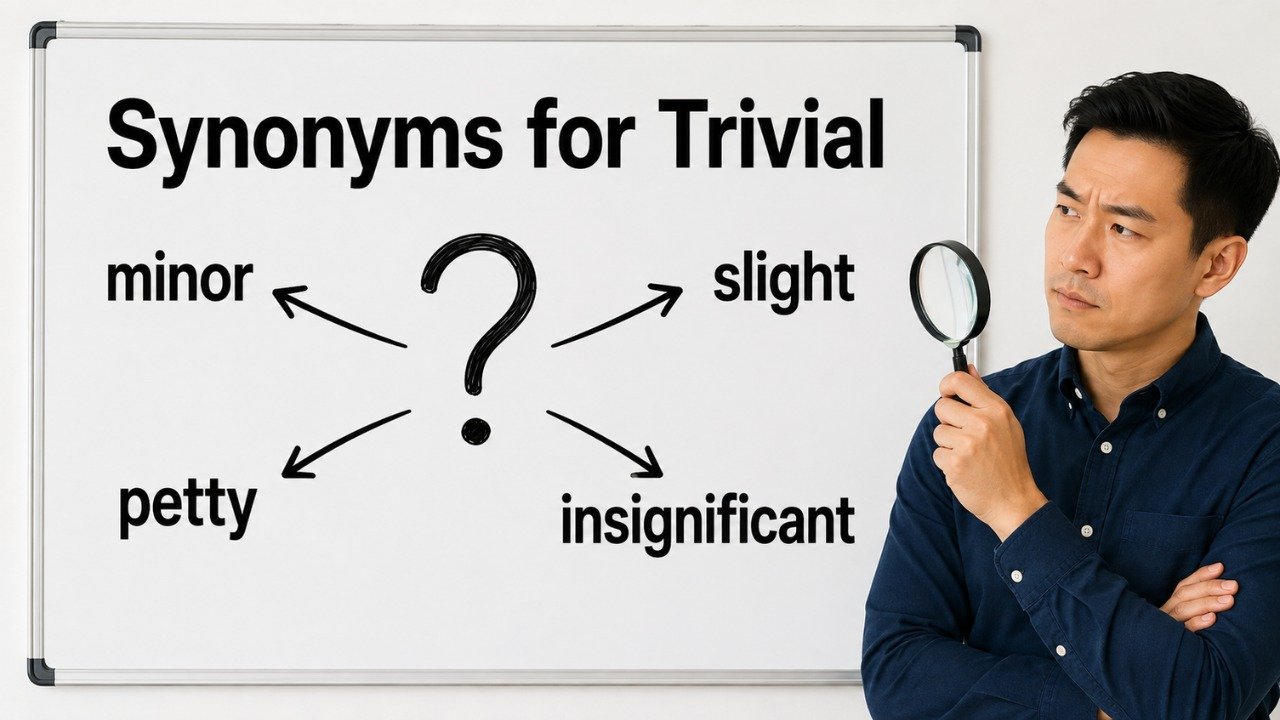
Quick Answer: Common synonyms for trivial include insignificant, minor, unimportant, petty, negligible, inconsequential, slight, superficial, ordinary, and meaningless. The best choice depends on context. Insignificant works well in formal and academic writing, minor suits small problems or details, petty describes matters that seem foolishly unimportant, negligible fits amounts or effects that barely matter, superficial describes something lacking depth, and inconsequential emphasizes that something has little or no effect.
Pronunciation and Word Details
Word: Trivial.
Pronunciation: /ˈtrɪviəl/
Part of Speech: Adjective.
Meaning: Having little importance, seriousness, value, difficulty, or significance.
US Pronunciation:
UK Pronunciation:
What Does “Trivial” Mean?
Trivial means unimportant, minor, simple, or lacking serious value or significance. It is mainly used as an adjective to describe matters, details, problems, differences, activities, or information that do not deserve much attention.
The word can describe something that has very little importance.
Example: They argued over a trivial issue.
It can also describe a problem that is very easy to solve.
Example: The calculation was trivial for an experienced student.
Trivial may sometimes describe information or conversation that is shallow or lacking depth.
Example: The discussion focused on trivial details rather than the main problem.
In some contexts, trivial can sound dismissive because it suggests that something does not matter very much.
Meaning, Tone, and Context of “Trivial”
Trivial is generally neutral to slightly negative in tone. It often suggests that something is too small, simple, or unimportant to deserve serious attention.
In formal writing, trivial may describe insignificant differences, minor concerns, or simple problems. Academic and technical writing may also use trivial when a question or solution is extremely easy or obvious.
In casual conversation, people often use trivial to describe small problems, pointless arguments, or details that do not matter much.
The word can sound critical when applied to another person’s concern.
Neutral Context: The difference between the two measurements was trivial.
Formal Context: The study found only a trivial change in performance.
Casual Context: They spent the evening talking about trivial things.
Critical Context: He became upset over a trivial mistake.
Technical Context: The first case has a trivial solution.
When and How to Use “Trivial”
For Small Problems: Use trivial when a problem is too minor to require much concern.
Example: The error was trivial and easy to correct.
For Unimportant Details: Trivial can describe details that have little effect on the larger issue.
Example: The debate became distracted by trivial details.
For Minor Differences: Use trivial when a difference is too small to have meaningful importance.
Example: The difference in cost was trivial.
For Easy Tasks: Trivial may describe a task or problem that requires very little effort or thought.
Example: The final calculation was trivial.
For Petty Arguments: Trivial can describe disputes about matters that are not worth serious disagreement.
Example: Their argument began over a trivial misunderstanding.
For Superficial Topics: The word may describe subjects that lack depth or seriousness.
Example: The conversation remained focused on trivial matters.
Best Synonyms for Trivial
Insignificant: Too small or unimportant to have much effect.
Example: The difference between the two results was insignificant.
Minor: Small in importance, seriousness, or degree.
Example: The report contained only a minor mistake.
Unimportant: Not deserving serious attention or concern.
Example: She ignored the unimportant details.
Petty: Unimportant in a way that seems foolish or overly concerned with small matters.
Example: They became involved in a petty dispute.
Negligible: So small that it can reasonably be ignored.
Example: The additional cost was negligible.
Inconsequential: Having little or no important effect or result.
Example: The change was largely inconsequential.
Slight: Small in degree, amount, or importance.
Example: There was only a slight difference between the two versions.
Superficial: Lacking depth, seriousness, or careful consideration.
Example: The analysis was too superficial to be useful.
Meaningless: Having little purpose, importance, or significance.
Example: The argument became a meaningless exchange of complaints.
Ordinary: Common and lacking special importance or distinction.
Example: What seemed dramatic at first was actually an ordinary problem.
50 Synonyms for Trivial with Short Meanings
- Insignificant: Too unimportant to matter greatly.
- Minor: Small in importance or seriousness.
- Unimportant: Not deserving much attention.
- Petty: Foolishly concerned with small matters.
- Negligible: Too small to have meaningful importance.
- Inconsequential: Having little effect or significance.
- Slight: Small in degree or importance.
- Superficial: Lacking depth or seriousness.
- Meaningless: Having little value or significance.
- Ordinary: Common and not especially important.
- Small: Limited in importance or scale.
- Little: Minor in amount, importance, or degree.
- Tiny: Extremely small or limited.
- Minute: Very small in size, degree, or importance.
- Paltry: Disappointingly small or insignificant.
- Meager: Small and lacking in amount or value.
- Marginal: Limited in importance or effect.
- Nominal: Very small or existing mainly in name.
- Minimal: Extremely small in amount or importance.
- Scant: Very small or barely sufficient.
- Frivolous: Lacking seriousness or useful purpose.
- Shallow: Lacking depth or thoughtful importance.
- Empty: Lacking meaningful substance or value.
- Pointless: Having no useful purpose or meaningful result.
- Worthless: Having little or no practical value.
- Irrelevant: Not important to the matter being considered.
- Immaterial: Not important or relevant to a decision.
- Incidental: Occurring as a minor or secondary matter.
- Secondary: Less important than something else.
- Peripheral: Not central or essential to the main issue.
- Subordinate: Lower in importance or priority.
- Unsubstantial: Lacking meaningful weight or importance.
- Unremarkable: Not special or important enough to attract attention.
- Commonplace: Ordinary and lacking special importance.
- Routine: Normal and requiring little special attention.
- Simple: Easy and not complicated.
- Easy: Requiring little effort or difficulty.
- Elementary: Very basic and simple.
- Basic: Simple and involving only essential elements.
- Obvious: Easy to understand or recognize.
- Straightforward: Simple and easy to deal with.
- Puny: Very small or weak in importance or effect.
- Trifling: Too small or unimportant to matter.
- Piddling: Very small or unimportant in an informal sense.
- Unworthy: Not deserving serious attention or consideration.
- Low Priority: Having little urgency or importance.
- Nonessential: Not necessary or central.
- Dispensable: Able to be omitted without serious loss.
- Forgettable: Not important or memorable.
- Small Scale: Limited in extent, importance, or effect.
Read Also:
Synonyms for Nation

Synonyms for Trivial by Context
When Trivial Means Unimportant
Insignificant, unimportant, inconsequential, immaterial, marginal, minor, and negligible are strong choices when something has little importance.
Example: The disagreement concerned a trivial detail.
Alternative: The disagreement concerned an insignificant detail.
Example: The difference was trivial compared with the larger problem.
Alternative: The difference was inconsequential compared with the larger problem.
When Trivial Means Small
Minor, slight, minimal, minute, negligible, marginal, and tiny work well when trivial describes a small amount, effect, difference, or problem.
Example: The repair required only a trivial amount of money.
Alternative: The repair required only a negligible amount of money.
Example: There was a trivial difference between the two measurements.
Alternative: There was a slight difference between the two measurements.
When Trivial Means Petty or Foolish
Petty, trifling, frivolous, piddling, pointless, and unworthy are useful when someone gives too much attention to a small matter.
Example: They continued arguing over a trivial complaint.
Alternative: They continued arguing over a petty complaint.
When Trivial Means Easy
Simple, elementary, basic, obvious, easy, and straightforward fit tasks, questions, or problems that require little thought.
Example: The exercise was trivial for advanced learners.
Alternative: The exercise was elementary for advanced learners.
When Trivial Means Superficial
Superficial, shallow, empty, meaningless, commonplace, and ordinary may describe ideas, conversations, or discussions that lack depth.
Example: The meeting became focused on trivial conversation.
Alternative: The meeting became focused on superficial conversation.
Another Word for Trivial
Another word for trivial is insignificant. It is one of the strongest general replacements because both words describe something that has little importance or effect.
However, the best synonym depends on context. Use minor for small problems, negligible for tiny amounts or effects, petty for foolishly small concerns, superficial for ideas lacking depth, and simple for easy tasks.
Original: The mistake was trivial and did not affect the final result.
Better Option: The mistake was insignificant and did not affect the final result.
Original: They argued about a trivial issue.
Better Option: They argued about a petty issue.
Original: The difference in price was trivial.
Better Option: The difference in price was negligible.
Original: The problem was trivial for an experienced engineer.
Better Option: The problem was straightforward for an experienced engineer.
When Not to Use “Trivial”
Trivial can sound dismissive when describing a concern that another person considers important. In sensitive conversations, minor or relatively small may sound more respectful.
Weak: Your concerns are trivial.
Better: Your concerns appear minor in relation to the main issue.
Avoid trivial when a more precise word can explain why something lacks importance.
Weak: The cost increase was trivial.
Better: The cost increase was negligible.
Trivial can also be unclear when describing an easy problem because readers may assume you mean unimportant rather than simple.
Weak: The assignment was trivial.
Better: The assignment was straightforward.
Do not use trivial for an issue that has serious consequences.
Weak: The safety problem was trivial despite the risk involved.
Better: The safety problem was serious because it created a significant risk.
Words Commonly Confused With Trivial
Trivial vs Insignificant: Both describe something unimportant, but insignificant is usually more neutral and formal. Trivial can sometimes suggest that a matter is foolishly small.
Trivial vs Minor: Minor means small in seriousness, degree, or importance. Trivial often suggests an even lower level of importance.
Trivial vs Petty: Petty usually describes excessive concern with small or foolish matters, while trivial simply means unimportant or minor.
Trivial vs Negligible: Negligible describes something so small that it can be ignored, especially an amount, difference, cost, effect, or risk. Trivial is broader.
Trivial vs Superficial: Trivial refers to lack of importance, while superficial refers to lack of depth or thoroughness.
Trivial vs Frivolous: Frivolous suggests a lack of seriousness or sensible purpose. Trivial focuses more directly on limited importance.
Trivial vs Simple: Simple means easy or uncomplicated. Trivial can mean easy, but it can also mean unimportant.
Which Synonym Should You Choose?
Choose insignificant when you need a neutral or formal way to describe something with little importance.
Choose minor when discussing small errors, problems, injuries, changes, or details.
Choose negligible when the amount, effect, difference, or risk is so small that it can almost be ignored.
Choose petty when describing arguments, complaints, rivalries, or behavior focused on foolishly small matters.
Choose inconsequential when an action or detail has little effect on the final result.
Choose superficial when describing ideas, analysis, discussions, or observations that lack depth.
Choose frivolous when something lacks seriousness or sensible purpose.
Choose simple or straightforward when trivial means easy rather than unimportant.
Choose immaterial when a fact or detail has no meaningful influence on a decision, argument, or conclusion.
Choose slight when discussing a small difference, change, improvement, or effect.
Real Life Examples of “Trivial” in Sentences
Original: The manager ignored the trivial error.
Better Option: The manager ignored the minor error.
Original: The difference between the two prices was trivial.
Better Option: The difference between the two prices was negligible.
Original: They wasted time discussing trivial details.
Better Option: They wasted time discussing insignificant details.
Original: The disagreement began over a trivial issue.
Better Option: The disagreement began over a petty issue.
Original: The change had a trivial effect on performance.
Better Option: The change had an inconsequential effect on performance.
Original: The question seemed trivial to experienced students.
Better Option: The question seemed elementary to experienced students.
Original: The report focused on trivial matters.
Better Option: The report focused on peripheral matters.
Original: Their conversation remained trivial throughout dinner.
Better Option: Their conversation remained superficial throughout dinner.
Original: The expense was trivial compared with the total budget.
Better Option: The expense was minimal compared with the total budget.
Original: Solving the final step was trivial.
Better Option: Solving the final step was straightforward.
Synonym Groups and Usage Differences
Importance Group
Insignificant, unimportant, inconsequential, immaterial, and marginal describe things with little importance.
Insignificant is often the most neutral general alternative.
Example: The difference was insignificant and had no effect on the conclusion.
Size and Degree Group
Minor, slight, minimal, negligible, minute, and small describe limited amounts or effects.
Negligible is strongest when the amount is almost too small to matter.
Example: The increase in cost was negligible.
Petty Matters Group
Petty, trifling, piddling, frivolous, and pointless describe matters that seem foolishly small or undeserving of serious attention.
Petty often carries stronger criticism of the person or behavior involved.
Example: Their petty disagreement continued for several days.
Simplicity Group
Simple, straightforward, elementary, basic, easy, and obvious describe tasks or problems that require little effort or thought.
These alternatives are better when trivial refers to difficulty rather than importance.
Example: The final question was straightforward.
Lack of Depth Group
Superficial, shallow, empty, meaningless, and commonplace can describe ideas or discussions without much depth or significance.
Example: The article offered only a superficial explanation of the issue.
Relevance Group
Irrelevant, incidental, peripheral, secondary, and immaterial describe information that is not central to the main point.
Example: The extra detail was peripheral to the main argument.
Antonyms of Trivial
The opposite of trivial depends on whether the word refers to importance, seriousness, size, difficulty, or depth.
Important: Having great value or significance.
Significant: Important enough to have a meaningful effect.
Major: Large or serious in importance or degree.
Serious: Deserving careful attention or concern.
Meaningful: Having purpose, importance, or value.
Consequential: Producing important results or effects.
Substantial: Considerable in size, importance, or value.
Essential: Completely necessary or extremely important.
Critical: Extremely important to a result or situation.
Profound: Deep in meaning, thought, or significance.
Complex: Difficult and involving many connected parts.
Challenging: Requiring considerable thought, skill, or effort.
Comparison: Trivial vs Related Words
Trivial vs Insignificant
Trivial and insignificant both describe something of little importance. Insignificant is generally more neutral, while trivial may sound more dismissive.
Example With Trivial: The argument started over a trivial issue.
Example With Insignificant: The difference in the final totals was insignificant.
Trivial vs Minor
Minor usually means small but still noticeable or relevant. Trivial often suggests that something deserves almost no attention.
Example With Trivial: The complaint concerned a trivial matter.
Example With Minor: The document contained a minor error.
Trivial vs Petty
Trivial describes the matter itself as unimportant. Petty often criticizes an attitude, complaint, dispute, or behavior for focusing on small matters.
Example With Trivial: The problem was trivial.
Example With Petty: Their petty rivalry distracted the entire group.
Trivial vs Negligible
Trivial is broad, while negligible is especially useful for amounts, effects, costs, differences, and risks that are extremely small.
Example With Trivial: The difference seemed trivial.
Example With Negligible: The difference in cost was negligible.
Trivial vs Superficial
Trivial means unimportant, while superficial means lacking depth or careful examination.
Example With Trivial: They discussed trivial topics.
Example With Superficial: The report gave a superficial explanation.
Trivial vs Frivolous
Trivial focuses on lack of importance. Frivolous often suggests a lack of seriousness, usefulness, or good judgment.
Example With Trivial: The detail was trivial.
Example With Frivolous: The complaint was dismissed as frivolous.
Trivial vs Simple
Simple describes something easy or uncomplicated. Trivial can sometimes mean easy, but its more common meaning is unimportant.
Example With Trivial: The final calculation was trivial.
Example With Simple: The final calculation was simple.
Common Phrases and Expressions With Trivial
Trivial Matter: An issue with very little importance.
Trivial Issue: A small problem or concern.
Trivial Detail: A detail that does not significantly affect the main subject.
Trivial Difference: A difference too small to be important.
Trivial Problem: A minor problem or an easy problem, depending on context.
Trivial Mistake: A small error with little effect.
Trivial Amount: A very small quantity or sum.
Trivial Question: A question that is either unimportant or very easy.
Trivial Conversation: Talk about subjects lacking depth or importance.
Trivial Concern: A concern considered minor compared with more serious issues.
Common Mistakes to Avoid
A common mistake is assuming every synonym for trivial has exactly the same meaning. Minor, petty, superficial, negligible, and simple overlap with trivial, but each expresses a different idea.
Use minor for something small but still relevant. Use negligible when an amount or effect is extremely small. Use petty when a person or dispute is overly focused on unimportant matters.
Another mistake is using trivial to dismiss someone’s genuine concern. The word can sound insensitive when the subject is emotionally important to another person.
Avoid using trivial when you actually mean easy. A task may be simple without being unimportant.
Writers should also avoid repeating trivial several times in one paragraph. Choose specific alternatives such as insignificant, minor, marginal, or inconsequential when they better express the intended meaning.
Do not confuse superficial with trivial. A superficial analysis lacks depth, while a trivial issue lacks importance.
Finally, make sure the synonym matches the noun. Negligible cost sounds natural, while petty cost usually does not. Petty argument is natural, while negligible argument normally is not.
Conclusion
Synonyms for trivial include insignificant, minor, unimportant, petty, negligible, inconsequential, superficial, slight, simple, and immaterial. Insignificant is a strong general choice for formal writing, while minor works well for small problems and mistakes. Negligible suits tiny amounts or effects, petty fits foolish disputes, and superficial describes ideas lacking depth. When trivial means easy, simple or straightforward is often clearer. Choosing a synonym by context makes your writing more precise and prevents important differences in meaning from being lost.
FAQs About Synonyms for Trivial
What is the best synonym for trivial?
Insignificant is one of the best general synonyms for trivial because it clearly describes something with little importance or effect.
What is a formal synonym for trivial?
Insignificant, inconsequential, immaterial, negligible, and marginal are useful formal alternatives.
What is another word for a trivial problem?
Minor problem, insignificant problem, small problem, or simple problem may work depending on whether you mean unimportant or easy.
Is petty the same as trivial?
Not exactly. Petty usually adds criticism and suggests excessive attention to foolishly small matters, while trivial simply means unimportant or minor.
What synonym for trivial means very small?
Negligible, minimal, slight, minute, and minor can describe something very small in amount, degree, or effect.
Can trivial mean easy?
Yes. In academic, mathematical, technical, and general contexts, trivial can describe a problem or task that is extremely simple or obvious.
What is the opposite of trivial?
Common opposites include important, significant, major, serious, meaningful, substantial, critical, and consequential.
