
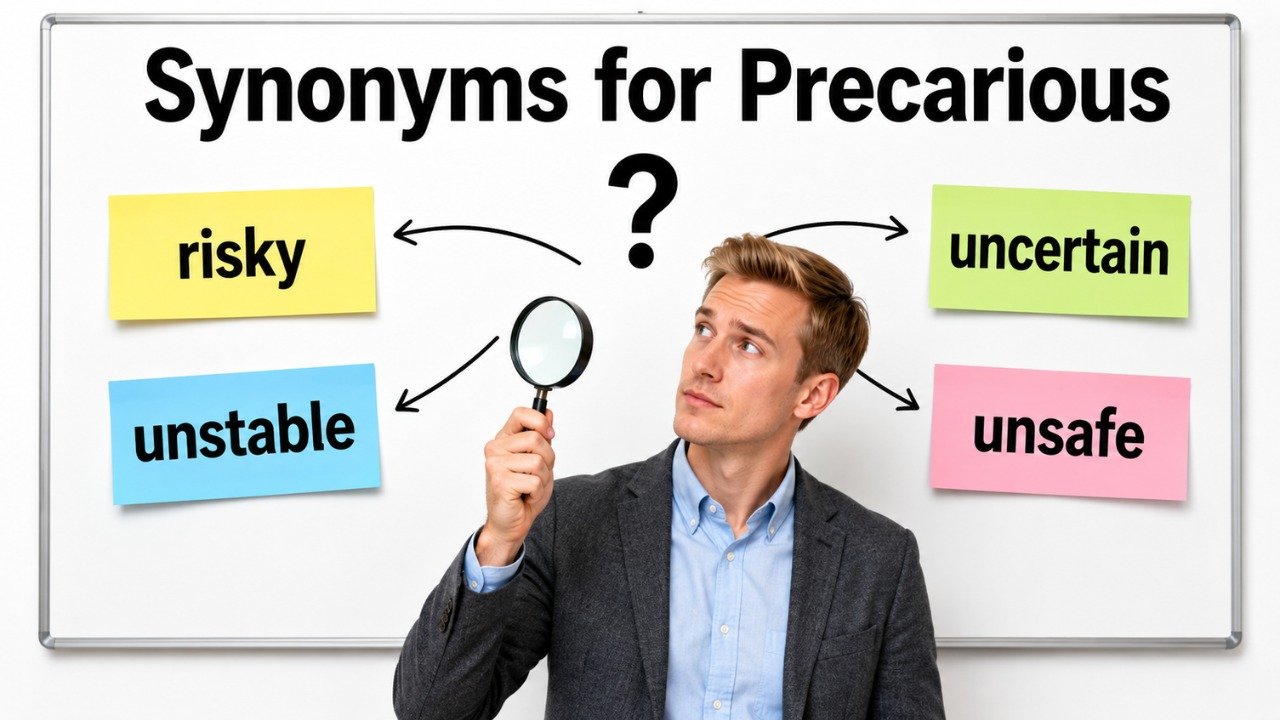
Quick Answer: The best synonyms for precarious include risky, dangerous, unstable, uncertain, insecure, unsafe, vulnerable, perilous, fragile, and tenuous. Use risky for a general possibility of loss or harm, dangerous for direct physical danger, unstable for something likely to collapse or change, uncertain for an unknown outcome, and vulnerable for a person or position open to harm. Perilous expresses severe danger, while tenuous is best for a weak connection, argument, agreement, or relationship. The right choice among synonyms for precarious depends on whether you are describing danger, instability, uncertainty, weakness, or exposure to harm.
Pronunciation and Word Details
Word: Precarious.
Pronunciation: /prɪˈkeəriəs/.
Part of Speech: Adjective.
Meaning: Unsafe, unstable, uncertain, or likely to fail, worsen, or cause harm.
US Pronunciation:
UK Pronunciation:
What Does “Precarious” Mean?
Precarious means unsafe, uncertain, or lacking a stable foundation. It describes something that could easily collapse, fail, change, or become dangerous.
Precarious is an adjective. It can describe physical objects, personal circumstances, employment, finances, health, relationships, agreements, political conditions, and future outcomes.
A precarious structure is physically unstable and may fall. A precarious financial position may quickly become worse. A precarious agreement may fail because it lacks strong support. A person in a precarious situation faces danger, uncertainty, or both.
Physical Situation: The ladder stood in a precarious position against the wall.
Financial Situation: The family was in a precarious financial condition after losing its main source of income.
Employment Situation: His employment became precarious after the project was reduced.
Relationship: Their agreement remained precarious because neither side fully trusted the other.
Future Outcome: The team’s position in the competition was precarious.
The word often combines two ideas. Something precarious is usually both unstable and risky. However, the exact meaning changes with the noun it describes.
Meaning, Tone, and Context of “Precarious”
Precarious has a serious, formal, and usually negative tone. It communicates concern about danger, instability, weakness, or uncertainty.
The word is common in academic writing, professional reports, essays, safety discussions, financial analysis, political commentary, employment discussions, and descriptive writing. It can also appear in everyday conversation, although risky, unsafe, or unstable may sound more natural in casual speech.
Formal Tone: Precarious is suitable for reports, essays, research discussions, and professional communication.
Serious Tone: The word usually suggests that a situation requires attention because it could worsen.
Negative Tone: Precarious rarely describes something desirable. It signals weakness, danger, or uncertainty.
Academic Context: Writers may discuss precarious employment, precarious living conditions, or a precarious economic position.
Physical Context: The word can describe an object placed in an unstable or unsafe position.
Emotional Context: A person may feel precarious when security, confidence, or stability is missing.
Conversational Context: In ordinary speech, people often replace precarious with risky, shaky, dangerous, or uncertain.
Technical Context: Precarious can describe systems, structures, conditions, or arrangements that lack dependable support.
When and How to Use “Precarious”
Use precarious when a situation is not secure and may easily lead to failure, harm, or sudden change.
For Physical Instability: Use precarious when an object is poorly supported or likely to fall.
Example: The boxes were stacked in a precarious tower near the doorway.
For Dangerous Situations: Use precarious when a person faces serious risk because conditions are unsafe.
Example: The climber found himself in a precarious position above the narrow ledge.
For Financial Insecurity: Use precarious when income, savings, or financial stability could quickly disappear.
Example: Without regular work, her financial position became precarious.
For Uncertain Employment: Use precarious for work that lacks security, stability, or predictable income.
Example: Temporary contracts left many workers in a precarious position.
For Weak Agreements: Use precarious when an agreement, peace, or partnership may easily collapse.
Example: The two groups maintained a precarious peace after months of disagreement.
For Uncertain Futures: Use precarious when the future depends on conditions that may change unexpectedly.
Example: The organization faced a precarious future after losing several major supporters.
For Vulnerable People: Use precarious when someone lacks protection, resources, or dependable support.
Example: The sudden closure placed many families in a precarious situation.
For Unstable Systems: Use precarious for systems that appear functional but could fail under pressure.
Example: The outdated equipment left the entire process in a precarious state.
For Weak Arguments: Use precarious when a claim or conclusion depends on limited evidence.
Example: The argument rested on a precarious assumption.
For Formal Warnings: Use precarious when you need to communicate serious concern without using highly emotional language.
Example: The report described the building’s condition as precarious.
Best Synonyms for Precarious
Risky: Involving the possibility of harm, failure, or loss.
Example: Investing all the available money in one project would be risky.
Dangerous: Likely to cause injury, damage, or serious problems.
Example: It was dangerous to cross the damaged bridge.
Unstable: Not firmly fixed, balanced, dependable, or likely to remain unchanged.
Example: The unstable shelf began to lean forward.
Uncertain: Not known, settled, or guaranteed.
Example: The future of the program remains uncertain.
Insecure: Lacking safety, protection, confidence, or stability.
Example: The family lived in an insecure financial position.
Unsafe: Exposed to danger or likely to cause harm.
Example: The damaged staircase was unsafe to use.
Vulnerable: Open to attack, harm, loss, or negative change.
Example: Small communities were vulnerable to sudden price increases.
Perilous: Extremely dangerous or full of serious risk.
Example: The explorers began a perilous journey across the frozen landscape.
Fragile: Easily damaged, broken, weakened, or destroyed.
Example: The fragile agreement depended on continued cooperation.
Tenuous: Very weak, slight, or lacking secure support.
Example: The conclusion was based on a tenuous connection between the events.
50 Synonyms for Precarious With Short Meanings
- Dangerous: Likely to cause harm, injury, or serious problems.
- Risky: Involving a significant possibility of loss or failure.
- Unstable: Not firmly supported, balanced, or dependable.
- Uncertain: Not known, settled, or guaranteed.
- Insecure: Lacking safety, stability, or protection.
- Unsafe: Not protected from danger or harm.
- Vulnerable: Open to damage, attack, or loss.
- Perilous: Extremely dangerous and full of risk.
- Fragile: Easily damaged, weakened, or destroyed.
- Tenuous: Weak, slight, or poorly supported.
- Hazardous: Presenting a risk to safety or health.
- Shaky: Weak, unstable, or not dependable.
- Unsteady: Not firmly balanced, controlled, or fixed.
- Doubtful: Uncertain or unlikely to succeed.
- Unpredictable: Likely to change without warning.
- Exposed: Left without protection from danger.
- Threatened: Facing possible harm, loss, or destruction.
- Jeopardized: Placed in danger of failure or damage.
- Fraught: Filled with danger, difficulty, or anxiety.
- Critical: At a serious or decisive stage.
- Delicate: Easily disturbed, damaged, or made worse.
- Unsound: Not safe, reliable, or firmly constructed.
- Unreliable: Not consistently safe, accurate, or dependable.
- Treacherous: Dangerous because of hidden or changing risks.
- Dubious: Uncertain, questionable, or not trustworthy.
- Questionable: Open to doubt about safety or reliability.
- Volatile: Likely to change suddenly or become dangerous.
- Unsettled: Not stable, decided, or secure.
- Wobbly: Unsteady and likely to fall or fail.
- Rickety: Weakly built and likely to collapse.
- Tottering: Shaking or appearing ready to fall.
- Crumbling: Gradually breaking down or losing strength.
- Compromised: Weakened, damaged, or made less secure.
- Weak: Lacking strength, support, or stability.
- Flimsy: Poorly built, weak, or easily damaged.
- Defenseless: Without protection against harm or attack.
- Susceptible: Easily affected, harmed, or influenced.
- Unprotected: Not guarded against danger or damage.
- Endangered: At risk of serious harm or disappearance.
- Imperiled: Placed in immediate or serious danger.
- At risk: Exposed to the possibility of harm or failure.
- In jeopardy: In danger of being harmed, lost, or ruined.
- Under threat: Facing possible danger or destruction.
- Touch and go: So uncertain that success or failure is equally possible.
- Chancy: Involving uncertainty and possible danger.
- Dicey: Informally describing something risky or uncertain.
- On a knife edge: Balanced between success and failure.
- On the brink: Very close to a serious change or failure.
- Hanging by a thread: Extremely weak and close to ending or collapsing.
- Frail: Weak, delicate, and easily damaged.
Read Also:
Synonyms for Issue or Problem
Synonyms for Precarious by Context
When Precarious Means Physically Unsafe
Use these synonyms for places, objects, structures, or activities that may cause injury or damage.
Dangerous: The broadest choice for something likely to cause harm.
Example: The damaged electrical cable was dangerous.
Unsafe: Best when something fails to meet basic safety needs.
Example: The old balcony was unsafe for visitors.
Hazardous: Common in formal safety instructions and reports.
Example: Workers were warned about the hazardous conditions.
Perilous: Expresses serious or extreme danger.
Example: They attempted a perilous crossing during the storm.
Treacherous: Suggests hidden, changing, or difficult dangers.
Example: Ice made the mountain path treacherous.
When Precarious Means Unstable
Use these words when something lacks balance, support, or a dependable foundation.
Unstable: The most direct choice for weak balance or support.
Example: The table became unstable after one leg cracked.
Shaky: Suitable for physical objects, plans, relationships, and arguments.
Example: The proposal rested on shaky financial estimates.
Unsteady: Describes movement or support that is not firm.
Example: He stepped carefully onto the unsteady platform.
Wobbly: A casual word for something that moves from side to side.
Example: The chair felt wobbly on the uneven floor.
Rickety: Best for an old or poorly built structure.
Example: They crossed a rickety wooden bridge.
Tottering: Describes something that appears ready to fall.
Example: A tottering pile of books stood on the desk.
When Precarious Means Uncertain
Use these alternatives when the result, future, or situation is not settled.
Uncertain: The clearest replacement for an unknown outcome.
Example: The future of the local service remains uncertain.
Doubtful: Suggests that success is unlikely or open to question.
Example: It is doubtful that the repairs will be finished this week.
Unpredictable: Best when conditions may change unexpectedly.
Example: The region experienced unpredictable weather.
Touch and go: Suitable for a situation with an uncertain result.
Example: For several hours, the rescue effort was touch and go.
Chancy: An informal choice for something depending heavily on luck.
Example: Driving through the flooded area would be chancy.
Dicey: A casual alternative for risky or uncertain circumstances.
Example: The plan became dicey once the weather changed.
When Precarious Means Vulnerable
Use these words when a person, group, position, or system lacks protection.
Vulnerable: The best general word for being open to harm.
Example: The outdated network was vulnerable to disruption.
Exposed: Emphasizes the absence of protection.
Example: Without shelter, the travelers were exposed to severe weather.
Insecure: Suitable for finances, employment, housing, and emotional safety.
Example: Many workers felt insecure about their future.
Threatened: Indicates that harm or loss may occur.
Example: The habitat was threatened by expanding development.
Defenseless: Describes someone or something unable to resist harm.
Example: The small settlement was defenseless against the advancing fire.
When Precarious Means Weak or Delicate
Use these alternatives for agreements, relationships, arguments, systems, or conditions that may easily fail.
Fragile: Best for something easily damaged or destroyed.
Example: Their fragile partnership required careful communication.
Tenuous: Suitable for weak connections, explanations, claims, and agreements.
Example: The theory depended on a tenuous link between two events.
Delicate: Suggests that careful handling is necessary.
Example: The negotiations had reached a delicate stage.
Compromised: Describes something weakened by damage or interference.
Example: The building’s foundation had been compromised by water.
Flimsy: Suitable for weak materials, excuses, arguments, or plans.
Example: The decision was based on a flimsy explanation.
When Precarious Means Close to Failure
Use these phrases when a situation is near collapse, defeat, or a serious turning point.
In jeopardy: Means that success, safety, or survival is threatened.
Example: The entire project was in jeopardy after funding was reduced.
On the brink: Suggests being very close to a major event or failure.
Example: The business stood on the brink of closure.
On a knife edge: Describes a fine balance between two possible outcomes.
Example: The final decision remained on a knife edge.
Hanging by a thread: Means that very little support remains.
Example: The agreement was hanging by a thread.
Critical: Describes a serious stage where the outcome may soon be decided.
Example: The negotiations had reached a critical point.
Another Word for Precarious
Risky is usually the best general replacement for precarious. It is natural, widely understood, and suitable for situations that may lead to danger, loss, or failure.
However, the best alternative depends on the precise meaning. Use unstable for weak physical support, uncertain for an unknown future, vulnerable for exposure to harm, and tenuous for a weak connection or argument.
Original: The workers stood on a precarious platform.
Better Option: The workers stood on an unstable platform.
Original: The organization faced a precarious future.
Better Option: The organization faced an uncertain future.
Original: Their financial position was precarious.
Better Option: Their financial position was insecure.
Original: The agreement remained precarious after the meeting.
Better Option: The agreement remained fragile after the meeting.
When Not to Use “Precarious”
Precarious is useful, but it may sound too formal, vague, repetitive, or less precise than another word.
When the Danger Is Direct and Physical
Use dangerous or hazardous when the main point is immediate physical harm.
Weak: The chemical spill created a precarious environment.
Better: The chemical spill created a hazardous environment.
When You Only Mean Uncertain
A future outcome can be uncertain without being dangerous or unstable.
Weak: The date of the event is precarious.
Better: The date of the event is uncertain.
When Describing an Old Structure
Rickety, unstable, or unsound may create a clearer physical image.
Weak: They entered the precarious wooden shed.
Better: They entered the rickety wooden shed.
When Describing a Weak Connection
Tenuous is more precise for evidence, relationships, explanations, and logical links.
Weak: The writer made a precarious connection between the two ideas.
Better: The writer made a tenuous connection between the two ideas.
When Writing Casual Conversation
Risky, shaky, or dicey may sound more natural in relaxed speech.
Weak: Taking that shortcut seems precarious.
Better: Taking that shortcut seems risky.
When the Situation Is Merely Uncomfortable
Precarious suggests real instability or danger. It can sound exaggerated when the problem is minor.
Weak: The long meeting placed me in a precarious mood.
Better: The long meeting placed me in an uncomfortable mood.
When Repetition Reduces Clarity
Using precarious several times in one paragraph can make writing sound heavy.
Weak: The precarious bridge led to a precarious path beside a precarious cliff.
Better: The unstable bridge led to a dangerous path beside a steep cliff.
Words Commonly Confused With Precarious
Precarious vs Dangerous: Precarious emphasizes instability, insecurity, or the possibility of failure. Dangerous focuses more directly on the likelihood of harm.
Precarious vs Risky: Precarious often describes an existing condition that lacks stability. Risky commonly describes an action or choice that may produce a negative result.
Precarious vs Perilous: Precarious can describe mild or serious instability. Perilous usually communicates severe and immediate danger.
Precarious vs Unstable: Unstable focuses on a lack of balance, support, or consistency. Precarious adds the idea that this instability may lead to danger or failure.
Precarious vs Uncertain: Uncertain means that an outcome is unknown. Precarious suggests that the unknown outcome may be harmful or that the situation lacks security.
Precarious vs Vulnerable: Vulnerable means open to harm or attack. Precarious means insecure, unstable, or likely to worsen.
Precarious vs Fragile: Fragile describes something easily damaged or destroyed. Precarious describes something that is dangerously unstable or uncertain.
Precarious vs Tenuous: Tenuous means weak, slight, or poorly supported. It is especially common for arguments, connections, relationships, and claims.
Precarious vs Hazardous: Hazardous is often used for materials, activities, or conditions that present a safety risk. Precarious is broader and can also describe finances, employment, relationships, and future outcomes.
Which Synonym Should You Choose?
Choose risky: When describing an action, decision, investment, plan, or choice that could cause loss or failure.
Choose dangerous: When physical injury, serious damage, or immediate harm is the main concern.
Choose hazardous: When writing formal safety instructions, workplace reports, or warnings about dangerous materials and conditions.
Choose unstable: When something lacks balance, structural support, consistency, or dependable control.
Choose uncertain: When the main issue is an unknown outcome rather than immediate danger.
Choose insecure: When discussing employment, housing, income, finances, or a lack of dependable protection.
Choose vulnerable: When a person, community, system, or position is open to attack, harm, or negative change.
Choose perilous: When the danger is severe, dramatic, or life threatening.
Choose fragile: When an agreement, relationship, system, or condition may easily be damaged or destroyed.
Choose tenuous: When an argument, explanation, relationship, connection, or claim has weak support.
Choose shaky: In casual speech when a plan, arrangement, structure, or explanation seems weak.
Choose rickety: When describing an old, weak, or poorly constructed object.
Choose volatile: When a situation may change suddenly and become dangerous.
Choose delicate: When a situation requires careful handling to prevent failure or conflict.
For Formal Writing: Precarious, perilous, hazardous, vulnerable, tenuous, and unstable are suitable choices.
For Casual Speech: Risky, shaky, unsafe, dicey, and wobbly sound more conversational.
For Reports: Choose hazardous for safety concerns, unstable for structural concerns, uncertain for projections, and vulnerable for exposure to harm.
For Essays: Choose precarious when discussing complex conditions that involve both insecurity and possible danger.
For Emails: Choose risky or uncertain for plain communication unless a more formal tone is required.
For Conversation: Risky is usually the clearest general replacement.
Real Life Examples of “Precarious” in Sentences
Original: The ladder was balanced in a precarious position.
Better Option: The ladder was balanced in an unstable position.
Original: The family remained in a precarious financial situation.
Better Option: The family remained in an insecure financial situation.
Original: Their agreement became precarious after another disagreement.
Better Option: Their agreement became fragile after another disagreement.
Original: The hikers followed a precarious path along the cliff.
Better Option: The hikers followed a dangerous path along the cliff.
Original: The project faced a precarious future after its budget was reduced.
Better Option: The project faced an uncertain future after its budget was reduced.
Original: The building was in a precarious condition.
Better Option: The building was in an unstable condition.
Original: Her position in the organization was precarious.
Better Option: Her position in the organization was insecure.
Original: The conclusion rested on precarious evidence.
Better Option: The conclusion rested on tenuous evidence.
Original: The damaged road created precarious driving conditions.
Better Option: The damaged road created hazardous driving conditions.
Original: The peaceful relationship between the groups remained precarious.
Better Option: The peaceful relationship between the groups remained delicate.
Synonym Groups and Usage Differences
Danger Group
Dangerous, perilous, hazardous, treacherous, and unsafe describe situations that may cause injury, damage, or serious harm.
Dangerous is the broadest choice. Perilous is stronger and more dramatic. Hazardous is common in formal safety language. Treacherous suggests hidden or changing danger.
Example: Heavy rain made the narrow road treacherous.
Instability Group
Unstable, shaky, unsteady, wobbly, rickety, tottering, and unsound describe weak physical support or unreliable conditions.
Unstable is neutral and precise. Shaky can describe both physical objects and abstract plans. Rickety usually describes old, weak structures.
Example: The rickety staircase moved beneath every step.
Uncertainty Group
Uncertain, doubtful, unpredictable, chancy, dicey, and touch and go describe outcomes that are unknown or difficult to predict.
Uncertain is suitable for formal and everyday writing. Chancy and dicey are more casual. Touch and go suggests that success and failure are both possible.
Example: The outcome remained uncertain until the final decision.
Vulnerability Group
Vulnerable, exposed, insecure, threatened, susceptible, defenseless, and unprotected describe a lack of protection.
Vulnerable is the most flexible word. Exposed emphasizes direct contact with danger. Insecure often describes employment, housing, income, and emotional conditions.
Example: The small community was vulnerable to sudden flooding.
Weakness Group
Fragile, tenuous, delicate, flimsy, weak, compromised, and frail describe something that lacks strength or dependable support.
Fragile suggests easy damage. Tenuous describes weak evidence or connections. Delicate suggests that careful handling is needed. Flimsy often expresses criticism.
Example: The proposal was supported by a flimsy argument.
Crisis Group
Critical, imperiled, endangered, in jeopardy, on the brink, and hanging by a thread describe situations close to serious failure or harm.
Critical focuses on an important turning point. Imperiled and endangered emphasize direct danger. Hanging by a thread suggests that almost no support remains.
Example: The rescue plan was in jeopardy after communication was lost.
Antonyms of Precarious
The opposite of precarious depends on whether the word refers to physical safety, emotional security, structural strength, or a predictable outcome.
Safe: Protected from danger, harm, or injury.
Secure: Firmly protected, fixed, or unlikely to be lost.
Stable: Firm, balanced, dependable, and unlikely to change suddenly.
Certain: Known, settled, or guaranteed.
Reliable: Consistently dependable and trustworthy.
Firm: Strongly fixed and unlikely to move or fail.
Sound: Strong, safe, and in good condition.
Protected: Guarded against danger, damage, or loss.
Strong: Having enough power, support, or stability.
Dependable: Able to be trusted or relied upon.
Settled: Decided, calm, and no longer uncertain.
Assured: Confident, guaranteed, or free from doubt.
Steady: Stable, controlled, and consistent.
Solid: Strong, firm, and securely supported.
Predictable: Expected to behave or develop in a known way.
Comparison of Precarious and Related Words
Precarious vs Dangerous
Precarious describes something unstable, insecure, or uncertain enough to create risk. Dangerous directly describes something likely to cause harm.
Example With Precarious: The boxes were stacked in a precarious tower.
Example With Dangerous: The damaged cable was dangerous to touch.
Precarious vs Risky
Precarious usually describes a condition or position. Risky often describes a choice, action, or plan.
Example With Precarious: The organization remained in a precarious financial position.
Example With Risky: Expanding without enough funding would be risky.
Precarious vs Unstable
Precarious combines instability with possible danger or failure. Unstable focuses mainly on weak balance, support, or consistency.
Example With Precarious: The climber held a precarious position above the valley.
Example With Unstable: The platform became unstable after the support moved.
Precarious vs Uncertain
Precarious suggests that uncertainty creates insecurity or danger. Uncertain simply means that the result is not known.
Example With Precarious: The community faced a precarious future without reliable water supplies.
Example With Uncertain: The exact delivery date remains uncertain.
Precarious vs Vulnerable
Precarious describes an unstable or insecure condition. Vulnerable describes someone or something open to harm.
Example With Precarious: The agreement remained precarious after the meeting.
Example With Vulnerable: The damaged system was vulnerable to further disruption.
Precarious vs Fragile
Precarious emphasizes instability and risk. Fragile emphasizes how easily something can be damaged or destroyed.
Example With Precarious: Their financial position was precarious.
Example With Fragile: Their partnership was fragile after several disagreements.
Precarious vs Tenuous
Precarious is broader and can describe danger, instability, or insecurity. Tenuous is best for weak evidence, claims, links, relationships, or support.
Example With Precarious: The peace between the groups was precarious.
Example With Tenuous: The argument relied on a tenuous connection between the two facts.
Precarious vs Perilous
Precarious may describe a situation that could become dangerous. Perilous already involves severe danger.
Example With Precarious: The ladder rested at a precarious angle.
Example With Perilous: They began a perilous journey through the storm.
Common Phrases and Expressions With Precarious
Precarious Position: A situation involving danger, insecurity, or possible failure.
Precarious Situation: A condition that could easily worsen or become harmful.
Precarious Balance: A state in which a small change could cause collapse or failure.
Precarious Footing: Weak physical support or an insecure position.
Precarious Future: A future that is uncertain and potentially difficult.
Precarious Existence: A life or condition lacking dependable safety and resources.
Precarious Condition: A weak, unstable, or dangerous state.
Precarious Arrangement: An agreement or system that may easily fail.
Precarious Employment: Work that lacks stability, security, or dependable income.
Precarious Peace: A period without conflict that may end suddenly.
Common Mistakes to Avoid
Using Precarious for Every Kind of Danger
Precarious is best when danger comes from instability, insecurity, or uncertainty. Use dangerous for direct physical harm.
Less Precise: The poisonous substance was precarious.
More Precise: The poisonous substance was dangerous.
Confusing Precarious With Precious
Precarious means unsafe or unstable. Precious means valuable, loved, or rare.
Incorrect: The necklace was precarious to her.
Correct: The necklace was precious to her.
Using Precarious for Simple Uncertainty
Not every unknown outcome is precarious. The word may sound too serious when no danger or instability exists.
Overstated: Our lunch time is precarious.
Natural: Our lunch time is uncertain.
Choosing the Wrong Synonym
Dangerous, unstable, uncertain, vulnerable, and tenuous are not interchangeable in every sentence.
Unclear: The argument was dangerous.
Clearer: The argument was tenuous.
Repeating Precarious Too Often
Frequent repetition makes writing sound heavy and prevents precise description.
Repetitive: Their precarious position created a precarious future under precarious conditions.
Improved: Their insecure position created an uncertain future under unstable conditions.
Using an Unnatural Noun Combination
Precarious normally describes a position, situation, balance, condition, future, existence, arrangement, or form of security.
Unnatural: She gave a precarious answer to the question.
Natural: She gave an uncertain answer to the question.
Forgetting the Adverb Form
Precarious is an adjective. Precariously is the adverb.
Incorrect: The vase balanced precarious on the shelf.
Correct: The vase balanced precariously on the shelf.
Using Precarious When Fragile Is More Accurate
Use fragile when something is easily damaged rather than dangerously unstable.
Less Precise: The glass ornament was precarious.
More Precise: The glass ornament was fragile.
Using Informal Synonyms in Formal Writing
Dicey and chancy are useful in conversation but may sound too casual in reports or academic essays.
Too Casual: The financial outlook is dicey.
More Formal: The financial outlook is uncertain.
Conclusion
The most useful synonyms for precarious include risky, dangerous, unstable, uncertain, insecure, vulnerable, fragile, perilous, and tenuous. Choose dangerous for direct harm, unstable for weak support, uncertain for unknown outcomes, and vulnerable for exposure to damage. Fragile works well for relationships and agreements, while tenuous suits weak arguments or connections. Understanding the differences among synonyms for precarious helps you describe risk, insecurity, and instability with greater accuracy in essays, reports, emails, and everyday conversation.
FAQs About Synonyms for Precarious
What Is the Best Synonym for Precarious?
Risky is the best general synonym. Unstable, uncertain, dangerous, or vulnerable may be more accurate in specific contexts.
What Is a Stronger Word for Precarious?
Perilous is a stronger word when the situation involves severe or immediate danger.
Is Dangerous the Same as Precarious?
Not exactly. Dangerous focuses on possible harm, while precarious emphasizes instability, insecurity, or uncertainty that may lead to harm.
What Is a Synonym for a Precarious Situation?
A precarious situation may be described as risky, unstable, uncertain, dangerous, insecure, or critical.
What Is the Opposite of Precarious?
Common opposites include safe, secure, stable, certain, reliable, sound, and protected.
How Do You Use Precarious in a Sentence?
You can write, “The boxes were stacked in a precarious position near the edge of the shelf.”
Is Precarious a Formal Word?
Yes. Precarious has a serious and slightly formal tone, although it is also understood in everyday conversation.
