
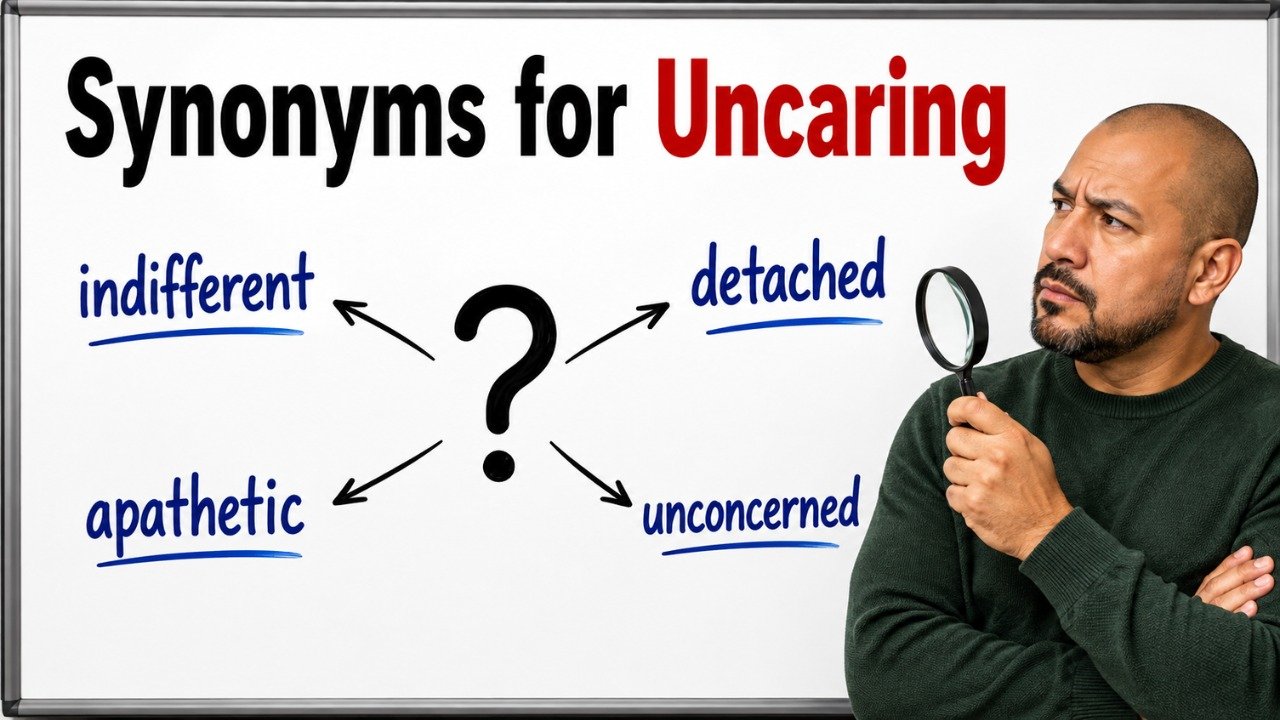
Quick Answer: The best synonyms for uncaring include indifferent, insensitive, unfeeling, callous, cold, detached, apathetic, heartless, unsympathetic, and unconcerned. Indifferent is a strong neutral choice when someone shows little interest. Insensitive works when a person ignores another person’s feelings. Callous and heartless are stronger choices for cruel emotional behavior. Detached suits formal or professional contexts, while unconcerned describes a lack of worry or interest. The right choice among synonyms for uncaring depends on whether you mean emotionally distant, thoughtless, uninterested, unsympathetic, or deliberately cold.
Pronunciation and Word Details
Word: Uncaring
Pronunciation: /ʌnˈkerɪŋ/
Part of Speech: Adjective
Meaning: Not showing enough care, concern, sympathy, or interest in another person or situation.
US Pronunciation:
UK Pronunciation:
What Does “Uncaring” Mean?
Uncaring means showing little or no concern, sympathy, kindness, or emotional interest toward someone or something.
It is mainly used as an adjective. It can describe a person, attitude, response, behavior, organization, decision, or way of speaking.
Example: His uncaring response made her feel ignored.
In this sentence, uncaring describes a response that lacks sympathy.
Example: She appeared uncaring toward the problems of her neighbors.
Here, the word suggests that she showed little concern for other people’s difficulties.
Uncaring does not always mean openly cruel. A person may seem uncaring because they are indifferent, emotionally distant, distracted, insensitive, or unwilling to become involved. Stronger synonyms such as heartless and callous suggest a more serious lack of compassion.
The exact meaning therefore depends on context.
Meaning, Tone, and Context of “Uncaring”
Uncaring usually carries a negative tone. It criticizes someone or something for failing to show appropriate concern, sympathy, attention, or kindness.
Emotional Tone: The word often communicates disappointment, criticism, or hurt.
Formality: Uncaring is suitable for both everyday and moderately formal writing.
Conversational Use: It is common when describing someone who seems emotionally distant or uninterested.
Formal Use: In reports or essays, alternatives such as indifferent, detached, unsympathetic, or unconcerned may provide greater precision.
Strong Use: Words such as callous, heartless, and coldhearted express a stronger judgment than uncaring.
Neutral Use: Indifferent or unconcerned may sound less emotionally charged in some situations.
Personal Context: Uncaring commonly describes relationships, conversations, reactions, and behavior.
Social Context: It may describe a lack of concern for another person’s needs or difficulties.
Professional Context: It can describe communication or decisions that appear to ignore people’s concerns.
Because the word expresses judgment, writers should choose it carefully when describing motives they cannot know for certain. Sometimes distant, reserved, distracted, or unaware may be more accurate.
When and How to Use “Uncaring”
For Lack of Sympathy: Use uncaring when someone does not appear to respond compassionately to another person’s feelings.
Example: His uncaring reply made the situation more painful.
For Emotional Distance: Use it when someone seems disconnected from the emotions of others.
Example: She seemed uncaring during the difficult conversation.
For Indifference: Use uncaring when a person shows little interest in what happens.
Example: The uncaring observer walked away without offering help.
For Thoughtless Behavior: The word can describe actions that fail to consider how other people may be affected.
Example: His uncaring remark embarrassed his colleague.
For Lack of Concern: Use it when someone does not appear worried about a problem that affects others.
Example: Their uncaring attitude frustrated the residents.
For Character Description: Uncaring can describe a fictional or real person’s apparent manner.
Example: The character initially seems uncaring but later shows compassion.
For Critical Writing: It may be used when evaluating behavior that lacks empathy.
Example: The essay describes the decision as uncaring toward vulnerable families.
Best Synonyms for Uncaring
Indifferent: Showing little interest, concern, or emotional involvement.
Example: He seemed indifferent to the criticism.
Insensitive: Failing to notice or respect another person’s feelings.
Example: Her insensitive comment upset several people.
Unfeeling: Showing little sympathy or emotional warmth.
Example: His unfeeling response surprised his friends.
Callous: Emotionally hardened and showing little concern for suffering.
Example: The callous remark showed no sympathy for the victim.
Cold: Emotionally distant and lacking warmth.
Example: His cold manner made conversation difficult.
Detached: Emotionally removed or uninvolved.
Example: She remained detached throughout the discussion.
Apathetic: Showing little interest, enthusiasm, or concern.
Example: The audience appeared apathetic about the proposal.
Heartless: Showing a severe lack of compassion or kindness.
Example: Leaving the injured animal without help seemed heartless.
Unsympathetic: Not showing understanding or compassion for another person’s difficulties.
Example: The manager sounded unsympathetic when the employee explained the problem.
Unconcerned: Not worried, interested, or troubled about something.
Example: He appeared unconcerned about the consequences.
50 Synonyms for Uncaring with Short Meanings
- Indifferent: Showing little interest or concern.
- Insensitive: Not considering another person’s feelings.
- Unfeeling: Lacking emotional sympathy or warmth.
- Callous: Hardened toward the suffering of others.
- Cold: Emotionally distant or unfriendly.
- Detached: Emotionally uninvolved or removed.
- Apathetic: Lacking interest, enthusiasm, or concern.
- Heartless: Showing no compassion or kindness.
- Unsympathetic: Lacking sympathy or understanding.
- Unconcerned: Showing little worry or interest.
- Emotionless: Showing little visible emotion.
- Dispassionate: Not influenced by strong emotion.
- Aloof: Emotionally distant and reserved.
- Distant: Not emotionally close or responsive.
- Coldhearted: Lacking kindness and compassion.
- Hardhearted: Unwilling to show pity or tenderness.
- Remorseless: Showing no regret for causing harm.
- Pitiless: Showing no pity toward suffering.
- Merciless: Showing no mercy or compassion.
- Ruthless: Showing little concern for harm caused while pursuing a goal.
- Thoughtless: Failing to consider another person’s needs or feelings.
- Inconsiderate: Not giving enough thought to others.
- Neglectful: Failing to give proper care or attention.
- Unmindful: Not paying enough attention to another person’s needs.
- Disinterested: Lacking personal interest or involvement in some contexts.
- Uninterested: Showing no interest in something.
- Unresponsive: Not reacting with expected attention or emotion.
- Impassive: Showing little visible feeling or reaction.
- Stoic: Showing little outward emotion, especially during difficulty.
- Remote: Emotionally distant or inaccessible.
- Withdrawn: Avoiding emotional or social engagement.
- Disengaged: Not emotionally or actively involved.
- Uninvolved: Taking little part or emotional interest.
- Unattentive: Failing to give sufficient attention.
- Negligent: Failing to provide reasonable care or attention.
- Dismissive: Treating concerns as unimportant.
- Scornful: Showing contempt rather than sympathy.
- Harsh: Severe and lacking gentleness.
- Stern: Strict and not openly warm.
- Cruel: Willing to cause or ignore pain.
- Unsparing: Showing little mercy or leniency.
- Uncompassionate: Lacking compassion for others.
- Unempathetic: Showing little understanding of another person’s feelings.
- Inattentive: Not giving sufficient attention or care.
- Oblivious: Unaware of how others are affected.
- Unmoved: Not emotionally affected by something.
- Unbothered: Not troubled or concerned.
- Casual: Showing less concern than a situation may deserve.
- Cool: Emotionally restrained or distant.
- Impersonal: Lacking personal warmth or emotional connection.
Read Also:
Synonyms for Enthusiasm
Synonyms for Uncaring by Context
When Uncaring Means Indifferent
Indifferent is often the best choice when someone simply does not seem interested or concerned.
Useful Synonyms: Indifferent, unconcerned, apathetic, uninterested, disengaged.
Example: He remained indifferent to the complaints.
These words do not necessarily imply cruelty. They mainly describe a lack of interest, emotional involvement, or concern.
When Uncaring Means Insensitive
Insensitive is more precise when someone fails to recognize how their words or actions affect another person’s feelings.
Useful Synonyms: Insensitive, thoughtless, inconsiderate, unmindful, inattentive.
Example: Her insensitive joke made an uncomfortable situation worse.
This group is useful when the problem involves poor awareness or consideration rather than deliberate cruelty.
When Uncaring Means Emotionally Cold
Sometimes uncaring describes a person who shows little emotional warmth.
Useful Synonyms: Cold, unfeeling, aloof, distant, remote, impersonal.
Example: His cold response made her feel unwelcome.
These alternatives work well when describing emotional distance, reserved behavior, or a lack of warmth.
When Uncaring Means Cruel or Heartless
Stronger words are appropriate when a person appears to have little compassion for real suffering.
Useful Synonyms: Heartless, callous, hardhearted, pitiless, merciless, cruel.
Example: The callous treatment of the injured animal shocked everyone.
These terms are much stronger than uncaring and should not be used for minor thoughtlessness.
When Uncaring Means Emotionally Detached
Detached can describe emotional distance without necessarily implying cruelty.
Useful Synonyms: Detached, dispassionate, impassive, disengaged, uninvolved.
Example: She remained detached while reviewing the disagreement.
These words may even be neutral in professional situations where emotional distance helps someone make an objective decision.
When Uncaring Means Neglectful
Sometimes a lack of care appears through inaction rather than words or emotions.
Useful Synonyms: Neglectful, negligent, inattentive, unmindful, inconsiderate.
Example: The neglectful behavior allowed the problem to become worse.
This group focuses on insufficient attention, responsibility, or care.
Another Word for Uncaring
Indifferent is one of the best general replacements for uncaring. It describes someone who shows little interest, concern, or emotional involvement without automatically suggesting deliberate cruelty.
However, the best alternative depends on what kind of lack of care you mean. Choose insensitive for hurtful behavior, detached for emotional distance, callous for serious lack of compassion, and apathetic for a lack of interest or motivation.
Original: He seemed uncaring about their concerns.
Better Option: He seemed indifferent to their concerns.
Original: Her uncaring comment upset the whole group.
Better Option: Her insensitive comment upset the whole group.
Original: The supervisor gave an uncaring response to the complaint.
Better Option: The supervisor gave an unsympathetic response to the complaint.
Original: His uncaring attitude toward their suffering was disturbing.
Better Option: His callous attitude toward their suffering was disturbing.
When Not to Use “Uncaring”
Do not use uncaring when a more precise word explains the behavior better.
Someone who is quiet or emotionally reserved is not necessarily uncaring.
Weak: She was uncaring because she did not say much during the meeting.
Better: She was reserved and spoke very little during the meeting.
Do not describe someone as uncaring merely because they remain calm.
Weak: The doctor seemed uncaring because she remained calm.
Better: The doctor remained composed while explaining the situation.
Avoid uncaring when someone simply does not know about another person’s problem.
Weak: He was uncaring about her difficulty because he never offered assistance.
Better: He was unaware of her difficulty and therefore did not offer assistance.
Use a stronger synonym when deliberate cruelty is clearly the intended meaning.
Weak: His uncaring treatment of the helpless animal was shocking.
Better: His cruel treatment of the helpless animal was shocking.
Use a more neutral word when emotional distance is appropriate to the context.
Weak: The evaluator remained uncaring while reviewing the evidence.
Better: The evaluator remained impartial and emotionally detached while reviewing the evidence.
Avoid repeating uncaring when different behaviors are being described.
Weak: She sounded uncaring, gave an uncaring answer, and showed an uncaring attitude.
Better: She sounded cold, gave an insensitive answer, and remained indifferent to the problem.
Words Commonly Confused With Uncaring
Uncaring vs Indifferent: Uncaring suggests a failure to show appropriate care, while indifferent mainly means having little interest or concern.
Uncaring vs Insensitive: Uncaring is broader. Insensitive specifically describes a failure to recognize or respect another person’s feelings.
Uncaring vs Callous: Callous is stronger than uncaring. It suggests that someone has become emotionally hardened toward suffering.
Uncaring vs Apathetic: Apathetic describes a lack of interest, enthusiasm, or motivation. Uncaring more directly suggests insufficient concern for others.
Uncaring vs Detached: Detached means emotionally removed or uninvolved. It can be neutral or useful in professional settings, while uncaring is usually negative.
Uncaring vs Cold: Cold often refers to someone’s manner or emotional style. Uncaring emphasizes the lack of concern itself.
Uncaring vs Heartless: Heartless expresses a much stronger moral judgment and suggests a severe lack of compassion.
Uncaring vs Emotionless: Emotionless means showing little visible emotion. A person may appear emotionless while still caring deeply.
Which Synonym Should You Choose?
Choose indifferent when someone shows little interest or concern but is not necessarily cruel.
Choose insensitive when words or actions fail to consider another person’s feelings.
Choose unfeeling when someone displays little sympathy or emotional warmth.
Choose callous when the lack of compassion is serious and especially noticeable around suffering.
Choose cold when describing an unfriendly or emotionally distant manner.
Choose detached when emotional separation is the main idea, especially in formal writing.
Choose apathetic when someone lacks interest, motivation, or enthusiasm.
Choose heartless when you need a strong word for behavior that appears completely lacking in compassion.
Choose unsympathetic when someone fails to show understanding toward another person’s difficulty.
Choose unconcerned when someone does not seem worried about a particular issue.
Choose thoughtless in everyday conversation when a person acts without considering how others may feel.
Choose inconsiderate when someone’s behavior ignores the comfort, needs, or convenience of other people.
For essays and reports, indifferent, insensitive, detached, apathetic, and unsympathetic are often precise choices.
For casual conversation, cold, thoughtless, uncaring, and inconsiderate may sound more natural.
For strong emotional emphasis, callous, heartless, cruel, or hardhearted may be appropriate when the context truly supports them.
Real Life Examples of “Uncaring” in Sentences
Original: His uncaring reply made the customer feel ignored.
Better Option: His dismissive reply made the customer feel ignored.
Original: She seemed uncaring when her friend described the problem.
Better Option: She seemed unsympathetic when her friend described the problem.
Original: The uncaring comment hurt his feelings.
Better Option: The insensitive comment hurt his feelings.
Original: He appeared uncaring about the consequences of his decision.
Better Option: He appeared unconcerned about the consequences of his decision.
Original: Her uncaring manner made the conversation uncomfortable.
Better Option: Her cold manner made the conversation uncomfortable.
Original: The character initially appears uncaring toward everyone around him.
Better Option: The character initially appears emotionally detached from everyone around him.
Original: Their uncaring attitude toward the complaints caused frustration.
Better Option: Their indifferent attitude toward the complaints caused frustration.
Original: His uncaring treatment of people in distress was disturbing.
Better Option: His callous treatment of people in distress was disturbing.
Original: The uncaring response suggested that nobody was listening.
Better Option: The dismissive response suggested that nobody was listening.
Original: She was criticized for appearing uncaring during the discussion.
Better Option: She was criticized for appearing insensitive during the discussion.
Synonym Groups and Usage Differences
Indifference Group
This group describes a lack of interest, concern, or involvement.
Words: Indifferent, unconcerned, apathetic, uninterested, disengaged.
Indifferent is the broadest choice. Apathetic often suggests low motivation as well as low concern.
Example: He seemed indifferent to whether the plan succeeded.
Insensitivity Group
These words focus on failing to consider another person’s feelings or needs.
Words: Insensitive, thoughtless, inconsiderate, unmindful, inattentive.
Insensitive is especially useful for comments and reactions. Inconsiderate often describes behavior that creates inconvenience or discomfort for others.
Example: The insensitive remark embarrassed her.
Emotional Distance Group
These terms describe a person who appears emotionally removed.
Words: Detached, aloof, distant, remote, impersonal, cool.
Detached can be neutral, while aloof often suggests deliberate distance.
Example: His detached tone made it difficult to know how he felt.
Lack of Compassion Group
These words describe a stronger absence of sympathy.
Words: Unfeeling, callous, coldhearted, hardhearted, unsympathetic.
Callous is especially strong because it suggests emotional hardness toward suffering.
Example: Her callous response shocked the people around her.
Cruelty Group
This group contains the strongest alternatives.
Words: Heartless, cruel, pitiless, merciless, ruthless.
These words should be reserved for serious behavior rather than ordinary social mistakes.
Example: Abandoning someone in such circumstances would have been heartless.
Neglect Group
These words describe a failure to provide appropriate attention or care.
Words: Neglectful, negligent, inattentive, unmindful.
Negligent may carry a more formal sense of failing to meet a duty or reasonable standard of care.
Example: His neglectful approach allowed several problems to remain unresolved.
Antonyms of Uncaring
The opposite of uncaring depends on whether you mean compassionate, attentive, emotionally warm, or concerned.
Caring: Showing concern for another person’s needs or feelings.
Compassionate: Feeling and showing sympathy toward suffering.
Kind: Treating people with consideration and warmth.
Concerned: Interested in and worried about someone’s welfare or a situation.
Sympathetic: Showing understanding and compassion.
Empathetic: Able to understand and respond to another person’s feelings.
Thoughtful: Considering how actions may affect other people.
Considerate: Respecting the feelings, needs, and comfort of others.
Attentive: Giving careful attention and care.
Warm: Friendly, affectionate, and emotionally open.
Tender: Showing gentleness and affection.
Supportive: Providing encouragement, understanding, or practical help.
Sensitive: Aware of and responsive to other people’s feelings.
Compassionate: Showing concern for people experiencing difficulty or pain.
Responsive: Reacting appropriately to another person’s needs or concerns.
Comparison of Uncaring and Related Words
Uncaring vs Indifferent
Uncaring describes a lack of appropriate concern or compassion. Indifferent focuses more on a lack of interest or preference.
Example With Uncaring: His uncaring response made her feel abandoned.
Example With Indifferent: He seemed indifferent to which option they selected.
Indifferent can therefore be more neutral.
Uncaring vs Insensitive
Insensitive is more specific than uncaring. It usually describes words, actions, or attitudes that fail to recognize another person’s feelings.
Example With Uncaring: She seemed uncaring about his disappointment.
Example With Insensitive: She made an insensitive remark about his disappointment.
Uncaring vs Callous
Callous is significantly stronger. It implies emotional hardness and a disturbing lack of concern for suffering.
Example With Uncaring: His uncaring manner upset the family.
Example With Callous: His callous joke about their suffering shocked the family.
Uncaring vs Apathetic
Apathetic mainly describes a lack of enthusiasm, motivation, or interest. Uncaring more directly concerns a lack of care.
Example With Uncaring: She seemed uncaring about her friend’s distress.
Example With Apathetic: The students seemed apathetic about the optional activity.
Uncaring vs Detached
Detached means emotionally separate or uninvolved. Unlike uncaring, it is not always negative.
Example With Uncaring: The response sounded uncaring and dismissive.
Example With Detached: The mediator remained detached while listening to both sides.
Uncaring vs Heartless
Heartless is much stronger and carries a severe moral judgment.
Example With Uncaring: Ignoring the request seemed uncaring.
Example With Heartless: Mocking someone during a personal tragedy seemed heartless.
Uncaring vs Unconcerned
Unconcerned means not worried about something. It does not always imply a lack of compassion.
Example With Uncaring: He seemed uncaring about the people affected.
Example With Unconcerned: He remained unconcerned about the minor delay.
Common Phrases and Expressions With Uncaring
Uncaring Attitude: A manner that shows little concern or sympathy.
Example: His uncaring attitude made cooperation difficult.
Uncaring Person: Someone who appears to show little concern for others.
Example: The story initially presents him as an uncaring person.
Uncaring Response: A reply that lacks sympathy or consideration.
Example: Her uncaring response made him regret asking for help.
Uncaring Behavior: Actions that demonstrate little concern for another person.
Example: The teacher addressed the uncaring behavior immediately.
Uncaring Manner: A way of behaving that seems emotionally cold.
Example: His uncaring manner created distance between them.
Uncaring Tone: A voice or writing style that appears lacking in sympathy.
Example: The uncaring tone of the message caused unnecessary tension.
Uncaring Remark: A comment that shows little consideration for feelings.
Example: His uncaring remark upset the group.
Uncaring Approach: A way of handling something without enough attention to people’s needs.
Example: The uncaring approach made the problem harder to resolve.
Seem Uncaring: To give the impression of lacking concern.
Example: Remaining silent can sometimes make a person seem uncaring.
Appear Uncaring: To look emotionally indifferent even when that may not reflect someone’s true feelings.
Example: She did not want to appear uncaring during the difficult conversation.
Common Mistakes to Avoid
One common mistake is treating every synonym for uncaring as interchangeable. The alternatives differ significantly in strength and meaning.
Wrong Choice: He was heartless because he forgot to reply to my message.
Better Choice: He was thoughtless because he forgot to reply.
Heartless is too strong for ordinary carelessness unless the wider context supports such a severe judgment.
Another mistake is confusing emotional restraint with a lack of care.
Unclear: She remained calm, so she was uncaring.
Better: She remained calm but continued to show concern.
A person can control their emotions while still being deeply compassionate.
Avoid confusing indifferent with cruel. Indifference means a lack of interest or concern. Cruel describes behavior that causes or disregards suffering in a stronger way.
Do not use apathetic when you specifically mean insensitive.
Less Precise: His apathetic joke hurt her feelings.
Better: His insensitive joke hurt her feelings.
Apathetic usually describes low interest or motivation rather than offensive speech.
Be careful with detached. It can describe useful emotional objectivity rather than a moral failing.
Unclear: The judge was uncaring.
More Precise: The judge remained emotionally detached while considering the evidence.
Avoid repetitive wording in descriptive passages.
Repetitive: He was uncaring, spoke in an uncaring way, and gave an uncaring answer.
Better: He appeared indifferent, spoke coldly, and gave an insensitive answer.
Do not use uncaring vaguely when you can identify the exact problem.
Instead of saying someone was uncaring, ask whether they were dismissive, inattentive, insensitive, neglectful, indifferent, or emotionally distant. Precise vocabulary creates clearer and fairer writing.
Conclusion
Synonyms for uncaring range from mild descriptions of indifference to strong judgments about a lack of compassion. Indifferent and unconcerned work when interest is absent, while insensitive and inconsiderate suit thoughtless behavior. Detached and distant describe emotional separation, whereas callous, heartless, and cruel express much stronger criticism. Choosing the right word depends on whether the person lacks interest, empathy, attention, warmth, or compassion. Precise synonym choice makes descriptions clearer, more accurate, and more appropriate to the situation.
FAQs About Synonyms for Uncaring
What is the best synonym for uncaring?
Indifferent is one of the best general synonyms for uncaring. It describes someone who shows little interest or concern without automatically suggesting cruelty.
What is a stronger word for uncaring?
Callous, heartless, coldhearted, and cruel are stronger words. Use them only when the context shows a serious lack of compassion.
Is insensitive the same as uncaring?
Not exactly. Insensitive specifically means failing to consider another person’s feelings, while uncaring has a broader meaning that includes indifference, emotional distance, and lack of concern.
What is a formal synonym for uncaring?
Indifferent, detached, apathetic, unsympathetic, and unconcerned are useful formal alternatives. The best choice depends on the exact behavior being described.
What is a polite way to say someone is uncaring?
Emotionally distant, detached, less responsive, or unconcerned may sound less harsh, depending on the situation. These terms describe behavior without making as strong a moral judgment.
Is callous stronger than uncaring?
Yes. Callous usually suggests a hardened lack of sympathy toward another person’s suffering, making it considerably stronger than uncaring.
What is the opposite of uncaring?
Common antonyms include caring, compassionate, sympathetic, empathetic, considerate, thoughtful, attentive, kind, and supportive.
