
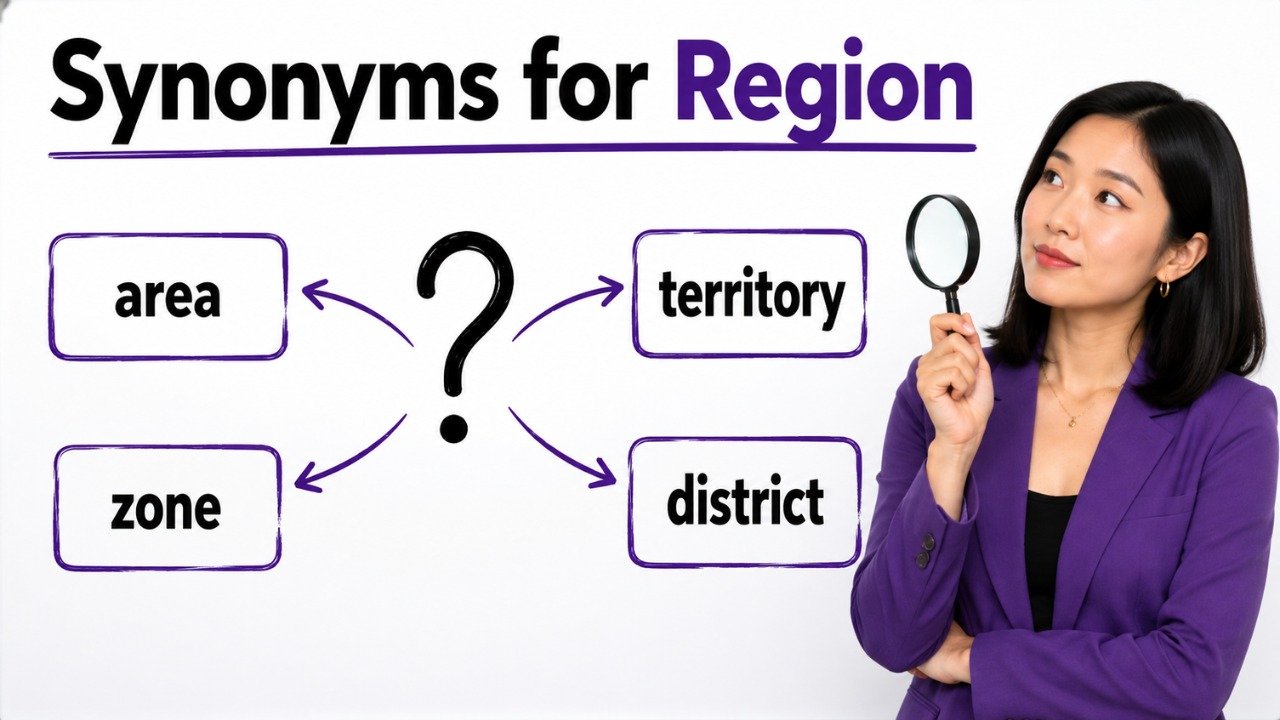
Quick Answer: Common synonyms for region include area, zone, territory, district, locality, sector, province, section, part, and tract. The best choice depends on context. Use area for a general place, zone for a clearly defined space, territory for land under control or ownership, district for an administrative or urban division, locality for a particular place, province for a formal political division, and sector or section when referring to one part of a larger whole. These synonyms for region help make geographical, academic, business, and everyday writing more precise.
Pronunciation and Word Details
Word: Region
Pronunciation: /ˈriːdʒən/
Part of Speech: Noun
Meaning: A region is a particular area, part, or section of a place, country, body, system, or larger whole.
US Pronunciation:
UK Pronunciation:
What Does “Region” Mean?
Region means a particular area or part of a larger place or whole. It is a noun commonly used in geography, government, business, science, anatomy, travel, economics, and everyday conversation.
A region can refer to a broad geographical area.
Example: The northern region receives more rainfall.
It can also describe an administrative or political division.
Example: The region has its own local government.
Region may describe an area that shares similar physical, cultural, economic, or climatic features.
Example: The coastal region is known for mild winters.
The word can also refer to part of the body.
Example: The patient felt pain in the abdominal region.
In technical or academic contexts, region can describe a specific part of a system, diagram, space, or field.
Example: This region of the chart shows the strongest growth.
Because region has several uses, synonyms such as area, zone, territory, district, locality, sector, province, section, and tract differ slightly in meaning.
Meaning, Tone, and Context of “Region”
Region is a neutral and versatile word. It can sound natural in everyday conversation while also being suitable for formal, academic, scientific, geographical, and professional writing.
Geographical Tone: Region is commonly used for a large area identified by location, climate, landscape, or cultural characteristics.
Example: The eastern region contains several mountain ranges.
Administrative Tone: Region may describe an officially organized part of a country or territory.
Example: Each region follows the national regulations.
Academic Tone: Researchers often use region when describing areas with shared physical, social, or economic characteristics.
Example: The study compares employment levels across the region.
Scientific Tone: Region can identify a defined part of an object, body, organism, or diagram.
Example: This region of the brain is associated with memory.
Business Tone: Region may describe a sales, distribution, or operational area.
Example: Demand increased throughout the western region.
Conversational Tone: In everyday speech, area is often more natural than region for small or ordinary locations.
Example: There are several restaurants in this area.
Region usually sounds broader and somewhat more structured than place or area.
When and How to Use “Region”
Use region when you need to describe a distinct area within something larger. The exact meaning depends on whether you are discussing geography, administration, business, science, anatomy, or another field.
For Geography: Use region for a broad area identified by physical or geographical characteristics.
Example: The southern region has a warmer climate.
For Culture: Use region when an area shares traditions, language, food, history, or customs.
Example: This region is known for its distinctive cuisine.
For Administration: Use region for a recognized governmental or organizational division.
Example: The agency operates through several regional offices.
For Business: Use region when a company or organization divides operations by location.
Example: Sales increased across the eastern region.
For Climate: Use region when referring to an area with similar weather patterns.
Example: The region experiences long, dry summers.
For Science: Use region to identify a specific part of an object, organism, chart, or field.
Example: The darker region indicates greater density.
For Anatomy: Use region for a particular part of the body.
Example: He reported discomfort in the lower back region.
For General Location: Use region when the exact boundaries do not need to be highly precise.
Example: Several small towns are located in the surrounding region.
Best Synonyms for Region
Area: A general part of a place or space.
Example: The coastal area attracts many visitors.
Zone: A defined space with a particular purpose, feature, or condition.
Example: The building is located in an industrial zone.
Territory: Land belonging to, controlled by, or associated with a group, country, or authority.
Example: The animals defend their territory from intruders.
District: A defined administrative, commercial, residential, or urban division.
Example: She works in the financial district.
Locality: A particular place or small geographical area.
Example: This species is found only in one locality.
Sector: One part of a larger area, system, economy, or organization.
Example: Development is concentrated in the northern sector.
Province: A major administrative division within certain countries or territories.
Example: The province contains several large cities.
Section: A distinct part of a larger place or object.
Example: This section of the park is closed for repairs.
Territory: A particular geographical area, especially one connected with control or jurisdiction.
Example: The territory stretches from the river to the mountains.
Tract: A continuous stretch or area of land.
Example: A large tract of forest surrounds the village.
50 Synonyms for Region with Short Meanings
- Area: A general part of a place or space.
- Zone: A defined area with a particular use or feature.
- Territory: Land associated with ownership, control, or jurisdiction.
- District: A defined administrative or urban division.
- Locality: A particular place or limited geographical area.
- Sector: One part of a larger area or system.
- Province: A major political or administrative division.
- Section: A distinct part of a larger whole.
- Tract: A continuous stretch of land.
- Part: A portion of something larger.
- Place: A particular location or area.
- Location: A specific position or place.
- Locale: A place considered in relation to its surroundings or events.
- Quarter: A particular section of a town or city.
- Neighborhood: A local area within a town or city.
- Division: A part separated from a larger whole.
- Subdivision: A smaller section within a larger division.
- Territory: A defined geographical space under control or influence.
- Belt: A long area characterized by a particular feature.
- Strip: A long and narrow area of land.
- Stretch: A continuous area or extent.
- Expanse: A broad and open area.
- District Area: A defined portion of a larger administrative place.
- Precinct: A defined district created for administrative or official purposes.
- Jurisdiction: An area under a particular authority.
- Domain: An area controlled, owned, or influenced by someone or something.
- Sphere: A particular field, area, or range of activity.
- Realm: An area of activity, knowledge, influence, or territory.
- Field: An area of activity, study, or operation.
- Range: An area or extent over which something occurs.
- Territory Area: A portion of land recognized by boundaries or control.
- Land: An area of ground or territory.
- Country: A geographical or political territory.
- Countryside: A rural region outside towns and cities.
- Landscape: An area considered by its visible physical features.
- Terrain: Land considered according to its physical characteristics.
- Environment: The surrounding area or conditions.
- Surroundings: The area around a particular place.
- Vicinity: The area near a particular location.
- Environs: The surrounding district or area.
- Quarter: A distinct part of a city or town.
- Patch: A relatively small area with distinct features.
- Pocket: A small, distinct area within a larger one.
- Corridor: A long narrow region connecting places or activities.
- Basin: A geographical area drained by a river system or surrounded by higher land.
- Coast: A region along the edge of the sea.
- Interior: The inner part of a country, region, or area.
- Borderland: An area near a boundary between territories.
- Heartland: A central or important region of a country or activity.
- Territorial Division: An officially defined section of land.
Read Also:
Synonyms for Uncaring
Synonyms for Region by Context
When Region Means a General Area
Area, place, locality, locale, section, part, and location are useful when region simply means a particular place.
Area: The most flexible everyday replacement.
Example: The surrounding area has several small lakes.
Locality: Best when referring to a particular geographical place.
Example: The plant is common in this locality.
Locale: Often refers to a setting connected with an activity or event.
Example: The coastal village was chosen as the locale for the festival.
Section: Useful when describing one part of a larger space.
Example: This section of the city is mainly residential.
When Region Means a Political or Administrative Area
Province, district, territory, precinct, jurisdiction, division, and subdivision work when boundaries are officially recognized.
Province: Appropriate for a major governmental division.
Example: The province has a population spread across several cities.
District: Common for administrative, electoral, educational, or urban areas.
Example: The school serves families throughout the district.
Territory: Best when land is governed, controlled, or claimed by an authority.
Example: The territory has clearly defined borders.
Jurisdiction: Focuses on the area within which an authority has legal power.
Example: The court has authority throughout the jurisdiction.
When Region Means a Geographical Area
Territory, terrain, landscape, belt, basin, coast, interior, tract, and expanse can describe geographical regions.
Terrain: Focuses on the physical features of the land.
Example: The mountainous terrain makes travel difficult.
Landscape: Emphasizes the visible characteristics of an area.
Example: The landscape changes dramatically farther north.
Belt: Describes a broad strip known for one dominant characteristic.
Example: The agricultural belt produces much of the region’s grain.
Basin: Useful for an area shaped by drainage or surrounding landforms.
Example: Several rivers flow through the basin.
When Region Means a Business or Operational Area
Sector, territory, division, district, zone, and field may replace region in business contexts.
Territory: Common when an employee or team is responsible for a particular sales area.
Example: She manages the northern sales territory.
Sector: Useful when a geographical area is one part of a larger operation.
Example: Growth was strongest in the western sector.
Division: Appropriate when an organization is separated into major operational parts.
Example: The regional division oversees several branches.
When Region Means a Defined Zone
Zone, sector, belt, corridor, district, and precinct are useful when the area has particular boundaries, functions, or conditions.
Zone: Best for an area defined by rules, purpose, or physical conditions.
Example: Parking is prohibited in this zone.
Corridor: Describes a long area that connects important places or supports movement.
Example: New businesses have developed along the transport corridor.
Precinct: Refers to a clearly defined administrative or official district.
Example: Residents voted at the designated precinct.
When Region Means a Part of the Body
Area, section, zone, and part can replace region in general anatomical descriptions.
Area: The most natural alternative in everyday medical language.
Example: She felt pain in the shoulder area.
Section: Useful when discussing a specific anatomical portion.
Example: The image shows a section of the upper abdomen.
Zone: Sometimes used in technical descriptions for a defined anatomical area.
Example: The tissue in this zone appears darker.
When Region Means a Field or Sphere
Sphere, realm, domain, field, and area can replace region when the word is figurative rather than geographical.
Sphere: Refers to a field of activity or influence.
Example: His research lies within the sphere of environmental science.
Realm: Often describes a broad field of thought or experience.
Example: The topic belongs to the realm of economics.
Domain: Refers to an area of knowledge, activity, or authority.
Example: This question falls within the domain of biology.
Another Word for Region
The best general replacement for region is area because it works naturally in many everyday and formal sentences. However, the ideal synonym depends on what kind of region you mean.
Use zone for a defined or controlled space, district for an official or urban division, territory for land under control, province for an administrative division, and sector for one portion of a larger geographical or operational area.
Original: This region receives heavy rainfall in winter.
Better Option: This area receives heavy rainfall in winter.
Original: The company plans to expand throughout the region.
Better Option: The company plans to expand throughout the territory.
Original: This region of the city contains many offices.
Better Option: This district of the city contains many offices.
Original: The northern region showed the strongest sales growth.
Better Option: The northern sector showed the strongest sales growth.
When Not to Use “Region”
Region is broad, so it can become vague when a more precise noun would improve the sentence.
Avoid region when you mean a small local place and area or neighborhood would sound more natural.
Weak: There are three parks in my region.
Better: There are three parks in my neighborhood.
Avoid region when official administrative boundaries matter.
Weak: The province is one important region of the country.
Better: The province is one important administrative division of the country.
Avoid region when discussing land under legal or political control.
Weak: The army entered a neighboring region.
Better: The army entered a neighboring territory.
Avoid region when the meaning is specifically about one business category.
Weak: The technology region grew rapidly.
Better: The technology sector grew rapidly.
Avoid region when describing the visible features of land.
Weak: The region was rocky and steep.
Better: The terrain was rocky and steep.
Avoid repeated use when several different meanings appear close together.
Weak: The region includes a farming region, a mountain region, and a business region.
Better: The area includes an agricultural belt, a mountain district, and a commercial zone.
Words Commonly Confused With Region
Region vs Area: Region often suggests a broad or recognizable part of a larger geographical whole. Area is more general and can describe places of almost any size.
Region vs Zone: A region can have natural or informal boundaries. A zone usually has a clearer function, condition, or defined boundary.
Region vs Territory: Region describes an area without necessarily implying ownership or control. Territory often involves political, legal, personal, or organizational control.
Region vs District: Region is usually broader and less specific. District often refers to an officially defined, urban, commercial, or administrative area.
Region vs Province: Region is a general geographical term. Province is a formal governmental division in places that use that administrative system.
Region vs Locality: Region usually describes a larger area. Locality refers to a particular place, often smaller and more specific.
Region vs Sector: Region mainly describes a geographical or spatial area. Sector may describe either part of a geographical area or a category within an economy or organization.
Region vs Terrain: Region tells you where an area is. Terrain describes the physical character of the land.
Which Synonym Should You Choose?
Choose area for general everyday references to places or spaces.
Choose zone when the place has defined boundaries, rules, conditions, or functions.
Choose territory when ownership, jurisdiction, control, or responsibility matters.
Choose district for urban, administrative, electoral, educational, or commercial areas.
Choose locality when referring to one particular geographical place.
Choose province when describing an official administrative division that is formally called a province.
Choose sector when dividing a larger region, market, operation, or territory into parts.
Choose tract when referring to a continuous stretch of land.
Choose terrain when emphasizing hills, valleys, mountains, slopes, or other physical land features.
Choose landscape when discussing the visible appearance of an area.
Choose vicinity when describing places close to a particular location.
Choose environs when referring to the surrounding area in more formal writing.
Choose neighborhood for a local residential or urban area.
Choose jurisdiction when legal or administrative authority defines the boundary.
Choose realm, sphere, domain, or field when region is being used figuratively for an area of knowledge or activity.
For reports and academic writing, region, area, sector, district, territory, and zone are generally useful, but the most precise word should match the type of boundary being discussed.
For casual conversation, area, place, neighborhood, and part usually sound natural.
Real Life Examples of “Region” in Sentences
Original: The region receives very little rain during summer.
Better Option: The area receives very little rain during summer.
Original: Several factories operate in this region.
Better Option: Several factories operate in this industrial zone.
Original: She manages sales throughout the northern region.
Better Option: She manages sales throughout the northern territory.
Original: This region of the city is famous for restaurants.
Better Option: This district of the city is famous for restaurants.
Original: The region contains several small farming communities.
Better Option: The locality contains several small farming communities.
Original: Wildlife is protected throughout the region.
Better Option: Wildlife is protected throughout the designated territory.
Original: The eastern region reported higher demand this month.
Better Option: The eastern sector reported higher demand this month.
Original: The region around the river is extremely fertile.
Better Option: The river basin is extremely fertile.
Original: The patient experienced pain in the chest region.
Better Option: The patient experienced pain in the chest area.
Original: This region of research has developed rapidly.
Better Option: This field of research has developed rapidly.
Synonym Groups and Usage Differences
General Location Group
Area, place, locality, locale, location, and vicinity describe places without strongly emphasizing government or ownership.
Area is the broadest and most flexible. Locality and locale are more specific. Vicinity means the surrounding area near a particular point.
Example: Several hotels are located in the immediate vicinity.
Administrative Group
District, province, jurisdiction, precinct, division, and subdivision describe formally organized areas.
District is common for cities and public administration. Province refers to a major governmental unit. Jurisdiction emphasizes legal authority.
Example: The district contains several public schools.
Geographical Group
Terrain, landscape, basin, coast, belt, tract, interior, and borderland emphasize physical or geographical characteristics.
Terrain focuses on the shape and nature of land. Landscape focuses on appearance. Basin describes a natural geographical formation.
Example: The terrain becomes more mountainous toward the north.
Boundary Group
Zone, territory, precinct, sector, and corridor often imply clearer limits or functions.
Zone is often created for a specific purpose. Territory may be controlled or managed. Corridor usually describes a narrow connected stretch.
Example: Development is restricted within the conservation zone.
Urban Group
District, quarter, neighborhood, locality, and precinct work well for parts of towns or cities.
Neighborhood is usually residential and informal. District may be official, commercial, cultural, or administrative. Quarter often refers to a distinctive part of a city.
Example: The old quarter contains narrow streets and historic buildings.
Business Group
Territory, sector, division, zone, field, and district can describe business operations or economic activity.
Territory commonly refers to sales responsibility. Sector often refers to a part of an economy. Division usually describes an organizational unit.
Example: The western sales territory exceeded its target.
Figurative Group
Realm, domain, sphere, field, and area describe nonphysical regions of knowledge, activity, responsibility, or influence.
Domain often sounds technical or academic. Realm can be more conceptual. Field is common in education and professional contexts.
Example: Artificial reasoning belongs to a complex field of study.
Antonyms of Region
Region does not have one exact antonym because it refers to a part of a larger whole. Its opposites depend on whether you mean a limited area, an internal section, or a specific location.
Whole: The complete thing rather than one region or section.
Entirety: The complete extent of something.
Totality: Everything considered together rather than one part.
Center: The middle point rather than a surrounding region.
Outside: A place beyond the limits of a particular area.
Exterior: The outer part rather than an internal region.
Everywhere: All places rather than one defined area.
Nationwide: Covering an entire country rather than one region.
Global: Covering the whole world rather than one geographical region.
Universal: Applying everywhere rather than within a specific area.
Central Point: A specific middle location rather than a broad region.
Whole Territory: The complete territorial area rather than one section.
Comparison: Region vs Related Words
Region vs Area
Region generally suggests a recognizable geographical or functional part of a larger whole. Area is more general and can refer to spaces of any size.
Example With Region: The northern region is colder than the coast.
Example With Area: This area has several walking paths.
Region vs Zone
Region may have broad or natural boundaries. Zone usually refers to a space defined by purpose, rules, conditions, or measurable limits.
Example With Region: The region is known for vineyards.
Example With Zone: Construction is prohibited in this zone.
Region vs Territory
Region describes location. Territory often adds the idea of control, ownership, authority, or responsibility.
Example With Region: The region contains several rivers.
Example With Territory: The team is responsible for the entire sales territory.
Region vs District
Region is usually broader and may be informal. District is often a defined administrative, commercial, residential, or urban division.
Example With Region: The western region is mostly rural.
Example With District: The financial district contains many office buildings.
Region vs Province
Region is a general description. Province is a formal political or administrative term where that system of government is used.
Example With Region: The region has a diverse climate.
Example With Province: The province administers several public services.
Region vs Locality
Region normally refers to a broader area. Locality points to a more specific place.
Example With Region: The species occurs throughout the coastal region.
Example With Locality: The species was recorded at only one locality.
Region vs Sector
Region usually identifies a geographical area. Sector can mean one geographical portion or one category of activity, business, or economy.
Example With Region: Population growth is strongest in the eastern region.
Example With Sector: Most new construction is occurring in the eastern sector.
Region vs Terrain
Region identifies an area. Terrain describes the physical features of the land within an area.
Example With Region: The region is difficult to access.
Example With Terrain: The rocky terrain is difficult to cross.
Common Phrases and Expressions With “Region”
Geographical Region: An area defined by physical, political, cultural, or environmental features.
Coastal Region: An area located near a sea or ocean.
Northern Region: The part of a larger territory located toward the north.
Southern Region: The part of a larger territory located toward the south.
Mountainous Region: An area dominated by mountains or elevated terrain.
Rural Region: An area mainly consisting of countryside and small communities.
Urban Region: An area dominated by cities or densely developed settlements.
Economic Region: An area considered according to economic activity and connections.
Administrative Region: A defined territorial division used for government or organization.
Surrounding Region: The broader area around a particular place.
Common Mistakes to Avoid
One common mistake is treating every synonym for region as interchangeable. Words such as area, territory, district, province, zone, and locality all describe places, but each carries a different meaning.
Weak: The parking region closes at night.
Better: The parking zone closes at night.
A second mistake is using region where an official administrative term would be more accurate.
Weak: She governs one region of the country.
Better: She governs one province of the country.
Do not use territory when there is no idea of control, ownership, jurisdiction, or responsibility unless the context naturally supports it.
Weak: We walked through a beautiful territory near the lake.
Better: We walked through a beautiful area near the lake.
Avoid calling a small neighborhood a region unless you intentionally want a very broad or technical description.
Weak: There is a grocery store in my region.
Better: There is a grocery store in my neighborhood.
Do not confuse terrain with region. Terrain refers to physical land characteristics rather than geographical location alone.
Weak: The northern terrain has several large cities.
Better: The northern region has several large cities.
Avoid unnecessary repetition in reports and essays.
Weak: The region contains forests. The region also contains farms. The region has several rivers.
Better: The region contains forests, farmland, and several rivers.
Be careful when using sector. It can refer to a geographical portion, but it also commonly describes part of an economy or organization.
Example: The western sector of the city experienced rapid growth.
Different Meaning: The manufacturing sector created additional jobs.
Another mistake is using province as a general synonym when the place being discussed does not use that official administrative term. Province should be reserved for contexts where the label is actually appropriate.
Use precise synonyms according to boundaries, size, function, government, geography, and context. A specific word usually makes a sentence clearer than a broad replacement chosen only to avoid repetition.
Conclusion
Understanding synonyms for region helps you describe places, boundaries, territories, and sections with greater precision. Area is the best general alternative, while zone suits defined spaces, district works for administrative or urban divisions, territory emphasizes control, province identifies a formal political division, and sector describes one part of a larger whole. For physical geography, terrain, basin, belt, coast, and landscape may be better choices. Selecting the right synonym makes descriptions clearer, more natural, and more accurate in both everyday and formal writing.
FAQs About Synonyms for Region
What Is the Best Synonym for Region?
The best general synonym for region is area. It works in many geographical, everyday, and descriptive contexts, although district, territory, zone, and sector may be more precise in specific situations.
What Is Another Word for Region in Geography?
Useful Alternatives: Area, territory, terrain, zone, tract, basin, belt, coast, and landscape can work depending on the geographical feature being described.
What Is a Formal Synonym for Region?
Formal Alternatives: Territory, district, jurisdiction, sector, province, locality, and administrative division can be suitable in formal writing.
Are Region and Area the Same?
Not exactly. Area is a very general word for any space or place. Region usually suggests a broader or recognizable part of a larger geographical or functional whole.
What Is the Difference Between Region and Territory?
Region mainly identifies an area. Territory often suggests control, ownership, political authority, jurisdiction, or organizational responsibility.
What Is Another Word for Region in a City?
Best Choices: District, quarter, neighborhood, locality, precinct, section, and zone are useful alternatives for parts of a city.
Which Synonym for Region Is Best in Academic Writing?
Area is useful for general descriptions, region works well for broad geographical analysis, sector suits divided systems, territory is useful when control matters, and locality works when referring to a specific place.
