
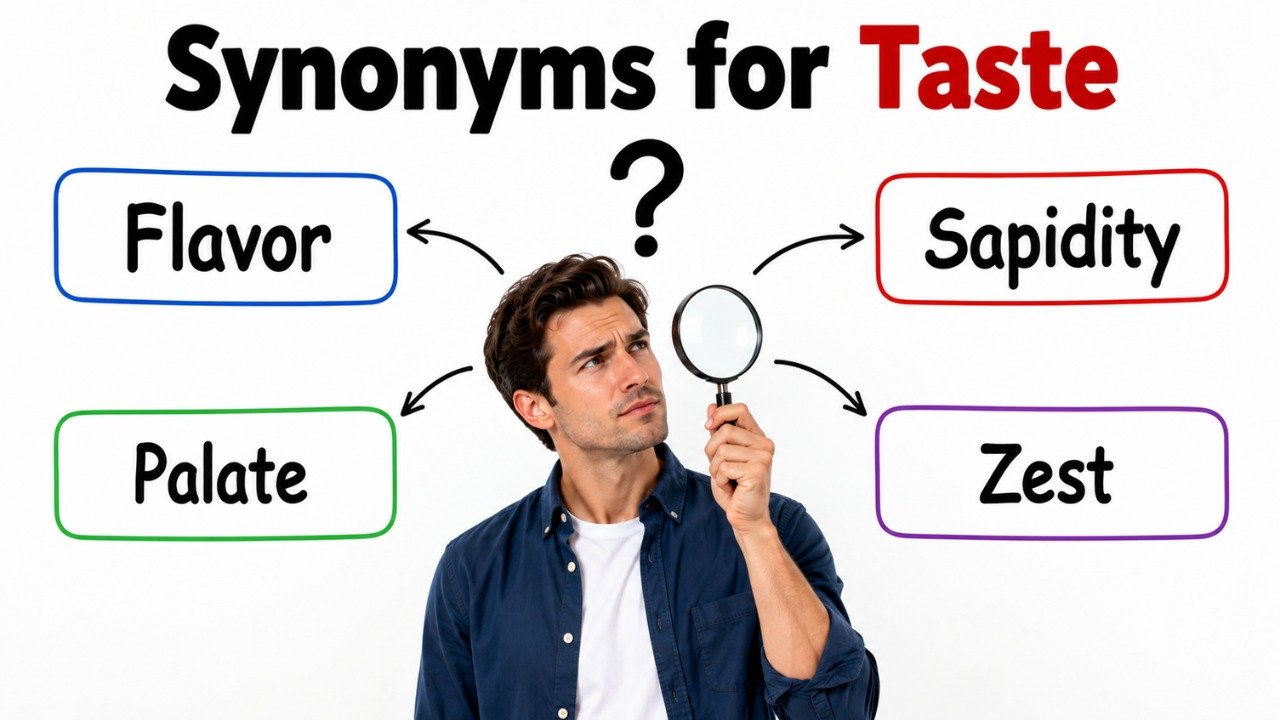
Quick Answer: The best synonyms for taste include flavor, savor, sample, preference, liking, palate, style, discernment, hint, and experience. Use flavor when describing the quality of food or drink. Choose sample or try when someone consumes a small amount. Preference and liking describe personal choices, while style, palate, and discernment refer to artistic judgment or an appreciation of quality. The most suitable synonyms for taste depend on whether the word refers to flavor, testing, preference, style, or personal experience.
Pronunciation and Word Details
Word: Taste.
Pronunciation: /teɪst/.
Part of Speech: Noun and verb.
Meaning: The flavor of something, the act of sampling it, or a personal preference for a particular thing.
US Pronunciation:
UK Pronunciation:
What Does “Taste” Mean?
Taste means the flavor a person notices when food or drink touches the tongue. It can also mean the act of trying a small amount of something, a personal preference, an artistic judgment, or a brief experience.
As a noun, taste can describe a physical sensation.
Example: The soup has a rich and spicy taste.
It can also describe a personal preference.
Example: Her taste in furniture is simple and elegant.
As a verb, taste means to notice flavor through the mouth or to try a small amount.
Example: Taste the sauce before adding more salt.
Taste may also describe experiencing something briefly.
Example: The team finally tasted success after years of effort.
Because taste has several meanings, the correct synonym depends on the sentence. Flavor may fit food, preference may fit personal choices, sample may fit trying something, and discernment may fit artistic judgment.
Meaning, Tone, and Context of “Taste”
Taste is a neutral and widely used word. It appears naturally in casual conversation, formal writing, food descriptions, reviews, health discussions, art criticism, fashion writing, and everyday communication.
When taste describes food or drink, its tone is usually neutral and descriptive.
Example: The fruit has a sweet taste.
When it describes personal preferences, it can sound conversational or polite.
Example: We have different tastes in music.
When taste refers to judgment or refinement, it can sound more formal.
Example: The room was decorated with excellent taste.
The word can also carry an emotional meaning when it describes an unpleasant memory or experience.
Example: The argument left a bitter taste in his mind.
In technical discussions, taste may refer to one of the physical senses. In creative writing, it may appear figuratively to describe experience, success, failure, freedom, or danger.
When and How to Use “Taste”
For Flavor
Use taste when describing the sensation produced by food or drink.
Example: The tea has a refreshing taste.
For Sampling Food
Use taste as a verb when someone tries a small amount of food or drink.
Example: Please taste the soup and tell me whether it needs seasoning.
For Personal Preference
Use taste when discussing what someone likes in music, art, clothing, food, decoration, or entertainment.
Example: His taste in films is very different from mine.
For Artistic Style
Taste can describe a person’s ability to choose attractive, suitable, or elegant things.
Example: She furnished the apartment with great taste.
For Judgment
Use taste when describing someone’s sense of quality, appropriateness, or refinement.
Example: The joke showed poor taste.
For a Small Experience
Taste can mean a brief experience of something.
Example: The internship gave her a taste of professional life.
For Figurative Success or Failure
Taste may describe experiencing an important result or emotion.
Example: The young player tasted victory for the first time.
Best Synonyms for Taste
Flavor: The distinctive quality noticed when food or drink is consumed.
Example: The herbs added a fresh flavor to the sauce.
Savor: A pleasant or noticeable flavor, especially one that is enjoyed slowly.
Example: The stew had the savor of roasted vegetables.
Sample: To try a small quantity of food, drink, or another product.
Example: Visitors may sample several varieties of cheese.
Try: To eat, drink, or experience something to discover what it is like.
Example: You should try the vegetable soup.
Preference: A greater liking for one option than another.
Example: Her preference is for quiet restaurants.
Liking: A feeling of enjoyment or approval toward something.
Example: He developed a liking for strong coffee.
Palate: A person’s ability to recognize, appreciate, or judge flavors.
Example: The dish appealed to her experienced palate.
Style: A particular manner of choosing, arranging, or expressing things.
Example: His decorating style is modern and practical.
Discernment: The ability to recognize and choose what is good, suitable, or valuable.
Example: Her choice of artwork showed excellent discernment.
Hint: A small or faint amount of a flavor, quality, or sensation.
Example: The drink had a hint of lemon.
50 Synonyms for Taste with Short Meanings
- Flavor: The quality noticed when food or drink is consumed.
- Savor: A distinctive or enjoyable flavor.
- Tang: A strong, sharp, or lively flavor.
- Zest: A fresh, exciting, or slightly sharp flavor.
- Relish: An enjoyable flavor or strong appreciation.
- Smack: A noticeable trace of a particular flavor.
- Piquancy: A pleasantly sharp or spicy quality.
- Aftertaste: A flavor that remains after eating or drinking.
- Finish: The final flavor left after swallowing something.
- Note: A particular quality within a larger flavor.
- Hint: A small amount of flavor or quality.
- Trace: A very slight amount of a sensation.
- Touch: A small but noticeable amount.
- Suggestion: A faint sign of a flavor or quality.
- Nuance: A subtle difference in flavor or character.
- Undertone: A quiet or less obvious quality beneath the main flavor.
- Essence: The central quality or character of something.
- Character: The distinctive nature of a flavor or style.
- Quality: A noticeable feature or characteristic.
- Sensation: A physical feeling produced by the senses.
- Sample: A small amount tried for evaluation.
- Try: To test something by eating, drinking, or experiencing it.
- Sip: To drink a small amount slowly.
- Nibble: To eat a small amount in little bites.
- Test: To examine something by trying it.
- Experience: To feel, encounter, or undergo something.
- Encounter: To come into contact with a feeling or situation.
- Feel: To experience a physical or emotional sensation.
- Know: To become familiar with something through experience.
- Undergo: To experience a particular event or condition.
- Preference: A stronger liking for one option.
- Liking: A feeling of enjoyment or approval.
- Inclination: A natural tendency to prefer something.
- Fondness: A warm or gentle liking.
- Choice: A selected option based on personal preference.
- Fancy: A casual desire or liking for something.
- Appetite: A desire for food or a particular experience.
- Partiality: A special liking for one thing.
- Predilection: A strong established preference.
- Penchant: A noticeable tendency to like something.
- Style: A particular way of choosing or presenting things.
- Judgment: The ability to make sensible choices.
- Discernment: Skill in recognizing quality and value.
- Sensibility: An awareness of beauty, quality, or appropriateness.
- Refinement: Polished judgment and appreciation.
- Elegance: Graceful and tasteful quality.
- Aesthetic: A particular sense of beauty or artistic value.
- Sophistication: Knowledgeable and refined appreciation.
- Discrimination: The ability to notice differences in quality.
- Appreciation: Understanding and enjoyment of value or quality.
Read Also:
Synonyms for Differently

Synonyms for Taste by Context
When Taste Means Flavor
Flavor is the most direct synonym when taste refers to the quality of food or drink.
Other useful alternatives include savor, tang, zest, aftertaste, finish, note, and piquancy.
Example With Taste: The sauce has a rich taste.
Example With Flavor: The sauce has a rich flavor.
Use tang when the flavor is sharp or lively.
Example: The yogurt has a pleasant tang.
Use aftertaste when describing a flavor that remains after swallowing.
Example: The medicine left a bitter aftertaste.
When Taste Means Trying Food
Sample and try are the strongest alternatives when taste means consuming a small amount.
Sip works for drinks, while nibble works for food eaten in small bites.
Example With Taste: Taste the cake before serving it.
Example With Sample: Sample the cake before serving it.
Example With Try: Try the cake and tell me what you think.
When Taste Means Personal Preference
Preference, liking, inclination, fondness, partiality, predilection, and penchant describe what someone enjoys or chooses.
Example With Taste: She has a taste for classical music.
Example With Preference: She has a preference for classical music.
Use liking in everyday conversation.
Example: He has a strong liking for mystery novels.
Use predilection in more formal writing.
Example: The designer has a predilection for natural materials.
When Taste Means Artistic Judgment
Style, discernment, refinement, sensibility, aesthetic, and sophistication describe a person’s ability to recognize beauty or quality.
Example With Taste: The office was decorated with good taste.
Example With Discernment: The office was decorated with great discernment.
Style is useful when describing a visible way of presenting or arranging things.
Example: Her personal style combines comfort with elegance.
When Taste Means a Brief Experience
Experience, encounter, feel, know, and undergo can replace taste when the word describes a short experience.
Example With Taste: The trip gave them a taste of village life.
Example With Experience: The trip allowed them to experience village life.
Use glimpse when the experience is brief and incomplete, although it is not a direct synonym in every sentence.
Example: The visit offered a glimpse of life in the countryside.
Another Word for Taste
Flavor is usually the best single replacement when taste refers to food or drink. However, the strongest alternative changes with the intended meaning.
Use preference for personal choices, sample for trying a small amount, style for appearance, and discernment for refined judgment.
Original: The soup has a smoky taste.
Better Option: The soup has a smoky flavor.
Original: He has unusual taste in music.
Better Option: He has an unusual preference in music.
Original: Taste the bread before buying a loaf.
Better Option: Sample the bread before buying a loaf.
Original: She selected the furniture with excellent taste.
Better Option: She selected the furniture with excellent discernment.
When Not to Use “Taste”
Taste should not be used when its meaning could be unclear. Because it can refer to flavor, preference, judgment, or experience, readers may misunderstand a sentence without enough context.
Weak: His taste changed after the trip.
This sentence does not explain whether his food preferences, artistic preferences, or opinions changed.
Better: His preference for spicy food changed after the trip.
Avoid repeating taste several times in the same paragraph.
Weak: The dish had a sweet taste, but the taste became bitter, and the final taste was unpleasant.
Better: The dish began with a sweet flavor, developed a bitter note, and ended with an unpleasant aftertaste.
Do not use taste when a more exact sensory word is needed.
Weak: The lemon had a strong taste.
Better: The lemon had a sharp, sour flavor.
Taste may also sound too casual in formal discussions of artistic judgment.
Weak: The architect showed good taste.
Better: The architect demonstrated strong aesthetic judgment.
Do not replace taste with flavor when the sentence is about personal preference.
Weak: Her flavor in clothing is traditional.
Better: Her taste in clothing is traditional.
Better: Her clothing preference is traditional.
Words Commonly Confused With Taste
Taste vs Flavor: Taste can describe a physical sense, a personal preference, or artistic judgment. Flavor usually refers specifically to the combined qualities noticed in food or drink.
Taste vs Palate: Taste is the sensation or preference itself. Palate is the ability to recognize and appreciate flavors.
Taste vs Savor: Taste can be neutral and general. Savor usually suggests a distinctive or enjoyable flavor and may also mean enjoying something slowly.
Taste vs Preference: Taste may describe a general pattern of liking. Preference usually describes choosing one option over another.
Taste vs Style: Taste refers to personal judgment or preference. Style refers to the visible way someone presents, arranges, or creates something.
Taste vs Aroma: Taste is noticed mainly through the mouth. Aroma is noticed through the sense of smell, although aroma can influence the overall perception of flavor.
Taste vs Appetite: Taste describes flavor or preference. Appetite describes a desire to eat or a strong desire for something.
Taste vs Discernment: Taste can be either good or poor. Discernment specifically suggests the ability to recognize quality and make wise choices.
Which Synonym Should You Choose?
Choose flavor when describing food, drinks, sauces, ingredients, or recipes.
Choose savor when emphasizing an enjoyable or distinctive flavor.
Choose tang when describing a sharp, sour, or lively flavor.
Choose sample when someone tries a small amount for evaluation.
Choose try in casual speech when encouraging someone to eat, drink, or experience something.
Choose preference when discussing a person’s choice between options.
Choose liking when describing a simple, everyday feeling of enjoyment.
Choose palate when discussing someone’s ability to recognize or appreciate flavors.
Choose style when describing clothing, decoration, design, writing, or presentation.
Choose discernment for formal writing about judgment, quality, art, or refinement.
Choose aesthetic when discussing a particular view of beauty or artistic appearance.
Choose experience when taste refers to briefly encountering a situation, feeling, success, or lifestyle.
Real Life Examples of “Taste” in Sentences
Original: The soup has a mild taste.
Better Option: The soup has a mild flavor.
Original: Would you like to taste the dessert?
Better Option: Would you like to sample the dessert?
Original: She has expensive taste in furniture.
Better Option: She has a preference for expensive furniture.
Original: His taste in music changed during college.
Better Option: His musical preferences changed during college.
Original: The drink has a taste of fresh berries.
Better Option: The drink has a hint of fresh berries.
Original: The meal left a strange taste in my mouth.
Better Option: The meal left a strange aftertaste.
Original: The designer showed excellent taste.
Better Option: The designer showed excellent discernment.
Original: The program gave students a taste of working life.
Better Option: The program gave students a brief experience of working life.
Original: She finally tasted success after years of practice.
Better Option: She finally experienced success after years of practice.
Original: I do not share his taste in films.
Better Option: I do not share his preference for those films.
Synonym Groups and Usage Differences
Flavor and Sensation Group
Flavor, savor, tang, zest, aftertaste, finish, note, nuance, and piquancy describe sensory qualities in food and drink.
Flavor is general. Tang suggests sharpness. Zest suggests freshness. Aftertaste describes what remains after swallowing. Note refers to one particular quality within a complex flavor.
Example: The sauce had a rich flavor with a hint of garlic and a sharp tang.
Sampling and Testing Group
Sample, try, sip, nibble, and test describe consuming or examining a small amount.
Sample is useful when the purpose is evaluation. Try is more conversational. Sip applies to liquids, while nibble applies to small bites of food.
Example: She sampled the soup, sipped the tea, and nibbled the bread.
Preference and Liking Group
Preference, liking, inclination, fondness, partiality, predilection, and penchant describe personal choices or attractions.
Preference is neutral and versatile. Fondness sounds warm and emotional. Predilection and penchant are more formal and often suggest a repeated tendency.
Example: He has a fondness for simple meals and a preference for quiet cafés.
Style and Discernment Group
Style, judgment, discernment, sensibility, refinement, elegance, aesthetic, and sophistication relate to artistic or social taste.
Style describes visible expression. Discernment describes the ability to recognize quality. Refinement and sophistication suggest developed knowledge and polished judgment.
Example: Her simple style and careful choices revealed strong artistic discernment.
Experience Group
Experience, encounter, feel, know, and undergo can replace taste when it means becoming familiar with a situation or emotion.
Experience is the most flexible choice. Encounter often suggests meeting something unexpectedly. Undergo usually refers to passing through a process or difficult situation.
Example: The project allowed students to experience the pressures of professional work.
Antonyms of Taste
The opposite of taste depends on which meaning is intended.
Tastelessness: The absence of flavor or good judgment.
Blandness: A lack of strong or interesting flavor.
Insipidity: A dull or uninteresting quality, especially in food or writing.
Flavorlessness: The condition of having little or no flavor.
Dislike: A feeling of not enjoying something.
Aversion: A strong feeling of dislike or avoidance.
Distaste: Dislike or disapproval toward something.
Indifference: A lack of preference, interest, or concern.
Crudeness: A lack of refinement or sensitivity.
Vulgarity: Behavior or style considered lacking in good taste.
Inelegance: A lack of grace, polish, or attractive style.
Inexperience: A lack of direct knowledge or practical exposure.
Unfamiliarity: A lack of knowledge gained through experience.
Comparison: Taste vs Related Words
Taste vs Flavor
Taste has several meanings, including physical sensation, preference, style, and experience. Flavor mainly describes the qualities of food or drink.
Example With Taste: I dislike the taste of the medicine.
Example With Flavor: The medicine has a bitter flavor.
Taste vs Savor
Taste is a general word for flavor or the act of trying something. Savor suggests a distinctive flavor or the act of enjoying something slowly.
Example With Taste: Taste the sauce before serving it.
Example With Savor: She paused to savor the rich sauce.
Taste vs Palate
Taste can mean a flavor or preference. Palate describes a person’s ability to recognize and judge flavors.
Example With Taste: He enjoys the taste of dark chocolate.
Example With Palate: His trained palate detected notes of fruit and spice.
Taste vs Preference
Taste may describe a broad pattern of personal choices. Preference usually identifies one option that someone likes more than another.
Example With Taste: Her taste in books is varied.
Example With Preference: Her preference is for historical novels.
Taste vs Style
Taste concerns judgment, liking, or appreciation. Style is the recognizable manner in which something is designed, presented, or expressed.
Example With Taste: She has excellent taste in clothing.
Example With Style: Her clothing style is simple and elegant.
Taste vs Discernment
Taste can describe any personal preference, whether informed or not. Discernment suggests careful judgment and an ability to recognize quality.
Example With Taste: His taste in artwork is unusual.
Example With Discernment: His collection demonstrates remarkable discernment.
Taste vs Aroma
Taste is sensed mainly through the mouth. Aroma is sensed through the nose and contributes to the complete experience of flavor.
Example With Taste: The tea has a slightly bitter taste.
Example With Aroma: The tea has a floral aroma.
Common Phrases and Expressions With Taste
Taste Good: To have an enjoyable flavor.
Example: The fresh bread tastes good with butter.
Taste Bad: To have an unpleasant flavor.
Example: The milk tasted bad because it was no longer fresh.
Taste Like: To have a flavor similar to something.
Example: The sauce tastes like roasted tomatoes.
Taste Of: To contain a noticeable flavor or quality.
Example: The drink tastes of lemon and mint.
A Taste For: A liking or preference for something.
Example: She developed a taste for classical music.
Good Taste: Sound judgment about style, behavior, or quality.
Example: The simple decoration showed good taste.
Bad Taste: Poor judgment or something considered inappropriate.
Example: The offensive comment was in bad taste.
Acquired Taste: Something that becomes enjoyable after repeated experience.
Example: Strong coffee can be an acquired taste.
Taste Test: An evaluation in which food or drink is sampled.
Example: The cooks conducted a taste test before finalizing the recipe.
To One’s Taste: Suitable for a person’s individual preference.
Example: The bold decoration was not to everyone’s taste.
Leave a Bad Taste: To create an unpleasant memory or feeling.
Example: The unfair decision left a bad taste in the employees’ minds.
A Taste of Something: A brief or limited experience of something.
Example: The workshop offered students a taste of professional design.
Common Mistakes to Avoid
Repetition: Avoid using taste repeatedly when more specific words would improve the description.
Weak: The food had a sweet taste, a fruity taste, and a fresh taste.
Better: The food had a sweet flavor, fruity notes, and a fresh finish.
Wrong Synonym Choice: Do not use flavor when discussing clothing, music, decoration, or personal choices.
Incorrect: She has a unique flavor in clothing.
Correct: She has unique taste in clothing.
Correct: She has a unique clothing style.
Confusing Taste and Palate: Palate does not simply mean flavor. It often refers to a person’s ability to recognize and appreciate flavors.
Incorrect: The soup has a salty palate.
Correct: The soup has a salty taste.
Correct: His experienced palate noticed that the soup was too salty.
Unnatural Formality: Avoid overly formal synonyms in casual sentences.
Unnatural: I possess a predilection for chocolate cake.
Natural: I have a taste for chocolate cake.
Vague Usage: Clarify which meaning of taste is intended when the context could be misunderstood.
Vague: Her taste improved.
Clear: Her taste in interior design became more refined.
Noun and Verb Confusion: Taste can function as both a noun and a verb, but the sentence structure changes.
Noun: The drink has a pleasant taste.
Verb: The drink tastes pleasant.
Incorrect Comparison: Do not use more tastier because tastier already expresses comparison.
Incorrect: This soup is more tastier than the other one.
Correct: This soup is tastier than the other one.
Conclusion
The most useful synonyms for taste depend on the intended meaning. Flavor, savor, tang, and aftertaste describe food or drink. Sample and try fit the act of testing something. Preference, liking, and fondness express personal choice, while style, discernment, and refinement relate to artistic judgment. Experience works when taste describes a brief encounter with a feeling or situation. Choosing precise synonyms for taste makes descriptions clearer, prevents repetition, and helps readers understand whether you mean flavor, preference, style, sampling, or experience.
FAQs About Synonyms for Taste
What Is the Best Synonym for Taste?
Flavor is the best synonym when taste refers to food or drink. Preference is better for personal choices, while sample works for the act of trying something.
What Is Another Word for Taste in Food?
Flavor, savor, tang, note, aftertaste, and finish are useful alternatives. The best choice depends on the particular quality being described.
What Is a Synonym for Personal Taste?
Preference, liking, inclination, fondness, partiality, and style can describe personal taste.
Can Flavor Always Replace Taste?
No. Flavor can replace taste in many food related sentences, but it cannot normally replace taste when discussing clothing, music, judgment, or personal preference.
What Is a Formal Synonym for Good Taste?
Discernment, refinement, sophistication, and aesthetic judgment are suitable formal alternatives for good taste.
What Is a Synonym for Taste as a Verb?
Sample, try, sip, nibble, and test can replace taste as a verb, depending on what is being consumed.
Are Taste and Palate the Same?
No. Taste is the sensation, flavor, or preference. Palate is the ability to notice, recognize, and appreciate different flavors.
