
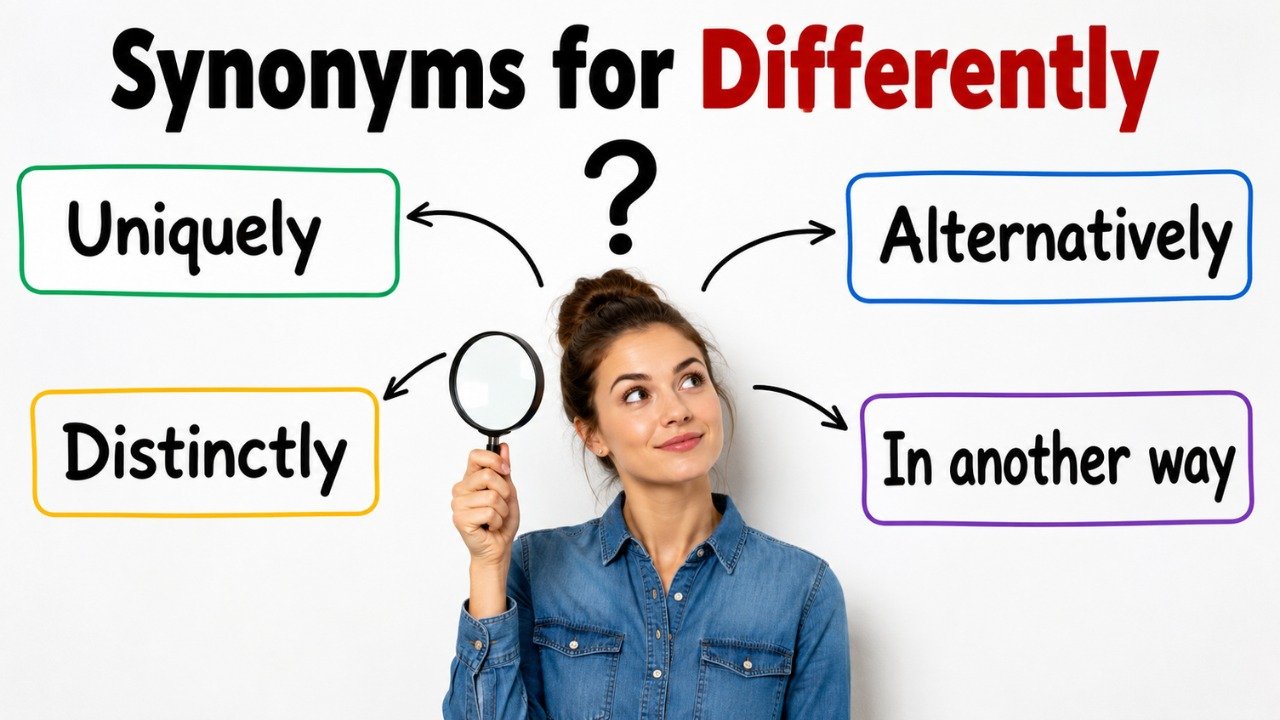
Quick Answer: The best synonyms for differently include otherwise, alternatively, dissimilarly, distinctively, uniquely, separately, individually, variously, unusually, and in another way. Use otherwise for a general contrast, alternatively for another choice or method, and dissimilarly for a formal comparison. Distinctively and uniquely describe a special style or quality. Separately and individually suit situations involving independent treatment, while variously shows that something happens in several ways. In casual speech, in another way is often the clearest replacement.
Pronunciation and Word Details
Word: Differently.
Pronunciation: /ˈdɪfərəntli/.
Part of Speech: Adverb.
Meaning: In a way that is not the same as another way, person, situation, or result.
US Pronunciation:
UK Pronunciation:
What Does “Differently” Mean?
Differently means in another way or in a manner that is not the same. It is an adverb, so it usually describes how an action happens, how a person behaves, how something appears, or how a situation develops.
The word often introduces a comparison. That comparison may be stated directly or understood from the surrounding context.
Direct Comparison: She completed the assignment differently from the other students.
Implied Comparison: I would handle the situation differently.
In the second example, the speaker means that they would use another method, even though the exact comparison is not stated.
Differently can describe changes in method, appearance, opinion, treatment, interpretation, behavior, or results.
Method: We organized the files differently this time.
Opinion: He thinks differently about the issue.
Treatment: The new employees were treated differently.
Appearance: The room looks differently under natural light.
Result: The plan could have ended differently.
The central idea is always some form of variation, contrast, or departure from what is normal, expected, or previously mentioned.
Meaning, Tone, and Context of “Differently”
Differently is generally a neutral and flexible word. It can appear in casual conversations, professional emails, academic essays, reports, instructions, and formal discussions.
In everyday speech, it often describes another personal opinion or method.
Example: I see the problem differently.
In professional writing, it can explain a change in procedure, strategy, or interpretation.
Example: The department will manage future requests differently.
In academic writing, differently may compare the behavior, performance, or treatment of separate groups.
Example: The two groups responded differently to the same conditions.
The word itself is not emotional. However, its tone depends on the sentence around it. It may sound positive when describing creativity and innovation.
Example: She approaches familiar problems differently.
It may sound negative when suggesting unfair treatment or inconsistency.
Example: The applicants were judged differently despite having similar qualifications.
Differently is also useful when a speaker wants to express disagreement politely.
Example: I understand your point, but I interpret the situation differently.
This wording is often softer than directly saying that another person is wrong.
When and How to Use “Differently”
For Another Method
Use differently when an action is completed through another process, strategy, or technique.
Example: We need to approach this task differently.
For a Changed Opinion
Use differently when someone develops another view, belief, or interpretation.
Example: After reading the full report, she thought differently about the proposal.
For Personal Perspective
Use differently when people understand or experience the same situation in separate ways.
Example: Every person may view success differently.
For Unusual Behavior
Use differently when someone acts in a way that is not normal or expected.
Example: He has been behaving differently since the meeting.
For Separate Treatment
Use differently when people, objects, or situations do not receive the same treatment.
Example: Similar requests should not be handled differently without a clear reason.
For a Change in Appearance
Use differently when something looks or feels unlike its usual form.
Example: The fabric appears differently in bright light.
For Alternative Results
Use differently when discussing another possible outcome.
Example: The event might have ended differently with better preparation.
For Creative Thinking
Use differently when someone challenges common assumptions or finds an original solution.
Example: Strong problem solvers often think differently.
For Polite Disagreement
Use differently to express another opinion without sounding aggressive.
Example: I respect your conclusion, although I see the evidence differently.
For Comparing Groups
Use differently when explaining how two or more groups react, perform, or develop in unequal ways.
Example: Children may respond differently to the same teaching method.
Best Synonyms for Differently
Otherwise
Synonym: In another way or under other circumstances.
Example: The instructions were clear, but she understood them otherwise.
Otherwise is one of the broadest replacements for differently. It is useful for general contrast, alternative circumstances, and changed outcomes.
Alternatively
Synonym: As another possible choice, method, or course of action.
Example: You can complete the form online or, alternatively, submit a printed copy.
Alternatively works best when presenting another option rather than simply describing a contrast.
Dissimilarly
Synonym: In a way that is not alike.
Example: The two materials reacted dissimilarly under pressure.
Dissimilarly is formal and works well in academic, analytical, or technical comparisons.
Distinctively
Synonym: In a clearly recognizable or characteristic way.
Example: The artist used color distinctively throughout the collection.
Distinctively emphasizes a noticeable style or quality rather than a general difference.
Uniquely
Synonym: In a way that belongs only to one person, thing, or situation.
Example: Each candidate responded uniquely to the challenge.
Uniquely is best when the difference is special, individual, or one of a kind.
Separately
Synonym: Apart from others or as a different unit.
Example: The two applications should be reviewed separately.
Separately emphasizes physical, procedural, or organizational division.
Individually
Synonym: One person or item at a time.
Example: Each student was assessed individually.
Individually is useful when attention is given to separate people or items rather than to a group.
Variously
Synonym: In several different ways.
Example: The rule has been variously interpreted by different readers.
Variously shows that several interpretations, descriptions, or methods exist.
Unusually
Synonym: In a way that is not normal or common.
Example: The building was unusually quiet that morning.
Unusually emphasizes departure from what is expected.
In Another Way
Synonym: By a different method, style, or interpretation.
Example: Could you explain the idea in another way?
This phrase is clear, natural, and suitable for both casual and formal communication.
50 Synonyms for Differently with Short Meanings
- Otherwise: In another way or under other conditions.
- Alternatively: As another available choice or method.
- Dissimilarly: In a way that is not alike.
- Distinctively: In a clearly recognizable way.
- Uniquely: In a special or individual way.
- Separately: Apart from other people or things.
- Individually: One person or item at a time.
- Variously: In several different ways.
- Unusually: In a way that is not normal.
- Independently: Without relying on or joining others.
- In Another Way: Through a different method or manner.
- In a Different Manner: In a manner that is not the same.
- By Another Method: Through an alternative process.
- Through Another Approach: By using a different strategy.
- From Another Perspective: According to a different viewpoint.
- From Another Angle: By considering another side of an issue.
- In Another Form: Presented or expressed in a changed form.
- In Another Style: With a different appearance or technique.
- In a New Way: Through a method not used before.
- In an Altered Manner: In a modified or adjusted way.
- In a Changed Way: In a manner that has become different.
- In Contrast: In a way that shows a clear difference.
- Conversely: In an opposite or reversed relationship.
- Contrarily: In an opposing or conflicting way.
- Unlike Before: In a manner that has changed from the past.
- Distinctly: In a clearly separate or noticeable way.
- Diversely: In varied or multiple ways.
- Differentially: In a way that varies between groups or conditions.
- Creatively: In an imaginative or original way.
- Originally: In a fresh and inventive manner.
- Unconventionally: In a way that does not follow common practice.
- Nontraditionally: In a way that differs from established traditions.
- Atypically: In a way that is not typical.
- Peculiarly: In a strange, particular, or characteristic way.
- Oddly: In a way that seems unusual or unexpected.
- Strangely: In an unfamiliar or surprising manner.
- Singularly: In a highly distinctive or unusual way.
- Exceptionally: In a way that stands apart from the ordinary.
- Variably: In ways that change across situations or times.
- With Variation: With noticeable changes or differences.
- With a Different Emphasis: By giving importance to another point.
- Under Another Interpretation: According to a different understanding.
- According to Another View: Based on a separate opinion or perspective.
- In Another Direction: Toward a different goal or course.
- On Another Basis: According to different reasons or standards.
- By Separate Means: Through an independent method or process.
- In a Separate Fashion: In a way that keeps things apart.
- In a Distinct Fashion: In a clearly different and recognizable manner.
- In an Individual Manner: According to personal qualities or needs.
- In a Contrasting Manner: In a way that highlights opposition or difference.
Read Also:
Synonyms for Interpret
Synonyms for Differently by Context
When Differently Means by Another Method
Use these alternatives when discussing a new process, plan, technique, or solution.
Alternatively: As another available option.
In Another Way: Through a different method.
By Another Method: Using another process.
Through Another Approach: Following another strategy.
In a New Way: Using a fresh method.
Example: We need to solve the problem through another approach.
When Differently Means From Another Perspective
Use these alternatives when describing opinions, beliefs, interpretations, or points of view.
Otherwise: According to another understanding.
From Another Perspective: Based on a separate viewpoint.
From Another Angle: By considering another side.
Under Another Interpretation: According to a different explanation.
According to Another View: Based on another opinion.
Example: The decision appears reasonable from another perspective.
When Differently Means in a Distinctive Style
Use these synonyms when describing a recognizable, personal, or original style.
Distinctively: In a recognizable manner.
Uniquely: In a special individual way.
Originally: In a fresh and inventive manner.
Creatively: With imagination and new ideas.
Singularly: In an unusually distinctive way.
Example: The designer arranged the space distinctively.
When Differently Means Separately
Use these alternatives when people or things are divided, assessed, or handled one at a time.
Separately: Apart from the others.
Individually: One at a time.
Independently: Without depending on others.
By Separate Means: Through an independent process.
In an Individual Manner: According to personal needs.
Example: Each request should be considered individually.
When Differently Means Unusually
Use these alternatives when behavior, appearance, or results do not follow the usual pattern.
Unusually: In a way that is not normal.
Atypically: In a way that is not typical.
Oddly: In an unexpected manner.
Strangely: In a surprising or unfamiliar way.
Peculiarly: In a distinctive or unusual manner.
Example: The machine was operating unusually after the repair.
When Differently Means in Several Ways
Use these words when something varies across people, places, situations, or interpretations.
Variously: In several different ways.
Diversely: In a broad range of ways.
Variably: With changes across situations.
Differentially: With different effects on separate groups.
With Variation: With noticeable differences.
Example: The policy has been variously understood by employees.
When Differently Means in Contrast
Use these alternatives when emphasizing an opposite, unequal, or clearly separate result.
In Contrast: In a way that shows a difference.
Conversely: In an opposite relationship.
Contrarily: In opposition to another idea.
Dissimilarly: In a way that is not alike.
In a Contrasting Manner: In a way that emphasizes difference.
Example: The second group responded dissimilarly to the same instructions.
Another Word for Differently
Otherwise is often the best single word replacement for differently because it can express another method, interpretation, or outcome. However, the strongest alternative depends on the intended meaning.
Use alternatively when introducing another option. Use separately when things are handled apart. Use uniquely when emphasizing individuality. Use dissimilarly when making a formal comparison.
Original: I would organize the information differently.
Better Option: I would organize the information otherwise.
Original: You could complete the task differently.
Better Option: Alternatively, you could use the online form.
Original: Each application was considered differently.
Better Option: Each application was considered individually.
Original: She expresses familiar ideas differently.
Better Option: She expresses familiar ideas uniquely.
When Not to Use “Differently”
Differently is useful, but it can become weak when the sentence does not explain what the difference involves. A more exact synonym may communicate the intended meaning more clearly.
When You Mean Separately
Differently may suggest unequal methods or treatment, while separately simply means apart.
Weak: The two documents were stored differently.
Better: The two documents were stored separately.
When You Mean Individually
Use individually when each person or item receives separate attention.
Weak: The students were interviewed differently.
Better: The students were interviewed individually.
When You Mean an Alternative Choice
Alternatively is clearer when presenting another option.
Weak: Differently, you can submit the request by email.
Better: Alternatively, you can submit the request by email.
When You Mean Unusually
Use unusually or atypically when the main point is that something does not follow its normal pattern.
Weak: The engine sounded differently this morning.
Better: The engine sounded unusually loud this morning.
When You Mean Uniquely
Use uniquely when a person or object has a special quality that others do not share.
Weak: She approaches every client differently.
Better: She approaches every client uniquely according to individual needs.
When a Comparison Is Missing
Differently may sound vague if readers do not know what is being compared.
Weak: The system operates differently.
Better: The system operates differently from the previous version.
When an Adjective Is Required
Differently is an adverb. Do not use it before a noun when you need the adjective different.
Weak: We need a differently plan.
Better: We need a different plan.
When the Sentence Repeats the Same Idea
Avoid combining differently with phrases that already express a different manner.
Weak: We completed the project differently in another way.
Better: We completed the project in another way.
Words Commonly Confused With Differently
Differently vs Different: Differently is an adverb that describes how an action happens. Different is an adjective that describes a noun.
Example With Differently: She answered the question differently.
Example With Different: She gave a different answer.
Differently vs Otherwise: Differently describes another manner. Otherwise can describe another manner, an alternative situation, or a consequence.
Example With Differently: I would explain the concept differently.
Example With Otherwise: Follow the instructions carefully. Otherwise, the result may be inaccurate.
Differently vs Alternatively: Differently describes a changed manner. Alternatively introduces another option or choice.
Example With Differently: We could arrange the room differently.
Example With Alternatively: Alternatively, we could use the larger room.
Differently vs Separately: Differently means in an unlike manner. Separately means apart or one at a time.
Example With Differently: The two cases were handled differently.
Example With Separately: The two cases were handled separately.
Differently vs Unusually: Differently indicates a contrast. Unusually suggests that something is outside the normal pattern.
Example With Differently: He dressed differently from his coworkers.
Example With Unusually: He was unusually quiet during the meeting.
Differently vs Uniquely: Differently shows a general difference. Uniquely emphasizes a special quality found in one person or thing.
Example With Differently: Each writer describes the setting differently.
Example With Uniquely: Her voice is uniquely expressive.
Differently vs Differentially: Differently is a general everyday adverb. Differentially is more technical and often describes unequal effects across groups, conditions, or categories.
Example With Differently: The students learned the material differently.
Example With Differentially: The policy affected small and large businesses differentially.
Which Synonym Should You Choose?
Choose otherwise when you need a broad replacement meaning in another way or under other conditions.
Choose alternatively when presenting another choice, plan, method, or solution.
Choose dissimilarly when formally comparing two reactions, patterns, materials, or results.
Choose distinctly when the difference is clear and noticeable.
Choose distinctively when describing a recognizable style, voice, appearance, or behavior.
Choose uniquely when emphasizing an individual or one of a kind quality.
Choose separately when people or objects are physically, procedurally, or organizationally apart.
Choose individually when each person or item receives separate attention.
Choose variously when something has several interpretations, descriptions, or forms.
Choose unusually when something does not follow its normal pattern.
Choose atypically when writing formally about behavior or results that are not typical.
Choose differentially in technical, scientific, economic, or analytical writing about unequal effects across groups.
Choose unconventionally when someone rejects traditional practices or common expectations.
Choose creatively when the difference comes from imagination or original thinking.
Choose in another way in casual speech, instructions, explanations, and simple writing.
Choose from another perspective when discussing opinions, interpretation, analysis, or disagreement.
Choose through another approach in reports, plans, proposals, and professional communication about strategy.
Choose in contrast when showing a clear difference between two facts, people, results, or situations.
Real Life Examples of “Differently” in Sentences
Original: I would prepare the presentation differently next time.
Better Option: I would use another approach when preparing the presentation next time.
Original: The two managers communicate differently.
Better Option: The two managers communicate in distinct ways.
Original: Every child learns differently.
Better Option: Every child learns in an individual manner.
Original: She viewed the criticism differently after receiving more context.
Better Option: She viewed the criticism from another perspective after receiving more context.
Original: The new software processes information differently.
Better Option: The new software uses another method to process information.
Original: The applicants were treated differently during the interviews.
Better Option: The applicants received dissimilar treatment during the interviews.
Original: He dresses differently from everyone else in the office.
Better Option: He dresses distinctively compared with everyone else in the office.
Original: The situation could have developed differently.
Better Option: The situation could have developed otherwise.
Original: Different communities interpreted the rule differently.
Better Option: Different communities interpreted the rule variously.
Original: We need to think differently about the problem.
Better Option: We need to examine the problem from another angle.
Synonym Groups and Usage Differences
Alternative Method Group
This group includes alternatively, otherwise, in another way, by another method, and through another approach.
Use these expressions when discussing another procedure, strategy, or choice. Alternatively clearly introduces an option, while through another approach emphasizes a change in strategy.
Example: Alternatively, the team could divide the project into smaller stages.
Perspective Group
This group includes from another perspective, from another angle, under another interpretation, and according to another view.
Use these phrases when differences come from opinions, beliefs, experiences, or interpretations.
Example: The policy may seem more reasonable from another perspective.
Distinctive Style Group
This group includes distinctively, uniquely, originally, creatively, and singularly.
These words describe a personal, recognizable, or imaginative manner. Uniquely emphasizes individuality, while distinctively emphasizes a noticeable characteristic.
Example: The author presents historical events distinctively.
Separation Group
This group includes separately, individually, independently, by separate means, and in an individual manner.
Use these words when people, items, or processes are divided or handled one at a time. Separately focuses on division, while individually focuses on personal attention.
Example: Each complaint was reviewed individually.
Variation Group
This group includes variously, diversely, variably, differentially, and with variation.
Use these terms when something changes across people, groups, places, or conditions. Differentially is the most technical option.
Example: The treatment affected the age groups differentially.
Unusual Manner Group
This group includes unusually, atypically, oddly, strangely, peculiarly, and unconventionally.
These words describe behavior or results that do not follow the normal pattern. Unconventionally often suggests a deliberate rejection of common practice.
Example: The company organized its teams unconventionally.
Contrast Group
This group includes dissimilarly, in contrast, conversely, contrarily, and in a contrasting manner.
Use these alternatives when two ideas, actions, or results are unlike or opposed.
Example: The second material reacted dissimilarly under the same conditions.
Antonyms of Differently
The opposite of differently depends on whether the sentence refers to method, appearance, treatment, behavior, or results.
Similarly: In nearly the same way.
Likewise: In the same or a comparable manner.
Identically: In exactly the same way.
Equally: To the same degree or according to the same standard.
Uniformly: In a consistent and unchanging manner.
Consistently: In the same manner over time.
Conventionally: According to common or accepted practice.
Traditionally: According to established customs or methods.
Normally: In the usual or expected way.
Commonly: In a way that is usual among many people.
Together: With other people or things rather than separately.
Collectively: As a group rather than individually.
Alike: In a similar manner or with similar qualities.
Correspondingly: In a matching or related manner.
Comparably: In a manner that is similar enough for comparison.
Comparison: Differently vs Related Words
Differently vs Otherwise
Differently describes a changed or unlike manner. Otherwise has several meanings. It can mean in another way, under different circumstances, or if not.
Example With Differently: I would arrange the schedule differently.
Example With Otherwise: I would arrange the schedule otherwise.
Example Showing Consequence: Submit the form today. Otherwise, your request may be delayed.
Differently vs Alternatively
Differently focuses on how something is done. Alternatively introduces another available option.
Example With Differently: You could explain the process differently.
Example With Alternatively: Alternatively, you could provide a diagram.
Differently vs Dissimilarly
Differently is neutral and common in everyday communication. Dissimilarly is more formal and directly emphasizes a lack of similarity.
Example With Differently: The two students answered differently.
Example With Dissimilarly: The two groups responded dissimilarly to the instructions.
Differently vs Separately
Differently means in unlike ways. Separately means apart or as independent units.
Example With Differently: The reports were formatted differently.
Example With Separately: The reports were submitted separately.
Differently vs Individually
Differently describes variation in manner. Individually emphasizes one person or item at a time.
Example With Differently: The employees completed the training differently.
Example With Individually: The employees completed the assessment individually.
Differently vs Uniquely
Differently expresses a general contrast. Uniquely suggests that a quality or approach is special to one person or thing.
Example With Differently: She solves problems differently.
Example With Uniquely: She is uniquely skilled at simplifying complex problems.
Differently vs Distinctively
Differently means in another way. Distinctively means in a way that is clearly recognizable.
Example With Differently: He writes differently from his colleagues.
Example With Distinctively: He writes distinctively, using short sentences and vivid descriptions.
Differently vs Unusually
Differently requires an actual or implied comparison. Unusually compares something with its normal or expected condition.
Example With Differently: The room looks differently from the photograph.
Example With Unusually: The room looks unusually dark this morning.
Differently vs Variously
Differently may describe one contrast or change. Variously indicates several forms, interpretations, or methods.
Example With Differently: Each person described the event differently.
Example With Variously: The event was variously described as inspiring, confusing, and unexpected.
Differently vs Differentially
Differently is suitable for general conversation and writing. Differentially is a specialized term used when effects or treatment vary between groups or conditions.
Example With Differently: The change affected employees differently.
Example With Differentially: The tax change affected income groups differentially.
Common Phrases and Expressions With Differently
Think Differently: Consider ideas through a new or unconventional approach.
See Things Differently: Understand a situation from another perspective.
Do Things Differently: Use another method or process.
Treat Someone Differently: Give one person treatment that is not the same as another person’s treatment.
Look at It Differently: Examine an issue from another angle.
Feel Differently: Have another emotion, preference, or opinion.
React Differently: Respond in another way.
Work Differently: Follow another process, schedule, or style of working.
Handle It Differently: Manage a problem through another method.
Turn Out Differently: Produce another result or outcome.
Behave Differently: Act in a way that is not usual.
Communicate Differently: Express ideas through another style or method.
Common Mistakes to Avoid
Using Differently Before a Noun
Differently is an adverb and should not directly describe a noun. Use different when you need an adjective.
Incorrect: We need a differently solution.
Correct: We need a different solution.
Writing “In a Differently Way”
Use in a different way because way is a noun that requires the adjective different.
Incorrect: She explained the rule in a differently way.
Correct: She explained the rule in a different way.
Making the Comparison Unclear
Differently may feel vague when the reader cannot identify the comparison.
Unclear: The updated system works differently.
Clear: The updated system works differently from the previous system.
Choosing Separately When You Mean Differently
Separately refers to division, not necessarily variation in method.
Incorrect Meaning: The teams solved the problem separately.
This means the teams worked apart.
Different Meaning: The teams solved the problem differently.
This means they used unlike methods.
Choosing Uniquely for Every Difference
Uniquely should describe something special or exclusive, not every small variation.
Weak: The two doors open uniquely.
Better: The two doors open differently.
Overusing Differently
Repeated use can make a paragraph sound vague or monotonous. Replace it with more exact wording when possible.
Repetitive: The groups worked differently, communicated differently, and responded differently.
Improved: The groups used separate methods, followed distinct communication styles, and produced contrasting responses.
Using Differently as a Negative Judgment
Differently does not automatically mean incorrectly, strangely, or badly. Do not assume that another method is inferior.
Unfair: She completed the task differently, so her answer must be wrong.
Better: She completed the task through another method, so the result should be checked fairly.
Confusing Variation With Opposition
Differently indicates a difference, but not always a complete opposite. Use conversely or contrarily only when the relationship is truly reversed or opposed.
Incorrect: The first student wrote in blue. Conversely, the second student wrote in black.
Better: The first student wrote in blue, while the second student wrote in black.
Using a Formal Synonym in Casual Writing
Dissimilarly and differentially may sound too technical in everyday conversation.
Too Formal: My brother and I dress dissimilarly.
Natural: My brother and I dress differently.
Conclusion
The best synonyms for differently depend on the type of contrast being expressed. Otherwise and in another way suit general situations, while alternatively introduces another choice or method. Use separately or individually for independent treatment, uniquely or distinctively for personal style, and variously for several interpretations. Dissimilarly works well in formal comparisons, while differentially suits technical analysis. Choosing a precise replacement makes sentences clearer and helps readers understand whether the difference involves method, opinion, behavior, appearance, treatment, or results.
FAQs About Synonyms for Differently
What Is the Best Synonym for Differently?
Otherwise is the best general synonym. Alternatively, separately, uniquely, and in another way may be better in specific contexts.
Is Otherwise Always a Synonym for Differently?
No. Otherwise can mean in another way, but it can also introduce a consequence or describe different circumstances.
What Is a Formal Synonym for Differently?
Dissimilarly is a formal synonym for direct comparison. Differentially is suitable when effects vary between groups or conditions.
Can Separately Replace Differently?
Separately can replace differently only when the sentence means apart or one at a time. It does not describe every type of difference.
What Is the Difference Between Different and Differently?
Different is an adjective that describes a noun. Differently is an adverb that describes an action, condition, or manner.
What Is an Informal Way to Say Differently?
In another way is a simple and natural alternative for casual speech and everyday writing.
What Is the Opposite of Differently?
Similarly is the most common opposite. Other antonyms include identically, uniformly, equally, consistently, and likewise.
